Tight Reductions for Diffie-Hellman Variants in the
Algebraic Group Model
∗Taiga Mizuide†, Atsushi Takayasu‡, Tsuyoshi Takagi§
June 29, 2019
Abstract
Fuchsbauer, Kiltz, and Loss (Crypto’18) gave a simple and clean definition of an alge-braic group model (AGM) that lies in between the standard model and the generic group model (GGM). Specifically, an algebraic adversary is able to exploit group-specific structures as the standard model while the AGM successfully provides meaningful hardness results as the GGM. As an application of the AGM, they showed a tight computational equivalence between the computing Diffie-Hellman (CDH) assumption and the discrete logarithm (DL) assumption. For the purpose, they used the square Diffie-Hellman assumption as a bridge, i.e., they first proved the equivalence between the DL assumption and the square Diffie-Hellman assumption in the AGM, then used the known equivalence between the square Diffie-Hellman assumption and the CDH assumption in the standard model. In this paper, we provide an alternative proof that directly shows the tight equivalence between the DL assumption and the CDH assumption. The crucial benefit of the direct reduction is that we can easily extend the approach to several variants of the CDH assumption, e.g., the bilinear Diffie-Hellman assumption. Indeed, we show several tight computational equivalences and discuss applicabilities of our techniques. In this full version, we provide further applications (including thematrix computational Diffie-Hellman assumption and thekernel matrix Diffie-Hellman assumption) and a detailed overview of our techniques.
∗We would like to thank anonymous reviewers of CT-RSA 2019 for their helpful comments and suggestions. This
research was supported by JST CREST Grant Number JPMJCR14D6, Japan. This is the full version of [MTT19]. †Department of Creative Informatics, The University of Tokyo.
‡Department of Mathematical Informatics, The University of Tokyo and National Institute of Advanced Industrial
Contents
1 Introduction 3
1.1 Background . . . 3
1.2 Our Contributions . . . 4
1.3 Technical Overview . . . 5
1.4 Organization . . . 6
2 Computational Problems 6 2.1 Diffie-Hellman Variants in Cyclic Groups . . . 6
2.2 Diffie-Hellman Variants in Symmetric Bilinear Groups . . . 7
2.3 Matrix Diffie-Hellman Problem . . . 8
3 Algebraic Group Model 11 4 Reductions for Diffie-Hellman Variants in Cyclic Groups 13 4.1 DL to CDH Reduction via Affine Embedding . . . 13
4.2 Master Theorem in Cyclic Groups . . . 14
5 Reductions for Diffie-Hellman Variants in Symmetric Bilinear Groups 16 5.1 Algebraic Symmetric Bilinear Group Model . . . 16
5.2 BDL to CBDH Reduction via Affine Embedding . . . 16
5.3 Master Theorem in Symmetric Bilinear Groups . . . 18
6 Reduction for Matrix Computational Diffie-Hellman Problem 20 6.1 Algebraic Group Model for Matrix Computational Diffie-Hellman Problem. . . 21
6.2 BDL to Computational k-Lin Reduction via Implicit Embedding . . . 21
6.3 Master Theorem for Matrix Computational Diffie-Hellman Problem . . . 22
7 Reduction for Matrix Kernel Diffie-Hellman Problem 26 7.1 Algebraic Group Model for Matrix Kernel Diffie-Hellman Problem . . . 27
7.2 Master Theorem for Matrix Kernel Diffie-Hellman Problem . . . 27
1
Introduction
1.1 Background
Diffie-Hellman Problem in the Generic Group Model. The discrete logarithm (DL) as-sumption and the computational Diffie-Hellman (CDH) asas-sumption including its variants have been devoted to constructing numerous cryptographic protocols. Hence, estimating the computational hardness of solving the problems is a fundamental research topic in cryptography. For the pur-pose, thegeneric group model (GGM) [Nec94,BL96,Sho97,MW98,Mau05] over cyclic groups is a wonderful tool and has successfully provided several fantastic results in the context. Generic al-gorithms are not able to exploit specific structures of cyclic groups in the sense that the alal-gorithms are given group elements only via abstract handles. Then, the algorithms are able to output only group elements which are computed by interacting with an oracle and applying group operations to given elements. Therefore, generic algorithms such as a baby-step giant-step algorithm, the Pohlig-Hellman algorithm [PH78] (in composite-order groups), and Pollard’s rho algorithm [Pol78] work in any cyclic groups.
Furthermore, the most substantial benefit of the GGM is that we are able to derive information theoretic lower bounds of computational problems, where analogous analyses seem infeasible in the standard model. For example, any generic algorithms require at least O(√p) group operations to solve the DL problem in cyclic groups of a prime-orderp. Analogous analyses have also been made for the CDH problem and its variants in an ad-hoc manner. Thus far, the GGM has been extended and used for studying computational problems in bilinear (and multilinear) groups [BB08,Boy08, KSW13,MRV16,EHK+17].
One main criticism of the GGM is that computational problems that are generically hard may not be hard when instantiated in concrete groups. Jager and Schwenk [JS13] proved that computing a Jacobi symbol of an integer modulo a composite n generically is equivalent to factorization; however, the computation is easy when given an actual representation ofZn. Similarly, the number field sieves [Gor93] in specific groups are able to solve the DL problem in subexponential time in logp, i.e., faster than the generic algorithms. Hence, the GGM gives us certain confidence of computational hardness while we want to obtain analogous results in the standard model or less restricted models than the GGM.
Algebraic Group Model. In Crypto’18, Fuchsbauer, Kiltz, and Loss [FKL18] introduced an algebraic group model (AGM). The definition of the AGM lies in between the standard model and the GGM. Like the standard model and unlike the GGM, an algebraic algorithm is given an actual representation of cyclic groups. On the other hand, like the GGM and unlike the standard model, an algebraic algorithm is able to output only group elements by applying group operations to given elements. Although the algebraic algorithm is not required to interact with an oracle for the compu-tation, it should output a record of a group operation which Fuchsbauer et al. called a representa-tion. LetG:= (G, G, p) be a group description, whereGis an additive cyclic group of a prime-order
p and G is a generator. When an algebraic algorithm is given
(
G, ⃗X := (X1, . . . , Xℓ)∈Gℓ
)
and
outputsZ ∈G, it has to also output a vector⃗z:= (z0, z1, . . . , zℓ)∈Zℓp+1 as a representation of Z with respect to X⃗ such that Z =∑ℓi=0ziXi, where X0 := G. Similar definitions of an algebraic algorithm are already known in [BV98, PV05]; however, Fuchsbauer et al.’s definition is simpler and clearer.
problem [MW96,BDS98] as an intermediate step. They first proved a tight reduction from the DL to the square DH in the AGM. Let (G, X) be a DL instance such that X := xG. The reduction algorithm gives (G, X) to a square DH algorithm and receives an answer Z = x2G along with a representation vector⃗z. Fuchsbauer et al. showed that the vector⃗z and the relation
z0G+z1X=Z
are sufficient to recover the DL solutionxby solving an equation modulo a primep. Then, thanks to the known computational equivalence between the square DH and the CDH [MW99,BDZ03], their reduction implies a tight reduction from the DL to the CDH in the AGM. Furthermore, a valuable feature of the result is that the reduction algorithm isgeneric. Due to the fact, an existence of the tight reduction implies an information theoretic lower bounds of the CDH asO(√p) in the GGM. Fuchsbauer et al. claimed that a benefit of the AGM is that we are able to derive information theoretic lower bounds of the CDH in the GGM via quite simple arguments. Indeed, Fuchsbauer et al.’s reduction in the AGM is much simpler than the analogous analysis in the GGM. Therefore, providing generic reductions from the DL to other computational problems of the CDH family in the AGM has to be an interesting open problem.
1.2 Our Contributions
In this paper, we provide generic and tight reductions from the DL to several computational prob-lems of the CDH family in the AGM. A starting point of our technique is adirect reduction from the DL to the CDH without using the square DH as the intermediate step. Given the DL in-stance (G, X), our reduction algorithm randomly samplesr∈Zp and gives (G,(X1, X2)) to a CDH
algorithm, where
X1 :=X=xG and X2 :=X+rG= (x+r)G.
Here, (G,(X1, X2)) is a properly distributed CDH instance in the sense that x and x+r are independently distributed to uniform inZp from the CDH algorithm’s view. Then, the reduction algorithm receives a solution of the CDHZ =x(x+r)Galong with a representation vector⃗z. We show that the vector⃗z and the relation
z0G+z1X1+z2X2 =Z
are sufficient to recover x by solving an equation modulo a primep. The approach is very simple as Fuchsbauer et al.’s one and easily applicable to several CDH variants which are not studied in [FKL18]. We believe that the simplicity is a main benefit of our result. To explain our technique as simple as possible, we consider only tight reductions in the sense that the reduction algorithm uses an algorithm for CDH variantsonly once.
Furthermore, we extend the AGM to an algebraic bilinear group model (ABGM) for studying computational problems in symmetric bilinear groups equipped with a mape:G×G→GT. We define an algebraic bilinear algorithm so that it is given(G:= (G,GT, G, e, p), ⃗X := (X1, . . . , Xk)∈
Gk, ⃗Y := (Y1, . . . , Y
ℓ)∈GℓT
)
and outputsZ ∈GT along with a representation vector⃗zthat indicates howZ is computed by the given elements. Then, we extend the approach used in cyclic groups and provide generic and tight reductions from the DL to several computational problems of the CDH family including the computational bilinear Diffie-Hellman problem.
In the preliminary version [MTT19], our master theorem in cyclic groups does not capture the computational k-linear problem. Thus, we gave a tailor-made reduction for the problem. In this full version, we provide a new master theorem for the matrix computational Diffie-Hellman problem that includes the computational k-linear problem as a special case. Furthermore, we show a new application called the kernel matrix Diffie-Hellman problem in this full version.
1.3 Technical Overview
In this subsection, we provide more detailed explanation of our technique, where the discussion did not appear in the preliminary version [MTT19].
In [FKL18], the reduction algorithm of Fuchsbauer et al. gives (G, X), which is exactly the DL instance, to a square DH algorithm. We call the reduction approach an identity embedding since the DL solution x is used only by xG = X as a group element. In other words, even if we want to use an algorithm which takes multiple group elements (X1, X2, . . .) as the input, the identity embedding can embed the DL solution x into only one group element. Since the square DH is computationally equivalent to the CDH in the standard model, the identity embedding is enable to show a computational equivalence between the DL and the CDH by using the square DH as the intermediate bridge.
However, the identity embedding looks insufficient for providing a direct reduction from the DL to the CDH. The limitation of the identity embedding is that the DL solution is used only for one group element. When we try to use the identity embedding to provide a reduction for the CDH, the reduction algorithm randomly samples r∈Zp and sets
X1 :=X =xG and X2 :=rG.
However, in this case the relation
z0G+z1X1+z2X2 =Z
obtained by the output of the CDH algorithm is insufficient for recovering the DL solution x. Intuitively, the output of the CDH algorithm xrG does not give the reduction algorithm any additional information, since the reduction algorithm is able to compute Z=xrG=rX by itself.
To this end, we introduce a new embedding which we call anaffine embedding. As claimed above, when we provide a reduction for the CDH problem, the reduction algorithm gives (G,(X1, X2)) to
a CDH algorithm, where
X1 :=X=xG and X2 :=X+rG= (x+r)G
by picking a random r ∈ Zp. The affine embedding embeds the DL solution x into two group elements (X1, X2), where x +r that is an exponent of X2 has an affine relation of x. Then, the reduction algorithm is able to obtain non-trivial information since it is not able to compute
Z =x(x+r)G(orx2G) by itself. Similarly, the affine embedding is able to embed the DL solution
x into multiple group elements ((x+r1)G, . . . ,(x+rℓ)G) by picking random (r1, . . . , rℓ) ∈ Zℓp. Note that the discrete logarithm of group elements (x, x+r1, . . . , x+rℓ) look random inZℓp+1 from Diffie-Hellman algorithm’s view.
The affine embedding is still insufficient for the computational k-linear problem, i.e., given (G, X1 := x1G, . . . , Xk := xkG, Y1 := x1y1, . . . , Yk := xkykG) for random (x1, . . . , xk, y1, . . . , yk) and compute (y1 +· · ·+yk)G. Specifically, by embedding an affine relation of the DL solution
may result in a zero polynomial. To avoid the obstacle, we sample a random x1 by ourselves and
implicitly embed the DL solutionx intox1y1. We call the embedding implicit embedding since we
do not know a value of y1. In other words, a k-linear algorithm enables us to obtain a non-trivial valuey1 =x1/xthat enables us to provide a reduction from the DL to thek-linear problem.
1.4 Organization
In Section2, we review several computational problems which we study in this paper. In Section3, we review a definition of the algebraic group model (AGM) defined by Fuchsbauer et al. [FKL18]. In Sections 4 and 5, we show our technique to provide generic and tight reductions from the DL to the CDH family in cyclic groups and symmetric bilinear groups along with master theorems, respectively. In Sections 6 and 7, we show new applications of this full version, i.e., generic and tight reductions from the DL problem to the matrix computational Diffie-Hellman problem and the matrix kernel Diffie-Hellman problem, respectively.
Notations. We usex←$ Zp to denote a uniformly random sampling fromZpand (x1, . . . , xℓ)
$
←Zℓ p to denote every element is sampled by xi
$
← Zp independently. Let a capital case bold letter A and a lower case bold letter adenote a matrix and a column vector, respectively. Let0k denote a
k-dimensional zero vector. For an (m+n)-variate polynomialf(x1, . . . , xm, y1, . . . , yn), we use degf to denote a degree of the polynomial and degx1,...,xmf to denote a degree of the polynomial only with respect to variables x1, . . . , xm. As an example for f(x, y, z) := x2yz, we use the notations degf = 4, degxf = 2, and degx,y = 3. As a notational convenience, we use degf = 1/k for
f =x1/k and degf =−k forf =x−k.
2
Computational Problems
In this section, we review several computational problems that we study in this paper. Specifically, in Sections 2.1, 2.2, and 2.3, we review Diffie-Hellman variants in cyclic groups, symmetric bilin-ear groups, and matrix Diffie-Hellman problems in asymmetric bilinbilin-ear groups, respectively. The contents of this section refer to [Boy08,KSW13,MRV16,EHK+17].
2.1 Diffie-Hellman Variants in Cyclic Groups
We review computational problems in cyclic groups. Let G := (G, G, p) be a group description, whereGis an additive group generated byGand has a prime-order p.1 For simplicity, when given
G we use the notation [a] :=aGfora∈Zp.
We first define a discrete logarithm problem to which other problems will be reduced.
Definition 1 (Discrete Logarithm (DL) Problem). Given a group description G := (G, G, p) and a group element X:= [x]∈G;x←$ Zp, compute x∈Zp.
Then, we summarize the CDH problem and its variants which we study in this paper.
Definition 2 (Computational Diffie-Hellman (CDH) Problem [DH76]). Given a group description
G := (G, G, p) and group elements (X1 := [x1], X2 := [x2]) ∈ G2; (x1, x2) ←$ Z2p, compute Z := [x1x2]∈G.
1 To construct a reduction, we solve an equation modulo an order ofG. Hence, if the order is composite, we do
Definition 3 (k-party Diffie-Hellman (k-PDH) Problem [Bis08]). Given a group description G := (G, G, p) and group elements (X1 := [x1], . . . , Xk := [xk]) ∈Gk; (x1, . . . , xk)
$ ← Zk
p, compute Z := [x1· · ·xk]∈G.
The followingk-exponent Diffie-Hellman assumption fork= 2 called the square Diffie-Hellman assumption was used in [MW96,BDS98].
Definition 4 (k-exponent Diffie-Hellman (k-EDH) Problem). Given a group description G := (G, G, p) and a group element X:= [x]∈G;x←$ Zp, compute Z := [xk]∈G.
The following k-th root Diffie-Hellman problem fork= 2 called the square root Diffie-Hellman problem was used in [KMS04].
Definition 5 (k-th Root Diffie-Hellman (k-RDH) Problem). Given a group description G := (G, G, p) and a group element X:= [x]∈G;x←$ Zp, compute Z := [x1/k]∈G.
The following k-Inverse Diffie-Hellman problem for k = 1 called the inverse computational Diffie-Hellman problem was used in [BDZ03].
Definition 6 (k-Inverse Diffie-Hellman (k-IDH) Problem). Given a group description G := (G, G, p) and a group element X:= [x]∈G;x←$ Zp, compute Z := [x−k]∈G.
To provide our master theorem in cyclic groups, we define a generalized version of the Diffie-Hellman problem as follows.
Definition 7 (Generalized Diffie-Hellman (GDH) Problem). Let f1(x1, . . . , xm, y1, . . . , yn), . . . ,
fℓ(x1, . . . , xm, y1, . . . , yn), and g(x1, . . . , xm) be known fixed non-zero polynomials. Given a group description G := (G, G, p) and group elements
(X1:= [f1(x1, . . . , xm, y1, . . . , yn)], . . . , Xℓ := [fℓ(x1, . . . , xm, y1, . . . , yn)])∈Gℓ; (x1, . . . , xm, y1, . . . , yn)
$ ←Zm+n
p ,
compute
Z := [g(x1, . . . , xm)]∈G.
Note that the GDH problem contains the CDH, the k-PDH, the k-EDH, thek-RDH, and the
k-IDH problem as special cases.
2.2 Diffie-Hellman Variants in Symmetric Bilinear Groups
We review computational problems in bilinear groups. For simplicity, we focus only onsymmetric bilinear mapse:G×G→ GT. Let G := (G,GT, G, e, p) be a bilinear group description, whereG is an additive group generated by Gand has a prime-order p, andGT is a multiplicative group of order passociated with a non-degenerate bilinear mape:G×G→GT, i.e., e(G, G) is a generator
ofGT and e(xG, yG) =e(G, G)xy. For simplicity, when givenGwe use the notations [a] :=aGand
[a]T :=e(G, G)a fora∈Zp.
We will provide a reduction from the DL in source groupsGto CDH variants. Hence, we define a bilinear discrete logarithm problem as follows.
Definition 8 (Bilinear Discrete Logarithm (BDL) Problem). Given a bilinear group description
G:= (G,GT, G, e, p) and a group elementX := [x]∈G;x
$
Then, we summarize the CDH variants in symmetric bilinear groups.
Definition 9 (Computational Bilinear Diffie-Hellman (CBDH) Problem [BF03,Jou04]). Given a bilinear group description G := (G,GT, G, e, p) and group elements (X1 := [x1], X2 := [x2], X3 :=
[x3])∈G3; (x1, x2, x3)
$ ←Z3
p, compute Z := [x1x2x3]T ∈GT.
Definition 10 (k-party Bilinear Diffie-Hellman (k-PBDH) Problem). Given a group description
G := (G,GT, G, e, p) and group elements (X1 := [x1], . . . , Xk := [xk]) ∈ Gk; (x1, . . . , xk)
$ ← Zk
p, computeZ := [x1· · ·xk]T ∈GT.
Definition 11(k-exponent Bilinear Diffie-Hellman (k-EBDH) Problem). Given a group description
G:= (G,GT, G, e, p) and a group elementX := [x]∈G;x
$
←Zp, compute Z := [xk]T ∈GT.
Definition 12(k-th Root Bilinear Diffie-Hellman (k-RBDH) Problem). Given a group description
G:= (G,GT, G, e, p) and a group elementX := [x]∈G;x
$
←Zp, compute Z := [x1/k]T ∈GT.
Definition 13 (k-Inverse Bilinear Diffie-Hellman (k-IBDH) Problem). Given a group description
G:= (G,GT, G, e, p) and a group elementX := [x]∈G;x
$
←Zp, compute Z := [x−k]T ∈GT.
To provide our master theorem in bilinear groups, we define a generalized version of the bilinear Diffie-Hellman problem as follows.
Definition 14 (Generalized Bilinear Diffie-Hellman (GBDH) Problem). Let f1(x1, . . . , xm, y1, . . . , yn), . . . , fk(x1, . . . , xm, y1, . . . , yn),g1(x1, . . . , xm, y1, . . . , yn), . . . , gℓ(x1, . . . , xm, y1, . . . , yn), and
h(x1, . . . , xm) be known fixed non-zero polynomials. Given a bilinear group description G :=
(G,GT, G, e, p) and group elements
(
X1 := [f1(x1, . . . , xm, y1, . . . , yn)], . . . , Xk:= [fk(x1, . . . , xm, y1, . . . , yn)],
Y1:= [g1(x1, . . . , xm, y1, . . . , yn)]T, . . . , Yℓ := [gℓ(x1, . . . , xm, y1, . . . , yn)]T
)
∈Gk×Gℓ T;
(x1, . . . , xm, y1, . . . , yn)
$ ←Zm+n
p ,
compute
Z := [h(x1, . . . , xm)]T ∈GT.
Note that the GBDH problem contains the CBDH, the k-PBDH, the k-EBDH, the k-RBDH, and thek-IBDH problem as special cases.
2.3 Matrix Diffie-Hellman Problem
We review matrix Diffie-Hellman problems in asymmetric bilinear groups2. Let G := (G,GT,
G1, G2, e, p) be an asymmetric bilinear group description, where G1 and G2 are additive groups
generated by G1 and G2 respectively, and has a prime-order p, and GT is a multiplicative group of order p associated with a non-degenerate bilinear map e : G1 ×G2 → GT, i.e., e(G1, G2) is a
generator ofGT ande(xG1, yG2) =e(G1, G2)xy. For simplicity, when givenG we use the notations [a]1 :=aG1, [a]2 := aG2, and [a]T := e(G1, G2)a fora∈Zp. Furthermore, for a matrixA= (ai,j) we use the notation [A]1 to denote a matrix whose every (i, j) element is [ai,j]1. We use analogous
notations to denote [A]2 and [A]T.
Matrix Distribution. Let Dk be a matrix distribution to sample a matrix A ∈ Z(pk+1)×k. Let ¯
A and a⊤ denote a top k×k submatrix and a bottom row vector of A, respectively. Escala
2
et al. [EHK+17] introduced a matrix decisional Diffie-Hellman (matrix DDH) problem. Roughly speaking, the matrix DDH problem states that ([A]1,[As]1) and ([A]1,[u]1) in G(1k+1)×k×G
k+1 1
are computationally indistinguishable, whereA← Dk,s
$
←Zk
p, andu
$
←Zk+1
p . The matrix DDH contains several decisional problems as special cases. For example, we show examples of matrix distributions Dk for theSymmetric k-Cascade assumption (SCk), the k-Cascade assumption (Ck), the decisional k-linear assumption (Lk), the incremental k-linear assumption (ILk) that were introduced in [EHK+17], and the randomized k-linear assumption (RLk) that were introduced in [JR14] (they called the assumptionk-lifted assumption and the randomizedk-linear assumption was named in [MRV16]) as follows:
Lk:A=
a1 0 . ..
0 ak
1 · · · 1
, SCk :A=
a 0
1 . .. . .. a
0 1
, Ck:A= a1 0
1 . .. . .. ak
0 1 ,
ILk :A=
a 0
a+ 1
. ..
0 a+k−1
1 · · · 1
, RLk:A=
a1 0
. ..
0 ak
ak+1 · · · a2k
.
We define a generalized matrix distribution to provide our master theorems as follows:
Definition 15 (Generalized Matrix DistributionGMk). Let fi,j(x1, . . . , xm) be known fixed poly-nomials (which may include zero polypoly-nomials) for (i, j) ∈ {1,2, . . . , k+ 1} × {1,2, . . . , k}. The generalized matrix distribution GMk is defined by A= (ai,j)∈Z(pk+1)×k for
ai,j =fi,j(x1, . . . , xm); (x1, . . . , xm)
$ ←Zm
p ,
where
• A¯ is full rank with overwhelming probability.
• There is at least one indexj ∈ {1,2, . . . , k} such that fk+1,j(x1, . . . , xm)are non-zero polyno-mials.
We use the notation Xi,j to denote [ai,j]1.
We will provide generic and tight reductions for computational counter parts of matrix Diffie-Hellaman problems based on the following bilinear discrete logarithm problem in a group G1.
Definition 16 (Bilinear Discrete Logarithm (BDL) Problem in G1). Given a bilinear group
de-scription G := (G1,G2,GT, G1, G2, e, p) and a group element X := [x]1 ∈ G1;x
$
← Zp, compute
x∈Zp.
In this paper, we study computational counterparts of the matrix DDH assumption in the following two ways as [MRV16].
Matrix Computational Diffie-Hellman Problem. The first computational counterpart is the matrix computational Diffie-Hellman (MCDH) problem. Roughly speaking, the MCDH problem states that given ([A]1,[ ¯As]1) ∈G1(k+1)×k×G1k+1 then computing [a⊤s]1 ∈G1 is computationally
hard, whereA← Dk ands
$
Definition 17 (Computational k-Linear (k-Lin) Problem). Given a group description G := (G,GT, G1, G2, e, p) and group elements (X1 := [x1]1, . . . , Xk := [xk]1, Y1 := [x1y1]1, . . . , Yk := [xkyk]1)∈G12k+1; (x1, . . . , xk, y1, . . . , yk)
$ ←Z2k
p , compute Z := [y1+· · ·+yk]1 ∈G1.
Definition 18 (Computational Symmetric k-Cascade (k-SCasc) Problem). Given a group de-scription G := (G,GT, G1, G2, e, p) and group elements (X := [x]1, Y1 := [xy1]1, Y2 := [y1 + xy2]1, . . . , Yk:= [yk−1+xyk]1)∈Gk1+1; (x, y1, . . . , yk)
$ ←Zk+1
p , compute Z:= [yk]1 ∈G1.
Definition 19 (Computational k-Cascade (k-Casc) Problem). Given a group description G := (G,GT, G1, G2, e, p) and group elements (X1 := [x1]1, . . . , Xk := [xk]1, Y1 := [x1y1]1, Y2 := [y1+
x2y2]1, . . . , Yk:= [yk−1+xkyk]1)∈G21k; (x1, . . . , xk, y1, . . . , yk)
$ ←Z2k
p , compute Z := [yk]1∈G1.
Definition 20 (Computational Incrementalk-Linear (k-IL) Problem). Given a group description
G:= (G,GT, G1, G2, e, p) and group elements (X:= [x]1, Y1 := [x1y1]1, Y2 := [(x+ 1)y2]1, . . . , Yk:= [(x+k−1)yk]1)∈Gk1+1; (x, y1, . . . , yk)
$ ←Zk+1
p , compute Z:= [y1+· · ·+yk]1 ∈G1.
Definition 21 (Computational Radnomized k-Linear (k-RL) Problem). Given a group
descrip-tion G := (G,GT, G1, G2, e, p) and group elements (X1 := [x1]1, . . . , X2k := [x2k]1, Y1 :=
[x1y1]1, . . . , Yk := [xkyk]1) ∈ G31k; (x1, . . . , x2k, y1, . . . , yk)
$ ← Z3k
p , compute Z := [xk+1y1 +· · ·+ x2kyk]1∈G1.
When the matrix distribution follows a generalized matrix distribution GMk in Definition 15, we call the computational problem ageneralized matrix computational Diffie-Hellman problem. We formally define it as follows.
Definition 22 (Generalized Matrix Computational Diffie-Hellman (GMCDH) Problem). Let
fi,j(x1, . . . , xm) for (i, j)∈ {1,2, . . . , k+ 1} × {1,2, . . . , k} be polynomials in Definition 15. Given a group descriptionG := (G,GT, G1, G2, e, p) and group elements
((Xi,j := [fi,j(x1, . . . , xm)]1)(i,j)∈{1,2,...,k+1}×{1,2,...,k},(Yi := [ k
∑
j=1
fi,j(x1, . . . , xm)yj]1)j∈{1,2,...,k})∈Gk1(k+2);
(x1, . . . , xm, y1, . . . , yk)
$ ←Zm+k
p ,
compute
Z := [
k
∑
j=1
fk+1,j(x1, . . . , xm)yj]1∈G1.
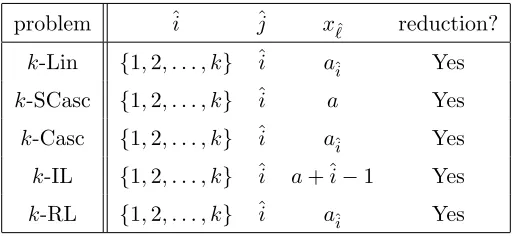
Note that the GMCDH problem contains computational variants of the k-SCasc, the k-Casc, thek-Lin, k-IL, and thek-RL problems as special cases.
Matrix Kernel Diffie-Hellman Problem. The other computational counterpart is the matrix kernel Diffie-Hellman (MKDH) problem. Roughly speaking, the MKDH problem states that given [A]1 ∈ G(1k+1)×k then computing [v]2 ∈ Zpk+1 \ {0k+1} such that A⊤v = 0k is computationally hard, whereA← Dk.
Definition 23 (Kernel k-Linear (k-Lin) Problem). Given a group description G := (G,GT, G1, G2, e, p) and group elements (X1 := [x1]1, . . . , Xk := [xk]1) ∈ Gk; (x1, . . . , xk)
$ ← Zk
p, compute (Z1 := [z1]2, . . . , Zk+1 := [zk+1]2) ∈G2k+1 such that x1z1+zk+1 =· · ·=xkzk+zk+1 = 0
Definition 24 (Kernel Symmetric k-Cascade (k-SCasc) Problem). Given a group description
G := (G,GT, G1, G2, e, p) and a group element X := [x]1 ∈ G1;x
$
← Zp, compute (Z1 :=
[z1]2, . . . , Zk+1 := [zk+1]2) ∈Gk2+1 such that xz1+z2 =· · ·=xzk+zk+1 = 0 and (z1, . . . , zk+1)̸=
0k+1.
Definition 25 (Kernel k-Cascade (k-Casc) Problem). Given a group description G := (G,GT, G1, G2, e, p) and group elements (X1 := [x1]1, . . . , Xk := [xk]1) ∈ Gk; (x1, . . . , xk)
$ ← Zk
p, compute(Z1:= [z1]2, . . . , Zk+1:= [zk+1]2)∈G2k+1 such thatx1z1+z2 =· · ·=xkzk+zk+1= 0 and
(z1, . . . , zk+1)̸=0k+1.
Definition 26 (Kernel Incremental k-Linear (k-IL) Problem). Given a group description
G := (G,GT, G1, G2, e, p) and a group element X := [x]1 ∈ G1;x
$
← Zp, compute (Z1 := [z1]2, . . . , Zk+1 := [zk+1]2) ∈ Gk2+1 such that xz1 +zk+1 = (x + 1)z2 +zk+1 = · · · = (x +k−
1)zk+zk+1 = 0 and (z1, . . . , zk+1)̸=0k+1.
Definition 27 (Kernel Radnomized k-Linear (k-RL) Problem). Given a group description G := (G,GT, G1, G2, e, p) and group elements (X1 := [x1]1, . . . , X2k := [x2k]1) ∈ G12k; (x1, . . . , x2k)
$ ←
Z2k
p , compute (Z1 := [z1]2, . . . , Zk+1 := [zk+1]2) ∈G2k+1 such that x1z1+xk+1zk+1 =· · ·=xkzk+
x2kzk+1= 0 and (z1, . . . , zk+1)̸=0k+1.
When the matrix distribution follows a generalized matrix distribution GMk in Definition 15, we call the kernel problem a generalized matrix kernel Diffie-Hellman problem.
Definition 28 (Generalized Matrix Kernel Diffie-Hellman (GMKDH) Problem). Let
fi,j(x1, . . . , xm) for (i, j)∈ {1,2, . . . , k+ 1} × {1,2, . . . , k} be polynomials in Definition 15. Given a group descriptionG := (G,GT, G1, G2, e, p) and group elements
(Xi,j := [fi,j(x1, . . . , xm)]1)(i,j)∈{1,2,...,k+1}×{1,2,...,k} ∈G k(k+1)
1 ; (x1, . . . , xm)
$ ←Zm
p ,
compute(Z1 := [z1]2, . . . , Zk+1:= [zk+1]2)∈Gk2+1 such that
f1,j(x1, . . . , xm)z1+· · ·+fk+1,j(x1, . . . , xm)zk+1 = 0
for all j∈ {1,2, . . . , k} and (z1, . . . , zk+1)̸=0k+1.
Note that the GMKDH problem contains kernel variants of thek-SCasc, thek-Casc, thek-Lin,
k-IL, and the k-RL problems as special cases.
3
Algebraic Group Model
In this section, we review basic notions of security games, the generic group model, and the algebraic group model. The contents of this section heavily refer to [FKL18].
Algebraic Security Game. LetGGbe analgebraicsecurity game relative to a group description
G:= (G, G, p); an adversaryAreceivesGand an instance of the problemX⃗ from a challenger, then
returns an output. For example, we use CDHG to denote security games of the CDH problem relative to G; an adversaryAreceivesG and (X1, X2) from a challenger, then returns an outputZ. We useGAG to denote an output of a gameGG between a challenger and an adversary A. Ais said to win if GAG = 1; CDHAG = 1 when Z = [x1x2]. We define an advantage and a running time of an
Generic Group Model (GGM). In the GGM, an adversary Agen is not given actual
represen-tations of group elements but the elements via abstract handles. For example, an adversaryAgenin
a security gameCDHG receives a group description G:= (G,00, p) and (01,02) from a challenger. Here,Gonly contains an information of an additive cyclic group of a prime-orderp. The adversary
Agen is able to perform group operations only via oracle queries, e.g., a generic adversary Agen
queries (01,02,+) to an oracle and obtains03, where01=X1,02=X2,and 03=X1+X2. Since a behavior of the generic adversary Agen is independent of actual group representations, it works
in any groups.
Some computational problems that are hard in the GGM may not be hard when instantiated in concrete groups. However, the GGM is still useful since it enables us to obtain information theoretic lower bounds. We use a notion of (ε, t)-hard if for all generic algorithmsAgen in a game
GG
TimeGG,Agen ≤t ⇒ AdvGG,Agen ≤ε
holds. The following fact is known for the discrete logarithm problem.
Lemma 1 (Generic Hardness of DL [Sho97,Mau05]). The discrete logarithm problem is (t2/p, t )-hard in the GGM.
Algebraic Algorithm. Now, we review a notion of analgebraic algorithm defined by Fuchsbauer et al. [FKL18]. An algebraic algorithm is able to output group elements only via group additions of given elements. Furthermore, the algebraic algorithm should also output arepresentation which indicates how output group elements are calculated with respect to given elements.
Definition 29 (Algebraic Algorithm, Definition 2.1 of [FKL18]). An algorithm Aalg executed in
an algebraic security game GG in a cyclic group G := (G, G, p) is called algebraic if for all group elements Z ∈ G that Aalg outputs, it additionally returns the representation of Z with respect to
given group elements. Specifically, ifX⃗ := (X0, . . . , Xℓ)∈Gℓ+1, whereX0:=G, is the list of group
elements that Aalg has received so far, then Aalg must also return a vector ⃗z := (zi)0≤i≤ℓ ∈ Zℓp+1 such that Z =∑ℓi=0ziXi. We use [Z]⃗z to denote such an output.
We remark that every generic algorithm Agen can be modeled as an algebraic one. A generic
algorithm Agen is able to output only group elements which are derived from group additions of given elements as an algebraic algorithm. Furthermore, by keeping a record of all oracle queries, a generic algorithmAgen is able to output a group elementZ along with its representation⃗z. Hence,
a generic algorithm Agen is able to behave as an algebraic algorithm. Moreover, let Aalg and Bgen
be an algebraic and a generic algorithm, respectively. Then, Balg := B Aalg
gen is also an algebraic
algorithm.
Reduction between Algebraic Security Games. LetGG and HG be two algebraic security games. Please keep in mind thatGG andHGwill be the game for the CDH variants and the (B)DL, respectively. We useHG ⇒alg GG to denote an existence of agenericand tight reduction algorithm
Rgensuch that for every algorithm A, an algorithm B:=RAgensatisfies
AdvHG,B =AdvGG,A and TimeHG,B=TimeGG,A.
The crucial point of the definition is that a reduction algorithm Rgen is generic. Hence, ifA=Aalg
is algebraic,B=Balg is also algebraic. Furthermore, ifA=Agenis generic,B=Bgenis also generic.
Thanks to the generic reduction algorithmRgen, we are able to obtain information theoretic lower
Lemma 2(Lemma 2.2 of [FKL18]). Let GG andHGbe algebraic security games such thatHG⇒alg GG and winningHG is(ε, t)-hard in the GGM. Then, GG is (ε, t)-hard in the GGM.
4
Reductions for Diffie-Hellman Variants in Cyclic Groups
In this section, we show generic and tight reductions from the discrete logarithm (DL) problem to the computational Diffie-Hellman (CDH) problem and its variants in the algebraic group model. We first provide adirectreduction to the CDH in Section4.1. Then, we provide our master theorem in Section4.2.
4.1 DL to CDH Reduction via Affine Embedding
In this section, we show a basic approach of this paper by providing a generic and tight reduction from the DL to the CDH in the AGM via the affine embedding.
Theorem 1. DLG⇒alg CDHG.
Proof. We construct a generic and tight reduction algorithm Rgen. Specifically, the reduction
al-gorithm Rgen uses an algebraic adversary Aalg on the CDHG only once and construct an algebraic
adversaryBalg :=RAgenalg on the DLG.
The reduction algorithmRgenis given a group descriptionG:= (G, G, p) and an instance of the DLG, i.e., X := [x]∈ G for an unknown x ∈ Zp. Then, the reduction algorithm Rgen creates an
instance of the CDHG as follows: Pick a randomr ←$ Zp and compute
X2 =X+rG= [x+r]∈G,
then set
(X1 =X, X2)∈G2.
The reduction algorithm Rgen gives a group description G := (G, G, p) and group elements
(X1, X2)∈G2 toAalg. Observe that (X1, X2) is a valid CDH instance by implicitly setting
(x1, x2) = (x, x+r)
sincex2 is independently distributed of x1 to uniform in Zp fromAalg’s view. Hence, an algebraic
adversary Aalg outputs a correct solution [Z]⃗z with an advantage AdvCDHG,Aalg and a running time
TimeCDHG,Aalg.
Next, the reduction algorithm Rgen uses [Z]⃗z output by an algebraic adversary Aalg on the CDHG and computes a solution of theDLG. Assume the output is a correct solution of the CDH, i.e.,Z = [x1x2]. It holds with probabilityAdvCDHG,Aalg. Then, the representation vector⃗z:= (z0, z1, z2)
satisfies
[x1x2] = [x(x+r)] = z0G+z1X+z2Y
= [z0+z1x+z2(x+r)].
Hence, the reduction algorithm Rgen obtains the following univariate equation modulo a primep:
x(x+r) =z0+z1x+z2(x+r) mod p
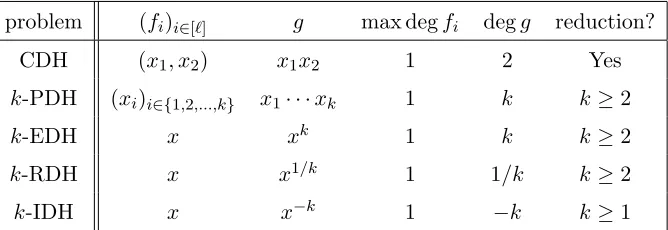
Table 1: Applicability of our technique in cyclic groups
problem (fi)i∈[ℓ] g max degfi degg reduction?
CDH (x1, x2) x1x2 1 2 Yes
k-PDH (xi)i∈{1,2,...,k} x1· · ·xk 1 k k≥2
k-EDH x xk 1 k k≥2
k-RDH x x1/k 1 1/k k≥2
k-IDH x x−k 1 −k k≥1
Observe that the left hand side is a degree 2 monic polynomial; hence, a non-zero polynomial. Since the reduction algorithm Rgen knows a value of r, it is able to find all solutions forx in polynomial
time. By checking [x] =X, the reduction algorithmRgensuccessfully finds a correct solution of the
DLG.
By combining with Lemmas1,2, and Theorem1, we are able to obtain an information theoretic lower bound for the CDH.
Theorem 2 (Generic Hardness of CDH). The computational Diffie-Hellman problem in
Defini-tion 2 is (t2/p, t)-hard in the generic group model.
4.2 Master Theorem in Cyclic Groups
In this subsection, we provide the following master theorem in cyclic groups to indicate the power of our technique.
Theorem 3 (Master Theorem in Cyclic Groups). DLG ⇒alg GDHG holds when the following conditions hold:
(1) degx1,...,xmfi(x1, . . . , xm, y1, . . . , yn)∈ {0,1} for alli∈ {1,2, . . . , ℓ},
(2) degg(x1, . . . , xm)∈ {/ 0,1}.
Before providing a proof, we summarize the CDH variants which we summarized in Section2.1
and the conditions of Theorem 3 in Table 1. As the table shows, CDH, k-PDH, k-EDH, k-RDH, and k-IDH simultaneously satisfy the conditions (1) and (2) in Theorem 3 (although there are restrictions of k). Hence, as immediate corollary of the master theorem, we are able to provide generic and tight reductions from the DL to thek-PDH, k-EDH,k-RDH, andk-IDH.
Then, we show a proof of Theorem 3. In advance, we claim that the condition (1) will be used to ensure that the reduction algorithm is able to produce all group elements of the GDH during a reduction, while both the conditions (1) and (2) will be used to ensure that the modular equation never becomes a zero polynomial.
Proof. We construct a generic and tight reduction algorithmRgen. Specifically, the reduction algo-rithm Rgen uses an algebraic adversary Aalg on the GDHG only once and constructs an algebraic
adversaryBalg :=R Aalg
The reduction algorithmRgenis given a group descriptionG:= (G, G, p) and an instance of the
DLG, i.e., X:= [x]∈Gfor an unknown x∈Zp. Thanks to the condition (1), we use the notation
fi(x1, . . . , xm, y1, . . . , yn) =fiL(y1, . . . , yn)xˆi+fiR(y1, . . . , yn)
with some ˆi∈ {1,2, . . . , m} for all i∈ {1,2, . . . , ℓ}. Then, the reduction algorithmRgen creates an
instance of the GDHG as follows: Pick random (r2, . . . , rm, s1, . . . , sn)
$
←Zm+n−1
p and compute
Xi =fiL(s1, . . . , sn)·(X+rˆiG) +fiR(s1, . . . , sn)·G
= [fiL(s1, . . . , sn)·x+fiL(s1, . . . , sn)·rˆi+fiR(s1, . . . , sn)]∈G
for all i∈ {1,2, . . . , ℓ} by implicitly setting
(x1, x2, . . . , xm, y1, . . . , yn) = (x, x+r2, . . . , x+rm, s1, . . . , sn).
Here, we use the notation r1 = 0 for simplicity. Then, the reduction algorithm Rgen gives a
group description G := (G, G, p) and group elements (X1, . . . , Xℓ) ∈ Gℓ to Aalg. Observe that
(X1, . . . , Xℓ) is a valid GDH instance since (x2, . . . , xm) is independently distributed ofx1to uniform inZmp−1 from Aalg’s view. Hence, an algebraic adversary Aalg outputs a correct solution [Z]⃗z with an advantageAdvGDHG,Aalg and a running time TimeGDHG,Aalg.
Next, the reduction algorithm Rgen uses [Z]⃗z output by an algebraic adversary Aalg on the GDHG and computes a solution of theDLG. Assume the output is a correct solution of the GDH, i.e., Z = [g(x1, . . . , xm)]. It holds with probability AdvGDHG,Aalg. Then, the representation vector
⃗
z:= (z0, z1, . . . , zℓ) satisfies
[g(x1, . . . , xm)]
=z0G+z1X1+· · ·+zℓXℓ
= [z0+
ℓ
∑
i=1
zifi(x1, . . . , xm, y1, . . . , yn)]
= [z0+ ℓ
∑
i=1 zi
(
fiL(s1, . . . , sn)·x+fiL(s1, . . . , sn)·rˆi+f
R
i (s1, . . . , sn)
)
]
= [
( ℓ ∑
i=1
zifiL(s1, . . . , sn)
)
x+z0+
ℓ
∑
i=1 zi
(
fiL(s1, . . . , sn)·rˆi+fiR(s1, . . . , sn)
)
].
Hence, the reduction algorithm Rgen obtains the following univariate equation modulo a primep:
g(x, x+r2, . . . , x+rm)
=
( ℓ ∑
i=1
zifiL(s1, . . . , sn)
)
x+z0+
ℓ
∑
i=1 zi
(
fiL(s1, . . . , sn)·rˆi+fiR(s1, . . . , sn)
)
modp.
By combining with Lemmas1,2, and Theorem3, we are able to obtain an information theoretic lower bound for the GDH as follows.
Theorem 4(Generic Hardness of GDH). The generalized Diffie-Hellman problem in Definition7is
(t2/p, t)-hard in the generic group model if the conditions (1) and (2) of Theorem3 simultaneously
hold.
5
Reductions for Diffie-Hellman Variants in Symmetric Bilinear
Groups
In this section, we show generic and tight reductions from the bilinear discrete logarithm (BDL) problem to the computational bilinear Diffie-Hellman (CBDH) problem and its variants in an algebraic bilinear group model which we define in Section5.1. In Section5.2, we provide a reduction from the BDL to the CBDH. Finally, we provide our master theorem in Section5.3.
5.1 Algebraic Symmetric Bilinear Group Model
In advance of the reduction, we define an algebraic symmetric bilinear algorithm. The definition is analogous to Definition 29 in the sense that the algebraic symmetric bilinear algorithm is able to output only group elements which are derived from group additions inG, group multiplications in GT, and pairing e of given elements. Furthermore, the algebraic symmetric bilinear algorithm should also output arepresentation which indicates how output group elements are calculated. In this paper, we study computational problems in bilinear groups whose solutions Z are elements in
GT. Hence, we define a representation so that it records howZ is computed by group multiplications of given elements in GT and pairing of given elements in G. We formally provide a definition as follows.
Definition 30 (Algebraic Symmetric Bilinear Algorithm). An algorithm Aalg executed in an
alge-braic security gameGG for G:= (G,GT, G, e, p) is calledalgebraicif for all group elementsZ ∈GT that Aalg outputs, it additionally return the representation of Z with respect to given group ele-ments. Specifically, if X⃗ := (X0, . . . , Xk) ∈ Gk+1, where X0 := G, and Y⃗ := (Y1, . . . , Yℓ) ∈ GℓT are the list of group elements that Aalg has received so far, then Aalg must also return a vector
⃗
z:= ((zi,j)0≤i≤j≤k,(zi′)1≤i≤ℓ)∈Z
(k+1)(k+2)
2 +ℓ
p such thatZ =
(∏
0≤i≤j≤ke(Xi, Xj)zi,j
) ·(∏ℓ
i=1Y
z′i i
)
. We denote such an output as [Z]⃗z.
We note that the CBDH, k-PBDH, k-EBDH,k-RBDH, and k-IBDH do not take elements in
GT as the input. Therefore, the algorithm outputs Z along with a vector⃗z∈Z
(k+1)(k+2) 2
p .
5.2 BDL to CBDH Reduction via Affine Embedding
In this subsection, we extend the approach in Section 4 and prove the following reduction via the affine embedding.
Theorem 5. BDLG ⇒alg BDHG.
Proof. We construct a generic and tight reduction algorithm Rgen. Specifically, the reduction
al-gorithm Rgen uses an algebraic adversary Aalg on the BDHG only once and construct an algebraic adversaryBalg :=R
Aalg
The reduction algorithm Rgen is given a bilinear group descriptionG := (G,GT, G, e, p) and an instance of the BDLG, i.e., X := [x]∈G for an unknown x∈Zp. Then, the reduction algorithm
Rgencreates an instance of the BDHG as follows: Pick a random (r, s)
$
←Z2
p and compute
(X2=X+rG= [x+r], X3 =X+sG= [x+s])∈G2,
then set
(X1 =X, X2, X3)∈G3.
The reduction algorithm Rgen gives a bilinear group description G := (G,GT, G, e, p) and group elements (X1, X2, X3) ∈ G3 to Aalg. Observe that (X1, X2, X3) is a valid CBDH instance since
(x2, x3) is independently distributed of x to uniform in Z2p from Aalg’s view. Hence, an algebraic
adversary Aalg outputs a correct solution [Z]⃗z with an advantage AdvBDHG,Aalg and a running time TimeBDHG,A
alg.
Next, the reduction algorithm Rgen uses [Z]⃗z output by an algebraic adversary Aalg on the
BDHG and computes a solution of the BDLG. Assume the output is a correct solution of the CBDH, i.e., Z = e(G, G)x1x2x3. It holds with probability AdvBDH
G,Aalg. Then, we use X0 := [1] for
notational convenience and the representation vector ⃗z:= (zi,j)0≤i≤j≤3 satisfies
[x1x2x3]T = [x(x+r)(x+s)]T
= ∏
0≤i≤j≤3
e(Xi, Xj)zi,j
= [z0,0+z0,1x+z0,2(x+r) +z0,3(x+s) +z1,1x2+z1,2x(x+r) +z1,3x(x+s)
+z2,2(x+r)2+z2,3(x+r)(x+s) +z3,3(x+s)2]T.
Hence, the reduction algorithm Rgen obtains the following univariate equation modulo a primep:
x(x+r)(x+s)
=z0,0+z0,1x+z0,2(x+r) +z0,3(x+s) +z1,1x2+z1,2x(x+r)
+z1,3x(x+s) +z2,2(x+r)2+z2,3(x+r)(x+s) +z3,3(x+s)2 mod p
⇔ x3+ (r+s−z1,1−z1,2−z1,3−z2,2−z2,3−z3,3)x2
+ (rs−z0,1−z0,2−z0,3−rz1,2−sz1,3−2rz2,2−(r+s)z2,3−2sz3,3)x
−z0,0−rz0,2−sz0,3−r2z2,2−rsz2,3−s2z3,3 = 0 mod p.
Observe that the left hand side is a degree 3 monic polynomial; hence, a non-zero polynomial. Since the reduction algorithm Rgen knows values ofr and s, it is able to find all solutions forx in polynomial time. By checking [x] = X, the reduction algorithm Rgen successfully finds a correct
solution of the BDLG.
By combining with Lemmas1,2, and Theorem5, we are able to obtain an information theoretic lower bound for the CBDH.
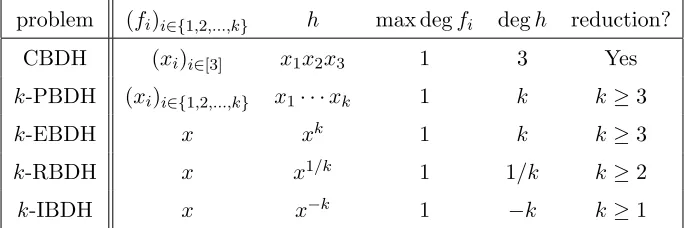
Table 2: Applicability of our technique in symmetric bilinear groups
problem (fi)i∈{1,2,...,k} h max degfi degh reduction?
CBDH (xi)i∈[3] x1x2x3 1 3 Yes
k-PBDH (xi)i∈{1,2,...,k} x1· · ·xk 1 k k≥3
k-EBDH x xk 1 k k≥3
k-RBDH x x1/k 1 1/k k≥2
k-IBDH x x−k 1 −k k≥1
5.3 Master Theorem in Symmetric Bilinear Groups
In this subsection, we provide the following master theorem in bilinear groups to indicate the power of our technique.
Theorem 7(Master Theorem in Bilinear Groups). BDLG⇒alg GBDHG holds when the following conditions hold:
(1) degx1,...,xmfi(x1, . . . , xm, y1, . . . , yn)∈ {0,1} for alli∈ {1,2, . . . , k},
(2) degx1,...,xmgi(x1, . . . , xm, y1, . . . , yn)∈ {0,1,2} for all i∈ {1,2, . . . , ℓ},
(3) degh(x1, . . . , xm)∈ {/ 0,1,2}.
Before providing a proof, we summarize the CBDH variants which we summarized in Section2.2
and the conditions of Theorem7 in Table 2. Since these problems do not take group elements in
GT as the input, we omit the condition (2) in the table. As the table shows, CBDH, k-PBDH,
k-EBDH, k-RBDH, and k-IBDH simultaneously satisfy the conditions (1) and (3) in Theorem 7
(although there are restrictions ofk). Hence, as immediate corollary of the master theorem, we are able to provide generic and tight reductions from the BDL to the k-PBDH, k-EBDH, k-RBDH, and k-IBDH.
Then, we show a proof of Theorem 7. In advance, we claim that the conditions (1) and (2) will be used to ensure that the reduction algorithm is able to produce all group elements of the GBDH during a reduction, while all the conditions (1), (2), and (3) will be used to ensure that the modular equation never becomes a zero polynomial.
Proof. We construct a generic and tight reduction algorithmRgen. Specifically, the reduction algo-rithmRgenuses an algebraic adversary Aalg on theGBDHG only once and constructs an algebraic
adversaryBalg :=RAgenalg on the BDLG.
The reduction algorithm Rgen is given a bilinear group descriptionG := (G,GT, G, e, p) and an instance of theBDLG, i.e.,X := [x]∈Gfor an unknown x∈Zp. Thanks to the condition (1), we use the notation
fi(x1, . . . , xm, y1, . . . , yn) =fiL(y1, . . . , yn)xˆi+f
R
i (y1, . . . , yn)
with some ˆi ∈ {1,2, . . . , m} for all i ∈ {1,2, . . . , k}. Thanks to the condition (2), we use the notation
with some ˆi1,ˆi2,ˆi3 ∈ {1,2, . . . , m} for all i ∈ {1,2, . . . , ℓ}. Then, the reduction algorithm Rgen
creates an instance of theGBDHG as follows: Pick random (r2, . . . , rm, s1, . . . , sn)
$
←Zm+n−1
p and
compute
Xi =fiL(s1, . . . , sn)·(X+rˆiG) +fiR(s1, . . . , sn)·G
= [fiL(s1, . . . , sn)·(x+rˆi) +fiR(s1, . . . , sn)]∈G for all i∈ {1,2, . . . , k}and
Yi =e(X+rˆi1G, X+rˆi2G)g
L
i(s1,...,sn)·e(G, X+rˆ i3G)
gM
i(s1,...,sn)·e(G, G)giR(s1,...,sn)
= [giL(s1, . . . , sn)·(x+rˆi1)(x+rˆi2) +g
M
i (s1, . . . , sn)·(x+rˆi3) +g
R
i(s1, . . . , sn)]T ∈GT for all i∈ {1,2, . . . , ℓ} by implicitly setting
(x1, x2, . . . , xm, y1, . . . , yn) = (x, x+r2, . . . , x+rm, s1, . . . , sn).
Here, we use the notation r1 = 0 for simplicity. Then, the reduction algorithm Rgen gives a bilinear group descriptionG:= (G,GT, G, e, p) and group elements (X1, . . . , Xk, Y1, . . . , Yℓ)∈Gk×
Gℓ
T to Aalg. Observe that (X1, . . . , Xk, Y1, . . . , Yℓ) is a valid GBDH instance since (x2, . . . , xm) is independently distributed ofx1to uniform inZmp −1 fromAalg’s view. Hence, an algebraic adversary
Aalg outputs a correct solution [Z]⃗z with an advantageAdvGBDHG,Aalg and a running time Time
GBDH
G,Aalg .
Next, the reduction algorithm Rgen uses [Z]⃗z output by an algebraic adversary Aalg on the
GBDHG and computes a solution of the BDLG. Assume the output is a correct solution of the GBDH, i.e., Z = [h(x1, . . . , xm)]T. It holds with probabilityAdvGBDHG,Aalg . Then, the representation
vector⃗z:= ((zi,j)0≤i≤j≤k,(zi′)1≤i≤ℓ) satisfies
[h(x1, . . . , xm)]T
=
∏
0≤i≤j≤k
e(Xi, Xj)zi,j
·
∏
1≤i≤ℓ
Yzi′ i
= [ ∑
0≤i≤j≤k
zi,jfi(x1, . . . , xm, y1, . . . , yn)·fj(x1, . . . , xm, y1, . . . , yn) + ℓ
∑
i=1
zi′gi(x1, . . . , xm, y1, . . . , yn)]T
= [ ∑
0≤i≤j≤k
zi,j
(
fiL(s1, . . . , sn)·(x+rˆi) +fiR(s1, . . . , sn)
) (
fjL(s1, . . . , sn)·(x+rˆj) +fjR(s1, . . . , sn)
)
+ ℓ
∑
i=1 zi′
(
gLi(s1, . . . , sn)·(x+rˆi1)(x+rˆi2) +gMi (s1, . . . , sn)·(x+rˆi3) +gRi(s1, . . . , sn)
)
]T
= [
∑
0≤i≤j≤k
zi,jfiL(s1, . . . , sn)fjL(s1, . . . , sn) + ℓ
∑
i=1
z′igLi(s1, . . . , sn)
x2
+
∑
0≤i≤j≤k
zi,j
(
fiL(s1, . . . , sn)(fjL(s1, . . . , sn)·rˆj+fjR(s1, . . . , sn))
+fjL(s1, . . . , sn)(fiL(s1, . . . , sn)·rˆi+fiR(s1, . . . , sn))
)
+ ℓ
∑
i=1 zi′
(
giL(s1, . . . , sn)·(rˆi1 +rˆi2) +giM(s1, . . . , sn)
))