Tight Adaptively Secure Broadcast Encryption
with Short Ciphertexts and Keys
Romain Gay∗ ENS, Paris, France [email protected]
Lucas Kowalczyk† Columbia University [email protected]
Hoeteck Wee‡ ENS, Paris, France
Abstract
We present a new public key broadcast encryption scheme where both the ciphertext and secret keys consist of a constant number of group elements. Our result improves upon the work of Boneh, Gentry and Waters (Crypto ’05) as well as several recent follow-ups (TCC ’16-A, Asiacrypt ’16) in two ways: (i) we achieve adaptive security instead of selective security, and (ii) our construction relies on the decisionalk-Linear Assumption in prime-order groups (as opposed toq-type assumptions or subgroup decisional assumptions in composite-order groups); our improvements come at the cost of a larger public key. Finally, we show that our scheme achieves adaptive security in the multi-ciphertext setting with a security loss that is independent of the number of challenge ciphertexts.
1
Introduction
Broadcast encryption schemes [FN94] allow a sender to encrypt messages to a set Γ⊂ [n] of authorized users such that any user in the set Γ can decrypt, and no (possibly colluding) set of unauthorized users can learn anything about the plaintext. Two key measures of efficiency for broadcast encryption are the size of the secret keys and the ciphertext overhead (beyond description of the recipient set and the symmetric encryption of the message). The early contructions of broadcast encryption schemes achieve ciphertext overhead that grows with the number of either authorized or excluded users [NNL01,HS02,DF02,GST04].
The BGW Cryptosystem. Ideally, we would like a broadcast encryption scheme where the size of secret keys and ciphertext overhead is independent of the number of users. This was first achieved in the break-through work of Boneh, Gentry and Waters [BGW05], which presented a broadcast encryption scheme in bilinear groups where both the secret keys and ciphertext overhead consist of a constant number of group elements. In their scheme, the decryption algorithm needs to know the public key, which is linear in the number of users.
∗
Supported in part by a Google Fellowship.
†
Work done while visiting ENS, Paris. Supported in part by the Defense Advanced Research Project Agency (DARPA) and Army Research Office (ARO) under Contract W911NF-15-C-0236; NSF grants CNS-1445424, CNS-1552932, and CCF-1423306; and an NSF Graduate Research Fellowship DGE-16-44869. Any opinions, findings, and conclusions or recommendations expressed are those of the authors and do not necessarily reflect the views of the Defense Advanced Research Projects Agency, Army Research Office, the National Science Foundation, or the U.S. Government.
‡
The BGW cryptosystem has two main limitations, which is the focus of several follow-up works as well as our current one:
• First, the BGW scheme achieves selective security, where an adversary must declare a target set of unauthorized users with which it will attack the schemebefore even seeing the system parameters. This restriction does not capture the power of many kinds of attackers (for instance: an attacker might choose to corrupt a user after seeing the public parameters,
or in response to seeing secret keys for already corrupted parties), so in practice, we would prefer to have schemes that satisfy the more general and stronger notion of adaptive security, which does not place such restrictions on the adversary.
• Next, the BGW scheme relies on parameterized assumptions. Parameterized assumptions (a.k.aq-type assumptions), while in some cases allowing for improvements over the state-of-the-art, are not particularly well understood. The assumptions are often closely related to the schemes which use them. For example, the size of the assumption often scales with the number of oracle queries that can be made in the security reduction. Furthermore,q-type assumptions become stronger as q grows, with the time needed to recover the discrete logarithm and break the assumption scaling inversely with q [Che06]. As a result, it is desirable to design systems that can be proven secure under static assumptions, like the decisionalk-Linear Assumption in prime-order bilinear groups (k-Lin).
These limitations were fixed individually by the works of [GW09] and [Wee16, CMM16a] respectively (the latter in composite-order groups), but improving [BGW05] to achieve security that is both adaptive and based on a static assumption has remained out of reach.
1.1 Our Results
In this paper we present the first broadcast encryption scheme with constant key and ciphertext overhead size that simultaneously overcomes both of the limitations above. Namely, we achieve adaptive security under a static assumption (k-Lin) in prime-order bilinear groups. Our improve-ments come at the cost of a larger public key that is quadratic instead of linear in the total number of users. We stress that prior to this work, it was not known how to achieve broadcast encryption with any size public parameters, constant-sized keys and ciphertext overhead, and even justselective security under a static assumption in prime-order groups.
As with the BGW cryptosystem and the follow-up works in [Wee16,CMM16a], the decryption algorithm in our scheme needs to know the public key in addition to the secret key. Considering the complications that come with managing user secret keys, which have to be distributed individually and stored securely, we achieve a desirable public/private key size tradeoff that makes sense particularly in applications where decryptors have access to large shared public storage.
We give an additional broadcast encryption scheme with constant key and ciphertext overhead size which is adaptively-securein the multi-challenge setting under static assumptions with atight
security reduction (where the security loss is independent of the number of challenge ciphertexts).
security loss is independent of the number of challenge ciphertexts, it remains proportional ton: the number of users in the system. In this work, we viewnas being not too large since our public key containsO(n2) group elements, which would be impractical for very large nanyway. Thus, a security loss of a small constant times nis much more desirable than one that is proportional to the number of challenge ciphertexts, which could be much larger for largely deployed systems.
1.2 Related Work
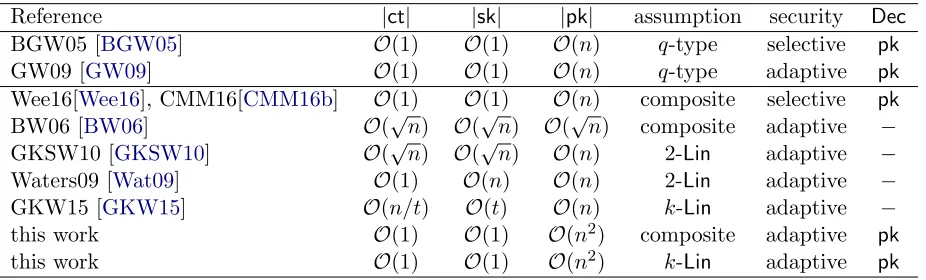
Previous broadcast encryption schemes fornusers that are secure in the standard model either carry the baggage of a (n/t, t)-tradeoff in key/ciphertext size, use a non-static assumption (i.e
q-type assumption), or are only secure in the weaker, selective security setting (see Figure1). In fact, all known broadcast encryption schemes that are adaptively secure under a static assumption and that use the Dual System Encryption methodology [Att14,Wee14,CGW15,AC16] fall in the scope of the lower bound of (n/t, t) for the (ciphertext overhead, secret key) size proved in [GKW15]. We note that we are able to bypass this lower bound by using the modified definition of broadcast encryption proposed by [BGW05], where decryption is allowed to take public parameters as input in addition to the secret key, as explained above.
Reference |ct| |sk| |pk| assumption security Dec
BGW05 [BGW05] O(1) O(1) O(n) q-type selective pk
GW09 [GW09] O(1) O(1) O(n) q-type adaptive pk
Wee16[Wee16], CMM16[CMM16b] O(1) O(1) O(n) composite selective pk
BW06 [BW06] O(√n) O(√n) O(√n) composite adaptive −
GKSW10 [GKSW10] O(√n) O(√n) O(n) 2-Lin adaptive −
Waters09 [Wat09] O(1) O(n) O(n) 2-Lin adaptive −
GKW15 [GKW15] O(n/t) O(t) O(n) k-Lin adaptive −
this work O(1) O(1) O(n2) composite adaptive pk
this work O(1) O(1) O(n2) k-Lin adaptive pk
Figure 1: Comparison amongst broadcast encryption schemes in the standard model, wheren
denotes the number of users,|ct|, |sk|and|pk|respectively denote the ciphertext, secret key and public key size (i.e the number of group elements or exponents of group elements). The last column refers to whether or not the decryption algorithmDecrequires the public keypkas input.
Short keys and ciphertext overhead have been accomplished in other schemes by moving outside the standard model: [GW09] gives a construction (different from the one depicted in Figure 1
1.3 Our Techniques
We give a construction in the composite-order setting which is secure under standard static decision assumptions to illustrate the main techniques, as well as a construction using prime-order bilinear groups which is secure under k-Lin.
Dual System Proof Methodology. We employ the dual system proof methodology [Wat09] to achieve the adaptive security of our schemes. A dual system encryption scheme is constructed so that an adversary cannot distinguish the distribution of normal keys (or ciphertexts) from special “semi-functional” keys (or ciphertexts). Semi-functional keys are capable of decrypting normal ciphertexts, but semi-functional keys cannot decrypt a semi-functional ciphertext. A typical dual system proof consists of a hybrid where the first step is constructing the challenge ciphertext as a semi-functional ciphertext. The hybrid then runs over each key requested by the adversary, replacing each requested key with a functional key. At the end, only semi-functional keys are given to an adversary whose job is to break the security of a semi-semi-functional ciphertext. Due to the way semi-functional ciphertexts and secret keys are constructed, it is typically easy to argue the game’s security at this point (semi-functional secret keys cannot be used to decrypt any semi-functional ciphertexts, including the semi-functional challenge ciphertext).
Overview of the Construction Our constructions can be understood by starting with the Boneh-Gentry-Waters construction for broadcast encryption [BGW05], which is selectively-secure under a (non-static)q-type assumption. BGW’s public parameters look like:
pk:= (gγ, gα, gα2, . . . , gαn, hα, hα2, . . . , hαn, hαn+2, . . . , hα2n, e(g, h)αn+1)
where γ, α are random exponents inZp, andg, h respectively generate prime order groupsG, H,
where |G|=|H|=p, and e:G×H →GT.
The ciphertext for a subset Γ⊆[n] and the key for a user i∈[n] are given by:
ctΓ:= (gs, g(γ+ P
j∈Γαj)s, e(g, h)sαn+1·M), sk
i:=hα
n−i+1γ
Decryption works as follows. Note that a message M in a ciphertext is hidden by an encapsulation key e(g, h)sαn+1. First, an authorized user of index ipairshαn−i+1 from the public parameters with g(γ+
P
j∈Γαj)s from the ciphertext to get the encapsulation key hidden by a product of e(g, h)s(n+1−i+j) for j 6= i∈Γ and e(g, h)sαn−i+1γ. The former can be removed by performing judicious pairings with elements from pk andgs from the ciphertext, and the latter
can only by removed by computing the pairing of gs with the (authorized) user’s secret keyski.
The encapsulation key can therefore be computed and used to obtain the message M.
The q-type assumption underlying BGW’s security is enabled by the powers of α. These powers prevent a straightforward dual-system proof of adaptive security from static assumptions. To obtain a construction based on static assumptions, we need to remove the powers of α in the scheme. Towards this goal, consider the substitutions:
gαj 7→gwj, hαn−j+1 7→hrj, j ∈[n]
where w1, . . . , wn, r1, . . . , rn are chosen uniformly at random. Correctness of BGW scheme relies
on the fact that
lies in a set of linear size, namely
{e(gs, hα), . . . , e(gs, hαn), e(gs, hαn+2), . . . , e(gs, hα2n)}.
With our substitutions, the corresponding collection lies in a set
{e(gs, hwjri)}
i,j∈[n],j6=i
of sizeO(n2), and hence the corresponding blow-up in the size of the public key, which needs to additionally contain{hwjri}
i,j∈[n],i6=j.
Finally, replacing the prime-order pairing group by an composite-order asymmetric bilinear group (G, H, GT) where |G|=|H|=N =pq, so as to use a subgroup membership assumption
instead of theq-DBDH assumption used in BGW, and replacing g7→gp,h7→hp, wheregp, hp
respectively generate Gp, Hp: prime order subgroups of groupsG, H, we obtain our
composite-order scheme.
Alternative Viewpoint. As seen above, we can view our construction as a modification of the broadcast encryption scheme from [BGW05] where we improve the secret key/public key size trade-off. An alternative way to view our construction is to start from the broadcast encryption scheme of Waters [Wat09], which can be proven adaptively secure from static assumptions (using the dual system proof methodology) and features constant size ciphertext overhead, but linear size secret keys. We describe the construction using composite-order asymmetric bilinear groups for simplicity:
pk:= {gwj
p }j∈[n], e(gp, hp)α
ctΓ:= gps, g s(u+P
j /∈Γwj)
p , e(gp, hp)sα·M
ski:= hrpi, {h wjri
p }j∈[n], j6=i
, hα+uri
p
wheres, u, α, wj, ri for i, j∈[n] are random exponents in ZN, and gp, hp respectively generate
Gp, Hp: prime order subgroups of groupsG, H, where|G|=|H|=N =pq, and e:G×H→GT.
Decryption works as follows. Note that a message M in a ciphertext is again hidden by an encapsulation keye(gp, hp)sα. To get the encapsulation key e(gp, hp)sα, decryption pairsgps
with hα+uri
p . To get rid of the extra terme(gp, hp)suri, it pairsg s(u+P
j /∈Γwj)
p from the ciphertext
together withhri
p. Doing so, decryption also gets many cross terms of the forme(gp, hp)s P
j /∈Γwjri
which can be stripped away, pairinggps with the appropriatehwjri
p from the secret key. Note that
these secret key elements are all available only when i∈Γ and the key is therefore authorized. To improve this construction’s linear-sized secret keys to constant-size, we pre-compute the values {hri
p , h wjri
p }j∈[n],j6=i and include them in the public parameters instead of the secret key.
Therefore, the secret key is reduced to the part that contains the encapsulation keyα. Note that this crucially takes advantage of our modified model of broadcast encryption where decryption is allowed to use elements from the public key as well as the secret key.
Indeed, the main technical challenge in proving our schemes secure is to carry on the dual-system proof when the values{hri
p, h wjri
p }j∈[n],j=6 i are public for every i∈[n], and only a single
group element remains private. This is in contrast to the security proof of previous dual system schemes, such as [Wat09], where the values hri
p,{h wjri
p }j∈[n],j6=i are known to the adversary only
for queried keysski. We solve it by carefully switching the hrpi,{h wjri
one by one to semi-functional, thereby changing the distribution of the public parameters over the hybrid through the keys. Similar techniques are also found in the selectively secure broadcast encryption of [Wee16, CMM16a], which removed the use of q-type assumptions in [BGW05], using the D´ej`aQ paradigm introduced by [CM14].
Prime-Order Groups. The scheme we just described in two ways is based on composite-order asymmetric bilinear groups. We give the scheme in detail in Section3and its proof in Section 4. For efficiency reasons [Gui13], schemes based on prime-order groups are preferable in practice. As such, we additionally provide a translation of our composite-order scheme to the prime-order setting in Section5.
Our construction uses a proof paradigm that can be seen as an optimization of known composite to prime-order translation frameworks, such as [Fre10, OT08, OT09, Lew12, CGW15, Att15, AC16]. Roughly speaking, in these frameworks, a random group elementgsp of a composite order bilinear group G is emulated by a vector of group elements [As]1, where s ∈ Zkp, A ∈
Z(pk+1)×k is a k-Lin matrix, and we use the bracket notation [a]i to denote the element gia for
i∈ {1,2, T} (for a prime order bilinear group G1×G2 →GT). Here, k depends on the k-Lin
assumption used, i.e: k= 1 corresponds to the Symmetric External Diffie-Hellman Assumption, or SXDH. The decision assumption used to argue thatgsp≈gspgsq in composite order groups is
replaced by the k-Lin assumption: [As]1 ≈[u]1, where A∈Zp(k+1)×k is a k-Lin matrix, s←RZkp,
andu←RZkp+1 is a uniformly random vector overZkp+1. Finally, each group element gwi of the
public parameters is mapped to a (k+ 1)×(k+ 1) matrix of group elements.
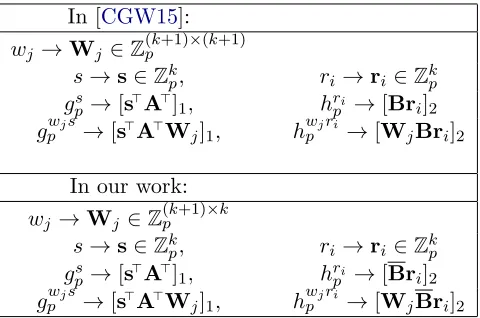
Our constructions employ an optimization that uses public parameter matrices of size only (k+ 1)×k, thereby reducing the public parameters and the ciphertext size by a factor of k+ 1 (see Figure 2). This is done by replacing the information theoretic argument at the heart of the dual system encryption methodology (used to switch secret keys to semi-functional secret keys) with a computational argument. Similar techniques are used in [CW14,BKP14,AC16].
In [CGW15]:
wj →Wj ∈Z(pk+1)×(k+1)
s→s∈Zk
p, ri→ri∈Zkp
gps→[s>A>]
1, hrpi →[Bri]2 gwjs
p →[s>A>Wj]1, h
wjri
p →[WjBri]2
In our work:
wj →Wj ∈Z(pk+1)×k
s→s∈Zk
p, ri→ri∈Zkp
gps→[s>A>]1, hri
p →[Bri]2 gwpjs→[s>A>Wj]1, hwpjri →[WjBri]2
Figure 2: A,B∈Z(pk+1)×k arek-Linmatrices,B∈Zkp×k denotes thekupper rows of B.
requested via a standard hybrid argument. However, using such an argument incurs a security loss that is proportional to the number of challenge ciphertexts. This can be problematic since real-life attacks might be performed on many challenge ciphertexts. In particular, for widely deployed schemes, the number of challenge ciphertexts can be as large as 220, or even 230. A standard hybrid over the ciphertexts in the latter case results in an increase in the size of the security parameter by 30 compared to the setting where the adversary receives only one challenge ciphertext. For elliptic curve groups eligible to instantiate our scheme in which the SXDH assumption is believed to hold, such an increase would translate to a 2·30 = 60 bit increase in the size of each group element description. Thus, a tight security reduction allows for shorter group element descriptions and increased efficiency. Finally, note that the number of challenge ciphertexts can be unknown during the setup phase, which means that a conservative estimate could assume it to be high during security parameter calculation, thereby resulting in needlessly large group elements used in the scheme. Tight security reductions avoid this problem by allowing the security parameter to be set in a way that is independent of the number of challenge ciphertexts.
To obtain a tightly secure construction, we slightly modify the prime-order scheme mentioned above, so as to allow a different proof strategy. The modification does not incur any increase in the ciphertext size for the most efficient version of the scheme: when k= 1 and security holds under 1-Lin a.k.a. the SXDH assumption. In general, the ciphertext size in the tightly secure scheme increases byk−1 group elements when security is based onk-Lin. In the tight-security proof, we simultaneously switch all of the challenge ciphertexts to semi-functional mode using the random self reducibility of thek-Linassumption. Then, the high-level proof structure is similar to that of previous scheme: we perform a hybrid argument that switches each secret key one by one to a semi-functional version (note that the number of secret keys is upper bounded byn, so this hybrid argument only incurs a security loss that is proportional ton, the number of users). To switch the key sk` to semi-functional mode, we use entropy from the component [W0r`]2 in
the keysk` to obtain a new random semi-functional component (the component γ`a⊥). Doing so
requires analysis of the entropy ofW0 leaked by the public key and the challenge ciphertext(s).
When there is only one challenge ciphertext for some set of users Γ, the (non-tight) proof crucially relies on the fact that` /∈Γ for the challenge Γ, as required by the security game definition and the fact that the adversary queriedsk`. For the tight reduction, we have many challenges Γi, so
we must deal with potentially more information aboutW0 leaked. In fact, this is not the case:
the challenge ciphertexts for all sets Γi queried toEncOdo not leak more information aboutW0
than a single ciphertext for the set S
iΓi, which would be an allowed challenge query given the
same set of user keys. This allows us to reduce to the argument for the single-ciphertext case.
1.4 Discussion
Prior to this work, it wasn’t clear what the bottleneck was in improving a broadcast encryption scheme with constant size secret keys and ciphertext overhead based on q-type assumptions to being based only on static assumptions. More specifically, one might ask: “What exactly is the use of q-type assumptions in [BGW05] buying us?” Our work clarifies that the main bottleneck is to get to linear-size public keys (and not constant-size secret keys or ciphertext overhead). Indeed, as noted earlier, if you replace theri, wi in the composite-order scheme of Section 3with
powers ofα (ri =αi, wi=αn−i+1), we can compress the public parameters to linear size, and
2
Preliminaries
2.1 Notation
We denote by x←RX the fact thatx is picked uniformly at random from a finite set X. By “PPT”, we denote a probabilistic polynomial-time algorithm.
2.2 Bilinear Groups
We instantiate both broadcast encryption schemes using asymmetric bilinear groups. LetG be a probabilistic polynomial time (PPT) algorithm that on input a security parameter 1λ returns an asymmetric bilinear group descriptionG:= (N, G1, G2, GT, e), whereG1,G2 andGT are cyclic
groups of orderN, ande:G1×G2→GT is a non-degenerate bilinear map. We require that the
group operations inG1, G2 andGT as well as the bilinear map eare computable in deterministic
polynomial time.
Composite-order groups. For the composite-order construction in Section 3, we consider groups of order N =pq, where p, q are distinct primes of Θ(λ) bits, and G1 =G, G2 =H are
asymmetric groups. In this setting, we can writeG=GpGqandH=HpHq, whereGp, Gq, Hp, Hq
are subgroups of the subscripted order. In addition, we use G∗s, Hs∗ to denoteGs\ {1}, Hs\ {1},
where s ∈ {p, q}. We will often use write gp, gq, hp, hq to denote random generators for the
subgroupGp, Gq, Hp, Hq.
Prime-order groups. For the prime-order construction in Section5, we consider groups of orderN =p for some prime pof Θ(λ) bits, whereG1 and G2 are possibly different groups (type 1, 2 or 3 pairing). We write g1,g2 to denote random generators of G1 and G2 respectively, and gT :=e(g1, g2), which is a generator of GT. We use implicit representation of group elements: for
a∈Zp, define [a]s=ags ∈Gs as the implicit representation of ainGs, fors∈ {1,2, T}. Given
[a]1 and [b]2, one can efficiently compute [ab]T using the pairinge. For two matrices A∈Z`p×m,
B∈Zm×n
p , definee([A]1,[B]2) := [AB]T ∈G`T×m.
2.3 Static Composite-Order Assumptions
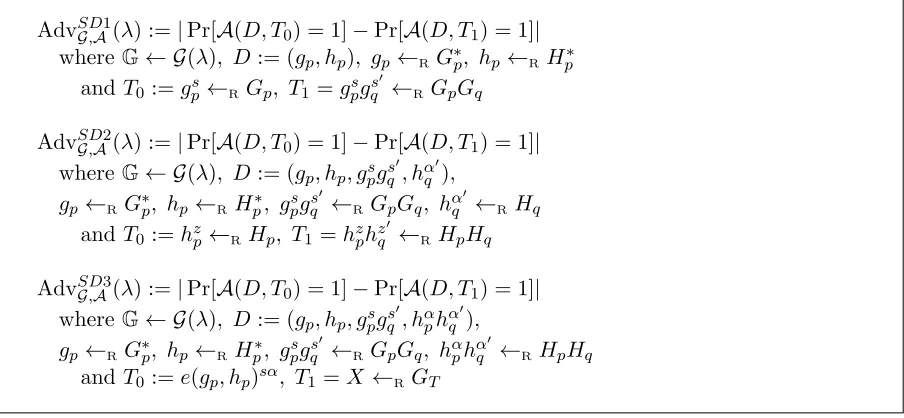
The security of the composite-order scheme in Section 3is proven under three static assumptions in composite-order asymmetric bilinear groups. We define the advantage functions referred to in the assumptions in Figure 3.
Definition 2.1 (Composite-Order Static Decision Assumptions). We say that the Static Deci-sion Assumptions hold relative to G if for all PPT adversaries A, the advantages AdvSDG,A1(λ),
AdvGSD,A2(λ), and AdvGSD,A3(λ) are negligible functions in λ.
2.4 Matrix Diffie-Hellman Assumptions
The security of the prime-order scheme in Section 5 is proven under the Matrix Decision Diffie-Hellman (MDDH) Assumption [EHK+13], whose definition we recall here.
AdvSDG,A1(λ) :=|Pr[A(D, T0) = 1]−Pr[A(D, T1) = 1]|
whereG← G(λ), D:= (gp, hp), gp ←R G∗p, hp ←RHp∗ and T0 :=gsp←RGp, T1 =gpsgs
0
q ←RGpGq
AdvSDG,A2(λ) :=|Pr[A(D, T0) = 1]−Pr[A(D, T1) = 1]|
whereG← G(λ), D:= (gp, hp, gpsgs 0 q , hα
0 q ),
gp ←R G∗p, hp ←RHp∗, gspgs 0
q ←RGpGq, hα 0
q ←RHq
and T0 :=hzp ←RHp, T1=hzphz 0
q ←RHpHq
AdvSDG,A3(λ) :=|Pr[A(D, T0) = 1]−Pr[A(D, T1) = 1]|
whereG← G(λ), D:= (gp, hp, gpsgs 0 q , hαphα
0 q ),
gp ←R G∗p, hp ←RHp∗, gspgs 0
q ←RGpGq, hαphα 0
q ←R HpHq
and T0 :=e(gp, hp)sα, T1 =X←RGT
Figure 3: Advantage functions
Without loss of generality, we assume the first k rows of A ←R D`,k form an invertible
matrix. The D`,k-Matrix Diffie-Hellman problem inGs for s∈ {1,2, T} is to distinguish the two
distributions ([A]s,[Aw]s) and ([A]s,[u]s) whereA←RD`,k,w←R Zkp and u←RZ`p.
Definition 2.3 (D`,k-Matrix Diffie-Hellman Assumption D`,k-MDDH). Let D`,k be a matrix distribution. We say that theD`,k-Matrix Diffie-Hellman (D`,k-MDDH) Assumption holds relative
toG inGs fors∈ {1,2, T}if for all PPT adversariesA,
AdvMDDHG,D
`,k,A(λ) :=|Pr[A(,[A]s,[Aw]s) = 1]−Pr[A(,[A]s,[u]s) = 1]|=negl(λ),
where the probability is taken over←RG(1λ), A←RDk,w←R Zkp,u←RZ`p.
For each k ≥ 1, [EHK+13] specifies distributions Lk, SCk, Ck (and others) over Z(pk+1)×k
such that the corresponding Dk-MDDH assumptions are generically secure in bilinear groups and form a hierarchy of increasingly weaker assumptions. Lk-MDDHis the well known k-Linear Assumption k-Lin with 1-Lin =DDH.
Definition 2.4 (Uniform distribution). Let `, k∈N, with` > k. We denote byU`,k the uniform distribution over all full-rank`×k matrices overZp. LetUk:=Uk+1,k.
Among all possible matrix distributions D`,k, the uniform matrix distribution Uk is the hardest possible instance, so in particular k-Lin⇒ Uk-MDDH.
Lemma 2.5 (D`,k-MDDH⇒ Uk-MDDH, [EHK+13]). Let D`,k be a matrix distribution. For any
PPT adversary A, there exists an adversary B such that T(B) ≈T(A) and AdvMDDHG,D
`,k,A(λ) =
AdvMDDHG,Uk,B(λ).
Let Q≥1. ForW←R Z
k×Q
p ,U←RZ
`×Q
p , we consider the Q-foldD`,k-MDDHAssumption
in Gs for s ∈ {1,2, T} which consists in distinguishing the distributions ([A]s,[AW]s) from
([A]s,[U]s). That is, a challenge for theQ-foldD`,k-MDDHAssumption consists ofQindependent
Lemma 2.6 (Random self-reducibility of D`,k-MDDH, [EHK+13]). Let`, k, Q∈N with ` > k.
For any PPT adversary A, there exists an adversary B such that T(B) ≈T(A) +Q·poly(λ)
withpoly(λ) independent of T(A), and
AdvQG,-DMDDH
`,k,A(λ)≤(`−k)·Adv
MDDH G,D`,k,B(λ) +
1
p−1
where AdvQG,-DMDDH
`,k,A(λ) :=|Pr[A(G,[A]s,[AW]s) = 1]−Pr[B(G,[A]s,[U]s) = 1]|and the
proba-bility is overG←RG(1λ),A←RD`,k,W←RZ
k×Q
p ,U←RZ
`×Q p .
2.5 Broadcast encryption
A broadcast encryption scheme consists of three randomized algorithms (Setup,Enc,Dec), along with a fourth deterministic procedure: KeyGen.
• Setup(1λ,1n)→ (pk,msk). The setup algorithm gets as input the security parameter 1λ and the number of users 1n. It outputs the public parameters pk and master secret key msk.
• KeyGen(msk, i)→ski. The key generation algorithm gets as input the master secret key
mskand an index i∈[n]. It (deterministically) outputs the secret key for useri: ski.
• Enc(pk,Γ, M)→ctΓ. The encryption algorithm gets as input pk and a subset Γ⊆[n]. It
outputs a ciphertextctΓ. Here, Γ is public givenctΓ.
• Dec(pk,ski,ctΓ)→M. The decryption algorithm gets as input pk,ski, andctΓ. It outputs
a messageM.
Correctness
We require that for all Γ⊆[n], messages M, and i∈[n] for which i∈Γ,
Pr[ctΓ←Enc(pk,Γ, M),ski←KeyGen(msk, i);Dec(pk,ski,ctΓ) =M] = 1
where the probability is taken over (pk,msk)←Setup(1λ,1n) and the coins of Enc.
Security
For an adversaryA, we define the advantage function
AdvBEA (λ) :=
Pr
(b,pk,msk)←SetupO h
b0=b b
0 ← AKeyGenO(·),EncO(·,·)(1λ)i−1/2
where:
• SetupO samples (pk,msk) ←R Setup(1λ,1n) and b ←R {0,1}, and returns pk. SetupO is called once at the beginning of the game.
• KeyGenO(i∈[n]) returns KeyGen(msk, i).
with the restriction that for all queriesi∈[n] thatAmakes toKeyGenO(·) and all queries Γ⊂[n] toEncOsatisfyi /∈Γ (that is,ski does not decryptctΓ).
Note that this definition allows the adversary to queryEncOmultiple times. We call this the
multi-challenge setting and say that a broadcast encryption scheme isadaptively secure in the
multi-challenge setting if for all PPT adversariesA, AdvBEA (λ) is a negligible function in λ.
If we only consider adversaries that queryEncOonce, we have the standard notion of adaptive security. Namely, we say that a broadcast encryption scheme is adaptively secure if for all PPT adversaries Athat issue only one query toEnc, AdvBEA (λ) is a negligible function in λ.
3
Composite-Order Construction
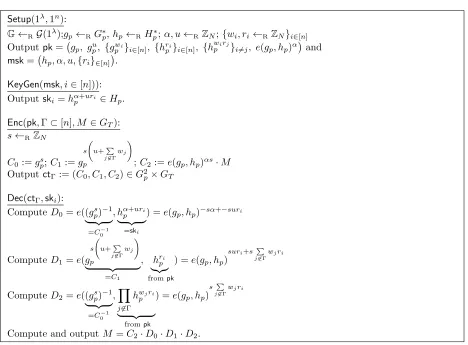
Figure4 shows our composite order construction.
Setup(1λ,1n):
G←RG(1λ);gp←RG∗p,hp←RHp∗; α, u←RZN;{wi, ri←RZN}i∈[n] Outputpk= gp, gpu, {gpwi}i∈[n], {hrpi}i∈[n], {h
wirj
p }i6=j, e(gp, hp)αand
msk= hp, α, u,{ri}∈[n]
.
KeyGen(msk, i∈[n])): Outputski=hαp+uri∈Hp.
Enc(pk,Γ⊂[n], M ∈GT):
s←RZN
C0:=gsp;C1:=g
s u+P
j6∈Γ
wj
!
p ;C2:=e(gp, hp)αs·M
OutputctΓ:= (C0, C1, C2)∈G2p×GT
Dec(ctΓ,ski):
ComputeD0=e((gsp)−
1
| {z }
=C−1 0
, hα+uri
p
| {z }
=ski
) =e(gp, hp)−sα+−suri
ComputeD1=e(g
s u+P
j6∈Γ
wj
!
p
| {z }
=C1
, hri
p
|{z}
frompk
) =e(gp, hp)
suri+sP j6∈Γ
wjri
ComputeD2=e((gsp)−
1
| {z }
=C0−1
,Y
j6∈Γ hwjri
p
| {z }
frompk
) =e(gp, hp) sP
j6∈Γ
wjri
Compute and outputM =C2·D0·D1·D2.
Figure 4: BEcomposite, an adaptively secure broadcast encryption scheme based on composite-order
bilinear groups.
4
Security Proof of the Composite-Order Construction
4.1 Hybrid definitions
Our proof will be accomplished through a standard “dual system” series of hybrids over the challenge ciphertext and n key indices, beginning with Gamereal, the real security game, and
ending at Gamef inal, a game in which the adversary has no advantage.
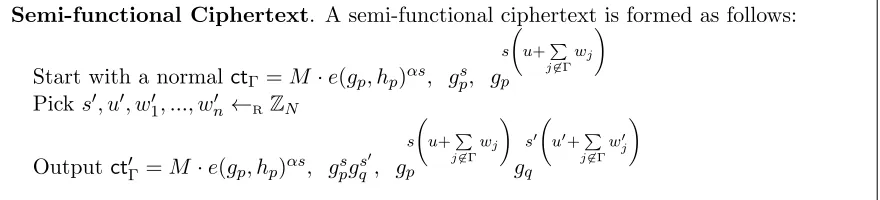
These games will differ in the distribution of the challenge ciphertext, secret keys, and public parameters. We define new semifunctional distributions of ciphertexts and secret keys in Figures5
Semi-functional Ciphertext. A semi-functional ciphertext is formed as follows:
Start with a normalctΓ=M·e(gp, hp)αs, gps, g s u+P
j6∈Γ
wj !
p
Picks0, u0, w01, ..., w0n←RZN
Outputct0Γ=M ·e(gp, hp)αs, gpsgs 0 q, g
s u+P j6∈Γ
wj !
p g
s0 u0+P j6∈Γ
w0j !
q
Figure 5: Semi-functional Ciphertext
To form semi-functional (keys, public parameters) for index t, first the normal public parameter and key generation procedures are performed to get:
pk:= (gp, gpu,{gwpi}i∈[n], {hrpi}i∈[n], {h
wirj
p }i6=j, e(gp, hp)α)
skt:=hαp+uyt
Draw α0, w01, .., w0n, r10, ..., r0n←RZN. The remaining steps depend on the particular type
of semi-functional key / public parameters:
Type (t,1) Semi-functional keys:
Semi-functional keys of type (t,1) are formed as follows: skt,1:=hαp+urth
u0r0t q
Type (t,2) Semi-functional keys:
Semifunctional keys of type (t,2) are formed as follows: skt,2:=hαp+urth
α0+u0r0t
q
Type (t,3) Semi-functional keys:
A semi-functional key of type (t,3) is formed as follows: skt,3:=hαp+urthα
0 q
Type t public parameters:
Semi-functional public parameters of typet are formed as follows: pkt:=gp, gpu, {gpwi}i∈[n], {hrpi}i6=t∈[n]∪ {hrpth
rt0
q }, {h wirj
p }i6=j j6=t
∪ {hwirt
p h w0
irt0
q }i6=t,
e(gp, hp)α
Game0
Same asGamereal, but challenge ciphertext is semi-functional.
Game`,1
Same asGame(`−1),3, but the public parameters are semi-functional of type` and the
key for index `is semi-functional of type (`,1).
Game`,2
Same as Game`,1, but the key for index ` is semi-functional of type (`,2) (public
parameters remain semi-functional of type `).
Game`,3
Same asGame`,2, but the public parameters are normally formed and the key for index `is semi-functional of type (`,3).
Gamef inal
Same asGamen,3, except the message Mb in the challenge ciphertext is blinded by an
independently random group element X←RGT instead ofe(gp, hp)αs.
Figure 7: Hybrid Games
We use these distributions in Figure 7to define the following hybrid games, where` ranges from 1 ton.
Note thatGame0 is identical toGame0,3.
We first argue that no adversary can achieve non-negligible difference in advantage between Gamereal andGame0 ≡Game0,3. We then hybrid over each key index, arguing that no adversary
can achieve non-negligible difference in advantage betweenGame(`−1),3 andGame`,1, thenGame`,1
and Game`,2, then Game`,2 and Game`,3 for ` = 1, ...n until arriving at Gamen,3, then finally
Gamef inal, at which the adversary has no non-negligible advantage. Namely, we show that
Gamereal≈cGame0≡Game0,3≈cGame1,0≈cGame1,1≡Game1,2 ≈cGame1,3
≈cGame2,0 . . . ≈cGamen,3≈cGamef inal
where ≡denotes statistical equality, and≈cdenotes computational indistinguishability.
Figure 8details how the constructions change throughout these games.
Notice that in the hybrid over key requests, all semi-functional keys before the hybrid indext
SetupO:
G= (N, G, H, GT, e)← G(1λ)
α, u←RZN; α0 ←RZN ; u0 ←RZN
{wi, ri←RZN}i∈[n]; {w0i, ri0 ←RZN}i∈[n]
pk=gp, gpu, {gpwi}i∈[n], {hrpi}i∈[n], {h
wirj
p }i6=j, e(gp, hp)α
pkt:=gp, gpu, {gwpi}i, {hrpi}i6=t∪ {hrpth r0t
q }, {hwpirj}i6=j j6=t ∪ {h
wirt
p h w0ir0t
q }i6=t, e(gp, hp)α
pkt:=gp, gpu, {gwpi}i, {hrpi}i6=t∪ {hrpth r0t q }, {h
wirj
p }i6=j j6=t
∪ {hwirt
p h w0ir0t
q }i6=t, e(gp, hp)α
pk:=gp, gup, {gpwi}i, {hrpi}i, {h wirj
p }i6=j, e(gp, hp)α
Outputpk
EncO(Γ?⊂[n], M0∈
GT, M1∈GT):
b←R{0,1}, s←RZN, s0 ←RZN
C0:=gsp gs
0
q
C1:=g
s u+ P
j6∈Γ?
wj
!
p g
s0 u0+ P
j6∈Γ?
w0
j
!
q
C2:=e(gp, hp)αs·Mb
OutputctΓ?:= (C0, C1, C2)∈G×G×GT
KeyGenO(`∈[n]):
For` < t,sk`:=hαp+ur` hα
0
q
For`=t,skt:=hαp+urth u0r0t q
For`=t,skt:=hαp+urth α0+u0r0t q
For`=t,skt:=hαp+urthα
0
q
For` > tand all keys inGamereal,sk`:=hαp+ur`
Outputsk`
Gamereal, Game0, Gamet,1 ,Gamet,2,Gamet,3
Figure 8: Gamereal,Game0,Gamet,1,Gamet,2(for 1≤t≤n),Gamet,3 (for 0≤t≤n) for the proof
of security ofBEcomposite defined in Figure 4. In each procedure, the components inside a solid
4.2 Hybrid Indistinguishability
We will show that any PPT adversary A’s advantage in the real game, AdvBEA (λ) = Advreal,
satisfies the following:
AdvABE(λ) = Advreal≤AdvSDG,A11(λ) +n·Adv
SD2
G,A2(λ) +n·Adv
SD2
G,A3(λ) + Adv
SD3 G,A4(λ)
for adversaries A1,A2,A3,A4 whose running times are essentially the same as A’s.
We accomplish this in the following lemmas. Let Advi denote the adversary’s advantage in
Gamei. Then:
Lemma 4.1. Advreal−Adv0 = Advreal−Adv0,3≤AdvSDG,A11(λ)
Proof. Given gp ←R G∗p, hp ←R Hp∗, and T = gps ←R Gp or gspgs
0
q ←R GpGq, an adversary A1
could simulate the security game with Aby running Setupand usingKeyGen to respond to all key requests as usual withgp, hp.
When the challenge ciphertext is requested for set Γ?, form it as follows:
ctΓ? =Mb·e(T, hp)α, T, T
u+ P j6∈Γ?
wj
Notice that when T =gps, then this is the same distribution as Gamereal.
When T =gpsgqs0, then this is the same distribution asGame0= Game0,3
(due to the Chinese Remainder theorem, g
u+ P j6∈Γ?
wj
q is distributed identically tog u0+ P
j6∈Γ?
w0 j
q
where u0, wj0 are chosen independently at random fromZN).
It follows that a difference in advantage Advreal−Adv0,3 ofAcould be used byA1 to achieve
the same advantage in the Static Decision Problem 1, so
Advreal−Adv0,3≤AdvGSD,A11(λ)
Lemma 4.2. Adv(t−1),3−Advt,1 ≤AdvGSD,A22(λ) for t= 1, ..., n.
Proof. Given gp ←R G∗p, hp ←R Hp∗, gpsgs
0
q ←R GpGq, hα 0
q ←R Hq, and T = hzp ←R Hp or
hzphzq0 ←RHpHq, an adversary A2 could simulate the security game withA by first forming the
public parameters as follows:
α, u, w1, ..., wn, r1, ..., rt−1, rt+1, ..., rn←RZN
Output:
pk=gp, gpu, {gpwi}i∈[n], {hrpi}i6=t∪ {T}, {h wirj
p }i6=j,j6=t∪ {Twi}i6=t, e(gp, hp)α
To form the (semi-functional) challenge ciphertext for set Γ?, compute:
ctΓ? =Mb·e(gspgs 0
q, hp)α, (gspgs 0
q), (gspgs 0 q)
u+ P j6∈Γ?
(recall that due to the Chinese Remainder Theorem, the gupgqu,gwi
p gqwi are distributed
identi-cally togu pgu
0 q ,gpwig
w0i
q for independently chosenu0, w0i)
To form (semi-functional of type (`,3)) keys for indices `less thant, compute:
sk0`,3 =hα+ur`
p (hα 0 q )
Notice that (normal) keys for indices greater than tcan also be computed, since α, u, hp and
r` are known (for all`6=t).
For a key request for index t, compute:
skt=hαp(T)u
Notice that whenT =hzp, then this is the same distribution as Game(t−1),3 (the skfor index tand the public parameters are distributed normally), where rt=z.
When T = hzphqz0, then this is the same distribution as Gamet,1 (the sk for index t is
semi-functional of type (t,1) and the public parameters are semi-functional of type t), wherert=z,
and r0t=z0.
It follows that a difference in advantage Adv(t−1),3−Advt,1 ofAfor any t= 1, ..., ncould be
used byA2 to achieve the same advantage in the Static Decision Problem 2 , so Adv(t−1),3−Advt,1≤AdvSDG,A22(λ) fort= 1, ..., n
Lemma 4.3. Advt,1−Advt,2 = 0 for t= 1, ..., n.
Proof. The distributions of Gamet,1 and Gamet,2 are actually identical. To see this, note that
the only difference between Gamet,1 and Gamet,2 is that thehq component of the secret key for
indextgoes from hr0tu0
q toh α0+r0
tu0
q .
If index t is not queried, then there is obviously no difference in the distribution between games.
Otherwise, if a key for indext is queried, notice that the only place wt0 occurs is in the gq
component of the challenge ciphertext: g
s0(u0+ P j6∈Γ?
wj0)
q (we know thatwt0 occurs in the sum because
this key request must be for an indextnot in the authorized set Γ?). Therefore, this wt0 in the summation is enough to information-theoretically hide the value ofu0 given just the challenge ciphertext. The only other place u0 occurs is in the hq component of the secret key for index
t: hr 0 tu0
q . So, u0 is enough to make the distribution of thehr 0 tu0
q uniformly random (identical to
hα0+r0tu0
q for an independent randomα0).
Either way, the two distributions are identical, and therefore Advt,1 − Advt,2 = 0 for t= 1, ..., n.
Lemma 4.4. Advt,2−Advt,3 ≤AdvGSD,A23(λ) for t= 1, ..., n.
Proof. Given gp ←R G
∗
p, hp ←R H
∗ p, gpsgs
0
q ←R GpGq, hα
0
q ←R Hq, and T = hzp ←R Hp or
hzphzq0 ←RHpHq, an adversary A3 could simulate the security game withA by first forming the
public parameters as follows:
Output:
pk=gp, gpu, {gpwi}i∈[n], {hrpi}i6=t∪ {T}, {hwpirj}i6=j,j6=t∪ {Twi}i6=t, e(gp, hp)α
To form the (semi-functional) challenge ciphertext for set Γ?, compute:
ctΓ? =Mb·e(gspgs 0
q, hp)α, (gspgs 0
q), (gspgs 0 q)
u+ P j6∈Γ?
wj
(recall that due to the Chinese Remainder Theorem, the gupgqu,gwi
p gqwi are distributed
identi-cally togu pgu
0 q ,gpwig
w0i
q for independently chosenu0, w0i)
To form (semi-functional of type (`,3)) keys for indices less than t, compute:
sk0`,3 =hα+ur`
p (hα 0 q )
Notice that (normal) keys for indices greater thantcan also be computed, sinceα, u, hp,and
r` are known (for all`6=t).
For a key request for index tcompute:
skt=hαp(T)u(gα 0 q )
Notice that whenT =hz phz
0
q, then this is the same distribution asGamet,2 (The skfor index tis semi-functional of type (t,2) and the public parameters are semi-functional of type t), where
rt=z, andr0t=z0.
When T = hzp, then this is the same distribution as Gamet,3) (the public parameters are
distributed normally and thetth sk is semi-functional of type (t,3)), where rt=z.
It follows that a difference in advantage Advt,2−Advt,3 of A for any t= 1, ..., n could be
used byA3 to achieve the same advantage in the Static Decision Problem 2, so
Advt,2−Advt,3 ≤AdvSDG,A23(λ) for t= 1, ..., n.
The preceding three lemmas take us all the way up toGamen,3, where the public parameters
are normally formed, the challenge ciphertext is semi-functional, and all keys are semi-functional of type (n,3). We argue that any difference in advantage of Abetween this game andGamef inal,
which is the same game except the message Mb is blinded by a independently random target
group element, can be used to achieve the same advantage in the Static Decision Problem 3:
Lemma 4.5. Advn,3−Advf inal≤AdvGSD,A34(λ)
Proof. Given gp ←R G
∗
p, hp ←R H
∗ p, gpsgs
0
q ←R GpGq, hαphα 0
q ←R HpHq, and T =e(gp, hp)αs or
X ←R GT, an adversary A4 could simulate the security game with A by forming the public
parameters as follows:
u, w1, ..., wn, r1, ..., rn←RZN
pk=gp, gpu, {gpwi}i∈[n], {hrpi}i∈[n], {h
wirj
To form the (semi-functional) challenge ciphertext for set Γ?, compute:
ctΓ? =Mb·T, (gpsgs 0
q ), (gspgs 0 q)
u+ P j6∈Γ?
wj
To form (semi-functional of type (`,3)) keys, compute:
sk`,3 = (hαphα 0 q )hurp `
for any `∈[n] requested.
Note that ifT =e(gp, hp)αs, then this game is distributed exactly as inGamen,3.
If T =X for a uniformly randomX, then we are inGamef inal.
It follows that a difference in advantage Advn,3−Advf inalofAcould be used byA4to achieve
the same advantage in the Static Decision Problem 3, so Advn,3−Advf inal≤AdvGSD,A34(λ). Theorem 4.6. If the Static Decision Assumptions of Definition 2.1 hold, then the broadcast
encryption scheme BEcomposite defined in Figure 4 is adaptively secure.
Proof. Summing the statements of the previous lemmas gives us:
Advreal−Advf inal ≤AdvGSD,A11(λ) +n·Adv
SD2
G,A2(λ) +n·Adv
SD2
G,A3(λ) + Adv
SD3 G,A4(λ)
InGamef inal the challenge messageMb is information theoretically hidden byX, so it is obvious
that no PPT adversary can achieve nonzero advantage in this game (that is, Advf inal= 0). So,
we have:
Advreal≤AdvSDG,A11(λ) +n·Adv
SD2
G,A2(λ) +n·Adv
SD2
G,A3(λ) + Adv
SD3 G,A4(λ)
Our static decision assumptions state that AdvSDG,A11(λ), Adv
SD2
G,A2(λ), Adv
SD2
G,A3(λ), Adv
SD3
G,A4(λ) are negligible functions ofλ (and nis a polynomial function of λ), so the advantage AdvBEA (λ) =
5
Prime Order Construction
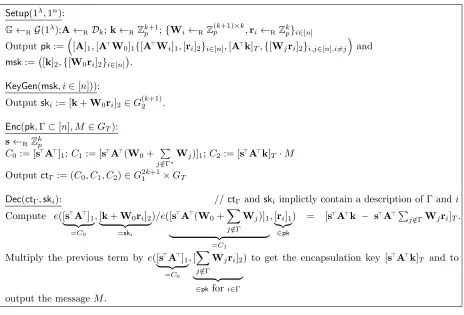
Our prime-order construction is detailed in Figure9.
Setup(1λ,1n):
G←RG(1λ);A←RDk;k←RZkp+1;{Wi ←RZ
(k+1)×k
p ,ri←RZkp}i∈[n] Outputpk:=[A]1,[A>W0]1{[A>W
i]1,[ri]2}i∈[n],[A>k]T,{[Wjri]2}i,j∈[n],i6=j
and
msk:= [k]2,{[W0ri]2}i∈[n]
.
KeyGen(msk, i∈[n])):
Outputski:= [k+W0ri]2∈G
(k+1) 2 .
Enc(pk,Γ⊂[n], M ∈GT):
s←RZkp
C0:= [s>A>]1;C1:= [s>A>(W
0+ P
j /∈Γ?
Wj)]1;C2:= [s>A>k]T·M
OutputctΓ:= (C0, C1, C2)∈G21k+1×GT
Dec(ctΓ,ski): //ctΓ andski implictly contain a description of Γ andi
Compute e([s> A>
]1
| {z }
=C0
,[k+W0ri]2
| {z }
=ski
)/e([s> A>
(W0+
X
j /∈Γ
Wj)]1
| {z }
=C1
,[ri]1
|{z}
∈pk
) = [s>A>k − s>A>P
j /∈ΓWjri]T.
Multiply the previous term by e([s>A>]
1
| {z }
=C0
,[X
j /∈Γ
Wjri]2
| {z }
∈pkfori∈Γ
) to get the encapsulation key [s>A>k]
T and to
output the message M.
Figure 9: BEprime, an adaptively secure broadcast encryption scheme based on prime-order
bilinear groups.
6
Security Proof of the Prime-Order Construction
We now give the security proof of the scheme BEprime, presented in Figure9.
Theorem 6.1. If theDk-MDDH Assumption holds inG1 and G2, then the broadcast encryption
scheme BEprime defined in Figure 9 is adaptively secure (as defined in section 2.5). Namely, for
any adversaryA, there exists an adversary B such thatT(B)≈T(A) and
AdvBEA (λ)≤(2n+ 1)·AdvMDDHG,Dk,B(λ) + 2 −Ω(λ),
where n is the number of users.
We prove Theorem6.1 via a series of games described in Figure10and we use Advi to denote
the advantage of A in game Gamei. Namely, we show that: Gamereal ≈c Game0 ≈c Game1 ≈c
. . . ≈c Gamen, where≈c denotes computational indistinguishability. Gamereal is the security
game as defined in Section 2.5, and the other Gamei are defined in Figure 10. Theorem 6.1
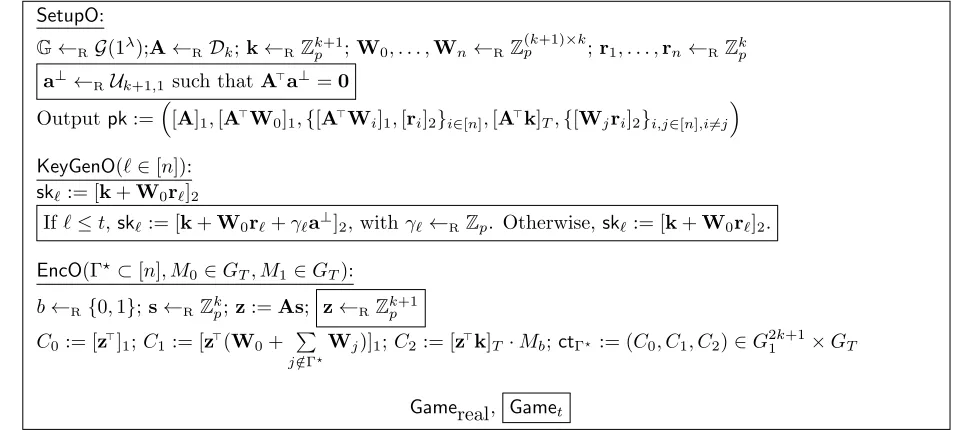
SetupO:
G←RG(1λ);A←RDk;k←RZkp+1;W0, . . . ,Wn←RZ
(k+1)×k
p ; r1, . . . ,rn←RZkp
a⊥←RUk+1,1 such thatA>a⊥ =0 Outputpk:=[A]1,[A>W0]1,{[A>W
i]1,[ri]2}i∈[n],[A>k]T,{[Wjri]2}i,j∈[n],i6=j
KeyGenO(`∈[n]):
sk`:= [k+W0r`]2
If`≤t,sk`:= [k+W0r`+γ`a⊥]2, withγ`←RZp. Otherwise,sk`:= [k+W0r`]2.
EncO(Γ?⊂[n], M0∈G
T, M1∈GT):
b←R{0,1};s←RZkp;z:=As; z←RZkp+1
C0:= [z>]1;C1:= [z>(W0+ P
j /∈Γ?
Wj)]1; C2:= [z>k]T ·Mb;ctΓ?:= (C0, C1, C2)∈G21k+1×GT
Gamereal, Gamet
Figure 10: Gamereal,Gamet(for 0≤t≤n) for the proof of security ofBEprime defined in Figure9.
Herendenotes the number of users. In each procedure, the components inside a solid frame are only present in the games marked by a solid frame.
Lemma 6.2 (Gamereal ≈cGame0). There exists an adversaryB0 such that T(B0)≈T(A) and
|Advreal−Adv0| ≤AdvMDDHG,Dk,B0(λ).
Here, we use the MDDHassumption to switch the distribution of the challenge ciphertext.
Proof. To go fromGamerealtoGame0, we switch the distribution of the vector [z]1in the challenge
ciphertext, using theDk-MDDHAssumption on [A]1 (see Definition 2.3).
Upon receiving a challenge (G,[A]1,[v]1) for theDk-MDDHAssumption,B0picksb←R{0,1}, k←R Zkp+1; W0, . . . ,Wn ←R Z
(k+1)×k
p ; r1, . . . ,rn ←R Zkp, sets [z]1 := [v]1, and simulates the
public parameters, the secret keys and the challenge ciphertext as defined in Figure10. Note that when [v]1 is a proper MDDHsample, B0 simulates Gamereal, and when [v]1 is uniformly
random overGk1+1, it simulates Game0.
Lemma 6.3 (Gamet−1 ≈c Gamet). For all t ∈ [n], there exists an adversary Bt−1 such that
T(Bt−1)≈T(A) and
|Advt−1−Advt| ≤2·AdvGMDDH,Dk,Bt−1(λ).
Here, we embed an MDDH challenge in pk and skt. More precisely, the simulator sets
rt:=Bvt∈Zkp, where B←RDk andvt←RZkp, i.e. the upper part of anMDDHchallenge. The lower part Bvt ∈Zp is embedded inskt, if skt is queried by the adversary (it may not be the
case, in particular ift∈Γ?). Note that the simulator needs to know ifsk
tis going to be queried
by the adversary when simulatingpk.
Proof. Upon receiving a challenge (G,[B]2,[v]2) for theDk-MDDHAssumption, Bt−1 simulates
• SetupO:
Bt−1 guesses if A is going to queryskt (by picking a randomβ ←R {0,1}). If so (β= 1), W0 and Wt are implicitly defined as W0 := Wc0 −a⊥TB and Wt := Wct +a⊥TB,
where Wc0,Wct ←R Z
(k+1)×k
p , and TB := BB
−1
∈ Z1p×k (recall that wlog., B is an
invertible matrix). Otherwise (β = 0), they are defined as W0 :=Wc0 ←R Z (k+1)×k
p and
Wt:=Wct←RZ
(k+1)×k
p .
Then, Bt−1 picks A ←R Dk; a⊥ ← Uk+1,1 such that A>a⊥ = 0; k ←R Zkp+1; Wi ←R
Z(pk+1)×k; vi ←R Zkp and sets [ri]2 := [Bvi]2, for i∈[n], i 6=t. Finally, Bt−1 embeds the
upper part of theMDDHchallenge inrt by setting [rt]2:= [v]2. It outputs
pk:=[A>
]1,[A>W0]1, . . . ,[A>Wt]1 | {z } =[A>
c
Wt]1
, . . . ,[A>
Wn]1,[A>k]T,[r1]2, . . . ,[rt]2 |{z} =[v]2
, . . . ,[rn]2,
{[Wirj]2}i,j∈[n],i6=j,i6=t,{ [Wtrj]2 | {z } =[WctBvi]2 ifβ= 0
=[WctBvi+a⊥Bvi]2 ifβ = 1
}j∈[n],j6=t.
Note that the simulated pk is identically distributed (independently of β) as the pk is Gamet−1 and Gamet(pk is identically distributed in these two games).
• KeyGenO(`∈[n]):
For each query `∈[n], Bt−1 picks γ` ←RZp and outputs sk` := [k+W0r`+γ`·a⊥]2 if `≤t−1, andsk`:= [k+W0r`]2 if` > t, whereW0 is implicitly set toWc0 ifβ = 0, and to c
W0−a⊥TB ifβ = 1. If `=t, then,β should be 1. If this is not the case,Bt−1 aborts the
simulation, since the guess was incorrect. Otherwise, it outputsskt:= [k+Wc0v+a⊥v]2.
Note that when [v]2 is a realMDDH challenge, i.e v=TBv, then Wc0v+a⊥v=W0rt,
that is, skt is distributed as in Gamet−1. When it is a uniformly random vector, i.e
v=TBv+ γt, where γt←RZp, thenWc0v+a⊥v+ γta⊥ , that is, skt is distributed as
inGamet.
• EncO(Γ?⊂[n], M0∈GT, M1∈GT):
Bt−1 picksb←R {0,1};z←RZpk+1; setsC0:= [z>]1 and C2 := [z>k]T ·Mb. Then,
– Ifβ = 0: Then,Bt−1 sets
C1 := [z>(W0+ X
j /∈Γ?
Wj)]1,
whereW0 =Wc0 and Wt=Wct.
– Ifβ = 1:
Ift∈Γ?, then in particularskt cannot be queried byA, by defintion of the security
game. Therefore,Bt−1 aborts the simulation: the guess was incorrect. Otherwise, it
sets
C1 := [z>(Wc0+ X
i /∈Γ?,i6=t
Note that Bt−1 is correctly simulating skt, since W0+Wt =Wc0−a⊥TB +dWt+
a⊥TB = Wc0+dWt, i.e the extra terms cancel out. Recall that these terms must
cancel out sinceBt−1 only knowsWc0 and Wct, and not TB.
Finally, Bt−1 outputsctΓ?:= (C0, C1, C2).
We have shown that when the guessβ is correct: if [v]2 is anMDDHchallenge, Bt−1 simulates
Gamet−1, otherwise, it simulates Gamet. The guess β is correct with probability exactly 1/2,
sinceβ ←R{0,1} is independent fromA’s view, and independent, in particular, from A’s secret key queries. When β is correct, if the adversary A guesses correctly b, then Bt−1 outputs 1;
otherwise, it outputs 0. When the guess β is chosen incorrectly, Bt−1 aborts the simulation and
outputs 0. We callE the event: guessβ is successful,¬E its complement. We have:
AdvMDDHG,D
k,Bt−1(λ) =|Pr[Bt−1(G,[B]2,[Br]2) = 1]−Pr[Bt−1(G,[B]2,[u]2) = 1]| = Pr[E]·Pr[Bt−1(G,[B]2,[Br]2) = 1|E] + Pr[¬E]·Pr[Bt−1(G,[B]2,[Br]2) = 1|¬E]
−Pr[E]·Pr[Bt−1(G,[B]2,[u]2) = 1|E]−Pr[¬E]·Pr[Bt−1(G,[B]2,[u]2) = 1|¬E]|
≥1/2· |Pr[Bt−1(G,[B]2,[Br]2) = 1|E]−Pr[Bt−1(G,[B]2,[u]2) = 1|E]|
= 1/2· |Advt−1−Advt|
where r←R Zkp, u ←R Zkp+1, and the probabilities are taken over the random coins of A and
Bt−1.
Lemma 6.4 (Gamen).
|Advn| ≤1/p.
Proof. Here, we argue that the component of k in span(a⊥) is masked by γ` in sk`, and it is
hidden from the pk since onlyA>kappears. Therefore, if z used in the challenge ciphertext is
not in the span of A, then the value [z>k]
T is random and completely masks the message Mb.
We use the fact that the following two distributions are the same:
(k,{γi}`∈[n]) and (k+µ·a⊥,{γi−µ}i∈[n]),
where k ←R Zkp+1, γ`, µ ←R Zp. Note that the extra component µ·a⊥ does not appear in
the pk since A>(k+µ·a⊥)) = A>k and it does not appear in the secret keys since k+µ·
a⊥+γ` ·a⊥−µ·a⊥ = k+γ` ·a⊥, i.e the extra terms cancel out. The challenge ciphertext
contains C2 := [z>k+ µ·z>
a⊥ ]T ·Mb. If z>a⊥ 6= 0 (which happens with probability 1−1/p
over the choice ofz ←R Zkp+1), then, C2 is uniformly random over GT, andA cannot guess b
7
Tightly Secure, Prime Order Construction
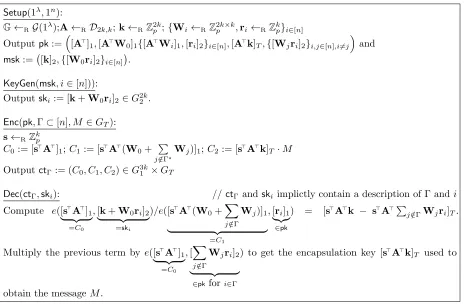
Figure 11 contains our tightly secure prime-order construction. It is similar to the scheme of Figure 9 except that matrices A and B are sampled from the distribution D2k,k, and not
Dk. In fact, the scheme of Figure 9 is already tightly-secure under the SXDH assumption (corresponding to the case k = 1). We generalize the construction here to work under the
D2k,k-MDDHAssumption for any k∈Nand any matrix distributionD2k,k.
Setup(1λ,1n):
G←RG(1λ);A←RD2k,k;k←RZ2pk;{Wi ←RZ2pk×k,ri←RZkp}i∈[n] Outputpk:=[A>]1,[A>W0]1{[A>W
i]1,[ri]2}i∈[n],[A>k]T,{[Wjri]2}i,j∈[n],i6=j
and
msk:= [k]2,{[W0ri]2}i∈[n]
.
KeyGen(msk, i∈[n])):
Outputski:= [k+W0ri]2∈G22k.
Enc(pk,Γ⊂[n], M ∈GT):
s←RZkp
C0:= [s>A>]1;C1:= [s>A>(W
0+ P
j /∈Γ?
Wj)]1;C2:= [s>A>k]T·M
OutputctΓ:= (C0, C1, C2)∈G31k×GT
Dec(ctΓ,ski): //ctΓ andski implictly contain a description of Γ andi
Compute e([s>A>]
1
| {z }
=C0
,[k+W0ri]2
| {z }
=ski
)/e([s>A>(W
0+
X
j /∈Γ
Wj)]1
| {z }
=C1
,[ri]1
|{z}
∈pk
) = [s>A>k − s>A>P
j /∈ΓWjri]T.
Multiply the previous term by e([s>A>]1 | {z }
=C0
,[X
j /∈Γ
Wjri]2
| {z }
∈pkfori∈Γ
) to get the encapsulation key [s>A>k]
T used to
obtain the messageM.
Figure 11: BEtight, a tightly, adaptively-secure broadcast encryption scheme based on prime-order
bilinear groups.
8
Security Proof of the Tightly Secure, Prime-Order
Construc-tion
We now prove the security of the schemeBEtight, presented in Figure11.
Theorem 8.1. If theDk-MDDH Assumption holds inG1 and G2, then the broadcast encryption
scheme BEtight defined in Figure 11 is tightly, adaptively secure in the multi-challenge setting
(as defined in section 2.5). Namely, for any adversary A, there exists an adversaryB such that
T(B) ≈T(A) + (Qct+Qsk)·poly(λ), where Qct, Qsk denote the number of calls to EncOand
KeyGenO respectively,poly(λ) is independent ofT(A), and
AdvBEA,multiChal(λ)≤2(n+k)·AdvMDDHG,D2k,k,B(λ) + 2 −Ω(λ),
where n is the number of users.
SetupO:
G←RG(1λ);A←RD2k,k;k←RZ2pk;{Wi ←RZ2pk×k,ri←RZkp}i∈[n]
A⊥ ←RUk+1,k such thatA>A⊥=0
Outputpk:=[A]1,[A>W0]1,{[A>W
i]1,[ri]2}i∈[n],[A>k]T,{[Wjri]2}i,j∈[n],i6=j
KeyGenO(`∈[n]):
sk`:= [k+W0r`]2
If`≤t,sk`:= [k+W0r`+A⊥u`]2, withu`←RZkp. Otherwise,sk`:= [k+W0r`]2.
Outputsk`
EncO(Γ⊂[n], M0∈GT, M1∈GT):
b←R{0,1};s←RZkp;z:=As; z←RZ2pk
C0:= [z>]1;C1:= [z>(W
0+ P
j /∈Γ?
Wj)]1;
C2:= [z>k]T·Mb; C2←RGT
OutputctΓ?:= (C0, C1, C2)∈G31k×GT
Gamereal, Gamet,Gamen+1
Figure 12: Gamereal,Gamet (for 0≤t≤n),Gamen+1 for the proof of security of BEtight defined
in Figure11. Here ndenotes the number of users. In each procedure, the components inside a solid (dotted) frame are only present in the games marked by a solid (dotted) frame.
We prove Theorem8.1 via a series of games described in Figure12and we use Advi to denote
the advantage ofAin game Gamei. Namely, we show that:
Gamereal ≈cGame0≈cGame1≈c. . .≈cGamen+1
where ≈c denotes computational indistinguishability. Gamereal is the security game as defined
in Section 2.5, and the other Gamei are defined in Figure 12. Theorem 8.1 follows from the
Lemma 8.2 (Gamereal ≈c Game0). There exists an adversary B0 such that T(B0) ≈ T(A) +
(Qct+Qsk)·poly(λ), whereQct,Qsk denote the number of calls toEncOand KeyGenOrespectively,
poly(λ) is independent ofT(A), and
|Advreal−Adv0| ≤k·AdvGMDDH,D2k,k,B0(λ) + 1
p−1.
Here, we use the MDDH assumption to tightly switch the distribution of all challenge ciphertexts.
Proof. To go fromGamereal toGame0, we switch the distribution of the vector [z]1 in all challenge
ciphertexts, using the Qct-fold Dk-MDDHAssumption on [A]1 (see Definition 2.3).
We build an adversary B00 against theQct-foldD2k,k-MDDHAssumption, such thatT(B00)≈
T(A) + (Qct+Qsk)·poly(λ) withpoly(λ) independent ofT(A), and
|Adv0−Adv1| ≤AdvQG,ct-DMDDH
2k,k,B00(λ).
This implies the lemma by Lemma 2.6 (self-reducibility of D2k,k-MDDH). Upon receiving a challenge (G,[A]1 ∈ G21k×k,[H]1 := [h1|h2|. . .|hQct]1 ∈ G
2k×Qct
1 ) for the Qct-fold Dk-MDDH
Assumption, B00 picks b ←R {0,1}, k ←R Z2pk; W0, . . . ,Wn ←R Z2pk×k; r1, . . . ,rn ←R Zkp, thanks to which it can simulate SetupO and KeyGenO as described in Figure 12. To simu-late EncO(Γ, M0, M1) on its i’th query, for i = 1, . . . , Qct, B00 sets [z]1 := [hi]1, and returns
([z>]
1,[z>(W0+Pj /∈ΓWj)]1,[z>k]T ·Mb. Note that when [H]1 is a properMDDH sample,B00
simulatesGamereal, and when [H]1 is uniformly random overG12k×Qct, it simulates Game0.
Lemma 8.3 (Gamet−1 ≈c Gamet). For all t ∈ [n], there exists an adversary Bt−1 such that
T(Bt−1)≈T(A) + (Qct+Qsk)·poly(λ), with poly(λ) independent of T(A); and
|Advt−1−Advt| ≤2·AdvGMDDH,D2k,k,Bt−1(λ).
Here, we embed an MDDH challenge in pk and skt. More precisely, the simulator sets
rt:=Bvt∈Zkp, where B←RDk andvt←RZkp, i.e. the upper part of anMDDHchallenge. The
lower partBvt∈Zp is embedded inskt, ifsktis queried by the adversary (it may not be the case,
in particular ift∈Γ?). Note that the simulator needs to know ifskt is going to be queried by
the adversary when simulatingpk. The proof of this lemma is exactly as the proof of Lemma6.3, in Section5. See the later for further details.
Lemma 8.4 (Gamen≈c Gamen+1). There exists an adversary Bn such that T(Bn) ≈T(A) +
(Qct+Qsk)·poly(λ), with poly(λ) independent of T(A); and
|Advn−Advn+1| ≤k·AdvMDDHG,D2k,k,Bn(λ) +
1
p−1.
Here, we use the MDDH Assumption to increase the entropy in all challenge ciphertexts, thereby hiding the underlying plaintexts. Namely, we use the fact that the vectorkhas some entropy that is not revealed by pk and the queried sk, which can be used together with the randomness of the challenge ciphertexts (the vectorz←RZ2pk) to embed anMDDHchallenge.
1. we can writek←RZ2pk:=k0+A⊥u, where k0 ←RZ2pk andu←RZkp, without changing the distribution ofk. Note that the termA⊥udoes not appear in thepksinceA>(k0+A⊥u) =
A>k0, and is hidden from the queriedsk
` thanks to theA⊥u` components in them.
2. we write z←RZ2pk sampled in challenge ciphertexts asz:=Av+Bw, wherev,w←RZkp,
(A|B) forms a basis of Z2pk, andB>A⊥ is invertible.
3. we write the vectoru used ink0+A⊥u as B>A⊥−1u0, where u0 ←
RZkp which does not
change the distribution ofu.
From these three facts, we deduce we can write challenge ciphertexts asctΓ := [z]1 := [v>A>+
w>
B>
]1,[z>
(W0+Pj /∈ΓWj)]1,[z >
k0]T+[w>u0]T+Mb
. We can argue that [ w>wu0
]1 ≈c[w0]1←R
Gk1+1 by theUk-MDDHAssumption. More concretely, we build an adversary B0n, against the
Qct-foldUk-MDDHAssumption, such that T(Bn0)≈T(A) + (Qct+Qsk)·poly(λ) with poly(λ)
independent ofT(A), and
|Advn−Advn+1| ≤AdvGQ,ct-UkMDDH,B0n (λ).
This implies the lemma by Lemma 2.5 (D2k,k-MDDH ⇒ Uk-MDDH) and Lemma 2.6 (self-reducibility ofD2k,k-MDDH).
Upon receiving a challenge (G,[U]1 ←R G
(k+1)×k
1 ,[H]1 := [h1|h2|. . .|hQct]1 ∈ G
(k+1)×Qct
1 )
for the Qct-fold Dk-MDDH Assumption, B0n picks A ←R D2k,k, b ←R {0,1}, k0 ←R Z2pk; W0, . . . ,Wn ←R Z2k
×k
p ; r1, . . . ,rn ←R Zkp, thanks to which it can simulate SetupO and
KeyGenO as described in Figure 12. To simulate EncO(Γ, M0, M1) on its i’th query, for i = 1, . . . , Qct, B0n picks v ←R Zkp, B ←R Z2pk×k and sets [z]1 := [Av]1 + [Bhi]1, and
re-turnsctΓ:= ([z>]1,[z>(W0+Pj /∈ΓWj)]1,[z >k0]
T + [hi]T +Mb. Note that when [H]1 is a proper
Uk-MDDHsample, that is, when hi := w>wu0
with w,u0 ←RZpk, B0n simulatesGamen, and when
[H]1 is uniformly random overG(k+1) ×Qct
1 , it simulates Gamen+1.
Lemma 8.5 (Gamen+1). For all A, Advn+1= 0.
Proof. In this game, plaintexts are completely masked by uniformly random values in the
References
[AC16] Shashank Agrawal and Melissa Chase. A study of pair encodings: Predicate encryp-tion in prime order groups. In Eyal Kushilevitz and Tal Malkin, editors,TCC 2016-A,
Part II, volume 9563 ofLNCS, pages 259–288, Tel Aviv, Israel, January 10–13, 2016.
Springer, Heidelberg, Germany.
[Att14] Nuttapong Attrapadung. Dual system encryption via doubly selective security: Framework, fully secure functional encryption for regular languages, and more. In Phong Q. Nguyen and Elisabeth Oswald, editors, EUROCRYPT 2014, volume 8441 ofLNCS, pages 557–577, Copenhagen, Denmark, May 11–15, 2014. Springer, Heidelberg, Germany.
[Att15] Nuttapong Attrapadung. Dual system encryption framework in prime-order groups.
IACR Cryptology ePrint Archive, 2015:390, 2015.
[BBG05] Dan Boneh, Xavier Boyen, and Eu-Jin Goh. Hierarchical identity based encryption with constant size ciphertext. In Ronald Cramer, editor, EUROCRYPT 2005, volume 3494 ofLNCS, pages 440–456, Aarhus, Denmark, May 22–26, 2005. Springer, Heidelberg, Germany.
[BBM00] Mihir Bellare, Alexandra Boldyreva, and Silvio Micali. Public-key encryption in a multi-user setting: Security proofs and improvements. In Bart Preneel, editor,
EUROCRYPT 2000, volume 1807 ofLNCS, pages 259–274, Bruges, Belgium, May 14–
18, 2000. Springer, Heidelberg, Germany.
[BGI+01] Boaz Barak, Oded Goldreich, Russell Impagliazzo, Steven Rudich, Amit Sahai, Salil P. Vadhan, and Ke Yang. On the (im)possibility of obfuscating programs. In Joe Kilian, editor, CRYPTO 2001, volume 2139 ofLNCS, pages 1–18, Santa Barbara, CA, USA, August 19–23, 2001. Springer, Heidelberg, Germany.
[BGW05] Dan Boneh, Craig Gentry, and Brent Waters. Collusion resistant broadcast encryption with short ciphertexts and private keys. In Victor Shoup, editor, CRYPTO 2005, volume 3621 ofLNCS, pages 258–275, Santa Barbara, CA, USA, August 14–18, 2005. Springer, Heidelberg, Germany.
[BKP14] Olivier Blazy, Eike Kiltz, and Jiaxin Pan. (Hierarchical) identity-based encryption from affine message authentication. In Juan A. Garay and Rosario Gennaro, editors,
CRYPTO 2014, Part I, volume 8616 ofLNCS, pages 408–425, Santa Barbara, CA,
USA, August 17–21, 2014. Springer, Heidelberg, Germany.
[BW06] Dan Boneh and Brent Waters. A fully collusion resistant broadcast, trace, and revoke system. In Ari Juels, Rebecca N. Wright, and Sabrina De Capitani di Vimercati, editors, ACM CCS 06, pages 211–220, Alexandria, Virginia, USA, October 30 – November 3, 2006. ACM Press.
[BWZ14] Dan Boneh, Brent Waters, and Mark Zhandry. Low overhead broadcast encryp-tion from multilinear maps. In Juan A. Garay and Rosario Gennaro, editors,
CRYPTO 2014, Part I, volume 8616 ofLNCS, pages 206–223, Santa Barbara, CA,
[BZ14] Dan Boneh and Mark Zhandry. Multiparty key exchange, efficient traitor tracing, and more from indistinguishability obfuscation. In Juan A. Garay and Rosario Gennaro, editors, CRYPTO 2014, Part I, volume 8616 of LNCS, pages 480–499, Santa Barbara, CA, USA, August 17–21, 2014. Springer, Heidelberg, Germany.
[CGW15] Jie Chen, Romain Gay, and Hoeteck Wee. Improved dual system ABE in prime-order groups via predicate encodings. In Elisabeth Oswald and Marc Fischlin, editors,
EUROCRYPT 2015, Part II, volume 9057 of LNCS, pages 595–624, Sofia, Bulgaria,
April 26–30, 2015. Springer, Heidelberg, Germany.
[Che06] Jung Hee Cheon. Security analysis of the strong Diffie-Hellman problem. In Serge Vau-denay, editor,EUROCRYPT 2006, volume 4004 ofLNCS, pages 1–11, St. Petersburg, Russia, May 28 – June 1, 2006. Springer, Heidelberg, Germany.
[CM14] Melissa Chase and Sarah Meiklejohn. D´ej`a Q: Using dual systems to revisit q-type assumptions. In Phong Q. Nguyen and Elisabeth Oswald, editors,EUROCRYPT 2014, volume 8441 of LNCS, pages 622–639, Copenhagen, Denmark, May 11–15, 2014. Springer, Heidelberg, Germany.
[CMM16a] Melissa Chase, Mary Maller, and Sarah Meiklejohn. D´ej`a Q all over again: Tighter and broader reductions of q-type assumptions. In Jung Hee Cheon and Tsuyoshi Takagi, editors, ASIACRYPT 2016, Part II, volume 10032 ofLNCS, pages 655–681, Hanoi, Vietnam, December 4–8, 2016. Springer, Heidelberg, Germany.
[CMM16b] Melissa Chase, Mary Maller, and Sarah Meiklejohn. Deja q all over again: Tighter and broader reductions of q-type assumptions. Cryptology ePrint Archive, Report 2016/840, 2016. http://eprint.iacr.org/.
[Cor00] Jean-S´ebastien Coron. On the exact security of full domain hash. In Mihir Bellare, editor,CRYPTO 2000, volume 1880 ofLNCS, pages 229–235, Santa Barbara, CA, USA, August 20–24, 2000. Springer, Heidelberg, Germany.
[CW13] Jie Chen and Hoeteck Wee. Fully, (almost) tightly secure IBE and dual system groups. In Ran Canetti and Juan A. Garay, editors,CRYPTO 2013, Part II, volume 8043 of LNCS, pages 435–460, Santa Barbara, CA, USA, August 18–22, 2013. Springer, Heidelberg, Germany.
[CW14] Jie Chen and Hoeteck Wee. Semi-adaptive attribute-based encryption and improved delegation for Boolean formula. In Michel Abdalla and Roberto De Prisco, editors,
SCN 14, volume 8642 of LNCS, pages 277–297, Amalfi, Italy, September 3–5, 2014.
Springer, Heidelberg, Germany.
[DF02] Y. Dodis and N. Fazio. Public key broadcast encryption for stateless receivers. In
DRM, pages 61–80, 2002.