Ecosystem
Taotao Li, Dequan Li No Institute Given
Abstract. Data, an important asset in digital economy, has fueled the emergence of a new data trading market. Big data market can efficiently promote data trading and further increases the utility of data. However, to realize effective data trading, several challenges needs to be resolved. First, it needs to resolve disputes over data availability in the data trad-ing. Second, atomic exchange and payment fairness between the seller and the buyer are hard to guarantee. Third, data trading platform is the single-point-failure. In this paper, we resolve these challenges by pre-senting a valid blockchain-based data trading ecosystem. The ecosystem constructs a decentralized arbitration mechanism to address the dispute over data availability in data trading. The ecosystem also designs a sale contract and a deterministic public-key encryption algorithm to guaran-tee fairness of data trading between the seller and buyer. The features of blockchain is preventing single-point-failure of data trading platform. We prove the desirable security properties that a secure data trading ecosystem should have. Discussion of the presented ecosystem is given. To demonstrate availability, we implement our proposed data trading ecosystem using smart contract in Solidity and program in Java, and evaluate its performance.
Keywords: data trading, smart contract, decentralized arbitration, blockchain
1
Introduction
With a number of new technologies and applications are integrated into our daily life, such as mobile and social networking applications, and smart-world systems based on the Internet of Things (smart city, smart home, smart grid, smart transportation, and others), vast amount of data will be collected [22, 32, 31, 36, 39, 40, 24]. Some companies and public sectors [10, 28, 25] use such data to make market decisions and improve their services [26]. In the era of big data, the generated data have become important asset and fueled the emergence of a new data trading in data market. In fact, several data trading markets have already emerged recently, such as the DataExchange and Datacoup [18, 20].
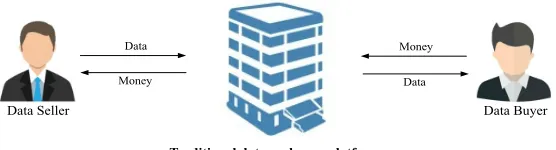
to the data exchange platform. On receiving the money, the data exchange plat-form transfers data purchased to the buyer and pays partial money to the seller (deducting transaction fees and management fees). When the buyer believes that data he/she purchased is invalid, the data exchange platform resolves the dispute relying on a centralized mechanism or a trusted third entity.
To realize effective data exchange in such a centralized exchange model [43, 14, 9, 21], several challenges needs to solved, as explained below:
1) How the platform uses a decentralized mechanism to resolve the dispute over data availability in the data trading. And the dispute means that the buyer believes that data he/she purchased is invalid.
2) Atomic exchange and payment fairness between the seller and the buyer are hard to guarantee, due to the opaque nature of data exchange platform. 3) The centralized data exchange platform is the single-point-failure. When the
data exchange platform crash and/or is attacked, it will halt.
Data Seller Data Buyer
Money
Data Data
Money
Traditional data exchange platform
Fig. 1.Simplified conventional data trading and centralized data process
Chen et al. [9] presented a blockchain-based ecosystem for big data market. The ecosystem uses blockchain technology to record transaction logs and other important documents. Zhou et al [42] proposed a distributed blockchain-based data vending framework, which integrates the data embedding and similarity learning to tackle the dilemma between the effective of data retrieval and leak-age risk from indexing the data. However, they mechanisms are insufficient for solving the dispute and availability for fair data exchange based on blockchain. Yang et al [38] presented a design of data trading platform based on blockchain by combining cryptography technology, which ensures that the platform does not have the opportunity to peek, copy and store trading data. Wang et al. [34] pro-posed a distributed data management based on blockchain. The data manage-ment mode guarantees that datas in the process of data trading is not retained and copied by the third-party. However, these schemes are not implemented in a real blockchain environment.
Our contributions. In this paper, we present a valid blockchain-based data trading ecosystem to complement the existing data trading ecosystem. A decentralized arbitration mechanism consisting of an arbitration contract, a producing contract and a deterministic digital signature algorithm resolves the dispute over data availability in data trading. The system designs the sale contract, advanced encryption standard algorithm and deterministic public-key encryption algorithm to guarantee fairness of data trading between the seller and buyer. The features of blockchain is preventing single-point-failure of data trading platform. We formally prove the security of our system and discuss the arbitration process. We implement our system using smart contract in Solid-ity and program in Java, and demonstrates the validSolid-ity of our system. The full code of smart contract and API interface have been released to the GitHub (https://github.com/01007467319/TTL-ECO-SC.git).
1.1 Organization
The rest of this paper is organized as follows. In Section 2, we introduce the preliminaries of our system. We present mode and security requirements of data trading in Section 3. We describe overview and module design of data trading protocol in Section 4, and the security analysis and discussion are given in Section 5 and 6. In Section 7, we implement a valid data trading system, and evaluate its execution efficiency and cost. We conclude this paper in the last section.
2
Preliminaries
2.1 Smart contract
platform, which is a “autonomous agent” stored in the blockchain, encoded as part of the “create” transaction, which introduces a contract blockchain. Once successfully created, smart contracts are identified by contract addresses; each contract has a certain number of virtual coins (such as ether) and private stor-age associated with its predefined executable code. The contract state consists of two main parts: the private store and the number of virtual coins it holds. Contract code can manipulate variables like traditional imperative programs. For example, the Ethereum contract code is a stack-based, low-level bytecode language called the Ethereum Virtual Machine (EVM) code. The player defines the contract using a high-level programming language, such as Solidity [15] (a JavaScript-like language), and then compiles it into EVM code. In order to invoke the contract, players send the transaction to the contract address. Transactions typically include: payment for the execution of the contract or input data for the invocation.
2.2 Advanced encryption standard
In January 1997, the US National Institute of Standards and Technology (NIST) issued a call for an Advanced Encryption Standard (AES) to replace the current Data Encryption Standard (DES). In October 2000, NIST [1] announced that the winning algorithm was Rijndael [11] (a block cipher designed by the Belgian cryptographers Vincent Rijmen and Joan Daemen based on SPN structure). Today, AES is widely used and no significant security weaknesses have been discovered. We apply the practical AES [11] to implement data trading. There are three algorithms in AES: Key generate (AES.Gen), Encrypt (AES.Enc), and Decrypt (AES.Dec). The details are given below:
• AES.Gen.The key-generation algorithmAES.Gentakes as input the se-curity parameter 1nand outputs a key k; we write this as k←AES.Gen(1n)
(emphasizing thatAES.Genis a randomized algorithm). We assume that any key k←AES.Gen(1n) satisfies|k| ≥n.
• AES.Enc.The encryption algorithmAES.Enctakes as input a key k and a plaintext message m∈ {0,1}?and outputs a ciphertext c; we write this as
c←AES.Enck(m).
• AES.Dec. The decryption algorithm AES.Dec takes as input a key k and a ciphertext c, and outputs a message m or ⊥. We write this as m :=AES.Deck(c) (assuming here thatDecdoes not return an⊥).
It is required that for every n, every key k←AES.Gen(1n), and every m
∈ {0,1}?, it holds thatAES.Dec
k(AES.Enck(m)) =m.
2.3 Deterministic Public-Key encryption scheme
algorithm is deterministic. When using a deterministic encryption algorithm, however, the full-fledged notion of semantic security [17] is out of reach. Subse-quent research results [4, 7, 3, 8, 16, 27, 35] has successfully shown that a natural variant of the notion of semantic security can be guaranteed even when using a deterministic encryption algorithm, as long as plaintexts are independent of the public key used by the scheme. Raghunathan et al [30] extends the previously proposed notions of security, allowing adversaries to adaptively choose plaintext distributions after seeing the public key, in an interactive manner.
In this section, we briefly introduce the algorithms of deterministic public-key encryption that are used in the protocol we proposed below. A determin-istic public-key encryption scheme is a tuple of polynomial-time algorithms
(DPKE.Gen, DPKE.Enc, DPKE.Dec) such that:
• DPKE.Gen. The key-generation algorithmDPKE.Gen is a randomized algorithm that takes as input the security parameter 1λand outputs a pair
of keys (sk, pk); we write this as (sk, pk)←DPKE.Gen(1λ) with thepk is
the public key andskis the private key.
• DPKE.Enc.The encryption algorithmDPKE.Encis a deterministic algo-rithm that takes as input a public keypkand a message m∈ {0,1}n(λ)withn = ploy(λ), and outputs a ciphertext c. We write this as c←DP KE.Encpk(m).
• DPKE.Dec.The decryption algorithmDPKE.Decis a possibly random-ized algorithm that takes as input a private keysk and a ciphertext c, and outputs a message m∈ {0,1}n(λ)or a special symbol⊥denoting failure. We write this as m :=DP KE.Decsk(c).
It is required that, except possibly with negligible probability over (sk, pk) ← DPKE.Gen(1λ), we haveDP KE.Dec
sk(DP KE.Encpk(m)) =m for any
(le-gal) message m.
2.4 Deterministic digital signature algorithm scheme
Deterministic digital signature algorithm (DDSA) was first described by Bern-stein et al. [5]. The characteristic of DDSA is that there is no need for generating fresh random numbers per signature. Edwards curve Digital Signature Algorithm (EdDSA) [5] follows a similar approach and uses the hash of the private key and the message M as a nonce. Thus, any change of M results in a new nonce. Some deterministic variant [29, 6, 23] of DSA was provided. We apply the DDSA to support the algorithm Producing (see section 4.2.4 for details) in the data trading protocol and adopt the practical instantiation of DDSA scheme [29]. A deterministic digital signature algorithm scheme is a tuple of polynomial-time algorithms (DDSA.Gen, DDSA.Sign, DDSA.Ver) such that:
• DDSA.Gen.The key-generation algorithmDDSA.Gentakes as input the security parameter 1n and outputs a pair of keys (sk, pk); we write this as
(sk, pk) ← DDSA.Gen(1n) with the pk is the public key and sk is the
• DDSA.Sign.The signature algorithmDDSA.Signtakes as input a private keyskand a message m from some message space (that may depend onpk), and outputs a signatureσ. We write this asσ←DDSA.Signsk(m).
• DDSA.Ver.The deterministic verification algorithmDDSA.Vertakes as input a public keypk, a message m and a signatureσ, and outputs a bit b, with b = 1 denoting valid and b = 0 denoting invalid. We write this as b :=DDSA.V erpk(m, σ).
It is required that, except with negligible probability over (pk, sk)←DDSA.Gen(1n), it holds thatDDSA.V erpk(m, DDSA.Signsk(m)) = 1 for every (legal) message
m.
3
Blockchain-based data trading model and security
requirements
In the section, we introduce the blockchain-based data trading model and rele-vant security requirements.
3.1 Blockchain-based data trading model
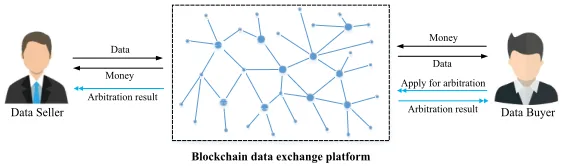
There are three entities, namely: seller, buyer and blockchain data exchange platform - see also Fig 2. The seller is the data provider, and profits from selling the data. The buyer is the consumer of the data and generates payment transac-tion in the platform to purchase the data. The platform is secure blockchain for contract deployment, contract invoking and contract execution; and consists of nodes and arbitrators (a.k.a, miners). The data exchange platform provides two services for the buyer and the seller. The former is a fair data trading service that supports the buyer sales data and the buyer purchases data. The latter is a decentralized arbitration service that provides arbitration for the buyer and the seller. Especially, when the buyer believes that the purchased data does not con-sistent with the description of the raw data, the buyer can apply for arbitration and gains a fair result.
Data Seller Data Buyer
Money Data Apply for arbitration
Arbitration result Data
Money Arbitration result
Blockchain data exchange platform
Definition 1 (Blockchain-based data trading protocol).The data trading protocol is a tuple of polynomial time algorithms (Segmenting, Sale, Arbitra-tion, Producing) such that:
• Segmenting.The algorithm Segmenting takes as input the data and the
key, and outputs ciphertextc; we write this asc←Segmenting(data, key). Parsec into(c1, c2, ..., cn).
• Sale.The algorithmSaletakes as input the seller’s depositdepositseller, the
buyer’s deposit depositbuyer, the public key pk of the buyer, the index i of
the data segment and the moneymoneyi of the data segment, and outputs a
result. We write this asresult←Sale(depositseller, depositbuyer, pk, i, moneyi).
• Arbitration. The algorithm Arbitration takes as input a data ciphertext
ci, data key ki, public key pk, a ciphertext wi and the description ddesi of
the i-th data segment, and outputs a bit b ∈ {0,1}. We write this as b ←
Arbitration(ci, ki, pk, wi, ddesi).
• Producing.The algorithmProducingtakes as input a block headerblockheader,
an integerk, and outputs a committee A consisting of k arbitrator. We write this asA←P roducing(blockheader, k). Parse Ainto(A1, A2, ..., Ak).
3.2 Security requirements
Following security requirements of Zhao et al. [41] a secure blockchain-based data trading protocol should satisfy the following requirements:
• Completeness.The completeness means that, if both the sellers and the buyers are honest at all epochs, then an honest seller can receive the money and an honest buyer can gain the valid data.
• Confidentiality.The confidentiality says that a malicious buyer without the money is unable to gain the data.
• Availability.If a seller’s behavior is honest, then the buyer can gain valid data. If a malicious seller sells fake data, he will be punished in the sense that he loses his deposit.
• Fairness. The fairness means that, at the end of the protocol, either the seller obtains the money and the buyer gets valid data or neither the seller and the buyer obtain nothing.
In addition, we define a decentralization requirement for the data trading protocol.
• Decentralization.The decentralization says that, when the buyer believes that data he/she purchased is invalid, the protocol can solve the dispute by decentralizing arbitration contract.
4
Data trading protocol
4.1 Overview
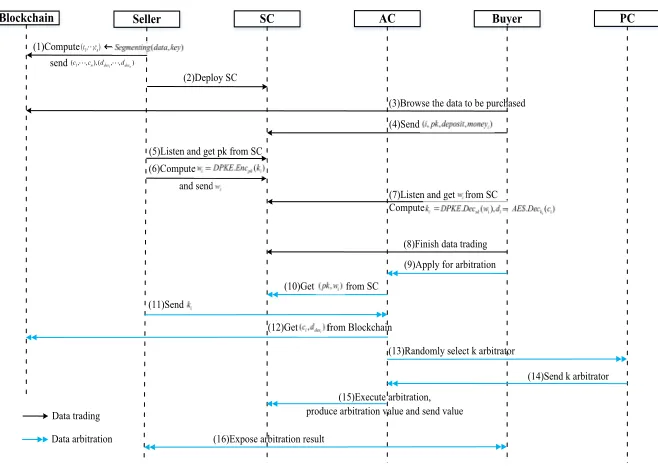
A typical workflow in our protocol is shown in Fig. 2. For the convenience of description, we especially extract the Sale contract (SC), Arbitration contract (AC) and Producing contract (PC) from the blockchain.
• Step(1)-(4). The seller posts the information of data to be sold to the blockchain and deploys the SC. The buyer browses the data information and submits purchasing data information to the SC.
• Step(5)-(7). The seller sends encrypted data key to the buyer. The buyer then gets the data by decrypting encrypted datas with its private key and data key obtained by decrypting.
• Step(8)(9). The buyer verifies the validity of the data. If the data is valid, the buyer submits application of transaction finish. Otherwise the buyer applies for arbitration.
• Step(10)-(14). The decentralizing AC gets arbitration information from the blockchain such as the SC, and randomly selects k arbitrator by calling the PC.
• Step(15)(16). The decentralizing AC produces an arbitration result and sends it to the SC. The SC then executes arbitration result returned by the AC.
In the protocol, the buyer has his/her DPKE key pair (sk, pk) and the seller has his/her AES keyk.
4.2 Module design
In this section, we present an elaborate module design of the data trading proto-col. These interacting modules are Data segmenting, Sale contract, Arbitration contract and Producing contract. A summary of notations used in our protocol is shown in Tables 1.
4.2.1 Data segmenting
The process of data segmenting is as shown in Algorithm 1. First, the seller divides the data into multiple segments of data di(i ∈ [1, n]); then, the seller
encrypts each data segment separately with different data keys ki(i ∈ [1, n]),
and obtains the ciphertexts ci = AES.Encki(di)(i ∈[1, n]). Finally, the seller stores the ciphertextsci, the descriptionddesiand the price for the data segments in the blockchain.
Blockchain Seller SC AC Buyer PC
(2)Deploy SC (1)Compute
send
(3)Browse the data to be purchased 1
1 ( , , ), (c… × × ×cn ddes, ,… × × ×ddesn)
(4)Send
(5)Listen and get pk from SC
(6)Compute
and send 1
( , , )c… × × ×cn
(7)Listen and get from SC Compute
(8)Finish data trading
(9)Apply for arbitration
(10)Get from SC
(11)Send
(12)Get from Blockchain
(13)Randomly select k arbitrator
(14)Send k arbitrator
(15)Execute arbitration, produce arbitration value and send value
(16)Expose arbitration result Data trading
Data arbitration
Fig. 3.The overview of the proposed protocol
Table 1.Summary of notations
Notation Explanation
Drole the address of role
depositrole the deposit of role
τ deposit threshold
ddesi the description of thei-thdata segment
moneyi money for purchasing thei-thdata segment
valueAi the voting result of thei-tharbitrator
blockheader the header of the block
Algorithm 1Segmenting 1: functionsegment(data, key)
2: (d1, d2, ..., dn)←data
3: (k1, k2, ..., kn)←key
4: fori≤ndo
5: ci=AES.Encki(di)
6: end for
7: return (c1, c2, ..., cn)
8: end function
4.2.2 Sale contract
The main task of a sale contract is to execute the data trading. The process of the sales contract is shown in Algorithm 2. In the practical environment, the buyer can browse the information of data segments, determine the data to be purchased, and submit the depositdepositbuyer, the money moneyi, the public
keypk and the indexiof the data segment to be purchased to the algorithm 2. The buyer can determine whether the seller depositdepositseller is sufficient.
If the seller does not submit the deposit, or the amount of the deposit is insuf-ficient, Algorithm 2 will automatically refund the buyer’s deposit and money, and the transaction will be terminated. If the seller’s deposit is sufficient, the seller uses the buyer’s public key pk to encrypt the data key ki
correspond-ing to the data segment purchased by the buyer; the seller obtains ciphertext wi=DP KE.Encpk(ki) and sends it the Sale contract.
Upon obtaining the ciphertextwi from the Sale contract, the buyer uses the
private keyskto decrypt ciphertextwiand obtains data keyki=DP KE.Decsk(wi).
The buyer then decrypts the ciphertext ci using the data key ki to obtain the
data segment di = AES.Decki(ci). Finally, the buyer determines whether the data segment di is valid (meaning whether a valid data key ki is received by
the buyer and whether the data segment is consistent with its the description, etc.). Ifdi is valid, Algorithm 2 transfers themoneyito the seller; the deposits is
refunded and the transaction ends. Otherwise, the buyer applies for arbitration.
4.2.3 Arbitration contract
The main task of the Arbitration contract is to perform data arbitration. Be-fore executing arbitration, it is necessary to determine the arbitration committee (as described in Section 4.2.4). When the buyer believes that the purchased data di is invalid, the buyer submits the arbitration application to the Arbitration
contract within the specified time. The process of the Arbitration contract is shown in Algorithm 3.
• Preparing data. The Arbitration contract getsci, pk, wi, ddesifrom the blockchain such as the Sale contract. The seller provides the data keykito the Arbitration
contract.
Algorithm 2Sale
1: functionsale(depositseller, depositbuyer, pk, i, moneyi)
2: if depositseller≥τ then . if the seller’s deposit is enough
3: wi=DP KE.Encpk(ki)
4: else
5: Dbuyer=moneyi
6: Dbuyer=depositbuyer
7: exit() 8: end if
9: ki=DP KE.Decsk(wi)
10: if di=AES.Decki(ci) then . if thekireceived by the buyer is true
11: Dseller=moneyi
12: Dseller=depositseller
13: Dbuyer=depositbuyer
14: else
15: if (invoke ARBITRATION()) = 1then
16: Dseller=moneyi
17: Dseller=depositseller
18: Dcommittee=depositbuyer
19: else
20: Dbuyer=moneyi
21: Dbuyer=depositbuyer
22: Dcommittee=depositseller
23: end if 24: end if 25: end function
both the seller and the buyer are honest in the data trading process. The arbitration is as follows:
- Is the data segmentdisold by the seller consistent with the descriptionddesi of thedi (a.k.a., ddesi =AES.Decki(ci))? If they are consistent, the result is “Yes”, otherwise the result is “No”.
- Did the seller submit a valid data keykito the buyer (a.k.a.,wi=DP KE.Encpk(ki))?
If theki is valid, the result is “Yes”, otherwise the result is “No”.
Only when the results of the above two judgments are “Yes”, does the ar-bitrator vote to support the seller, that is, the arar-bitrator adds ”value” to 1. Otherwise the arbitrator votes to support the buyer and subtracts ”value” by 1. If the seller does not provide the information required for arbitration within a certain period of time, the arbitrator subtracts ”value” by 1.
re-Algorithm 3Arbitration
1: functionarbitration(ci, pk, wi, ddesi, ki) 2: value←0
3: whilei≤kdo .arbitrated by each arbitratorAi
4: Ai←invoke(P RODU CIN G())
5: if wi=DP KE.Encpk(ki)then
6: if ddesi=AES.Decki(ci)then
7: value = value + 1
8: else
9: value = value−1 10: end if
11: else
12: value = value−1 13: end if
14: i+ +
15: end while
16: if value>0then . indicate arbitration result 17: return 1
18: else 19: return 0 20: end if 21: end function
funded by the Sale contract, the buyer’s deposit serves as arbitration fees, and vice versa.
4.2.4 Generation of arbitrator
The process of generating an arbitrator is shown in Algorithm 4. The arbi-tration committee consists of k arbitrators, where k is an odd number greater than 3 (analysis as described in Section 6). In the practical environment, the arbitrator can be volunteered by the miners who generates the valid block. In order to randomly generate each arbitrator, Algorithm 4 takes the newly block header blockheader (without facing risk of forking) on the current blockchain as
a random source 1. The specific method is as follows: the hash calculation is performed on the block header blockheader, and the hash value h is obtained;
the hmodulo the height number chainheight of the current blockchain (for
se-curity, the height number of the stable blockchain is taken), obtaining a certain block; the arbitrators are miners who had mined the block. For the fairness of arbitration, each arbitrator is selected after the previous arbitrator completes the voting. The implementing process is as follows: after each arbitrator finishes the voting, the parameter blockheader is signed to obtain a signature value σi;
hashing theσiand theblockheader, and producing the (i+ 1)-tharbitratorAi+1.
1 the hash value of the block header is generally randomly generated. For example,
In order to avoid arbitrators cheating, the digital signature algorithm used here is a deterministic digital signature algorithm [29].
It is very important that, since the members of the arbitration committee are randomly selected, this is a decentralized arbitration mechanism consisting of Arbitration contract and deterministic digital signature algorithm. The mech-anism facilitates the completion of the transactions and reduces the occurrence of dishonest behavior in the transaction process.
Algorithm 4Producing
1: functionproducing(blockheader, k)
2: fori≤kdo 3: if i= 1then
4: h=Hash(blockheader)
5: Ai←hmod(chainheight)
6: σi=DDSA.SignAski(blockheader)
7: else
8: h=Hash(blockheader||σi−1)
9: Ai←hmod(chainheight)
10: σi=DDSA.SignAski(blockheader)
11: end if 12: end for
13: return (A1, A2, ..., Ak)
14: end function
5
Proofs of security
In this section, we prove the security of the blockchain-based data trading pro-tocol.
Lemma 1. The presented blockchain-based data trading protocol is complete-ness.
Proof. If both the buyer and the seller honestly abide by the data trading proto-col described in Section 4, then from the completeness of the underlying DPKE and AES scheme, the buyer can always receive the data key ki and uses it to
decrypt the ciphertextci. Therefore, the buyer obtains the data segmentdi, and
the seller also gets the moneymoneyi. ut
Lemma 2. The presented blockchain-based data trading protocol is confidential-ity.
Proof. In our protocol, data segment di is encrypted by the seller using data
key ki, the seller will use the public key pk provided by the buyer to encrypt
buyer has paid the money for datadi. If the buyer does not provide the money,
the buyer can not obtain the ciphertextwi. Without thewi, the buyer can not
extract the data keyki to decrypt the ciphertextci. ut
Lemma 3. The presented blockchain-based data trading protocol is availability.
Proof. If the seller’s behavior is honest, the honest buyer can obtain the cipher-textwiand extract the data keykifrom thewito decrypt the ciphertextci. The
buyer then obtains valid datadi. If a malicious seller who provides the invalid
ciphertextcior data keyki, he will be punished (analysis as described in Section
4.2.3). For the malicious buyer, he can not gain the data key ki to decrypt the
ciphertextci. ut
Lemma 4. The presented blockchain-based data trading protocol is fairness.
Proof. First, we suppose that the seller is malicious, the seller can obtain the money but does not submit the valid data segment (the content of the data segment does not match its description) and data key. In this case, the buyer receives the invalid data and will apply for arbitration. The result of the arbi-tration is that the seller not only loses the buyer’s money, but also loses his/her deposit, as described in Section 4.2.3. This contradicts the assumption. The seller can cheat with only negligible probability.
Then, we consider that the buyer is malicious and the seller is honest, in the sense that the buyer can gain the valid data without providing the money for data segment, or the buyer attempts to withdraw the money by submitting an arbitration application after receiving the valid data. For the former, the seller never sends ciphertextwi for data keyki to the buyer. The buyer is unable to
extract the data keykifrom the ciphertextwi to decrypt theci. For the latter,
the result of the arbitration is that the buyer not only can not get his/her the money, but he/she also loses his/her deposit. Based on the above situation, a malicious buyer gains a contradiction. The probability of success for a malicious buyer is negligible. Therefore, the presented blockchain-based data trading
pro-tocol is fairness. ut
Lemma 5. The presented blockchain-based data trading protocol is decentraliza-tion.
Proof. We consider that the protocol can solve the dispute over data availability in data trading through a decentralized Arbitration contract. In our protocol, when receiving the arbitration application submitted by the buyer, the Arbi-tration contract will generate an arbiArbi-tration committee formed by randomly selecting a group of arbitrators, as described in Section 4.2.4. Each arbitrator in the committee has only one voting right, and needs to arbitrating and voting for the arbitration application. In this case, the result of the arbitration relies on a group of arbitrators rather than a single arbitrator. It is negligible that a single arbitrator can solve the dispute. Therefore, the presented blockchain-based data
6
Discussion of the arbitration
Let us first note that the number of arbitrators should be an odd number greater than 3. One reason is that if the number of arbitrators is too small, arbitrators are prone to corruption. For example, when the arbitration committee has only three arbitrators, the second arbitrator may directly choose a vote that is consistent with the vote of the first arbitrator in order to easily obtain the arbitration fees. In this case, the process of the arbitration is not very different from the case where there is only one arbitrator to arbitrate. Another reason is that an odd number of arbitrators can always produce an arbitration result. It is worth noting that if an arbitrator does not vote or has a problem in the process of voting, the final value of “value” may be equal to 0. In order to avoid this environment, the Arbitration contract additionally randomly selects an arbitrator to vote.
Arbitration candidates may decide whether to participate in arbitration ac-cording to the amount of arbitration fees. The number of arbitrators can be determined by both the buyer and the seller through an Arbitration contract, or by a Sale contract pre-designed by the seller. Afterkarbitrators execute voting, the vote is terminated and no new arbitrators are created. Note that when the number of votes supporting a party reaches k+12 , even if some arbitrators have not yet arbitrated, the voting result is determined, and the voting can be termi-nated early. More than half of the voting results will be used as final arbitration results.
In the case of a dispute, the amount of the deposit should be sufficient to pay the arbitration fee. In order to facilitate the seller to submit the transac-tion deposit each time, the seller can prepay a certain amount of deposit to its ”deposit pool2”. In each transaction, the same amount as the buyer’s deposit is taken from the seller’s deposit pool and used as a deposit for the transaction. When the deposit is refunded, it will be returned directly to the deposit pool. The advantage is that both the buyer and seller deposits are the same, which reflects fairness; on the other hand, it reduces the seller’s operations for each transaction, and also reduces the load of data storage on the blockchain. When the seller decides not to sell the data, the deposit in the deposit pool is returned to the seller after a period of lock-up. The purpose of setting a period of lock-up is to avoid having unfinished transactions in progress.
In the process of arbitration, if the deposit used as the arbitration fee is insufficient, it may result in fewer participants in the arbitration and the inability to complete the arbitration within a long period of time. At this time, both parties need to add a deposit. If the party fails to append the deposit, the Arbitration contract will automatically determine that he/she has failed.
The fail party arbitrated by the arbitration committee served his/her deposit as an arbitration fees to the arbitration committee and distributed it among the arbitrators. The method of distribution may be that all arbitrators divide the arbitration fees equally, or those arbitrators that votes are consistent with the
2
final result of the arbitration divide the arbitration fees equally. The latter can enable arbitrators to conduct fair arbitration, because only honest arbitrators can get more arbitration fees. However, in the case of a small arbitration com-mittee, this method of distribution may result in the arbitrator not making a fair decision. For example, in order to get the arbitration fee early, the arbitrator only supports the party with the most votes currently. Therefore, the number of arbitrators is preferably greater than 3.
7
Performance evaluation
In this section, we execute a prototype of our protocol using smart contract in Solidity and programs in Java, and show its performance evaluation. Since Solidity does not provide the application programme interface (API) of Seg-menting, DPKE and DDSA for the time of research, we will separately quan-tify the gas cost of smart contract and the time cost of cryptographic algo-rithms. We implement DPKE and DDSA algorithms with the Java cryptogra-phy API3 (java.security and java.crypto) for our simulation. which the DPKE is variant of the RSA without padding and the DDSA is variant of the Elga-mal. Our open source code related to this prototype has been posted online at https://github.com/01007467319/T T L-ECO-SC.git.
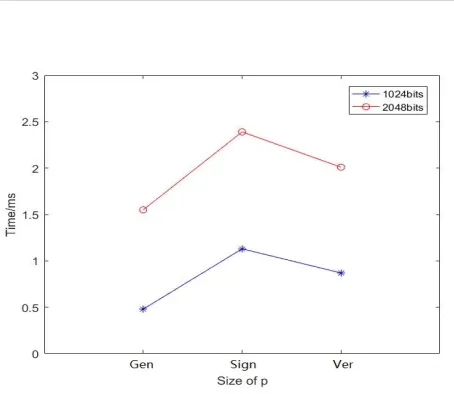
The simulation platform is Intel(R) Core(TM) i5-4570 CPU 3.20 GHz 4.00GB RAM and Windows 10 operate system. The time cost of Segmenting algorithms is shown in Table 2. The Segmenting algorithms has different time cost with dif-ferent security level and difdif-ferent size of data encrypted. The AES.Enc algorithm and the AES.Dec algorithm are extremely fast, and their time cost are not very different on different security level. The time cost of cryptographic algorithms is shown in Table 3 (the modulus nis 1024 bits) and Table 4 with the average of 200 runs. The DPKE algorithm and the DDSA algorithm are cheap. If the DPKE.Gen algorithm only generates one key pair (sk, pk), it average costs 0.004 ms. We analyze the time cost of DDSA on different size of the prime numberp in Fig. 4. See Table 4 and Fig. 4 for more details. We can find that the execution time of the DDSA.Ver algorithm is considerably fast, thus it is very easy for verifying an arbitrator.
We deploy the interacting Sale contract, Arbitration contract and Produc-ing contract in our protocol by Solidity. They implement on a local computer based on Remix. The estimated gas cost to deploy, call and execute contract is provided in Table 5. The Sale contract to deploy is expensive since it includes to call Arbitration contract and Producing contract. The function of Sale con-tract consists of depositing deposit, returning deposit, paying money, submitting data and executing arbitration. Fig. 5 shows the relationship between the size of committee and execution time. This relationship is that, with the expansion of the size of the arbitration committee, the time for selecting arbitrators increases linearly.
3
Table 2.The time cost of Segmenting algorithms
Security Data size Execute time (s) AES.Enc (µs) AES.Dec (µs)
128 bits 10 kb 0.45 0.94 0.96
128 bits 20 kb 0.64 0.96 0.95
128 bits 30 kb 0.84 0.97 0.96
256 bits 10 kb 0.48 1.29 1.28
256 bits 20 kb 0.71 1.30 1.29
256 bits 30 kb 0.89 1.26 1.28
Table 3.The time cost of DPKE algorithms
DPKE DPKE.Gen (ms) DPKE.Enc (ms) DPKE.Dec (ms)
Max time 0.025 0.004 0.197
Min time 0.001 0.001 0.097
Average time 0.004 0.002 0.134
Table 4.The time cost of DDSA algorithms
DDSA Size of p DDSA.Gen (ms) DDSA.Sign (ms) DDSA.Ver (ms)
Max time 1024 bits 0.63 1.30 0.98
Min time 1024 bits 0.32 0.96 0.76
Average time 1024 bits 0.48 1.13 0.87
Table 5.Gas cost of smart contract
Smart contract Function Transaction gas Execute gas Gas cost (ether)
Sale
deploy contract 2099770 1554189 0.07307918 deposit seller 82312 61040 0.00286704 deposit buyer 104058 82786 0.00373688 deposit buyerdata 64218 40578 0.00209592 payment sellerdata 45049 21729 0.00133556 payment transaction 31430 41395 0.00145650
withdraw 24389 27505 0.00103788
arbitration invoke 262510 272350 0.01069720 Producing deploy contract 244230 145386 0.00779232 producing 168265 144625 0.00625780 Arbitration deploy contract 308436 194640 0.01006152 arbitration 119763 101075 0.00441676
3 9 15 21 27 33 39 45
Size of committee 0
2 4 6 8 10 12
Time/s
8
Conclusion
In this paper, we have proposed a valid data trading ecosystem based on blockchain to complement deficiencies in existing data trading market. By introducing a de-centralized arbitration mechanism consisting of an arbitration contract, a pro-ducing contract and a deterministic digital signature algorithm, we system can resolve the dispute over data availability in data trading. We also design a sale contract, advanced encryption standard algorithm and deterministic public-key encryption algorithm to ensure fairness of data trading between the seller and buyer. We utilize the advantage of blockchain to prevent single-point-failure of data trading platform. We formally prove the security of our system and discuss the arbitration process. The system was implemented based on smart contract and Java, and its performance evaluated.
[1] Federal Information Processing Standards Publication 197. Advanced en-cryption standard. InU.S. Department of Commerce, National Institute of Standards and Technology, 2001.
[2] Mihir Bellare, Alexandra Boldyreva, and Adam O’Neill. Deterministic and efficiently searchable encryption. In Alfred Menezes, editor,Advances in Cryptology - CRYPTO 2007, pages 535–552, Berlin, Heidelberg, 2007. Springer Berlin Heidelberg.
[3] Mihir Bellare, Zvika Brakerski, Moni Naor, Thomas Ristenpart, Gil Segev, Hovav Shacham, and Scott Yilek. Hedged public-key encryption: How to protect against bad randomness. InAdvances in Cryptology - ASIACRYPT 2009, 15th International Conference on the Theory and Application of Cryp-tology and Information Security, Tokyo, Japan, December 6-10, 2009. Pro-ceedings, pages 232–249, 2009.
[4] Mihir Bellare, Marc Fischlin, Adam O’Neill, and Thomas Ristenpart. De-terministic encryption: Definitional equivalences and constructions without random oracles. InAdvances in Cryptology - CRYPTO 2008, 28th Annual International Cryptology Conference, Santa Barbara, CA, USA, August 17-21, 2008. Proceedings, pages 360–378, 2008.
[5] Daniel J. Bernstein, Niels Duif, Tanja Lange, Peter Schwabe, and Bo-Yin Yang. High-speed high-security signatures. J. Cryptographic Engineering, 2(2):77–89, 2012.
[6] Nina Bindel, Sedat Akleylek, Erdem Alkim, Paulo S. L. M. Barreto, Jo-hannes Buchmann, Edward Eaton, Gus Gutoski, Juliane Kr¨amer, Patrick Longa, Harun Polat, Jefferson E. Ricardini, and Gustavo Zanon. qtesla. Sub-mission to the NIST Post-Quantum Cryptography Standardization [NIS], https://qtesla.org, 2017.
[7] Alexandra Boldyreva, Serge Fehr, and Adam O’Neill. On notions of secu-rity for deterministic encryption, and efficient constructions without random oracles. In Advances in Cryptology - CRYPTO 2008, 28th Annual Inter-national Cryptology Conference, Santa Barbara, CA, USA, August 17-21, 2008. Proceedings, pages 335–359, 2008.
[8] Zvika Brakerski and Gil Segev. Better security for deterministic public-key encryption: The auxiliary-input setting.J. Cryptology, 27(2):210–247, 2014. [9] Jinchuan Chen and Yunzhi Xue. Bootstrapping a blockchain based ecosys-tem for big data exchange. In 2017 IEEE International Congress on Big Data, BigData Congress 2017, Honolulu, HI, USA, June 25-30, 2017, pages 460–463, 2017.
[10] Xue-wen Chen and Xiaotong Lin. Big data deep learning: Challenges and perspectives. IEEE Access, 2:514–525, 2014.
’98, Louvain-la-Neuve, Belgium, September 14-16, 1998, Proceedings, pages 277–284, 1998.
[12] Weiqi Dai, Chunkai Dai, Kim-Kwang Raymond Choo, Changze Cui, Deiqing Zou, and Hai Jin. SDTE: A secure blockchain-based data trading ecosystem.
IEEE Trans. Information Forensics and Security, 15:725–737, 2020. [13] Sergi Delgado-Segura, Cristina P´erez-Sol`a, Guillermo Navarro-Arribas, and
Jordi Herrera-Joancomart´ı. A fair protocol for data trading based on bitcoin transactions. IACR Cryptology ePrint Archive, 2017:1018, 2017.
[14] Massimo Felici, Theofrastos Koulouris, and Siani Pearson. Accountabil-ity for data governance in cloud ecosystems. In IEEE 5th International Conference on Cloud Computing Technology and Science, CloudCom 2013, Bristol, United Kingdom, December 2-5, 2013, Volume 2, pages 327–332, 2013.
[15] Ethereum Foundation. The serpent contract-oriented programming lan-guage.
[16] Benjamin Fuller, Adam O’Neill, and Leonid Reyzin. A unified approach to deterministic encryption: New constructions and a connection to computa-tional entropy. In Theory of Cryptography - 9th Theory of Cryptography Conference, TCC 2012, Taormina, Sicily, Italy, March 19-21, 2012. Pro-ceedings, pages 582–599, 2012.
[17] Shafi Goldwasser and Silvio Micali. Probabilistic encryption. J. Comput. Syst. Sci., 28(2):270–299, 1984.
[18] Taeho Jung, Xiang-Yang Li, Wenchao Huang, Jianwei Qian, Linlin Chen, Junze Han, Jiahui Hou, and Cheng Su. Accounttrade: Accountable pro-tocols for big data trading against dishonest consumers. In 2017 IEEE Conference on Computer Communications, INFOCOM 2017, Atlanta, GA, USA, May 1-4, 2017, pages 1–9, 2017.
[19] Aggelos Kiayias, Alexander Russell, Bernardo David, and Roman Oliynykov. Ouroboros: A provably secure proof-of-stake blockchain pro-tocol. In Advances in Cryptology - CRYPTO 2017 - 37th Annual Inter-national Cryptology Conference, Santa Barbara, CA, USA, August 20-24, 2017, Proceedings, Part I, pages 357–388, 2017.
[20] Fan Liang, Wei Yu, Dou An, Qingyu Yang, Xinwen Fu, and Wei Zhao. A survey on big data market: Pricing, trading and protection. IEEE Access, 6:15132–15154, 2018.
[21] Kaitai Liang, Willy Susilo, and Joseph K. Liu. Privacy-preserving ciphertext multi-sharing control for big data storage. IEEE Transactions on Informa-tion Forensics and Security, 10(8):1578–1589.
[22] Jie Lin, Wei Yu, Nan Zhang, Xinyu Yang, Hanlin Zhang, and Wei Zhao. A survey on internet of things: Architecture, enabling technologies, security and privacy, and applications.IEEE Internet of Things Journal, 4(5):1125– 1142, 2017.
[24] Sriharsha Mallapuram, Nnatubemugo Ngwum, Fang Yuan, Chao Lu, and Wei Yu. Smart city: The state of the art, datasets, and evaluation platforms.
In16th IEEE/ACIS International Conference on Computer and
Informa-tion Science, ICIS 2017, Wuhan, China, May 24-26, 2017, pages 447–452, 2017.
[25] J. Manyika, M. Chui, B. Brown, J. Bughin, R. Dobbs, C. Roxburgh, and A. H. Byers. Big data: The next frontier for innovation, com-petition, and productivity. pages https://www.mckinsey.com/business– functions/digital–mckin sey/our–insights/big–data–the–next–frontier–for– innovation, 2011.
[26] Andrew Mcafee and Erik Brynjolfsson. Big data: The management revolu-tion. Harv Bus Rev, 90(10):60–6, 68, 128, 2012.
[27] Ilya Mironov, Omkant Pandey, Omer Reingold, and Gil Segev. Incremen-tal deterministic public-key encryption. In Advances in Cryptology - EU-ROCRYPT 2012 - 31st Annual International Conference on the Theory and Applications of Cryptographic Techniques, Cambridge, UK, April 15-19, 2012. Proceedings, pages 628–644, 2012.
[28] Mehdi Mohammadi, Ala I. Al-Fuqaha, Sameh Sorour, and Mohsen Guizani. Deep learning for iot big data and streaming analytics: A survey. IEEE Communications Surveys and Tutorials, 20(4):2923–2960, 2018.
[29] Thomas Pornin. Deterministic usage of the digital signature algorithm (DSA) and elliptic curve digital signature algorithm (ECDSA). RFC, 6979:1–79, 2013.
[30] Ananth Raghunathan, Gil Segev, and Salil P. Vadhan. Deterministic public-key encryption for adaptively-chosen plaintext distributions.J. Cryptology, 31(4):1012–1063, 2018.
[31] John A. Stankovic. Research directions for the internet of things. IEEE Internet of Things Journal, 1(1):3–9, 2014.
[32] Yunchuan Sun, Houbing Song, Antonio J. Jara, and Rongfang Bie. Internet of things and big data analytics for smart and connected communities.IEEE Access, 4:766–773, 2016.
[33] Nick Szabo. Formalizing and securing relationships on public networks.
First Monday, 2(9), 1997.
[34] Y. Z. Wang, J. Hou, , and Y. Zhang. Data management based on block chain technology. Electron. Des. Eng., 27:87–90 and 95, 2019.
[35] Hoeteck Wee. Dual projective hashing and its applications - lossy trapdoor functions and more. In Advances in Cryptology EUROCRYPT 2012 -31st Annual International Conference on the Theory and Applications of Cryptographic Techniques, Cambridge, UK, April 15-19, 2012. Proceedings, pages 246–262, 2012.
[36] Jianjia Wu and Wei Zhao. Design and realization of winternet: From net of things to internet of things. TCPS, 1(1):2:1–2:12, 2016.
[37] Wei Xiong and Li Xiong. Smart contract based data trading mode using blockchain and machine learning. IEEE Access, 7:102331–102344, 2019. [38] Maojiang Yang and Pingan Technology. A design of data trading platform
[39] Xinyu Yang, Xuebin Ren, Jie Lin, and Wei Yu. On binary decomposi-tion based privacy-preserving aggregadecomposi-tion schemes in real-time monitoring systems. IEEE Trans. Parallel Distrib. Syst., 27(10):2967–2983, 2016. [40] Andrea Zanella, Nicola Bui, Angelo Paolo Castellani, Lorenzo Vangelista,
and Michele Zorzi. Internet of things for smart cities. IEEE Internet of Things Journal, 1(1):22–32, 2014.
[41] Yanqi Zhao, Yong Yu, Yannan Li, Gang Han, and Xiaojiang Du. Machine learning based privacy-preserving fair data trading in big data market. Inf. Sci., 478:449–460, 2019.
[42] Jiayu Zhou, Fengyi Tang, He Zhu, Ning Nan, and Ziheng Zhou. Dis-tributed data vending on blockchain. In IEEE International Con-ference on Internet of Things (iThings) and IEEE Green Comput-ing and Communications (GreenCom) and IEEE Cyber, Physical and Social Computing (CPSCom) and IEEE Smart Data (SmartData), iThings/GreenCom/CPSCom/SmartData 2018, Halifax, NS, Canada, July 30 - August 3, 2018, pages 1100–1107, 2018.