Fast Secure Matrix Multiplications
over Ring-Based Homomorphic Encryption
Pradeep Kumar Mishra1, Deevashwer Rathee2, Dung Hoang Duong3, and Masaya Yasuda4
1
Graduate School of Mathematics, Kyushu University, 744 Motooka Nishi-ku, Fukuoka 819-0395, Japan
2 Department of Computer Science and Engineering, Indian Institute of Technology (BHU) Varanasi 221005, India.
3
School of Computing and Information Technology, University of Wollongong, Northfields Avenue, Wollongong NSW 2522, Australia.
4
Institute of Mathematics for Industry, Kyushu University, 744 Motooka Nishi-ku, Fukuoka 819-0395, Japan
Abstract. Secure matrix computation is one of the most fundamen-tal and useful operations for statistical analysis and machine learning with protecting the confidentiality of input data. Secure computation can be achieved by homomorphic encryption, supporting meaningful op-erations over encrypted data. HElib is a software library that implements the Brakerski-Gentry-Vaikuntanathan (BGV) homomorphic scheme, in which secure matrix-vector multiplication is proposed for operating ma-trices. Recently, Duong et al. (Tatra Mt. Publ. 2016) proposed a new method for secure single matrix multiplication over a ring-LWE-based scheme. In this paper, we generalize Duong et al.’s method for secure
multiple matrix multiplications over the BGV scheme. We also imple-ment our method using HElib and show that our method is much faster than the matrix-vector multiplication in HElib for secure matrix multi-plications.
Key words: Secure matrix multiplications, Leveled fully homomorphic encryption, Packing methods.
1
Introduction
first introduced by Rivest et al. in 1978 [25]. About 30 years later, the first scheme of fully homomorphic encryption (FHE) that supports arbitrary operations on encrypted data was constructed by Gentry [11]. After Gentry’s pioneering work, a number of FHE schemes have been proposed and improved in both theory and practice. However, currently known FHE schemes are yet impractical for real applications. For example, it is reported in a recent work [7] that it takes 52 milliseconds forsingle gate bootstrapping to refresh the error in a ciphertext for unlimited operations. On the other hand, the Paillier scheme [24] and the BGN scheme [2] are practical, but their functionality is very limited. In recent years,
somewhat homomorphic encryption (SHE), initially used as a building block for FHE construction, and its leveled improvement (called leveled FHE) have at-tracted a lot of attention from various communities. Both SHE and leveled FHE can support only a limited number of additions and multiplications, but it is applicable in various scenarios with reasonable performance (e.g., see [23, 13, 29, 1, 31, 6]). In particular, since leveled FHE has slower growth of the error in a ciphertext, it is more useful to evaluate a circuit of large depth.
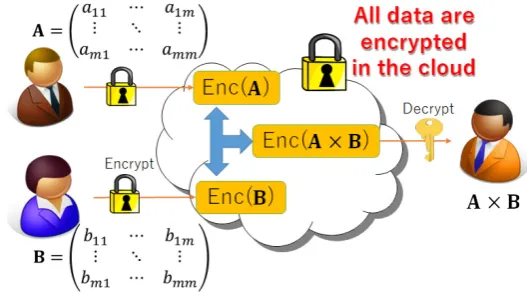
Matrix computation is one of the most basic and useful operations for var-ious applications, including statistical analysis, image processing and machine learning. In this paper, we focus on secure matrix multiplications (see Figure 1 below for an image of our goal). At present, ring-based leveled FHE schemes, such as BGV [4], FV [10], YASHE [3], and NTRU [19], are efficient and useful. BGV and FV schemes are based on the ring-LWE (learning with errors) as-sumption [21], and YASHE is a variant of NTRU. Costache and Smart [8] com-pared features of such schemes (see also [18] for a comparison), and showed that the BGV scheme is more efficient for large plaintext space than other schemes. Hence we useHElib[16] as a software library in our implementation of the BGV scheme. (Recently,HElibhas been improved for efficiency [17].) For secure ma-trix computation, mama-trix-vector multiplication is proposed inHElib(see [15] for its manual). Recently, Lu et al. [20] slightly modified the matrix-vector multipli-cation for secure statistical analysis over HElib. As an individual work, Duong et al. [9] proposed efficient methods for securesingle matrix multiplication over ring-based SHE schemes. Later, Wang et al. [28] modified Duong et al.’s meth-ods for flexible matrix computation, but their modification is much less efficient for matrices of larger size.
Our Contributions We generalize Duong et al.’s methods [9] for secure mul-tiple matrix multiplications over the BGV scheme using R =Z[x]/(xn+ 1) as the base ring for a 2-power integer n. Our method can be used over the other ring-based SHE schemes. For secure multiplication between two matricesAand B, a main ingredient of [9] is to pack A and B into two types of polynomial over R, and then encrypt the polynomials. The homomorphic property of the
A1 by the first transformation of [9], and flip the columns ofA2and pack them using a method similar to A1 to obtain the entries of A1×A2 in polynomial format. We propose new transformation to pack the product A3× · · · ×A`−1 into polynomial format. In contrast, we make use of the second transformation of [9] forA`. But our method requires for us to take an appropriate jump for ex-ponents of the variablexof the polynomial ringRgreater than the total degree of polynomials overR corresponding to the matrices A1, . . . ,A`−1, in order to avoid overlapping the coefficients of the decryption polynomial.
Different from ours, the matrix-vector multiplication implemented inHElib makes use of the plaintext slots of the BGV scheme, useful for SIMD (Single Instruction Multiple Data) operations (see [13] for a typical use). While the matrix-vector multiplication can only pack a row or column vector into a single ciphertext, ours can pack a matrix. Our method can also perform secure matrix multiplications by a few homomorphic multiplications over our packed cipher-texts. For a comparison of performance, we implement our method and compare with the matrix-vector multiplication overHElib. With our implementation re-sults, we also discuss advantages and limitations of our method.
This is a fully revised paper of the conference paper [22]. Main differences are as follows:
1. We complete a proof of our secure matrix multiplications among three ma-trices (Theorem 2 below).
2. We also give a generalization of Duong et al.’s method for A1× · · · ×A` with`≥4 (Subsection 3.2 below).
3. While the BV scheme [5] is implemented in [22], we here implement the BGV scheme over HElib for our secure matrix multiplications. Furthermore, we compare performance results of our method and the matrix-vector multipli-cation overHElib (Section 4 below).
2
Preliminaries
HElib [16] is an open-sourceC++library that implements a variant of the ring-LWE-based BGV scheme [4], improved by Gentry, Halevi and Smart [12]. It includes the Smart-Vercauteren ciphertext packing [26], high-level procedures for data-movement and simple linear algebra, modulus and key switching operations, and bootstrapping. In this section, we review the BGV scheme implemented in HElib.
2.1 The BGV Scheme
The BGV scheme is a leveled homomorphic encryption scheme based on ring-LWE. For a positive integerN, the scheme is defined over the ring
R=Z[x]/(ΦN(x)),
with coefficients in Z (coefficient representation). A distribution χ over R is implemented in HElib for error polynomials, drawing a random polynomial in Rwith every coefficient chosen at random from a discrete Gaussian distribution with zero mean and varianceσ2for a parameterσ(σ= 3.2 is default inHElib). For an odd primeq, denote by [·]qthe reduction moduloq, mapping an element of R to the element ofR with every coefficient equal to the unique representative of its equivalence class modulo q in the interval (−q/2, q/2]. For a prime or prime-powerp, we denote the ringRp=R/pR.
Thenative plaintext space of the BGV scheme, implemented inHElib, isRt for a prime-powert=pr (cf., see Subsection 2.3 below for plaintext slots). The scheme is parametrized by a sequence of decreasing moduli
qL> qL−1>· · ·> q0 (1)
for homomorphic evaluation. For every modulus qi, an i-th level ciphertext in the scheme is a vector in R2
qi. A secret key in HElib is chosen as an element s ∈ R with coefficients in {0,±1} and low Hamming weight H (e.g., H = 64). Set sk = (1,−s) as a secret key. For correct decryption, every i-th level ciphertextvi= (c0, c1)∈R2qiof a plaintextα∈Rtshould satisfy that the “noise” polynomial [hsk, vii]qi = [c0−c1s]qi ∈R has the form α+tε for some “small” errorε∈R (i.e., all the coefficients oftε∈R are considerably smaller thanqi). Then the decryption procedure Dec(vi,sk) = [hsk, vii]qi modt can recover the correct plaintext.
A public key is a pairpk= (a, b)∈R2
qL, where ais uniformly sampled from RqL and b= [as+te]qL is generated by samplinge from the distributionχ. A “fresh” ciphertext (i.e., an L-th level ciphertext) vL = Enc(α,pk) = (c0, c1) ∈ Rq2L of a plaintextα∈Rt is given by
(
c0=α+bv+te0,
c1=av+te1,
where v∈R is a randomly chosen polynomial with coefficients in{0,±1}, and e0, e1∈R are chosen fromχ. Since
c0−c1s=α+bv+te0−s(av+te1)
≡α+t(ve+e0−se1) modqL, (2)
the noise polynomial ofvLsatisfies the requirement of correct decryption if large qLis taken (note that every coefficient ofve+e0−se1is small). Otheri-th level ciphertexts, computed after homomorphic operations, are described below.
2.2 Homomorphic Operations and Noise Control
The noise polynomial of a ciphertext should be small for correct decryption. In HElib, the size of such noise is measured by thecanonical embedding norm
represented as ((c0, c1), i, ν), whereν is an estimate on the noise magnitude in the ciphertext. For example, according to equation (2), an estimate for a fresh ciphertext is initialized by four parameters (N, t, σ, H) inHElib (see [14, Sub-section 3.1.4]). Given c = ((c0, c1), i, ν) and c0 = ((c00, c01), i0, ν0), homomorphic operations are defined as follows:
1. Homomorphic Addition: Ifi =i0, we add these two ciphertext vectors and
two noise estimates as
c+c0= (([c0+c00]qi,[c1+c
0
1]qi), i, ν+ν
0).
Ifi6=i0, we reduce the larger one modulo the smaller of the two moduli to bring them to the same level.
2. Homomorphic Multiplication: If needed, we bring the two ciphertexts to the same level. When i = i0, we first perform the tensor product of c and c0 as ((d0, d1, d2), i, νν0), where (d0, d1, d2) is the extended ciphertext (c0c00, c0c01+c00c1, c1c01) ∈ R3qi. We then perform the “relinearlization/key-switching” operation [14, Subsection 3.1.4] to obtain acanonical ciphertext (c000, c001) ∈R2qi of the same plaintext, and estimate its noise magnitude ν
00.
As a result, homomorphic multiplication outputs the information
c∗c0 = ((c000, c001), i, ν00).
The homomorphic correctness of the BGV scheme follows the ring structure of the plaintext spaceRt; For twoi-th level ciphertextscandc0 of plaintextsα andα0, we have
(
Dec(c+c0,sk) =α+α0,
Dec(c∗c0,sk) =αα0, (3)
if the i-th level modulus qi is sufficiently large. In contrast, every homomor-phic operation grows the noise of a ciphertext, and it might fail to decrypt the ciphertext after a number of operations. In particular, homomorphic multiplica-tion grows the noise much larger than addimultiplica-tion, and the noise grows only linearly with the number of multiplications. The “modulus-switching” operation takes as input ani-th level ciphertext to output an (i−1)-th level ciphertext of the same plaintext, but it can reduce the noise size (see [14, Subsection 3.1.5]). InHElib, if one of the input ciphertexts for homomorphic multiplication have larger noises than a preset constant, the modulus-switching is performed before the multi-plication in order to avoid decryption failure. Namely, noises of ciphertexts are automatically controlled inHElib. Then we can ignore the noise magnitude and the level of a ciphertext in usingHElib.
2.3 Plaintext Slots of the BGV Scheme
F2(x)× · · · ×Fk(x) (modp) for some k ∈ Z. Every polynomial Fi(x)∈ Fp[x] has degreed=φ(N)/k. Due to the ring-isomorphism
Rp'Fp[x]/(F1(x))× · · · ×Fp[x]/(Fk(x)), (4)
any plaintext polynomialα∈Rpcan be identified as the vector (αmodFi(x))ki=1. Conversely, since every spaceFp[x]/(Fi(x)) is isomorphic to the extension field Fpd, we can handle any vectora= (a1, . . . , ak)∈Fkpd as a plaintext (each entry is called a “slot”), and encrypt the vector asEnc(a,pk). By the isomorphism (4), for two ciphertextsc,c0 of vectors (a1, . . . , ak),(b1, . . . , bk), it satisfies
(
Dec(c+c0,sk) = (a1+b1, . . . , ak+bk),
Dec(c∗c0,sk) = (a1b1, . . . , akbk).
(5)
Namely, homomorphic addition (resp., multiplication) allows us to operate element-wise addition (resp., multiplication) over plaintext slots (cf., the homomorphic property (3) over the native plaintext space Rt). Simply speaking, it enables SIMD operation over slots (see [13] for a typical use). Furthermore, procedures for data-movement such as rotation and shift over slots are implemented in HElib.
2.4 Other Optimizations
We describe the following two optimizations implemented inHElib, which shall be used in our implementation.
1. Modulus Chain and Double-CRT Representation [14, Subsection 1.2]: For the moduli chain (1), small primesp0, p1, . . . , pL are chosen so thatΦN(x) factors modulo pi to linear terms for all 0 ≤ i ≤ L. The `-th modulus in the chain is defined as q` = Q`j=0pj in HElib. For efficient arithmetic over ciphertexts, a polynomial a(x) ∈ Rq` (in coefficient representation) is represented as an (`+ 1)×φ(N) matrix DoubleCRT`(a) (in evaluation representation), whose (i, j)-th entry is the evaluation of a(x) at j-th root ofΦN(x) modulopi. Addition and multiplication in Rq` is done entry-wise modulo the appropriate primespi. In the rest of description, we ignore the double CRT representation of polynomials lying in the ciphertext space and describe the scheme as if we were operating on polynomials directly. 2. Key Switching [14, Subsection 3.1.6]: The public key has key switching
ma-trices that transform a ciphertext decryptable by a secret key sk0 into a ciphertext decryptable by another secret keysk. This transformation is used in multiplication and data-movement over slots (in particular, this is an op-timization in getting a canonical ciphertext).
3
Secure Matrix Multiplications
image). We also extend the method of Duong et al. [9] for securemultiplematrix multiplications. For simplicity, in this paper, we only handle square matrices of sizem with positive integer entries.
3.1 Typical Known Methods
Matrix-Vector Multiplication in HElib To perform secure matrix multi-plications, several methods for the matrix-vector multiplication over the BGV scheme are implemented inHElib. According to [15, Subsection 4.3], the method to put a matrix indiagonal order is the best solution if the matrix is given to us in plaintext (cf., if a matrix is encrypted, expensive data movement techniques in HElibare required to change the representation of the matrix). LetA= (aij) be an integer square matrix of sizem, andv= (vi) a column vector of lengthm. We representAbymcolumn vectors in diagonal order asd1= (a1,1, a2,2, . . . , am,m) and
di= (a1,i, a2,i+1, . . . , am−i+1,m, am−i+2,1,· · · , am,i−1)
for 2≤i≤m. Then the product A×vcan be computed as Pm
i=1di×(v≪ i) ∈ Zm, where (v ≪ i) is the i times left-rotated vector of v and a×b is the element-wise multiplication between two vectors a and b. To evaluate this procedure over the BGV scheme, we encrypt vectorsdi andv encoded in slots as ci =Enc(di,pk) and c= Enc(v,pk) (it requires at least m slots). From the homomorphic property (5) over slots, a combination of homomorphic operations
m X
i=1
ci∗Rotatei−1(c)
outputs a ciphertext of the productA×v, whereRotatej(c) is the j times left-rotated ciphertext of c. This requires (m−1) rotations and additions, and m multiplications. The hoisting technique mentioned in [17] can be used to make rotations more efficient when multiple rotations are to be performed on the same ciphertext. This matrix-vector multiplication can be applied to matrix cations. (Recently, Lu et al. [20] slightly modified the matrix-vector multipli-cation of [15, Section 4.3] for homomorphic evaluation of principal component analysis and linear regression.)
Duong et al.’s Method for Single Matrix Multiplication While the above method makes use of the homomorphic property (5) over slots, Duong et al. [9] use the property (3) over the native plaintext spaceRtof the BGV scheme (they in [9] implemented their method over the BV scheme [5], the origin of the BGV scheme without optimizations).
For a 2-power integern, we here takeN= 2nas the parameter defining the base ringR of the BGV scheme. Then we haveΦN(x) =xn+ 1 and hence
Fig. 1.An image of secure matrix multiplicationA×Bin the cloud
LetAandBbe two square matrices of sizemwith positive integer entries. We pack each row Ai = (ai,0, . . . , ai,m−1) and column BTj = (b0,j, . . . , bm−1,j) of matricesAandB, respectively, into polynomials ofR as follows:
pm(1)2 (Ai) := m−1
X
u=0 ai,uxu,
pm(2)2 (BTj) :=− m X
v=0
bv,jxn−v.
Furthermore, define the following two types of polynomial in R associated to two matricesAandB:
Pol(1)2 (A) := m X
i=1
pm(1)2 (Ai)x(i−1)m,
Pol(2)2 (B) := m X
j=1
pm(2)2 (BjT)x(j−1)m2.
We then encrypt the two types of polynomial as
ct2(i)(A) :=EncPol2(i)(A),pk fori= 1,2.
Over packed ciphertexts, we have the following result [9, Theorem 7] (they mod-ify the result for large entries in [9, Subsection 4.2], based on Yasuda et al.’s modification [31]):
Theorem 1. Assume n≥m3. Let
and letDec(ct2,sk)∈Rtdenote its decryption polynomial. If decryption is correct
for ct2, then the inner product Ai, BjT
modulo t is equal to the coefficient of
x(i−1)m+(j−1)m2 inDec(ct2,sk) for every1≤i, j≤m.
Proof. Here we only give a sketch of proof. Due to the homomorphic property (3) over the native plaintext spaceRt, the decryption result ofct2 is equal to
F(x) := Pol(1)2 (A)×Pol(2)2 (B)
modulo t. All the entries Ai, BjT
of A×B are obtained from coefficients of the polynomial F(x) ∈ Rt at certain positions. This is due to the structure of the special ring Rt =Ft[x]/(xn + 1). This idea is based on Yasuda et al.’s method [30] for secure multiple inner products, but suitable arrangement of entries of a matrix is required for secure matrix multiplication to avoid overlaps. For details, see the proof of Theorem 2 below for the case of three matrices.
By Theorem 1, if we take sufficiently large t, all the entries of A×B can be obtained from coefficients of the decryption polynomial Dec(ct2,sk) ∈ Rt. This method can pack a matrix into a single ciphertext, and it requires only one homomorphic multiplication over packed ciphertexts for a single secure matrix multiplicationA×B. (cf., the method described in Subsection 3.1 packs a row or column vector of a matrix into a single ciphertext, and it requires at leastm2 homomorphic multiplications forA×B.) An obstacle of Duong et al.’s method is that it requires considerably largenandtfor large sizemand entries of matrices (see Subsection 4.1 below for this obstacle).
Remark 1. In Duong et al.’s method, types of packed polynomial are different for two matricesA andB, and hence we can not change the order of matrices for multiplication. In [28], Wang et al. modified Duong et al.’s packing method so that it can pack a matrix into a single ciphertext in the same way, and it can also compute both A×B and B×A simultaneously over packed ciphertexts. However, Wang et al.’s method requires largernfor the ringR=Z[x]/(xn+ 1) to pack a matrix, and it would be much less efficient than Duong et al.’s method for matrices of larger size.
3.2 Generalization of Duong et al.’s Method for Multiple Matrix Multiplications
The method by Duong et al. [9] is only for a single secure multiplication. Here we generalize their method to multiple matrix multiplications A1× · · · ×A`. Throughout this subsection, we let Ai (resp., ATi) denote the ith row (resp., column) of a matrix A. We use the notation “pm`” for packing a row (or a column) of matrix, where`stands for the number of matrices being multiplied.
subsection, we give two types of polynomial inR =Z[x]/(xn+ 1) for each row Ai= (ai,0, . . . , ai,m−1) ofAas follows:
pm(1)3 (Ai) := m−1
X
u=0 ai,uxu,
pm(2)3 (Ai) :=− m−1
X
u=0
ai,uxn−um
2−m+1
,
Now we define three types of polynomial in R associated with three matrices A,B, andC as follows:
Pol(1)3 (A) := m X
i=1
pm(1)3 (Ai)x(i−1)m,
Pol(2)3 (B) := m X
j=1
pm(1)3 BTjx(j−1)m2,
Pol(3)3 (C) := m X
k=1
pm(2)3 CkTx(k−1)m3,
whereBT
j = (b0,j, . . . , bm−1,j) andCkT are thej
thand thekthcolumns ofBand C, respectively, and set
BTj = (bm−1,j, . . . , b0,j) (i.e., flipping the columnBT
j). Now we define three types of packed ciphertext for a matrixAto be
ct3(i)(A) :=EncPol3(i)(A),pk fori= 1,2,3.
Then we have a similar result to Theorem 1 for the case of three matrices as follows:
Theorem 2. Assume n≥m4. Let
ct3=ct(1)3 (A)∗ct3(2)(B)∗ct(3)3 (C),
and letDec(ct3,sk)∈Rtdenote its decryption polynomial. If decryption is correct
forct3, then the(i, k)th entry ofA×B×C modulo tis equal to the coefficient of x(i−1)m+(k−1)m3 inDec(ct3,sk)for every 1≤i, k≤m.
Proof. The idea is the same as the proof of Theorem 1. It follows from our construction that
pm(1)3 (Ai)×pm (1) 3
BTj
= m X u=1 m X v=1
aiubm−v+1,jxu+v−2
=Ai, BjT
withu6=m−v+ 1 andu, v∈ {0, . . . , m−1}. As seen from the above equation,
the coefficient of the monomialxm−1in pm(1)
3 (Ai)×pm (1) 3
BTj∈R gives the inner product
Ai, BTj
. Furthermore we have
pm(1)3 (Ai)×Pol (2) 3 (B)
= m X
j=1
Ai, BjT
x(j−1)m2+m−1+ other terms of degree (u+v−2 + (j−1)m2).
Furthermore, since xn=−1 holds overR, we obtain
pm(1)3 (Ai)×Pol (2)
3 (B)×pm (2) 3 C T k = m X j=1
Ai, BTj
x(j−1)m2+m−1×pm(2)3 CkT
+ other terms of degree (n+u+v−m−1 + (j−1)m2−(w−1)m2)
=− m X j=1 m X w=1
Ai, BjT
ck,wxn+(j−1)m
2−(w−1)m2
+ other terms of degree (n+u+v−m−1 + (j−w)m2)
= Vi, CkT
+ other terms of degree (n+u+v−m−1 + (j−w)m2)
with w 6= j for w, j ∈ {0, . . . , m−1}, where we set Vi =
Ai, BjT m
j=1 for 1≤i≤m. If decryption is correct for the ciphertextct3, we have
Dec(ct3,sk) =Pol(1)3 (A)×Pol(2)3 (B)×Pol(3)3 (C)
= m X i=1 m X k=1
pm(1)3 (Ai)×Pol (2)
m,3(B)×pm (2)
3 C
T k
x(i−1)m+(k−1)m3.
Furthermore, for fixed indicesiandk, we have
pm(1)3 (Ai)×Pol (2)
3 (B)×pm (2)
3 C
T k
x(i−1)m+(k−1)m3 =
Vi, CkT
x(i−1)m+(k−1)m3
+ other terms of degree (n+u+v−m−1+(j−w)m2+(i−1)m+ (k−1)m3
withu+v6=m+ 1 andw6=jforu, v, j, w∈ {0, . . . , m−1}. The exponent ofxis modulonoverR, and thereforen+u+v−m−1+(j−w)m2+(h−1)m+(`−1)m3 is never equal to (i−1)m+ (k−1)m3foru+v=6 m+ 1, w6=jandj, w, h, `, i, k∈
{1, . . . , m}. This implies that the term of degree (i−1)m+ (k−1)m3 in
Pol(1)3 (A)×Pol(2)3 (B)×Pol(3)3 (C)
is exactly the term of degree (i−1)m+ (k−1)m3 in
pm(1)3 (Ai)×Pol (2)
3 (B)×pm (2)
3 C
T k
Hence the inner product Vi, CkT
, the (i, k)th entry of A×B×C, can be recovered from the coefficient of x(i−1)m+(k−1)m3
in the decryption polynomial
Dec(ct3,sk)∈Rt.
Case of `≥4 LetAbe a square matrix of sizem. For more than three matri-ces, we define (`−1) types of polynomial inRfor each rowAi = (ai,0, . . . , ai,m−1) ofAas follows:
pm(1)` (Ai) := m−1
X
u=0 ai,uxu,
pm(2)` (Ai) :=− m−1
X
u=0
ai,uxn−(α+β+m−1),
pm(`w)(Ai) := m−1
X
u=0
ai,uxum w−1
for 3≤w≤`−1,
where α=um`−1 andβ =P`−2
s=2(m−1)m
s. Furthermore, we define `types of polynomial inRassociated to matrices A1, . . . ,A` as follows:
Pol(1)` (A1) := m X
i=1
pm(1)` (A1,i)x(i−1)m,
Pol(2)` (A2) := m X
j=1
pm(1)` AT2,jx(j−1)m2,
Pol(`h)(Ah) := m X
k=1
pm(`h)ATh,kx(k−1)mh (3≤h≤`−1),
Pol(``)(A`) := m X
w=1
pm(2)` AT`,w
x(w−1)m`,
where Ah,j and ATh,j =
a0(h,j), . . . , a(mh−)1,j are the row and column of Ah
re-spectively, and ATh,j = a(mh−)1,j, . . . , a(0h,j) (i.e., flipping the column AT h,j) for 3≤h≤`−1. Define` types of packed ciphertext for a given matrixAto be
ct`(h)(A) :=EncPol`(h)(A),pk for 1≤h≤`.
Similar to Theorem 2, we obtain the following result for secure matrix multipli-cations over packed ciphertexts:
Theorem 3. Assume n≥m`+1. Let
ct`= ` Y
h=1
and letDec(ct`,sk)∈Rtdenote its decryption polynomial. If decryption is correct
forct`, then the(i, j)th entry ofA1× · · · ×A`modulotis equal to the coefficient
of x(i−1)m+(j−1)m` inDec(ct
`,sk) for every1≤i, j≤m.
4
Implementation Results
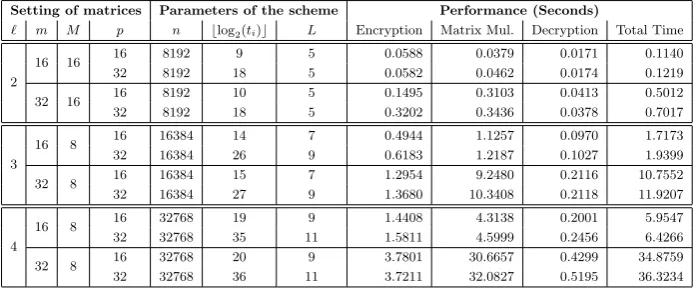
In this section, we show implementation results for our secure multiple matrix multiplications (described in Subsection 3.2) over HElib [16]. Specifically, we show performance of secure matrix multiplications A1× · · · ×A`, where every Aiis a square matrix of sizemwith positive integer entries ofp-bit for`= 2,3,4, m = 16,32 and p= 16,32. Note that the case ` = 2 stands for Duong et al.’s method [9], presented in Subsection 3.1.
4.1 Some Modifications
As described in the paragraph before Remark 1, Duong et al.’s and our packing methods require very large n (degree of ΦN(x) for N = 2n) and t (plaintext modulus) for matrices with large size and entries. (This problem is not specific to our method, and in particular, such largetmight be required in any technique.) Such setting makes the BGV scheme very slow. Here we give two modifications to relax the problem.
Block-Matrix Method LetAbe a square matrix of sizem. We take a block size M satisfying m = bM for some b ∈ Z. Consider A as a matrix with b2 sub-matricesAij with sizeM×M for 1≤i, j≤b. In this method, we pack each sub-matrix Aij into a single polynomial by our packing method, and encrypt the polynomial. This enables us to take smallnfor packing every M×M sub-matrix Aij, instead of the whole matrix A (this requires n ≥ M`+1, instead of n ≥ m`+1). On the other hand, this method requires more homomorphic operations. For example, it requiresb3homomorphic multiplications andb2(b−1) homomorphic additions for secure matrix multiplication between two matrices.
CRT Method for Plaintext Modulus We can split the plaintext modulust intoesmall different primes ti as
t= e Y
i=1 ti
for some e ∈ Z. Given a message modulo t, we encrypt the plaintext modulo every ti. After decryption modulo everyti, we can recover the original message by the CRT method. This enables us to use Fti[x]/(x
4.2 Selection of Parameters
Here we describe how to select suitable parameters of the BGV scheme for our secure matrix multiplications. In our experiments, we use our CRT method with e = 4, suitable for running our programs over 4 threads (it requires to set different primestifor 1≤i≤4). In usingHElib, we basically need to select the following three parameters (see [14, Section 5] for usage):
– n: 2-power integer definingR=Z[x]/(xn+ 1) – ti: prime moduli of plaintext spaces for 1≤i≤4 – L: number of moduli for leveled ciphertext spaces
For other parameters in HElib, we use default parameters such as σ = 3.2 (standard deviation parameter for discrete Gaussian distribution) andH = 64 (Hamming weight of secret keys). We also setk= 128 as the security parameter (actually, our chosen parameters have much more than 128-bit security level from the estimate of HElib since our method requires large n). In our experiments, we use our block-matrix method with block size M = 16 (resp., M = 8) for `= 2 (resp.,`= 3,4). Then we select a 2-power integernsatisfyingn≥M`+1, suitable for both security and efficiency. Since every coefficient ofA1× · · · ×A` in our block-matrix method is at mostM`−12`p, it needs to taket > M`−12`p for obtaining the correct decryption result, where pis the maximum bit size of entries ofAi andtis the plaintext modulus without our CRT method. Then we take 4 different small primes forti’s satisfying
ti> M`−12`p 1/4
.
In contrast, choice of the parameter L depends on the number ` of successive
homomorphic multiplications and the size of plaintext space ti to accept any noises in evaluation. For our experiments, we select around 2` ∼ 3` for the parameterL. (See Table 1 below for our chosen parameters.)
4.3 Implementation and Performance Results
Implementation We implemented our secure matrix multiplications. Our ex-periments ran on an Intel(R)Xeon(R) CPU [email protected], usingHElib[16] as a library. In our experiments, we make use of multi-threaded implementation (4 threads), compatible with our CRT-method. (cf., Our pre-experiments show that computation over 4 threads is about 2.5 times faster than a single thread.) In particular, we use the half-primes optimization in making the moduli chain (1) for efficiency (see [13, Section 3]).
Table 1.Performance of our secure matrix multiplicationsA1× · · · ×A`overHElib,
where every square matrixAihas sizemandp-bit integer entries (we representAi as M×Msub-matrices in our block-matrix method, and split the plaintext modulus into 4 primest1, . . . , t4 in our CRT method)
Setting of matrices Parameters of the scheme Performance (Seconds)
` m M p n blog2(ti)c L Encryption Matrix Mul. Decryption Total Time
2
16 16 16 8192 9 5 0.0588 0.0379 0.0171 0.1140 32 8192 18 5 0.0582 0.0462 0.0174 0.1219
32 16 16 8192 10 5 0.1495 0.3103 0.0413 0.5012 32 8192 18 5 0.3202 0.3436 0.0378 0.7017
3
16 8 16 16384 14 7 0.4944 1.1257 0.0970 1.7173 32 16384 26 9 0.6183 1.2187 0.1027 1.9399
32 8 16 16384 15 7 1.2954 9.2480 0.2116 10.7552 32 16384 27 9 1.3680 10.3408 0.2118 11.9207
4
16 8 16 32768 19 9 1.4408 4.3138 0.2001 5.9547 32 32768 35 11 1.5811 4.5999 0.2456 6.4266
32 8 16 32768 20 9 3.7801 30.6657 0.4299 34.8759 32 32768 36 11 3.7211 32.0827 0.5195 36.3234
1. For the case`= 2, our method is the same as Duong et al.’s method [9]. For two square matrices of sizem = 16 withp= 10-bit entries, Duong et al.’s packing method (the modified version for large entries) in [9, Subsection 4.2] needsn= 131072 by [9, Theorem 10], and it took about 7.27 seconds from [9, Table 2]. In contrast, Table 1 shows that it took only 0.1140 seconds for m= 16 andp= 16. This is mainly due to our modifications sincen= 8192 is sufficient in our block-matrix method.
2. For the case`= 3, performance results are given in our conference paper [22]. From [22, Table 2],n= 65536 is set without our CRT-method and it took 45.8430 (resp., 58.7190) seconds for m = 32 and p = 16 (resp., p = 32) over a single thread of Intel Core i7-4790 CPU with 3.60 GHz, using PARI library [27] (version 2.9.2) inCprograms for implementing the BV scheme [5]. In this full version paper, we use M = 8 as the size of sub-matrices (cf., M = 16 is used in [22]), and hence smaller n is sufficient. From Table 1, our method took 10.7552 (resp., 11.9207) seconds form = 32 and p= 16 (resp.,p= 32). This is about 4 or 5 times faster than [22, Table 2], mainly due to smallernand use of 4 threads over HElib. (Arithmetic in HElib is faster thanPARIsince it is optimized for the BGV scheme.) In particular, our implementation requires less time of both decryption and circuit because of relinearlization. It also requires less ciphertext modulus size due to modulus switching.
since huge n is required in our method. Actually, big jumping exponents are used in our packed polynomials for large`(see Subsection 3.2). See also Subsection 4.4 below for advantages and limitations of our method.
4.4 Comparison in Matrix-Vector Multiplications
As described in Subsection 3.1, the diagonal-based matrix-vector multiplication is implemented inHElib. For`≥2 andm≥1, letA1,· · ·,A`−1be`−1 square matrices of size m and v a column vector of length m. For a 2-power integer n, our packing method over R = Z[x]/(xn + 1) enables us to perform secure matrix-vector multiplications as follows (the following result holds for`≥4, but a similar result for`= 2,3 can be obtained from Subsections 3.1 and 3.2):
Theorem 4. Let `≥4 and assumen≥m`. Let
ct=ct(`)(v)×
`−1 Y
h=1
ct(`h)(Ah),
wherect(`)(v) =Encpm(2)` (v),pkis a packed ciphertext ofv(see also Subsec-tion 3.2 for other packed ciphertexts). Let Dec(ct,sk)∈Rtdenote its decryption
polynomial. If decryption is correct forct, then theithentry of the column vector A1× · · · ×A`−1×vmodulotis equal to the coefficient ofx(i−1)minDec(ct,sk).
Performance Comparison In Table 2, we compare the performance of our method with the diagonal-based method inHElibfor secure matrix-vector mul-tiplications A1× · · · ×A`−1×v for`= 2,3 and 4, where every square matrix Ai and column vector v have size m and p-bit integer entries. We performed experiments over 4 threads with our CRT-method as in Table 1. We also used the hoisting optimization mentioned in [17] to further speed up the diagonal-based method (this optimization makes the performance about 1.3 faster in our experiments). In the following, we describe how to select parameters of the BGV schemes in our experiments for both our method and the diagonal-based method:
1. For our method, we selected parameters of the BGV scheme in the same way as in Subsection 4.2. For secure matrix-vector multiplications, we set larger M as the size of every sub-matrix than Table 1, but we used slightly smaller nfor the base ring R =Z[x]/(xn+ 1). Since noise estimates in HElib are suitable for plaintext slots, our chosen parameters might be not optimal. 2. For the diagonal-based method, we used the same split plaintext moduli
Table 2.Performance comparison of our method (Theorem 4) with the diagonal-based method (Subsection 3.1) for secure matrix-vector multiplications A1× · · ·A`−1×v, where every square matrix Ai and column vector v have size m and p-bit integer
entries. We represent Ai as M ×M sub-matrices in our block-matrix method and
vectorv is represented asM size sub-vectors, and split the plaintext modulus into 4 primest1,· · ·, t4in our CRT method. The performance of our method is shown in bold face (our method usesZ[x]/(ΦN(x)) forN= 2nwith 2-power integern).
Setting of matrices Parameters of the scheme Performance (Seconds)
` m M p blog2(ti)c N L Encryption Circuit Decryption Total Time
2 16 16
16 10 6553 5 0.4033 0.6496 0.0236 1.0765 2·8192 5 0.0217 0.0367 0.0080 0.0664
32 18 6737 5 0.4792 0.7117 0.0397 1.02306 2·8192 5 0.0237 0.0286 0.0072 0.0595
32 32
16 10 6689 5 0.8514 1.3918 0.0397 1.2306 2·8192 5 0.0489 0.0605 0.0118 0.1212
32 18 7457 5 0.9925 1.5331 0.1539 2.6795 2·8192 5 0.0170 0.0201 0.0051 0.0422
3 16 16
16 15 8753 7 1.7826 2.9803 0.0529 4.8158 2·8192 7 0.0284 0.0645 0.0051 0.0980
32 28 13649 9 2.5603 4.1327 0.2313 6.9243 2·16384 9 0.0925 0.2523 0.0291 0.3739
32 32
16 15 8929 7 4.5275 5.9489 0.2178 10.6942
16 2·8192 7 0.1408 0.3099 0.0122 0.4629
32
32 28 13217 11 6.1762 9.2014 0.1439 15.5215
16 2·16384 9 0.3156 0.8628 0.0332 1.2116
4 16
16
16 20 13649 11 4.2130 7.4059 0.0946 11.7135
8 2·16384 9 0.4277 1.3914 0.0290 1.8481
16
32 36 20753 15 10.0600 17.5948 0.5150 28.1698
8 2·16384 11 0.4508 1.5136 0.0272 1.9916
32 32
16 20 13217 11 8.5144 13.9225 0.1439 22.5808
8 2·16384 9 1.9307 8.3040 0.0582 10.2929
32
32 36 20897 17 23.4615 38.7671 0.3008 62.5294 8 2·16384 11 1.6782 9.0052 0.0633 10.7467
efficient and true rotations over slots (see [15, Section 5] for good and bad dimensions). The parameterLhas been chosen through experimentation, but our chosenLfor the diagonal-based method is equal to or slightly larger than our method for correct decryption (around 2` ∼3` was chosen forL as in our method). In practice, the diagonal-based method works efficiently when ciphertexts are multiplied one after other, and hence a largerLis required. For`= 4, the diagonal-based method takes 3 successive multiplications while ours takes 2 successive multiplications.
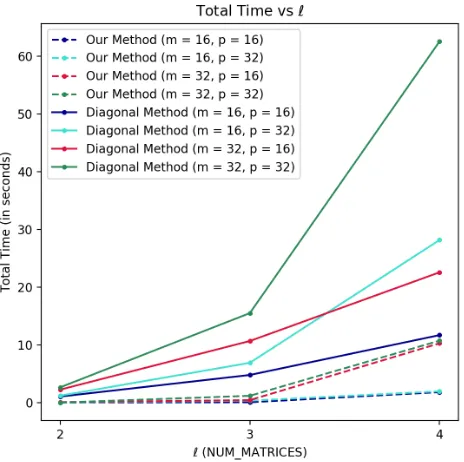
Fig. 2.Plot showing comparison of the results between our method and the diagonal-based method for secure matrix-vector multiplicationsA1×· · ·×A`−1×v. Dashed lines and solid lines are used to represent the total time of our method and the diagonal-based method, respectively (the data are given from Table 2).
memory usage of the diagonal-based method is less than our method, but our method required less memory once the context got initialized. The context gen-erates some components consuming a lot of memory, which are not being used by our method. Hence for a better instantiation of the scheme, without the un-necessary components of context, our method will require less memory than the diagonal-based method.
Advantages and Limitations of Our Method In Figure 2, we summarize comparison results of the total time of both our method and the diagonal-based method for secure matrix-vector multiplicationsA1×· · ·×A`−1×vfrom Table 2. In the following, we shall discuss advantages and limitations of our method (the same discussion holds for secure matrix multiplications):
m(`−1) homomorphic multiplications and (expensive) rotations, wheremis the size of every square matrix Ai. More precisely, our method takes O(log`) suc-cessive multiplications while the diagonal-based method takes O(`) successive multiplications. Hence a considerably largeLis required for the diagonal-based method, as a result, a largeNis required for security considerations. This is why for the slopes in Figure 2 for the diagonal-based method is much larger than ours for larger`. We also see from Table 2 that encryption time of our method is con-siderably faster than the diagonal-based method (expensive encoding encryption in the diagonal-based method also makes the performance slow). This is due to that our method can pack a matrix (or a vector) into a single ciphertext, but the diagonal-based method can only pack a row or column vector into slots.
Limitations For large ` such as ` ≥ 8, we predict that our method would be slower than the diagonal-based method. This is due to that hugeN = 2n with 2-power n is required in our method while flexible primes N can be chosen in the diagonal-based method. Furthermore, since our packing method is different for each matrix Ai, our method does not allow to operate packed ciphertexts flexibly. For example, we can not change the order of matrices for multiplications in our method as described in Remark 1. On the other hand, since the diagonal-based method can pack a row or column vector of a matrix in the same way, it enables to operate packed ciphertexts more flexibly over HElib with high-level procedures for data-movement over slots (see [15]).
5
Conclusion
We generalized Duong et al.’s packing method [9] for securemultiplematrix mul-tiplicationsA1×· · ·×A`with integer entries over the BGV scheme. Our method can pack a matrix into a single ciphertext while the diagonal-based method im-plemented in HElib can only pack a row or column vector. Furthermore, our method enables us to perform secure matrix multiplications by only a few ho-momorphic multiplications over packed ciphertexts. In particular, our method makes use of the homomorphic property over the native plaintext space of the BGV scheme while the diagonal-based method uses plaintext slots, suitable for SIMD. Our experimental results showed that our method is much faster than the diagonal-based method implemented inHElibfor small`such as`= 2,3 and 4 (our method might be slower for large`≥8). Compared to the diagonal-based method, ours is not flexible for operating matrices in encrypted format, but it requires much less memory. Therefore we hope that our method would be useful in evaluating afixed circuit including matrix multiplications.
Acknowledgment
References
1. Dan Boneh, Craig Gentry, Shai Halevi, Frank Wang, and David J Wu. Private database queries using somewhat homomorphic encryption. InApplied Cryptogra-phy and Network Security–ACNS 2013, volume 7954 ofLecture Notes in Computer Science, pages 102–118. Springer, 2013.
2. Dan Boneh, Eu-Jin Goh, and Kobbi Nissim. Evaluating 2-DNF formulas on ci-phertexts. InTheory of Cryptography–TCC 2005, volume 3378 ofLecture Notes in Computer Science, pages 325–341. Springer, 2005.
3. Joppe W. Bos, Kristin Lauter, Jake Loftus, and Michael Naehrig. Improved secu-rity for a ring-based fully homomorphic encryption scheme. InCryptography and Coding–IMACC 2013, volume 8308 of Lecture Notes in Computer Science, pages 45–64. Springer, 2013.
4. Zvika Brakerski, Craig Gentry, and Vinod Vaikuntanathan. (Leveled) fully homo-morphic encryption without bootstrapping. ACM Transactions on Computation Theory (TOCT) - Special issue on innovations in theoretical computer science 2012 - Part II, 6(3):13, 2014.
5. Zvika Brakerski and Vinod Vaikuntanathan. Fully homomorphic encryption from ring-LWE and security for key dependent messages. In Advances in Cryptology– CRYPTO 2011, volume 6841 ofLecture Notes in Computer Science, pages 505–524. Springer, 2011.
6. Jung Hee Cheon, Miran Kim, and Myungsun Kim. Optimized search-and-compute circuits and their application to query evaluation on encrypted data. IEEE Trans-actions on Information Forensics and Security, 11(1):188–199, 2016.
7. Ilaria Chillotti, Nicolas Gama, Mariya Georgieva, and Malika Izabachene. Faster fully homomorphic encryption: Bootstrapping in less than 0.1 seconds. InAdvacens in Cryptology–ASIACRYPT 2016, volume 10031 of Lecture Notes in Computer Science, pages 3–33. Springer, 2016.
8. Ana Costache and Nigel P. Smart. Which ring based somewhat homomorphic encryption scheme is best? InTopics in Cryptology–CT-RSA 2016, volume 9610 ofLecture Notes in Computer Science, pages 325–340. Springer, 2016.
9. Dung Hoang Duong, Pradeep Kumar Mishra, and Masaya Yasuda. Efficient secure matrix multiplication over LWE-based homomorphic encryption.Tatra Mountains Mathematical Publications, 67(1), 2016.
10. Junfeng Fan and Frederik Vercauteren. Somewhat practical fully homomorphic encryption. IACR Cryptology ePrint Archive, Report 2012/144, 2012.
11. Craig Gentry. Fully homomorphic encryption using ideal lattices. InSymposium on Theory of Computing–STOC 2009, pages 169–178. ACM, 2009.
12. Craig Gentry, Shai Halevi, and Nigel P. Smart. Fully homomorphic encryption with polylog overhead. InAdvances in Cryptology – EUROCRYPT 2012, volume 7237 ofLecture Notes in Computer Science, pages 465–482. Springer, 2012. 13. Craig Gentry, Shai Halevi, and Nigel P. Smart. Homomorphic evaluation of the
AES circuit. InAdvances in Cryptology – CRYPTO 2012, volume 7417 ofLecture Notes in Computer Science, pages 850–867. Springer, 2012.
14. Shai Halevi and Victor Shoup. Design and implementation of a homomorphic-encryption library, 2013.
15. Shai Halevi and Victor Shoup. Algorithms in HElib. In Juan A. Garay and Rosario Gennaro, editors,Advances in Cryptology – CRYPTO 2014, pages 554–571, Berlin, Heidelberg, 2014. Springer Berlin Heidelberg.
17. Shai Halevi and Victor Shoup. Faster homomorphic linear transformations in HElib. Cryptology ePrint Archive, Report 2018/244, 2018.
18. Tancrede Lepoint and Michael Naehrig. A comparison of the homomorphic encryp-tion schemes FV and YASHE. InProgress in Cryptology–AFRICACRYPT 2014, volume 8469 ofLecture Notes in Computer Science, pages 318–335. Springer, 2014. 19. Adriana L´opez-Alt, Eran Tromer, and Vinod Vaikuntanathan. On-the-fly multi-party computation on the cloud via multikey fully homomorphic encryption. In
Proceedings of the Forty-fourth Annual ACM Symposium on Theory of Computing– STOC 2012, pages 1219–1234. ACM, 2012.
20. Wenjie Lu, Shohei Kawasaki, and Jun Sakuma. Using fully homomorphic encryp-tion for statistical analysis of categorical, ordinal and numerical data (this is the full version of the conference paper presented at NDSS 2017). IACR Cryptology ePrint Archive, Report 2016/1163, 2016.
21. Vadim Lyubashevsky, Chris Peikert, and Oded Regev. On ideal lattices and learn-ing with errors over rlearn-ings. Journal of the ACM (JACM), 60(6):43, 2013.
22. Pradeep Kumar Mishra, Dung Hoang Duong, and Masaya Yasuda. Enhancement for secure multiple matrix multiplications over ring-LWE homomorphic encryption. In International Conference on Information Security Practice and Experience– ISPEC 2017, volume 10701 ofLecture Notes in Computer Science, pages 320–330. Springer, 2017.
23. Michael Naehrig, Kristin Lauter, and Vinod Vaikuntanathan. Can homomorphic encryption be practical? InProceedings of the 3rd ACM Workshop on Cloud Com-puting Security Workshop–CCSW 2011, pages 113–124. ACM, 2011.
24. Pascal Paillier. Public-key cryptosystems based on composite degree residuosity classes. InAdvances in Cryptology–EUROCRYPT 1999, volume 1592 ofLecture Notes in Computer Science, pages 223–238, 1999.
25. Ronald L Rivest, Adi Shamir, and Leonard Adleman. A method for obtaining digital signatures and public-key cryptosystems. Communications of the ACM, 21(2):120–126, 1978.
26. Nigel P Smart and Frederik Vercauteren. Fully homomorphic SIMD operations.
Designs, codes and cryptography, 71(1):57–81, 2014.
27. The PARI Group, Bordeaux. Pari/gp https://pari.math.u-bordeaux.fr/ download.html.
28. Lihua Wang, Yoshinori Aono, and Le Trieu Phong. A new secure matrix multi-plication from ring-LWE. InInternational Conference on Cryptology and Network Security–CANS 2017. to be published.
29. Masaya Yasuda, Takeshi Shimoyama, Jun Kogure, Kazuhiro Yokoyama, and Takeshi Koshiba. Secure pattern matching using somewhat homomorphic encryp-tion. In Proceedings of the 2013 ACM workshop on Cloud computing security workshop–CCSW 2013, pages 65–76. ACM, 2013.
30. Masaya Yasuda, Takeshi Shimoyama, Jun Kogure, Kazuhiro Yokoyama, and Takeshi Koshiba. New packing method in somewhat homomorphic encryption and its applications. Security and Communication Networks, 8(13):2194–2213, 2015. 31. Masaya Yasuda, Takeshi Shimoyama, Jun Kogure, Kazuhiro Yokoyama, and