Probabilistic Model Based Tracking in
MANETs with the Help of Gossip Protocol
1
I. Sankar Babu, 2K.VenkataRamana, 3G.Lakshmi kanth 1
Assistant professor, Dept of CSE, Sri Venkatesa Perumal College of Engineering & Technology, Andhra Pradesh,
India 2
Research scholar, Dept of CSE, Dr.RR &Dr.SR Technological University, Chennai, Tamil Nadu, India 3
Associate Professor, Dept of CSE, SRET, India
ABSTRACT: Mobile Adhoc Network does not require fixed infrastructure support for Tracking to reach a Target node.We need to accomplish a goal is to improve the effectiveness of structure –free tracking.we already recognizes a problem of tracking of a mobile target node in a mobile adhoc network(set-up).we includes a generic tracking framework for a online tracking applications.we proposes a online statistically estimatedhybrid estimated markov model of an gradient based protocols of the target’s likely direction. A PMBT is a probabilistic online tracking algorithm that computes information utilities at each step,and then chooses the next step toward the target based on the maximum expected utility. We provides a light weight implementation of the state of nodes in each cell and a polite gossip mechanism for forwarding the tracking messages.we consider a benchmark approach to solve a tracking problem in MANET,A PMBT algorithm significantly outperforms both gradient-based and markov model with the help of polite gossip mechanism.
KEYWORDS: MANET, PMBT, Gradient Model, HMM, target, tracking.
I.INTRODUCTION
Existing work on target tracking in MANETs mainly lie in two categories: structure-based approaches and structure-free approaches. The first type of protocols dynamically maintain certain structures, such as trees or overlay graphs, such that a message may simply follow the structure to reach the target. Tracking of a mobile target is an important service for MANETs that enables routing of a message to the mobile target [1, 5, 6]. Such target tracking in MANETs is challenging because the tracking protocols need to deal with---in addition to the mobility of the target--- the mobility of the intermediate nodes that maintain a track toward the target. Mobile ad hoc networks (MANETs) [1, 2] do not require a fixed infrastructure support for communication and routing, and hence find many applications in urban warfare, disaster recovery, and large-scale sensing/surveillance scenarios.
ISSN (Online) : 2319 - 8753
ISSN (Print) : 2347 - 6710
I
nternationalJ
ournal ofI
nnovativeR
esearch inS
cience,E
ngineering andT
echnologyAn ISO 3297: 2007 Certified Organization Volume 4, Special Issue 11, September 2015
National Conference on Emerging Trends in Computing, Communication & Control Engineering [NCET 2K15]
On 4th September, 2015
Organized by
Department of CSE, ECE & EEE, Magna College of Engineering, Chennai-600055, India.
encountered tracking targets. To save energy, they are not exchanged between nodes.
III. HIDDEN MARKOV MODEL
A discrete HMM can be applied when the division of the region is finite. The approach we describe here discretizes the target region into cells and formalizes the transition matrix in an online probabilistic model rather than deterministic transition parameters.
The HMM model for tracking contains the following parameters:
1. The possible states S=S1,S2,……SN , each cell corresponds to one state.
2. The transition probabilities A=aij(1<=i<=N). where aij is defined as the transition probability of moving from state S1 to S2 , that is aij=p(qk=sj/qk-1=si). Geometrically, aij is only meaningful when the states Si and Sj are neighboring cells. To simplify, we consider only four transitions, moving up, down, left and right (It is straightforward to allow more transitions such as moving upleft, upright, downleft and downright). The rest of the elements in matrix are all zeros.
3. An initial distribution of the target in each state ∏ =∏i(1<=i<=N)
:
Viterbi algorithm can be used to find the most likely track (state sequence) given the observations O1,O2,O3,….ON.(i.e., signals). Although the HMM model has been used in target tracking applications, it adds some constraints when applied to distributed mobile ad hoc networks. Firstly, the algorithm relies on the target's prior probability distribution, which is hard to acquire precisely; secondly, the HMM model assumes each state
IV. GRADIENT-BASED MODEL
The tracking message marks the local maxima node to prevent the message being looped back by neighboring nodes. This way tracking messages can escape from local maxima and eventually be forwarded to the target.
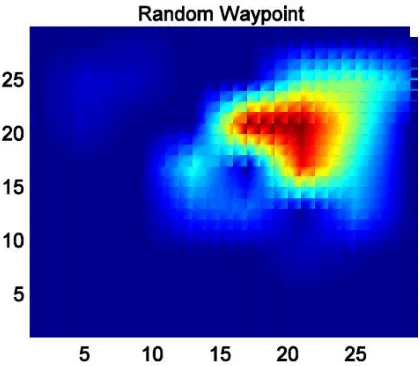
Figure 2: Information decay space distribution with mobile speed 2m/s. Both the random walk model and the random waypoint model show similar decay behavior
ISSN (Online) : 2319 - 8753
ISSN (Print) : 2347 - 6710
I
nternationalJ
ournal ofI
nnovativeR
esearch inS
cience,E
ngineering andT
echnologyAn ISO 3297: 2007 Certified Organization Volume 4, Special Issue 11, September 2015
National Conference on Emerging Trends in Computing, Communication & Control Engineering [NCET 2K15]
On 4th September, 2015
Organized by
Department of CSE, ECE & EEE, Magna College of Engineering, Chennai-600055, India.
V. PMBT MODEL (PROBABILISTIC MODEL BASED TRACKING MODEL)
The gradient-based model provides a progressive tracking scheme, but is quite limited to the freedom and the percentage of mobile nodes: in an extreme case where all nodes are static, the target's information cannot be distributed, hence the model will not work well. HMM only works when the target is highly predictable, and gradient model does not work well when the nodes are static as our gradient distribution relies on the node mobility. In order to reap the advantages of both the gradient-based model and the HMM model while minimizing their disadvantages, we use information utility for measuring the contribution of nodes in each cell. As both the transition probability and gradient measures the likely direction of the target, φ(i)=αф(aij)cos(θij)+βф2(g(i,t)) (2)
Here, ф1(aij) is the normalized weight of the Markov transition probability where aij is the best move for HMM model, and ф2(g(I,t)) is the weight for the gradient at cell i (as shown in Figure 1). We illustrate the definitions for in Figure 3
Figure 3: The figure shows the construction of the information utility. The coefficient cos(θij) is indicates the projection of ф1=(aij) on the gradient ф2(g(I,t)),α and β are the weights for each model.
Given the information utility, the message forwarding strategy is as follows: when a message arrives at a cell, the nodes in the cell make a decision based on the calculated information utility as to which cell the message should be forwarded. Nodes in a cell hold
same aij but different git. Hence nodes in the same cell have various utility values at each snapshot. The node with highest utility decides the next forwarding direction. Our implementation (Section 3) avoids communication between nodes in this decision process by
associating the utility value to an application layer backoff timer.
Theorem 1 (Convergence Theorem).
PMBT is guaranteed to deliver all tracking messages to the target's location in a connected network given that βis not zero and satisfies the following condition: step from i to j , ф2(g(j,t))>=ф2(g(I,t))+(α/β) ф1(1)cos(θ)(0<=θ<=π).
PMBT is guaranteed to deliver all tracking messages to the target's location given the conditions. Note that during the tracking process a querying message does not know the real location of the target. We can only use the
recorded/estimated target location to compute the projection angle θ. Obviously, the effectiveness of the tracking algorithm is affected by the precision of estimating θ. In the following discussion, we first prove that the estimation error
(of θ) is bounded, and then derive the formula to calculate the confidence as the quality.
Theorem 2. The error (Є) of calculating the projection angle using the recorded
VI. DISTRIBUTED IMPLEMENTATION
Implementation of PMBT are:
1) how data is coordinated in cell layer, and
2) how to forward tracking messages efficiently. Moreover, as we show in the following discussion, our design of soft-state loose synchrony for each cell and polite gossip message forwarding further reduces message overhead to keep the system lightweight.
Note that each cell only holds the information locally, without knowing the neighboring cell's information. To select next move, the cell may ask neighboring cells for their utility information before making a decision. However, this operation not only requires cell synchronization over the data within each cell but also introduces large overhead. To keep the model lightweight, we provide an alternative distributed implementation of message forwarding-Polite Gossip and soft state strategy in the following discussion.
VII. LOOSE SYNCHRONY
ISSN (Online) : 2319 - 8753
ISSN (Print) : 2347 - 6710
I
nternationalJ
ournal ofI
nnovativeR
esearch inS
cience,E
ngineering andT
echnologyAn ISO 3297: 2007 Certified Organization Volume 4, Special Issue 11, September 2015
National Conference on Emerging Trends in Computing, Communication & Control Engineering [NCET 2K15]
On 4th September, 2015
Organized by
Department of CSE, ECE & EEE, Magna College of Engineering, Chennai-600055, India.
when all the nodes holding the shared information move out of a cell, while those newly joined nodes have no clue. In this case, the nodes simply forward the message to a randomly selected neighboring cell. The reasons of a message failure could be: a message is forwarded to an empty cell or a message is lost due to collisions.
VIII. POLITE GOSSIP FORWARDING
We make all nodes in a cell behave uniformly as a single node by employing the following polite gossip mechanism. In polite gossip, a node suppresses sending a message on hearing the same message sent by other nodes within the same cell: if during the backoff period, a node hears any other node sending the same message, it drops the message from the sending queue.
To realize polite gossip forwarding effectively, we use two types of backoff timer: a default CSMA backoff timer and an application layer backoff timer. These two timers perform different functions in our model: the default CSMA backoff timer is used for reducing collisions between cells, and the application layer backoff timer is used for suppressing the sending of duplicated messages in a cell. We set the application layer backoff timer of each node inside a cell to be proportional to the node's utility function. Therefore, nodes with high utility functions are more likely to trigger the response messages. The implementation of this scheme nicely integrates PMBT and message forwarding, and is lightweight and scalable.
The application layer backoff timer should be carefully designed to reduce message duplications and conflicts in forwarding. Let Tapp denote the application layer maximum backoff time and Tmsg be the time to send a message. If there are n nodes within the same cell, the joint probability of back off timer for n nodes in the cell p(t1,t2,,,,tn) can be written in conditional probability.
p(t1,t2,,,,tn)=p(t1/t2,t3,,,,,tn)* p(t2,t3,,,,tn)
the probability that the rest n-1 nodes can hear the first nodes transmission attempts is: p=(1-Tmsg/Tapp)n
Using this formula, we can set Tapp appropriately according to system requirements.For example, assuming there are two nodes in a cell on average and requiring that the duplication of sending is less than 20%, the application layer backoff is:
Tapp=10*Tmsg
In our implementation of polite-gossip forwarding, we use implicit acknowledgment. When a node that transmits a message to the next cell does not hear this message forwarding further by that cell, it will resend its message. This is a best effort mechanism and it fails if the transmitter node leaves its cell before it had a chance to resend the message.
IX. SIMULATIONS
We consider the random waypoint mobility model: a node selects a random point which is uniformly distributed in the field and moves toward the destination at a certain speed. When the node reaches the destination, it rests for a a certain period of time and selects the next point. The performance of the framework is closely related to the mobility process as a cell's behaviors are simulated by the physical nodes in the cell that are loosely synchronized.
400 NODES
600 NODES
Figure 6: Cell empty probability distribution, random waypoint model
ISSN (Online) : 2319 - 8753
ISSN (Print) : 2347 - 6710
I
nternationalJ
ournal ofI
nnovativeR
esearch inS
cience,E
ngineering andT
echnologyAn ISO 3297: 2007 Certified Organization Volume 4, Special Issue 11, September 2015
National Conference on Emerging Trends in Computing, Communication & Control Engineering [NCET 2K15]
On 4th September, 2015
Organized by
Department of CSE, ECE & EEE, Magna College of Engineering, Chennai-600055, India.
X. ROAD MODEL
That is because the cells faraway from the road are absent of any prior knowledge after the training process, making the first few steps relatively blind. However, after reaching the road, it is able to catch the real target movement trace. On the other hand, the Gradient model usually can pick a short path, but it is not sensitive to the movement trail of a target. At any moment, the gradients are determined by the mobile nodes that might not be perfectly inverse to the distance to the target (as we can see from Figure 2, the contour are not perfect circles). That is why we see that tracking paths cross the road instead of simply following the road. The PMBT model (Trust model in the figure) integrates these two models: at the beginning, the path is comparable to the Gradient model; and later it is comparable to the HMM model.
A-PMBT slightly out performs PMBT owing to the adaptive tuning of parameters. In the simulation we let the tracking node locate on the road that is the best case for HMM; whereas if the tracking node is far away from the road, HMM becomes less efficient to catch the target due to the lack of information around the tracking node.
XI. α,β TUNING
For PMBT model without adaptive tuning, the initial setting of weight and impacts the performance. Changing of the initial weight factor may cause the success rate to increase or decrease. The success rate PMBT model with different weights are shown in Figure 10 for Road environment and Figure 11 for Field environment. In neither mode the line is monotonic, it is low in both ends and high in between. The left end represents Gradient model (α െ◌ൗ 0), and the right side (αെ◌ൗ 1) represents an improved Markov model. According to the definition of utility, when βെ◌ൗ 0 it only considers Markov model, whereas PMBT still shows better performance than the Markov model. This is owing to the contribution of projection coefficient, which makes some correction for the transition probability. When β െ◌ൗ 1, this becomes exactly the Gradient model, so the performance of PMBT is close to the Gradient model.
An exact optimal setting is often hard to find due to the dynamics of a system, nevertheless, a range close to optimal setting is more practically achievable. In our case, when α ሾ0.2,0.8ሿ in ROAD model or α
ሾ0.1,0.9ሿ in FIELD model, the success rate is close to optimal and does not change much. The size of window is relevant to the selection of
XII. FUTUREWORK
A Framework is proposed for acoustic target tracking in wireless sensor networks. Self-organizing and robus ad-hoc
networkLightweight protocols with low packet overheads Optimization of protocols for power Efficiency Attribute or location- based connectivity.It Supports Potential use of in-network processing & Storage New privacy and security considerations New socket abstractions&TP options. HMMs are used to calculate most probable object paths given historical observations. As we mentioned before, HMM models haves limitations in nature when applied in WSNs: HMM predicts next move only based on the last location, hence leads to large errors against real trails; Moreover, HMM is more appropriate for offline processing than online tracking.As a node detects the target, it pushes the event into the tree until the event reaches the root. Hence a frequent update scheme is needed to keep the information up-to-date. In [20], a framework is proposed for acoustic target tracking in wireless sensor networks. All these structure based approaches involves structure reconfiguration via explicit message exchanges at each move for every mobile nodes, hence cost considerable amount of energy. Information driven PMBT model is different from all aboves in that it does not have a 'tree structure' at all, and thus such coordination cost is reduced.Gradient based structure-free approaches are also commonly used in routing and tracking applications. GRAB [12] builds and maintains a cost field, providing each node the direction to forward messages. FRESH [14] constructs age gradients for all nodes encountered.Messages are forwarded anchor by anchor that is discovered by broadcast-based searching at each step. Both FRESH and GRAB protocols aim to limit the radius of broadcast to save energy, whereas broadcast is still costly compared with PMBT. GraDrive [13] is also a gradient driven model for dynamic target tracking applications. GraDrive integrates per-node prediction with global collaborative prediction to estimate the location of a target. Although GraDrive provides a shortest path to the target, it requires a global view of the entire dataset, which is often impossible for a fully distributed network. Furthermore, it is also not energy.
XII. CONCLUSION
We are provide generic framework results of information.It can provides perfect target direction of information.PMBT model provides good quality locations with performance results specification process.We are going to reduce the overall transmission cost of information In this paper, PMBT achieves O(1) updatingcost with comparable performance as deterministic protocols such as GLS. The A-PMBT model, a PMBT model capable of tuning the weights adaptively based on the evaluation of the gradient quality, provides a slight performance improvement.
ISSN (Online) : 2319 - 8753
ISSN (Print) : 2347 - 6710
I
nternationalJ
ournal ofI
nnovativeR
esearch inS
cience,E
ngineering andT
echnologyAn ISO 3297: 2007 Certified Organization Volume 4, Special Issue 11, September 2015
National Conference on Emerging Trends in Computing, Communication & Control Engineering [NCET 2K15]
On 4th September, 2015
Organized by
Department of CSE, ECE & EEE, Magna College of Engineering, Chennai-600055, India.
International Symposium on Mobile Ad Hoc Networking and Computing , pages 257–266, June, 2003. http://dx.doi.org/10.1145/778415.778446
[5] S. Ratnasamy, B. Karp, L. Yin, F. Yu, D. Estrin, R. Govindan, and S. Shenker. Ght: a geographic hash table for data-centric storage. In SNA ’02: Proceedings of the 1st ACM international workshop on Wireless sensor networks and applications, pages 78–87, 2002. http://dx.doi.org/ 10.1.1.1.4507
[6] J. Faruque, K. Psounis, and A. Helmy. Analysis of gradient-based routing protocols in sensor networks. IEEE/ACM Int’l Conference on Distributed Computing in Sensor Systems (DCOSS), June 2005. http://dx.doi.org/10.1007/11502593_21
[7] C. C. Ke, J. G. Herrero, and J. Llinas. Comparative analysis of alternative ground target tracking techniques. Proceedings of the Third International Conference on Information Fusion, 2:WEB5:3–10, 2000. http://dx.doi.org/ 10.1109/IFIC.2000.859832
[8] F. Martinerie. Data fusion and tracking using hmms in a distributed sensor networks. IEEE Trans. On Aerospace andElectronic Systems, 33(1):11–28, 1997. http://dx.doi.org/10.1109/7.570704
[9] S. Philip. Scalable Location Management for Geographic Routing in Mobile Ad hoc Networks. PhD thesis, University at Buffalo, SUNY, 2005. [10] W. Chen, J. C. Hou, and L. Sha. Dynamic clustering for acoustic target tracking in wireless sensor networks. IEEE Transaction on Mobile Computing, 3(3):258–271, 2004. http://dx.doi.org/10.1109/TMC.2004.22
[11] M. Demirbas, X.Lu, and P.Singla. An in-network querying framework for wireless sensor networks. IEEE Transaction on Parallel and Distributed Computing, 2009. http://dx.doi.org/10.1109/TPDS.2008.217
[12] C. Bettstetter, G. Resta, and P. Santi. The node distribution of the random waypoint mobility model for wireless ad hoc networks. IEEE Transactions on Mobile Computing, 2(3):257–269, 2003. http://dx.doi.org/10.1109/TMC.2003.1233531