A Study on Quality Of Work Life Balance With Special
Referrence To Employees Working In Plast Tech
Engineering.
* Dr.K.G.Selvan
**Mr.U.Vijayshankar
*
Associate Dean, PRIST SCHOOL OF BUSINESS, PRIST UNIVERSITY,THANJAVUR – 613403.
**Assistant Professor, PRIST SCHOOL OF BUSINESS, PRIST UNIVERSITY,THANJAVUR – 613403.
Abstract
To Proceed with the study the researcher took structured questionnaire which was under various parameters such as Commutation to work place, Sufficient time spend with the family, How big impact the work has on the Work Life Balance, Increase in Organizational Productivity, Designation and Barriers, Work Life Balance and Organizational Growth and Reputation and Personality development and Work Life Balance etc., the Whole Population of the employees was taken on the basis of Convenience Sampling in conducting Survey. The Sample Size taken is 100 employees to describe the study under descriptive research design, to analyze various objectives; Statistical tools were used such as Percentage analysis, Chi-Square Analysis, Annova.
Key Words: Work Life Balance, Spending Sufficient Time, Organizational Productivity and Growth & Reputation.
1. Introduction
Work life balance is a self-defined, self-determined state of well being that a person can reach or can set a goal, that allow them to manage effectively multiple responsibilities at work, at home and on their community; it supports physical, emotional, family and community health and does so without grief, stress or negative impact. The demands of work put pressure on the workers especially on their physical and mental psyches. The pressure of work increases as workers have to toil out for longer periods of time. This affects their lifestyle and could lead to damaging their mental health as well.
Quality of work life (QWL) refers to the favourableness or unfavourableness of a job environment for the people working in an organisation. The period of scientific management which focused solely on specialisation and efficiency, has undergone a revolutionary change. The traditional management (like scientific management) gave inadequate attention to human values. In the present scenario, needs and aspirations of the employees are changing. Employers are now redesigning jobs for better QWL.
Quality of life is defined as the level of enjoyment in a person's life. In general, it is based on many factors. At a minimum, a person's basic needs must be met for them to have a high quality of life - they must be generally healthy, have enough to eat and have a place to live. Once a person's basic needs are met, that person's quality of life is largely determined by their own personality, their desires and their level of personal fulfillment. A person with a high quality of life tends to feel as though all of their important needs and wants are fulfilled. They are generally happy and overall feel as though their life is good. A person without quality of life is lacking in one or several basic areas of his life.
1.1 Definition:
The QWL as strategy of Human Resource Management has assumed increasing interest and importance. Many other terms have come to be used interchangeably with QWL such as ‘humanisations of work’ ‘quality of working life, ‘industrial democracy’ and ‘participative work’.
There are divergent views as to the exact meaning of QWL.
2. WORK-LIFE BALANCE PROBLEMS
Plast Tech Engineering Company has been operating from 2002, the firm has around 1700 employees working under different categories and have the business of manufacturing Plastic Injection molded components for Automotive Industries, Electronics and Electrical Industries. The major customers of the company were:
** TVS Sundaram Fasteners Ltd.,
** WIPRO
** Hindustan Coca cola ( Kinley )
** Electron India
** TT Electronics
The Company has grown with growing problems such as 1) Employees are doing a lot of overtime as the youth is targeted as they are more energetic and young to do any task.2) In lieu of earning money they do not get enough time to spend with family and it may lead to issues related to personal life even health may not support for a long period of time. 3) High rates of absenteeism or staff sickness. 4) High levels of staff turnover. 5) Employees taking a lot of time off to deal with “emergencies” involving children or other dependents. 6) High levels of employee stress Employees should be made to get recharge as they will be working for long hours they need break from hectic work schedule. For all these problems Management must understand that they should interact with people and make them to balance their work for the management and employees. Keeping in view of the Quality of Work Life problem faced by the company, The Researchers framed the following research objectives.
3. Review of Literature:
A review on previous studies on Quality of Work life of the employees is necessary to know the areas already covered which will help to find new area uncovered and to study them in depth. The earlier studies made on Quality of Work life among the employees are briefly reviewed here. Various authors and researchers have proposed models of QWL which include a wide range of Factors. The Selected models are reviewed below.
3.1 According to : Making Flextime Work For Your Firm. Ioma's Report On Managing Benefits Plans. New York:( Dec 2008) Vol. 08, Iss. 12; pg. 1, 5 pgs
Even employees with access to flextime, however, are concerned that taking advantage of it subjects them to penalties. In fact, 39 percent of employees believe that using flextime would jeopardize their career advancement. Employers that offer flextime arrangements must reassure workers that they won't be penalized if they choose a flexible option.
3.2 According to : The Influence Of Work-Family Culture And Workplace Relationships On Work Interference With Family: A Multilevel Model
Debra A Major, Thomas D Fletcher, Donald D Davis, Lisa M Germano. Journal of Organizational Behavior. Chichester: (Oct 2009) Vol. 29, Iss. 7; pg. 881
This research tested a multilevel model examining the influence of work-family culture and supportive workplace relationships on work interference with family. Web-based survey data were provided by 792 information technology employees from 10 organizations. Random coefficient modeling was used to test a path model examining the relationships between work-family culture, leader-member exchange (LMX), co-worker support, and work interference with family. The direct effects of LMX and co-worker support on work interference with family were significant. The indirect effect of work-family culture on work interference with family was also significant. Results demonstrate the value of work-family culture in understanding supportive supervisory and co-worker relationships and work interference with family and highlight the need to employ multilevel models to understand these relationships.
4. OBJECTIVE OF THE STUDY
• To Study the Quality of Work Life Balance in the selected company.
• To analyze the impact of work on employees’ personal life and how it affects the productivity of the Organization.
• To identify the factors influence and impact of the work on employee and other problems face by the PLAST Tech Engineering.
• To provide suitable suggestions for balancing the Quality of Work-Life.
5. RESEARCH DESIGN
The Rersearch design for the selected study is based on Descriptive and Survey method.
The survey deals with personal interviews with management and employees. Personal interviews are selected as the mode of survey to make the research more meaningful & so that maximum information could be collected. For conducting the personal interviews of the employees, questionnaires will be prepared. The questionnaire will be having both open ended & close ended questions. Both Primary and Secondary data were used in the present study. Open ended Questions are used in this study. Research Tools such as Chi-Square and Annova were employed.
SAMPLE SIZE
Sample sizes of 100 employees are taken based on the designation levels.
SAMPLING METHODS
The Sampling Technique followed in this research is Non-Probability based on the S a m p l i n g T e c h n i q u e s .
Convenience sampling technique is followed to collect the data quickly & efficiently from the large number of respondents
Sampling technique : Convenience samples
Sample size : Sample size chosen here for this research is 150. Sample unit : Employees with different job designations across the
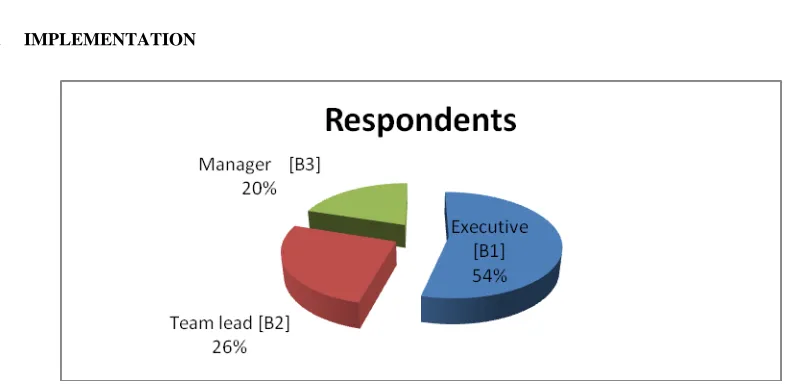
Organizations as follows: B1 – Executives, B2 - Team Leaders and B3 - Team Managers.
HYPOTHESIS:
Keeping in view of the Objective of the study the following Hypothesis has been framed and tested.
1. There is no significant relationship exist between Designation and Barriers arising in balancing their Work Life.
2. There is no close association between spending Time with their relatives during the festival and their Work Life.
6. IMPLEMENTATION
TABLE 6.1
Opinion of Respondents towards Spending Sufficient Time With Family
Do you feel you spend sufficient time with your family
Always 6%
Often 16%
Sometimes 46%
Rarely 32%
Total 100%
CHART 6.1
Opinion of Respondents towards Spending Sufficient Time With Family.
TABLE 6.2
Designation and Work - Life Balance of Respondents
Do you generally feel you are able to balance your work and family life Total
Yes No
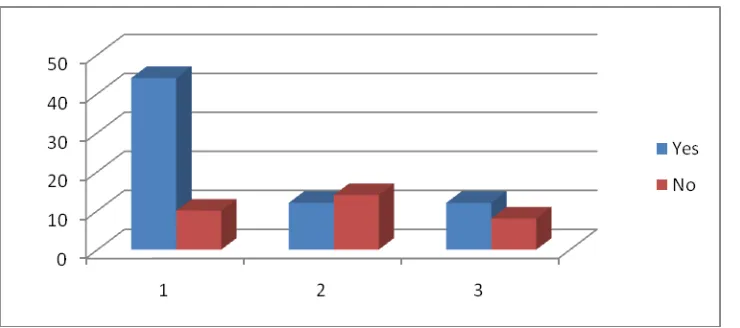
Designation B1 44 10 54
B2 12 14 26
B3 12 8 20
Total 68 32 100
CHART 6.2
Designation and Work - Life Balance of Respondents
TABLE 6.3.
How Big Impact Work has on the Work – Life Balance [WLB] of the Respondents
Sum of Squares df Mean Square F Sig.
Between Groups 480.687 4 120.172 5.482 0.001
Within Groups 2082.353 95 21.92
Total 2563.04 99
• Sum of Squares / df
480.687 / 4 = 120.172
• Sum of Squares / df
2082.353 / 95 = 21.92
Inference:
The critical value (sig) is less than 0.05.
Any value less than this will result in significant effects ,ie. The effect on different work experience group with opinion on Impact work has on work – Life balance.
Since this value is usually set at .05, any value less than this will result in significant effects, while any value greater than this value will result in non significant effects.
TABLE 6.4. Work Life Balance Enables Respondents to Work Better
Opinion of the Respondents No. of Respondents Percentage %
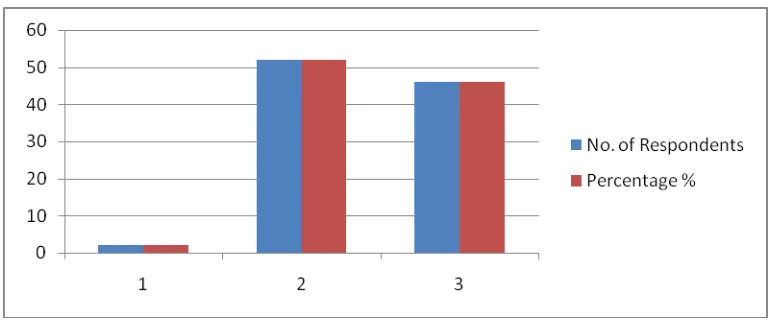
Disagree 2 2
Agree 52 52
Strongly agree 46 46
Total 100 100
CHART 6.4
Work Life Enables Respondents to Work Better
TABLE 6.5
Opinion of Respondents on the impact of Current Work Life Balance on Organizational Productivity
No. of Respondents Percentage
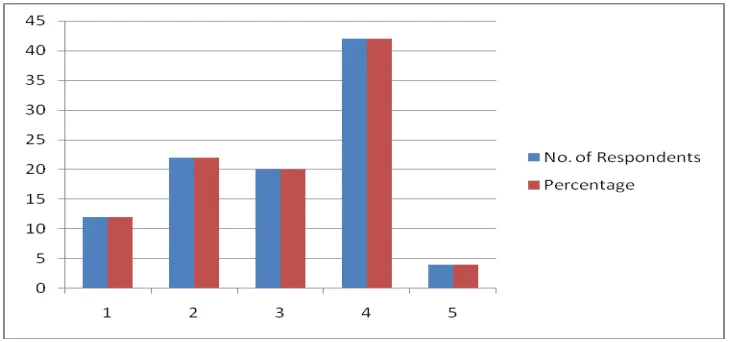
Strongly disagree 12 12.0
Disagree 22 22.0
Neutral 20 20.0
Agree 42 42.0
Strongly agree 4 4.0
Total 100 100.0
CHART 6.5
Opinion of Respondents on the impact of Current Work Life Balance on Organizational Productivity
RESLUT OF THE RESEARCH ( Chi - Square Test )
11. Significant relationship between employees’ Designation & barriers arising in balancing their Work – Life
H0: significant relationship between employees’ Designation & barriers arising in balancing their Work – Life are independent
H1 : significant relationship between employees’ Designation & barriers arising in balancing their Work – Life are dependent
Ei = 70 + 20 + 5 + 5
4
(N – Columns = 4)
Ei = 100/4 = 25
N = 4
2
Cal
χ
= 36.04O i E i (O i-E i)² ( O i-E i ) 2
/E i
70 25 100 4
20 25 25 0
4 25 441 17.64
6 25 361 14.4
100
χ
Cal2 = 36.04Degree of freedom
2 05 . 0
χ
With (n-1) df = (4-1) df (df - degree of freedom)= 3df
= 9.49
Accept Ho; since p value (< 0.05), there exists significant relationship
Inference:
From the table, the significance value is less than 0.05. Hence, there exists significant relationship between employees’ Designation ( Executive, Team Lead and Managers) and barriers arising in balancing their Work – Life.
TABLE 6.6
Respondents opinion on the impact of Current Work Life Balance on Organizational growth and reputation
No. of
Respondents
Percentage (%)
Strongly disagree
12
12.0
disagree
22
22.0
Neutral
20
20.0
agree
42
42.0
Strongly agree
4
4.0
Total
100
100.0
CHART 6.6
Respondents opinion on the impact of Current Work Life Balance on Organizational growth and reputation
TABLE 6.7
Opinion on Personality Development and Work - Life Balance wrt quality of Work Life of the Respondents
Do you generally feel you are able to balance your work and family life
Total
Yes No
Designation
B1 44 10 54
B2 12 14 26
B3 12 8 20
Total 68 32 100
CHART 6.7
Opinion on Personality Development and Work - Life Balance wrt quality of Work Life of the Respondents
7. MAJOR FINDINGS
* The study reveals that 54% are in Executive category remaining are Team Leader and Managers.
* Most of the employees belongs to 3 – 6 Yrs of Experience.
* The Study shows that 40% of the Respondents are very comfortable in communication to the work place.
* It is inferred from the analysis that 68% of Respondents are able to balance their work and family life
* It is understood from the study 52% of the Respondents agree that, Wok-Life Balance enables people to work better
* It is found that 46% of the Respondents say that, they Spend Sufficient Time sometimes with the close relatives during festival days
* The Analysis shows 42% of the Respondents agree that, Current Work Life Balance helps the Organization in its growth and reputation.
* Only 4% of the Respondents are spending valuable time towards spirituality
8. SUGGESTIONS:
The Following are the suggestions recommended by the researchers from the study
Employees are not aware of work culture and the current set up of the organization is not supporting it. Hence the management should take some necessary steps to adopt some Work – Life balance programs. The work Life balance programs should be beneficial both the individual and the organization. It should also be;
• Flexible, so that work-life balance programs can be changed to meet the needs of employees and the organization as they change
• Highlight the need for management, unions and employees to work in partnership to identify issues and discuss relevant and workable solutions
• Be widely communicated, so that employees are aware of what is available
• Be fair and equitable, recognizing that different cultures, abilities/disabilities, religions, beliefs, and family practices may mean different solutions for different people, and that "one size does not fit all"
• Be affordable for the organization and realistically budgeted
• Value employees for their contribution to the organization, regardless of their working pattern.
• Include a monitoring and evaluation mechanism, to investigate if they are succeeding in their aims and are being applied consistently.
• Be carefully planned and agreed and practical, so that they can work
• Recognize that the needs of both the organization and employees are not static, but change over time
• Be broad, in order to cover a wide variety of situations (e.g. not just targeted at those with children) and employee needs
• Be easily accessible, i.e. employees know what is available and feel they can use the provisions without being penalized
• Be integrated with human resource and people management policies and practice
9. Conclusions
Work-life programs have the potential to significantly improve employee morale, reduce absenteeism, and retain organizational knowledge particularly during the difficult economic times. In today’s global marketplace, manufacturing employees aim to reduce cost, it is necessary to understand the critical issue of work-life balance and to champion work-life programs. This would offer a win-win situation for employers and employees..
10. BIBLIOGRAPHY
Book Referred:
1. Burke,R.J ( 1988 ).Some antecedents and consequences for work – family conflict. Journal of Social Behaviour and personality.
2. Gutek,B.A.,Searle,S., & Klepa, L ( 1991 ). Rational versus gender role explorations for work family conflict. Journal of applied psychology .
3.Arthur, J. B. 1994. Effects of human resource systems on manufacturing performance and turnover. The Academy of Manufacturing Performance.
4. Beatty,C.A ( 1996 ). The stress of managerial and professional women: Is the price too high? Journal of organizational behavior.
5. Aryee, S., Fields, D. & Luk, V. 1999. 'A cross-cultural test of model of the work-family interface', Journal of Management.
6. Aryee,S.,Luk,V.,Leung,A., & Lo,S.( 1999). Role stressors, interrole
Conflict and well-being;The moderating influence of spousal support and coping behaviours among employed parents in Honk Kong. Journal of Vocational Behaviour.
Related Websites and Links:
• www.citehr.com • www.ebscohost.com • www.globalhr.com • www.eiarticles.com • www.icrm.com
• http://www.magazine.emerck/en/life/careers/work_life_balance1.html?wt.srch=1&gclid=CIP QqsLA5McCFQGTjgod7bsENg
• http://www.forbes.com/sites/jacquelynsmith/2013/04/18/8-ways-to-achieve-better-work-life-balance/