Towards Understanding the Known-Key
Security of Block Ciphers
?Elena Andreeva1, Andrey Bogdanov2 and Bart Mennink1 1
Dept. Electrical Engineering, ESAT/COSIC, KU Leuven, and iMinds, Belgium {elena.andreeva, bart.mennink}@esat.kuleuven.be
2 Technical University of Denmark
Abstract. Known-key distinguishers for block ciphers were proposed by Knudsen and Rijmen at ASIACRYPT 2007 and have been a major research topic in cryptanalysis since then. A formalization of known-key attacks in general is known to be difficult. In this paper, we tackle this problem for the case of block ciphers based on ideal components such as random permutations and random functions as well as propose new generic known-key attacks on generalized Feistel ciphers. We introduce the notion of known-key indifferentiability to capture the security of such block ciphers under a known key. To show its meaningfulness, we prove that the known-key attacks on block ciphers with ideal primitives to date violate security under known-key indifferentiability. On the other hand, to demonstrate its constructiveness, we prove the balanced Feistel cipher with random functions and the multiple Even-Mansour cipher with ran-dom permutations known-key indifferentiable for a sufficient number of rounds. We note that known-key indifferentiability is more quickly and tightly attained by multiple Even-Mansour which puts it forward as a construction provably secure against known-key attacks.
Keywords. Block ciphers, known-key security, known-key distinguish-ers, indifferentiability.
1
Introduction
Known-key attacks and our approach. Known-key distinguishersfor block ciphers were introduced by Lars Knudsen and Vincent Rijmen at ASIACRYPT 2007 [25]. In the classical single secret-key setting, the attacker does not know the randomly generated key and aims to recover it or build another distinguisher for the cipher. The security model in known-key attacks is quite different though: the attacker knows the randomly drawn key the block cipher operates with and aims to find a structural property for the cipher under the known key – a property which an ideal cipher (a permutation drawn at random) would not have. An example of such a structural property from [25] is as follows. For ann-bit block
?IACR 2013. This article is the final version submitted by the authors to the IACR
cipher with a known key, the goal is to find a plaintext/ciphertext pair with the least s < n/2 significant bits zero. For the ideal cipher, the adversary needs to invest about 2s encryptions. A cipher that allows one to find such a pair with
much less effort than 2s encryptions is considered insecure in the known-key
model. The seminal work [25] proposes a distinguisher for a permutation-based 7-round Feistel cipher and for 7 rounds of AES.
Since their introduction, known-key attacks have been a major research topic in the symmetric-key community. In explicit terms, there has been a great deal of effort towards refining and extending the distinguishers proposed by Knudsen and Rijmen, including generalizations to Rijndael [34, 44], SP-based Feistel ci-phers [45–47] and some other constructions [17,35,37]. More importantly though, implicitly, known-key attacks have drawn attention to the security of block ci-phers in the open key model where the adversary knows or even chooses keys. We think it is to some extent this renewed attention that eventually has given rise to a recent line of cryptanalytic results for the full AES: chosen-key distin-guishers [7], related-key attacks [5–7] and single-key biclique meet-in-the-middle attacks [8] — all essentially exploiting the weaknesses of AES in the open key model.
Despite this cumulative impact in the symmetric-key community over the last years, known-key attacks have been known to be difficult to formalize since, for-mally speaking, it is not clear what an exploitable structural property of a block cipher under a known key is. There have been several attempts to solve the prob-lem in general but we are not aware of any published results here. In this work, we take a slightly different approach to the problem: we focus on known-key distin-guishers for block ciphers based on idealized primitives such as randomly drawn functions or permutations (examples of such constructions are balanced Feistel ciphers, generalized Feistel ciphers, and (multiple) Even-Mansour ciphers). For such block ciphers, we formulate the new notion ofknown-key indifferentiability which we believe captures the known-key security. To demonstrate its mean-ingfulness, we prove that the existing known-key attacks on block ciphers with idealized primitives actually lead to the violation of this notion. To demonstrate its constructiveness, we prove Feistel and Even-Mansour known-key indifferen-tiable for a sufficient number of rounds.
analyzed by [9, 18, 51]. Indistinguishability has been established as the de facto security notion for block ciphers because in the encryption setting the intended use of the cipher key is in a secret manner; a fact comfortably accommodated by the notion of indistinguishability.
However, block ciphers find numerous and important uses beyond encryp-tion. Block ciphers have been used as a building block for hash functions [19, 23, 26, 31, 33, 42, 50].3 Here, the block cipher should work towards achieving the de-sired property of the higher level structure, and the cipher key is not necessarily secret, but known or easy to manipulate by a distinguisher. Clearly, indistin-guishability cannot provide strong security guarantees in the open key model: a distinguisher’s task becomes trivial once the key is known or chosen. Even more, if for example we decide to examine the indistinguishability “security” of a block cipher built out of an ideal underlying primitive (by explicitly giving to the distinguisher additional access to the internal primitive) in the open key setting, then again the notion indistinguishability falls short. A straightforward distinguishability attack here is possible in only two queries: one (K, M) query to the cipher C to obtain Y and one message and/or public key dependant x
input to the underlying primitive P to help him compute Y0 as a function of CK. The distinguisher needs to only verify ifY equalsY0, which is true for the
real construction C and false with high probability for a random permutation R. The weakness of such an indistinguishability notion that allows access to the internal primitives lays in the fact that there is an obvious “constructive” gap in the ideal world where no communication between Rand P is provided (as opposed to the real world whereC evaluates onP).
It is here where the notion ofindifferentiabilityof Maurer et al. [29] comes into use to allow for: (i) arguing security in the open key model and (ii) enabling the distinguisher to gain access to the input/output behavior of the underlying prim-itive. The notion of indifferentiability argues the security of an idealized system built upon ideal underlying components, such as random functions or permuta-tions. Initially, indifferentiability was used to analyze hash functions [1–4,11,20], more recently results for block ciphers have also appeared. In [15], Dodis and Puniya proved that the Feistel construction with a super-logarithmic number of rounds (random functions) is indifferentiable from an ideal permutation in the honest-but-curious indifferentiability model, where the adversary can only query the global Feistel construction and get all the intermediate results. The work of Coron et al. [10] attempted an indifferentiability proof for the Feistel construction with 6 rounds to obtain a fixed random permutation. But it were Holenstein et al. [22] who succeeded in proving a 14 round Feistel construc-tion indifferentiable from a fixed random permutaconstruc-tion. Weaker variants of the indifferentiability notion have appeared also in [16, 28, 53].
In its essence, indifferentiability, similarly to indistinguishability, aims at es-timating the adversarial distinguishing advantage between the cipherCandRin the real and ideal worlds, respectively. Indifferentiability allows the adversary to
3
access the underlying primitive(s) where the underlying ideal primitive(s) in the ideal world is replaced by a simulatorS, which aims to both mimic the behavior of the ideal primitive(s) and provide for responses that evaluate correctly when computed under the cipher composition. To fulfill the latter task the simulator is given access to the idealized system R. That functionality of S allows for overcoming the existing “constructive” gap in the indistinguishability definition. In fact, indifferentiability was introduced as the right notion to argue security of a block cipher as an ideal cipher, where each key names a new randomly chosen permutation. This theoretical treatment of block ciphers allows one to argue security results in a setting where the adversary freely chooses the key and each chosen key namely fixes a new random permutation. But while this interpretation might accommodate the analysis of block ciphers in the chosen key setting, it appears to be too strong for the case when the key is actually fixed but publicly known and thus the permutation is fixed. This brings us to our newly proposed notion of known-key indifferentiability (iff-KK), which examines the security of a block cipher as a composition from ideal primitives under a known key. Notice that an indifferentiability related view was already taken in the work of Mandal, Patarin and Seurin [28], who introduced the notion sequential indifferentiability and then relate it to that of correlation intractability in the ideal model to argue known key security. Our iff-KK notion is however more general and differs by the fact that it does not limit the adversary to make queries first to the underlying primitive and then to the cipher. Moreover, iff-KK explicitly provides the distinguisher with a public key which directly influences the queries to the block cipher and potentially the ones to the underlying primitives (whenever that is required by composition).
Our Contributions. The contributions of this paper are as follows:
Known-key attacks on type-I generalized Feistel networks. Knudsen-Rijmen [25] proposed known-key distinguishers on 7 rounds of the 2-line (balanced) Feistel network: GFN(2,7)with any permutations and explicit key addition at the begin-ning of the round function. We propose a known-key attack on 4`−1 rounds of an`-line permutation-based type-I generalized Feistel network: GFN(`,4`−1)also with explicit key addition at the beginning of the round function. See Sect. 3.
Known-key indifferentiability. We propose a way to formalize the known-key se-curity of block ciphers based on ideal primitives via the indifferentiability frame-work and put forward the notion ofknown-key indifferentiability in Sect. 4. By no means we claim to have formalized what a known-key attack is for all block ciphers and all existing attacks, but we do believe to have found an appropriate notion when the underlying components of the cipher are ideal (e.g. random permutations or random functions).
known-key attacks proposed to date on block ciphers with ideal components and ex-plicit key input (namely, the attack by Knudsen-Rijmen on 7-round Feistel with permutations, our attack on (4`−1)-round`-line type-I Generalized Feistel con-struction, and an attack by Coron et al. and Mandal et al. [10, 28]) imply the known-key differentiability bound computed in Sect. 5.
Constructiveness of known-key indifferentiability. To demonstrate the construc-tiveness of our known-key indifferentiability notion, we prove two popular generic block cipher constructions known-key indifferentiable in Sect. 6. First, regarding the general indifferentiability result of [22], we prove that 14 rounds of bal-anced Feistel with random functions are known-key indifferentiable with a secu-rity bounds of O(q16/2n/2). Second, we prove that the multiple Even-Mansour construction instantiated with random permutations is perfectly known-key in-differentiable for any number of rounds starting from 1. As opposed to Feistel ciphers, this puts forward the Even-Mansour construction as particularly suit-able for building known-key resistant ciphers.
2
Block Cipher Constructions
In this work, we mainly focus on known-key security of generalized Feistel net-works and multiple Even-Mansour constructions.
1 Fgen
k
i· · ·
π
1 Fgen
K
dots
k
i−1k
iπ
π
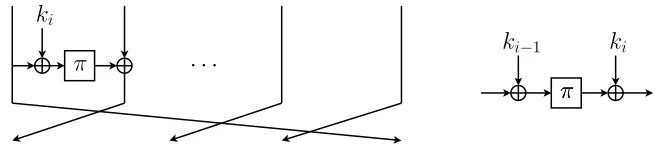
Fig. 1: For 1 ≤ i ≤ r, round i of GFN(`,r) with ` input lines (left) and EMr
(right, with XOR of previous key additionally included).
2.1 Generalized Feistel Networks
Feistel networks are very common block cipher designs, dating back to the design of Lucifer [49], and many generalizations of this design appeared in literature. In our work, we focus on type-I networks, as described by Zheng, Matsumoto and Imai [54], simply referring to it as generalized Feistel networks.
The generalized Feistel network GFN(`,r):{0,1}k×{0,1}n → {0,1}nconsists ofrevaluations of a fixed random permutationπonn/`bits, and it uses`lines. Fori∈ {1, . . . , r}, thei-th roundψi of GFN(`,r)is defined as
where k1, . . . , kr denote the round keys derived from the master key K using
some key schedule. The function ψi is depicted in Fig. 1. In this work, we also
consider a slightly modified variant of GFN(`,r), where no keys are XORed with the inputs to the primitive, but instead,rdifferent random functionsf1, . . . , fr
are employed. We refer to this construction as GFNR(`,r), where thei-th round is defined asψi(p1, . . . , p`) = (p2⊕fi(pi), p3, . . . , p`, p1). Note that by construction,
GFNR(`,r)does not have an explicit key input. However, one can append ann -bit subkey to the input of functionfiif explicit key input is needed. In this case,
random function fi maps (1 + 1/`)nbits to n/`bits.
Luby and Rackoff showed in the setting where independent pseudorandom functions are used, three (four) rounds of the balanced Feistel construction (that is, GFNR(2,3)and GFNR(2,4)) yield a pseudorandom permutation (strong pseu-dorandom permutation) where the distinguisher does not have access to the internal functions. This research line was followed up by a number of works [21, 30, 36, 38–41, 52].
2.2 Multiple Even-Mansour
The multiple Even-Mansour construction relates to the notion of key-alternating ciphers, which itself goes back to Daemen [12–14] and was used in the design of AES. However, it was Knudsen [24] who proposed to instantiate multiple-round key-alternating ciphers with randomly drawn, fixed and public permutations. The single-round key-alternating construction or EM1 was proposed by Even-Mansour [18].
Multiple Even-Mansour constructions EMr : {0,1}k × {0,1}n → {0,1}n
consist ofrevaluations of a fixed permutationπonnbits, which are separated by key addition. In other words,
EMr(K, p) =kr⊕π(· · ·π(k1⊕π(k0⊕p))· · ·),
wherek0, . . . , krdenote the round keys derived from the master keyKusing some
key schedule. Fori∈ {1, . . . , r}, roundiof EMr (together with the addition of
the previous key) is depicted in Fig. 1.
In the setting where therpermutations are distinct and the round keys are independently generated and secret, Bogdanov et al. [9] recently proved that EMr
is indistinguishable from a randomly drawn permutation with less than 22n/3 queries forr≥2, and Steinberger [51] improved this result to indistinguishability up to 23n/4 queries forr≥3.
3
Known-Key Attacks on GFN
(`,r)Consider GFN(`,4`−1)based on r= 4`−1 calls to a random invertible function
π. Label the incoming lines as p= (p1, . . . , p`) and the outgoing ones as c =
(c1, . . . , c`). Denote byKthe random, but known, master key, and letk1, . . . , kr
that there is a one-to-one correspondence betweenpand (s1, . . . , s`), as well as
betweencand (sr−`+1, . . . , sr). Following the idea of Knudsen and Rijmen [25],
the goal is to find tuplesp, p0with correspondingc, c0that satisfyp1⊕c2=p01⊕c02. Note that c2 = sr−`+2 by construction, and in our analysis we refrain from computing (sr−`+3, . . . , sr) if not needed.
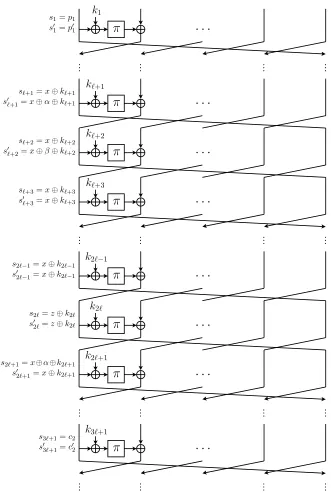
Before describing the inputs p, p0 chosen by the attacker, we first explain the attack. Letxbe an arbitrary value, and considerz, α, β, γ, δvariables to be determined later. DistinguisherDaims at the following intermediate state values
s`+1=x⊕k`+1 s0`+1=x⊕α⊕k`+1
s`+2=x⊕k`+2 s0`+2=x⊕β⊕k`+2
s`+3=x⊕k`+3 s0`+3=x⊕k`+3 ..
. ...
s2`−1=x⊕k2`−1 s02`−1=x⊕k2`−1
s2`=z⊕k2` s02`=z⊕γ⊕k2` s2`+1=x⊕δ⊕k2`+1 s02`+1=x⊕k2`+1.
Here, we point out two exceptions from this general (otherwise) description of the attack. Firstly, for`= 2,s4ands04 adapt the value ofs2` ands02`, and similarly
fors5 and s05. Secondly, for `= 3,s6 and s06 follow the notation ofs2` ands02`,
and similarly for later state values. For` >3 the description is non-ambiguous. Then,s`, . . . , s1 ands2`+2, . . . , srare computed in the straightforward way (i.e.
usingsi=si+`⊕f(si+`−1⊕ki+`−1)), and similar for thes0-values. For` >3, the general attack is depicted in Fig. 2. By construction,zandγneed to be such that
π(z) =δ⊕k`+1⊕k2`+1(froms`+1,s2`, ands2`+1) andπ(z⊕γ) =α⊕k`+1⊕k2`+1 (from s0`+1, s20`, and s02`+1). For the rest of the attack, we distinguish among
`= 2,`= 3, and ` >3.
`= 2. Starting with`= 2 (this is in fact the attack of Knudsen and Rijmen [25]). Note thatβ does not occur in the analysis. We simply setγ= 0, and thusδ=α
and we requireπ(z) =α⊕k3⊕k5. It remains to determine the valueα. We have:
p1=s1=x⊕k3⊕π(z⊕k2⊕k4⊕π(x))
c2=s7=x⊕α⊕k5⊕π(z⊕k4⊕k6⊕π(x⊕α))
p01=s01=x⊕α⊕k3⊕π(z⊕k2⊕k4⊕π(x⊕α))
c02=s07=x⊕k5⊕π(z⊕k4⊕k6⊕π(x)).
`= 3. Next we consider`= 3. This case turns out to require a special treatment. We have:
p1=s1=x⊕k4⊕π(z⊕k3⊕k6⊕π(x))
c2=s10=x⊕δ⊕k7⊕π(z⊕k6⊕k9⊕π(x⊕k5⊕k8⊕π(x⊕δ)))
p01=s01=x⊕α⊕k4⊕π(z⊕γ⊕k3⊕k6⊕π(x⊕β))
c02=s010=x⊕k7⊕π(z⊕γ⊕k6⊕k9⊕π(x⊕β⊕k5⊕k8⊕π(x))). Note that
p1⊕c2=π(z)⊕π(z⊕k3⊕k6⊕π(x))⊕
π(z⊕k6⊕k9⊕π(x⊕k5⊕k8⊕π(x⊕δ)))
p01⊕c02=π(z⊕γ)⊕π(z⊕γ⊕k3⊕k6⊕π(x⊕β))⊕
π(z⊕γ⊕k6⊕k9⊕π(x⊕β⊕k5⊕k8⊕π(x))). Our goal is these values to satisfy p1⊕c2 = p01⊕c02, but the same approach as for ` = 2 (and [25]) does not work here. However, if we take δ such that
π(x⊕k5⊕k8⊕π(x⊕δ)) =k6⊕k9, andβ such thatπ(x⊕β⊕k5⊕k8⊕π(x)) =
k6⊕k9, and γ = π(x)⊕π(x⊕β), the desired equation is satisfied. Then, by construction,z=π−1(δ⊕k4⊕k7) andα=π(z⊕γ)⊕k4⊕k7. The tuplespand
p0 queried byDare easily derivable and not discussed.
` > 3. Remains to consider the general case, ` > 3. This attack is visualized in Fig. 2. In this case, we simply set γ = 0, and thus δ = α and we require
π(z) =α⊕k`+1⊕k2`+1. It remains to determine the valuesαandβ. We find: p1=s1=x⊕k`+1⊕π(z⊕k`⊕k2`⊕π(x))
c2=s3`+1=x⊕α⊕k2`+1⊕π(z⊕k2`⊕k3`⊕π˜(K, x, α)) p01=s01=x⊕α⊕k`+1⊕π(z⊕k`⊕k2`⊕π(x)) c02=s03`+1=x⊕k2`+1⊕π(z⊕k2`⊕k3`⊕˜π0(K, x, α, β)),
where ˜
π(K, x, α) =π(x⊕k2`−1⊕k3`−1⊕ · · ·π(x⊕k`+2⊕k2`+2⊕
π(x⊕k`+1⊕k2`+1⊕π(x⊕α)))· · ·) ˜
π0(K, x, α, β) =π(x⊕k2`−1⊕k3`−1⊕ · · ·π(x⊕β⊕k`+2⊕k2`+2⊕
π(x⊕α⊕k`+1⊕k2`+1⊕π(x)))· · ·). Note that
p1⊕c2⊕p01⊕c 0
2=π(z⊕k2`⊕k3`⊕˜π(K, x, α))⊕ π(z⊕k2`⊕k3`⊕˜π0(K, x, α, β)).
We now putαto satisfy ˜π(K, x, α) =k2`⊕k3`(note that by the construction of
˜
πthis is really possible), andβto satisfy ˜π0(K, x, α, β) =k2`⊕k3`for this given α. This choice is well-defined: α is defined as a function of K and x, while β
1
Fgen
· · ·
· · ·
· · ·
· · ·
· · ·
· · ·
· · ·
· · ·
...
...
...
...
...
...
...
...
...
...
...
...
...
...
...
...
π
π
π
π
π
π
π
π
k
1k
ℓ+1k
ℓ+2k
ℓ+3k
2ℓ−1k
2ℓk
2ℓ+1k
3ℓ+1s1=p1
s′1=p′1
sℓ+1=x⊕kℓ+1
s′ℓ+1=x⊕α⊕kℓ+1
sℓ+2=x⊕kℓ+2
s′ℓ+2=x⊕β⊕kℓ+2
sℓ+3=x⊕kℓ+3
s′ℓ+3=x⊕kℓ+3
s2ℓ−1=x⊕k2ℓ−1
s′2ℓ−1=x⊕k2ℓ−1
s2ℓ=z⊕k2ℓ s′2ℓ=z⊕k2ℓ
s2ℓ+1=x⊕α⊕k2ℓ+1
s′2ℓ+1=x⊕k2ℓ+1
s3ℓ+1=c2
s′3ℓ+1=c′2
Fig. 2: Attack of Sect. 3 for` >3. Parameterxcan be freely chosen, parameters
Conclusion of the attack. Oncexis arbitrarily chosen,z, α, β, γ, δare easily com-putable fromKandx. For GFN(`,4`−1), the resulting plaintexts and ciphertexts satisfyp1⊕c2=p01⊕c02with probability 1. This equation is, however, satisfied by an ideal cipherRwith probability at most 1/2n/`. This completes the attack.
4
Known-Key Indifferentiability for Block Ciphers
Consider a composed system C : {0,1}k × {0,1}n → {0,1}n based on an
un-derlying idealized primitiveP :{0,1}κ× {0,1}x→ {0,1}y. Here,C is always a
keyed primitive (i.e., a block cipher), butP may or may not be keyed, and the key space may differ from that of C. Furthermore, depending on C, P denotes either a single or a composition of multiple idealized primitivesPi.
Where the classical notion of indistinguishability is established to provide strong security guarantees in thesecret key setting, this is not true in theopen key model where chosen or known keys come into play. In the latter setting, one can benefit from the known indifferentiability definition introduced in the work of Maurer et al. [29] and adapted for the case of hash functions by Coron et al. [11]. Building upon these results, we propose a new definition of known-key security. Our definition differs from earlier weaker versions of indifferentiability [11, 16, 28, 53] by its generality and the fact that it explicitly provides the distinguishing adversary with a public key under which it queries both the block cipher and potentially the underlying primitives (if that is required by composition). It moreover, does not limit the adversary’s type of queries, as is the case for leaky, public, and sequential indifferentiability.
We thus propose the following formalization:
Definition 1. LetCbe a composed primitive with oracle access to an ideal prim-itive P. Let Rbe an ideal primitive with the same domain and range asC. Let S be a simulator with the same domain and range as P with oracle access to Rand making at most qS queries, and letD be a distinguisher making at most
qD queries. The known-key indifferentiability advantage AdviffC,S-KK(D) of D is defined as
Pr
K← {0$ ,1}k;DCP,P(K) = 1−PrK $
← {0,1}k;DR,SR(K) = 1 .
ByAdviffC,S-KK(qD)we denote the maximum advantage of any distinguisher
mak-ing at most qD queries to its oracles. Primitive C is said to be(qD;qS;ε) indif-ferentiable from RifAdviffC,S-KK(qD)< ε.
K. Hence,Dcan forward query a message inputM to receiveC=C(K, M) in the left world andC=R(M) in the right world (here the randomly chosen key
K implicitly fixes an instance ofR), orDcan also backward queryC to receive
M = C−1(K, C) and M = R−1(M) in the left and right worlds, respectively. We refer toP andS as the “small” oraclesO2, to which Dhas full access (i.e., even ifC is designed to queryP only on the keyK), but we note thatS knows this public key K. From a practical point of view, the full access to the small oracles makes perfect sense, as the original idea of indifferentiability is that the distinguisher may know the underlying structure, and thus, use the underlying primitive as it wishes.
The particular way of allowing the key input to the composed primitive to be always the known keyKbut the key input to the small primitive to be anything, sets this known-key indifferentiability definition apart from existing versions of indifferentiability like [11, 16, 28, 53]. In more detail, in Table 1, we compare the interfaces in Def. 1 with the ones used in the indifferentiability definition (see [10, 22] for its block cipher instantiation). As it turns out, this change makes our definition particularly suitable for analyzing known-key security. In Prop. 1, we prove that iff implies iff-KK. Moreover, in Sect. 6 we also show a counterexample that an implication in the opposite direction does not hold.
Table 1: Interface of D with the composed oracle O1 (C in the left world, R in the right world) in the standard indifferentiability setting and in Def. 1. For both security definitions, the interface with the right oracleO2 is the same:D has full access toO2.
Indifferentiability forwardO1query inverseO1query
Indifferentiability (iff) (K, M)−→C=O1(K, M) (K, C)−→M=O1−1(K, C)
Known-key indiff. (iff-KK)
(K← {$ 0,1}kfixed, public) M−→C=O1(K, M) C−→M=O−11(K, C)
Proposition 1. If C is (qD;qS;ε) iff-secure block cipher, then it is (qD;qS;ε) iff-KK-secure.
Proof. LetS be a simulator such that for any distinguisher Dmaking at most
qDqueries, the iff advantage is at most ε. We defineS0 =S to be the simulator
for the iff-KK security. We prove that for any iff-KK distinguisherD0making at mostqD queries, we haveAdviff-KKC,S0 (D0)< ε.
LetD0be any such distinguisher. We build an iff distinguisherDusingD0that has the same advantage in breakingC. DistinguisherDsimulates the environment forD0 as follows: firstly, it selects uniformly at random a keyK $
← {0,1}k and
5
Known-Key Indifferentiability is Meaningful
Consider any known-key distinguishing attack on a block cipherCwith idealized primitiveP. LetK∈ {0,1}kbe a known key. A classical known-key distinguisher
for a functionC(K,·) based on ideal primitiveP operates as follows: it makesq
queries to its primitives, and then it outputs 1 if the queries show some “unex-pected” relation, which means that such relation should not hold for a random primitive Rwith the same domain and range ofC. We formalize and translate such known-key distinguisherDto a distinguisher for the indifferentiability no-tion iff-KK as follows. LetS be a simulator. In advance of making any queries, this distinguisher fixes a predicateϕ(Q), whereQis a list of query tuples. Then, the distinguisher makesqDqueries to its left and right oracles, to obtain a query
historyQqD of sizeqD. Ifϕ(QqD) holds, it outputs 1, and otherwise it outputs 0.
Clearly,Dbases its decision solely on the predicateϕ(QqD), and by Def. 1:
AdviffC,S-KK(qD)≥Adviff-KKC,S (D) =Pr ϕ(QqD) forC
P,P
−Pr ϕ(QqD) forR,S
R .
(1)
Now, in classical known-key distinguishing attacks, the first probability is (close to) 1, while the second probability is significantly smaller. Note that for the second probability, the distinguisher may ask queries to the simulatorS, but in order for S to be successful, it will try to consult R as often as possible and queries toS can consequently be seen as indirect queries toR.
We demonstrate this approach using the attack of Sect. 3 on GFN(`,4`−1)and an attack on GFNR(2,5) by Coron et al. and Mandal et al. [10, 28], therewith demonstrating that this approach applies toanyknown-key distinguishing attack known in literature.
Theorem 1. LetC be GFN(`,r):{0,1}k× {0,1}n → {0,1}n forr= 4`−1 with oracle access to an ideal primitive P =π : {0,1}n/` → {0,1}n/` (cf. Sect. 3).
Let R denote an ideal cipher with the same domain and range as C. For any simulator S that makes at most qS ≤ 2n−1−1 queries to R, there exists a distinguisherDthat makes at most 2r+ 2 queries to its oracles, such that
AdviffC,S-KK(D)≥1−q 2 S+ 2 2n/` .
Proof. LetSbe any simulator making at mostqS queries toR. LetK
$
← {0,1}k
be the given key, andk1, . . . , kr be the round keys. We construct a distinguisher
Dthat differentiates (C,P) from (R,S) with high probability. Define predicate
ϕ(Q) as follows:
∃(p1. . . p`;c1. . . c`),(p01. . . p0`;c01. . . c0`)∈ Qsuch thatp1⊕c2=p01⊕c02. (2)
exactly two left oracle queries. By construction,
Prϕ(Q2r+2) for GFNP(`,r),P
= 1.
Remains to consider the probabilityϕ(Q2r+2) holds in the other game. Suppose the simulator makes qS queries, denote by QS the query history ofS toR. By basic probability theory:
Pr ϕ(Q2r+2) forR,SR
= Pr ϕ(Q2r+2) forR,SR|ϕ(QS)
Pr ϕ(QS)
+ Pr ϕ(Q2r+2) forR,SR| ¬ϕ(QS)Pr ¬ϕ(QS)
≤Pr ϕ(QS)+ Pr ϕ(Q2r+2) forR,SR| ¬ϕ(QS)
.
We first consider Pr ϕ(QS)
. Any two queries the simulator makes toRsatisfy
p1⊕c2 = p01⊕c02 with probability at most 2n−n/`
2n−qS, as any query is randomly
drawn from a set of size at least 2n−qS. Consequently, as the simulator makes
qS queries, and any couple may result in a collision,
Pr ϕ(QS)≤
q
S 2
2n−n/`
2n−q
S
.
Regarding the second probability: conditioned on ¬ϕ(QS), (2) may still hold if the two queries the distinguisher makes to Raccidentally satisfy it. As the second oracle query is drawn from a set of size at least 2n−(qS+ 1), the queries satisfyp1⊕c2=p01⊕c02with probability at most
2n−n/`
2n−(qS+1). Concluding, we find
Pr ϕ(Q2r+2) forR,SR
≤
q
S 2
+ 1
2n−n/`
2n−(q
S+ 1) ≤q
2 S+ 2 2n/` .
where we use that 2n−(q
S + 1) ≥ 2n−1 for qS + 1 ≤ 2n−1. Hence, we find Adviff-KKC,S (2r+ 2)≥1−
q2
S+2
2n/`. ut
Next we consider a distinguishing attack described in [10] and [28, App. C].
1 Fgen
f
f
1f
2f
3f
4f
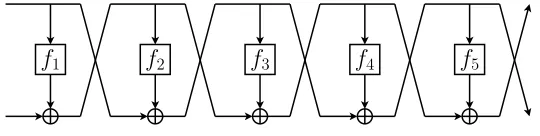
5Fig. 3: GFNR(2,5)(see Thm. 2).
Let Rdenote an ideal permutation with the same domain and range as C. For any simulator S that makes at mostqS ≤2n−1−1 queries toR, there exists a distinguisherDthat makes at most 24queries to its oracles, such that
AdviffC,S-KK(D)≥1−q 4 S+ 2 2n/2 .
Proof. Denote the inputs of a GFNR(2,5) evaluation by (p, r) and the outputs by (c, d). The attack of [10] and [28, App. C] describes a way to find 4 plaintext-ciphertext pairs that satisfy p1⊕p2⊕p3⊕p4 = d1⊕d2⊕d3⊕d4 = 0. As in Thm. 1, predicateϕ(Q) is defined as follows:
∃(p1, r1;c1, d1), . . . ,(p4, r4;c4, d4)∈ Qsuch that
p1⊕p2⊕p3⊕p4=d1⊕d2⊕d3⊕d4= 0. (3)
The distinguisher makes 20 queries toP(as in the proof of Thm. 1), and the four corresponding queries to the left oracle, which results in Q24. By construction,
ϕ(Q24) holds for GFNP(2,5),P with probability 1, and it remains to consider the probability ϕ(Q24) holds in the other game. Similar to the proof of Thm. 1, we find
Pr ϕ(Q24) forR,SR
≤
qS 4
2n/2 2n−q
S
+ 2
n/2
2n−(q
S+ 1)
,
and hence we obtainAdviff-KKC,S (24)≥1−
q4
S+2
2n/2, forqS+ 1≤2
n−1. ut
6
Known-Key Indifferentiability is Constructive
The next obvious question then is, whether there exist block cipher constructions that are known-key indifferentiable from an ideal cipher. In this section, we prove that this is indeed the case.
First, we consider generalized Feistel networks. In [22], Holenstein et al. con-sidered GFNR(2,14), a variant of GFN(2,14) where the keys are not XORed to get the input to the primitives, but are used to obtain 14 different random func-tions (see also Sect. 2), and proved that this construction has indifferentiable advantage from an ideal cipher ofO(q16/2n/2). Here, we refer to standard indif-ferentiability (see Table 1 for the interfaces in this notion). Using this result, we obtain the following theorem.
Theorem 3. Let C be GFNR(2,14) with oracle access to an ideal primitive P consisting of 14 random functions (and where no round keys are XORed). Let D be an arbitrary distinguisher making at most q queries. Then there exists a simulator S such that
AdviffC,S-KK(D) =O(q16/2n/2),
Proof. Holenstein et al. [22] proved that forCbeing GFN(2,14)any distinguisher making at mostq queries, has indifferentiability an advantage ofAdviffC,S(D) =
O(q16/2n/2). Their simulator makes at most 1400q8 queries to R and runs in timeO(q8). From Prop. 1, we conclude that the same bound holds for the iff-KK-security of GFN(2,14), which completes the proof. ut Next, we consider multiple Even-Mansour, and show that already with one round, this construction turns out to be optimally known-key indifferentiable secure.
Theorem 4. Let forr≥1,Crbe EMrwith oracle access to an ideal primitiveP
consisting ofrrandom permutations. LetDbe an arbitrary distinguisher making at mostq queries. Then there exists a simulatorS such that
AdviffC,S-KK(D) = 0,
whereS makes at mostq queries toRand runs in timeO(q). Proof. First, considerr= 1. Letk0kk1
$
← {0,1}2nbe the public key. Intuitively,
as soon ask0kk1 is fixed,Cbehaves perfectly as a random permutation asP is. Formally, simulatorS uses oracleRto respond withY =R(X⊕k0)⊕k1 on a forward queryX; and uses its oracleRto respond withX=R−1(Y ⊕k
1)⊕k0 on an inverse query Y. By construction, all queries made by the distinguisher to S are exactly in correspondence with the random primitiveRandDcannot distinguish.
Now, forr >1, the proof is not much different, although the simulator needs to do some more bookkeeping. It responds randomly at every query, except when it completes a chain, an evaluation EMr(K, p), in which case it adapts
its response to fit the random oracle. Note that, as the key is fixed, it can be considered constant, and different EMr evaluations never collide somewhere in
the middle. In other words, for any i ∈ {1, . . . , r} the following holds: if πi
denotes the permutation in the i-th round, then one input-output-tuple of πi
corresponds to exactly oneC(K,·) evaluation, and vice versa. ut We note that EM1 is not iff-secure. Briefly, let S be any simulator making at most qS queries. We construct a distinguisher D as follows. Here, O1 denotes its composed oracle (C or R) and O2 its primitive oracle (P or S). Firstly, D chooses arbitrary keyk0kk1and messageM, and queriesY ← O2(M⊕k0) and
C← O1(k0kk1, M). Then, ifC=Y⊕k1, thenDoutputs 1, otherwise it outputs 0. Note that C =Y ⊕k1 holds with probability 1 in the real world, and with probability 1/2n in the ideal world (as in this setting the simulator does not know k1). Using Thm. 4, this renders a separation between iff-KK and iff, as already mentioned in Sect. 4.
GOA TENSE. Elena Andreeva is supported by a Postdoctoral Fellowship from the Flemish Research Foundation (FWO-Vlaanderen). Bart Mennink is sup-ported by a Ph.D. Fellowship from the Institute for the Promotion of Innovation through Science and Technology in Flanders (IWT-Vlaanderen).
References
1. Andreeva, E., Mennink, B., Preneel, B.: On the indifferentiability of the Grøstl hash function. In: Security and Cryptography for Networks 2010. LNCS, vol. 6280, pp. 88–105. Springer, Heidelberg (2010)
2. Bellare, M., Ristenpart, T.: Multi-property-preserving hash domain extension and the EMD Transform. In: ASIACRYPT 2006. LNCS, vol. 4284, pp. 299–314. Springer, Heidelberg (2006)
3. Bertoni, G., Daemen, J., Peeters, M., Van Assche, G.: On the indifferentiability of the Sponge construction. In: EUROCRYPT 2008. LNCS, vol. 4965, pp. 181–197. Springer, Heidelberg (2008)
4. Bhattacharyya, R., Mandal, A., Nandi, M.: Security analysis of the mode of JH hash function. In: FSE 2010. LNCS, vol. 6147, pp. 168–191. Springer, Heidelberg (2010)
5. Biryukov, A., Dunkelman, O., Keller, N., Khovratovich, D., Shamir, A.: Key recov-ery attacks of practical complexity on AES-256 variants with up to 10 rounds. In: EUROCRYPT 2010. LNCS, vol. 6110, pp. 299–319. Springer, Heidelberg (2010) 6. Biryukov, A., Khovratovich, D.: Related-key cryptanalysis of the full AES-192 and
AES-256. In: ASIACRYPT 2009. LNCS, vol. 5912, pp. 1–18. Springer, Heidelberg (2009)
7. Biryukov, A., Khovratovich, D., Nikolic, I.: Distinguisher and related-key attack on the full AES-256. In: CRYPTO 2009. LNCS, vol. 5677, pp. 231–249. Springer, Heidelberg (2009)
8. Bogdanov, A., Khovratovich, D., Rechberger, C.: Biclique cryptanalysis of the full AES. In: ASIACRYPT 2011. LNCS, vol. 7073, pp. 344–371. Springer, Heidelberg (2011)
9. Bogdanov, A., Knudsen, L.R., Leander, G., Standaert, F.X., Steinberger, J., Tis-chhauser, E.: Key-alternating ciphers in a provable setting: Encryption using a small number of public permutations. In: EUROCRYPT 2012. LNCS, vol. 7237, pp. 45–62. Springer, Heidelberg (2012)
10. Coron, J.S., Patarin, J., Seurin, Y.: The random oracle model and the ideal cipher model are equivalent. In: CRYPTO 2008. LNCS, vol. 5157, pp. 1–20. Springer, Heidelberg (2008)
11. Coron, J.S., Dodis, Y., Malinaud, C., Puniya, P.: Merkle-Damg˚ard revisited: How to construct a hash function. In: CRYPTO 2005. LNCS, vol. 3621, pp. 430–448. Springer, Heidelberg (2005)
12. Daemen, J., Govaerts, R., Vandewalle, J.: Correlation matrices. In: FSE 1994. LNCS, vol. 1008, pp. 275–285. Springer, Heidelberg (1996)
13. Daemen, J., Rijmen, V.: The wide trail design strategy. In: IMA Int. Conf. 2001. LNCS, vol. 2260, pp. 222–238. Springer, Heidelberg (2001)
14. Daemen, J., Rijmen, V.: The Design of Rijndael: AES - The Advanced Encryption Standard. Springer (2002)
16. Dodis, Y., Ristenpart, T., Shrimpton, T.: Salvaging Merkle-Damg˚ard for practical applications. In: EUROCRYPT 2009. LNCS, vol. 5479, pp. 371–388. Springer, Heidelberg (2009)
17. Dong, L., Wu, W., Wu, S., Zou, J.: Known-key distinguisher on round-reduced 3D block cipher. In: WISA 2011. LNCS, vol. 7115, pp. 55–69. Springer, Heidelberg (2011)
18. Even, S., Mansour, Y.: A construction of a cipher from a single pseudorandom per-mutation. In: ASIACRYPT ’91. LNCS, vol. 739, pp. 201–224. Springer, Heidelberg (1991)
19. Hirose, S.: Some plausible constructions of double-block-length hash functions. In: FSE 2006. LNCS, vol. 4047, pp. 210–225. Springer, Heidelberg (2006)
20. Hirose, S., Park, J., Yun, A.: A simple variant of the Merkle-Damg˚ard scheme with a permutation. In: ASIACRYPT 2007. LNCS, vol. 4833, pp. 113–129. Springer, Heidelberg (2007)
21. Hoang, V.T., Rogaway, P.: On generalized Feistel networks. In: CRYPTO 2010. LNCS, vol. 6223, pp. 613–630. Springer, Heidelberg (2010)
22. Holenstein, T., K¨unzler, R., Tessaro, S.: The equivalence of the random oracle model and the ideal cipher model, revisited. In: ACM Symposium on Theory of Computing, STOC. pp. 89–98. ACM, San Jose, CA, USA (2011)
23. Jetchev, D., ¨Ozen, O., Stam, M.: Collisions are not incidental: A compression function exploiting discrete geometry. In: TCC 2012. LNCS, vol. 7194, pp. 303– 320. Springer, Heidelberg (2012)
24. Knudsen, L.: Block ciphers - the basics (May 2011), eCRYPT II Summer School on Design and Security of Cryptographic Algorithms and Devices, Invited talk, Albena, Bulgaria
25. Knudsen, L., Rijmen, V.: Known-key distinguishers for some block ciphers. In: ASIACRYPT 2007. LNCS, vol. 4833, pp. 315–324. Springer, Heidelberg (2007) 26. Lai, X., Massey, J.: Hash function based on block ciphers. In: EUROCRYPT ’92.
LNCS, vol. 658, pp. 55–70. Springer, Heidelberg (1992)
27. Luby, M., Rackoff, C.: How to construct pseudorandom permutations from pseu-dorandom functions. SIAM Journal of Computing 17(2), 373–386 (1988)
28. Mandal, A., Patarin, J., Seurin, Y.: On the public indifferentiability and correlation intractability of the 6-round Feistel construction. In: TCC 2012. LNCS, vol. 7194, pp. 285–302. Springer, Heidelberg (2012)
29. Maurer, U., Renner, R., Holenstein, C.: Indifferentiability, impossibility results on reductions, and applications to the random oracle methodology. In: TCC 2004. LNCS, vol. 2951, pp. 21–39. Springer, Heidelberg (2004)
30. Maurer, U.M.: A simplified and generalized treatment of Luby-Rackoff pseudoran-dom permutation generator. In: EUROCRYPT 1992. LNCS, vol. 658, pp. 239–255. Springer, Heidelberg (1992)
31. Mennink, B.: Optimal collision security in double block length hashing with sin-gle length key. In: ASIACRYPT 2012. LNCS, vol. 7658, pp. 526–543. Springer, Heidelberg (2012)
32. Mennink, B., Preneel, B.: Hash functions based on three permutations: A generic security analysis. In: CRYPTO 2012. LNCS, vol. 7417, pp. 330–347. Springer, Heidelberg (2012)
33. Meyer, C., Schilling, M.: Secure program load with manipulation detection code. In: Proc. Securicom. pp. 111–130 (1988)
35. Nakahara Jr., J.: New impossible differential and known-key distinguishers for the 3D cipher. In: ISPEC 2011. LNCS, vol. 6672, pp. 208–221. Springer, Heidelberg (2011)
36. Naor, M., Reingold, O.: On the construction of pseudorandom permutations: Luby-Rackoff revisited. Journal of Cryptology 12(1), 2966 (1999)
37. Nikolic, I., Pieprzyk, J., Sokolowski, P., Steinfeld, R.: Known and chosen key differ-ential distinguishers for block ciphers. In: ICISC 2010. LNCS, vol. 6829, pp. 29–48. Springer, Heidelberg (2010)
38. Patarin, J.: Pseudorandom permutations based on the DES scheme. In: EU-ROCODE 1990. LNCS, vol. 514, pp. 193–204. Springer, Heidelberg (1990) 39. Patarin, J.: New results on pseudorandom permutation generators based on the
DES scheme. In: CRYPTO 1991. LNCS, vol. 576, pp. 301–312. Springer, Heidelberg (1991)
40. Patarin, J.: About Feistel schemes with six (or more) rounds. In: FSE 1998. LNCS, vol. 1372, p. 103121. Springer, Heidelberg (1998)
41. Patarin, J.: Security of random Feistel schemes with 5 or more rounds. In: CRYPTO 2004. LNCS, vol. 3152, p. 106122. Springer, Heidelberg (2004)
42. Preneel, B., Govaerts, R., Vandewalle, J.: Hash functions based on block ciphers: A synthetic approach. In: CRYPTO ’93. LNCS, vol. 773, pp. 368–378. Springer, Heidelberg (1993)
43. Rogaway, P., Steinberger, J.: Constructing cryptographic hash functions from fixed-key blockciphers. In: CRYPTO 2008. LNCS, vol. 5157, pp. 433–450. Springer, Heidelberg (2008)
44. Sasaki, Y.: Known-key attacks on Rijndael with large blocks and strengthening
ShiftRow parameter. In: IWSEC 2010. LNCS, vol. 6434, pp. 301–315. Springer, Heidelberg (2010)
45. Sasaki, Y.: Known-key attacks on Rijndael with large blocks and strengthening
ShiftRowparameter. IEICE Transactions 95-A(1), 21–28 (2012)
46. Sasaki, Y., Emami, S., Hong, D., Kumar, A.: Improved known-key distinguishers on Feistel-SP ciphers and application to Camellia. In: ACISP 2011. LNCS, vol. 7372, pp. 87–100. Springer, Heidelberg (2012)
47. Sasaki, Y., Yasuda, K.: Known-key distinguishers on 11-round Feistel and colli-sion attacks on its hashing modes. In: FSE 2011. LNCS, vol. 6733, pp. 397–415. Springer, Heidelberg (2011)
48. Shrimpton, T., Stam, M.: Building a collision-resistant compression function from non-compressing primitives. In: ICALP (2) 2008. LNCS, vol. 5126, pp. 643–654. Springer, Heidelberg (2008)
49. Smith, J.: The design of Lucifer: a cryptographic device for data communications. IBM Research Report RC 3326 (1971)
50. Stam, M.: Blockcipher-based hashing revisited. In: FSE 2009. LNCS, vol. 5665, pp. 67–83. Springer, Heidelberg (2009)
51. Steinberger, J.: Improved security bounds for key-alternating ciphers via Hellinger distance. Cryptology ePrint Archive, Report 2012/481 (2012)
52. Vaudenay, S.: Decorrelation: A theory for block cipher security. Journal of Cryp-tology 16(1), 249–286 (2003)
53. Yoneyama, K., Miyagawa, S., Ohta, K.: Leaky random oracle. IEICE Transactions 92-A(1), 1795–1807 (2009)