Certificate-Based Encryption Resilient to Key Leakage
Qihong Yua, Jiguo Lia1, Yichen Zhanga, Wei Wub,c, Xinyi Huangb,c, Yang Xiangc
aCollege of Computer and Information, Hohai University, Nanjing 211100, China
bSchool of Mathematics and Computer Science, Fujian Normal University, Fuzhou, China, 350117 cSchool of Information Technology, Deakin University, Burwood, VIC 3125, Australia
Abstract: Certificate-based encryption (CBE) is an important class of public key encryption but the existing schemes are secure only under the premise that the decryption key (or private key) and master private key are absolutely secret. In fact, a lot of side channel attacks and cold boot attacks can leak secret information of a cryptographic system. In this case, the security of the cryptographic system is destroyed, so a new model called leakage-resilient (LR) cryptography is introduced to solve this problem. While some traditional public key encryption and identity-based encryption with resilient-leakage schemes have been constructed, as far as we know, there is no leakage-resilient scheme in certificate-based cryptosystems. This paper puts forward the first certificate-based encryption scheme which can resist not only the decryption key leakage but also the master secret key leakage. Based on composite order bilinear group assumption, the security of the scheme is proved by using dual system encryption. The relative leakage rate of key is close to 1/3.
Keywords: certificate-based encryption, master secret key leakage, dual system encryption, composite order bilinear group
1 Introduction
In order to solve certificate management problem in traditional public key cryptosystems and the key escrow problem in identity based cryptosystems, Gentry [1] proposed a new cryptography paradigm called certificate-based encryption. From then on, many concrete schemes [2, 3, 4, 5, 6, 7, 8] were constructed under the assumption that the decryption key and master secret key are absolutely confidential.
But that is not always the case, and some side channel attacks [9, 10, 11, 12, 13] have been found in real world. From the attacks, the adversary can obtain some information by observing execution timing, energy consumption, etc. This results in secret information leakage which includes the information of the vital master secret key and decryption key. Side channel attacks give the adversaries an advantage to obtain the secret information. Therefore, the security of previous cryptographic schemes is compromised under the circumstances. New model must be constructed to capture such attacks.
In order to guarantee the security of cryptographic systems under some circumstances, we usually define an attack model to limit the attacker’s behavior. If the attacker satisfies the constraints, the corresponding cryptosystems are regarded as safe in the model. Leakage resilient cryptography is to capture side channel attacks. In fact, it has become a research hotspot in recent years.
For identity-based cryptosystems and traditional public key cryptosystems, some leakage-resilient schemes have been constructed. For certificate-based cryptosystems, as far as we know, no leakage-resilient scheme is presented. The paper puts forward the first certificate-based encryption scheme resilient to master secret key leakage and decryption key leakage.
1.1 Related Work
In 2004, Micali and Reyzin [14] proposed “only computation leaks information” model: computation is divided into many steps. Only the part of the secret state which is accessed (i.e. active) in that step can leak. The other part of the secret state that is not accessed (i.e. inactive) will not leak in that step. Under this model, the leakage-resilient stream cipher [15, 16] and leakage-resilient signature [17] were constructed. Although “only computation leaks information” model describes a large class of leakage attacks, it has shortcomings, namely, it does not capture the setting where the inactive part in memory also leaks information (for example, the cold boot attack [9]). In order to solve this problem, the work [18] introduced “bounded leakage” model, it is a stronger model than “only computation leaks information” model. In “bounded leakage” model, the leakage of inactive part is also considered. Under the “bounded leakage” model, leakage-resilient encryption and signature schemes [19, 20, 21] were
1
constructed. The constructions of leakage-resilient identity-based schemes attract more attention. Some achievements have been given in the works [22, 23, 24].
By constructing the hash proof system, the work [20] gave the leakage-resilient encryption scheme which can resist
l
/ 4
bits information leakage about private key (l
is the bit length of private key). The work [25] extended the method of the work [20] to construct the identity-based hash proof system and further to put forward the leakage-resilient identity-based encryption (LR-IBE) in the bounded retrieval model. To improve the property of leakage resilience, the work [26] introduced the dual system encryption.1.2 Our Contribution
Similar to traditional security model of CBE, we consider two types of adversaries as well. The first type of adversary
A1
is the malicious user who is allowed to replace public key without knowing the master secret key. The second type of adversaryA2
is the dishonest certificate authority (CA) who has the master secret key for generating the certificate but he is not allowed to replace the public key. Inspired by the leakage-resilient certificateless encryption (CLE) [27] and the certificate-based encryption [28], we propose the formal definition and the security model of the leakage-resilient certificate-based encryption (LR-CBE) and further present the first leakage-resilient certificate-based encryption scheme in the “bounded leakage” model. The security of the scheme has been proved by utilizing dual system encryption technique. The leakage bound amounts to 1/3 ifn
is large enough. Performance comparison illustrates the encryption operation of our scheme is faster than that of the schemes given in [1]. However, decryption cost is linearly correlated with the vector size n. In order to make the scheme more efficient, we can take n=2 and the decryption operation needs 4 pairings which is acceptable in practical application.1.3 Our Technique
In the security proof we use dual system encryption technique proposed in [29]. The dual system encryption technique can be used to improve the security of cryptographic systems. In the dual system encryption the decryption keys and ciphertexts have two states: normal and semi-functional (SF). The normal decryption keys can decrypt the normal and semi-functional ciphertexts. The semi-functional decryption keys can only decrypt the normal ciphertexts correctly. In real security game, all decryption keys and ciphertexts are normal. The security proof is a hybrid argument where the ciphertexts are first altered to semi-functional ones, then, the keys are altered to semi-functional ones gradually. For the consecutive two games we prove that the attacker cannot detect the difference between them with non-negligible advantage. Finally, we give such a game: we only need to produce semi-functional decryption keys and ciphertexts. Thus the attacker cannot correctly decrypt. This allows us to prove security.
1.4 Organization
In Section 2, we give some preliminaries that will be used. Formal description and security model of LR-CBE are given in Section 3. In Section 4, concrete construction of LR-CBE is put forward. Security proof of the proposed scheme is shown in Section 5. The leakage bound is analyzed in Section 6. The comparisons with other schemes are given in Section 7. Section 8 concludes this paper.
2 Preliminaries
2.1 Several Basic Conceptions Definition 1: Bilinear Map
Let
G
andG
T be multiplicative cyclic groups of orderq
andP
be a generator ofG
, a bilinear mape G G
:
× →
G
T has three properties as follows:(1) Bilinearity: For
P Q G
,
∈
anda b Z
,
∈
*,e P Q
(
a,
b)
=
e P Q
( , )
ab.(2) Non-degeneracy: For
P Q G
,
∈
,e P Q
( , ) 1
≠
.Let
R
be a binary relation in a languageL
. For( , )
x w
∈
R
,x
is called the statement andw
is called the witness. A non-interactive zero-knowledge (NIZK) proof system consists of three algorithms(
G
e
n
,
Pr
f
,
Ver
)
. The algorithmGen
takes as input a security parameter1
ϑ and outputs the common reference stringcrs
. The proverPrf
takes as input(
crs x w
, , )
and gives an argument or proofπ
if( , )
x w
∈
R
. The verifierVer
takes as input(
crs x
, , )
π
and outputs “accept” or “reject”. We call(
G
e
n
,
Pr
f
,
Ver
)
an NIZK proof system for the relationR
if it has three properties: soundness, completeness and zero knowledge as [31].Definition 3: Collision-Resistant Hash Function
For the hash function
H
:{0,1}
∗→
{0,1}
k, the algorithmA
can obtain the advantageε
inbreaking the collision-resistance of
H
ifPr[ ( ) ( , ) :
A H
=
m m
0 1m
0≠
m H m
1, ( )
0=
H m
( )]
1≥
ε
, where the advantage is over the random bits ofA
. A hash functionis collision-resistant if the advantage that any probabilistic polynomial-time (PPT) adversary can obtain is negligible.2.2 Complexity Assumptions
2.2.1 Composite Order Bilinear Groups
Composite order bilinear groups are first introduced in [32]. Let
ψ
denote a generator algorithm of composite order bilinear groups.ψ
takes as input a security parameter and outputs a description of composite order bilinear groupsΩ=
{
N p p p G G e
=
1 2 3, , , }
T , wherep p p
1,
2,
3 are threeλ
-bit primes (Theλ
is related to the security parameter and has an influence on the leakage bound which will be analyzed in Section 6),G
andG
T are cyclic groups of orderN
=
p p p
1 2 3 ande
is a bilinear map:G G
× →
G
T.Denote
1
,
2p p
G G
and3
p
G
as the subgroups ofG
with orderp p p
1,
2,
3 respectively. Ifi
i p
h
∈
G
,j
j p
h
∈
G
andi
≠
j
, we havee h h
( , )
i j =1. For example, supposeh
1∈
G
p1,h
2∈
G
p2, andg
is a generator ofG
. Thus,g
p p1 2is a generator of 3p
G
,g
p p1 3 is a generator of 2p
G
and2 3
p p
g
is a generator of1
p
G
. So, there existsα α
1,
2such that 2 3 11
(
)
p p
h
=
g
α and 1 3 22
(
)
p p
h
=
g
α .Then, 2 3 1 1 3 2 1 3 2 1 2 3
1 2
( , )
(
p p,
p p)
(
,
p)
p p p1
e h h
=
e g
αg
α=
e g g
α α=
. Therefore,1
,
2p p
G G
and3
p
G
are mutual orthogonal.If an element
X
can be written uniquely as the product of an element of1
p
G
and an element of2
p
G
, we call them “1
p
G
part ofX
” and “2
p
G
part ofX
” respectively.We denote vectors by angle brackets
< ⋅ ⋅ ⋅ >
, ,
and denote collections of elements of different types by parentheses( , , )
⋅ ⋅ ⋅
. Denote dot product of vectors by⋅
and denote component-wise multiplication by∗
. We denote the size or number of bits of the termW
asW
.We define the exponentiation for vectors as follows: For
,
1, ,...,
2 n ng G u
∈
G
=<
u u
u
>∈
G
,1 2
,
, ,...,
N n N
a Z b
∈
G
=<
b b
b
>∈
Z
, we defineg
b=<
g g
b1,
b2,...,
g
bn>
G, a 1a
,
2a,...,
an
u
G
=<
u u
u
>
.The resulting terms are elements of
G
n. For a bilinear groupG
, we define the pairing operation inG
n : For 1, ,...,
2 nn
u
G
=<
u u
u
>∈
G
and 1, ,...,
2 nn
v
G
=<
v v
v
>∈
G
, the pairing ise u v
( , )
G G
1
( , )
n
i i T
i
e u v
G
==
∏
∈
.2.2.2 Three Assumptions
Here we review three assumptions given in [27, 29, 30] which will be used in our security proof. Denote
1 2
p p
Let
ψ
be a generator algorithm of composite order bilinear groups. On input a security parameter1
ϑ,ψ
outputs a description of composite order bilinear groups. That is,( , ,
, )
R TN G G e
←⎯⎯
ψ
, whereN
=
p p p
1 2 3. Letg
1,g
2andg
3 be the generators of1
p
G
,2
p
G
and3
p
G
, respectively.Assumption 1:Given
D
1=
( , ,
N G G e g g
T, , , )
1 3 , no PPT adversary succeeds in distinguishing1
0 1
z
T
=
g
fromT
11=
g g
1z 2v with non-negligible advantage, wherez v Z
,
∈
N. The advantage that adversaryA
breaks assumption 1 is defined as:Adv
1 ( ) | Pr[ ( , ) 1] Pr[ ( , ) 1]|.
ψ,Aϑ
=
A
D T
1 01= −
A
D T
1 11=
We say that assumption 1 holds if the advantage
Adv
1
ψ,A( )
ϑ
is negligible for any PPT adversary.Assumption 2: Given 2
( , ,
, , , ,
1 3 1z 2v,
2u 3)
T
D
=
N G G e g g g g g g
ρ wherez v u
, , ,
ρ
∈
Z
N, no PPT adversary succeeds in distinguishingT
02=
g g
1ω σ3 fromT
12=
g g g
1ω κ σ2 3 with non-negligible advantage, whereω κ σ
, ,
∈
Z
N.The advantage that adversary
A
breaks assumption 2 is defined as:Adv
2 ( ) | Pr[ ( , ) 1] Pr[ ( , ) 1]|.
ψ,Aϑ
=
A
D T
2 02= −
A
D T
2 12=
We say that assumption 2 holds if the advantage
Adv
2
ψ,A( )
ϑ
is negligible for any PPT adversary.Assumption 3:Given
D
3=
( , ,
N G G e g g g g g g g
T, , , , ,
1 2 3 1α 2v,
1s 2u)
whereα
,s, ,
v u Z
∈
N , no PPT adversary succeeds in distinguishingT
03=
g
1αz from1
3
1 p
T
∈
G
with non-negligible advantage. The advantage that adversaryA
breaks assumption 3 is defined as:
Adv
3 ( ) | Pr[ ( , ) 1] Pr[ ( , ) 1]|.
ψ,Aϑ
=
A
D T
3 03= −
A
D T
3 13=
We say that assumption 3 holds if the advantage
Adv
3
ψ,A( )
ϑ
is negligible for any PPT adversary.3 Formal Definition and Security Model of LR-CBE
3.1 Formal Definition of LR-CBE
Inspired by the works [26, 27], we put forward the formal definition of LR-CBE which is resilient to master secret key leakage and decryption key leakage. We will use a hash function:
:
H
ID PK
×
→
ID
, whereID
is the identity space andPK
is the public key space. Thefunctionality of the hash function is to maintain the security when a CLE is converted to a CBE ( Please refer to [28]). Our LR-CBE scheme is composed of the following seven algorithms.
Setup:
Setup
(1 )
ϑ→
(
mpk msk
,
)
. The algorithm is run by the CA. By taking a security parameter1
ϑas input, the algorithm generates the master public keympk
and the master secret keymsk
. Thempk
is public to all users. Thempk
includes the information presentation of the identity space.SetPrivateKey:
SetPrivateKey ID mpk
(
,
)
→
sk
ID. The algorithm is run by the user. It takes as input the master public keympk
and the identityID
. It outputs the user’s private keysk
ID.SetPublicKey:
SetPublicKey ID sk
(
,
ID,
mpk
)
→
pk
ID. The algorithm is run by the userID
. It takes as input the master public keympk
and the private keysk
ID. It outputs the user’s public keyID
pk
.SetCertificate:
SetCertificate ID pk
(
,
ID,
mpk msk
,
)
→
Cert
ID. The algorithm is run by CA. For an identityID
, it first calculatesH ID pk
(
,
ID)
→
ID
′
. Then, it takes as input the master public keympk
, the master secret keymsk
,ID
′
and the publicpk
ID. It outputs the user’s certificateID
Cert
.the master public key
mpk
, the plaintextM
, the receiver’s identityID
and its corresponding public keypk
ID. It outputs the ciphertextC
.SetDecryptKey:
SetDecryptKey sk Cert
(
ID,
ID)
→
dk
ID. The algorithm generates the decryption keydk
ID by usingsk
ID andCert
ID.Decrypt:
Decrypt mpk C dk
(
, ,
ID)
→
M
. The algorithm is run by the receiver. It takes as input the master public keympk
, the ciphertextC
, the decryption keydk
ID which is generated by usingID
sk
andCert
ID. It outputs the plaintextM
.3.2 Adversaries and Oracles of LR-CBE
We consider two types of adversaries in our model like the works [2-8]. One type of adversaries is denoted by
A1
. Another type of adversaries is denoted byA2
.A1
acts as the dishonest users.A1
can not query the certificate of the target user but he is allowed to replace any user’s public key.A2
acts as the CA.A2
can not replace the public key of the target user but he may generate any user’s certificate.The security of LR-CBE against
A1
is defined by the gameT1
_
Game R
_
which will be given in the next subsection. In the game the challenger holds a list:L1
=
( ,
H ID ID pk
,
′
,
ID,
sk Cert
ID,
ID,
, ,
)
ID dk msk
dk l l
. The item consists of a handle counter, an identity, a hashed identity, a public key, a private key, a certificate, a decryption key, the amount of decryption key leakage and the amount of master secret key leakage. When an attacker makes a create queryO
-
Create
(Please refer to the concrete definition in the following), the challenger generates a unique handleH
and a related item( ,
H ID ID pk
,
′
,
ID,
sk
ID, , ,0,0)
⊥ ⊥
. Given a handle, an adversary can make leakage query. After the leakage query, the value ofl
dk orl
msk which is initially zero will be updated. The other oracle queries will refer the handle.The security of LR-CBE against
A2
is defined by the gameT2
_
Game R
_
which will be given in the next subsection. In the game the challenger holds a list:L2
=
( ,
H ID ID pk
,
′
,
ID,
sk Cert
ID,
ID,
, )
ID dk
dk l
. The item consists of a handle counter, an identity, a hashed identity, a public key, a private key, a certificate, a decryption key and the amount of decryption key leakage. When an attacker makes a create query, the challenger generates a unique handleH
and a related item( ,
H ID ID pk
,
′
,
ID,
, , ,0)
ID
sk
⊥ ⊥
. Given a handle, an adversary can make leakage query. After the leakage query, the value ofl
dkwhich is initially zero will be updated. The other oracle queries will refer the handle.We give the oracles that will be used.
(1)
O
-
Create
:On the given identityID
from the adversary, the challengerC
does as follows.(
,
)
IDSetPrivateKey ID mpk
→
sk
,SetPublicKey ID sk
(
,
ID,
mpk
)
→
pk
ID. For the adversaryA1
, it adds an item( ,
H ID ID pk
,
′
,
ID,
sk
ID, , ,0,0)
⊥ ⊥
inL1
. For adversaryA2
, it calculates:(
,
ID)
ID
′ ←
H ID pk
,SetCertificate ID pk
(
′
,
ID,
mpk msk
,
)
→
Cert
ID. It adds an item( ,
H ID
,
,
ID,
ID,
ID, ,0)
ID pk
′
sk Cert
⊥
inL2
. For the two cases,C
will updateH
←
H
+
1
. We suppose that the other oracles defined later only respond to the identity which has been created.(2)
O
-
Publickey
: For a handleH
, the challenger looks up the identityID
in the listL1
orL2
and returns the public keypk
ID to the adversaryA1
orA2
.0,0)
in the listL1
. It updatesH
←
H
+
1
. The constraint is that for the challenge identityID
∗ the adversaryA1
isn’t allowed to replace the public key before the challenge phase and at the same time queries the certificate at some point. ThusA1
obtains a challenge ciphertext about a public key on which he calculates the decryption key.(4)
O
-
Certificate
: For a handleH
, the challenger looks up the identityID
in the listL1
. The challenger calculates:H ID pk
(
,
ID)
→
ID
′
,SetCertificate ID pk
(
′
,
ID,
mpk msk
,
)
→
Cert
ID . It returns the certificateCert
ID to the adversaryA1
and updates the item( ,
H ID ID pk
,
′
,
ID,
sk
ID, ,
⊥
,0,0)
⊥
with( ,
H ID ID pk
,
′
,
ID,
sk Cert
ID,
ID, ,0,0)
⊥
.(5)
O
-
Decryptionkey
: The query can be done for the identity that his public key is not replaced. If an adversary queries the decryption key for the identityID
, the challengerC
scans the listL1
orL2
to findsk
ID andCert
ID. Then it calculates the decryption key:SetDecryptKey sk
(
ID,
)
ID ID
Cert
→
dk
. ForA1
,C
outputsdk
ID toA1
and updates the item( ,
H ID ID pk
,
′
,
ID,
,
, ,0,0)
ID ID
sk Cert
⊥
with( ,
H ID ID pk
,
′
,
ID,
sk Cert
ID,
ID,
dk
ID,0,0)
. ForA2
,C
outputsdk
ID to it and updates the item( ,
H ID ID pk
,
′
,
ID,
sk Cert
ID,
ID, ,0)
⊥
with( ,
H ID ID pk
,
′
,
ID,
sk Cert
ID,
ID,
dk
ID,0)
.(6)
O
-
Decrypt
: If the adversary queries a decryption for(
ID C
,
)
, the challenger scans the listL1
orL2
to get the decryption keydk
ID. The challenger invokes the algorithm Decrypt to obtain the corresponding plaintextM
and gives it to the adversaryA1
orA2
.(7)
O
-
Leakdecryptionkey
: Given a handleH
and a leakage functionf
with the output of constant size, the challengerC
looks up the item( ,
H ID ID pk
,
′
,
ID,
sk Cert
ID,
ID,
dk l l
ID, ,
dk msk)
or( ,
H ID ID pk
,
′
,
ID,
sk Cert
ID,
ID,
dk l
ID, )
dk which includesH
in listL1
orL2
.l
dk andl
msk are initially zero.C
judges ifl + f dk
dk| (
ID) |
≤
λ
dk whereλ
dk is the leakage bound of the decryption key. If this is true, the challenger returns the output off dk
(
ID)
toA1
orA2
and updatesl
dk withl + f dk
dk| (
ID) |
in listL1
orL2
.(8)
O
-
Leakmasterkey
: Given a handleH
and a leakage functionf
with the output of constant size, the challenger looks up the item( ,
H ID ID pk
,
′
,
ID,
sk Cert
ID,
ID,
dk l l
ID, ,
dk msk)
which includesH
in listL1
. It judges ifl + f msk
msk| (
) |
≤
λ
msk whereλ
msk is the leakage bound of the master secret key. If this is true, the challenger returns the output off msk
(
)
toA1
and updatesmsk
l
withl + f msk
msk| (
) |
in listL1
.3.3 Security Model of LR-CBE
In our model there are two type adversaries, so the security is obtained from two security games. The challenger plays the games with the adversary
A1
orA2
.3.3.1 Security against Type I Adversary
The security of LR-CBE against
A1
is defined by the gameT1
_
Game R
_
which is played between the challenger and the adversaryA1
.T1
_
Game R
_
is defined as follows._
Game R
_
T1
:Initialize: The challenger invokes the algorithm Setup to generate the master secret key and the master public key:
Setup
(1 )
ϑ→
(
mpk msk
,
)
. The challenger keeps the master secret key as secret and issues the master public key to all users.-
LeakMasterKey
O
,O
-
Certificate
,O
-
Replacepublickey
,O
-
Decryptionkey
,O
-
Decrypt
. The constraints are as follows.A1
can not query the decryption key for the challenge identityID
∗. For the challenger identityID
∗, ifA1
replaces the public key, he is not allowed to query the corresponding certificate.Challenge: The adversary
A1
gives two equal length messagesM M
0,
1∈
M
and an identityID
∗ to the challenger.M
is a given message space. The challenger looks up the corresponding item consisting of theID
∗ in listL1
. If the item is not in listL1
, the challenger will make create query-
Create
O
for the identityID
∗ firstly. Then the challenger randomly selects a bitξ
∈
{0,1}
and runs algorithm Encrypt to generate the ciphertextC
∗ about the messageM
ξ :(
,
,
,
ID)
Encrypt ID mpk M pk
∗ ξ ∗→
C
∗. At last, the challenger sends the ciphertextC
∗ toA1
.Phase 2: Just similar to Phase 1,
A1
queries the oracles:O
-
Create
,O
-
Publickey
,O
-
Decrypt
,-
Replacepublickey
O
,O
-
Certificate
,O
-
Decryptionkey
. The basic constraints are the same as that of Phase 1. The other constraints are that these oracles can not query the challenge identityID
∗. Furthermore, no leakage query is allowed in this phase. If we allow leakage queries, the adversary can encode the Decrypt algorithm ofC
∗as a leakage function and wins the game trivially.Guess: At last,
A1
guesses a bitξ
′∈
{0,1}
. Ifξ ξ
′ =
,A1
wins the game.The advantage that an adversary
A1
wins this game is _ _( ,
) Pr[
]
1
2
Game R
dk msk
Adv
T1λ λ
=
ξ ξ
′
= −
A1 .
Definition 4: If there is no PPT adversary
A1
who can winT1
_
Game R
_
with non-negligible advantage ( _Game R_(
,
)
dk msk
Adv
T1λ λ
≤
ε
A1 where
ε
is a negligible value), the LR-CBE is called type Isecure against the adaptive chosen ciphertext attacks.
3.3.2 Security against Type II Adversary
The security of LR-CBE against
A2
is defined by the gameT2
_
Game R
_
which is played between the challenger and the adversaryA2
.T2
_
Game R
_
is defined as follows._
Game R
_
T2
:Initialize: The challenger invokes the algorithm Setup to generate the master public key and the master secret key:
Setup
(1 )
ϑ→
(
mpk msk
,
)
. The challenger issues the master public key and the master secret key toA2
.Phase 1: The adversary may query the oracles:
O
-
Create
,O
-
Publickey
,O
-
Decryptionkey
,-
Decrypt
O
,O
-
Leakdecryptionkey
. BecauseA2
knows the master secret key it does not need to query the oracleO
-
Leakmasterkey
andO
-
Certificate
. The constraints are as follows.A2
can not query the decryption key for the challenge identityID
∗.A2
is not allowed to replace the public key at any point.Challenge: The adversary
A2
gives two equal length messagesM M
0,
1∈
M
and an identityID
∗ to the challenger.M
is a given message space. The challenger looks up the corresponding item consisting of theID
∗ in listL2
. If the item is not in listL2
, The challenger will make create queryO
-
Create
for the identityID
∗.Then the challenger randomly selects a bit
ξ
∈
{0,1}
and runs algorithm Encrypt to get the ciphertextC
∗ about the messageM
ξ :Encrypt ID mpk M pk
(
∗,
,
ξ,
ID∗)
→
C
∗ . At last, thechallenger sends the ciphertext
C
∗ to the adversaryA2
.Phase 2: Just similar to Phase 1,
A2
queries the oracles:O
-
Create
,O
-
Publickey
,O
-
Decrypt
,-
Decryptionkey
that these oracles can not query the challenge identity
ID
∗. Furthermore, no leakage query is allowed in this phase. If we allow leakage queries, the adversary can encode the Decrypt algorithm ofC
∗as a leakage function and wins the game trivially.Guess: At last,
A2
guesses a bitξ
′∈
{0,1}
. Ifξ ξ
′ =
,A2
wins the game.The advantage that an adversary
A2
wins this game is _ _(
)
Pr[
]
1
2
Game R dk
Adv
T2λ
=
ξ ξ
′
=
−
A2 .
Definition 5: If there is no PPT adversary
A2
who winsT2
_
Game R
_
with non-negligible advantage ( _Game R_(
)
dk
Adv
T2λ
≤
ε
A2 ), the LR-CBE is called type II secure against the adaptive chosen
ciphertext attacks.
4 Construction of our LR-CBE
We firstly give an NIZK proof system
∏ =
(
Gen Prf Ver
,
,
)
which will be employed in our scheme. We define∏ =
(
Gen Prf Ver
,
,
)
is an NIZK proof system with the languageL { :
=
β
Y
β=
Z
}
where
β
∈
Z
N, andY Z G
,
∈
T.H
:
ID PK
×
→
ID
is a hash function, whereID
is the identity space andPK
is the public key space. The hash function is used to maintain the security when a CLE is converted to a CBE (Please refer to [28]). Suppose that any identity is an element ofN
Z
. Our LR-CBE consists of the following seven algorithms.Setup: It firstly creates composite order bilinear groups
(
N
=
p p p G,G e
1 2 3,
T, )
. Then, it randomly selects1
1
, , ,
1 1 1 pg u h v
∈
G
and3
3 p
g
∈
G
. It runs algorithmGen
of∏
to generate the common reference stringcrs
and selects random( , , ,..., , , , ,..., )
1 2 1 2 2n 2n n N
x x
x r y y
y
Z
α
∈
+ and avector 1
,
2,...,
3 n 3 n+Z
Nρ
G
=<
ρ ρ
ρ
>∈
+ wheren
≥
2
is an integer. The value ofn
can be varied. Abigger value of
n
will generate a bigger leakage rate. Leakage rate is the value that the number of leaked bits from the decryption key or the master secret key divides by the number of bits for the decryption key or master secret key. A smaller value ofn
will lead to a smaller master public key. Itoutputs the master public key 1
1 1 1 1 1 1 1 1 3
, ,
, , ( , ) , ,
,...,
, , , ,
(
x xn,
)
T
mpk
=
N G G e e g v
αg g
g u h v g crs
andthe master secret key 1
-1 2 3 1 1 1 1 1 1 1 3
1
( ,
,
,
) (
,...,
n,
i i, , )
n
y x y
y r r r
i
msk
K K K K
v
v
g h
αg
−v u
g
ρ ==
G
= <
>
∏
∗
G.SetPrivateKey: The user sets the private key
sk
ID=
β
whereβ
∈
Z
N.SetPublicKey: The user sets public key
pk
ID=
(
Y
, ) (
π
=
e
( , )
g v
1 1 αβ,
π
)
whereπ
←
Prf crs
(
,
1 1 1 1
(
e g v
( , )
αβ,
e g v
( , )
α), )
β
is an NIZK proof thatβ
is the discrete logarithm ofe g v
( , )
1 1 αβ to the basee g v
( , )
1 1 α.SetCertificate: The CA randomly selects a vector 1
,
2,...,
2 n 2n
Z
Nρ
ρ ρ
ρ
+ +′
=<
′ ′
′
>∈
G
and
n
+
1
elements
( , ,..., )
1 n 1n N
r z
′
z
∈
Z
+ . Then, it calculates the certificate as follows:H ID pk
(
,
ID)
=
ID
′
,1
1 2 1 2 1 1 3 1 1 1 1 3
1
( ,
,
) ( ,
,
) (
,...,
n,(
)
(
)
i i,
)
n
z x z
z ID ID r r
ID
i
Cert
D D D
K K K
v
v
K
− ′u h
′ ′g
−v
′g
ρ′ ==
G
=
G
∗ <
>
∏
∗
G . The1
p
G
part ofCert
ID can be viewed as 11 1 1 1 1 1 1
1
(
,...,
n,
(
)
i i,
)
n
z x z
z ID r r
i
v
′v
′g u h
α ′ −′′g
− ′v
′′ =<
>
∏
for some1 1
( , ,..., )
nn N
r z
′′ ′
z
′ ∈
Z
+ wherei i i
z
′ = +
y
z
fori
=
1
ton
andr
′′
= +
r r
′
.Encrypt: The sender verifies the validation for proof
π
. Ifπ
is valid, it picks randomlys Z
∈
nand computes the ciphertext: 1
1 1 1 1 1
0 1 2
. ( , ) ,
1 1( , , ,
) (
M e g v
sg
x s,...,
x sn, ,
s(
ID) )
swhere
ID
′ =
H ID pk
(
,
ID)
.SetDecryptKey: The user picks 1
,...,
2 n 2n
Z
Nρ
ρ
ρ
+ +′′
=<
′′
′′
>∈
G
, 1
,...,
nn N
w
G
=<
w
w
>∈
Z
andt Z
∈
Nrandomly. The user calculates the decryption key as follows:
H ID pk
(
,
ID)
=
ID
′
,dk
ID=
( ,
S
G
1
1 2 1 2 1 1 1 1 1 1 3
1
, ) ( ,
,
)
(
,...,
n,(
)
i i, )
n
w x w
w ID t t
i
S S
D D D
βv
v
u h
′ −g
−v
g
ρ′′ ==
G
∗ <
>
∏
∗
G . The1
p
G
part ofdk
IDcan be viewed as 1
1 1 1 1 1 1 1
1
(
,...,
n,
(
)
i i, )
n
w x w
w ID t t
i
v
′v
′g
αβu h
′ −′g
− ′v
′ =<
>
∏
for some( , ,...,
1)
n 1n N
t w
′ ′
w
′ ∈
Z
+where
w
i′ =
w
i+
(
y
i+
z
i)
β fori
=
1
ton
andt
′
= + +
t
(
r r
′
)
β.Decrypt: By using the decryption key, the user gets 0
1 1 2 2
( , ) ( , ) ( , )
C
M
e C S e C S
e C S
=
⋅
⋅
G G
.Correctness.
1 1 2 2
( , ) ( , ) ( , )
e C S e C S
G G
⋅
⋅
e C S
= 1 1 ( 1 1) 1 ( )
1 1
1 1 3 3
(
x s,...,
x sn,
w,...,
wn*
,.
..,
n n n)
e
<
g
g
>
<
v
′v
′> <
g
ρ ρ+ ′β+ρ′′g
ρ ρ+ ′ β+ρ′′>
⋅
1
1 1 1 1 3
1 1
( ,
(
)
i i n)
n x D
s I t w
i
e
v
g
αβu h
′ −′g
− ′g
ρ′′+ =⋅
⋅
∏
21 1 1 3
((
ID) ,
s t n)
e u h
′v g
′⋅
ρ′′+= 1 1 ( 1 1) 1 ( )
1
1 1 3 1 3
(
x s,...,
x sn,
w,...,
wn n n n)
e
<
g
g
>
<
v
′⋅
g
ρ ρ+ ′β+ρ′′v
′⋅
g
ρ ρ+ ′ β+ρ′′>
⋅
1
1 1 1 1 3
1 1
( ,
(
)
i i n)
n x D
s I t w
i
e
v
g
αβu h
′ −′g
− ′g
ρ′′+ =⋅
⋅
∏
21 1 1 3
((
ID) ,
s t n)
e u h
′v g
′⋅
ρ′′+= ( )
1
1 1 3
(
i,
i i i i)
n
w
i
x s
e
g
v
′g
ρ ρ+ ′β+ρ′′ =⋅
⋅
∏
11 1 1 1 3
1 1
( ,
(
)
i i n)
n x D
s I t w
i
e
v
g
αβu h
′ −′g
− ′g
ρ′′+ =⋅
⋅
∏
21 1 1 3
((
ID) ,
s t n)
e u h
′v g
′⋅
ρ′′+= 1 1
1
,
(
xi i)
n
s w
i
e
g
v
′ =⋅
∏
( ) 3 1 1(
x si,
i i i)
n
i
e g
g
ρ ρ+ ′β+ρ′′ =⋅
∏
1 1 1 1 11
( ,
s(
)
i i)
n x w ID t
i
e
v
g
αβu h
′ −′g
− ′ =⋅
∏
13 1
( ,
s n)
e
v
g
ρ′′+⋅
e u h
((
1ID′ 1) , )
sv
1t′⋅
21 1 3
((
ID) ,
s n)
e u h
′g
ρ′′+= 1 1
1
,
(
xi i)
n
s w
i
e
g
v
′ =⋅
∏
1 1 1 1 11
( ,
s(
)
i i)
n x w ID t
i
e
v
g
αβu h
′ −′g
− ′ =⋅
∏
((
1 1) , )
1ID s t
e u h
′v
′= 1 1
1
,
(
xi i)
n
s w
i
e
g
v
′ =⋅
∏
1 11
( ,
i i)
n x w
i s
e
v
g
− ′ =⋅
∏
( ,
1 1)
se
v
g
αβ⋅
e
( ,(
v
1su h
1ID′ 1) )
−t′⋅
1 1 1
((
ID) , )
s te u h
′v
′=
1
1 1
(
i i,
)
n
w
x s
i
e
g
′v
=⋅
∏
1 11
( ,
i i)
n x w
i s
e
v
g
− ′ =⋅
∏
( , )
1 1s
e
v
g
αβ⋅
e
( ,(
v
1t′u h
1ID′ 1) )
−s⋅
1 1 1
((
ID) , )
s te u h
′v
′= 1 1
1
,
(
i i).
n
w s
i x
e
g
′v
=∏
1 11
( ,
i i)
n x w
i s
e
v
g
− ′ =⋅
∏
( , )
1 1s
e
v
g
αβ=
e
( , )
v
1g
1 αβs5 Security Proof
Inspired by dual system encryption method [26, 29, 30], we uses semi-functional ciphertexts and keys in our proof. In order to accomplish our proof, we give dual system construction of our LR-CBE.
5.1 Dual System Description of Our LR-CBE
DS-Setup: The algorithm is based on Setup. It outputs a normal master public key and a semi-functional master secret key
msk
k
.takes as input master public key
mpk
, the SF master secret keymsk
k
, the identityID
and the corresponding publicpk
ID. It outputs the user’s SF certificateCert
k
ID.DS-SetDecryptKey: The algorithm is run by the user
ID
. It takes as input the master public key. It outputs the user’s semi-functional decryption keydk
k
ID.DS-Encrypt: The algorithm is run by the sender. It takes as input the master public key
mpk
, the plaintextM
, the receiver’s identityID
and the corresponding publicpk
ID. It outputs the SF ciphertextC
i
.The SF decryption keys can only decrypt normal ciphertexts. The normal decryption keys can decrypt normal and semi-functional ciphertexts. Of course, if the input of the algorithm SetCertificate is the SF master secret key
msk
k
, the output of SetCertificate is SF certificateCert
k
ID. If the input of the algorithm SetDecryptKey is SF certificateCert
k
ID , the output of the algorithm SetDecryptKey is SF decryption keydk
k
ID.Here, we use
i
X
to denote the semi-functional construction ofX
. When the semantic context is clear, we also useX
to denote the corresponding semi-functional construction.5.2 Dual System Construction of Our LR-CBE
In section 4, keys and ciphertexts are normal. That is to say, they don’t contain
2
p
G
part. Here, we give the dual system construction of our LR-CBE according to the description in Subsection 5.1.DS-Setup: The algorithm invokes Setup to generate a normal master secret key
msk
=
( ,
K K
G
1,
2
,
3)
K K
. It selects n,( , , )
1 2 3 3N N
Z
Z
ι
G
∈
ι ι ι
∈
randomly, then computes the semi-functional mastersecret key
k
1 2 32 1 2 2 2 3 2
(
,
,
,
)
msk
=
K g K g K g K g
G
∗
ιG⋅
ι⋅
ι⋅
ι .DS-SetCertificate: The algorithm runs SetCertificate to generate the normal certificate
1 2
( ,
,
)
ID
Cert
=
D D D
G
. It selects n,( , )
1 2 2N N
Z
Z
η
G
∈
η η
∈
randomly, then computes thesemi-functional certificate
k
1 22 1 2 2 2
(
,
,
)
ID
Cert
=
D g D g D g
G
∗
ηG⋅
η⋅
η .DS-SetDecryptKey: The algorithm runs SetDecryptKey to generate the normal decryption key
1 2
( , , )
IDdk
=
S S S
G
. Next, it randomly selects n,( , )
1 2 2N N
Z
Z
θ
G
∈
θ θ
∈
and computes the semifunctional decryption key
k
1 22 1 2 2 2
(
,
,
)
ID
dk
=
S g S g S g
G
∗
θG⋅
θ⋅
θ .DS-Encrypt: The algorithm invokes Encrypt to get normal ciphertext
C
=
( , , ,
C C C C
0G
1 2)
. Next, it selects n,( , )
1 2 2N N
Z
Z
δ
G
∈
δ δ
∈
randomly and computes the semi-functional ciphertextC
i
=
( ,
C
01 2
2
,
1 2,
2 2)
C g C g C g
G
∗
δG⋅
δ⋅
δ .If
θ δ θ δ θ δ
G G
⋅ +
1 1+
2 2=
0 mod
p
2, the SF decryption key is called as nominal semi-functional (NSF) decryption key. In this case, even if the ciphertext is semi functional, Decrypt will be done successfully. Otherwise, we call the SF decryption key as true SF decryption key.5.3 Security of Our LR-CBE
5.3.1 Security Proof against Type I Adversary
In order to prove the security with leakage resilience, we give a series of games here, which are modifications of the game
T1
_
Game R
_
. If we prove that these games are indistinguishable we finish the security proof of our scheme. We useQ
to denote the maximum number ofO
-
Create
queries in the games._
Game 0
_
T1
: It is nearly the same asT1
_
Game R
_
besides the challenge ciphertext. In_
Game 0
_
T1
the challenge ciphertext is semi-functional._
Game k
_
T1
(k
=
1
toQ
): The challenge ciphertext is semi-functional. For the adversary’s queries, the challenger answers in two ways. Toward the firstk
queries, the challenger does as follows.If the adversary makes a certificate query or decryption key query, the challenger creates the SF certificate and SF decryption key. If the adversary makes a replace public key query, the challenger only creates the SF certificate. The challenger adds the corresponding item in list
L1
and gives it to the adversary.For the remaining queries, the challenger creates normal certificate and normal decryption key.
_
Game Msk
_
T1
: It is nearly the same asT1
_
Game Q
_
except that inT1
_
Game Msk
_
the master secret key is semi-functional. Thus, forO
-
Leakmasterkey
query, the challenger creates semi-functional master secret key and sends the output of the leakage function to the adversary. The leakage function takes the semi-functional master secret key as input._
Game Final
_
T1
: It is nearly the same asT1
_
Game Msk
_
except that the challenger randomly selects a messageM
ς and encrypts it. InT1
_
Game Msk
_
, the challenger encrypts a challenge messageM
ξ. From the adversary’s point of view, inT1
_
Game Final
_
the bitξ
′
of his choice is independent of the challenger’s bitξ
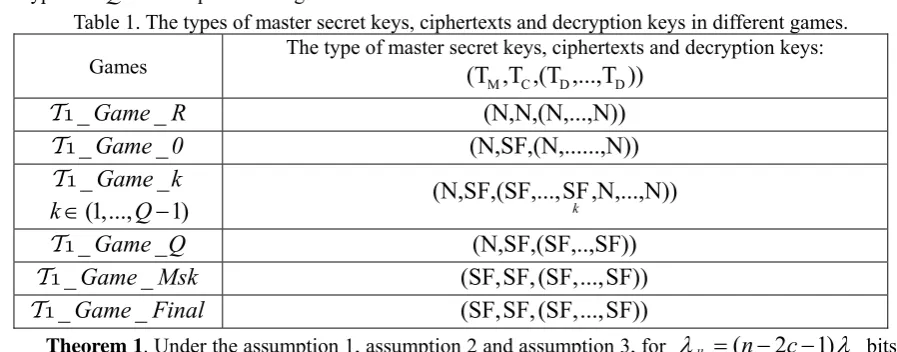
.In the following table 1, we explain the types of master secret key, ciphertexts and decryption keys which are created in different games. Let SF denote the semi-functional key or ciphertext. Let N denote the normal key or ciphertext. We use
T
M,T
C andT
D to denote the types of master secret key, ciphertext and decryption key, respectively. In each game, the maximum number of create queryO
-
Create
isQ
. Thus, we use( (T ,T ,T ),...,(T ,T ,T ) )
M C D M C DQ
to denote the according types
of
Q
create queries in a game. For every game above, the types of the ciphertexts are the same in every create query. At the same time, the types of master keys are the same in every create query. Thus,M C D M C D
((T ,T ,T ),...,(T ,T ,T ))
could be shortened as(T ,T ,( T ,...T ))
M C D DQ
to denote the accordingtypes of
Q
create queries in a game.Table 1. The types of master secret keys, ciphertexts and decryption keys in different games.
Games The type of master secret keys, ciphertexts and decryption keys:
M C D D
(T ,T ,(T ,...,T ))
_
Game R
_
T1
(N,N,(N,...,N))
_
Game 0
_
T1
(N,SF,(N,...,N))
_
Game k
_
T1
(1,...,
1)
k
∈
Q
−
(N,SF,(SF,...,SF,N,...,N))
k_
Game Q
_
T1
(N,SF,(SF,..,SF))
_
Game Msk
_
T1
(SF,SF,(SF,...,SF))
_
Game Final
_
T1
(SF,SF,(SF,...,SF))
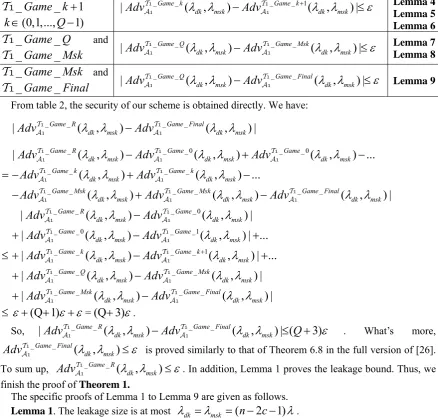
Theorem 1. Under the assumption 1, assumption 2 and assumption 3, for
λ
dk=
(
n
−
2
c
−
1)
λ
bits leakage of the decryption key andλ
msk=
(
n
−
2
c
−
1)
λ
bits leakage of the master secret key, the LR-CBE scheme is secure againstA1
wheren
≥
2
is an integer andc
is a fixed positive constant.The value of