R E V I E W
Open Access
Homeostatic plasticity in neural
development
Nai-Wen Tien
1,2*and Daniel Kerschensteiner
1,3,4,5*Abstract
Throughout life, neural circuits change their connectivity, especially during development, when neurons frequently
extend and retract dendrites and axons, and form and eliminate synapses. In spite of their changing connectivity,
neural circuits maintain relatively constant activity levels. Neural circuits achieve functional stability by homeostatic
plasticity, which equipoises intrinsic excitability and synaptic strength, balances network excitation and inhibition, and
coordinates changes in circuit connectivity. Here, we review how diverse mechanisms of homeostatic plasticity stabilize
activity in developing neural circuits.
Keywords:
Homeostatic plasticity, Neural development, Intrinsic excitability, Synaptic strength, Excitation/inhibition
ratio, Patterned spontaneous activity
Background
Nervous systems face a constant challenge: how to
maintain flexibility and stability at the same time. Neural
circuits must stay flexible to allow for changes in
con-nectivity and synaptic strength during development and
learning. As changes in connectivity push neural circuits
away from equilibrium, they need to maintain activity
within a working range and avoid extremes of
quies-cence and saturation. Functional stability is maintained
by homeostatic plasticity, which is defined broadly as a
set of neuronal changes that restore activity to a setpoint
following perturbation [
1–3
]. Recent studies have
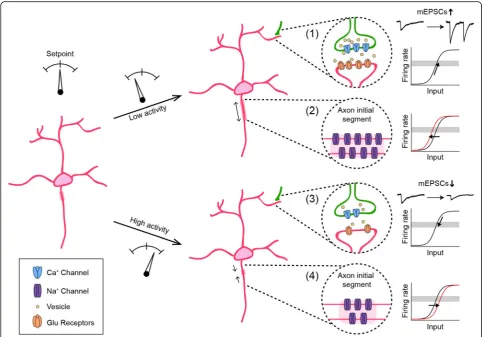
identi-fied diverse homeostatic plasticity mechanisms triggered
by a variety of perturbations. These mechanisms regulate
dendritic and axonal connectivity of a neuron, as well as
its intrinsic excitability (Fig.
1
). In addition to
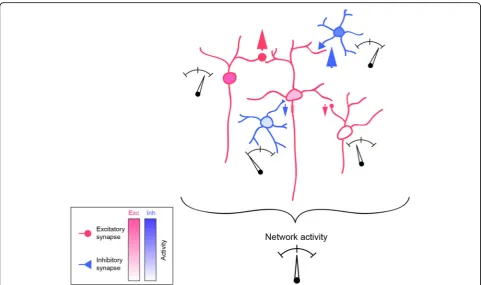
maintain-ing the activity of individual neurons, homeostatic
plasti-city can act at a network level to coordinate changes in
connectivity and excitability across multiple neurons to
stabilize circuit function [
4
] (Fig.
2
). Several recent
re-views have covered the function of homeostatic plasticity
in the mature nervous system [
5–8
]. Here, we focus on
homeostatic plasticity in developing circuits.
Homeostatic regulation of intrinsic excitability
Neuronal intrinsic excitability is determined by the density,
distribution, and function of ion channels, and controls
how synaptic inputs are converted into action potential
out-puts [
9
]. Several studies have found a reciprocal relationship
between intrinsic excitability and synaptic inputs across
de-velopment, which stabilizes activity [
10–12
]. As synaptic
in-puts increase in developing
Xenopus
retinotectal circuits,
Na
+currents decrease, reducing intrinsic excitability [
12
].
Conversely, silencing synaptic inputs to developing
Xenopus
tectal neurons and
Drosophila
motorneurons increases Na
+currents and intrinsic excitability [
10
,
12
,
13
]. Several
mechanisms mediate homeostatic changes in Na
+currents.
Translational repression and post-translational
phosphoryl-ation reduce the density and open probability, respectively,
of voltage-gated Na
+channels in
Drosophila
motorneurons
and rat cortical neurons in response to elevated
synaptic activity [
11
,
14–17
].
Multiple ion channels in the same neuron can balance
each other to stabilize activity [
2
,
18
,
19
]. For example, the
A-type K
+channels
shal
and
shaker
are reciprocally
regulated in motorneurons of
Drosophila
larvae:
shaker
is
up-regulated in
shal
mutants, and
shal
is up-regulated in
shaker
mutants [
20
]. However, compensatory expression is
not always a two-way street; in
Drosophila
mutants of the
delayed rectifier K
+channel
shab, increased expression of
the Ca
2+-dependent K
+channel
slo
prevents motorneuron
hyperactivity, but, loss of
slo
does not increase expression
* Correspondence:[email protected];[email protected]
1Department of Ophthalmology and Visual Sciences, Washington University
School of Medicine, Saint Louis, USA
Full list of author information is available at the end of the article
of
shab
[
21
]. Neurons can synergistically regulate ion
channels with opposite effects on excitability to restore
activity. Silencing of pyramidal neurons cultured from
visual cortex of rat pups with TTX increases Na
+currents
and decreases K
+currents [
22
]. Finally, neurons of the
same type with similar excitability can vary significantly in
their membrane conductances, which may reflect the
complex homeostatic interactions between ion channels
[
23–25
] (for more discussion, see [
26
,
27
]).
Detailed examination of the distribution of ion
chan-nels revealed an important role of the
axon-initial-segment
(AIS)
in
intrinsic
homeostatic
plasticity.
Changes in length and location of the AIS, a specialized
region with clusters of voltage-gated Na
+and K
+channels involved in spike generation, can counter the
effects of sensory deprivation or photostimulation [
28–31
].
In mice, eye opening at postnatal day 13
–
14 shortens
the AIS of pyramidal neurons in visual cortex [
32
,
33
].
Together, adjustments in ion channel density, distribution,
and function, resulting from changes in transcription,
translation, post-translational modifications, and
traf-ficking, can alter intrinsic excitability and balance
changes in synaptic input to maintain activity
homeo-stasis [
9
,
34–36
].
Homeostatic regulation of synapse strength and number
Homeostatic plasticity can regulate synaptic strength
pre- and postsynaptically, and its dominant expression
site can shift during development. In the early stages of
network formation, miniature excitatory postsynaptic
current (mEPSC) amplitudes increase when spike
gener-ation is blocked in cortical and hippocampal neuron
cul-tures (i.e., suppression of intrinsic excitability), indicative
of postsynaptic changes in AMPA receptor accumulation
[
37
]. At later stages, presynaptic regulation of vesicle
re-lease and recycling is added, and mEPSC frequencies
increase along with mEPSC amplitudes when spike
gener-ation is blocked [
37
,
38
]. This suggests a developmental
shift in the capacity for pre- and postsynaptic homeostatic
plasticity [
37
]. Homeostatic control of synaptic strength
has also been observed in vivo [
39
,
40
]. The extent and
ex-pression site of this control depends on circuit maturation
[
41–45
]. Homeostatic synaptic plasticity in layers 4 and 6
of primary visual cortex elicited by visual deprivation is
re-stricted to an early critical period (postnatal day 16 to 21)
[
42
,
43
]. Later, homeostatic regulation of mEPSC
ampli-tudes shifts to layers 2/3, where it persists into adulthood
[
42
,
44
]. The purpose of this shift in homeostatic plasticity
across cortical layers remains unknown [
41
]. Chronic
ac-tivity suppression by intracranial infusion of the Na
+channel blocker TTX or NMDA receptor blockers
increases spine densities of developing thalamocortical
neurons in the dorsolateral geniculate nucleus of cats and
ferrets [
46
,
47
]. Thus, homeostatic plasticity can regulate
synapse number as well as strength [
48–50
].
In addition to homeostatic synaptic changes elicited by
experimental perturbations, Desai et al. showed that
across development, mEPSC amplitudes in layers 2/3
and 4 of rat primary visual cortex decrease as mEPSC
frequencies and synapse numbers increase [
42
].
Retino-geniculate circuits provide another example of
develop-mental homeostatic co-regulation [
51–53
]. Initially,
many retinal ganglion cells converge onto
thalamocorti-cal cells, each forming weak connections. Then, for up
to 3 weeks after eye opening, thalamocortical cells prune
inputs, retaining synapses from fewer ganglion cells,
which strengthen their connections [
53
,
54
]. Thus,
pre-synaptic neurotransmitter release, postpre-synaptic receptor
abundance, and synapse number are homeostatically
co-regulated during normal development and after activity
perturbations. In several systems, the expression sites
and the combination of mechanisms engaged shift
across development [
2
,
3
,
55–57
].
Homeostatic regulation of network activity
Homeostatic plasticity can stabilize the activity of
individ-ual neurons [
54
,
58
,
59
]. Neurons connect to each other
in a cell-type-specific manner, forming circuits that
per-form specific functions. In the following sections, we
dis-cuss how homeostatic mechanisms are coordinated across
neurons to stabilize circuit function [
4
,
60
].
Homeostatic regulation of network excitation and inhibition
Network activity is determined by the ratio of excitation
and inhibition (E/I ratio) [
1
,
4
,
61
]. In response to
per-turbations, developing circuits can differentially adjust
inhibitory and excitatory connectivity to alter the E/I
ra-tio and restore activity [
62–65
]. In developing
hippo-campal and organotypic cerebellar cultures, TTX or
glutamate receptor antagonists decrease inhibitory
syn-apse densities and strengths, whereas blocking
GABAer-gic transmission with bicuculline increases the density of
inhibitory synapses. Similarly, brain slice recordings in
barrel cortex layer 4 showed that sensory deprivation
selectively reduces inhibitory input to layer 4 spiny
neurons in young but not in adult animals [
66
,
67
].
Activity-dependent
changes
in
inhibitory
synaptic
transmission appear to be regulated non-cell
autono-mously, as activity suppression of individual
presynap-tic or postsynappresynap-tic cells failed to elicit compensatory
changes observed after global application of TTX in
neonatal cultured hippocampal neurons [
65
]. It has
been suggested that inhibitory interneurons may
sacri-fice their own firing rate homeostasis to stabilize
spik-ing of cortical pyramidal neurons after global activity
blockade [
4
,
68
]. Another example of network
homeo-stasis comes from studies of monocular deprivation
during the critical period [
4
]. Here, homeostatic
plas-ticity adjusts recurrent and feedforward connections
between layer 4 circuits and layer 2/3 circuits in
pri-mary visual cortex. Visual deprivation via intraocular
TTX injection increases the excitatory drive and reduces
inhibitory drive from layer 4 to layer 2/3, compensating
for the lost excitatory sensory input [
4
,
69
,
70
].
Intri-guingly, in another deprivation paradigm (i.e., lid suture),
increased intrinsic excitability and decreased E/I ratios
stabilize activity in layer 2/3, indicating the same circuit
can use different combinations of homeostatic
mecha-nisms to compensate for sensory deprivation.
In addition to regulating excitatory and inhibitory
syn-apse strength and number, homeostatic plasticity can
switch the transmitter phenotype of neurons from
glu-tamate to GABA or vice versa to adjust the E/I ratio of
developing circuits [
71–73
]. In the embryonic
Xenopus
spinal cord, the fractions of neurons expressing
excita-tory transmitters increase and decrease, respectively,
when network activity is pharmacologically suppressed
and enhanced. These switches in transmitter phenotype
occur without changes in the expression of cell identity
markers [
74
]. Similar to homeostatic regulation of
in-hibitory synapses, the activity-dependent transmitter
switch is non-cell autonomous and depends on network
activity, evidenced by the reciprocal relationship between
the number of silenced cells and the ratio of neurons
ex-pressing GABA vs. glutamate [
75
]. Whether switches in
transmitter phenotypes contribute to network
homeosta-sis during normal development remains to be
investi-gated [
71
].
Homeostatic regulation of cell-type-specific connectivity
Recent advances in single-cell RNA sequencing together
with large-scale morphological and functional surveys
have revealed a great diversity of excitatory and
inhibi-tory cell types, which serve distinct circuit functions
[
76–79
]. This raises the questions whether, beyond
cat-egorical differences between excitatory and inhibitory
neurons, homeostatic plasticity may act in a
cell-type-specific manner to stabilize circuit function [
80
]. In the
developing dentate gyrus, loss of excitatory drive by
tet-anus toxin expression results in reduced inhibitory input
to granule cells [
81
]. This reduction is cell-type specific,
affecting somatic innervation by parvalbumin-positive
basket cells, but not dendritic innervation by
calretinin-and somatostatin-expressing interneurons. Selective
re-duction of somatic inhibition efficiently restores the
firing of granule cells [
82
,
83
]. Similarly, monocular
deprivation during a pre-critical period was shown to
regulate feedback but not feedforward inhibition to layer
4 pyramidal cells in rat primary visual cortex [
84
]; and
early hearing loss weakens inhibitory synapses from
fast-spiking interneurons but not from low-threshold fast-spiking
interneurons onto pyramidal cells [
85
,
86
].
Homeostatic regulation of excitatory connectivity can
also be cell type specific [
87
]. In the developing mouse
retina, following removal of their dominant B6 bipolar
cell input, ON
α
retinal ganglion cells up-regulate
con-nectivity with XBC, B7, and rod bipolar cells, but leave
input from B8 bipolar cells unchanged. This
cell-type-specific rewiring not only maintains the sustained
ac-tivity of ON
α
retinal ganglion cells, but also precisely
preserves their light responses. Thus, homeostatic
plasticity can regulate inhibitory and excitatory
connectiv-ity in a cell-type-specific manner to maintain the activconnectiv-ity
and sensory function of developing circuits.
Homeostatic regulation of patterned spontaneous activity
spinal networks revealed an important role of
excita-tory GABAergic currents in homeostatic regulation of
patterned spontaneous activity [
98
]. During
develop-ment, GABA switches from excitatory to inhibitory as
initially high intracellular Cl
−concentrations are lowered
by the developmentally regulated expression of
cation-chloride cotransporters [
99
,
100
]. When spontaneous
net-work activity in chick embryos was reduced by injection
of a sodium channel blocker, excitatory GABAergic
mEPSC amplitudes were found to increase because of an
increased Cl
−driving force due to intracellular Cl
−accumulation [
101
,
102
].
Although homeostatic mechanisms can restore
spontan-eous activity patterns following perturbations, the extent
to which these activity patterns support normal circuit
re-finement varies depending on age and means of
perturb-ation and needs to be further investigated [
103–105
].
Conclusions
Developing circuits undergo profound changes in
con-nectivity that threaten to destabilize their activity. Recent
research has revealed a diverse set of homeostatic
plasti-city mechanisms, which safeguard activity of developing
circuits. Different combinations of these mechanisms are
recruited by different perturbations in different neuronal
cell types at different stages of development. What
sig-nals control the recruitment of specific combinations of
mechanisms is unclear and an interesting topic for
future studies [
41
,
55
].
Another important and mostly unanswered question is
how activity setpoints are determined [
2
,
106–108
].
Recent evidence suggests that this may occur during
specific critical periods of development [
109
,
110
].
Alter-ing network activity in wild-type
Drosophila
during a
critical period induces subsequent seizures, whereas
cor-recting abnormal activity in mutant flies during the same
period is sufficient to suppress seizures for life.
Import-antly, in the seizure-prone flies, homeostatic plasticity
mechanisms are intact, but working toward the
“
wrong
”
setpoints. Insights into critical period timing and
deter-minants of activity setpoints could have significant
im-plications for the treatment of neurodevelopmental
diseases including epilepsy and autisms [
111–114
].
Abbreviations
AIS:Axon-initial-segment; E/I: Excitation/Inhibition; mEPSC: miniature excitatory postsynaptic current
Funding
Work of the authors was supported by funding from the National Institutes of Health (NIH EY023441, EY026978, and EY027411).
Availability of data and materials
Data sharing not applicable to this review article.
Authors’contributions
N-WT and DK wrote the manuscript. Both authors read and approved the final manuscript.
Ethics approval and consent to participate
Not applicable.
Competing interests
The authors declare that they have no competing interests.
Publisher
’
s Note
Springer Nature remains neutral with regard to jurisdictional claims in published maps and institutional affiliations.
Author details 1
Department of Ophthalmology and Visual Sciences, Washington University School of Medicine, Saint Louis, USA.2Graduate Program in Neuroscience,
Washington University School of Medicine, Saint Louis, USA.3Department of Neuroscience, Washington University School of Medicine, Saint Louis, USA.
4
Department of Biomedical Engineering, Washington University School of Medicine, Saint Louis, USA.5Hope Center for Neurological Disorders,
Washington University School of Medicine, Saint Louis, MO 63110, USA.
Received: 9 January 2018 Accepted: 24 April 2018
References
1. Turrigiano GG, Nelson SB. Homeostatic plasticity in the developing nervous system. Nat Rev Neurosci. 2004;5(2):97–107.
2. Davis GW. Homeostatic signaling and the stabilization of neural function. Neuron. 2013;80(3):718–28.
3. Wefelmeyer W, Puhl CJ, Burrone J. Homeostatic plasticity of subcellular neuronal structures: from inputs to outputs. Trends Neurosci. 2016;39(10):656–67. 4. Maffei A, Fontanini A. Network homeostasis: a matter of coordination. Curr
Opin Neurobiol. 2009;19(2):168–73.
5. Fox K, Stryker M. Integrating Hebbian and homeostatic plasticity: introduction. Philos Trans R Soc Lond Ser B Biol Sci. 2017;372(1715).https:// doi.org/10.1098/rstb.2016.0413.
6. Turrigiano GG. The dialectic of Hebb and homeostasis. Philos Trans R Soc Lond Ser B Biol Sci. 2017;372(1715).https://doi.org/10.1098/rstb.2016.0258. 7. Turrigiano GG. The self-tuning neuron: synaptic scaling of excitatory synapses.
Cell. 2008;135(3):422–35.
8. Vitureira N, Goda Y. Cell biology in neuroscience: the interplay between Hebbian and homeostatic synaptic plasticity. J Cell Biol. 2013;203(2):175–86. 9. Beck H, Yaari Y. Plasticity of intrinsic neuronal properties in CNS disorders.
Nat Rev Neurosci. 2008;9(5):357–69.
10. Baines RA, Uhler JP, Thompson A, Sweeney ST, Bate M. Altered electrical properties in Drosophila neurons developing without synaptic transmission. J Neurosci. 2001;21(5):1523–31.
11. Baines RA. Postsynaptic protein kinase a reduces neuronal excitability in response to increased synaptic excitation in the Drosophila CNS. J Neurosci. 2003;23(25):8664–72.
12. Pratt KG, Aizenman CD. Homeostatic regulation of intrinsic excitability and synaptic transmission in a developing visual circuit. J Neurosci. 2007;27(31): 8268–77.
13. Hamodi AS, Pratt KG. Region-specific regulation of voltage-gated intrinsic currents in the developing optic tectum of the Xenopus tadpole. J Neurophysiol. 2014;112(7):1644–55.
14. Mee CJ, Pym EC, Moffat KG, Baines RA. Regulation of neuronal excitability through pumilio-dependent control of a sodium channel gene. J Neurosci. 2004;24(40):8695–703.
15. Muraro NI, Weston AJ, Gerber AP, Luschnig S, Moffat KG, Baines RA. Pumilio binds Para mRNA and requires Nanos and brat to regulate sodium current in Drosophila motoneurons. J Neurosci. 2008;28(9):2099–109.
16. Driscoll HE, Muraro NI, He M, Baines RA. Pumilio-2 regulates translation of Nav1.6 to mediate homeostasis of membrane excitability. J Neurosci. 2013; 33(23):9644–54.
18. Turrigiano G, LeMasson G, Marder E. Selective regulation of current densities underlies spontaneous changes in the activity of cultured neurons. J Neurosci. 1995;15(5 Pt 1):3640–52.
19. Marder E, Prinz AA. Modeling stability in neuron and network function: the role of activity in homeostasis. Bioessays. 2002;24(12):1145–54.
20. Bergquist S, Dickman DK, Davis GW. A hierarchy of cell intrinsic and target-derived homeostatic signaling. Neuron. 2010;66(2):220–34.
21. Kim EZ, Vienne J, Rosbash M, Griffith LC. Nonreciprocal homeostatic compensation in Drosophila potassium channel mutants. J Neurophysiol. 2017; 117(6):2125–36.
22. Desai NS, Rutherford LC, Turrigiano GG. Plasticity in the intrinsic excitability of cortical pyramidal neurons. Nat Neurosci. 1999;2(6):515–20.
23. Schulz DJ, Goaillard JM, Marder E. Variable channel expression in identified single and electrically coupled neurons in different animals. Nat Neurosci. 2006;9(3):356–62.
24. Golowasch J, Goldman MS, Abbott LF, Marder E. Failure of averaging in the construction of a conductance-based neuron model. J Neurophysiol. 2002; 87(2):1129–31.
25. Schulz DJ. Plasticity and stability in neuronal output via changes in intrinsic excitability: it's what's inside that counts. J Exp Biol. 2006;209(Pt 24):4821–7.
26. O'Leary T, Williams AH, Caplan JS, Marder E. Correlations in ion channel expression emerge from homeostatic tuning rules. Proc Natl Acad Sci U S A. 2013;110(28):E2645–54.
27. Hudson AE, Prinz AA. Conductance ratios and cellular identity. PLoS Comput Biol. 2010;6(7):e1000838.
28. Grubb MS, Burrone J. Activity-dependent relocation of the axon initial segment fine-tunes neuronal excitability. Nature. 2010;465(7301):1070–4. 29. Kuba H, Oichi Y, Ohmori H. Presynaptic activity regulates Na(+) channel
distribution at the axon initial segment. Nature. 2010;465(7301):1075–8. 30. Evans MD, Dumitrescu AS, Kruijssen DLH, Taylor SE, Grubb MS. Rapid
modulation of axon initial segment length influences repetitive spike firing. Cell Rep. 2015;13(6):1233–45.
31. Yin J, Yuan Q. Structural homeostasis in the nervous system: a balancing act for wiring plasticity and stability. Front Cell Neurosci. 2014;8:439.
32. Gutzmann A, Ergul N, Grossmann R, Schultz C, Wahle P, Engelhardt M. A period of structural plasticity at the axon initial segment in developing visual cortex. Front Neuroanat. 2014;8:11.
33. Petersen AV, Cotel F, Perrier JF. Plasticity of the axon initial segment: fast and slow processes with multiple functional roles. Neuroscientist. 2016;23(4): 364–73.
34. Temporal S, Lett KM, Schulz DJ. Activity-dependent feedback regulates correlated ion channel mRNA levels in single identified motor neurons. Current biology : CB. 2014;24(16):1899–904.
35. Zhang W, Linden DJ. The other side of the engram: experience-driven changes in neuronal intrinsic excitability. Nat Rev Neurosci. 2003;4(11): 885–900.
36. Frick A, Johnston D. Plasticity of dendritic excitability. J Neurobiol. 2005; 64(1):100–15.
37. Wierenga CJ, Walsh MF, Turrigiano GG. Temporal regulation of the expression locus of homeostatic plasticity. J Neurophysiol. 2006;96(4):2127–33. 38. Burrone J, O'Byrne M, Murthy VN. Multiple forms of synaptic plasticity
triggered by selective suppression of activity in individual neurons. Nature. 2002;420(6914):414–8.
39. Kaneko M, Stryker MP. Homeostatic plasticity mechanisms in mouse V1. Philos Trans R Soc Lond Ser B Biol Sci. 2017;372(1715).https://doi.org/10. 1098/rstb.2016.0504.
40. Johnson RE, Tien NW, Shen N, Pearson JT, Soto F, Kerschensteiner D. Homeostatic plasticity shapes the visual system's first synapse. Nat Commun. 2017;8(1):1220. 41. Turrigiano G. Homeostatic synaptic plasticity: local and global mechanisms
for stabilizing neuronal function. Cold Spring Harb Perspect Biol. 2012;4(1): a005736.
42. Desai NS, Cudmore RH, Nelson SB, Turrigiano GG. Critical periods for experience-dependent synaptic scaling in visual cortex. Nat Neurosci. 2002;5(8):783–9.
43. Petrus E, Anguh TT, Pho H, Lee A, Gammon N, Lee HK. Developmental switch in the polarity of experience-dependent synaptic changes in layer 6 of mouse visual cortex. J Neurophysiol. 2011;106(5):2499–505.
44. Goel A, Lee HK. Persistence of experience-induced homeostatic synaptic plasticity through adulthood in superficial layers of mouse visual cortex. J Neurosci. 2007;27(25):6692–700.
45. Espinosa JS, Stryker MP. Development and plasticity of the primary visual cortex. Neuron. 2012;75(2):230–49.
46. Dalva MB, Ghosh A, Shatz CJ. Independent control of dendritic and axonal form in the developing lateral geniculate nucleus. J Neurosci. 1994;14(6): 3588–602.
47. Rocha M, Sur M. Rapid acquisition of dendritic spines by visual thalamic neurons after blockade of N-methyl-D-aspartate receptors. Proc Natl Acad Sci U S A. 1995;92(17):8026–30.
48. Pak DT, Sheng M. Targeted protein degradation and synapse remodeling by an inducible protein kinase. Science. 2003;302(5649):1368–73.
49. Seeburg DP, Sheng M. Activity-induced polo-like kinase 2 is required for homeostatic plasticity of hippocampal neurons during epileptiform activity. J Neurosci. 2008;28(26):6583–91.
50. Lee KJ, Lee Y, Rozeboom A, Lee JY, Udagawa N, Hoe HS, Pak DT. Requirement for Plk2 in orchestrated ras and rap signaling, homeostatic structural plasticity, and memory. Neuron. 2011;69(5):957–73.
51. Chen C, Regehr WG. Developmental remodeling of the retinogeniculate synapse. Neuron. 2000;28(3):955–66.
52. Jaubert-Miazza L, Green E, Lo FS, Bui K, Mills J, Guido W. Structural and functional composition of the developing retinogeniculate pathway in the mouse. Vis Neurosci. 2005;22(5):661–76.
53. Hooks BM, Chen C. Distinct roles for spontaneous and visual activity in remodeling of the retinogeniculate synapse. Neuron. 2006;52(2):281–91. 54. Lin DJ, Kang E, Chen C. Changes in input strength and number are driven
by distinct mechanisms at the retinogeniculate synapse. J Neurophysiol. 2014;112(4):942–50.
55. Davis GW, Muller M. Homeostatic control of presynaptic neurotransmitter release. Annu Rev Physiol. 2015;77:251–70.
56. Burrone J, Murthy VN. Synaptic gain control and homeostasis. Curr Opin Neurobiol. 2003;13(5):560–7.
57. Oleskevich S, Walmsley B. Synaptic transmission in the auditory brainstem of normal and congenitally deaf mice. J Physiol. 2002;540(Pt 2):447–55. 58. Echegoyen J, Neu A, Graber KD, Soltesz I. Homeostatic plasticity studied
using in vivo hippocampal activity-blockade: synaptic scaling, intrinsic plasticity and age-dependence. PLoS One. 2007;2(8):e700.
59. Lambo ME, Turrigiano GG. Synaptic and intrinsic homeostatic mechanisms cooperate to increase L2/3 pyramidal neuron excitability during a late phase of critical period plasticity. J Neurosci. 2013;33(20):8810–9.
60. Slomowitz E, Styr B, Vertkin I, Milshtein-Parush H, Nelken I, Slutsky M, Slutsky I. Interplay between population firing stability and single neuron dynamics in hippocampal networks. elife. 2015;4:e04378.
61. Pozo K, Goda Y. Unraveling mechanisms of homeostatic synaptic plasticity. Neuron. 2010;66(3):337–51.
62. Chattopadhyaya B, Di Cristo G, Higashiyama H, Knott GW, Kuhlman SJ, Welker E, Huang ZJ. Experience and activity-dependent maturation of perisomatic GABAergic innervation in primary visual cortex during a postnatal critical period. J Neurosci. 2004;24(43):9598–611.
63. Marty S, Wehrle R, Sotelo C. Neuronal activity and brain-derived neurotrophic factor regulate the density of inhibitory synapses in organotypic slice cultures of postnatal hippocampus. J Neurosci. 2000;20(21):8087–95.
64. Seil FJ, Drake-Baumann R. Reduced cortical inhibitory synaptogenesis in organotypic cerebellar cultures developing in the absence of neuronal activity. J Comp Neurol. 1994;342(3):366–77.
65. Hartman KN, Pal SK, Burrone J, Murthy VN. Activity-dependent regulation of inhibitory synaptic transmission in hippocampal neurons. Nat Neurosci. 2006;9(5):642–9.
66. Jiao Y, Zhang C, Yanagawa Y, Sun QQ. Major effects of sensory experiences on the neocortical inhibitory circuits. J Neurosci. 2006;26(34):8691–701. 67. Flores CE, Mendez P. Shaping inhibition: activity dependent structural
plasticity of GABAergic synapses. Front Cell Neurosci. 2014;8:327. 68. Rutherford LC, Nelson SB, Turrigiano GG. BDNF has opposite effects on the
quantal amplitude of pyramidal neuron and interneuron excitatory synapses. Neuron. 1998;21(3):521–30.
69. Maffei A, Nataraj K, Nelson SB, Turrigiano GG. Potentiation of cortical inhibition by visual deprivation. Nature. 2006;443(7107):81–4. 70. Maffei A, Turrigiano GG. Multiple modes of network homeostasis in visual
cortical layer 2/3. J Neurosci. 2008;28(17):4377–84.
71. Borodinsky LN, Belgacem YH, Swapna I, Sequerra EB. Dynamic regulation of neurotransmitter specification: relevance to nervous system homeostasis. Neuropharmacology. 2014;78:75–80.
73. Spitzer NC. Neurotransmitter switching in the developing and adult brain. Annu Rev Neurosci. 2017;40:1–19.
74. Borodinsky LN, Root CM, Cronin JA, Sann SB, Gu X, Spitzer NC. Activity-dependent homeostatic specification of transmitter expression in embryonic neurons. Nature. 2004;429(6991):523–30.
75. Guemez-Gamboa A, Xu L, Meng D, Spitzer NC. Non-cell-autonomous mechanism of activity-dependent neurotransmitter switching. Neuron. 2014;82(5):1004–16. 76. Tasic B, Menon V, Nguyen TN, Kim TK, Jarsky T, Yao Z, Levi B, Gray LT,
Sorensen SA, Dolbeare T, et al. Adult mouse cortical cell taxonomy revealed by single cell transcriptomics. Nat Neurosci. 2016;19(2):335–46. 77. Cembrowski MS, Wang L, Sugino K, Shields BC, Spruston N. Hipposeq: a
comprehensive RNA-seq database of gene expression in hippocampal principal neurons. elife. 2016;5:e14997.
78. Toledo-Rodriguez M, Markram H. Single-cell RT-PCR, a technique to decipher the electrical, anatomical, and genetic determinants of neuronal diversity. Methods Mol Biol. 2007;403:123–39.
79. Bloodgood BL, Sharma N, Browne HA, Trepman AZ, Greenberg ME. The activity-dependent transcription factor NPAS4 regulates domain-specific inhibition. Nature. 2013;503(7474):121–5.
80. Bartley AF, Huang ZJ, Huber KM, Gibson JR. Differential activity-dependent, homeostatic plasticity of two neocortical inhibitory circuits. J Neurophysiol. 2008;100(4):1983–94.
81. Pieraut S, Gounko N, Sando R 3rd, Dang W, Rebboah E, Panda S, Madisen L, Zeng H, Maximov A. Experience-dependent remodeling of basket cell networks in the dentate gyrus. Neuron. 2014;84(1):107–22.
82. Miles R, Toth K, Gulyas AI, Hajos N, Freund TF. Differences between somatic and dendritic inhibition in the hippocampus. Neuron. 1996;16(4):815–23. 83. Pouille F, Scanziani M. Enforcement of temporal fidelity in pyramidal cells by
somatic feed-forward inhibition. Science. 2001;293(5532):1159–63. 84. Maffei A, Nelson SB, Turrigiano GG. Selective reconfiguration of layer 4 visual
cortical circuitry by visual deprivation. Nat Neurosci. 2004;7(12):1353–9. 85. Takesian AE, Kotak VC, Sanes DH. Presynaptic GABA(B) receptors regulate
experience-dependent development of inhibitory short-term plasticity. J Neurosci. 2010;30(7):2716–27.
86. Takesian AE, Kotak VC, Sharma N, Sanes DH. Hearing loss differentially affects thalamic drive to two cortical interneuron subtypes. J Neurophysiol. 2013; 110(4):999–1008.
87. Tien NW, Soto F, Kerschensteiner D. Homeostatic plasticity shapes cell-type-specific wiring in the retina. Neuron. 2017;94(3):656–65. e654
88. Blankenship AG, Feller MB. Mechanisms underlying spontaneous patterned activity in developing neural circuits. Nat Rev Neurosci. 2010;11(1):18–29. 89. Kerschensteiner D. Spontaneous network activity and synaptic development.
J Neurosci. 2014;20(3):272–90.
90. Ackman JB, Burbridge TJ, Crair MC. Retinal waves coordinate patterned activity throughout the developing visual system. Nature. 2012;490(7419):219–25. 91. Assali A, Gaspar P, Rebsam A. Activity dependent mechanisms of visual map
formation–from retinal waves to molecular regulators. Semin Cell Dev Biol. 2014;35:136–46.
92. Arroyo DA, Feller MB. Spatiotemporal features of retinal waves instruct the wiring of the visual circuitry. Front Neural Circuits. 2016;10:54.
93. Stacy RC, Demas J, Burgess RW, Sanes JR, Wong RO. Disruption and recovery of patterned retinal activity in the absence of acetylcholine. J Neurosci. 2005; 25(41):9347–57.
94. Sun C, Warland DK, Ballesteros JM, van der List D, Chalupa LM: Retinal waves in mice lacking the beta2 subunit of the nicotinic acetylcholine receptor. Proc Natl Acad Sci U S A 2008, 105(36):13638–13643.
95. Stafford BK, Sher A, Litke AM, Feldheim DA. Spatial-temporal patterns of retinal waves underlying activity-dependent refinement of retinofugal projections. Neuron. 2009;64(2):200–12.
96. Bansal A, Singer JH, Hwang BJ, Xu W, Beaudet A, Feller MB. Mice lacking specific nicotinic acetylcholine receptor subunits exhibit dramatically altered spontaneous activity patterns and reveal a limited role for retinal waves in forming ON and OFF circuits in the inner retina. J Neurosci. 2000;20(20):7672–81.
97. Blankenship AG, Ford KJ, Johnson J, Seal RP, Edwards RH, Copenhagen DR, Feller MB. Synaptic and extrasynaptic factors governing glutamatergic retinal waves. Neuron. 2009;62(2):230–41.
98. Wenner P. Homeostatic synaptic plasticity in developing spinal networks driven by excitatory GABAergic currents. Neuropharmacology. 2014;78:55–62. 99. Ben-Ari Y, Gaiarsa JL, Tyzio R, Khazipov R. GABA: a pioneer transmitter that excites immature neurons and generates primitive oscillations. Physiol Rev. 2007;87(4):1215–84.
100. Blaesse P, Airaksinen MS, Rivera C, Kaila K. Cation-chloride cotransporters and neuronal function. Neuron. 2009;61(6):820–38.
101. Gonzalez-Islas C, Wenner P. Spontaneous network activity in the embryonic spinal cord regulates AMPAergic and GABAergic synaptic strength. Neuron. 2006;49(4):563–75.
102. Gonzalez-Islas C, Chub N, Garcia-Bereguiain MA, Wenner P. GABAergic synaptic scaling in embryonic motoneurons is mediated by a shift in the chloride reversal potential. J Neurosci. 2010;30(39):13016–20. 103. Torborg CL, Feller MB. Spontaneous patterned retinal activity and the
refinement of retinal projections. Prog Neurobiol. 2005;76(4):213–35. 104. Huberman AD, Wang GY, Liets LC, Collins OA, Chapman B, Chalupa LM.
Eye-specific retinogeniculate segregation independent of normal neuronal activity. Science. 2003;300(5621):994–8.
105. Torborg CL, Hansen KA, Feller MB. High frequency, synchronized bursting drives eye-specific segregation of retinogeniculate projections. Nat Neurosci. 2005;8(1):72–8.
106. Giachello CN, Baines RA. Regulation of motoneuron excitability and the setting of homeostatic limits. Curr Opin Neurobiol. 2017;43:1–6. 107. Hobert O. Terminal selectors of neuronal identity. Curr Top Dev Biol. 2016;
116:455–75.
108. Marder E, Goaillard JM. Variability, compensation and homeostasis in neuron and network function. Nat Rev Neurosci. 2006;7(7):563–74.
109. Giachello CN, Baines RA. Inappropriate neural activity during a sensitive period in embryogenesis results in persistent seizure-like behavior. Current biology : CB. 2015;25(22):2964–8.
110. Truszkowski TL, Aizenman CD. Neurobiology: setting the set point for neural homeostasis. Current biology : CB. 2015;25(23):R1132–3.
111. Ramocki MB, Zoghbi HY. Failure of neuronal homeostasis results in common neuropsychiatric phenotypes. Nature. 2008;455(7215):912–8.
112. Meredith RM, Dawitz J, Kramvis I. Sensitive time-windows for susceptibility in neurodevelopmental disorders. Trends Neurosci. 2012;35(6):335–44. 113. Mullins C, Fishell G, Tsien RW. Unifying views of autism Spectrum disorders:
a consideration of autoregulatory feedback loops. Neuron. 2016;89(6):1131–56. 114. Vislay RL, Martin BS, Olmos-Serrano JL, Kratovac S, Nelson DL, Corbin JG,