Open Access
Research
Identification of metabolic system parameters using global
optimization methods
Pradeep K Polisetty
1, Eberhard O Voit
2and Edward P Gatzke*
1Address: 1Department of Chemical Engineering, University of South Carolina, Swearingen Engineering Center, 301 Main Street, Columbia, SC
29208, USA and 2The Wallace H. Coulter Department of Biomedical Engineering, Georgia Institute of Technology and Emory University, 313 Ferst
Drive, Suite 4103, Atlanta, GA 30332, USA
Email: Pradeep K Polisetty - [email protected]; Eberhard O Voit - [email protected]; Edward P Gatzke* - [email protected] * Corresponding author
Abstract
Background: The problem of estimating the parameters of dynamic models of complex biological systems from time series data is becoming increasingly important.
Methods and results: Particular consideration is given to metabolic systems that are formulated as Generalized Mass Action (GMA) models. The estimation problem is posed as a global optimization task, for which novel techniques can be applied to determine the best set of parameter values given the measured responses of the biological system. The challenge is that this task is nonconvex. Nonetheless, deterministic optimization techniques can be used to find a global solution that best reconciles the model parameters and measurements. Specifically, the paper employs branch-and-bound principles to identify the best set of model parameters from observed time course data and illustrates this method with an existing model of the fermentation pathway in
Saccharomyces cerevisiae. This is a relatively simple yet representative system with five dependent states and a total of 19 unknown parameters of which the values are to be determined.
Conclusion: The efficacy of the branch-and-reduce algorithm is illustrated by the S. cerevisiae
example. The method described in this paper is likely to be widely applicable in the dynamic modeling of metabolic networks.
Background
The past few years have witnessed an enormous increase in the availability and quality of high-throughput data characterizing the status of cells at the genomic, pro-teomic, metabolic and physiological levels. In most cases, these data were interpreted as simple snapshots or in a comparative setting with the goal of differentiating between normal and perturbed or diseased cells. It is now becoming feasible to use the same methods to record the status of cells over time. The resulting time series data con-tain enormous amounts of information on the dynamics
of functioning cells. Several groups of scientists around the world have begun to develop methods for inferring from these profiles the underlying functional networks at the genomic or metabolic level. In principle, this task is a straightforward matter of defining a suitable model and estimating its structure, but numerous conceptual and computational difficulties have made the implementation of this inverse problem challenging. The difficulties fall into several categories.
Published: 27 January 2006
Theoretical Biology and Medical Modelling2006, 3:4 doi:10.1186/1742-4682-3-4
Received: 26 November 2005 Accepted: 27 January 2006
This article is available from: http://www.tbiomed.com/content/3/1/4
© 2006Polisetty et al; licensee BioMed Central Ltd.
First, it is necessary to select a mathematical modeling framework that is rich enough to capture the observed dynamics with sufficient accuracy but that is also struc-tured in a fashion that allows interpretation of results beyond pure parameter estimation. For instance, if one selected a high-order polynomial and estimated parame-ters capturing the observed time profiles, then the result-ing coefficients would not have much meanresult-ing and could hardly be translated into biological insight. Several groups [1-10] have therefore focused on S-system models within the modeling framework of Biochemical Systems Theory (BST), which itself has a rich history of successful analysis and application. S-systems, and the alternative variant of Generalized Mass Action (GMA) systems, have the advan-tage for inverse tasks that their parameter values map essentially one-to-one onto structural and regulatory fea-tures of biological networks. Thus, structure inference is reduced to the simpler task of parameter estimation. BST has been the subject of several hundred articles, reviews, books, chapters, and presentations [11-21], which per-mits us to review only a few features that are of particular interest here.
The second difficulty arising in the inference problem is the preparation of data and the preprocessing of the task itself. Clearly, noise in the data complicates the estimation and often leads to local minima in the search space, as well as to unwanted redundancies in inference. Further-more, the fact that essentially any model of a dynamic biological system involves differential equations necessi-tates efficient integrators, because these methods may consume in excess of 95% of the time required to estimate parameters in systems of differential equations [9]. In order to reduce this computational cost, several groups have devised methods addressing some of these prob-lems. One efficient strategy is the estimation of slopes of the profiles, which permits the replacement of differen-tials with the estimated slopes at many time points and consequently the conversion of systems of differential equations into larger systems of more easily computed algebraic equations [3,9,18,22,23]. A prerequisite of this method is obviously the reliable estimation of slopes, for which various smoothing methods have been proposed, including neural network smoothing [3,9], filtering [6] and collocation methods [8]. It was also shown that decoupling of systems of n differential equations may be achieved by treating n-1 of the data sets as inputs in the remaining equation [2]. In complementary approaches, the search process was simplified by making use of auxil-iary information about the biological system, which was translated into constraints on the parameters that had to be estimated [3], and by priming the search process with reasonable initial guesses, which were obtained directly from the topology of the systems [24] or through various means of linearization [25].
The third difficulty of the inverse problem is the estima-tion of parameters itself. Because of the inherent nonline-arities, the task is hampered by trapping of the search algorithm in local minima, lack of convergence, or a con-vergence speed that makes inference of larger systems infeasible. In the past, this step has probably received the least attention, and the various groups addressing the inverse problem have resorted to standard methods of nonlinear regression, genetic algorithms or simulated annealing. In this article, we address this subtask of the inference problem by replacing the regression step with a global optimization algorithm. Specifically, we formulate the nonconvex estimation problem as a global optimiza-tion task that uses branch-and-bound principles to iden-tify the best set of model parameters given observed time profiles. The greatest advantage of this method is that it guarantees that the optimum obtained is global within pre-defined bounds on the parameter search space. Note that global optimization does not guarantee that the resulting solution is unique; the method guarantees that no other points exist with a better objective function than the global solution. Multiple degenerate solution points could exist with identical unique objective function val-ues. As an example, we estimate the parameters of a model describing the fermentation pathway in Saccharomyces cer-evisiae, as described in [26]. This system has five depend-ent states and a total of 19 unknown parameters. It is manageable in size, yet representative of the nonlineari-ties typically encountered in metabolic modeling and has therefore been used for a variety of analyses in the past [18,27-29].
Model formulation
the GMA variant overcomes this issue, even though it loses some of the advantages of the S-system form such as its linearity at steady state [12] and its sometimes slightly higher accuracy [38,39]. GMA representations have the advantage that they are closer to biochemical intuition and that production and degradation terms do not vanish if one of the contributing fluxes disappears, as is the case with S-systems. GMA systems are also interesting in that they include both stoichiometric systems and S-systems as special cases so that they allow a seamless transition from linear to fully kinetic models. Our task in this article is thus the estimation of GMA parameters from time series.
In the GMA formulation within BST, the change in each dependent pool (state variable) is described as a differ-ence between the sums of all fluxes entering the pool and all fluxes leaving the pool. Each flux is individually linear-ized in logarithmic coordinates, which in Cartesian coor-dinates corresponds to a product of power-law functions that contains those and only those variables that directly affect the flux, raised to an exponent called its kinetic order. The product also contains a rate constant that deter-mines the magnitude of the flux or speed of the process. The mathematical formulation of any GMA model is thus
where γi1,...,γik are rate constants corresponding to k reac-tions of production/consumption, and ζijk are kinetic orders for species i in reaction k involving species j. In cases where species j does not have any influence on a given power-law term, ζijk = 0. The number of reactions in one differential equation, k, may be different for each spe-cies. Reaction terms for consumption of one species may appear as a production term for another species. The sys-tem consists of n differential equations, representing the time-dependent variables, but also contains m time-inde-pendent variables that affect the system but are not affected by the system and are typically constant from one experiment to the next. The power-law terms in Eq. (1) are the result of a straightforward Taylor approximation, which is applicable to an essentially unlimited variety of underlying processes and may include different types of interactions, activation, inhibition and processes associ-ated with dilution and growth.
It is interesting to note that every parameter of a GMA model has its unique role and interpretation. This situa-tion is significantly different from using unstructured fit-ting models such as higher-order polynomials or splines. In a generic polynomial representation, every coefficient is likely to change if additional data points are used for fit-ting or if points are removed. Thus, except for the fact that the higher-order coefficients are associated with higher derivatives, which otherwise are not very meaningful, not much can be said about their biological role in the mod-eled process. In the GMA model, by contrast, every param-eter has a unique meaning in the subject area of the model. Each kinetic order quantifies solely the effect that a particular variable has on a given process. For example, the first kinetic order in a later example is ζ121 = -0.2344 (see Figure 7). Thus, it uniquely describes the effect of metabolite X2 on the first production process of X1. The effect is inhibitory, which is indicated by the negative sign, and is only moderately strong, which is reflected in the small magnitude of the parameter. In this fashion, there is a one-to-one relationship between kinetic orders and structural features of the model. The interpretability of the parameters can also been seen from a different point of view: in principle, each kinetic order can be obtained directly from local information on the system. Namely, if it possible to vary X j while keeping all other variables con-stant, and to measure the consequent changes in the pro-duction of Xj, then the slope of the production process as
a function of Xj, in log space, is exactly the kinetic order in question. This type of interpretation is usually not possi-ble in global fitting models such as high-order polynomi-als. The constant multipliers are rate constants that, as in elemental chemical kinetics, quantify the turnover rate in each process and are always non-negative. Their magni-tudes depend on the scales (time, concentration, etc.) of the modeled system.
X X X
X
i i j
j n m
i j
j n m
ik j
j n m
ij ij
ijk
= ± ± +
± = +
= +
= +
∏
∏
γ γ
γ
1 1
2 1
1
1 2
ζ ζ
ζ
...
∏
∏
=( )
, i 1 2, ,...,n
1
Convex relaxation using linear constraints
Figure 1
The S-system representation within BST is formally a spe-cial case of a GMA system with at most one positive and one negative term. The correspondence between the bio-logical network and the mathematical representation is slightly different in an S-system because all fluxes entering a pool are collectively linearized in logarithmic coordi-nates and the same is done with all fluxes leaving the pool. Thus, each S-system equation has at most one influx and one efflux term and thus reads
where αi, βi are the rate constants and gij, hij are kinetic orders. These S-system parameters are directly tied to the corresponding GMA system through constraints [18].
Both forms are nonlinear and rich enough to capture any dynamic behavior that can be represented by any set of ordinary differential equations [38]. If set up as alternative descriptions of the same biological system, the two are equivalent at one operating point of choice and typically differ if the system deviates from this point, though the differences are often small in realistic situations [18].
Working with metabolic models consists of three phases: Model design, model analysis and model application. The present work focuses on the first phase of model design. This step is usually executed by assembling a topological map of the phenomenon of interest based on biological knowledge. Kinetic orders and rate constants are then
esti-mated from measured or published kinetic information. In the case of S-systems, it would also be feasible to use steady-state data from multiple experiments with different values of independent variables. Because the steady-state equations of S-systems are linear (in logarithmic coordi-nates), such data would allow use of a simple matrix inversion leading to optimal parameters, a pseudo-inverse method or a linear programming approach [37]. In the alternative GMA approach, logarithmic transformation does not completely transform the estimation problem into a linear formulation, thus requiring nonlinear meth-ods.
In addition to this traditional bottom-up approach, a top-down approach is becoming increasingly feasible. This
X X X
i n
i i j
g
j n m
i j
h
j n m
ij ij
= −
=
( )
=+
= +
∏
∏
α β
1 1
1 2
2
, ,...,
Simple GMA system having several feedback inhibitions
Figure 3
Simple GMA system having several feedback inhibitions.
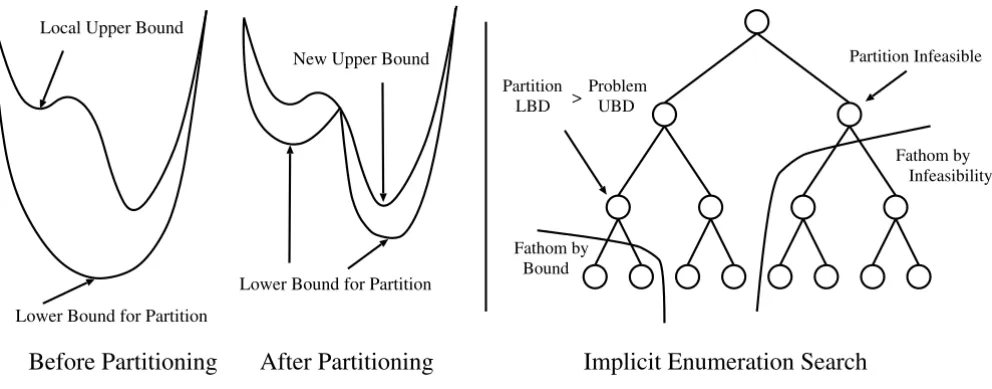
Left: A single branch-and-bound step for a nonconvex function of a continuous variable
Figure 2
Left: A single branch-and-bound step for a nonconvex function of a continuous variable. Right: Demonstration of implicit enu-meration search for a branch-and-bound tree.
Local Upper Bound
Lower Bound for Partition
New Upper Bound
Lower Bound for Partition
Before Partitioning
After Partitioning
Fathom by Infeasibility
Fathom by Bound
Partition Problem LBD UBD
Partition Infeasible
>
complementary approach is based on time profiles that are used for the determination of system parameters through some type of estimation and their interpretation in terms of structural and regulatory information. We describe in the following how this estimation is facilitated with a branch-and-bound method, which has not previ-ously been used for this purpose.
Optimization formulation
The goal of model identification is to estimate the "best" set of parameter values, which minimizes the error between the process data and the model response. This parameter estimation problem can be formulated as a nonconvex nonlinear optimization problem and can therefore be solved using global optimization techniques. The parameters to be estimated in GMA systems are rate constants γand kinetic orders ζas shown in Equation 1 leading to the following formulation:
The parameter r denotes the r-norm considered for mini-mization. It usually takes the values 1 (min sum abso-lute), 2 (min sum square), or ∞ (min max error). P is the number of data points sampled at times t, hi are the
non-linear rate expressions from Eq. (1) that define the pro-duction and consumption rates for species i given vectors of model parameters γand ζ, ei(t) are the errors associated
with each constraint equation for species i at time t, and n is the number of dependent variables. In the formulation described above, the objective function is linear because the maximum absolute error is minimized. The noncon-vexity arises from the equality constraints, which are non-linear. It is useful to split these nonlinear equality constraints into two inequality constraints, at least one of which will be nonconvex.
Following strategies proposed in the literature [6,8,9], it is possible to smooth the raw time profiles, which subse-quently allows the computation of slopes at many data points and thus the replacement of differentials on the left-hand side of Equation 1 with estimated slopes. Thus, assuming that the rate of change of each species is obtain-able at each desired time point, (t), and the values of the concentrations Xi(t) at time i are known, the optimiza-tion task in Eq. (3) can be formulated as a general
non-convex nonlinear programming problem in the form shown in Eq. (4):
where the vector x ∈RN is a vector of N unknowns
includ-ing the error terms and unknown parameters and f(x), gk(x) : RN →R1. Here, the index k represents constraint k
of m total constraints.
This formulation is rather general in that the functions f(x) and gk(x) may be nonlinear and nonconvex. In partic-ular, the formulation allows the estimation of globally optimal GMA systems, given time profiles. Deterministic methods for global optimizations of this type depend on the generation of convex function relaxations of the non-convex nonlinear functions. Numerous methods have been proposed for constructing such relaxations. For this work, we use a reformulation method for factorable expressions [40]. This method converts the original factor-able nonconvex nonlinear problem into an equivalent form through the introduction of new variables zik for every product of power-law terms at measurement sample time t in the system [15]:
Note that the species concentration Xi(t) in the preceding equation is assumed to be known from the observed data. If it is not, it may be obtained through interpolation from a preparatory smoothing of the observed data [3,9]. If no information at all is available on the variable, the GMA representation should probably be reduced in complexity [18]. As an example for such a reduction, suppose that X1 is converted into X2 and X2 is converted into X3. If X2 is not
observable, then one would probably formulate the sys-tem without X2, and make X3 a function of X1. Since the mathematics underlying the GMA representation is directly based on Taylor's theorem, X3 then simply becomes a power-law term containing X1. Such omissions
of variables have been discussed in the literature [31,41].
For simplicity of discussion, we assume that a complete data set is available. The problem specified in Eq. (3) is then of the form:
min
. . , ,
, ,...,
,
γ ζ
γ ζ
, e
s t X t h X t e t
i n
r t
r
i i i
( )
=(
( )
)
−( )
∀ = > ∀ =
1 2 0 1 2,,...,P
3
( )
Xi
min
. . ... x f x s t g x
k m
x x x
k
l u
( )
( )
≤ ∀ =≤ ≤
( )
0
1 4
zik t ik Xj t
j n m
ijk
( )
=(
( )
)
( )
= +
∏
γ ζ
1
where sik for reaction k of production or consumption of
species i is either +1 or -1. The variables in this reformu-lated problem can be collected into the vectors z, e, γ, and
ζ
To obtain efficacious solutions, the problem must be for-mulated such that it contains only linear and "simple" nonlinear constraint functions for which one can con-struct relaxations that use the convex envelopes already known for simple algebraic functions. The nonlinear equality constraints in the original GMA formulation become simple (linear) sums when they are expressed in the new variables, z. Furthermore, taking the logarithm of
each definition for z from Eq. (5) leads to a new set of lin-ear equations and simple nonlinlin-ear equations. The con-nection between these two sets is a set of simple logarithmic constraints. To streamline notation, the addi-tional new variables are defined as: wik = ln(zik) and Γik = ln(γik). Thus, we obtain a sum of logarithmic functions for each term zik(t), namely:
For the purpose of convexification, one can omit the log-arithm of the rate constant because it simply shifts the optimal solution by a constant. This results in the follow-ing formulation:
As sij, Xi(t), and (t) are known at time values t, the only
unknowns are w Γ, z, ζand e. Values for γcan be deter-mined easily when the solution value for Γ is found. All constraints other than wik(t) = ln(zik(t)) are linear.
min
. .
e
s t X t s z t e t
z t X t
r
i ik ik i
k
ik ik j
j
ijk
( )
=( )
−( )
( )
( )
=( )
∑
=
6
1
γ nn m ζ
i n
r
t P
+
∏
∀ = > ∀ =
1 2 0 1 2
, ,...,
, ,..., w t X t
w t z t
ik ik ijk j
j n m
ik ik
ik ik
( )
= +(
( )
)
( )
=(
( )
)
=
(
= +
∑
Γ
Γ
ζ
γ
ln
ln
ln 1
))
( )
7
min
. .
e
s t X t s z t e t
w t X
r
i ik ik i
k
ik ik ijk
j n m
( )
=( )
−( )
( )
= +∑
∑
= +
Γ ζ
1
ln jj
ik ik
t
w t z t
( )
(
)
( )
=(
( )
)
( )
ln
8
Xi
Model equations for simple GMA system
Figure 4
Model equations for simple GMA system.
˙
X
1= 0
.
8
X
2−1X
3−1X
40.5−
3
X
10.5X
2−0.1−
2
X
10.75X
3−0.2˙
X
2= 3
X
10.5X
2−0.1−
1
.
5
X
20.5˙
X
3= 2
X
10.75X
3−0.2−
5
X
30.5X
4= 0
.
25
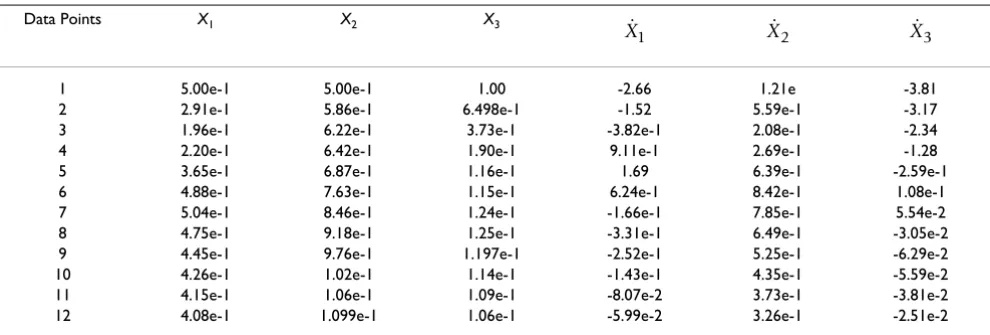
Table 1: Time series data of the states and slopes for the didactic example Data Points X1 X2 X3
1 5.00e-1 5.00e-1 1.00 -2.66 1.21e -3.81 2 2.91e-1 5.86e-1 6.498e-1 -1.52 5.59e-1 -3.17 3 1.96e-1 6.22e-1 3.73e-1 -3.82e-1 2.08e-1 -2.34 4 2.20e-1 6.42e-1 1.90e-1 9.11e-1 2.69e-1 -1.28 5 3.65e-1 6.87e-1 1.16e-1 1.69 6.39e-1 -2.59e-1 6 4.88e-1 7.63e-1 1.15e-1 6.24e-1 8.42e-1 1.08e-1 7 5.04e-1 8.46e-1 1.24e-1 -1.66e-1 7.85e-1 5.54e-2 8 4.75e-1 9.18e-1 1.25e-1 -3.31e-1 6.49e-1 -3.05e-2 9 4.45e-1 9.76e-1 1.197e-1 -2.52e-1 5.25e-1 -6.29e-2 10 4.26e-1 1.02e-1 1.14e-1 -1.43e-1 4.35e-1 -5.59e-2 11 4.15e-1 1.06e-1 1.09e-1 -8.07e-2 3.73e-1 -3.81e-2 12 4.08e-1 1.099e-1 1.06e-1 -5.99e-2 3.26e-1 -2.51e-2
As mentioned earlier, the parameter r in Eq (3) denotes the r-norm considered for minimization. In the case with r = 1, the sum absolute value of the error, which is linear, is desired for minimization. In the case of r = 2, the objec-tive function is nonlinear, but at least convex. This nonlin-earity increases the complexity of the task during the generation of problem relaxations, requiring additional variables and constraints in the linear relaxation. It is well known that when minimizing the absolute value of some variable, constraints of the form |f(x)| = e can be written as two inequality constraints, f(x) ≤e, and -f(x) ≤e. The formulation then may be written as follows:
Note that the variables Γik, ζijk and ei(t) can be consoli-dated into the vector y. The variables in this vector y only appear in linear constraints, while w and z are related through a simple nonlinear expression. Thus, in compari-son with the formulation of Equation 4, the variables x include w, z and y. The objective function f(x) and many of the constraint functions gk(x) are linear. The objective
function (1) represents a sum of the absolute value of errors on the balance equations. The balance equations in (2) and (3) relate the rate of change, (t) of the species at time t, to the individual reaction rates that consume or produce that species, zik(t), as well as the absolute error for that equation at that point in time. Constraints (4) and (5) result from the transformation of the power-law expressions for the rate equations.
The convex relaxation using linear constraints for a loga-rithmic function is illustrated in Figure 1. In this figure, the solid line corresponds to the nonlinear function w = 2 * ln(x), the dashed line represents the linear underestimat-ing function, and the dash-dot lines serve as the linear overestimating functions.
As bounds are known for the concave nonconvex func-tion, the secant can be used as a linear underestimation function. Multiple outer approximation linearizations can be used as linear overestimation functions. The
intersec-tion of these linear constraints is a relaxaintersec-tion of the origi-nal nonlinear function.
Taking the formulation in Eq. (9), coefficients for the lin-ear inequality constraints are the constant values of (t) and sik. The linear equality constraint coefficients include
the constant values ln(Xj(t)), while e, z, w, Γ and ζ, are the unknowns. The reformulated nonconvex Non-Linear Pro-gramming (NLP) problem is now in the form
where all linear inequality constraints are represented by A1[wT zT yT]T ≤b
1, and A2[wT zT yT]T = b2 defines the new
lin-ear constraints obtained from reformulation, while w =
η(z) provides the relationship between w and z. Bounds on w are determined from the bounds on z using interval methods. Note that ηconsists of simple nonlinear (loga-rithmic) terms and that the formulation in Equation 10 is the same as that in Equation 4 with the vector of unknowns x made up of w, z and y. Additionally, f(x) and
min
. .
, e t
s t X t s z t e t
X t s
i i t
i ik ik i
k
i ik
( )( )
( )
−( )
≤( )( )
−
( )
+∀
∑
∑
1
2
zz t e t
w t X t
w t
ik i
k
ik ik ijk
j n m
j
ik
( )
≤( )( )
( )
= +(
( )
)
( )
( )
∑
∑
= +
3
4 1
Γ ζ ln
==
(
( )
)
( )
( )
ln zik t 5
9
Xi
Xi
min
. . , , w z y
T T T T T
T T T T
T T T T
C w z y
s t A w z y b
A w z y b
w
≤
=
1 1
2 2
==
( )
≤ ≤ ≤ ≤ ≤ ≤( )
η z
z z z
w w w
y y y
l u
l u
l u
10
Dynamic response for the simple GMA system having feed-back inhibitions
Figure 5
many of the gk(x) are linear functions in Eq. (4). Note that any equality constraint gk(x) = 0 can be written equiva-lently with two inequalities as 0 ≤gk(x) ≤ 0 or gk(x) ≤ 0, -gk(x) ≤ 0.
Convex relaxations for this task are constructed with DAE-PACK [42,43], an automated code generation tool. The advantage of using the DAEPACK tool for this purpose is that it can be applied directly to legacy models coded in standard FORTRAN. The convex relaxations can be denoted as:
(w, z, wl, wu, zl, zu) ≤w ≤ (w, z, wl, wu, zl, zu) (11)
where and are the convex under-estimates and con-cave over-estimates of the reformulated problem, respec-tively.
A linearization strategy [42,44] is then used to generate a Linear Programming (LP) relaxation of the convex NLP created using DAEPACK. The resulting LP is of the form:
where A3 [wT zT yT]T ≤ b
3 expresses the new linear
con-straints resulting from the linearization process as illus-trated in Figure 1. This linearization technique is ideal because it yields a linear program for which robust solvers exist (e.g. ILOG CPLEX 8.0 [45] and the IBM OSL library [46]). Note that A3, b3, wl and wu are updated as zl and zu
change in the spatial branch-and-bound algorithm.
Solution methodology
The branch-and-bound algorithm [47] can be used as a deterministic method to solve the nonconvex nonlinear problem formulated above. This is illustrated in Figure 2. Branch-and-bound methods depend on generating tight upper and lower bounds for the objective function value at the global solution. A lower bound is generated by solv-ing the convex relaxation of the original nonconvex NLP problem. Any local minimizer for the original NLP prob-lem may serve as an initial upper bound for the objective
function value. If the lower bound is sufficiently close to the upper bound, within εtolerance, the algorithm termi-nates. If not, the feasible region is divided into partitions and lower bounds are generated for the new partitions. Any partition can be removed from further consideration if it is determined that the particular partition cannot con-tain a better solution than the best solution found so far, or that the lower bounding problem associated with the partition is found to be infeasible. In either case, the par-tition needs no additional separation. In general, the fath-oming criteria can be expressed as follows:
1. If the relaxed problem associated with the partition is infeasible, adding additional constraints will not make the problem feasible. The partition itself is infeasible and hence can be removed from further consideration.
2. If the objective function value of the relaxed problem associated with the current partition is greater or equal to the best solution found so far, then the partition can be removed from further consideration.
Any feasible solution to the original problem may serve as an upper bound for the global solution. The algorithm ter-minates when the lower bounds for all partitions either exceed or are sufficiently close to the best upper bound. At this point, a global optimum has been determined within the originally preset bounds on the parameter search space. This global optimum is the best value of the objec-tive function. It is noted that multiple points in the parameter space may lead to equivalent values of the objective function.
For the optimization problem shown in Eq. (3), a branch-and-reduce method [48] was implemented. This is an extension of the traditional branch-and-bound method with bound tightening techniques for accelerating the convergence of the algorithm. Within this branch-and-reduce algorithm, infeasible or suboptimal parts of the feasible region are eliminated by using range reduction techniques such as optimality-based and feasibility-based range reduction tests [48-50] or interval analysis tech-niques [51]. These techtech-niques render tighter variable bounds for a given partition in the search tree, thereby leading to more rapid convergence.
Didactic example
The identification of model parameters is first illustrated with a simple GMA system adopted from [18] and shown in Figure 3. The system has 3 dependent variables, 1 inde-pendent variable and 13 parameters. The initial condi-tions of the three dependent variables are: X1(0) = 0.50, X2(0) = 0.50 and X3(0) = 1.0. The parameters to be esti-mated are rate constants and kinetic orders; their true val-ues are shown in Figure 4. It is assumed that the
η η
η η
min
. . , , w z y
T T T T T
T T T T
T T T T
C w z y
s t A w z y b
A w z y b
A
≤
=
1 1
2 2
3
3 3
12
w z y b
z z z
w w w
y y y
T T T T
l u
l u
l u
≤
≤ ≤ ≤ ≤ ≤ ≤
concentration and rate of change for each individual spe-cies are known at a series of sampling times.
The chosen initial conditions do not correspond to a steady-state, resulting in a transient response before the system reaches its stable steady-state. Independent varia-bles are held constant and the dynamic data are generated using a single time series. Twelve data points from the transient response are used in this example. This response includes the concentration and rate of change for each individual species. This transient response is shown in Fig-ure 5 and the corresponding data are presented in Table 1. This information is used to formulate the optimization problem given in Eq. (3).
The parameters were estimated by means of the branch-and-reduce global optimization algorithm for various sce-narios that differed in both the initial guesses and the bounds for the parameter values. The initial guesses were selected in different ways. In the first series of experiments they were randomly chosen (with uniform distribution)
within a predefined range between lower bounds and upper bounds on the parameters. Computational results are presented here with the initial guesses selected as the lower bounds on the parameter search space. Initial parameter guesses can be based on collective experience with GMA and S-systems as described in [18]. Any reason-able initial solution may serve as the initial upper bound on the solution. For our illustration, the upper and lower bounds were selected at 10%, 100%, 200% and 500% around the true value. For instance, in the latter case, they were set at -500% and +500% of the true parameter val-ues, which we knew for this didactic example. The initial bounds on the parameters can thus be computed as:
[ktrue - 500% × ktrue, ktrue + 500% × ktrue] (13)
where ktrue is the true parameter value. This technique leads to search regions in parameter space centered on the nominal values. However, in the branch-and-reduce algo-rithm, various range reduction techniques are imple-mented prior to the global search for the solution. For
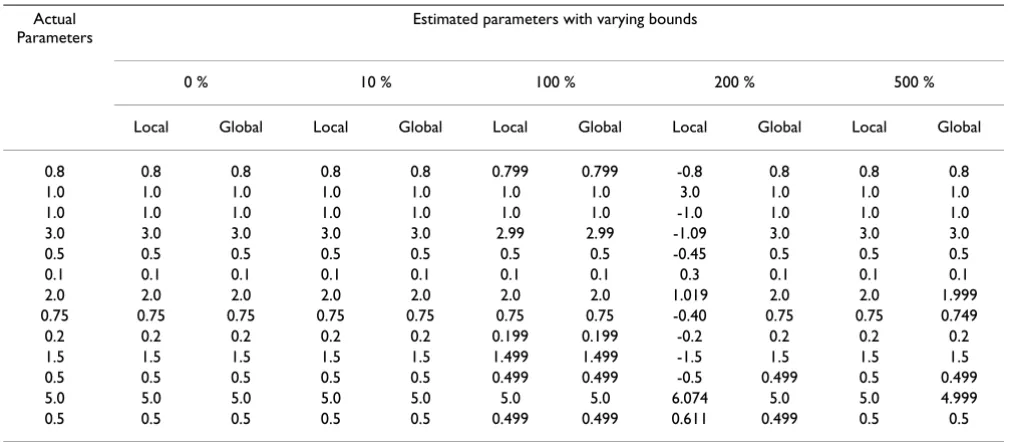
Table 2: Estimated parameters using local and global optimization algorithms for the simple GMA system Actual
Parameters
Estimated parameters with varying bounds
0 % 10 % 100 % 200 % 500 %
Local Global Local Global Local Global Local Global Local Global
0.8 0.8 0.8 0.8 0.8 0.799 0.799 -0.8 0.8 0.8 0.8 1.0 1.0 1.0 1.0 1.0 1.0 1.0 3.0 1.0 1.0 1.0 1.0 1.0 1.0 1.0 1.0 1.0 1.0 -1.0 1.0 1.0 1.0 3.0 3.0 3.0 3.0 3.0 2.99 2.99 -1.09 3.0 3.0 3.0 0.5 0.5 0.5 0.5 0.5 0.5 0.5 -0.45 0.5 0.5 0.5 0.1 0.1 0.1 0.1 0.1 0.1 0.1 0.3 0.1 0.1 0.1 2.0 2.0 2.0 2.0 2.0 2.0 2.0 1.019 2.0 2.0 1.999 0.75 0.75 0.75 0.75 0.75 0.75 0.75 -0.40 0.75 0.75 0.749 0.2 0.2 0.2 0.2 0.2 0.199 0.199 -0.2 0.2 0.2 0.2 1.5 1.5 1.5 1.5 1.5 1.499 1.499 -1.5 1.5 1.5 1.5 0.5 0.5 0.5 0.5 0.5 0.499 0.499 -0.5 0.499 0.5 0.499 5.0 5.0 5.0 5.0 5.0 5.0 5.0 6.074 5.0 5.0 4.999 0.5 0.5 0.5 0.5 0.5 0.499 0.499 0.611 0.499 0.5 0.5
Table 3: Total time taken for global solution, number of partitions created during the Branch-and-Reduce algorithm, nonconvex and convex problems solved, and objective function values for both local and global solution methods for the small GMA system.
Time for Global Sol (sec)
No of Partitions Nonconvex Problems
Convex Problems Obj fun Value (Global)
Obj fun Value (Local)
0 % 0.252 1 1 1 0.0 0.0
10 % 0.662 1 1 1 0.0 0.0
100 % 1.453 1 1 1 0.0 0.0
200 % 12.005 11 13 11 0.0 0.917
300 % 14.412 13 15 13 0.0 0.884
400 % 10.372 9 11 9 0.0 0.867
instance, one may derive tighter variable bounds on a given partition that are not centered around the nominal parameter values. In a realistic situation the true values are of course unknown, but considerable experience has been amassed throughout the years suggesting natural default values. We also included a 0% interval as a check that the true solution was recouped.
The estimated parameter values using both the local and global searches are given in Table 2. The total time required to obtain the global solution, the number of
par-titions created during the branch-and-reduce procedure and the number of nonconvex and convex problems solved; the objective function values for both local and global solutions are provided in Table 3.
The numerical results demonstrate that both the local and global solvers give the same solution when the parameter space is small and the bounds are tight. When the bounds are increased beyond 100%, the local solver may fail to find the true parameters, while the global solver still suc-ceeds. For instance, one notes that the local search with 200% bounds yielded a different solution, which however was inferior, as indicated by the value of the objective function.
Case study
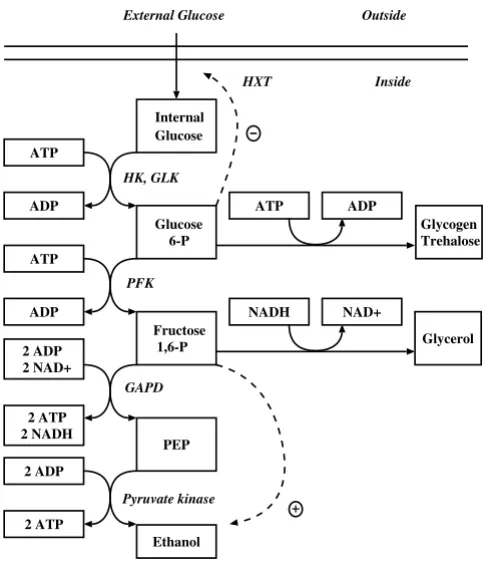
As a more complex illustration, consider the fermentation pathway in Saccharomyces cerevisiae described in [26]. This is a relatively simple metabolic pathway system of which the structural and numerical specifications are however directly based on careful kinetic experiments and bio-chemical analyses [52]. The metabolic pathway map is given in Figure 6. The GMA model equations adapted from [26,53] are given in Figure 7. The model has 5 dependent variables, 9 independent variables and 19 unknown rate constant and kinetic order parameters.
According to Galazzo and Bailey [52] and Curto et al. [26], the observed concentrations (mM) of the dependent variables at steady state are: X1(GIn) – Internal Glucose =
0.0346, X2(G6P) – Glucose-6-phosphate = 1.011,
X3(FDP) – Fructose-1,6-diphosphate = 9.1876, X4(PEP) – Phosphoenolpyruvate = 0.0095, and X5 – Adenosine tri-phosphate (ATP) = 1.1278. The values of the independent variables (mM min-1) are: X
6 – Glucose uptake = 19.7, X7 –
Hexokinase = 68.5, X8 – Phosphofructokinase = 31.7, X9 – Glyceraldehyde-3-phosphate dehydrogenase = 49.9, X10 – Pyruvate kinase = 3,440, X11 – Polysaccharide production (glycogen + trehalose) = 14.31, X12 – Glycerol production
= 203, X13 – ATPase = 25.1, and X14 – NAD+/NADH ratio
= 0.042.
GMA model equations for fermentation model in Figure 6
Figure 7
GMA model equations for fermentation model in Figure 6.
˙
X
1= 0
.
8122
X
2−0.2344X
6−
2
.
8632
X
10.7464X
50.0243X
7˙
X
2= 2
.
8632
X
10.7464X
50.0243X
7−
0
.
5232
X
20.7318X
5−0.3941X
8−
0
.
0009
X
28.6107X
11˙
X
3= 0
.
5232
X
20.7318X
5−0.3941X
8−
0
.
011
X
30.6159X
50.1308X
9X
14−0.6088−
0
.
04725
X
30.05X
40.533X
5−0.0822X
12˙
X
4= 0
.
022
X
30.6159X
50.1308X
9X
14−0.6088−
0
.
0945
X
30.05X
40.533X
5−0.0822X
10˙
X
5= 0
.
022
X
30.6159X
50.1308X
9X
14−0.6088+ 0
.
0945
X
30.05X
40.533X
5−0.0822X
10−
2
.
8632
X
10.7464X
50.0243X
7−
0
.
0009
X
8.61072
X
11−
0
.
5232
X
20.7318X
5−0.3941X
8−
1
.
0
X
51.0X
13Simplified model of anaerobic fermentation of glucose to eth-anol, glycerol, and polysaccharides in Saccharomyces Cerevi-siae
Figure 6
Simplified model of anaerobic fermentation of glucose to eth-anol, glycerol, and polysaccharides in Saccharomyces Cerevi-siae.
Internal Glucose
Glucose 6-P
Fructose 1,6-P
PEP
Ethanol ATP
ADP
ATP
ADP
2 ADP 2 NAD+
2 ATP 2 NADH
ATP ADP
Glycogen Trehalose
Glycerol
NADH NAD+
2 ADP
2 ATP
HK, GLK
PFK
GAPD
Pyruvate kinase
HXT Inside Outside External Glucose
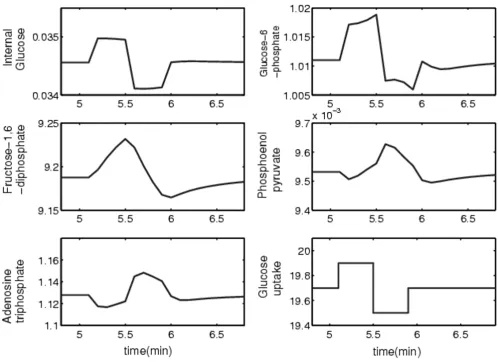
A typical dynamic response for the system is shown in Fig-ure 8. It was obtained by subjecting the glucose uptake to artificial step changes, which could have been imple-mented experimentally through externally controlled changes in substrate availability. Illustrative data were obtained by integrating the system and collecting the state and the slope values for each dependent variable every 6 seconds over a time horizon of length P. For a single time series, the horizon length is the number of data points col-lected for the state and slope values that are used in the optimization formulation.
For any given scenario, nP equations were written, and these served as the nonlinear equality constraints in the formulation given in Equation 3, which includes the unknown parameters (θ) that were to be estimated. For a
single time series, 10 data samples for the states and slope values were collected right after the first step change was introduced. The transient response data are presented in Table 4. The resulting optimization formulation thus required 70 variables (parameters) and 50 nonconvex constraints. The convex relaxation resulted in 276 total variables and 832 total convex constraints.
The parameters were estimated with the MINOS noncon-vex NLP solver for local searches and the branch-and-reduce algorithm for the global searches. As in the didactic example, we explored various scenarios that again differed with respect to the initial guesses for the parameters as well as the bounds on the parameter space to be searched. The lower and upper bounds on the parameters were selected at 100%, 200%, 300 %, and 500% around the
Dynamic response of independent variables when the external glucose uptake is subjected to step changes
Figure 8
true value. The initial guesses for the parameters were selected to be the lower bounds of the parameters search space.
It is known that the performance of any MINOS NLP solver is significantly affected by the specified tolerances. The convergence tolerances such as row, optimality and feasibility tolerances were set to 10-5. The maximum
number of iterations was set to 5000, and the maximum number of major and minor iterations between successive linearizations of nonlinear constraints was set to a value of 60. During the branch-and-reduce algorithm, only the parameters (γand p) were considered for branching. The ratios of the difference in the current bounds and the dif-ference in the original bounds for all variables (parame-ters) were computed. The particular variable with the worst (largest) ratio was then selected for branching. The algorithm was implemented using best-first search strat-egy and was able to guarantee the global solution within an ε= 0.0001 tolerance.
The computational results were generated using MINOS for NLP solution and CPLEX for the LP solution. An Ath-lon 1900+ dual processor machine was used with Linux Debian OS. The computational results demonstrate that the chosen optimization technique guarantees conver-gence to the global solution for all ∆ values tested. The global solution time, number of partitions, nonconvex and convex problems solved during the
branch-and-reduce search, and the objective function value for both the local and global solutions, are given in Table 5. The estimated parameters for the different scenarios are shown in Table 6.
Conclusion
The first step of any modeling effort is the definition of symbolic equations and the numerical definition of their parameter values. In the past, the latter has typically been accomplished by reformulating literature information on local processes, such as enzyme-catalyzed reaction steps, within the biological system of interest. High-throughput data are beginning to change this situation dramatically. Instead of working from the bottom up, it is becoming possible to infer the structure and regulation of biological systems from measured time profiles. An important com-ponent of this inference is the efficient estimation of parameters, which in the case of GMA and S-systems within BST can directly be interpreted as biological fea-tures, thereby potentially yielding novel insights.
We have shown here that the parameter estimation task may be posed as a nonconvex nonlinear optimization problem. Consequently, deterministic global optimiza-tion techniques can be applied, and among them the branch-and-reduce algorithm appears to be a very suitable choice, because it is guaranteed to find the global solu-tion. This is in stark contrast to local solvers, such as non-linear regression algorithms, which may not be able to
Table 4: Time series data of the states and slopes for the anaerobic fermentation case study (In every cell, the first value represents the state and the second value represents the slope)
Data Points X6
External Glucose X1
(GIn) X(G6P)2
X3 (FDP)
X4 (PEP)
X5 (ATP)
1 19.7 3.46e-2 1.011 9.188 9.53e-3 1.1278 -1.78e-15 1.10e-13 -1.97e-9 3.93e-9 3.93e-9 2 19.9 3.46e-2 1.011 9.188 9.53e-3 1.1278 1.62e-1 1.10e-13 -19.7e-9 3.93e-9 3.93e-9 3 19.9 3.498e-2 1.017 9.196 9.51e-3 1.1175 -7.399e-5 1.021e-2 1.38e-1 -9.79e-6 -4.68e-2 4 19.9 3.498e-2 1.017 9.21 9.52e-3 1.1167
-3.69e-5 2.04e-3 1.32e-1 2.04e-4 1.76e-2 5 19.9 3.497e-2 1.018 9.22 9.54e-3 1.1193 -1.177e-4 8.28e-3 1.06e-1 2.16e-4 2.91e-2 6 19.5 3.495e-2 1.019 9.232 9.56e-3 1.1221 -3.24e-1 9.67e-3 8.59e-2 1.821e-4 2.568e-2 7 19.5 3.41e-2 1.0075 9.22 9.63e-3 1.1449
5.68e-5 -1.36e-2 -2.03e-1 1.595e-4 1.131e-1 8 19.5 3.41e-2 1.008 9.201 9.616e-3 1.148
-1.34e-5 2.35e-3 -2.03e-1 -2.85e-4 -1.79e-2
9 19.5 3.412 1.0072 9.182 9.58e-3 1.145
1.47e-4 -1.02e-2 -1.63e-1 -3.26e-4 -4.32e-2 10 19.7 3.41e-2 1.006 9.168 9.55e-3 1.1406
1.62e-1 -1.38e-2 -1.32e-1 -2.77e-4 -3.91e-2
converge to the global solution when the parameter search space is large or the error surface is ragged. As a proof of concept, we demonstrated the features of the glo-bal search method with a didactic example and a simple yet realistic biological case study, which has been used by others for the exploration of new methods [18,26-29]. In order not to cloud the demonstration of the functioning of the branch-and-reduce search algorithm, both exam-ples were selected free of experimental error. While this may seem somewhat artificial, the omission of noise was intentional (a) in order to see how the method performs under ideal conditions and (b) because a preparatory smoothing step can significantly reduce if not eliminate noise. Nonetheless, it is now necessary to consider data that are corrupted by noise, and to compare the efficacy of the branch-and-reduce method with alternate methods such as nonlinear regression and genetic algorithms.
For the limited range of illustrative examples shown here, the computational results demonstrate that the branch-and-reduce algorithm is fast and reliable. Of course, it is difficult to judge in general to what degree this algorithm, combined with estimation of species concentration rate of change, outperforms other methods, but it seems clear that direct parameter estimation in systems of differential equations can be extremely time consuming. As a case in point, Kikuchi et al. [4] used a genetic algorithm to iden-tify the parameters of a five-variable S-system from noise-free data and showed that every cycle of the genetic algo-rithm took about 10 hours on a cluster of over 1,000 CPUs and that seven cycles were needed to complete the identification. Voit and Almeida [9] demonstrated that this computation time may be reduced drastically if the estimation of slopes, as we used here, is employed to replace the differential equations with sets of nonlinear
Table 6: Result of estimation analysis with the anaerobic fermentation pathway model. Total time required for global solution, number of partitions created during the Branch-and-Reduce search, number of nonconvex and convex problems solved, and the value of the objective function for both local and global solution methods.
Time for Global Sol (sec)
No of Partitions Nonconvex Problems
Convex Problems Obj fun Value (Global)
Obj fun Value (Local)
100 % 38.13 27 15 27 0.0 1.36 × 10⁻⁴
200 % 19.28 9 6 9 0.0 1.34 × 10⁻⁴
300 % 56.98 27 15 27 1.61 × 10⁻⁷ 1.31 × 10⁻⁴
400 % 58.39 25 14 25 0.0 1.31 × 10⁻⁴
500 % 57.15 25 14 25 3.51 × 10⁻⁸ 1.25 × 10⁻⁴ Table 5: Estimated parameters for anaerobic fermentation pathway using Branch-and-Reduce algorithm
Actual Parameters (θ)
Estimated parameters with varying bounds
100 % 300 % 500 %
Local Global Local Global Local Global
0.8122 0.8112 0.8122 0.8112 0.8122 0.8112 0.8122 0.2344 0.2393 0.2344 0.2396 0.2344 0.2398 0.2344 2.8632 2.8557 2.8632 2.8521 2.8632 2.8485 2.8632 0.7464 0.7460 0.7464 0.7456 0.7464 0.7452 0.7464 0.0243 0.0259 0.0243 0.0256 0.0243 0.0253 0.0243 0.5232 0.5221 0.5232 0.5214 0.5232 0.5206 0.5232 0.7318 0.7364 0.7318 0.7373 0.7318 0.7382 0.7318 0.3941 0.3941 0.3941 0.3949 0.3941 0.3954 0.3941 0.0009 0.0018 0.0009 0.0036 0.0009 0.0054 0.0009 8.6107 0.0000 8.6107 0.0000 8.6107 0.0000 8.6107 0.011 0.0109 0.011 0.0109 0.011 0.0109 0.011 0.6159 0.6169 0.6159 0.6177 0.6159 0.6185 0.6159 0.1308 0.1302 0.1308 0.1305 0.1308 0.1308 0.1308 0.04725 0.0337 0.034 0.0174 0.0467 0.0089 0.0464
0.05 0.1 0.1 0.2 0.0517 0.3000 0.0528
algebraic equations. Still they found the subsequent regression to be slow and not necessarily reliable, because of convergence to local minima or no convergence at all. Irrespective of computational speed, the branch-and-reduce algorithm employed here was shown to be success-ful in rather quickly finding global solutions within an ε tolerance, which is a great advance, because local search methods cannot guarantee convergence to the true solu-tion.
Acknowledgements
The Authors would like to acknowledge financial support from the South Carolina Collaborative Grants Program (E.P. Gatzke, PI), from an NSF Quantitative Systems Biotechnology (BES-0120288; E.O. Voit, PI) grant, and from a National Heart, Lung and Blood Institute Proteomics Initiative (Con-tract N01-HV-28181; D. Knapp, PI). Any opinions, findings, and conclusions or recommendations expressed in this material are those of the authors and do not necessarily reflect the views of the sponsoring institutions.
References
1. Seatzu C: A Fitting Based Method for Parameter Estimation
in S-Systems. Dynamic Systems Applications 2000, 9(1):77-98. 2. Maki Y, Tominaga D, Okamoto M, Watanabe S, Eguchi Y:
Develop-ment of a system for the inference of large scale genetic net-works. Pac Symp Biocomput 2001, 6:446-458.
3. Almeida J, Voit EO: Neural network-based parameter
estima-tion in complex biochemical systems. Genome Informatics 2003,
14:114-123.
4. Kikuchi S, Tominaga D, Arita M, Takahashi K, Tomita M: Dynamic modeling of genetic networks using genetic algorithm and S-system. Bioinformatics 2003, 19:643-650.
5. Lall R, Rutes A, Santos H, Almeida J, Voit EO: A New Approach to Parameter Estimation using S-systems: Modeling the Glyco-lytic Pathway of Lactococcus lactis. Georgia Tech-UGA Conference on Bioinformatics, Atlanta, GA . 2003 November 13–16
6. Borges CCH, Voit EO, Almeida J: Signal extraction for numerical decoupling of S-systems. International Conference on Molecular Sys-tems Biology (ICMSB '04), Tahoe, CA . 2004 August 21–25
7. Voit EO, Marino S, Lall R: Challenges for the identification of metabolic pathways from time series data. In Silico Biology 2004, 5:1-10.
8. Wang FS, Tsai KY: A global/local optimization approach for
dynamic system modeling of biological networks. Bioinformatic 2005, 21:1180-1188.
9. Voit EO, Almeida J: Decoupling dynamical systems for pathway identification from metabolic profiles. Bioinformatics 2004,
20(11):1670-1681.
10. Naval P, Gonzalez O, Mendoza E, Sison L: Heuristic Parameter Estimation Methods for S-System Models of Biochemical Networks. Second Humanoid, Nanotechnology, Information Technology, Communications and Control, Environment and Management (HNICEM), Manila, Philippines 2005.
11. Savageau MA: Biochemical Systems Analysis, I. Some
Mathe-matical Properties of the Rate Law for the Component Enzymatic Reactions. J Theor Biol 1969, 25:365-369.
12. Savageau MA: Biochemical Systems Analysis, II. The steady-state solutions for an n-pool system using a power-law approximation. J Theor Biol 1969, 25:370-379.
13. Savageau MA: Biochemical Systems Analysis: A Study of Func-tion and Design in Molecular Biology. Addison-Wesley, Massachu-setts 1976.
14. Savageau MA, Voit EO: Recasting Nonlinear Differential Equa-tions as S-Systems: A Canonical nonlinear Form. Math Biosci 1987, 87:83-115.
15. Torres NV, Voit EO: Pathway Analysis and Optimization in
Metabolic Engineering. Cambridge University Press, Cambridge, UK; 2002.
16. Voit EO: Canonical Nonlinear Modeling: S-System Approach
to Understanding Complexity. Van Nostrand Reinhold, New York; 1991.
17. Voit EO: Canonical modeling: A review of concepts with
emphasis on environmental health. Environmental Health Per-spectives, Mathematical Modeling in Environmental Health Studies 2000,
108(Suppl 5):895-909.
18. Voit EO: Computational Analysis of Biochemical Systems.
Cambridge University Press, New York; 2000.
19. Voit EO: Metabolic modeling : a tool of drug discovery in the post-genomic era. Drug Discov Today 2002, 7:621-628.
20. Voit EO: The Dawn of a New Era of Metabolic System
Analy-sis. Drug Discovery Today BioSilico 2004, 2(5):182-189.
21. Voit EO, Torres NV: Canonical modeling of complex pathways in biotechnology. Recent Res Devel in Biotech and Bioeng 1998,
1:321-341.
22. Voit EO, Almeida J: Dynamic Profiling and Canonical Modeling: Powerful Partners in Metabolic Pathway Identification. In Metabolite Profiling : Its Role in Biomaker Discovery and Gene Function Analysis Kluwer Academic Publishing, Dordrecht, The Netherlands; 2003.
23. Voit EO, Savageau MA: Power-law approach to modeling
bio-logical systems, 3. Methods of Analysis. J Ferment Technol 1982,
60(3):233-241.
24. Torralba AS, Yu K, Shen P, Oefner PJ, Ross J: Experimental test of a method for determining casual connectivities of species in reactions. Proc Natl Acad Sci 2003, 100:1494-1498.
25. Veflingstad SR, Almeida J, Voit EO: Priming nonlinear searches for pathway identification. BMC Theoretical Biology and Medical Modelling 2004, 1:8.
26. Curto R, Sorribas A, Cascante M: Comparative characterization of the fermentation pathway of Saccharomyces cerevisiae
using biochemical systems theory and metabolic control analysis. Model definition and nomenclature. Math Biosc 1995,
130:25-50.
27. Cascante M, Curto R, Sorribas A: Comparative characterization of the fermentation pathway of Saccharomyces cerevisiae
using biochemical systems theory and metabolic control analysis. Steady-state analysis. Math Biosc 1995, 130:51-69. 28. Sorribas A, Curto R, Cascante M: Comparative characterization
of the fermentation pathway of Saccharomyces cerevisiae
using biochemical systems theory and metabolic control analysis. Model validation and dynamic behavior. Math Biosc 1995, 130:71-84.
29. Torres NV, Voit EO, Glex-Alcon C, Rodriguez F: An indirect opti-mization for biochemical systems: Description of method and application to the maximization of the rate of ethanol, glyceerol, and carbohydrate production in Saccharomyces cerevisiae. Biotech Bioeng 1997, 55(5):758-772.
30. Stephanopoulos G, Aristidou A, Nielsen J: Metabolic Engineering. Principles and Methadologies. Avademic Press, San Diego, CA; 1998.
31. Reed JL, Palsson BO: Thirteen years of building constraint-based in silico models of Escherichia coli. J Bacteriol 2003,
185(9):2692-9.
32. Heinrich R, Rapoport TA: A linear steady-state treatment of enzymatic chains: General properties, control and effector strength. Eur J Biochem 1974, 42:89-95.
33. Hill CM, Waight RD, Bardsley WG: Does any enzyme follow the Michaelis-Menten equation? Molec Cell Biochem 1977,
15:173-178.
34. Savageau M: Enzyme kinetics in vitro and in vivo: Michaelis-Menten revisited. Volume 4. IAI Press Inc, Greenwich, Connecti-cut; 1995:93-146.
35. Fell DA: Understanding the Control of Metabolism. Portland Press, London; 1977.
36. Hatzimanikatis V, Bailey JE: MCA has more to say. J Theor Biol 1996, 182:233-242.
37. Voit EO: Optimization in integrated biochemical systems.
Biotechn Bioengin 1992, 40:572-582.
38. Voit EO, Savageau M: Accuracy of alternative representations for integrated biochemical systems. Biochemistry 1987,
26:6869-6880.
39. Sorribas A, Savageau M: Strategies for representing metabolic pathways within biochemical systems theory: Reversible Pathways. Math Biosci 1989, 94:239-269.
Publish with BioMed Central and every scientist can read your work free of charge "BioMed Central will be the most significant development for disseminating the results of biomedical researc h in our lifetime."
Sir Paul Nurse, Cancer Research UK
Your research papers will be:
available free of charge to the entire biomedical community
peer reviewed and published immediately upon acceptance
cited in PubMed and archived on PubMed Central
yours — you keep the copyright
Submit your manuscript here:
http://www.biomedcentral.com/info/publishing_adv.asp
BioMedcentral
41. Curto R, Voit EO, Sorribas A, Cascante M: Mathematical models of purine metabolism in man. Math Biosc 1998, 151:1-49. 42. Gatzke EP, Tolsma JE, Barton PI: Construction of Convex
Func-tion RelaxaFunc-tions Using Automated Code GeneraFunc-tion Tech-niques. Optimization and Engineering 2002, 3(3):305-326.
43. Tolsma JE, Barton PI: DAEPACK: An Open Modeling
Environ-ment for Legacy Code. Ind Eng Chem Res 2000, 39(6):1826-1839.
44. Tawarmalani M, Sahinidis NV: Global Optimization of Mixed
Integer Nonlinear Programs: A Theoretical and Computa-tional Study. Technical report, University of Illinois; 2000.
45. ILOG: ILOG CPLEX 8.1: User's Manual. Mountain View, CA;
2002.
46. IBM-OSL: IBM Optimization Solutions and Library Linear
Programming Solutions. Technical report I B M 1997.
47. Falk JE, Soland RM: An Algorithm for Separable Nonconvex
Programming Problems. Management Science 1969,
15(9):550-569.
48. Ryoo HS, Sahinidis NV: Global Optimization of Nonconvex
NLPS and MINLPs with Application to Process Design. Com-put Chem Eng 1995, 19(5):551-566.
49. Adjiman CS, Androulakis IP, Floudas CA: Global Optimization of Mixed-Integer Nonlinear Problems. AIChE J 2000,
46(9):1769-1797.
50. Smith EMB: On the Optimal Design of Continuous Processes.
In PhD thesis Imperial College, London; 1996.
51. Moore RE: Methods and Applications of Interval Analysis.
SIAM Philadelphia 1979.
52. Galazzo JL, Bailey JE: Fermentation pathway kinetics and meta-bolic flux control in suspended and immobilized Saccharo-myces cerevisiae. Enzyme Microb Technol 1990, 12:162-172.
53. Voit EO: Computational Analysis of Biochemical Systems.