
R E V I E W
Open Access
Grid-based multi-energy
systems—modelling, assessment, open source
modelling frameworks and challenges
Lukas Kriechbaum
*, Gerhild Scheiber and Thomas Kienberger
Abstract
Background: The transition to a sustainable future challenges the current energy grids with the integration of
variable, distributed renewable energy sources. On a technical level, multi-energy systems may provide the necessary flexibility to minimise the gap between demand and supply. Suitable methods and tools are necessary to derive relevant results and to support a transition to renewable energy sources. While several, dedicated tools to model grids and infrastructure of single-energy carriers exist, there are no tools capable of modelling multi-energy systems in detail. Thus, this paper presents the necessary aspects to consider when modelling grid-based multi-energy systems, presents three open source frameworks for modelling grid-based energy systems and points out the major challenges.
Methodology: The current main aspects and challenges for modelling grid-based energy systems are derived from a
literature review. Three open source multi-energy modelling frameworks (Calliope, oemof, urbs) are presented, and the extent to which they consider these aspects and how they tackle challenges is analysed.
Grid-based MES modelling: We identified five general energy system modelling aspects (modelling scope, model
formulation, spatial coverage, time horizon, data) and three aspects specific to modelling energy grids (level of detail, spatial resolution, temporal resolution). While the specific aspects mainly influence the representation of the technical parts of the energy system and the computational effort, the general aspects primarily relate to the system boundaries and scope of the model. For the evaluation of the modelling results, we identified several assessment criteria, including economic, energetic, exergetic and reliability. Each of the studied open source modelling frameworks provides generic capabilities to model energy converters, and the electricity, gas and district heat networks. However, the general and specific aspects present respective challenges. Relating to the general aspects, complexity of model formulation increases when including additional boundary conditions. The accuracy of the results is also dependent on data quality. Temporal and spatial resolutions are the major specific challenges for modelling the energy infrastructure.
Conclusions: There is still a broad field of opportunities for researchers to contribute to grid-based energy system
modelling. This encompasses especially the consideration of short- and long-term dynamics of renewable energy sources in planning models.
Keywords: Energy systems analysis, Energy assessment, Open source energy modelling frameworks
Background
Clean and sustainable energy supply is a societal chal-lenge of the twenty-first century. Despite the world’s pri-mary energy supply rising from 255 to 571 EJ between 1973 and 2015, the share of energy produced from fossil fuels has not changed significantly and is currently still
*Correspondence:[email protected]
Chair of Energy Network Technology, Montanuniversitaet Leoben, Franz-Josef-Strasse 18, 8700, Leoben, Austria
above 80% [1]. Different studies project a primary energy consumption between 770 and 1175 EJ in 2050 due to population and economic growth [2]. Over the upcom-ing decades, the primary energy supply from fossil fuels is expected to rise by approximately 1.5% per year [3]. Until now, the utilisation of fossil fuels accounts for 68% of the world’s anthropogenic greenhouse gas emissions [4]. In order to mitigate global warming, mainly caused by anthropogenic green house gas emissions, the parties of the United Nations Framework Convention on Climate
Change reached an agreement on lowering carbon energy supply at the COP 21 in Paris [5]. The participating coun-tries must adapt their energy policies to achieve the goals of the Paris agreement. Energy policy as a distinct field emerged with the occurrence of the first oil crisis [6]. Energy system models provide ‘the integrating framework that assists energy policy and industrial decision mak-ers’ [7]. The main goal of energy system modelling was ‘not to compute precise numbers but to gain insight into any complex system’ [8]. Mathematical methods like lin-ear programming developed for operations reslin-earch in the Second World War [9,10] were used to create mod-els which allowed the formalisation of scattered knowl-edge about complex interactions in the energy sector and helped analysts to understand a sector that had become complex [11].
The history of energy system planning was primarily closed and proprietary, but market liberalisation and the need for greenhouse gas emissions reductions require changes in the transparency of modelling assumptions and methodologies [12]. Pfenninger et al. [12] present four reasons why data and models are not open: very often,
sensitive datais used; sharing details and models creates anunwanted exposure, the effort topublish and maintain
the model and institutional and personal inertia. How-ever, transparency of the model, the datasets used and the communication of the assumptions made are all impor-tant points for the reproducibility and the acceptance of the results [13,14].
The need for transparency and the challenge to inte-grate variable renewable energy sources (RES) [1] call for new types of models. These models must incor-porate the rapid deployment and variability of wind and photovoltaic power loads as well as the grow-ing importance of flexibility options like energy stor-age and grid expansion [15]. They must also consider high spatial, temporal and technological details to accu-rately assess and estimate the effects caused by such changes [12].
In this review article, we present a comprehensive overview of the current, grid-based multi-energy system (MES) modelling. The “Motivation” section is followed by the “Definitions and methodology” section—where we provide necessary descriptions of the review and derive our review approach. In the “Integrated grid-based MES modelling” section, we first present general MES modelling aspects as well as the specific grid-based MES modelling aspects. The modelling approaches for energy networks, storage and converters are outlined in the “Grid-based MES modelling approaches” section. This section is followed by the presentation of three open source modelling frameworks in the “MES open source modelling frameworks” section. Subsequently, in the “MES modelling challenges” section, we discuss
current and possible future issues of MES modelling. The “Conclusions” section summarises and closes this review.
Motivation
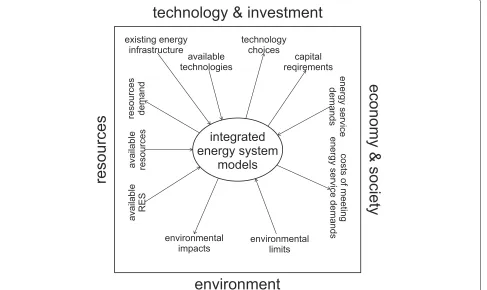
Integrated energy system models try to create a represen-tation of the various interactions between environment, resources, technology and investment, and economy and society (Fig. 1). Development of the first energy system models started in the 1970s. The Energy Technology Systems Analysis Program (ETSAP) of the International Energy Agency (IEA) first produced the MARKAL (MAR-ket ALlocation) [16] modelling platform. The Interna-tional Institute for Applied Systems Analysis (IIASA) developed its Model for Energy Supply Strategy Alterna-tives and their General Environmental Impact (MESSAGE [17,18]). Both models were originally designed for bottom up optimisation of large-scale energy systems of coun-tries or at an international level. Therefore, they require extreme simplifications such as country level aggregated values and seasonal or annual supply and demand balance [19]. Because all of the simplifications were accepted and well understood in energy systems consisting of base-load and fully dispatchable generators, such an energy-based perspectivewas sufficient for the desired purpose of such models. However, due to the temporal variability of RES, those tools may not fully capture the complexity of cur-rent and future energy systems. This leads to the necessity of apower-based perspectiveof future energy systems.
In this review, we focus on integrated, grid-based MES for three main reasons: (1) for a decarbonisation of the global energy system, fossil fuels must be substituted by renewable electricity [20], (2) the integration of fluc-tuating RES is especially a challenge for the electricity grid [21] and (3) an integrated MES approach supports a better utilisation of volatile RES and existing grid infrastructures [22].
The first two reasons address the implications of sub-stituting fossil fuels for RES. For example, the shift from gasoline or diesel cars to electric cars powered by renew-able energy [23]. Reason (3) considers the need to provide flexibility and virtual storage capacities1 when integrat-ing variable RES. This is to overcome the gap between fluctuating supply and demand.
Fig. 1Integrated energy systems modelling. Representation of the interactions between environment, resources, technology and investment, and economy and society in an integrated grid-based MES model. Adapted from [19]
increased productivity because of burden sharing and (4) a profound relevance to social debates.
Definitions and methodology
Different interpretations regarding the terminology and system boundaries in energy system modelling are avail-able. Their use and interpretation within this paper is described in this section, together with the methodology of this review article.
Definitions
The system boundaries must be carefully selected in order to adequately assess the overall system. For MES, all energy carriers ranging from extraction to services must be included within the system boundaries. In this work,
the definitions of an energy system and sector according to [27] are used. Anenergy systemincludes ‘all steps in the chain—from primary energy resources to energy services’. Theenergy sectorrefers to ‘the steps in the chain, from the extraction of primary energy resources to the delivery of final energy carriers for use in end-use technologies that produce energy services or goods’.
A consistent definition ofMulti-Energy-Systems(MES) has currently not been found. In general, a MES approach requires holistic consideration of an energy system, cov-ering the energy stages from the extraction and treatment (e.g. gas well, coal mine, sun) to the services (e.g. heating, illumination, transport), while also considering the differ-ent carriers (e.g. electricity, natural gas, oil, coal). In this paper, we focus on the grid-based energy carriers of the
energy sector in the range from primary energy to final energy (marked by the dashed box in Fig.3). Mancarella [28] points out four categories to characterise MES: spa-tial, service, fuel and network. While multi-service means that one energy source can supply energy services at the same time (e.g. a combined heat and power plant), multi-fuel means that different services can be pro-vided by multiple primary energy carriers (e.g. domestic heat can be produced by a heat pump or a gas boiler). The spatial category describes the spatial resolution of a MES model, where common resolutions are buildings, cities and entire countries. Energy networks are required to overcome the spatial distance between consumers and producers and to enable the development of multi-energy technologies and their interactions. In addition to the four categories Mancarella consider, time resolution should also be considered in models integrating variable RES and energy storage. Therefore, when considering MES in our work, five categories are incorporated: spatial, time, network, multi-service and the multi-fuel.
The definitions ofmodel, model generatorand frame-work are taken from [29]. Models are simplified replicas of real world systems and may consist of several
hard-or soft-linked sub-models. Model generathard-ors allow users to build models by the use of pre-defined units (e.g. a pre-defined set of equations represents a storage unit and converter). A modelling framework is a structured toolbox and may consist of sub-frameworks and model generators.
Methodology
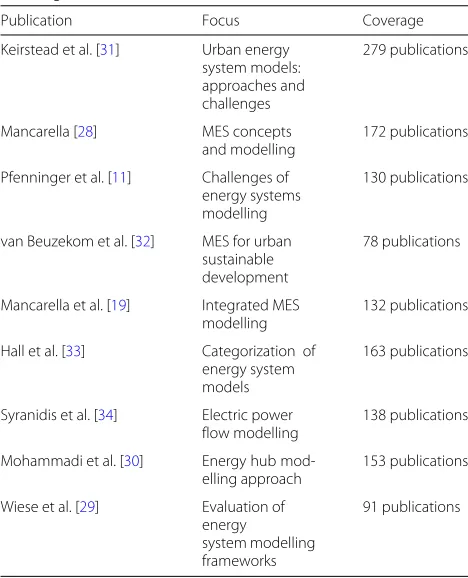
The aim of this review is to give a comprehensive overview and to discuss the requirements of grid-based MES models. Additionally, selected open source mod-elling frameworks are presented and characterised. Our work draws on several recent reviews of MES modelling and the implied challenges (Table 1). Additional litera-ture was consulted where necessary. The reviews can be grouped into five different fields: general MES modelling [19,28, 30], modelling of urban MES [31,32], categori-sation of energy system models and frameworks [29,33], evaluation of the challenges in energy system modelling [11] and the power flow modelling [34].
The review of Hall et al. [33] presents the prevalent usage and categorisation of energy system models in the UK. A qualitative evaluation method to categorise energy sytem modelling frameworks is proposed by Wiese et al.
Table 1Relevant literature on MES modelling and modelling challenges
Publication Focus Coverage
Keirstead et al. [31] Urban energy system models: approaches and challenges
279 publications
Mancarella [28] MES concepts and modelling
172 publications
Pfenninger et al. [11] Challenges of energy systems modelling
130 publications
van Beuzekom et al. [32] MES for urban sustainable development
78 publications
Mancarella et al. [19] Integrated MES modelling
132 publications
Hall et al. [33] Categorization of energy system models
163 publications
Syranidis et al. [34] Electric power flow modelling
138 publications
Mohammadi et al. [30] Energy hub mod-elling approach
153 publications
Wiese et al. [29] Evaluation of energy
system modelling frameworks
91 publications
[29]. Mohammadi et al. [30] analyse recent developments in the field of the energy hub, which is a generic and exten-sive MES approach (further details can be found in the “Energy hub” section). In his review, Mancarella [28] gives a broad overview on the currently available MES con-cepts, evaluation models and assessment techniques. In a later review Mancarella et al. [19] focus on the mod-elling of integrated MES. They present the requirements, opportunities and MES modelling applications ranging from optimal unit scheduling, optimal RES integration and optimal power flow between energy hubs.
Van Beuzekom et al. [32] identify suitable modelling tools and frameworks, whereas Keirstead et al. [31] iden-tify and evaluate the influence of technology design, building design, urban climate, systems design, policy assessment, and land use and transportation modelling. A further two reviews [11,29] look at the general challenges of recent energy system modelling. Only one review was found which focuses on modelling of control techniques and the modelling of electrical power flow across trans-mission networks [34], but nothing was found regarding the modelling of natural gas or district heating grids.
We used the literature review to determine the general aspects, modelling approaches and challenges for mod-elling MES as well as those specific to grid-based energy
systems. For the evaluation of such energy systems, suit-able assessment criteria are provided. Three selected open source MES modelling frameworks are assessed. Specif-ically, the review analyses each framework’s modelling approach and the extent to which the necessary aspects are considered.
We identified five general aspects important to MES modelling as well as three grid-specific aspects (Table2). In the following section, each of the aspects is presented in further detail and discussed. The two most common
modelling scopestoday are planning and operation. While planning models evaluate the long-term evolution of the energy system, operational models assess the operational soundness of scenarios. For planning models, the time horizonis especially important because it determines how far the model looks into the future. MES may range from a single building to districts, cities or whole countries. This is described in thespatial coverage. The mathemat-ical model formulation, together with the programming technique, influences the possible level of detail and the necessary computational effort. For detailed models,data
availability is essential, since it is often not known or is of bad quality. The level of detail describes how thor-oughly the physical properties of the single components (e.g. part load efficiencies, power flow models) are con-sidered within the model. The necessary aggregation and network representation are mainly affected by thespatial resolution. For the integration of variable RES, the tempo-ral resolutionis important and determines to which extent short- and long-term dynamics can be considered.
The MES modelling approaches consist of full and hybrid concepts. While the full approaches consider all available energy carriers, the hybrid approaches consider only some. The different energy and power flow repre-sentations in electricity, gas and district heat networks provide various degrees of detail. They range from sim-ple network flow models to more detailed power flow representations like DC or AC load flow.
Based on the general and specific modelling aspects, three open source modelling frameworks which are suited to model grid-based MES are evaluated according to the modelling aspects and approaches stated out above. The major requirements for such tools are the possibility to model multiple energy carriers, a temporal resolution to
Table 2General and specific grid-based MES modelling aspects
General aspects Specific aspects
Modelling scope Level of detail
Model formulation Spatial resolution
Spatial coverage Temporal resolution
Time horizon
model the short and long term dynamics of RES, a spatial resolution to model energy or power flows and suitable network or power flow representations.
Also compiled from the literature review are the modelling challenges. Data availability, data quality and increased model complexity (e.g. because of modelling data uncertainty or human behaviour) are all challenges affecting the general modelling aspects. The specific chal-lenges refer to the representation of time and space in the model.
MES modelling aspects and assessment
According to Box and Draper, ‘essentially, all models are wrong but some are useful’ [35]. To receive a useful result from a model, it is crucial to model the values which are relevant to the problem and not those which lend them-selves to modelling [11]. Therefore, in the next sections, we discuss several important aspects for MES modelling, from general to specific grid-based modelling aspects to the assessment of the results.
General aspects
Top-down (or macroeconomic) and bottom-up (techno-economic) are the currently most typical energy system modelling approaches (Table3). Models using top-down approaches try to provide a holistic perspective of the economy (this includes economic growth, employment, trade, etc.), but only consider the energy sector in a sim-plified and aggregated manner. In comparison, bottom-up models incorporate more technological detail and use an economically driven approach for evaluating investi-gated technologies. This allows them to provide more detailed outlooks on future supply and demand and pos-sible technology utilisation. The high technological detail requires extensive data. Many assumptions have to be made regarding technology diffusion, investments and operating cost [36].
Since modelling grid-based energy systems requires a high level of technological detail we further focus only on bottom up modelling approaches in this work.
Modelling scope
Planning models are used to investigate the long term evolution of energy systems. They consider investment
Table 3Energy systems modelling approaches [36]
Top-down Bottom-up
Input-output models Simulation models
Econometric models Optimisation models
Computable general equilibrium models Partial equilibrium models
System dynamics models Multi-agent models
decisions and account for a change in future parame-ters like fossil fuel availability, renewable resources, tech-nology prices, techtech-nology diffusion and future learning. These parameters are input variables for energy systems models, and must be chosen carefully to avoid creating biased results [29]. Typical energy planning models are MARKAL/TIMES and MESSAGE. Planning models typi-cally use an energy-based perspective because they work with highly aggregated data (e.g. annual demand and sup-ply values). Operational models examine the operational feasibility of a scenario and since the energy demand must be met at any time of the investigated period, a power-based perspective is necessary. This requires considera-tion of the short and long term dynamics of supply and demand, as well as technological, regulatory, economic and social constraints [15]. Typical operational models are PLEXOS, GTmax and EnergyPLAN.
Time horizon
The time horizon is closely connected to the modelling scope. While common time horizons for planning model are 30 to 50 years, typical investigation periods for opera-tional models range from a day to a year [32,37].
Spatial coverage
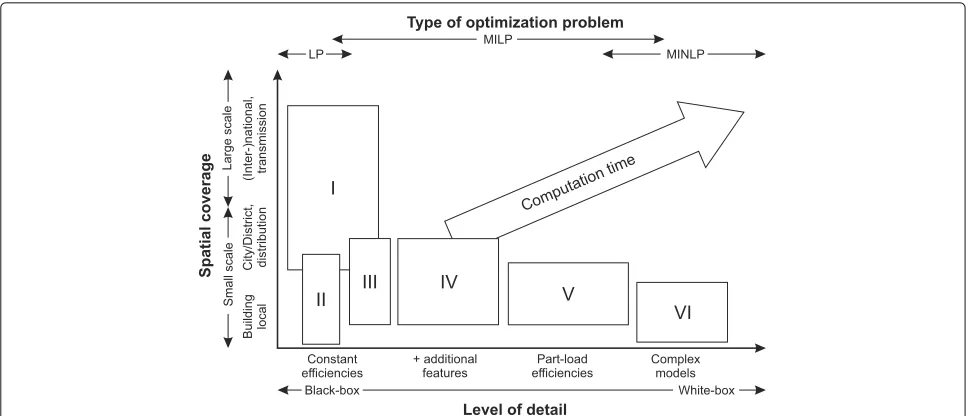
The spatial coverage may range from a local, single build-ing to districts and countries. It has a vast impact on the suitable programming techniques, the possible level of detail [38], and the possible time horizons and time-steps [37]. A classification of current MES models according to their spatial dimension and level of detail shows that models which cover a spatial dimension that is greater than multiple buildings usually use rather simple, highly aggregated modelling approaches with constant conver-sion efficiencies between energy carriers (Fig. 4, see also sections “Programming techniques” and ‘Level of detail’) [38].
Model formulation
The most common modelling approaches for bottom-up models are simulation 2, optimisation3 and partial-equilibrium 4 models [36]. Newer approaches include agent-based-modelling and co-simulation [39]. While simulation is descriptive, meaning it forecasts how the energy system might evolve, optimisation is normative— its primary aim being to provide scenarios of how the energy system could evolve [11].
Fig. 4Spatial coverage, model level of detail and typical optimisation problem formulation. Classification of existing MES models according to their level of detail and spatial resolution. I: large-scale grid studies relying on simplified models, II: simple tools for quick assessments of small-scale energy systems, III: building and city district energy system design studies with simplified models, IV: on-site energy system studies with additional features, V: mixed-integer linear programming with part-load efficiencies and VI: mixed-integer non-linear programming with complex models. Adapted from [38]
programming (LP), mixed-integer linear programming (MILP), mixed integer non-linear programming (MINLP) and dynamic programming (DP) [13]. In LP, all relation-ships are expressed in fully linearised terms that makes it an eas-to-use technique which delivers quick results [41]. However, the constant coefficients are also one of its main disadvantages, leading to deviations if describing non-linear phenomena. Almost all optimisation models for energy planning and technology-related, long-term energy research are LP models [37]. MILP is an extension of LP as it allows a greater detail in formulating techni-cal properties and relations. It adds decision variables and non-convex relations which allow, for example, to model an on/off mode for individual units [42]. MINLP can also take into account non-linear objective functions and con-straints meaning that it most closely approximates real world systems [43]. However, this adds a layer of complex-ity since the identification of the global optimum among the local optima in non-linear problems requires greater computational effort [44]. Because of the computationally costly solution process, MILP and MINLP models are usu-ally applied only on small scale energy systems (Fig.4, e.g. for dispatch modelling of combined heat and power plants [42] or thermal energy storage utilisation in an energy sys-tem with high shares of distributed energy sources [45]). DP is a method to find the optimum growth path. The problem is divided into several simple sub-problems for which the optimum solution is calculated and then com-bined to a global solution [41]. This method was applied for example on distribution system expansion planning
[46] or the optimal operation of a distribution network with dispersed generation units [47].
Data
The vast amount of data required for detailed bottom-up models causes challenges for the modellers. The neces-sary data is often not available because it is either not measured (high resolution load profiles of gas and elec-tricity), is commercially confidential [48], relates to the future and is highly uncertain [19], or is of doubtful qual-ity. Even though several methods exist to deal with this issue (probabilistic approaches, possibilistic approaches, interval programming, robust optimisation, etc. [49]), the majority of energy system models uses a deterministic logic (e.g. MARKAL, MESSAGE, etc.) and do not take into account any uncertainties. Probabilistic approaches use probability density functions for the input variables [9], for example the Weibull distribution of wind speed pat-terns [50]. In comparison, possibilistic approaches, also called fuzzy approaches, use membership functions to describe uncertainties [51]. Interval linear programming can deal with uncertainties in the system constraints and the objective function, as the lower and upper bound-aries are specified. However, it cannot handle distribution functions [52].
Specific modelling aspects
temporal and spatial resolutions. The variable and dis-tributed nature of RES, the inclusion of energy storage, and the restricted transport capacities of transmission lines demands that finer temporal and spatial resolutions be used [11]. This calls for an increased level of detail which has an influence on the mathematical tractability and computational effort (Fig. 4). The different energy vectors and the technical infrastructure in a MES may require particular levels of detail, temporal and spatial res-olutions [19]. These topics have recently been subject to many reviews, [53–57] evaluated the different levels of technical detail, [15,53,54,58–61] focus on the temporal resolution and [62,63] on the spatial details.
Level of detail
The different levels of detail can be divided into three categories: black-box, grey-box and white-box representa-tions [64]. Black-box models are highly aggregated, data-based input-output models without a representation of the underlying physical principles [65]. Therefore, they lead to straightforward and easy-to-solve models. How-ever, it should be ensured that they are appropriate and accurate enough for the relevant problem [66]. White-box models offer higher degrees of detail and are based on physical principles to calculate load flows and conver-sion efficiencies [65]. This also leads to increased mod-elling effort and the mathematical tractability of the model may cause issues [66]. Grey-box models use simplified physical representations, and their aggregation level and degree of detail is in between that of a white-box model and a black-box model [67] Almost all tools used for nationwide energy forecasts (e.g MARKAL/TIMES, MES-SAGE, etc.) use grey-box or black-box approaches. As shown in Fig. 4, complex white box models have lim-ited spatial coverage, there is no known model which features both.
Spatial resolution
MES models should consider spatial dimensions because energy supply and demand often occur in different loca-tions. To connect demand with supply, energy transfer infrastructure is necessary [19]. The smallest known com-mon entities in MES modelling are houses and residential buildings. In several papers, MES houses were addressed. Some examples include the high resolution modelling of residential demand [68] or the optimum integration of MES devices into buildings at design stage [69]. MES of the next resolution size—district or city—are the subject of intense research and many publications. In [70], inte-grated green- and brownfield MES approaches are used to determine the optimum solution for a district’s future energy system. Another publication [22] deals with the exergetic optimisation of a city’s grid-based energy sys-tem. Studies with a higher spatial coverage (e.g. [71,72])
usually do not account for system operation and infras-tructure details [19].
Aggregation of data is crucial for modelling MES. On the one hand, to make the problem computationally tractable and, on the other hand, to account for unavail-able or unmeasured data, different spatial and temporal resolutions may lead to deviating results. For district heat-ing in the UK, [73] used a spatially explicit model to model future district heat scenarios and [74] determined that dif-ferent spatial resolutions provide difdif-ferent results for the optimum heat supply strategies. For electrical networks, bus-aggregation methods are used for network reductions [75, 76]. Such simplified networks are further used to determine the effects of aggregating electric loads in the USA [77] and Europe [76].
Temporal resolution
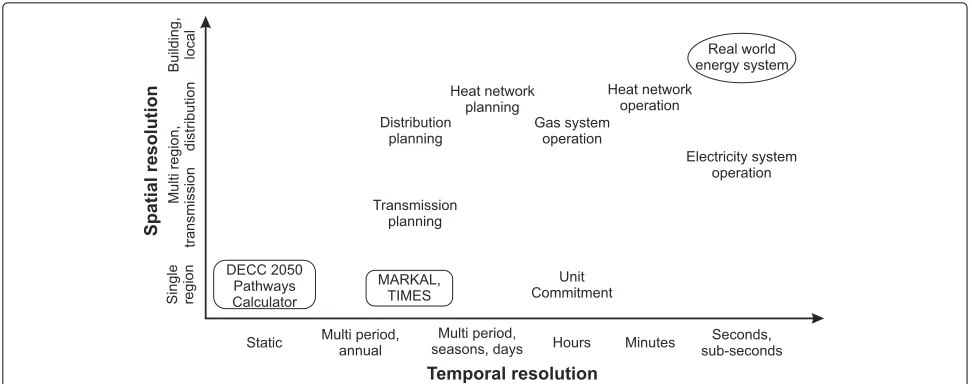
Using time-aggregated data, for example averaged hourly values, can lead to deviations in the results. For exam-ple, [78] showed that the design capacity of a micro combined heat and power plant varied by half between analysis using 5-min and 1-h time-steps. The necessary temporal and spatial scales for grid planning and opera-tion as well as the resoluopera-tions of current MES tools are shown in Fig.5. When modelling, it is assumed that fast phenomena have reached equilibrium at the end of a time-step. This is especially challenging when modelling MES as they cover a wide range of time scales, includ-ing microseconds in electric system operations, hours for gas transport in transmission lines and months in the case of seasonal influences of RES [19]. A possible solution to this problem is to interlink long-term energy system models with short term electricity system mod-els. However, while the information flow from long-term models to short-term models works quite well, the reverse seems to be more challenging [55]. A major challenge in MES modelling is to select a proper temporal reso-lution to fit the scope. The shares of RES which can be integrated might be over- or under-estimated if an unsuit-able resolution is chosen [15], for example [32] suggests a 15-min interval.
Assessment criteria
Fig. 5Spatial and temporal scales in MES. The different spatial and temporal scales required for MES planning and operation and current MES model resolutions. Adapted from [19]
AnEconomic Assessmentis the most widely used evalu-ation criterion. It can be applied anywhere from planning to the operational stage. The main premise is the minimi-sation of the total cost or the maximiminimi-sation of profits. For planning purposes, the discounted cash flow or the net present value theory are usually used. At the operational stage, the analysis of costs and revenues caused by system operation is the typical approach.
AnEnergetic Assessment is the comparison of energy output to energy input, also called first law efficiency or energy efficiency. This can be conducted for individual components or whole systems during a particular operat-ing state or over a certain period of time. Energy efficiency must always be compared to a reference case. An example of a relative indicator is when comparing energy savings by cogeneration to separate production [79].
AnExergetic Assessmentconsiders the first and the sec-ond law of thermodynamics. Exergy describes the max-imum share of energy that can be converted to useful technical work. While energy can be neither produced nor destroyed, it is the exergy that is consumed to provide a certain service. Therefore, exergy is a suitable com-mon basis when comparing different energy carriers in a MES. Exergy analysis allows the evaluation of cascading energy usage and is a powerful tool for identifying causes, locations and magnitudes of primary energy losses [80].
An Environmental Assessment is an important crite-rion in the field of energy policy development. It covers the wide range of impacts of MES on the environment, like greenhouse gas emissions, air pollutants, influence on biodiversity and groundwater resources. In general it can be distinguished between local impacts, for example par-ticulate matter and NOx-emissions, and global impacts, such as greenhouse gases and chlorofluorocarbons. In
this work, the environmental assessment focuses on the CO2-emissions related to energy production.
The Reliability Assessment rates the ability of energy systems to provide an adequate supply. The main aim of the reliability assessment is to identify the weak and crit-ical parts of the energy infrastructure, such as the outage rates of generating units, the failure rates of overhead lines and operational decisions. All those are predicted future events which cannot be estimated precisely and therefore have to be assessed probabilistically. Typical key perfor-mance indicators areloss of load probability(LOLP),loss of load expectation (LOLE), expected energy not served
(EENS) andloss of energy expectation(LOEE) [81].
Grid-based MES modelling approaches
In addition to supply and demand, grid-based MES mod-els must consider the energy flows in the networks, energy storage and the energy conversion between networks. Two approaches are used to model such systems: the inte-grated approach and model linkage or co-simulation. In the integrated approach, all components (networks, con-verters, storage) are modelled within the same framework. Co-simulation or model linkage means that several or all components have their own dedicated model, which are coupled by a superior tool. For the coupling tool, the sub-systems are black boxes.
Energy network modelling approaches
incorporated as a function of the corresponding flow. Power flow models are the most accurate and based on conservation of flow and on conservation laws, but also include non-linearities.
While the network flow models are relatively simple and the same for each of the three most common energy networks (electricity, gas and district heat), the power flow models are more complicated. Physical laws such as the relation between electric voltage and current, or hydraulic pressure and flow, are used to determine the load flows. Since these physical relations are specific for the individual energy carriers, no general model for all energy carriers is available [82]. For each network type there are dedicated static load flow calculation tools which are based on physical laws, for example NEPLAN5, PSS SINCAL6or DIgSILENT PowerFactory7. As well as mod-elling electricity networks, the first two tools can also model district heat and gas networks, however, it is not possible to interconnect each energy carrier.
Electric networks
There are two different approaches to model electrical power flow, the linear DC model and the more realis-tic AC model [83]. For the DC model, Kirchhoff ’s law is used to determine the active power flows which depend on the maximum power capacity and the resistance of the power lines [84]. Very often, linear DC power flow is used in operational electricity system models to decrease the complexity and calculation time for the non-linear optimal power flow problem [85]. For example, DC load flow models were used in two recent studies on the Ger-man electricity grid. One [86] investigated the necessary long term grid expansion due to the RES integration, the other was used to determine the optimal placing of stor-age power plants in 2020 [87]. DC load flow network representation was also used for an integrated day-ahead electricity market model in Turkey [88]. Several papers address the accuracy of DC load flow formulations [89] or compare results gained by AC and DC formulations [85,90,91].
As AC load flow representations also account for active and reactive power flows, data regarding capacitive and inductive behaviour of the transmission lines is required. However, this increased detail adds to the complexity of the model and results in longer calculation times [84]. Solving large-scale electricity systems with an AC power flow representation is still a challenge because for some operation states, standard methods like Newton-Raphson or optimal power flow do not deliver any results [85] and prevent full AC power flow models from being widely adopted in real time operation [92]. All of the above men-tioned load flow calculation tools are capable of AC power flow calculations. Geidl and Andersson [93] used an AC load flow representation to determine the optimum power
flow in an interconnected system of energy hubs. Other applications are the determination of the optimal load flow in the distribution grid [94].
Pipeline networks
Power flow models for pipeline networks must consider pressure losses and, in the case of district heat grids, must also consider heat losses and the temperatures of the feed and return flows. The tools described above, NEPLAN and PSS SINCAL, can solve the non-linear power flow equations, for example by using the Newton-Raphson algorithm. The non-linear dependency between flow and pressure loss is a challenge in case of integrated MES simulation, because it requires either linearisation or a non-linear problem formulation. Several works have dealt with optimal power flow modelling in MES: for pipeline networks, they either linearised the equations [95] or used non-linear models [93,96]. In practical modelling, generally static equations are used. This means that fast phenomena are negligible and have reached equilibrium before the end of the time-step [19]. In the case of fine time resolutions and large-scale pipeline networks, equi-librium might not be reached at the end of a time-step meaning full transient equations are necessary [97] to con-sider the changes in the linepack8[19]. The same applies if modelling storage that is intrinsically available in existing infrastructure, for example if using the slower dynamics as flexibility option for the power grid [99].
Converter and storage modelling approaches
There are several converter and storage modelling con-cepts with various levels of detail. The most generic one is the energy hub concept [100] which was specifically developed for describing the power flows in intercon-nected, grid-based MES. In his review, Mancarella [28] also includes themicrogrid[101] andvirtual power plant
[102] modelling concepts, which were originally designed for power grid modelling, in the MES modelling concepts. A more recent concept is thepower nodemodelling con-cept [103]—originally designed to model energy storage in electrical power systems. Whereas the energy hub is a full multi-energy modelling concept, the others primar-ily target the electricity system and only consider some multi-energy aspects, but do offer a higher degree of detail.
Energy hub
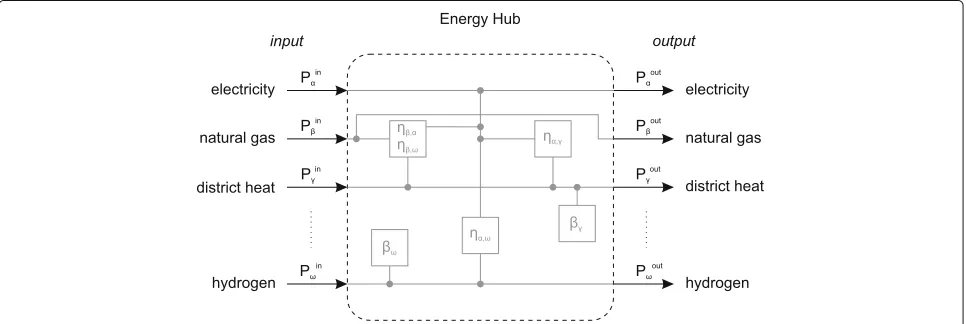
energy hub are converters, energy storage, and input and output connections (Fig.6). A converter is described by the energy efficiencyηα,βbetween input of energy carrier α and output of energy carrier β and can have multi-ple power inputsPinand outputsPout. A hub can consist of a single device or a combination of multiple convert-ers and has dedicated inputs and outputs. The general formulation of energy conversion for a multi-input and multi-output hub is analogous to a single converter and can be stated as followed [104]:
⎛ ⎜ ⎜ ⎜ ⎝
Pαout Pβout
.. .
Pωout
⎞ ⎟ ⎟ ⎟
⎠=
⎛ ⎜ ⎜ ⎜ ⎝
ηα,α ηβ,α · · · ηω,α ηα,β ηβ,β · · · ηω,β
..
. ... . .. ... ηα,ω ηβ,ω · · · ηω,ω
⎞ ⎟ ⎟ ⎟ ⎠
⎛ ⎜ ⎜ ⎜ ⎝
Pin
α
Pinβ
.. .
Pinω
⎞ ⎟ ⎟ ⎟
⎠ (1)
Energy systems of various scales and resolutions can be represented by a set of interconnected energy hubs. The energy transmission between the hubs can be represented by network or power flow models. The original approach uses a black-box modelling approach with constant con-version efficiencies for converters.
The majority of energy hub applications use an inte-grated modelling approach. Although the energy hub con-cept was originally developed for greenfield design studies [105], it has been used for several other purposes. In addition to optimal dispatch [104], optimal power flow modelling in the networks [93] and topological optimisa-tion [106], energy hub models were also used for reliability considerations [107] and exergetic optimisation [108]. A decent collection of published research on the energy hub can be found in [30].
Hybrid concepts
Amicro-gridis a distribution system with interconnected loads and distributed energy sources (PV, wind, storage,
etc.) which is controlled in a coordinated way, allow-ing it to operate in parallel with the grid or in island mode [109]. Micro-grids can be MES, if the loads and supplies of other forms of energy are included in their control strategy as well. Examples are the integration of co- and tri-generation as well as electrical heat pumps. A tool for efficient design and operation of polygeneration micro-grids was presented by [110, 111]. The applica-tion of a MES micro-grid was shown at the University of Genua [112].
A virtual power plant (VPP) is a flexible representa-tion of a portfolio of distributed energy resources. They are aggregated and coordinated in a way so that they act as a single power plant [113]. Currently, small power generation facilities like battery storage and distributed energy resources are generally prohibited from the elec-tricity spot market [114]. Virtual power plants can help overcome these barriers and meet the requirements for participation in the European Energy Exchange spot mar-ket [115] and the control energy tenders [116,117]. The application of VPP in MES concentrates on providing sys-tem flexibility, for example by including thermal storage in a cluster of CHP plants [118] or by using aggregated resources like heat pumps, electric vehicles and electroly-sers in replace of the spinning reserve [119]. For example, a VPP model is used to evaluate the feasibility of balancing the power in a renewables only power system using CHP, heat pumps and thermal storage [120].
ThePower Nodesmodelling concept is based on a Mul-tilevel Flow modelling approach, which is usually used to model industrial processes on several interconnected levels [121]. A power node represents a generic storage which is inserted in between the grid and the supply and demand processes. This adds a new degree of free-dom to balance the power grid and works in tandem with controllable loads by offering inherent storage capacity.
In order to provide a conceptual model for energy stor-age and different levels of controllability of power system units the power node approach aims to ‘introduce a model decomposition for operation functions in different plan-ning stages and operation time-scales’ [122]. A multi-stage formulation is used to provide equations for day-ahead and intra-day rescheduling as well as real-time operation. Although the power node modelling concept is mainly designed solely for electricity grid simulations, it may also be used in a MES context when considering power-to-heat applications. In a case study, a power grid with intermit-tent electricity supply, thermal load and thermal energy storage was investigated [103,122,123].
MES open source modelling frameworks
While in earlier times, models designed for urban or utility energy systems were not commercially available [124], the situation has changed and today there are sev-eral accessible MES modelling concepts and open source modelling frameworks. For our review, a collection of 29 open source energy modelling tools was established from [25,125, 126]. The complete collection, including infor-mation regarding the properties of the tools (e.g. program-ming language, available energy sectors, time resolution, energy grids), can be found in Additional file1. Sixteen of these tools support modelling energy grids, and only seven of those allow the modelling of more than a single energy carrier. Balmorel [127], ficus [128] and PyPSA [129] focus on modelling electricity and heat supply. TransiEnt [130] is a Dymola library for modelling the transient behaviour of electricity, gas and district heat networks. Calliope [131], oemof [132] and urbs [133] are the most generic and flexible modelling frameworks as they support mod-elling user-defined energy sectors and grids. They also allow user-defined time-resolutions and horizons. There-fore we selected them for a further evaluation according to the modelling aspects and approaches stated above. A short description of each framework is provided followed by a comparison.
Calliope
Calliopeis a framework used to model MES, developed by the universities ETH Zürich and University of Cambridge. The model is written in Python and has a clear separation of framework (code) and model (data). The focus is set on spatial and temporal explicitness, openness, transparency and the ability to compute and compare a large number of scenarios [11].
oemof
oemof is a ‘modular open source framework to model energy supply systems’ developed by the Reiner Lemoine Institut and the Center for Sustainable Energy Systems at Flensburg University of Applied Sciences. It is a
collaborative modelling approach that is still under devel-opment. The modular structure offers the ability to adapt to the desired scope, making it flexible in time resolu-tion and allows for the connecresolu-tion of multiple regions and energy sectors. It provides a rich set of tools to construct energy supply system models in high temporal and spa-tial resolution. The object-oriented implementation of the framework allows users to address the uncertainties of highly integrated future energy systems [134].
urbs
urbsis an energy modelling framework developed by the Technical University of Munich. It is a linear program-ming optimisation model built for capacity expansion planning and unit commitment for distributed energy sys-tems. It is suitable for MES with a focus on optimising storage size and use. The optimisation objective is to min-imise the cost of the energy system while satisfying the given demand [133].
Framework comparison
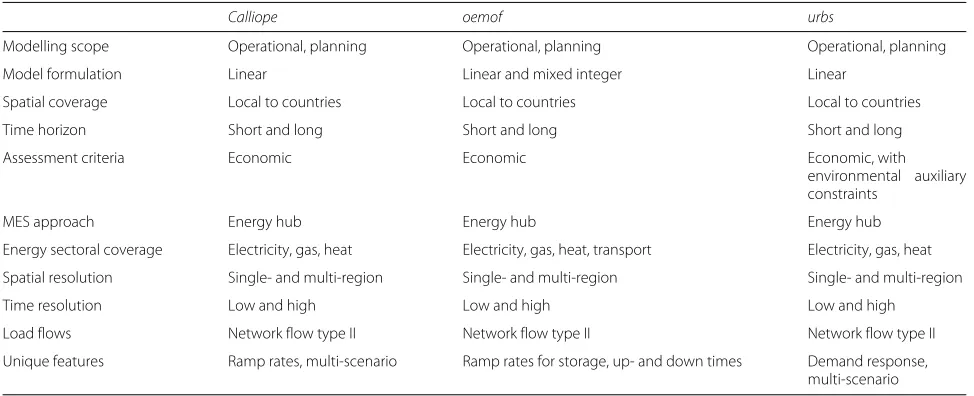
The general and specific characteristics of the modelling frameworks are summarised in Table4. All of the mod-elling frameworks are based on the energy hub concept and cover the electricity, heat and gas sector.oemof stands out with the option to include the transport sector. The basic features included are renewable energy sources, converters (including co- and tri-generation), consumers, storage and grids for electricity, heat and gas. Type II net-work flow models are used to describe the energy trans-mission between multiple regions. Since all frameworks have operational and planning modes incorporated, they support high time resolutions and long term investigation periods. Using a deterministic optimisation model formu-lation, all frameworks accept linear equations.oemof and
Calliopealso accept binary variables. This only allows a basic level of detail but high spatial coverage.
The main objective of all frameworks is to minimise costs for a given scenario. As well as economic constraints,
urbsalso offers the opportunity to include CO2emissions as an auxiliary constraint. The economic analysis ofurbs
is especially advanced as it includes a number of economic variables outside of the fixed and variable standard costs. It allows the user to explore investment costs, start-up cost, time variable buy and sell prices for commodities and an annuity factor formula for a given depreciation duration and interest rate. Even though the basic func-tions of the tools are quite similar, they also have some unique features.Calliopeandurbssupport multi-scenario evaluation andurbsalso provides demand response, while
oemof offers the implementation of minimum up- and down-times for converters.
The source codes for all the frameworks are hosted on
Table 4General and specific characteristics and features of the modelling frameworks
Calliope oemof urbs
Modelling scope Operational, planning Operational, planning Operational, planning
Model formulation Linear Linear and mixed integer Linear
Spatial coverage Local to countries Local to countries Local to countries
Time horizon Short and long Short and long Short and long
Assessment criteria Economic Economic Economic, with
environmental auxiliary constraints
MES approach Energy hub Energy hub Energy hub
Energy sectoral coverage Electricity, gas, heat Electricity, gas, heat, transport Electricity, gas, heat
Spatial resolution Single- and multi-region Single- and multi-region Single- and multi-region
Time resolution Low and high Low and high Low and high
Load flows Network flow type II Network flow type II Network flow type II
Unique features Ramp rates, multi-scenario Ramp rates for storage, up- and down times Demand response, multi-scenario
indicates that all projects continue to have active online communities who are further developing the codes and correcting errors. Road maps and feature lists show the path and schedule for future developments and releases. Issues and bug reports posted on github are usually answered and fixed by the developer community within a reasonable time.
Appropriate documentations help to support new users with understanding the structure and functions of the frameworks. Compared to the other frameworks,urbshas broader ranging application possibilities which are sup-ported by more extensively and detailed documentation. The well-structured source code of each framework is straightforward and of high quality. However,urbsstands out because its in-code documentation includes more details and additional information.
Even thoughurbs has the most extensive documenta-tion, the broad functionality and sophisticated economic assessment make it time consuming to change the code. A considerable advantage ofoemof is the clear and modular structure of the code which allows it to be easily adapted. In comparison to oemof, Calliope does not have such clear and strict separation between the model description, simulation and optimisation.
MES modelling challenges
Energy system modelling is influenced by various sectors and fields (see Fig. 1 and Table5). As well as detailing energy infrastructure components and technology, energy system models must also account for the stochastic nature of RES and the behaviour of consumers and market stake-holders.
General aspects
The main challenge when modelling an energy system is to accurately model the desired problem, and to select the
proper influencing factors and boundary conditions. It is important to model the factors that are relevant to the problem instead of prioritising factors that may be easier to use [11]. While energy system models are often imple-mented for technological and economic effects, they are rarely used to investigate the effects of aspects such as human behaviour, indirect costs, socio-political or non-financial barriers for technology [11].
Energy systems typically consist of the four intercon-nected fields listed in Table 5. On the path to a future energy system based on distributed RES, the number of interconnections between the individual energy carriers will need to increase. This adds to the complexity of the system and increases the overheads for maintenance [135,136].
Model formulation
Table 5Segments and modelling approaches for components of future energy systems [40]
Field Modelling approach Components
Physical world Continuous models Energy infrastructure and its components: generation, transport, distribution, consumption
Information Technology Discrete models Controllers, communication infrastructure, software
Roles and individual behaviour Game theory models Market players
Aggregated and stochastic elements Statistical models Weather, macro-view on consumers, aggregated behaviour of many individual elements
Including control systems in a MES model requires variable-structure, dynamic models [40]. Consumer behaviour and stochastic elements (Table 5) have rarely been included in energy system modelling to date. How-ever, these factors are expected to be important in future applications despite adding many layers of complexity to the models. For example, in the UK, there are very few low carbon emission energy scenarios which also take into account social or political aspects [137]. The estimation of future energy demand and the required energy infras-tructure can have significant influence on the future of energy supply [11]. In order to achieve a low-carbon emis-sion future, energy demand must, in addition to energy supply, be addressed and managed [20,138]. Furthermore, the public acceptance of renewable energy installations like rooftop solar panels in cities, on- and off-shore wind power plants, or new grid lines plays an important role for future energy systems. Overall, considering all four fields requires several different modelling methodologies, tech-niques and logics. This results in large stochastic hybrid models [40].
Data
Generally, there are two types of uncertainty: epistemic and aleatory [139]. An uncertainty is epistemic if the mod-eller thinks it can be reduced by better data and models, otherwise it is aleatory. There is no way to address epis-temic uncertainties except for better models and data, but there are formal methods for dealing with aleatory uncertainties—an example is the Monte Carlo method. The Monte Carlo method, or similar approaches to deter-mine uncertainty, exadeter-mine the changes of a model’s inputs and outputs by varying input data several times. The benefit of these methods is that they can be used in combination with existing deterministic models.
Stochastic models, for example, are designed to deal with uncertainties by handling a random input and pro-ducing a randomly distributed outcome. This means that distributions are fed into the model instead of determinis-tic parameters [11,31]. Ideally, input data and parameters should be assigned with deviation ranges. However, the necessary input information might not always be of suffi-cient quality. Alternatively, it may be unavailable, or may only be available on an aggregated level because of data
protection law limitations. If this is the case, then it must be adjusted or downscaled to the desired boundaries - for example from a national to a district level on a per-capita basis. Very often in these cases the uncertainty is difficult or impossible to determine. Unfortunately, the majority of studies do not describe the methods on how they dealt with the uncertainties related to their input data [31].
Specific aspects
The distributed nature and the necessary power-based perspective of RES mean that the modelling of time and space is crucial for accurate and robust results of MES models. Because it is very difficult to acquire sufficiently fine resolution data for RES, it is unlikely that traditional optimisation models (which use an energy based perspec-tive) can fully represent the resolution challenges [11].
Time and space
linked to short term operational power system models [53,54,60].
The weather dependency of RES potentials requires highly resolved data in space. However, such spatially resolved data is generally only available in annual values (e.g. in [143] where the annual RES potentials on a dis-trict level for Austria are presented). A newer approach is the renewable.nija database which provides time and space resolved PV and wind potentials [131,144]. The spa-tial distribution of demand was mainly addressed for the heating sector by two studies which investigated the heat demand in the UK [73, 74]. It was found that different levels of spatial resolution or aggregation also require a simplification of the energy networks. Network reduction is currently an important field for modellers of large-scale transmission power grids [62, 75, 77, 145, 146]. This is also an important consideration when modelling MES at a distribution level.
The cellular approach [147] is a method that supports network reduction. The studied area is divided into a number of cells, based on local conditions like consumers, producers and energy infrastructure. All individual enti-ties of the same type within a cell are aggregated and represented by one single cell. Because the internal load flows of a cell are neglected, network reduction methods are necessary so that inter-cellular load flows are correctly represented. Because of the averaging effect of aggrega-tion, the cellular approach allows the utilisation of stan-dardised or synthetic load profiles if no high resolution data is available.
Conclusions
In this paper, we presented an overview of the current research and challenges of modelling grid-based MES. General and specific aspects of modelling grid-based energy carrier systems have been provided.
In order to provide a robust and efficient future energy supply, MES models should incorporate the interactions between different energy carriers, and the representa-tion of load flows in grids. They should also enable the cost efficient integration of high shares of RES by using available synergies the different energy grids pro-vide. The aspects which necessitate a power-based per-spective in future planning models have been discussed. These aspects include the representation of modelling details, temporal and spatial resolutions, and network rep-resentations. Presented are three open source modelling frameworks that have been tested and used by the authors. The challenges discussed show that there are still wide gaps and several opportunities for future research topics. From a technical perspective, the amalgamation of plan-ning and operational models [11] is a major challenge. This is because it demands finer temporal and spatial res-olutions and requires the implementation of a lot more
technical details into the model. Moreover, the complex-ity of a model increases when accounting for interdisci-plinary aspects such as the interdependency of the food and water sector [29], or human behaviour in an energy system. The most common model families, like simula-tion and optimisasimula-tion, might not be sufficient for solving the resulting (usually non-linear) mathematical problem. Model coupling or new modelling approaches like agent-based-modelling might be necessary to obtain robust and relevant results.
Endnotes
1The flexibilities offered by one energy carrier that
can be used by another energy carrier, e.g. the enor-mous storage capacity of the natural gas grid is used with power-to-gas plants [24].
2For example, World Energy Model (WEM), National
Energy Modelling System – Residential Sector Demand Module (NEMS-RSDM)
3For example, MARKAL/TIMES, MESSAGE
4For example, Prospective Outlook on Long-term
Energy System (POLES), Price-Induced Market Equilib-rium System (PRIMES)
5https://www.neplan.ch
6https://www.siemens.com/sincal
7https://www.digsilent.de/de/powerfactory.html
8Linepack is the quantity of gas contained in the pipe at
a given time [98]. 9www.github.com
10A commit is a contribution to a github project.
Additional file
Additional file 1:Additional file 1 includes the complete collection of open source energy modelling tools established from [25,125,126]. It includes: information regarding the host, the software license, the programming language, the mathematical model formulation, the availability of a documentation, the scope, the available energy sectors, possible time-resolutions and geo-resolutions, suitability to model multiple regions, and the possibility to model energy grids. (XLSX 20 kb)
Abbreviations
CHP: Combined heat and power; COP 21: 2015 United Nations Climate Change Conference; DP: Dynamic programming; EENS: Expected energy not served; LOEE: Loss of energy expectation; LOLE: Loss of load expectation LOLP: Loss of load probability; LP: Linear programming; MES: Multi-energy systems; MILP: Mixed-integer linear programming; NLMIP: Non-linear mixed-integer programming; RES: Renewable energy sources; VPP: Virtual power plant
Acknowledgements
Not applicable.
Funding
Availability of data and materials
All the data supporting the conclusions is included in the text. The source codes of the open source modelling frameworks are available on github; links are cited within the text.
Authors’ contributions
The main work was conducted by LK: MES literature review and current challenges on energy systems modelling. GS carried out the analysis of open source energy modelling frameworks. TK initialised the work and revised and approved the final manuscript. All authors read and approved the final manuscript.
Ethics approval and consent to participate
Not applicable.
Consent for publication
Not applicable.
Competing interests
The authors declare that they have no competing interests.
Publisher’s Note
Springer Nature remains neutral with regard to jurisdictional claims in published maps and institutional affiliations.
Received: 4 March 2018 Accepted: 17 October 2018
References
1. International Energy Agency (2017) Key world energy statistics: also available on smartphones and tablets. IEA Publications, Paris
2. Moriarty P, Honnery D (2012) What is the global potential for renewable energy? Renew Sust Energ Rev 16(1):244–252.https://doi.org/10.1016/j. rser.2011.07.15
3. Lewis NS, Nocera DG (2006) Powering the planet: Chemical challenges in solar energy utilization. Proc Natl Acad Sci U S A 103(43):15729–15735. https://doi.org/10.1073/pnas.060339510
4. CO2 Emissions From Fuel Combustion (2017) Overview (International Energy Agency, ed.). Organization for Economic Cooperation & Development and Rowman & Littlefield Publishers, Incorporated, Paris 5. United Nations Framework Convention of Climate Change (2015)
United Nations Framework Convention on Climate Change: adoption of the Paris agreement (United Nations Framework Convention of Climate Change, ed.). United Nations, Paris.https://unfccc.int/sites/default/files/ english_paris_agreement.pdf. Accessed 27 Oct 2018
6. Helm D (2002) Energy policy: security of supply, sustainability and competition. Energy Policy 30(3):173–184
7. Strachan N, Fais B, Daly H (2016) Reinventing the energy
modelling–policy interface. Nat Energy 1(3):16012.https://doi.org/10. 1038/nenergy.2016.1
8. Huntington H, Weyant JP, Sweeney JL (1982) Modeling for insights, not numbers: the experiences of the energy modeling forum. Omega 10(5):449–462.https://doi.org/10.1016/0305-0483(82)90002-0 9. Dantzig GB (1965) Linear programming and extensions. Second printing
with corrections edn. Princeton University Press, Princeton
10. Zimmermann HJ (2005) Operations research: Methoden und Modelle ; Für Wirtschaftsingenieure, Betriebswirte, Informatiker. 1. aufl edn. Mathematik für Wirtschaftswissenschaftler. Vieweg, Wiesbaden 11. Pfenninger S, Hawkes A, Keirstead J (2014) Energy systems modeling for
twenty-first century energy challenges. Renew Sust Energ Rev 33:74–86. https://doi.org/10.1016/j.rser.2014.02.00
12. Pfenninger S, DeCarolis J, Hirth L, Quoilin S, Staffell I (2017) The importance of open data and software: Is energy research lagging behind? Energy Policy 101:211–215.https://doi.org/10.1016/j.enpol. 2016.11.04
13. Cao KK, Cebulla F, Gómez Vilchez JJ, Mousavi B, Prehofer S (2016) Raising awareness in model-based energy scenario studies—a transparency checklist. Energy Sustain Soc 6(1):519. https://doi.org/10.1186/s13705-016-0090-z
14. Morrison R (2018) Energy system modeling: Public transparency, scientific reproducibility, and open development. Energy Strateg Rev 20:49–63.https://doi.org/10.1016/j.esr.2017.12.01
15. Collins S, Deane JP, Poncelet K, Panos E, Pietzcker RC, Delarue E, Ó Gallachóir BP (2017) Integrating short term variations of the power system into integrated energy system models: A methodological review. Renew Sust Energ Rev 76:839–856.https://doi.org/10.1016/j.rser.2017. 03.09
16. IEA-ETSAP (2008) MARKAL: MARket ALlocation. IEA-ETSAP. http://iea-etsap.org/index.php/etsap-tools/model-generators/markal. Accessed 04 Dec 2017
17. Agnew M, Schrattenholzer L, Voss A (2017) A model for energy supply systems alternatives and their general environmental impact. IIASA, Laxenburg, Austria.http://pure.iiasa.ac.at/1177/. Accessed 07 Dec 2017 18. Messner S (1984) User’s guide for the matrix generator of message II.
Parts I and II: Model Description and Implementation Guide, and Appendices. IIASA, Laxenburg, Austria.http://pure.iiasa.ac.at/2447/. Accessed 07 Dec 2017
19. Mancarella P, Andersson G, Pecas-Lopes JA, Bell KRW (2016) Modelling of integrated multi-energy systems: drivers, requirements, and opportunities. In: 2016 Power Systems Computation Conference (PSCC). IEEE. pp 1–22.https://doi.org/10.1109/PSCC.2016.754103
20. Brauner G (2016) Energiesysteme: Regenerativ und Dezentral. Springer Fachmedien Wiesbaden, Wiesbaden. https://doi.org/10.1007/978-3-658-12755-8
21. Ruiz-Romero S, Colmenar-Santos A, Mur-Pérez F, López-Rey Á (2014) Integration of distributed generation in the power distribution network: the need for smart grid control systems, communication and equipment for a smart city — Use cases. Renew Sust Energ Rev 38:223–234.https://doi.org/10.1016/j.rser.2014.05.08
22. Heimberger M, Kaufmann T, Maier C, Nemec-Begluk S, Winter A, Gawlik W (2017) Energieträgerübergreifende Planung und Analyse von Energiesystemen. Elektrotechnik Informationstechnik 134(3):229–237.
https://doi.org/10.1007/s00502-017-0504-23. Heinrichs HU (2013) Analyse der Langfristigen Auswirkungen Von Elektromobilität Auf Das Deutsche Energiesystem Im Europäischen Energieverbund. In: Produktion und Energie / Karlsruher Institut für Technologie, Institut für Industriebetriebslehre und industrielle Produktion u. Deutsch-Französisches Institut für Umweltforschung, vol. 5, Print on demand edn. KIT Scientific Publishing, Karlsruhe
24. O’Malley M, Kroposki B, Hannegan B, Madsen H, Andersson M, D’haeseleer W, McGranaghan MF, Dent C, Strbac G, Baskaran S, Rinker M (2016) Energy Systems Integration. Defining and Describing the Value Proposition.https://doi.org/10.2172/125767
25. Energypedia (2017) openmod intiative.https://wiki.openmod-initiative. org/wiki/Open_Models. Accessed 17 Nov 2017
26. Pfenninger S, Hirth L, Schlecht I, Schmid E, Wiese F, Brown T, Davis C, Gidden M, Heinrichs H, Heuberger C, Hilpert S, Krien U, Matke C, Nebel A, Morrison R, Müller B, Pleßmann G, Reeg M, Richstein JC, Shivakumar A, Staffell I, Tröndle T, Wingenbach C (2018) Opening the black box of energy modelling: Strategies and lessons learned. Eng Strateg Rev 19:63–71.https://doi.org/10.1016/j.esr.2017.12.00
27. (2012) Global Energy Assessment (GEA): Toward a Sustainable Future. 1. publ edn(Johansson TB, ed.). Cambridge Univ. Press, Cambridge u.a. 28. Mancarella P (2014) MES (multi-energy systems): An overview of
concepts and evaluation models. Energy 65:1–17.https://doi.org/10. 1016/j.energy.2013.10.04
29. Wiese F, Hilpert S, Kaldemeyer C, Pleßmann G (2018) A qualitative evaluation approach for energy system modelling frameworks. Energy Sustain Soc 8(1):211.https://doi.org/10.1186/s13705-018-0154-3 30. Mohammadi M, Noorollahi Y, Mohammadi-ivatloo B, Yousefi H (2017)
Energy hub: from a model to a concept – a review. Renew Sust Energ Rev 80:1512–1527.https://doi.org/10.1016/j.rser.2017.07.03 31. Keirstead J, Jennings M, Sivakumar A (2012) A review of urban energy
system models: approaches, challenges and opportunities. Renew Sust Energ Rev 16(6):3847–3866.https://doi.org/10.1016/j.rser.2012.02.04 32. van Beuzekom I, Gibescu M, Slootweg JG (2015) A review of
multi-energy system planning and optimization tools for sustainable urban development. In: 2015 IEEE Eindhoven PowerTech. pp 1–7. https://doi.org/10.1109/PTC.2015.723236.http://ieeexplore.ieee.org/ stamp/stamp.jsp?arnumber=7232360

![Table 3 Energy systems modelling approaches [36]](https://thumb-us.123doks.com/thumbv2/123dok_us/326189.1525091/6.595.55.292.662.735/table-energy-systems-modelling-approaches.webp)
![Table 5 Segments and modelling approaches for components of future energy systems [40]](https://thumb-us.123doks.com/thumbv2/123dok_us/326189.1525091/14.595.55.527.98.187/table-segments-modelling-approaches-components-future-energy-systems.webp)
