Open Access
Research
The stochastic behavior of a molecular switching circuit with
feedback
Supriya Krishnamurthy*
1,2, Eric Smith*
3, David Krakauer
3and
Walter Fontana
4Address: 1Swedish Institute of Computer Science, Box 1263, SE-164 29 Kista, Sweden, 2Department of Information Technology and
Communication, KTH – Royal Institute of Technology, SE-164 40 Kista, Sweden, 3Santa Fe Institute, 1399 Hyde Park Road, Santa Fe, NM 87501, USA and 4Department of Systems Biology, Harvard Medical School, 200 Longwood Avenue, Boston MA 02115, USA
Email: Supriya Krishnamurthy* - [email protected]; Eric Smith* - [email protected]; David Krakauer - [email protected]; Walter Fontana - [email protected]
* Corresponding authors
Abstract
Background: Using a statistical physics approach, we study the stochastic switching behavior of a model circuit of multisite phosphorylation and dephosphorylation with feedback. The circuit consists of a kinase and phosphatase acting on multiple sites of a substrate that, contingent on its modification state, catalyzes its own phosphorylation and, in a symmetric scenario, dephosphorylation. The symmetric case is viewed as a cartoon of conflicting feedback that could result from antagonistic pathways impinging on the state of a shared component.
Results: Multisite phosphorylation is sufficient for bistable behavior under feedback even when catalysis is linear in substrate concentration, which is the case we consider. We compute the phase diagram, fluctuation spectrum and large-deviation properties related to switch memory within a statistical mechanics framework. Bistability occurs as either a first-order or second-order non-equilibrium phase transition, depending on the network symmetries and the ratio of phosphatase to kinase numbers. In the second-order case, the circuit never leaves the bistable regime upon increasing the number of substrate molecules at constant kinase to phosphatase ratio.
Conclusion: The number of substrate molecules is a key parameter controlling both the onset of the bistable regime, fluctuation intensity, and the residence time in a switched state. The relevance of the concept of memory depends on the degree of switch symmetry, as memory presupposes information to be remembered, which is highest for equal residence times in the switched states.
Reviewers: This article was reviewed by Artem Novozhilov (nominated by Eugene Koonin), Sergei Maslov, and Ned Wingreen.
Published: 31 May 2007
Biology Direct 2007, 2:13 doi:10.1186/1745-6150-2-13
Received: 30 April 2007 Accepted: 31 May 2007 This article is available from: http://www.biology-direct.com/content/2/1/13
© 2007 Krishnamurthy et al; licensee BioMed Central Ltd.
Open peer review
This article was reviewed by Artem Novozhilov (nomi-nated by Eugene Koonin), Sergei Maslov, and Ned Win-green. For the full reviews, please go to the Reviewers' comments section.
Background
Switching plays an important role in cell cycle progression [1,2], cellular differentiation [3-5], and neuronal memory [6]. It is therefore a critical property of molecular signal
transduction and gene expression circuits. Ultrasensitivity
[7,8] underlies one concept of switching defined by a sharp sigmoidal but continuous response in the concen-tration of a molecule over a narrow range of a (stationary) signal. A steep ultrasensitive response, however, leads to "chatter" when the signal fluctuates across the setpoint
[9]. In contrast, bistability [10] is a form of switching made
possible when two stable states, S1 and S2, co-exist over a
signal range. As a consequence, bistable systems exhibit two distinct thresholds as the signal is varied, one at
which a transition occurs from S1 to S2 and another at
which the system switches back from S2 to S1. The
separa-tion of thresholds leads to path dependence or hysteresis, and makes a switched state more impervious to stochastic fluctuations of the signal around the transition point. Skipping for the moment past Fig. 1, we utilize Fig. 2 to illustrate the difference between bistable and ultrasensi-tive switching. In Fig. 2 the red curves show switching through bistability and the green curve shows the ultra-sensitive form of switching.
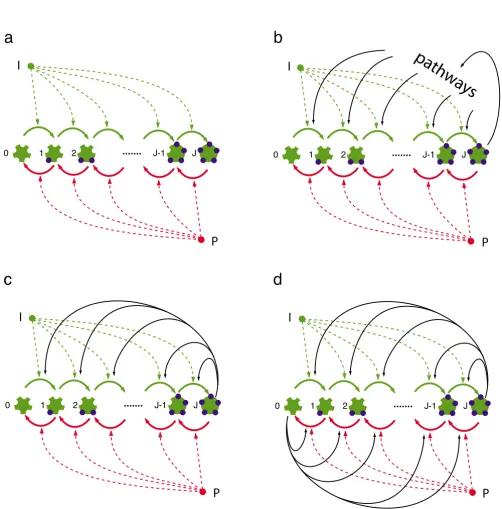
Stochasticity in biological processes at the molecular scale has attracted recent attention both experimentally and theoretically [9,11-15]. In this contribution we present a stochastic treatment of bistable switching generated by a reaction network based on a kinase and a phosphatase that phosphorylate and dephosphorylate, respectively, a substrate at multiple sites. The bistability arises from sym-metric or asymsym-metric autocatalytic feedback whereby the substrate catalyzes its own phosphorylation and dephos-phorylation (symmetric case), or it catalyzes one but not the other process (asymmetric case); see Fig. 1 for a pre-view. In statistical physics terminology, the bifurcation from monostable to bistable behavior appears as a non-equilibrium phase transition. Our first step is to derive analytical expressions for the phase diagram (the regions in parameter space where the system exhibits bistable switching) using a mean-field approximation, in which the consequences of correlations among fluctuations are ignored. We then improve on this by taking fluctuations more accurately into account. A major objective is to understand how network structure and molecule num-bers affect the thresholds (critical points) of the switch and the longevity of its memory through intrinsic fluctua-tions. Some of the analytical results germane to this
objec-tive are obtained with a field-theoretic approach whose technical details are laid out in a forthcoming paper [16]. Here we validate these calculations with numerical simu-lations and discuss their significance.
There are two possible meanings for the term "switching" in a bistable system. In one usage the circuit abruptly changes from monostability to bistability (from one to two possible, long-lived macroscopic phosphorylation
states), or vice versa, in response to the variation of a
parameter. Such a bifurcation in the behavioral repertoire of a system provides a ratchet-like "checkpoint" [17]. The other usage of switching refers to the spontaneous fluctu-ation-induced transition from one macroscopic phospho-rylation state to the other within the bistable regime. This corresponds to a cell losing memory of a dynamical state because of noise intrinsic to cellular processes at low mol-ecule numbers. In a stochastic setting, the number of sub-strate molecules affects both the transition from monostability to bistability and also the residence time in a macroscopic phosphorylation state. Clarifying the role played by fluctuations in these two cases of switching will lead to a better understanding of how reliable, device-like, macroscopic behavior can emerge from low-level stochas-tic molecular interactions – a theme dating back at least to von Neumann [18].
In summary, we consider a highly stylized kinetic mecha-nism of bistability that permits a fairly detailed analytical treatment of its stochastic behavior. We use techniques from non-equilibrium statistical mechanics, which may seem unfamiliar to biologists. Yet, these methods, in con-junction with a model emphasizing a pattern more than biological literalism, convey useful lessons in stochastic reaction-kinetics of biological systems.
Model and biological context
Molecular signal transduction involves the covalent mod-ification of proteins, giving rise to chemically distinct pro-tein states. A widely occuring modification is phosphorylation, which is the transfer of a phosphate group from an ATP molecule to a tyrosine, serine or thre-onine residue (referred to as phosphoacceptors) of a target protein by means of a kinase. The 1663 proteins docu-mented in version 3.0 of the Phospho.ELM database [19] contain between 1 and 26 phosphorylatable sites per pro-tein. A "serine/arginine repetitive matrix 2" protein (SwissProt accession Q9UQ35) exhibits 96 sites. A list of proteins with 10 phosphorylatable sites includes, for example, a glutamate-gated ion channel, lamin, glycogen synthase, DNA topoisomerase 2, insulin receptor, and var-ious protein kinases.
dephosphorylation events are catalyzed concurrently by kinase and phosphatase enzymes whose numbers are also fixed at the outset. In current terminology [11,20], we
focus on the intrinsic noise of the reaction system – the fluctuations in the microscopic phosphorylation states of proteins due to the probabilistic nature of chemical reca-Multisite phosphorylation and feedback structure
Figure 1
Multisite phosphorylation and feedback structure. (a) This panel depicts the basic phosphorylation chain without feed-back in which a target protein with J sites is phosphorylated by a kinase I and dephosphorylated by a phosphatase P. The ordered succession of phosphorylations yields J + 1 modification states, labelled 0, 1, ..., J. (b) The fully phosphorylated target protein relays a signal into pathways that eventually feed back on the phosphorylation chain. (c) Simplification of (b) in which the fully phosphorylated target protein acquires kinase activity and directly feeds back on the chain. We refer to this network configuration as the asymmetric circuit. (d) Schematic of the network with symmetric feedback in which the substrate protein is bifunctional, whereby the fully (de)phosphorylated form catalyzes (de)phosphorylation of its own precursors.
...
0 1 2 J-1 J
...
0 1 2 J-1 J
a
b
c
d
I
P
...
0 1 2 J-1 J
I
P
I
P
...
0 1 2 J-1 J
pathwa
ys
I
tions at fixed component numbers – not the additional (extrinsic) noise caused by fluctuations in the numbers of target, kinase, and phosphatase molecules.
The fully phosphorylated form of a protein often exhibits a distinct catalytic activity, possibly of the kinase or
phos-phatase type. For example, at each level of the mitogen-activated protein kinase (MAPK) cascade, a signaling cir-cuit widely duplicated and diversified within eukaryotes [21], the fully phosphorylated form of the target protein acquires the ability to act as a kinase for the subsequent level. In this paper we will only study a single level or tar-get protein with multiple phosphoaccepting sites.
The fully phosphorylated form of a protein may directly or indirectly promote its own phosphorylation. This is again the case in the MAP kinase cascade, where such feed-back reaches across levels. Once fully phosphorylated, the protein at the third level of the cascade catalyzes the accu-mulation of the kinase at the first level [4], thereby feeding back on its own activation. A positive feedback with a suit-able nonlinearity leads to bistability [4], and the cascade architecture provides that nonlinearity. Bistability can also occur with linear feedback, as in a single ylation/dephosphorylation loop, wherein the phosphor-ylated substrate catalyzes its own phosphorylation, provided the phosphatase reaction is saturable [6]. If, on the other hand, all reaction velocities are linear in the sub-strate, as is the case for large Michaelis constants and small substrate concentrations, the needed nonlinearity can still be generated by multisite phosphorylation. This is the case studied here. We mention for completeness that mul-tisite phosphorylation with saturation kinetics at each modification step can lead to bistability even in the absence of feedback [22,23].
We thus consider a protein with J sites that are
phosphor-ylated by a kinase and dephosphorphosphor-ylated by a phos-phatase, as illustrated in Fig. 1a. The numbers of kinase
molecules, I, and phosphatase molecules, P, are fixed. The
enzymes are assumed to operate in the linear regime where complex formation is not rate limiting. The site modifications occur in a specific order, thus sidestepping combinatorial complexity. Furthermore, phosphorylation (dephosphorylation) of substrate proteins is assumed to follow a distributive mechanism, whereby a kinase (phos-phatase) enzyme dissociates from its substrate between subsequent modification events [24,25]. These
assump-tions lead to J + 1 states for the substrate. The
phosphor-ylation chain with feedback is shown in the bottom half of Fig. 1. Panel (c) depicts an asymmetric topology in which the fully phosphorylated substrate catalyzes its own phosphorylation, while panel (d) shows the symmetric version in which a substrate molecule is bifunctional, act-ing as both a kinase and phosphatase dependact-ing on its
modification state. Kinase I and phosphatase P are
exoge-nous forces on the modification of the substrate, but the feedback is an endogenous force whose strength is pro-portional to the occupancy of the end-states of the chain. This occupancy is subject to intrinsic fluctuations and depends on the total number of substrate molecules. Ultrasensitive and bistable behavior in the symmetric
feed-back circuit with J = 2
Figure 2
Ultrasensitive and bistable behavior in the symmet-ric feedback circuit with J = 2. The ordinate is the order-parameter 冬nJ - n0冭/N measuring the macroscopic variable of interest. The abscissa measures the relative difference between kinase and phosphatase numbers. In this represen-tation, all kinase to phosphatase proportions are compressed symmetrically between -1 and 1. As a result, the hyperbolic behavior of a single phosphorylation/dephosphorylation loop (J = 1) without feedback is a straight line, the dotted diagonal. All other curves are for J = 2, which is the minimal ultrasensi-tive case capable of bistability. The blue curve shows the ultrasensitivity of the chain without feedback. As J →∞, the slope of the sigmoidal approaches 2 at the midpoint I = P (not shown). The blue curve already covers nearly 50% of the ultrasensitivity attainable at J = ∞. Ultrasensitivity is enhanced by feedback (green curve), when approaching the threshold for bistability from below. The strength of feedback is
reported in terms of g = N/ , where N is the number of substrate molecules (see text for details). In the case of the green curve g = 2.85. The slope at the midpoint is always 8 at the critical point for the onset of bistability in the presence of feedback. Above the threshold (red curve; g = 5) there is an intermediate range of (I - P)/(I + P) with two stable solutions. The dots connecting the two branches indicate a sudden change in stationary phosphorylation state as one of the branches ceases to exist when (I - P)/(I + P) passes outside the bistable range. This creates hysteresis.
−1 −0.8 −0.6 −0.4 −0.2 0 0.2 0.4 0.6 0.8 1
−1 −0.8 −0.6 −0.4 −0.2 0 0.2 0.4 0.6 0.8 1
(I-P) / (I+P)
<nJ
- n
0
> / N
Although each modification step is kinetically linear in both the number of substrate molecules and modification enzymes, the phosphorylation/dephosphorylation chain of Fig. 1a (no feedback) responds in a nonlinear fashion to a change in the ratio of kinase to phosphatase numbers. Absent feedback, the chain behaves like a random walk with drift and reflecting barriers in the space of substrate phosphoforms. The random walker hops to the right
(phosphorylation) with probability I/(I + P) and to the
left (desphosphorylation) with probability P/(I + P). As a
result of drift there is a geometric multiplier x linking the
expected occupancies of phosphoforms. In the absence of
feedback, this multiplier is simply I/P, the ratio of kinase
to phosphatase numbers. For all mean-field treatments, drift causes the expected occupancy of molecules in adja-cent phosphorylation states to satisfy
Thus the expected fractions of fully phosphorylated, 冬nJ冭/
N, and unphosphorylated substrate molecules, 冬n0冭/N, are
related as
n
N x
n
N
j j
= −1 . (1)
Phase diagrams
Figure 3
Phase diagrams. (a) Symmetric feedback circuit as in Fig. 1d. (b) Asymmetric feedback circuit (from the fully phosphorylated J-state) as in Fig. 1c. The coupling parameter g = N/ , the exogenous catalytic strength P/I, and the number of phosphoac-ceptor sites J are being varied. Symbols are simulation results (N = 1000) and solid lines are analytical results from the mean-field theory for J = 2, 3, 5 (solid, dash, dot). The discrepancies arise from fluctuations, which the mean-field theory ignores. In the circuit with symmetric feedback, there is one critical coupling strength gc for each ratio of phosphatase to kinase numbers. (The phase diagram for symmetric feedback is itself symmetric about 0 in log (I/P). Only half of the diagram is shown in panel (a); the symmetric half is obtained by reflection about the vertical axis.) As g is increased beyond gc, the system exhibits two stable distributions of phosphorylation states peaked at the end states of the chain. Below the critical number, the target mol-ecules are mostly unphosphorylated (P/I > 1) and the system remains in this state as it becomes bistable. Within the bistable regime, the system could be prepared in the mostly phosphorylated state, in which it persists as the number of target mole-cules is increased. Yet, as the number of target molemole-cules is decreased, the mostly phosphorylated state loses stability abruptly and the system shifts to the mostly unphosphorylated state. This is a first-order phase transition in statistical mechanics. In con-trast, for the symmetric feedback circuit and P/I = 1 (the leftmost point on the abscissa in panel a), the transition is second-order, that is, continuous in the phosphorylation state. This is shown in Fig. 5 below. Panel (a) reveals that, once bistable, the symmetric circuit never loses bistability again as N is further increased. In the language of statistical mechanics, only a lower critical coupling exists. Notice that for a fixed coupling g and increasing P/I the symmetric system loses bistability again, as illus-trated in Fig. 2. Unlike the symmetric case, the asymmetric circuit exhibits a window of bistability (lower and upper critical cou-plings) in N. For a suitable P/I, an increase in the number of target molecules N drives the system through a second threshold at which bistability disappears. If the system was mostly unphosphorylated, it now undergoes a (first-order) phase transition to the mostly phosphorylated state.
100 101
0 5 10 15 20 25
P/ I g C
a
100 101
0 5 10
P/ I
15
b
g C
The geometric progression is a conventional result of detailed balance. Since by construction
, we obtain
As the number of sites J tends to infinity, we observe
When the fully posphorylated end-state feeds back on the
chain, it alters x, affecting end-state occupancy as
described in equation (3). As the end-state occupancy increases, the efficacy of feedback catalysis in moving phosphoforms to the right eventually diminishes as the chain runs out of unphosphorylated substrate. The rele-vant observation here is that even without the individual reactions exhibiting saturation kinetics, a multisite
phos-phorylation chain with J ≤ 2 produces sufficient
nonline-arity for feedback to induce bistability. The addition of
feedback changes only the functional form of x in the
pre-ceding equations, as detailed below. n
N x
n
N
J = J 0
. (2)
nj N
j J
=
∑
0 / =1n
N
x
x x x
J x
J J
= −
− ≠
+ =
⎧
⎨ ⎪⎪
⎩ ⎪ ⎪
− 1
1
1
1 1
if
if ,
.
(3)
n
N
x
x x
J
J→∞
⎯⎯⎯→
≤
− >
⎧ ⎨ ⎪
⎩⎪
0 1
1 1 1
if
if ,
. (4)
Order parameter |冬nJ - n0冭|/N for the case I = P in the
symmet-ric circuit
Figure 5
Order parameter |冬 nJ - n0冭|/N for the case I = P in the
symmetric circuit. The modulus |·| folds the two symmet-ric branches (corresponding to the two stationary state dis-tributions) into one. The solid curves show the analytical results from the mean-field theory and the symbols repre-sent simulations. J + 1 = [5, 10, 100] is shown in [blue, green, red] for the mean-field theory and as [+, o, ×] for simula-tions. Target molecule numbers used in the simulations are, respectively, N = [4000, 2000, 400].
g
|
<n
J
- n
0
>|
/ N
0. 1 1.5 2 2.5 3 3.5
0 0.1 0.2 0.3 0.4 0.5 0.6 0.7
ξ(g) as obtained from inverting Eq. 9 for J = 2
Figure 4
ξ(g) as obtained from inverting Eq. 9 for J = 2. At a fixed ratio of kinase to phosphatase numbers, exp λ, the abscissa measures the total number of substrate molecules N in terms of g. The ordinate, ξ= log x, expresses (at fixed λ and J) the same information as the order parameter 冬nJ - n0冭/ N by virtue of Eq. 8. The colors indentify different values of λ, indicated at the top on the right hand side. The negative sign means that there is more phosphatase than kinase in the sys-tem, and the only stable distribution below the critical point has 冬nJ冭 < 冬n0冭. i.e. x < 1. The blue curve for λ= 0 depicts the second-order phase transition (also rendered in Fig. 5, where it is compared against simulations for different J). At gc = 3 the x = 1 solution becomes unstable (dotted continuation), branching off continuously into two stable stationary states. Parameter asymmetry (λ≠ 0) leads to a discontinous change of the order parameter (first-order phase transition), which becomes apparent when the system is prepared in the upper branch and the control parameter g is decreased below criti-cal. At that point, the system jumps to the stationary state on the lower curve of the corresponding color. Again, dotted segments indicate the unstable solution.
3
2
1
0
-1
-2
-3
log x
0 5 10 15
g
0 -0.25 -0.5 -0.75 -1 -1.25 -1.5
Remarks on realism
We have chosen phosphorylation over other types of post-translational modification for the sake of concreteness. The feedback topology of the model caricatures a few ele-ments present in biological systems. One such element is the competition between antagonistic pathways that may underlie cellular decision processes (for example [26]). A multisite phosphorylation chain of the type considered here could function as an evaluation point between com-peting and antagonistic pathways influenced by different active phosphoforms of the chain, provided these path-ways feed back to the chain. In a less extreme case, the fully phosphorylated form activates another kinase which then interacts with the chain. In these scenarios, feedback is mediated by a series of intervening processes, which may well affect the propagation of fluctuations. Yet, if delays are not too large, the collapsed scheme of Fig. 1c could be a reasonable proxy with the added benefit of mathematically tractability.
A scenario corresponding more literally to our model involves a bifunctional substrate capable of both kinase and phosphatase activity, depending on the substrate's modification state. One example is the HPr kinase/P-Ser-HPr phosphatase (HprK/P) protein, which operates in the phosphoenolpyruvate:carbohydrate phosphotransferase system of gram-positive bacteria. Upon stimulation by fructose-1,6-bisphosphate, HprK/P catalyzes the phos-phorylation of HPr at a seryl residue, while inorganic phosphate stimulates the opposing activity of dephos-phorylating the seryl-phosphorylated HPr (P-Ser-HPr)
[27]. Another example of a bifunctional kinase/phos-phatase is the NRII (Nitrogen Regulator II) protein. It phosphorylates and dephosphorylates NRI. NRI and NRII constitute a bacterial two-component signaling system, in which NRII is the "transmitter" and NRI the "receiver" that controls gene expression. NRII autophosphorylates at a histidine residue and transfers that phosphoryl group to NRI. The phosphatase activity of NRII is stimulated by the PII signaling protein (which also inhibits the kinase activ-ity). Several other transmitters in bacterial two-compo-nent systems seem to possess bifunctional kinase/ phosphatase activity [28].
This completes the sketch of the feedback circuit. We next discuss its statistical properties.
Results and discussion
Formal definitions and result overview
The state diagram of the circuit is shown in Fig. 1d. Sites
are indexed by j ∈ 0, ..., J representing phosphoforms of
the target protein. We describe a population of N target
proteins with a vector n = (nj), where component nj is the
number of proteins in phosphorylation state j and
. The distribution of phosphoforms in the
protein population changes in time because independent phosphorylation and dephosphorylation events cause individual proteins to hop from a state to a neighboring one along the state chain. We assume that both kinase and phosphatase actions occur on a time scale of 1 unit.
Phos-phorylations (hops from state j to j + 1) are catalyzed at
rate I + fJnJ, where I is the number of kinase molecules and
the second term describes the feedback resulting from the
fully phosphorylated state j = J. The intensity of this
feed-back is assumed to be proportional to the instantaneous
occupation nJ. The feedback is therefore a fluctuating
var-iable, whose strength is set implicitly by the total number
of target molecules N. Similarly, dephosphorylation
tran-sitions (backward hops from site j to j - 1) occur at rate P
+ f0n0, where P is the number of phosphatase molecules
and n0 is the number of target proteins in state 0. f0 and fJ
are measures of the feedback strengths of sites 0 and J,
respectively. In all that follows we only deal with the 2
cases f0 = fJ = 1, depicted in Fig. 1d and referred to as
sym-metric topology, and f0 = 0, fJ = 1, depicted in Fig. 1c and
referred to as asymmetric topology. It is straightforward to generalise the analysis to other cases.
We proceed with an overview of the salient features of this switch as we vary two kinds of asymmetries: parameter
asymmetry, I/P, and circuit asymmetry. These features are
nj N
j J
=
∑
0 =Fluctuations in the order parameter
Figure 6
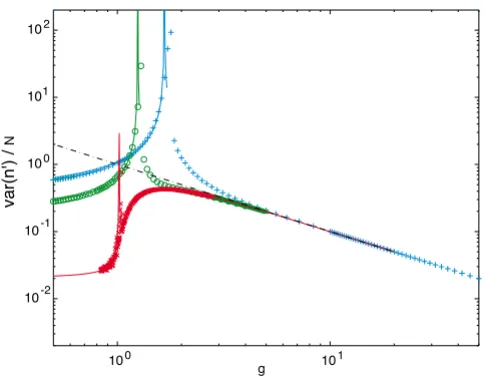
Fluctuations in the order parameter. The fits (solid lines) are leading order expansions about the mean-field solution obtained through the field-theory formalism (see text). The straight line has slope 1/g. Symbols, J + 1 values, and colors are as in Fig. 5.
g
var(n') /
N
100 101
obtained from the analysis detailed in the next section. In a deterministic setting, the transition from a single stable steady-state (monostability) to one with two stable steady-states (bistability) is a saddle-node bifurcation, while in statistical mechanics it appears as a non-equilib-rium phase transition. In both symmetric and asymmetric circuits such a phase transition occurs when the ratio of
feedback catalysis (the strength of which is set by N) to
exogenous catalysis (set by I and P) is varied. The number
of target molecules N therefore constitutes a degree of
freedom for switch control. Simulations, carried out with a simple procedure described in the Methods section,
indicate that (for J ~ 9 or greater) N ~ 10 is enough in
prac-tice to start showing a sharp transition in all cases. We find
analytically that bistability occurs for any J ≥ 2, despite the
enzymes' operating in the linear regime.
The case I = P ≡q for the symmetric circuit has a
second-order phase transition between monostability and
bista-bility as the ratio g ≡N/q is varied, that is, the transition
occurs at a critical point at which the order parameter |冬nJ
- n0冭|/N changes continuously, see Fig. 5 (and blue curve
in Fig. 4). However, the phase transition is different for
finite J and for infinite J. We do not know of any other
sta-tistical non-equilibrium model which shows this
behav-ior. The infinite-J case, although not directly relevant as a
biological model, remains important as it constitutes the
asymptotic behavior to which all the finite-J solutions
converge deep within the bistable regime, where the dynamics of the circuit involves nearly exclusively one boundary (all phosphorylated or all unphosphorylated), so that the configuration space is effectively semi-infinite.
Parameter asymmetry, I ≠ P, or circuit asymmetry also
generate transitions from monostability to bistabilty; but the transition is now first-order (the order parameter changes discontinuously), see Fig. 3b and Fig. 4.
For the symmetric circuit and I = P, the monostable phase
is one in which all the N target molecules are distributed
homogenously over the phosphorylation states, while the two degenerate bistable states are those where the popula-tion is concentrated on either end of the chain. The char-acter of the monostable state in cases with any type of asymmetry is different from the symmetric case, in that
the N particles follow a density profile peaked around j =
0 or j = J (depending on the parameters). In Fig. 3 we show
the phase diagram for symmetric and asymmetric circuits as a function of parameter asymmetry.
We can solve this model not only for the mean behavior, but also for the fluctuations as well as the residence time in the bistable regime. The latter is of biological interest since it addresses the persistence of switched states (mem-ory) when realized by small numbers of molecules [29].
Theoretical analysis
The system is entirely specified by the probability Pr(n),
where n = (n0, ..., nJ) is the vector of occupancies
intro-duced above. The master equation describing the hopping process in the space of phosphoforms for the symmetric circuit (Fig. 1d) is:
Here 1j represents the vector of zeros with a 1 in the jth
position, and δj, j' = 0 if j ≠j' and δj', j' = 1 (Kronecker delta). In all that follows, we are interested in the stationary state where the left-hand-side of Eq. 5 can be set to 0.
Eq. (5) is difficult to solve exactly for J > 1, however it is
amenable to a mean-field approximation. The idea
behind the mean-field theory is to reduce the system of N
target molecules interacting through a fluctuating
feed-back, to N non-interacting particles acted on by an averaged
feedback. In this approximation we replace the modifica-tion rates P + n0 and I + nJ in (5) by effective rates P + 冬n0冭
and I + 冬nj冭, respectively, where the 冬冭 denotes expectation
in the stationary state. This is identical to the spirit of mean-field theory for Ising spin systems where the fluctu-ating field felt by a spin (on account of its neighbours) is replaced by an average field, which is then determined self-consistently. The reader will find a brief summary of the mean-field approach in the Methods section.
It is helpful to define a generating function F(z) ≡F(z0, z1,
z2傼, zJ) ≡ , where the sum is over
all configurations {n} that preserve the total number of
target molecules. In the Methods section we solve Eq. (5)
for Pr(n) in the mean-field limit, and obtain the
generat-ing function for N substrate molecules as:
where we define
The expression for x is just a rewrite of x = (I + 冬nJ冭)/(P +
冬n0冭) in terms of the coupling strength (control parameter)
g. The definition of the kinase to phosphatase ratio as an
exponential enables convenient use of hyperbolic sines
below. Eq. (6) obeys the constraints F(1, 1, 傼, 1) = 1
d
dtPr( )n =j== ⎡⎣(I+nJ−δJ j,+1)(nj+1)Pr(n+ −1j 1j+1) (− +I n nJ) jPr( )n
−
+ + +
∑
+ + − + − + − + ⎤⎦
0 1
0 0 1 1 1 1 1 0 1
J
j j j j j
P n n n P n n n
( δ ,)( )Pr( ) ( ) Pr( ) ..
(5)
Pr( ) ....
{ } n z z z
n n
J n n
J
00 11
∑
F z z xz x z x z
x
x
J
j N
J N
N
( ) ( )
( )
( )
= + + + +
− + −
0 1 2 2 1
1
1
"
(6)
x=
(
eλ/2+g nJ /N)
/(
e−λ/2+g n0 /N)
, g=N/ IP,and eλ =I P/ .(probability conservation) and
(article number
conser-vation).
From Eq. 6 one obtains 冬nj冭 = x 冬nj-1冭 = xj 冬n
0冭, and N = 冬n0冭 (1
- xJ+1)/(1 - x). By defining x = eξ, we find
From 冬nj冭 = xj 冬n
0冭 and the definition of x, we obtain an
expression for g 冬nJ - n0冭/N, which, when combined with
Eq. 8, enables us to write g in terms of the parameter ξ:
In Fig. 4 we invert Eq. 9 to graph ξ= log x as a function of
g, showing the transitions to bistability for the symmetric
circuit at different values of λ.
In all that follows, we consider the simplest case of I = P
(λ= 0). Eq. 9 simplifies to
We can now solve for the order parameter |冬nJ - n0冭|/N as a
function of the parameter g for any J. When I = P, we find
that for J = 2 there is a critical coupling
gc = (J + 1)/(J - 1), (11)
such that for g ≤ gc the uniform distribution ξ= 0 with nj/
N = 1/(J + 1) for all j is stable, while for g > gc the
symmet-ric distribution is a saddle point and the ξ≠ 0 solutions
are stable. These results are readily extended to the asym-metric circuit, yielding the phase diagrams of Fig. 3.
In Fig. 5 the theoretical estimate of the order parameter from the mean-field approximation is compared against
simulations for different values of J. It is seen that the
mean-field estimate is very accurate for sufficiently large
N. The transition at finite J has the character of a
Curie-Weiss magnetization transition [30], with order parame-ter scaling as
For any J at g t 1 + 2 (gc - 1), the order parameter saturates
to a J-independent envelope value
Since gc - 1 → 2/J for large J, Eq. (13) also gives the
behav-ior in the formal J →∞ limit. The derivative of the order
parameter converges to 1 in arbitrarily small
neighbor-hoods of the critical point, rather than to ∞ as in the
Curie-Weiss regime; thus J → ∞ defines a different universality
class than any finite J. Qualitatively, the distinction
between large and small J is determined by whether one
or both reflecting boundaries, respectively, are sensed by the near-critical symmetry-broken state.
So far we have described the mean behavior of the system. Eq. 6 also makes predictions for higher moments, in
par-ticular the variance of the end-site occupancies σ2(n') =
冬(n0 - nJ)2冭 - 冬n
0 - nJ冭2. It is easy to show that for large g, σ2(n')
~ N/g (or the noise σ2/N2 ~ 1/Ng = /N2). As shown in
Fig. 6, this is a fairly accurate prediction for any J. At large
J, the form (N/g)(1 - g-2.5) represents an excellent
numeri-cal fit for the variance all the way down to the critinumeri-cal gc.
For a given distance not too far from the critical point, the
noise in the order parameter increases with decreasing J.
At large g, far inside the bistable region, the variances for
all J converge as indicated above and shown in Fig. 6.
Interestingly, for large J the noise increases to a maximum
past the critical point (red curve in Fig. 6), while for small
J it decreases. At a phenomenological level, we may
distin-guish between fluctuations and large-deviations. Roughly speaking, a large-deviation state is one that is very unlikely to be reached, but once reached, exhibits a certain dura-tion (residence time). This is the case for the spontaneous switching between stationary states in the bistable regime. A fluctuation does not necessarily have such distinct time scales. At or near criticality, however, there is no clear-cut separation between fluctuations and large-deviations. We return to the topic of large-deviations below.
Fig. 6 also demonstrates that the variance diverges at the
critical point. To understand this, we need to go beyond mean-field theory. We can do this by introducing an oper-ator algebra on a basis of number states [31,32], as done for many reaction-diffusion systems in physics, and writ-ing the master equation in terms of these number
opera-∂ opera-∂ = =
= = =
∑
jJ F zj∑
n Nz j j
J
/
0 1 0
n n N J J J− = ⎛ ⎝⎜ ⎞ ⎠⎟ ⎛ ⎝⎜ ⎞ ⎠⎟ + ⎛ ⎝⎜ ⎞ ⎠⎟
0 2 2
1 2 1 2 sinh sinh sinh . ξ ξ ξ (8) g J J = − ⎛ ⎝⎜ ⎞ ⎠⎟ + ⎛ ⎝⎜ ⎞ ⎠⎟ ⎛ ⎝⎜ ⎞ ⎠⎟ − ⎛ ⎝⎜ ⎞ ⎠⎟ sinh sinh sinh sinh ξ λ ξ ξ ξ 2 1 2 2 1 2 .. (9)
g= ⎛J+ J
⎝⎜ ⎞ ⎠⎟ − ⎛ ⎝⎜ ⎞ ⎠⎟
sinh 1 / sinh .
2
1 2
ξ ξ (10)
n n N J J g g J c − ≈ + − ⎛ ⎝ ⎜ ⎞ ⎠ ⎟
0 6 1 2
1 1 / . (12) n n N g J − → − 0
1 1. (13)
tors. This technique has been recently applied to models of simple gene expression circuits [33]. The technical development of our approach based on the formalism of field-theory and its application to molecular signal trans-duction is the main subject of a forthcoming manuscript [16]. Here we only sketch the spirit of the approach.
In principle, the master equation 5 contains the full con-tent of the stochastic process description of our system. The discrete master equation, however, is a function of the
instantaneous occupancies nj for any particular j, and does
not lend itself to study of collective changes of
phosphor-ylation state across the whole range of j values. One
pur-pose for field-theoretic methods is to re-express the content of the master equation in terms of the elementary modes of collective state change. Within this formalism, fluctuations in the phosphorylation state of the circuit can be expanded in a set of basis functions (modes) of the reaction-diffusion operator associated with the master equation. This treatment identifies the lowest mode of the diffusion equation as the collective fluctuation that
induces the instability as the coupling g approaches the
critical value gc. At the critical point, this mode becomes a
linear function of j, so that its fluctuations describe an
aggregate transformation of the substrate population upward or downward in phosphorylation state, collec-tively adding or subtracting a linear term to the phospho-rylation state distribution. All other modes of diffusion among phosphorylation states decay through the bistabil-ity transition, almost as they decay in the monostable region. This form of understanding the mechanism underlying instability in a stochastic circuit is more natu-ral in a field-theoretic representation than in the master equation 5.
Within the field-theory formalism, a systematic perturba-tion theory can be developed about the mean-field limit,
yielding expressions for the variance σ2(n') plotted in Fig.
6 (solid lines). This result confirms the similarity of the
finite-J transition to Curie-Weiss ferromagnetism, with a
divergence at the critical point scaling as
We can also compute the large-N dependence of the
aver-age residence time t. This is the average time a state in the
bistable regime will last before spontaneous fluctuations cause a transition to the other state. The residence time is related to the memory (stability) of a stochastic switch. The persistence of a switched state has been recently stud-ied in other contexts both numerically [34,35] and theo-retically [29,36,37]. We solve the master equation of the system, using the field-theoretic formalism described in
[16], and obtain the leading large-N dependence of the
residence time τas τ~ eN f(g, J), where the function f(g, J) is
independent of N at fixed g and J. We have numerically
evaluated analytical expressions for N f(g, J), obtained
from first principles at J = 2, and find good agreement
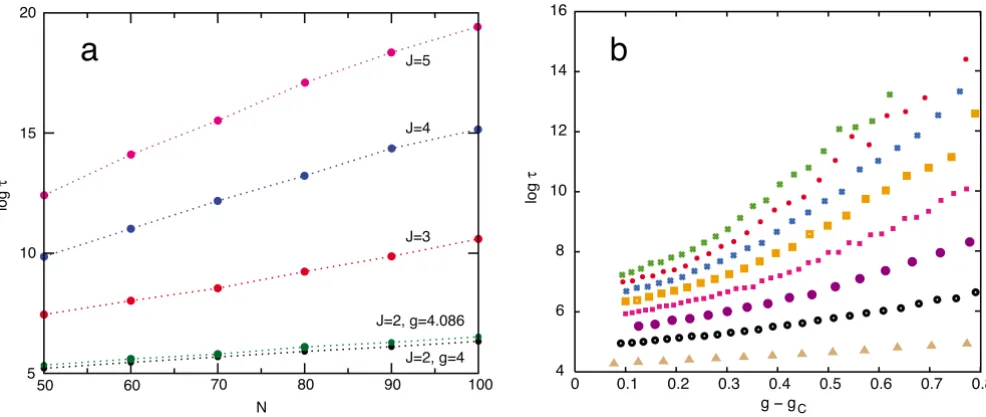
with Monte-Carlo simulations, as shown in Fig. 7.
These simulations were carried out with a rate constant of 1 for each elementary (de)phosphorylation step. To esti-mate biological time scales, let us assume a catalytic rate
constant of phosphorylation, kcat, of 0.01 s-1 [22] (another
frequently used value is 1.5 s-1 [8,22]).
Dephosphoryla-tion rate constants are roughly an order of magnitude higher [35]. These rate constants refer to the first-order conversion of an enzyme-substrate complex into enzyme and (de)phosphorylated product. Our model, however, does not include complex formation between enzyme and substrate, and (de)phosphorylation reactions are second-order. Because kinase and phosphatase concentrations remain unchanged at each step, we may absorb them into a pseudo first-order rate constant. To estimate that rate constant, we interpret our model as operating in the linear Michaelis-Menten regime, where the pseudo first-order
rate constant k becomes kcat [I]/Km, with Km the Michaelis
constant of the enzymatic reaction and [I] the
concentra-tion of kinase molecules. Ballpark figures for Km are 50 to
500 nM [22]. 1 nM corresponds to about 0.6 particles per femtoliter (fl), or roughly 25 particles per yeast cell vol-ume (42 fl on average). In the simulations and
calcula-tions of Fig. 7a we have I = P = N/g, to keep the coupling
g constant as N changes. The range of the abscissa in Fig.
7a therefore corresponds to kinase concentrations of 0.5 to 2 nM, assuming a yeast cell volume. To roughly esti-mate spontaneous switching times, consider the
symmet-ric circuit with J = 2, not too far past the critical point, and
N = 50 target particles corresponding to 2 nM, I = P = 12
kinase (phosphatase) particles corresponding to 0.5 nM,
and τ~ (1/k)e5.2 = 181/k seconds.
Using k = kcat [I]/Km = 0.01·0.5/50 = 10-4 s-1, we obtain an
expected residence time of 21 days in a yeast cell volume. Mammalian cell sizes range anywhere from twice to sev-eral hundred times a yeast cell volume, which increases the residence time of a switched state for the same number of particles. The main message is that for the type of sym-metric circuit considered here, the spontaneous switching times appear to be in the order of weeks to years for rather moderate numbers of molecules in the minimal circuit. Longer lasting memory may occur in the case of gene reg-ulatory networks [29], which typically involve smaller overall rate constants than post-translational signaling events.
The spontaneous switching time strongly increases with
the number of phosphoaccepting sites J, as can be seen in
( )
/( )
~
( )
n n n n
N J J g g
J J
c
− − −
+ ≈ + −
0 2 0 2
2 1
1 1
Fig. 7. Fits to the numerical data of Fig. 7 suggest τ~ αexp [N(g - gc)2(β+ γJ3/2)], where β< 0 (slightly), γ> 0, and α
> 0 exhibits a weak (N, J)-dependence. It is conceivable
that cellular circuits possess switched states spanning a wide range of persistence times and that the evolutionary
process acts on the longevity of such states by changing J.
A recent numerical study reports residence times of several decades for a bistable (auto)phosphorylation circuit implicated to function in long term potentiation [35]. The circuit involves calcium/calmodulin-dependent protein
kinase II (CaMKII) with J = 6. Despite an architecture that
differs considerably from the circuit considered here, the
authors also find an exponential N-dependence, predicted
in [29] to be a generic form for domain-switching proc-esses of this type by arguments similar to ours.
Conclusion
The circuit studied in this contribution represents a situa-tion in which competing feedbacks (enhancing phospho-rylation and, simultaneously, dephosphophospho-rylation) impinge on a protein with multiple phosphorylation sites. The literal reading of the model assumes a bifunc-tional enzyme, able to switch states (between kinase and
phosphatase activity) according to its degree of phospho-rylation. On another interpretation the model represents a contraction of indirect feedbacks that are mediated by antagonistic pathways regulated by the target substrate of the circuit. The extent to which this interpretation is appropriate depends on the sensitivities and delays of the intervening pathways. The primary value of this contribu-tion is to present, on a biologically motivated example, a framework (presented in detail elsewhere [16]) for com-puting the structure, scaling, and magnitudes of fluctua-tions and residence times for a class of stochastic switching circuits, along with analytical results for the symmetric case.
We show that multisite phosphorylation of a target pro-tein in the linear operating regime of enzymatic catalysis generates bistability when combined with positive feed-back. The change from monostability to bistability upon variation of the pertinent parameters can be characterized in terms of statistical mechanics as a non-equilibrium phase transition. The phase structure of the mean values, including the transition between monostable and bistable regions, is well approximated by the classical detailed bal-ance equations of chemical kinetics. Among the parame-Residence times t in the switched state as a function of J, N, and the distance from the critical point g - gc
Figure 7
Residence times t in the switched state as a function of J, N, and the distance from the critical point g - gc. In all
cases the circuit has symmetric feedback and I = P. (a): log t vs. N for J = 2, 3, 4, 5 based on Monte-Carlo simulations. To
mean-ingfully compare residence times, the coupling g = N/ is kept constant by varying the external kinase and phosphatase numbers appropriately, I = P = N/g. To compare across J, the distance from the critical point, g - gc, is held constant at 1 (recall that gc = (J + 1)/(J - 1)). The green curve is for J = 2 and g = 4.0862 (from setting ξ= 1 in Eq. 10). This is the case calculated from first principles in [16]. The best fit to the slope of the green simulation data is log t ~ N* 0.023, which is very close to our theoretical prediction log τ~ N* 0.021. (b): log t vs. g - gc for different Js at N = 50. Curves from bottom to top are for J = 2, 3, 4, 5, 6, 7, 8, 9.
50 60 70 80 90 100
5 10 15 20
log
τ
N
J=2, g=4 J=2, g=4.086
J=3 J=4 J=5
16
b
4 6 8 10 12 14
0 0.1 0.2 0.3 0.4 0.5 0.6 0.7
log
τ
g − g C
0.8
a
ters controlling system behavior is the number of target (substrate) molecules, not just the numbers of kinase and phosphatase molecules. This is worth emphasizing because the same number strongly affects the persistence times of the switch. Thus, in a molecular circuit like the one considered here, the number of target molecules influences both the existence of the switch and the likeli-hood that fluctuations cause spontaneous transitions between its stationary states.
The analytical framework we constructed for the fully sto-chastic process correctly predicts the phase diagram, fluc-tuation spectrum, and large deviation properties for a wide range of parameters as obtained from simulations. We summarize a few observations that follow from this analysis.
1. The behavior of multisite phosphorylation is often characterized in terms of the stationary fraction of fully phosphorylated form only. In this order parameter, mult-isite phosphorylation without feedback (where switching is of the "ultrasensitive" form) appears worse than
hyper-bolic in switching efficiency for any j > 1, and for j →∞
the response curve becomes a right-shifted hyperbola [38] (see also Eq. 4), justifying the label "thresholding device". In Fig. 2, however, the order parameter is the stationary
difference between the occupancies of the fully phosphor-ylated and unphosphorphosphor-ylated forms. In this rendition, the behavior of multisite phosphorylation increases switching
efficiency (as defined in [38]) for any j > 1 (though not
nearly as dramatically as with feedback) and does not exhibit a threshold. These are not contradictory observa-tions, but they illustrate the importance of the choice of observable (order parameter).
2. With the addition of feedback, the stochastic descrip-tion of the substrate populadescrip-tion evidences a non-equilib-rium phase transition between monostable and bistable regimes (corresponding to the saddle-node bifurcation in the deterministic picture). In the symmetric case, as is intuitively obvious, the monostable regime has all phos-phoforms represented with equal probability, whereas the bistable regime has two degenerate distributions peaked at the fully phosphorylated or fully dephosphorylated forms. In the fully symmetric case the phase transition is second-order, as in the Curie model of ferromagnetism. Interestingly, the ferromagnetic analogy breaks down in
the limit J → ∞. This limit is relevant in that the finite-J
behavior converges to it for increasing feedback at strengths deep inside the bistable regime. Any form of asymmetry considered here, circuit-wise or parameter-wise, leads to a first-order phase transition, as in boiling water.
3. The types of phase transition are helpful in framing questions about switch memory, that is, the system's resi-dence time in the stationary states. Consider the techni-cally imprecise but nonetheless informative metaphor of a switch as a double well potential. At the lower critical point a single well becomes a double well, the minima representing stationary states. Intrinsic fluctuations can knock the system from one well into the other, corre-sponding to a loss of memory. The concept of memory, however, is meaningful only if both wells have approxi-mately similar depth, because that is when observing the system in either well conveys information. This situation
is realized ideally for the symmetric circuit and I = P,
which is the second-order phase transition. If, on the other hand, the wells are extremely asymmetric, one much deeper than the other, the shallower well is but a rare and short-lived excursion from the deep one. There is little information in observing the system in the deep well, which is to say that there is (almost) nothing for the sys-tem to "remember". The only memory that can be lost (and fast at that) is the occupancy of the shallow well. Our first-principles calculations from [16], which agree quite well with simulations (see caption to Fig. 7), apply strictly
only to the second-order case at low J and near the critical
point, but we do not expect them to become meaningless when the transition is weakly first-order. Between the two extremes of second-order and strongly first-order there is an intermediate range for which the mean-field equations might be used to estimate ratios of spontaneous switching times from one well to the other in terms of the inverse ratio of residence times in the respective wells, as required by detailed balance.
4. The number of substrate molecules plays an important control role in selecting the monostable or bistable regimes. We point out that the symmetric circuit has a
bistable regime at constant coupling g as I/P is varied (see
Fig. 2), but it remains forever bistable as N is increased
past gc at constant I/P (see Fig. 3a). Increasing the number
of substrate molecules, increases the strength of feedback and reaction rates, thereby favoring bistability (and reduc-ing fluctuations).
5. The magnitude of fluctuations and residence times in a
stationary state as a function of the coupling strength g
strongly depend on the number of phosphoaccepting sites
J. The longevity of state memory could thus be tuned by
switched state to the number of phosphorylatable sites. Likewise, we do not know the extent to which cellular decision processes hinge on a wide spectrum of memory time scales in post-translational signaling, but such a spec-trum seems not to be difficult to achieve.
Methods
Monte Carlo simulations
The Monte Carlo simulations are carried out in a simple manner that follows the process described by the master
equation 5. A lattice of J + 1 sites (representing states or
phosphoforms) is populated with N target molecules
(particles) randomly distributed over the lattice. The par-ticles are numbered and we keep track of their location. To simulate the dynamics, particles are moved to adjacent sites on the lattice at discrete and equally spaced time
steps. At any one step, each particle has a probability (q +
nJ)/(2q + N) of moving to the right and (q + n0)/(2q + N)
of moving to the left, q ≡I = P. If the particle is located at
the first (or the last) site, it can only move to the right (or
the left) with probability (q + nJ)/(2q + N) (or (q + n0)/(2q
+ N), respectively). The system is evolved until it attains
steady-state, when all the measurements are made. The
normalisation factor 2q + N is an inverse time unit needed
to make the rates in Eq. 5 into probabilities.
The definition of mean-field approximations
The general form of master equations such as Eq. (5) may be written
In Eq. (15) the discrete argument n has been written as a
subscript denoting a vector index rather than a functional argument, and the sum over contributing terms is written as a matrix transformation on the vector with components
Prn. The matrix T is called the transfer matrix of the
proba-bility process under which Prn evolves.
Moments of Pr, such as the mean number, are defined through expectations
Through the master equation (15) the time evolution of
冬n冭 may be calculated as
The steady-state solution d冬n冭/dt = 0 may be solved
through Eq. (17) as a balance equation between moments of Pr expressed on the right-hand side of the equality. In
general, the moment equations are not closed, either for steady or non-steady states. The time dependence or
steady-state condition for 冬n冭 is a function of quadratic
moments in n, whose time dependence or steady state
conditions are in turn functions of higher-order moments.
The mean-field approximation truncates this hierarchy of dependencies into a closed system of equations for the
expectations 冬n冭. In particular, because the steady-state
solution to Eq. (17), for the master equation 5 involves only quadratic moments, the relation can be closed by replacing I + nJ by 冬I + nJ冭 and P + n0 by 冬P + n0冭 in Eq. 5 and
then evaluating the relation (17) at d冬n冭/dt = 0. The net
result is to replace terms such as 冬(I + nJ) nj冭 by the
approx-imations 冬I + nJ冭冬nj冭. The resulting feedback operates only
through its mean strength 冬I + nJ冭 = I + 冬nJ冭, which motivates
the term "mean field approximation".
The mean-field approximation of Eq. (5) leads to the clas-sical equations of detailed balance with hopping rates expressed in terms of mean occupation numbers. Thus, the mean particle numbers in adjacent phosphorylation states satisfy the relation
冬nj+1冭 = x冬nj冭, (18)
with the geometric factor
by the definitions, Eq. (7), in the main text.
The generating function for the steady-state master equation
To derive the equilibrium solution for the generating function from the master equation (5), first recall the
def-inition . By multiplying Eq.
(5) by and summing over {n}, we obtain the
equivalent time-evolution equation for the generating function
d
dtPrn =
∑
n′Tn n, ′Pr .n′ (15)n n n
n
=
∑
Pr . (16)d n
dt n
d
dt n T
n n
n n n
n n =
∑
=∑
∑
′ ′ ′ Pr Pr , (17)x I n
P n
e g n N
e g n N
J J = + + = + + − 0 2 2 0 λ λ / / / / , (19)
F z( ) n iJ ziniPr( )n
{ }
≡
∑
∏
=1zin
j
J i
=
∏
1d
dtF z I nJ J j nj zi n I n n z
n
j j J j nn
i i
( )= ( + −δ,+1)( +1) Pr( + −1 1+1) (− + ) Prr( )
( )( ) Pr(
{ }
,
n
P n n z n
i J i J j J n
j j i
ni = = = − + ∏ ∏ ∑ ∑ ⎡ ⎣ ⎢ ⎢ + + − + 1 1 0 1
0 δ0 1 1 −− + − +
⎤ ⎦ ⎥ ⎥ + + = = ∏
∏ 1 1 1 0 1
1 1
j j j i
n
i J
i J
P n n zi n
) ( ) Pr( ) .
Because {n} is now a variable of summation, it can be shifted in the first term of each line of Eq. (20), to obtain an equation without offsets in the indices,
Since , and likewise for j + 1,
we may further condense Eq. (21) into
The mean-field approximation consists in replacing the
terms P + n0 and I + nJ by their average values in the
con-figurations – self-consistently determined – which
domi-nate the sum (22). These are denoted P + 冬n0冭 and I + 冬nJ冭.
Note that with this approximation, the terms involving z
and ∂/∂z are separated from the index sum over
, which may be performed to recover a
dif-ferential equation for the scalar function F(z). Using the
definitions from Eq. (7) in the main text, and removing an overall scale for time to the front, we then recast Eq. (22) as
The negative sign reflects the convergence of a finite Markov process to its stationary distribution.
The polynomials (zj+1 - zj) in Eq. (23) are not needed to
identify a solution to dF/dt = 0, as any power of the
varia-ble
is annihilated by the derivative terms in parentheses in Eq.
(23), independently at each j. The particular combination
satisfies the normalization condition F1(z ≡ 1) = 1 for a
generating function, but its first-derivative satisfies
, identifying F1 as the generating
function for a single particle. For N particles, the
generat-ing function F(z) = , which is a general relation for the
non-interacting particles described by the mean-field approximation, and which recovers Eq. (6) in the main text.
Authors' contributions
S.K. and E.S. contributed equally to this work and are joint first authors. S.K and E.S developed the field-theoretic for-malism and carried out the analytical and numerical cal-culations. W.F. and D.K. suggested the problem, interpreted results in a biological light and, jointly with S.K and E.S., wrote the manuscript.
Reviewers' comments
Reviewer's report 1
Ned Wingreen, Department of Molecular Biology, Princeton University
This paper reports a careful mathematical analysis of a model biochemical circuit with feedback. The model con-sists of a protein with multiple phosphorylation sites, which can feed back to positively affect its own phospho-rylation or dephosphophospho-rylation rates, but only when fully phosphorylated or dephosphorylated, respectively. An asymmetric model containing only phosphorylation feed-back is also considered. The authors show that these sim-ple models display non-equilibrium phase transitions between a monostable and a bistable regime, and show that there is good agreement between mean-field theory results and exact simulations. Importantly, the rates of phosphorylation and dephosphorylation are taken to be linear functions of enzyme density. The bistability emerges instead from the assumption that full phosphor-ylation (or dephosphorphosphor-ylation) of multiple sites is required for feed back.
Overall, the paper makes the case that even very simple biochemical circuits can display bistability, with poten-tially very slow switching between distinct states. An important point raised in the paper is that the concentra-tion of proteins is an essential parameter in determining the regime of behavior. With increasing protein concen-tration, the relative strength of feedback becomes stronger, and the system is driven into the regime of bist-ability. This could be important in biological systems where protein concentrations can be actively controlled, e.g. by transcriptional regulation or by regulated protein degradation.
In the model section, the distinction between "ultrasensi-tive" and "threshold-like" behavior is not immediately
d
dtF z I n
z
z n P n
z z n J j j j j j j ( )= ( + )⎛ − ( ) ⎝ ⎜⎜ ⎞⎠⎟⎟ − + ⎛ − ⎝ ⎜⎜ ⎞⎠⎟⎟ + + + 1 0 1
1 1 11
1 0
1
zin n
i J
j J
n
iPr( ).
{ }= = −
∏
∑
∑
⎡ ⎣ ⎢ ⎢ (21) ∂∂z
∏
= z =∏
=n z z j i n j J j j i n i J i i 1 1 d
dtF z zj zj P n zj I nJ zj zi n
n i
i
( )= ( − ) ( + ) ∂ ( ) Pr( )
∂ − + ∂ ∂ ⎡ ⎣ ⎢ ⎢ ⎤ ⎦ ⎥ ⎥ + + 1 0 1 == = −
∏
∑
∑
1 0 1 J j J n . { } (22)zin n
i J i Pr( ) =
∏
1 d dtF zN
g e g
n
N j zj zj zj z zj
( )= ⎛ / + ( ) ⎝ ⎜⎜ ⎞⎠⎟⎟ − ∂ ∂ − ∂∂ ⎛ ⎝ ⎜⎜ ⎞⎠⎟⎟ − + +
λ 2 0
1 1 == −
∑
0 1 JF z( ).
(23)
ζ( )z x zi i,
i J ≡ =
∑
0 (24)F z z
x z x x i i J J 1 0 1 1 1 ( ) ( ) ( )( ) ( ) ≡ = − − = +
∑
ζ ζ (25) ∂ ∂ = = ≡∑
jJ / z Fjz
1 0 1 1
obvious. I recommend a figure showing showing exam-ples of these two types of behavior.
Author response: We have added what is now Figure 2 to
illustrate both forms of switching, but also to convey a wealth of further information to which we refer at various points in the manuscript.
From a biological point of view, it would be helpful to relate the switching time estimate to real biological parameters. Even a simple example that ends up with a estimated switching time would be helpful.
Author response:We have added an extensive paragraph
dis-cussing and estimating switching times.
Reviewer's report 2
Sergei Maslov, Brookhaven National Laboratories
The manuscript contains an exhaustive analytical and numerical study of the stochastic dynamics of a multistep phosphorylation/dephosphorylation of a single substrate in the presence of a positive feedback. From the mathe-matical standpoint the results are as complete as they could ever be: even the multi-variable generating function was computed (albeit in the mean-field limit). Expect-edly, under favorable conditions the positive feedback generates bistability which is also analyzed by the authors in great detail.
However, in my opinion authors should make a better case for the biological meaningfulness of these results.
Is there any evidence that the (possibly indirect) feedback in real-life systems of this type has a positive sign? Could authors name at least one concrete example where bista-bility of phosphorylation/dephosphorylation of a single substrate is at least suspected?
Author response:We have added a further example of a
pro-tein with bifunctional kinase/phosphatase activity. It is not known, however, whether these systems have switch character. We point to reference [26]as a recent example suggesting com-petition between antagonistic pathways in cellular decision processes. Again, it is unclear whether such antagonism con-verges on a shared circuit causing bistability along the lines we consider in our paper.
Since the case of infinite J has no biological meaning I
would recommend removing the discussion of its peculiar mathematical properties from the manuscript.
Author response:We disagree. We now explain in the text (as
is clear from the pertinent figure) that the infinite-J behavior is the asymptote for all finite-J cases deep inside the bistable regime. (The finite-J curves converge to the infinite-J curve at
large g.) It is, therefore, of interest to understand the infinite-J case.
What are the advantages and disadvantages of different values of J with respect to signal to noise ratio. In other words, are there any biological lessons to be learned from Figure 6?
Author response:We have added a brief paragraph in the
per-tinent section of the manuscript to verbally point to the fact shown in Figure 6 that noise decreases with J at a given dis-tance from the transition. We also point out that for a given J noise increases past the transition when J is large and decreases when J is small. We don't know whether this has biological sig-nificance.
Since the "average residence time" t is a very important
characteristic of any bistable switch used as a memory device could authors attempt to estimate it for some bio-logically realistic microscopic parameters? For example, in
Figure 7 for, say, N = 100 molecules would t be of order of
minutes, seconds, milliseconds?
Author response:We have added an extensive paragraph
addressing this issue (which was also raised by Dr. Wingreen).
Reviewer's report 3
Artem Novozhilov, National Center for Biotechnology Information (nominated by Eugene V Koonin, National Center for Biotechnology Information, NIH)
insight how macroscopic behavior can emerge from sto-chastic molecular interactions.
However, I have some comments and questions concern-ing the text.
I think that some of the statements presented in the Con-clusion section do not really follow from the results and discussion in the main text. The authors claim that "The primary value of this contribution is to present a thorough and rigorous stochastic analysis of a switching circuit" is disputable.
(a): The derivation of the mathematical results in the case of the mean-field analysis is, in my opinion, quite frag-mentary and could be supplemented with a Mathematical Appendix.
(b): The r