3267 IJSTR©2020
A Typical Analysis And Survey On Healthcare
Cyber Security
C.Thyagarajan, S.Suresh, N.Sathish, Dr.S.Suthir
Abstract— In this modern world we are going through new issues and challenges in clinical enterprise wherein all affected person-related information is bought in the market which has become very common. To keep away from this situation patient information have to be kept personal. Even though the statistics are maintained confidential via the health facility control some attackers try to thieve the information about the patients and sell it to the worldwide market place which results in convey the terrible call to the medical industry. To avoid these occasions all patient's records must be secured well. The entire device has to have proper information safety and cybersecurity evaluation to make certain that that information is kept personal. In this paper, we are completely reading the threats for medical industries and how all the ones can be made secured. This will totally assist readers to recognize the issues within the scientific enterprise and how it ought to be corrected in the future. The numerous cyber protection mechanisms must be followed in the destiny. The community layer is a chief goal for any eHealth company, this have indicated several network security metrics that want to be taken into consideration whilst designing and studies dealing with network protection for an eHealth business enterprise. The ultimate intention of this research is to identify the constraints within the current eHealth organization cybersecurity solutions mainly the network layer and advocate a subsequent-era cybersecurity answer for eHealth corporations.[2]
Index Terms— Attackers, Cybersecurity, Cyberattacks, Data, eHealth, Healthcare, Industry, Patient, Threats, Vulnerabilities.
————————————————————
1 INTRODUCTION
Cybersecurity refers back to the body of technology, approaches, and all the practices mainly designed to shield networks, devices, programs, and statistics from attack, harm, or unauthorized get right of entry to. The motive of cybersecurity is to help prevent cyber attacks, facts the breaches, and the identity theft and might aid in risk control. When an organization has a strong experience of community safety and an effective incident reaction plan, it's miles higher capable of saving you and mitigate cyber-assaults. Malware – Malicious software programs such as pc viruses, adware, Trojan horses, and key loggers. Ransomware – Malware that locks or encrypts data until the ransom is paid. Cybersecurity protects the statistics and integrity of computing belongings belonging to or connecting to a corporation's network. Its motive is to protect the only belongings in opposition to all threat actors inside the course of the complete life cycle of a cyber attack. Cybersecurity is an affected person accept as true with and protection issues.[2]
I. Electronic fitness records, the healthcare infrastructure, and person clinical gadgets are all objectives.
II. Healthcare is prone because of a historical loss of investment in cybersecurity, vulnerabilities in the present generation and employee conduct..
The healthcare quarter has to defend the non-public data of the patients because the hackers can leak them, and different thieves can use them to behavior clinical fraud and different financial gains. Cybersecurity allows in retaining the information of the affected person confidential for felony purposes and additionally prevent cybercrimes.
2
KEY
ASPECTS
OF
CYBER
SECURITY
FOR
HEALTH
CARE
ORGANIZATIONS
Fig 1: Health care cyber security Aspects
With the increasing quantity of eHealth structures that might be being constructed on cellular, net and cloud systems, providing effective security and privateness has to turn out to be a prime challenge. It is crucial no longer only to reduce fees however also to improve healthcare and patient protection. However, to achieve that they require health companies to proportion and alternate medical sensitive records inside a strong privateness-preserving environment. To defend the eHealth the company, the solution should be capable of reveal and control all protection factors of an eHealth company [1]
3
VARIOUS
ATTACKS
CAUSED
BY
ATTACKERS
Unauthorized change or injection of fake records can impact clinical choices. This may be thru the net via bypassing firewalls or direct, the usage of a portable device including a USB stick added into the pc (e.g. Within the clinic) to flood false information into the machine. The techniques vary and the attacker can use:
————————————————
C.THYAGARAJAN, Assistant Professor, Department of Computer Science and Engineering, Panimalar Engineering College,Chennai-600 123,Tamilnadu,India,PH-9003175205, E-mail: [email protected]
S.Suresh, Assistant Professor, Panimalar Engineering College, Chennai-600 123,Tamilnadu,India, PH-9841529881. E-mail: [email protected]
N.Sathish, Assistant Professor, Department of Computer Science and Engineering, Panimalar Engineering College,Chennai-600 123,Tamilnadu ,India,PH-9942891066.E-mail: [email protected] Dr.S.Suthir, Associate Professor, Department of Computer Science
3268
• Network packet detection to make use of the important device records, like user account records and passwords, community topology. It can insert new information or exchange present one within the packet.[1] [9]
• Spoofing assault (IP spoofing) to impersonate an authorized user without having to use its password by using falsifying records to benefit get admission to to the machine.[1] [10]
• Password assaults (like, password guessing, taking pictures, cracking – like a dictionary, brute force, phishing assault - and sniffing) to gain get entry to debts and services.[1]
• SQL injections to pass authentication and tamper with database information (insert, update and delete);[1]
• Deception attacks or even stealthy deception assaults are another form of false statistics injection to introduce into the communication signal a wrong sensor size or manage input, an incorrect timestamp, or an incorrect Identity of the sending tool;[1]
• Intrusion attacks (additionally, compromise the confidentiality objective) to illegally get admission to the cyber system – e.g. Malware like backdoors;[1] [10]
• Eavesdropping or sniffing – this is a passive attack in which the attacker listens and captures the network traffic packets;[1]
• Application layer assault – this form of assault goals the utility servers to motive a fault by way of reading, deleting or even enhancing records. It permits the attacker to introduce a packet sniffer into the inner network to gain private information or introduce viruses to spread and cause system disasters.[1]
4 VARIOUS
IMPERATIVE
FOR
HEALTH
CARE
CYBER SECURITY
Perhaps the most alarming finding with the aid of the HHS cybersecurity task pressure became out to additionally be one of the simplest to restoration: Three out of four hospitals do not have a designated employee to cope with cybersecurity troubles. In addition to raising the alarm approximately staffing wishes, the undertaking force prepared their findings round six key imperatives for the future.
1. Define and streamline management, governance, and expectancies for healthcare cybersecurity.
2. Improve clinical tool and fitness IT safety and resilience.
3. To develop the needed necessary healthcare team of workers' potential to prioritize and make sure cybersecurity recognition and technical skills.
4. To improve and Increase industry readiness with better cybersecurity detection and education.
5. Identify mechanisms to guard research and development efforts and intellectual assets from attacks and exposures.
6. Improve information sharing of enterprise threats, dangers, and mitigation.
Within those six imperatives, the mission force made over one hundred unique guidelines for improvement, certainly one of which changed into a name for a healthcare-unique safety framework. After all, healthcare experienced more breaches
because of cyber attacks than another industry in 2015, and the enterprise expects to continue increasing their spending on the prevention of cyber attack.
5 REAL WORLD CONSEQUENCES FROM
MEDICAL DATA BREACHES
The hype and paperwork surrounding healthcare IT can muddy the large-photo view, however it's crucial to remember the fact that the records on this dialogue isn't just 1's and 0's. It's human beings's lives. If clinicians don't have get right of entry to the proper information because of malware, or if facts has been compromised, it may surely suggest life or dying for a patient. That's why healthcare informatics isn't pretty much cyber protection and records management. It's about people.
6 DATA SECURITY AND INFRASTRUCTURE
THREATS IN HEALTH CARE INDUSTRY
3269
recognize where all of your statistics repositories live and the way they’re secured. Oftentimes, a lack of facts comes from poorly secured systems, machines, and facts storage practices. Furthermore, there are usually challenges in the way you allow personnel to store facts on their personal gadgets. Remember, desirable mobility and BYOD security practices can honestly assist lessen statistics loss threats.
7
RECORDS
ANALYSIS
ON
GREATEST
VULNERABILITIES AND SAFETY ISSUES
Fig 2: Sample Records on vulnerabilities and Safety issues
8 LITERATURE SURVEY
S.N
o. Title
Domai
n Focused Discussion
I.
The Security in Pervasive health care Networks: Current Research&Dev elopment and Future Challenges. [6] Health Care Network Security
In this paper they mentioned concept is to secure the informations which are transferred globally for consulting doctors when patients required. This should be avoided by enabling deep security on the health care networks.
II. Threat Modelling and Mitigation of the Medical Cyber – Physical Systems. [3] Threats and Vulnerabiliti es on MCPS
In this paper they have discussed about the investigation on MCPS. Then also the main basis for understanding the threatening Conditions in MCPS
III.
A Survey on Security Attacks in Electronic Healthcare Systems.[5] Patient Record Model and its Security in Helath care.
In this paper they have mainly focussed on securing the information which are exchanged between the doctors. These should be maintained securely.
IV.
IoT Security: A basic Review
of Risks and the Threats to the Healthcare Sector. [4]
IoT Devices Security
This paper is involved with the growing dependence of contemporary society on wi-fi technology and on the role of IoT in the healthcare sector specifically. IoT systems and their users are at risk of a variety of protection threats and
malicious activities.
IX.
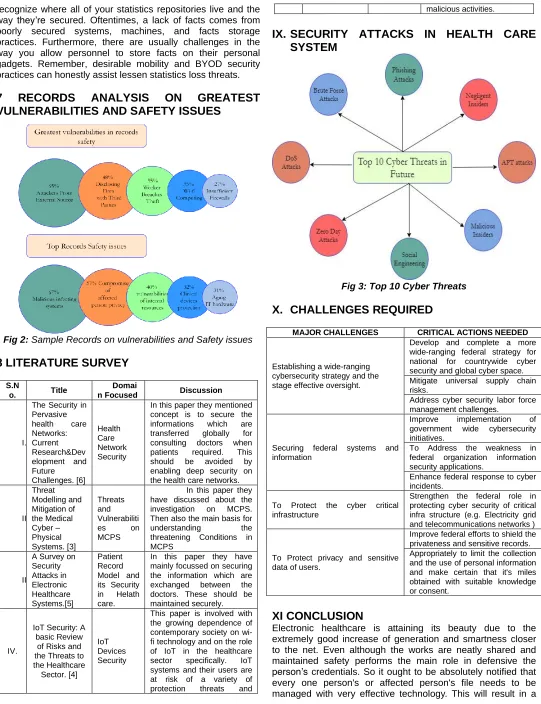
SECURITY ATTACKS IN HEALTH CARE
SYSTEM
Fig 3: Top 10 Cyber Threats
X.
CHALLENGES REQUIRED
MAJOR CHALLENGES CRITICAL ACTIONS NEEDED
Establishing a wide-ranging cybersecurity strategy and the stage effective oversight.
Develop and complete a more wide-ranging federal strategy for national for countrywide cyber security and global cyber space. Mitigate universal supply chain risks.
Address cyber security labor force management challenges.
Securing federal systems and information
Improve implementation of government wide cybersecurity initiatives.
To Address the weakness in federal organization information security applications.
Enhance federal response to cyber incidents.
To Protect the cyber critical infrastructure
Strengthen the federal role in protecting cyber security of critical infra structure (e.g. Electricity grid and telecommunications networks )
To Protect privacy and sensitive data of users.
Improve federal efforts to shield the privateness and sensitive records. Appropriately to limit the collection and the use of personal information and make certain that it's miles obtained with suitable knowledge or consent.
XI CONCLUSION
3270
clarity boom of the scientific enterprise. In this paper, we surely described the survey of the way assaults can be executed and what are all the approaches the records can be hacked. The safety measures and clean thoughts are mentioned. In destiny, extra security methods might be discussed with later industry-orientated elements.
REFERENCES
[1] Delia Ioana Dogaru, I. D. (2017). Cyber Security in Healthcare Networks. International Conference on E-Health and Bioengineering (pp. 414-417). Sinaia,Romania: IEEE.
[2] Hossam Ahmed1, A. A. (2017). Next Generation Cyber Security Solution for an. ICoICT. Malacca,Malaysia: IEEE.
[3] Hussain Almohri, L. C. (2017). On Threat Modeling and Mitigation of Medical Cyber Physical Systems. International Conference on Connected Health: Applications, Systems and Engineering Technology (pp. 114-119). IEEE.`
[4] Nasser S. Abouzakhar, A. J. (2017). Internet of Things Security: A Review of Risks and Threats to Healthcare Sector. IEEE International Conference on Internet of Things (iThings) and IEEE Green Computing and Communications (GreenCom) (pp. 373-378). IEEE.
[5] R. Priya, S. S. (2017). A Survey on Security Attacks in Electronic Health Care Systems. International Conference on Communication and Signal Processing (pp. 0691-0692). India: IEEE.
[6] Debargh Acharya, Security in Pervasive Health Care Networks:Current R&D and Future Challenges. (2010). Eleventh International Conference on Mobile Data Management (pp. 305-306). IEEE.
[7] V.-L. Dao, A.-T. Nguyen, V.-P. Hoang, and T.-A. Tran, "An ASIC implementation of low area AES encryption core for wireless networks," in Communications, Management and Telecommunications (ComManTel), 2015 International Conference on, 2015, pp. 99-102. [8] N. Ahmad, R. Hasan, and W. M. Jubadi, "Design of
AES S-Box using combinational logic optimization," in Industrial Electronics & Applications (ISIEA), 2010 IEEE Symposium on, 2010, pp. 696-699.
[9] Balaji.S, Sasilatha.T 2019, ‘A Peer to Peer Botnet Framework for Network Threat Detection in Wireless Networks’ in International Journal of Recent Technology and Engineering (IJRTE), Vol.7, Issue-5S2, pp 234-236.
[10] Balaji.S, Sasilatha.T 2018, ‘Detection of Denial of Service Attacks by Domination Graph Application in Wireless Sensor Networks’ in Cluster Computing- The Journal of Networks, Software Tools and Applications, Volume 22 Supplement 6, pp 15121 15126.
[11] Brackney, R.C. and R.H. Anderson, Understanding the Insider Threat. Proceedings of a March 2004 Workshop. 2004, DTIC Document.
[12] Klosek, J., Protecting Your Health Privacy: A Citizen's Guide to Safeguarding the Security of Your Medical Information. 2010: ABC-CLIO.
[13] D. Spinellis, S. Gritzalis, J. Iliadis, D. Gritzalis, S. Katsikas, “Trusted Third Party services for deploying
secure telemedical applications over the WWW ‖ , Computers and Security”, vol. 18, No. 7, 1999. [14] S-Di Bao and Y-Ting Zhang, “A New Symmetric