IN-VIVO EVALUATION OF BUCCOADHESIVE TABLETS USING STARCH-POLYMER COMBINATIONS
A.Jain*, R.S Gaud, A.Thaker, P. Shende
SPTM, NMIMS University, Mumbai-56
Summary
In this study combination of Starch-Carbopol 934 and Starch-polycarbophil were employed as carriers to develop the hydrophilic controlled buccoadhesive formulations. Tablets containing fixed amount of carvedilol were prepared by direct compression method using Starch: Carbopol 934 (F1 to F6) and Starch: Polycarbophil (E1 to E6) in various ratios 85:15, 75:25, 60:40, 50:50, 40:60, 25:75 and evaluated for thickness, hardness, assay, mucoadhesive strength, drug release and In vivo study. All the physicochemical characteristics are acceptable and found within the limit.
The mucoadhesive strength of all the ratio was seen with Starch: Carbopol 934 and Starch: Polycarbophil which were in the range of 10.3±0.29g/cm2 to 32.5±0.83g/cm2 and 5.31±0.40g/cm2 to 23.75± 0.06 g/cm2. The maximum rate of release was observed in tablets of Starch: Carbopol 934 as comparision to tablets of Starch: Polycarbophil. The Cmax, Tmax and AUC values observed higher for the formulated tablets of F4 (50:50) and E6 (25:75) than the oral conventional tablets, which was in the order of F4>E6>oral conventional tablets. It concluded that formulated tablets of Starch: Carbopol 934 showed better matrix structure and suitable release kinetic as compared to tablets of Starch: Polycarbophil.
Keyword: Buccal tablet, Bioadhesive strength, Bioadhesive Polymers, In vivo.
Address for correspondence
School of Pharmacy and Technology Management NMIMS University, Vile Parle (West)
Introduction
Bioadhesive delivery systems have received considerable attention as absorption promoters due to their ability to adhere to the mucin/epithelial cell surface and thereby anchor a dosage form at the site for optimum drug absorption and lead to an overall increase in bioavailability. Mucoadhesion utilizes the property of bioadhesion of certain water soluble or swellable polymers which become adhesive on hydration and hence can be used for targeting a drug to particular regions of the body where mucus or receptive epithelial cells are present e.g. nasal, buccal, GIT, cervical and vaginal. Bioadhesion appears to be especially attractive for the development of controlled drug delivery systems to improve intraoral administration of drugs systemically or locally. The adhesive mucosal dosage forms which have been suggested for oral delivery include adhesive tablets and adhesive patches, the strong adhesive contact to the mucosa generally being achieved by the use of mucoadhesive polymers.1, 2
Out of developed mucoadhesive buccal delivery systems such as ointments, creams, solutions, microparticles, tablets and patches, tablets appear to be the most preferred formulation. The disadvantage of most of these mentioned delivery systems is that they get easily washed away by the continuous salivary secretion. Mucoadhesive tablets appear attractive because they can readily adhere to buccal cavity, are retained for longer period of time and can be removed at any time. An ideal buccal dosage form should be able to (1) remain at the adhesive site for specified period, (2) provide unidirectional release of drug (3) exhibit sustained release profile when needed.3
In these study combinations of Starch: Carbopol 934 and Starch: Polycarbophil were employed as carriers to develop the hydrophilic controlled release formulations. Carvedilol was used as model drug.
On oral administration, carvedilol is rapidly and extensively absorbed but has absolute bioavailability of 25% due to a significant degree of hepatic first-pass metabolism. Carvedilol is a weak base and its pKa value is approximately 7.8, which satisfies the criterion for the selection of the drug. The log PC (partition coefficient) value for carvedilol is about 3.967. It indicates that carvedilol has sufficient lipophilicity to pass through the buccal membranes. The tmax of carvedilol is 1.2 h by peroral route, which is long and variable.4
Tablets containing fixed amount of carvedilol were prepared by direct compression method using pregelatinized Starch:Carbopol 934(F1 to F6) and Starch:Polycarbophil (E1 to E6) in various ratios 85:15, 75:25, 60:40, 50:50, 40:60, 25:75 and evaluated for thickness, hardness, assay, mucoadhesive strength, drug release and In vivo study.
Materials and Methods
Materials
Carvedilol was kindly supplied by Microlab Ltd, Houser, India. Carbopol 934P, (Noveon, USP) and Polycarbophil (Noveon, USP) were obtained from McW Pharmaceuticals, Indore as gift samples. Pregelatinized starch was supplied by National starch, Mumbai. Propranolol gifted by Alpa Laboratories Indore. Other chemicals used were of analytical grade.
Methods Formulation of buccal tablets
Table 1. Composition of formula
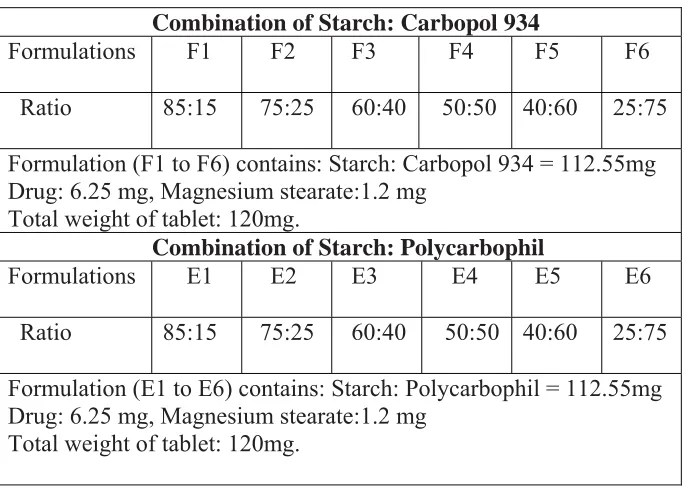
Combination of Starch: Carbopol 934
Formulations F1 F2 F3 F4 F5 F6
Ratio 85:15 75:25 60:40 50:50 40:60 25:75
Formulation (F1 to F6) contains: Starch: Carbopol 934 = 112.55mg Drug: 6.25 mg, Magnesium stearate:1.2 mg
Total weight of tablet: 120mg.
Combination of Starch: Polycarbophil
Formulations E1 E2 E3 E4 E5 E6
Ratio 85:15 75:25 60:40 50:50 40:60 25:75
Formulation (E1 to E6) contains: Starch: Polycarbophil = 112.55mg Drug: 6.25 mg, Magnesium stearate:1.2 mg
Total weight of tablet: 120mg.
Evaluation of tablets
Technological parameters
The diameter and thickness of the formulated tablets were measured using Vernier Caliper.
Assay
The formulated single layered tablet was dissolved in 100ml isotonic phosphate buffer (pH 6.8± 0.2): methanol (9:1). The solution was filtered through 0.45µ filter to remove any undissolved components. The resulted solution was analyzed spectrophometrically at 242 nm by UV spectrophotometer.4
Bioadhesion Study
Fresh sheep buccal mucosa was obtained from a local slaughterhouse (Andheri west) and used within 2 h of slaughter. The mucosal membrane was separated by removing the underlying fat and loose tissues. The membrane was washed with distilled water and then with isotonic phosphate buffer pH 6.8 at 370C. Bioadhesive strength of the tablet was measured (n = 3) on a modified physical balance.. A piece of buccal mucosa was tied on the upper side of the teflon block in the glass container, filled completely with isotonic phosphate buffer (pH 6.8, 37±10C). The tablet was stuck on the bottom side of another teflon which is hanging by ring. The mass, in grams, required to detach the tablet from the mucosal surface gave the measure of mucoadhesive strength.5, 6, 7
In vitro dissolution study
The USP XXIV rotating paddle method was used to study the drug release from buccal patches. The dissolution medium consisted of 200 ml of isotonic phosphate buffer pH 6.8 containing 2% sodium lauryl sulphate. The release was performed at 37 ± 0.5 0C, at a rotation speed of 50 rpm. One side of the buccal tablet was attached to a cover slip with instant adhesive (cyanoacrylate). The cover slip was put in the bottom of the dissolution vessel so that the tablet remained on the upper side of the slip. 2ml of samples were withdrawn at pre-determined time intervals (0.5, 1, 2, 3 upto 24h) and replaced with fresh medium. The samples were filtered through 0.45 mm Whatman filter paper with appropriate dilutions with phosphate buffer pH 6.8 and were assayed spectrophotometrically at 242 nm.8, 9
In vivo study
In this study a group of 6 healthy rabbits weighing 1.0-1.5 kg were used for the study for selected ratio of formulations. Protocol was approved by animal ethical committee (Protocol number: CPCSEA/SPTM/P-49/2008).Rabbits were anaethesized by diazepam (5mg/kg; i.m). The single layered tablet was applied directly to the buccal pouch of the rabbits after 10min post anaesthesia. Conventional marketed tablets (6.25mg) were administered orally to one group to compare the pharmacokinetic parameter after oral and buccal administration. A group of 6 rabbits were used as a control for the experiment. At a interval of 0, 4, 8, 12, 16, and 24h, 0.5-1.0ml of blood was withdrawn via marginal ear vein using 26 gauge needle. The blood was centrifuged at 8000 rpm, 10 min and plasma was collected. Protein separation from the plasma was done by adding equivalent amount of methanol and centrifuged at 10,000 rpm then protein free plasma was collected and analyzed by High Performance Liquid Chromatography (HPLC) using C18 column.10, 11
Analysis of blood sample
The above protein-free plasma was mixed with 50µl propranolol acting as internal standard and 20µl was injected through syringe filter into an isocratic HPLC with UV detector. The column employed was C18 (4.6 x 100mm, 3.5 µm). The mobile phase consisted of methanol: KH2PO4, (50:50, v/v) pH 2.5 and flow rate was adjusted to 1.0 ml/min. Area under curve (AUC) of the plasma drug concentration vs. time was determined with trapezoidal rule method, Cmax and tmax were calculated by using software (PK Solution 2.0). The pharmacokinetic data was compared with that obtained from conventional oral tablets.12, 13
Results and Discussion
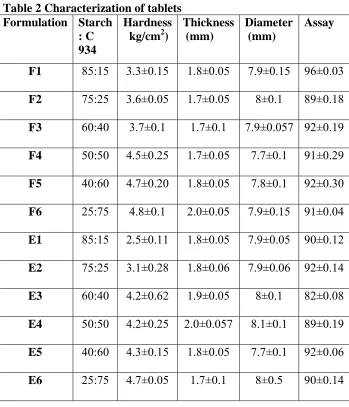
in the range of 1.7 ±0.01mm to 2.0±0.05 mm. Hardness were found in the range of 3.3±0.15 kg/cm2 to 4.8±0.1 kg/cm2. Assay values are ranged from 89±0.18 % (F1) to 93 ± 0.16% (F6). Diameter of formulated tablets of Starch: Polycarbophil were in the range of 7.9±0.05mm (E1) to 8.1±0.1mm (E6). Thickness was found in the range of 1.7±0.1mm to 2.0±0.057mm. Hardness were found in the range of 2.5±0.11 kg/cm2 to 4.7±0.05 kg/cm2. Assay values are ranged from 90±0.12 % (E1) to 93 ± 0.16% (E6).
Table 2 Characterization of tablets Formulation Starch
: C 934
Hardness kg/cm2)
Thickness (mm)
Diameter (mm)
Assay
F1 85:15 3.3±0.15 1.8±0.05 7.9±0.15 96±0.03
F2 75:25 3.6±0.05 1.7±0.05 8±0.1 89±0.18
F3 60:40 3.7±0.1 1.7±0.1 7.9±0.057 92±0.19
F4 50:50 4.5±0.25 1.7±0.05 7.7±0.1 91±0.29
F5 40:60 4.7±0.20 1.8±0.05 7.8±0.1 92±0.30
F6 25:75 4.8±0.1 2.0±0.05 7.9±0.15 91±0.04
E1 85:15 2.5±0.11 1.8±0.05 7.9±0.05 90±0.12
E2 75:25 3.1±0.28 1.8±0.06 7.9±0.06 92±0.14
E3 60:40 4.2±0.62 1.9±0.05 8±0.1 82±0.08
E4 50:50 4.2±0.25 2.0±0.057 8.1±0.1 89±0.19
E5 40:60 4.3±0.15 1.8±0.05 7.7±0.1 92±0.06
All the physicochemical parameters of the tablets were acceptable within the limit.
The test was performed for the formulated tablets of Starch: Carbopol 934 (F1 to F6) by using modified balance for determining the bioadhesive strength on the above mentioned ratios. Fig 1 and Table 4 showed the mucoadhesive strength of all the ratio was found in the range of 10.3±0.29 g/cm2 to 32.5±0.83 g/cm2. The maximum mucoadhesive strength was observed in the ratio F6.
Bioadhesive strength
0 5 10 15 20 25 30 35 40
F1 F2 F3 F4 F5 F6
Formulations
B
ioa
dhe
si
v
e
st
re
n
g
th
(
g
)
Series1
Fig 1. Bioadhesive strength of Starch: Carbopol 934 (F1 to F6)
Bioadhesive strength
0 5 10 15 20 25 30
E1 E2 E3 E4 E5 E6
Formulations
B
ioa
dhesi
ve st
re
ngt
h
(
g
)
Series1
Fig 2. Bioadhesive strength of Starch: Polycarbophil (E1 to E6)
Table 4 Bioadhesive strength
It was concluded that as the concentration of Carbopol 934 increases bioadhesive strength also increases. This may be attributed to the polymer and mucus interact with hydrogen bonds. Work of adhesion Code Bioadhesive
strength (g ) n=3 (±SD)
Code Bioadhesive strength (g )
n=3 (±SD)
F1 10.3±0.29 E1 5.31±0.40
F2 12.3±0.23 E2 9.98±0.09
F3 14.3±0.28 E3 17.01±0.11
F4 20.5±0.50 E4 15.77±0.57
F5 28.4±0.51 E5 14.17±0.19
dependent on the formation of hydrogen bonds between the functional groups of the bioadhesive agents and the mucus. Increasing the Carbopol concentration functional groups also increased which leads to better bioadhesive property. As compared with polycarbophil it shows more adhesion which may be due to its molecular weight. Structural changes may occur, as Carbopol is polyacrylic acid crosslinked with allyl sucrose while polycarbophil is cross linked with divinyl glycol.14
The controlled release tablets were fabricated with Starch: Carbopol 934 in the ratio of 85:15, 75:25, 60:40, 50:50, 40:60 and 25:75. Release profile of single layered tablets was shown in the Fig 3. The maximum controlled releases were observed in F3 and F4. By using 50% of Carbopol 934 it released 79.09±1.67% and 76.33 ± 1.98% respectively. This showed that as the concentration of Carbopol 934 increases upto 50% the release rate of formulation also increases but beyond that it did not show proper controlled release.
Controlled release buccoadhesive tablets were prepared with physical mixture of starch and polycarbophil (E1 to E6) in the ratio 85:15, 75:25, 60:40, 50:50, 40:60 and 25:75. In vitro release of Carvedilol from the formulation was studied. The drug release data are shown in Figure 4. The maximum releases of drug were observed in formulations E1 and E6. It released 76.95±0.45% and 78.35±0.41upto 24h.
In vitro Study
0 10 20 30 40 50 60 70 80 90
0 5 10 15 20 25 30
Time(h) C u m u la ti v e r e le a s e (% ) F1 F2 F3 F4 F5 F6
Fig 3.In vitro release profile of formulations (F1 to F6)
In vitro 0 10 20 30 40 50 60 70 80 90
0 5 10 15 20 25 30
Time(h) P e rcen ta g e cu mu la ti ve re le ase E1 E2 E3 E4 E5 E6
Fig 4. In vitro release profile of formulations (E1 to E6)
The possible reason behind that there might be ionization of Carbopol 934 at experimental pH 6.8 at higher concentration and this ionization process will lead to development of negative charge at polymer surface and it changed into an extended structure allowing water molecule to penetrate into it which leads to higher swelling and other reason may be the mixing of starch and Carbopol 934 within the particle resulting in a reduction of carboxylic groups available for hydration as a part of those acid groups situated in the inner core of the particle and as a part interacted with the hydroxyl groups of starch. This decreased the hydration of Carbopol 934 forming weaker gel with low viscosity. Due to higher mobility of the hydrated polymer chain of the individual Carbopol 934 particles in the physical mixtures, a more extensively swollen network which leads to diffusion of drug in controlled manner. Release profile shows that as concentration of polycarbophil increases more controlled dissolution of drug was observed and formulations E6 showed maximum controlled release of drug which is followed by zero order release (R2=9712) as kinetic model.15
On the basis of above mentioned studies formulation F4 and F6 were further selected for in vivo study.
Cavedilol buccal tablet (F4) than oral tablets (334.2±25.95 ng/ml) which is slightly higher than Cmax of oral conventional tablet. The AUC values after buccal administration of tablets (9204.217 ± 200.44 ng/ml) were significantly higher than the oral administration of tablet.
In vivo study
0 100 200 300 400 500 600
0 5 10 15 20 25 30
Time(h)
C
o
n
c
e
n
tr
a
tio
n
(n
g
/m
l)
Oral F4
Figure 5. Plasma concentration Vs Time profile for F4 and oral conventional tablets.
The plasma concentration profiles of formulated tablets of starch-Polycarbophil (E6) and oral conventional tablet were shown in Fig 6 and Table 5. The tmax was observed to be 20h for buccal tablets (E6) as compared to 4h for oral conventional tablet. The Cmax values observed higher (452.19± 69.31 ng/ml) for Cavedilol buccal tablet (E6) than oral tablets (334.2±25.95 ng/ml) which is slightly higher than Cmax of oral conventional tablet. The AUC values for buccal tablets (7881.483 ± 767.35 ng/ml) were significantly higher than the oral administration of tablet.
In vivo
-100 0 100 200 300 400 500 600 700 800 900 1000
0 5 10 15 20 25 30
Time(h)
C
oncent
ra
ti
on (
ng/
m
l)
Oral
E6
Figure 6. Plasma concentration Vs Time profile for E6 and oral conventional tablets.
Table. 5 Plasma profile of Carvedilol (ng/ml) following administration of oral and buccal tablet
It concluded that bioavailability of formulations were increased as compared to oral conventional tablets of Carvedilol available in market, However formulated tablets of Starch:Carbopol934 showed better bioavailability as compared to formulated tablets of Starch: Polycarbophil. Bioavailability was found in the order of
F4>E6>Oral conventional tablet.16, 17
Formulation
AUC (ng/ml)
Cmax
(ng/ml)
tmax (h)
Oral tablet 4523.6 ± 202.60 334.2±25.95 4
F4 9204.21 ± 200.44 535.25± 12.75 20
Acknowledgement
Authors are thankful to School of Pharmacy and Technology Management, NMIMS University, Mumbai for providing facilities.
References
1.Sudhakar Y, Kuotsu K. Bandhoupadhyay, A.K. Buccal bioadhesive drug delivery - a promising option for orally less efficient drugs, J. Cont. Rel. 2006; 114: 15–40.
2. Hao J, Heng P. Buccal Delivery Systems, Drug. Dev. Ind. Pharm. 2003; 29: 821–832.
3. Yedurkar PD, Dhiman M.K. Sawant K.K. Mucoadhesive bilayer tablets for buccal delivery of carvedilol: in vitro and in vivo investigations. Ars Pharm2007; 48: 259-274.
4. Panna T, Ghimire M, Mullen M, Stevens H. Controlled release oral delivery system containing water insoluble drug. Journ. Sci. Eng. Tech 2005; 1-10.
5.Doijad RC, Manvi FV., Malleshwar Rao, Patel, P.S., Buccoadhesive drug delivery of Isosorbitate Dinitrate: Formulation and evaluation. Indian. J. Pharm. Sci. 2008 ;744-769.
6.Gupta A, Garg, S and Khar, R.K “Measurement of bioadhesive strength of mucoadhesive buccal tablets:design of an in vitro assembly” Indian drugs, 1992; 30:152-155 .
7. Jimenez M R, Zia H, Rhodes CT “Assessment of an in vitro method of measuring the bioadhesiveness of tablet”, Int. J. Pharm.1993, 89: 223-228.
8. Mumtaz A M, Chng H S, “Design of a dissolution apparatus suitable for in situ release study of trimcinolone acetonide from bioadhesive buccal tablet”, Int. J. Pharm. 1995; 121: 129-139.
10. Hokama N, Hobara N, Kamerya H, Ohshiro S, Sakanashi M, Rapid and simple micro-determination of Carvedilol in rat plasma by high performance liquid chromatography. J. Chromatography B. 1999; 732:233-238.
11. Konishi H, Nishio S, Tsutamoto T, Minouchi T, Yamaji, A, Serum Carvedilol concentration and its relation to change in plasma brain natriuretic peptide level in the treatment of heart failure: a preliminary study. Int. J. Clinical Pharmacology and Therapeutic. 2003; 41: 578-586
12. Bradway F, Ghorab M, Adeyeye CM. Bioavailability of danazol-hydroxypropyl-ß- cyclodextrin complex by different routes of administration. Int.J.Pharmaceutics 1996; 145 :137-143.
13. Gruber P, Longer MA. Robinson, Some biological issues in oral controlled drug delivery. Adv. Drug. Delivery Rev. 1987; 1:1-18.
14. Maggi L, Carena E., Torre P., Giuenchedi P., In vitro/ ex vivo methods for the evaluation of biaodhesive polymers, a priminary study. S.T.P Pharma 1994; 343-348.
15. Alur H, Indiran Pather S, Mitra, A K, Thomas P J. Transmucosal sustained-delivery of chlorpheniramine maleate in rabbits using a novel, natural mucoadhesive gum as an excipient in buccal tablets. Int. J. Pharmaceutics 1999; 188:1–10.
16. Metia PK, Bandyopadhyay., Abstract: In vitro and in vivo evaluation of a novel mucoadhesive buccal oxytocin tablet prepared with Dilenia indica fruit mucilage. Pharmazie, 2008; 63 :270-274.