IJEDR1702049 International Journal of Engineering Development and Research (www.ijedr.org) 287
Study on Rose Diseases: Identification, Detection
and Cure
1Rishabh Sinha
1Research Scholar (M BA Tech) 1
Informat ion Technology Department 1SVKM’s NMIMS MPSTME Shirpur (MH, India)
_________________________________________________________________________________________ _______________
Abstract—Roses are liked by one and all, irrespective of the age group. A bouquet is incomplete until roses are not present in it. The reason why all of us love roses is the pleasant smell that it possesses. They are not only famous for their fragrance but also for the diversity in their colors. Plants that are grown today need utmost care so that they are made free from any sort of diseases. These diseases cause severe damage to the plants and their growth is affected. The rose plant is also no exception. It also s uffers fro m a nume rous disease that can cause it a stunned and a hampered growth.
IndexTerms—Stem canker; powdery mildew; Botrytis cinerea; Aphids; Blac kspots;RRV
______________________________________________________________________________________________________
I. IN TRO DUC TION
The different types of roses vary on the grounds of their ability to resist any disease and the maintenance they require. Fo r the successful growth of roses, we should be able to differentiate a mong the species that are in need of care that can be provide d. The shrub type roses bloom beautifully with the very less amount of chemica l control measures. On the other hand, the hybrid type of roses requires an effective spraying before the season begins [1]. The diseases in rose plants are caused either by the pathogens or insects and thus its beauty is affected to a great e xtent.
II. DISEASES C AUSED BY PATHOGENS
Some of the diseases that the rose plant suffers fro m a re enlisted below-
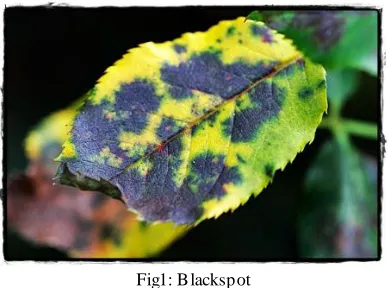
i. Black Spot: Blac k spot is a one of the common diseases that’s present in the in the roses. It is also considered as one of the most serious diseases that are caused by the fungus named Diplocarponrosae. The severity of the disease is at its peak post the warm springs.
The symptoms that can be seen in the rose plant include circula r, blac k spots that are surrounded by a yellow area. The leaves that are infected by this disease often fall off the plants. This infection is so harsh, that continues throughout the summe r season. As a result of this infection, the plants suffer fro m stunted growth, producing fewer and paler leaves. By the midst of the summer, the most severely affected plants, might have shed half of their leaves.
Pre venti on and Tre atme nt:
The spread of black spot in roses can be reduced and in near future the minimization of infections can be done by the following methods -
Maintai ning good sanitati on: The pract ice of good sanitation is must in order to reduce the future infections and disease development. In fa ll or winters, the old leaves are to be re moved on the ground along with any of mu lch that’s contaminated with the infected leaves. The fresh layer of mu lch is to be replaced before there’s a growth of new roses
Re moval and Destruction of Infec te d Canes: The canes that are affected by the black spot infection are to be removed and are dark and identified by reddish patches also known as the lesions. The most severely affected plants are to be prunced back in the winter season. During the growing season, the infected leaves should be re moved and disposed as soon as they are spotted [1].
IJEDR1702049 International Journal of Engineering Development and Research (www.ijedr.org) 288 Fig1: Blackspot
ii. Powdery Mil de w: The powdery mildew is caused in roses due to Peronosporasparsa, which is also responsible for its growth in other plants also such as raspberry [2]. The powdery milde w causes a grayish-white powdery substance on the surface of young leaves, shoots and buds. There are also chances of distortion in some of the leaves and some amount of leaves might also drop. There’s also a possibility that the flower buds may fail to blossom and the fortunate ones that open up, might be producing the poorer quality of flowers. Th is infection has no fixed time for its spread as it can occur at any point of time during the growing season, when the temperature is warm and the humid ity is high at night and low during the day time [1]. The severity of this disease can be seen in the shady areas and when the nights are cooler.
Pre venti on and Tre atme nt:
There is a diversity in the roses and they differ in their susceptibility to this particular disease. The resistant varieties of roses prove to be the best measure against this disease. A thin film o f water is responsible for the inhibition of infect ion and in the years where there is enough of rainfall especially during the spring and summer. The destruction and removal of a ll the diseased leaves along with the canes should take place during the growing season of the plant. Raking up and destroyed leaves should be placed under the plant in the fall season.
In case the severity of the disease is too high, and can’t be controlled by certain chemical controls, an appropriate fungicide should be chosen, that is responsible for stopping both blackspot and powdery mildew. So me of the common fungicides being used in home garden include - propiconazole, th iophanate-methyl, sulfur or neem oil or even baking soda that’s mixed with horticultural oil [1 ].
Fig 2: Powdery M ildew
IJEDR1702049 International Journal of Engineering Development and Research (www.ijedr.org) 289 Pre venti on and Tre atme nt:
As such there are no fungicides available that can control and eradicate stem cankers in roses. Care can be taken by controlling the spread of other diseases such as the black spot, powdery mildew.
Avoi ding injury to the plant: Wounds formed because of various ways such as cultivating, pruning, transplanting of flowe rs act as a gateway for the fungus to the plant. Thus, injury should be avoided so as to stop the spreading of fungus in the plants.
Pruning properly: Pruning should be done properly and to an outwards facing bud. Due to this too many branches wouldn’t grow at the center of p lant that might cross and rub against each other.
Re moval and destruc tion of all de ad & infecte d por tions of the cane : The removal and destruction of all dead as well as infected portions of the canes should be done immediate ly, as they might lead to further damage in the plants. Making all pruning cuts below the diseased and infected areas and also pruning about one -fourth inch above an outward facing bud node, but without cutting of the nodal tissues at an angle of 45 [1].
Fig 3: Stem Canker
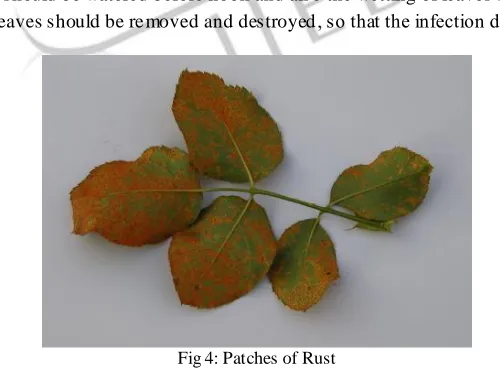
iv. Rust: Another disease that a rose plant suffers fro m is the rose rust, which is caused by the fungi Phraagmidiumspecies. This species of fungi cause an orange colored appearance on the stems as well as the leaves. When the rust is at its peak of severity, an orange dust-like substance can be seen on the plant surface as well as on the ground that lies below the plant. The rust attacks all the parts of the plants other than the roots and petals. The most infected and diseased leaves turn either yellowish or brownish and fina lly they drop.
Pre venti on and Tre atme nt:
The utmost care that should be taken is that the plants should be provided with good air circu lation. Also, the roses should not be planted in crowded areas and pruning of plants at regular intervals should be done in order to keep the centers of the plant open
The plants should be watered before noon and also the wetting of leaves should also be avoided Diseased leaves should be re moved and destroyed , so that the infection doesn’t spread
Fig 4: Patches of Rust
IJEDR1702049 International Journal of Engineering Development and Research (www.ijedr.org) 290 fail and often droop. Thirps can also cause a similar da mage to the semi -opened buds, therefore the plants need to be inspected carefully.
Pre venti on and Tre atme nt:
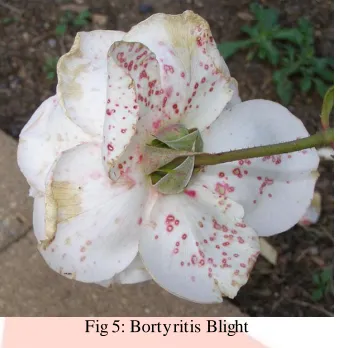
The most important factor for prevention of the disease is to keep the area clean. All the faded flo wer blossoms and leaves are collected and discarded. Good air circulation should be provided and wetting of the leaves should be avoided when it’s being watered
This particular disease can easily develop on the canes that have been damaged. It might also spread on the canes that are kept too wet due to the use of manure mu lch.
For necessary chemical controls, fungicides that contain thiophanate methyl or neem oil should be used. The neem o il is to be used on a trial basis, especially on the open blooms and during the hot weather [1].
Fig 5: Bortyritis Blight
vi . Rose Rosette Disease: This disease is considered to be an untreatable disease and is caused because of the Rose rosette virus (RRV). It is spread and introduced in the rose plant during the feeding that takes place by the rose leaf curl mite also known as Phyllocoptesfructiplilus. The e xtre me ly sma ll e riophyid mite feed on the cell sap of the tender stems and leaf petioles [1]. The leaf curl mite causes a very less damage but if it’s a carrier of the RRV v irus, the symptoms of infection can be seen within one to three months .
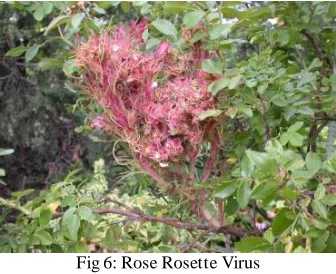
Some of the sympto ms that can be seen on the roses include the reddened terminal growth taking place on the infected leaves, with the stems becoming thicker. Ste ms of the plant exhibit an abnorma l high number of pliable thorns, present in either green or red colors. The leaves that are developed on the infected branches are smaller than the usual leaves. Lateral branches might grow excessively fro m the main stems and thereby creating a witch’s broom. The flowering capability of the plant is reduced, and thereby the petals may be distorted and fewer in number.
The symptoms are evident during the late spring to early summer and the progress during the growing season. Once the plant is infected, RRV moves throughout the plant and the entire plant is under infection. The RRV spreads to the neighboring plants after affecting the host plants and the infected plants die within a couple of years.
Pre venti on and Tre atme nt
The wild multiflora roses are very susceptible to this disease. Any wild plants planted nearby should be re moved and also promptly re moved.
The infected, cultivated roses should be immediately re moved and burned. No roots should be left behind so that there are any chances of sprouting of the disease again.
No part of the uprooted and infected plant should be left behind in the garden, as the mites might leave the rose plants for other plants
IJEDR1702049 International Journal of Engineering Development and Research (www.ijedr.org) 291 Fig 6: Rose Rosette Virus
vii. Crown Gall: This disease is caused due to soil inhibit ing bacteria na med, Agrobacterium tumefaciens. The symptoms of this disease include the swollen ga lls or swe llings that can occur take place at o r belo w the soil surface on stems and roots. The swollen galls are light green in color and at a tender age they are nearly white. With the increase in size, the galls darken in color and also become woody, ranging upto several inches in size. The galls are responsible for disruption of water flow and nutrients that travel upto the roots and plants, thereby ma king weaken ing and stunting the growth of the plant top.
Pre venti on and Tre atme nt:
For prevention of galls, disease-free roses should be chosen. Once a plant is infected, there a re no countermeasures to stop the infection.
Injury should be avoided to the roots and crown of the plant during the process of plantation and cultivation, as the bacteria can enter the plant through the fresh wounds
The infected plants should be removed as early as the galls are spotted
If possible, then soil should be removed and discarded immed iately fro m the area where the infected plant was located
IJEDR1702049 International Journal of Engineering Development and Research (www.ijedr.org) 292 S. No: Name of the
Disease
Causing Fungi Fungicide (s) Use d Image of the Disease
1. Black Spot Diplocarponrosae chlorothalonil, manc oze b
2. Powdery
Mil de w
Sphaerothecapannosa Propiconazole
3. Stem Canker Botryosphaeria, Leptosphaeria No particul ar fungi used for stem
cankers, but fungici des used for
contr olling black spot and mil de w nee d to be de ploye d
4. Rust Phragmidium Fungicides that
contain the porti ons of myclobutanil,
manc oze b or pr opic onazole
5. Botr ytis Blight Botrytis cinerea Fungicides containing thiophanate
methyl, chlorothalonil
6. Rose Rosette Disease
Rose rosette
vir usandPhyllocoptesfructiplilus
IJEDR1702049 International Journal of Engineering Development and Research (www.ijedr.org) 293 7. Crown Gall Agrobacterium tumefaciens Disinfecting the
pl ants in a solution of 0.5% sodium hypoc hlorite for several mi nutes
Table 1: Su mma ry of All the Diseases Caused In Rose Plant
III. DISEASES C AUSED BYINS ECTS
Some of the insects that cause harm to the rose plant are enlisted below-
i. Yellow Rose Aphi d: A widespread rose pest whose sighting is common and occurs during cooler season of fall, though it can also be spotted the whole year [4]. Different species of the aphids can cause infections to the plant. It feeds on the leaves leading to leaf drop. The honeydew that’s secreted by the aphids can serve as a major food source to the sooty mold breed, which in turn can cause the leaves to turn black and unsightly. Aphids can attract its enemies which feed on the aphids themselves or the honeydew secreted by them, which are rich in sugar content. Natural enemies of the aphids include lady beetles, lacewings, syrphid flies, predatory mites and thirps [4].
Fig 8: Rose Aphid
ii. Large Leaf Foote d Bug: The nymphs and the adult large leaf footed bugs are commonly found feeding on the rosebuds [4] and the blossoms that are expanding. Their eggs are shiny and golden in color which is commonly found in clu mps lying on the underside of the leaves. These are often found in roses during the mid to late summer and their da mage is limited to some of the flowe rs that are ma lformed with a few blossoms not opening up properly [4]. They can easily be re moved fro m roses by bare hands, provided they are present in large nu mbers.
IJEDR1702049 International Journal of Engineering Development and Research (www.ijedr.org) 294 iii. Fuller Rose Beetle: The fuller rose beetle of the Pantomorouscervinus species are introduced weevil that
usually feeds on the edge of the leaves and then notches them in an irregular fashion. The whitefingered beetle comple x, feeds on the leaves and also notches them irregula rly. The adult species of the battle are mostly active at night and can be found hiding on the secluded plants during the daytime. A flo wer beetle, Euphoria sepulcralisis a beetle pest [4] that’s found in the roses.
Fig 10: Fuller Rose Beetle
iv. Leafcutting Bees: A large number of bee species also known as the “leafcutting bees”, the reason being their habit of cutting out the circular sections of rose leaves for replenish ing the food cells for their larvae. The damage caused by the bees is obvious, as circular pieces of 0.5 inch are re moved from the leaflets. There are chances when more than one circle is cut fro m each of the leaflet.
Fig 11: Leafcutter Bee
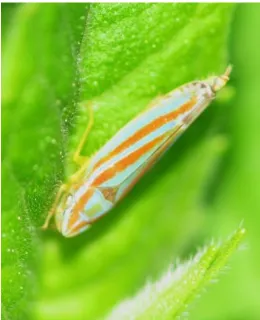
v. Leafhoppers: These are tiny insects which have piercing sucking mouth parts which can suck plant juices fro m the undersides of the leaves. The immature species of this insect are usually found in large nu mbers, and are found in colors ranging from pale white to yello w to green and move quickly fro m side to side, if they are disturbed. The damage caused from them is shown up as a “hopperburn”, wherein the leaves appear to be splotched, bronzed or even off colored. The damage that is caused by leafhoppers, thirps and mites are very similar in appearances.
IJEDR1702049 International Journal of Engineering Development and Research (www.ijedr.org) 295 vi. Thir ps: These are tiny, fast moving, rasping and sucking insect. Several species of thirps feed on various
rose parts such as leaves, buds and the flowers [4]. During the feeding stage, the thirps often leave the fecal matter on the leaves as dark spots that appear on the plant matter. These flower thirps can be a nuisance if the cut roses are brought indoors.
Fig 11: Rose Thirp
vii. Two-spotte d S pi der Mi te: These are very common rose pest that are found throughout the year can build up in large numbers very quickly. It feeds primarily on the underside of the leaves and protects itself by spinning thick webs around themselves. These pests suck chlorophyll and the juices fro m the outer cell of the leaves. This in turn causes the leaves to appear bleached or even stippled and at last they drop. Hot, dry weather plays a major ro le in the reproduction of the mites and enhances their buildup.
Fig 12: Two-spotted Spider M ite
IV. CONC LUSION
The number of diseases in rose is large. To keep its beauty intact, utmost care should be taken. The flower is liked by all and insects & pathogens are also no exception. By carrying out appropriate steps and safety measures the beauty can be easily sealed and made free fro m the impurities that try to damage it.
V. AC KNOWLEDGMEN T
The author Rishabh Sinha wishes to acknowledge his family and friends for their never ending support towards the successful completion of this paper.
REFER ENC ES
[1] Cle mson Cooperative Extension: Ho me and Garden Information Center: Rose Diseases
[2] A.R. Chase: “Rose Diseases and Their Control”
[3] Mark Windham, A lan Windham and Frank Hale: “Observations on Rose Rosette Disease” at University of Tennesssee