56
Measurment Of Costumer Satisfaction Using
Self-Management And Emotional Intelegence
Suharto, Ngaliman, Bambang Satriawan
Abstract: The aim of this research was to determine the effect of self-management. emotional intelligence. customer satisfaction. The quantitative approach is implemented in this research. Methods of research surveys on 160 customers were taken by accidental sampling and questionnaires as research instruments. The findings indicate that: self-management has a positive direct effect on emotional intelligence. self-management directly positive effect on customer satisfaction. emotional intelligence has a direct positive effect on customer satisfaction
Index Terms: self- management, emotional intelligence, customer satisfaction, Organization, Person Abilities, Competition
————————————————————
1
I
NTRODUCTIONCustomer satisfaction is an actual concept and is widely discussed through company management research However. the self-management that is owned by each member of a business organization and used to create customer satisfaction is still not much done. Self-management is one concept that is expected to have a lot of influence on customer satisfaction.. One of the main goals that are targeted by business organizations is customer satisfaction (Minh Ngo & Huan Huu. 2016). Some of them involve external party consultants so that the products or services produced by the company can satisfy customers. Internal management that observes the behavior of members of the organization. seeks to improve the self-management of each member of the organization in order to provide benefits to customers optimally (Ashry & Abdel Al. 2015). Organizations can pay attention to the personality of each employee to work better. be able to control their own desires and master group work. (Muhlbauer & Tziner. 2017). An employee's self-control related to work that is directly related to the customer will provide added value to the organization (Yukl. 2001). Organizations really need someone's emotional intelligence to be able to place the company's interests above their own interests (Adeyemo et al.. 2015). A person who has good emotional intelligence. will work better and be better able to compete with other competing organization members to win customers' hearts. Organizations that have members who are able to maintain and improve self-management and good emotional intelligence. will work optimally and in accordance with what is expected by customers (Hamid et al.. 2018; Boger et al.. 2015; Suharto et al.. 2019). Consumers will feel satisfied if employees who work for the benefit of customers have good self-management (Fraser et al.. 2010). The ability of employees to self-management and have an emotional intelligence that has added value. will give birth to a personality that is useful and can be used to avoid customer disappointment and contribute to public relations (Tamini & Chadha. 2018).
Asim (2016). define self-management as a mental attitude of a person or group of people who always desire to improve themselves. Self-management can also be interpreted when employees always do all the work and are done with better results compared to past work. The self-management process is carried out by training the employees to be able to develop self-control. obeying the existing rules and trying to be more effective in working. Cognitive self-management is very helpful for someone to build self-confidence and optimism to do tasks that are difficult to do Ashry & Abdel Al (2015). A cognitive and very helpful strategy is positive self-talk. which means emphasizing positive and optimistic thinking and avoiding pessimistic negative thinking (Manz. 1992). One translation is a difficult situation as an opportunity and does not see it as a problem. Self-confidence and determination that must be increased will be more likely to be found by concentrating on what can be done to make things better instead of struggling with difficulties or just thinking about mistakes. Concentrating on things that are better and positive is a person's ability to control themselves. Self-control ability is better known as emotional intelligence. Tamini & Chadha (2018) said that emotional intelligence is an awareness of one's own and others' emotional feelings. being empathetic. affectionate. motivated. and the ability to respond to the atmosphere of excitement and sadness quickly. Emotional intelligence can be enriched through a person's management review to control yourself (Singh. 2004; Mehmood et al.. 2013). So that someone who has good self-management has a great opportunity to be able to control his emotions. The existence of someone in a business organization needs to have the ability to manage emotions and mental disorder that is very necessary when dealing with customers (Akduman et al.. 2015). Emotional intelligence related to self-management is a person's ability to feel. understand. and effectively stimulate emotions to change into a movement of the heart to recognize the emotions of others and manage themselves and think rationally for the benefit of the organization. Based on these arguments. it can be assumed that self-management has a direct effect on emotional intelligence. In general. the purpose of a business organization is how to optimize profits. Employee involvement that supports the organization includes all aspects of behavior that are shown through activities that are beneficial. not pessimistic. and think for the benefit of the organization (Manz & Sims. 1995). The ability to manage yourself for a Frontline employee will have a direct impact on the customer's interests (Thirsk & Clark. 2014). The interests of customers who have a vision for the future or how they are treated as a customer. Self-management controlled by employees in an organization is a collective action that is the ________________________________
Suharto, Faculty Economics of Universitas Muhammadiyah Metro, E-mail: [email protected]
Ngaliman, Faculty Economics of Universtias Batam
57 responsibility of the organization. The organization has the
authority to provide direction and set targets. so that organizational goals are achieved optimally (Anwar. 2016). Organizational goals are shared goals that must be known and targeted by all members of the organization. An understanding of one's ability to manage good relationships with customers is not only aimed at yourself but must be developed for the benefit of customers in the long run (Agyapong. 2011; Ashry & Abdel Al. 2015). The relationship between members of the organization and customers can be enhanced through understanding the members of the organization about self-management and knowledge about how to make relationships with customers well-developed and can provide satisfaction to customers (Irfan. et al.. 2016; Kasapi. Z. & Mihiotis. A.. 2014). Customer satisfaction can be achieved if self-management has been understood and implemented within the organization (Cheung & Cheng. 1996). The behavior of employees who master self-management well will act in accordance with the goals of the organization in the long term. Organizational responsibility for goals and strategies for obtaining profits is an agreement that must be worked out together (Wantara. 2015). The ability of self-management of each member of the organization must be combined to win the competition and fight for markets and long-term benefits. Organizations that have the strength based on self-management of each member of the organization are expected to win the competition in providing satisfaction to the customers (Minh Ngo & Huan Huu. 2016). So that good self-management and belonging to members of the organization can create behavior that can satisfy customers. Emotional intelligence is a collection of non-cognitive skills. abilities and competition that affect a person's ability to succeed in facing environmental demands and pressures (Modassir & Singh. 2008; Kasapi & Mihitios. 2014). Emotional intelligence as a person's ability to adapt to the environment and business partners so that it can cause intimacy that can take place in the long run. Labhane & Baviskar (2015) said that emotional intelligence includes the ability to influence oneself based on reasonable considerations so that a person can succeed in facing the challenges around the environment. Various types of work demands in the organization can be solved well based on the skills and ability to face others. Skills and ability to control yourself for the benefit of others or customers is one of the characteristics of emotional intelligence (Prati et al.. 2003; Mehrad et al.. 2015). A customer who has a long-term interest in consuming a product or service produced by a company really hopes to get satisfactory service from employees on the front line. An employee's emotional intelligence will determine whether a consumer returns buy products or services produced by the company (Arfaraa & Samanta. 2016; Sumathy et al.. 2015; Daud, Anshar et. At, 2018). The better the emotional intelligence of an employee. the better the relationships created with customers will be. Consumers will feel valued because the ability of employees who serve them has the emotional intelligence and pleasant personality (Punia. 2015; Gayathri & Meenakshi. 2013). A pleasant personality from an employee will create a person's satisfaction if dealing with a company. Customer satisfaction is a person's feeling for the response of employees in serving customers. a guarantee. can understand customer needs and satisfactory service in accordance with customer expectations (Malik. 2012; Fonseca et al.. 2010). Feelings of pleasure or disappointment of someone as a result of the comparison between achievements
or products and services that are felt and expected (Fatimah & Alcantud, 2018). Basically. customer satisfaction is the result of the performance carried out by employees of a company. whether the customer feels satisfied or not (Suchánek & Králová. 2015). The level of customer satisfaction is a function that distinguishes between employee performance (perceived performance) and expectations desired by customers (expectations). According to Kärnä (2004); Nuridin. (2018). that customer satisfaction or dissatisfaction is the customer's responsibility for the evaluation of employee behavior. Based on this idea. it can be expected that emotional intelligence directly affects the satisfaction of the customer
2
RESEARCH METHODThe research constellation includes self-management as an exogenous variable (Andriyansah & Aryanto. V.D.W. 2017) emotional intelligence and customer satisfaction as endogenous variables. The target population is all customers at PT. Telkom Metro in Metro City. The sample used is calculated based on the Slovin formula (Hair. 2009) 160 respondents. The sampling technique uses accidental sampling (Naga. 1992). The instrument used in this study is multiple choice with 5 alternative choices and using a Likert scale model (Duchesne. S.. & McMaugh. A. (2018). for variables of self-management. emotional intelligence. and customer satisfaction. Instrument preparation steps include developing indicators. testing validity and reliability. revising instruments. and retrieving data in the field. The validity test used is the Product Moment correlation technique which correlates the item score with the total score (Ghozali. 2011). A valid item is declared invalid if the results are obtained rvalue < rtable (Naga. 1992). Reliability tests were calculated using Cronbach's Alpha for each instrument for each variable. Variables are said to be reliable if they provide values Cronbach’s Alpha > 0.60 (Hair. 2009). Data analysis techniques include descriptive and inferential statistical analysis. The test requirements analysis includes a linearity test. significance of regression. homogeneity. and normality (Fatimah.F. et al.. 2018). Multivariate statistical data processing using Structural Equation Modeling.
3
R
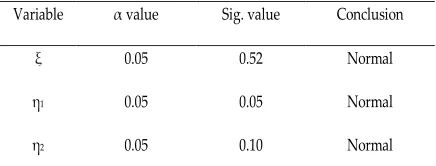
ESEARCH RESULTSAs demonstrated in this document, the numbering for sections upper case Arabic numerals, then upper case Arabic numerals, separated by periods. Initial paragraphs after the section title are not indented. Only the initial, introductory paragraph has a drop cap. Before data analysis is carried out. it is necessary to test the data normality analysis requirements as follows:
Table 1. The Summary of the Test Requirements of the Normality
Variable α value Sig. value Conclusion
ξ 0.05 0.52 Normal
η1 0.05 0.05 Normal
58 a. Tes Requirements of Homogeneity Analysis
The results of this test are used to determine the relationship between variables. with the requirement that each variable must have a homogeneous relationship.
b. Test Requirements for Linearity and Significance Analysis of Regression
The results of this test are used to determine the relationship between variables. with the requirement that each variable must have a significant linear and regression relationship.
Based on the results of the calculation shows that the value construct reliability. Self management variables of 0.664 are smaller than 0.70 (CR > 0.70) and value average variance extracted (VE) amount 0.044 smaller than 0.50 (VE < 0.50). This means that the three variables manifest self-management. namely for indicators X3 do not have consistency in measuring self-management.
Based on the results of the calculation shows that the value of constructs reliability variable emotional intelligence is 0.760 greater than 0.70 (CR > 0.70) and value average variance extracted (VE) amount 0.449 smaller than 0.50 (VE < 0.50). This means that the four manifest variables of emotional intelligence have consistency in measuring emotional intelligence.
Based on the results of the calculation shows that the value construct reliability variable customer satisfaction 0.787 is greater than 0.70 (CR > 0.70) and value average variance extracted (VE) amount 0.484 is smaller than 0.50 (VE < 0.50). This means that the four manifest variables
c. Path Calculation Coefficient Results. tvalue
59 Sub-Structural Path Coefficient 1
Analysis model of path sub-structure 1 coefficient is expressed in the form of equations ε1 = γ21ξ+ δ1. This test will provide a decision making hypothesis 1 test.
Figure 1. Sub-Structural Path Coefficient 1
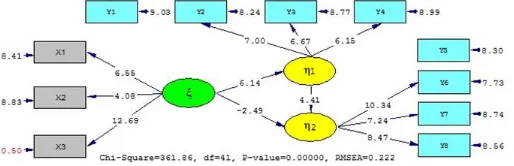
Based on the testing of sub-structure 1. the path coefficient is obtained (γ21) amount 0.83 and value tvalue = 6.14 > ttable(0.05:160) = 1.65 then Ho is rejected and the path coefficient γ21 is significant. meaning that self-management discipline has a direct positive effect on emotional intelligence.
Sub-Structural Path Coefficient 2
The path coefficient analysis model 2 is expressed in terms of equations ε2 = γ31ξ + β32ε1+ δ2. This test will provide decision making for hypothesis testing 2 and 3.
Figure 2. Sub-Structural Path Coefficient 2
Based on testing sub-structure 2. the path coefficient is obtained (γ31) equal to 0.73 and value tvalue = 2.49 > ttable(0.05:160) = 1.65. then Ho is rejected and the path coefficient γ31 is significant. that means self-management has a direct positive effect on customer satisfaction. Path coefficient (β32) amount 0.41 and value tvalue = 4.41 > ttable(0.05:160) = 1.65 then Ho is rejected and the path coefficient β32 is significant. that means emotional intelligence has a direct positive effect on customer satisfaction. Based on the calculation of the path coefficient and t-value for the purposes of testing the hypothesis that is set. shows that the value Sig. three coefficients found < 0.05 and t-value > 1.65. so that all the causal relationships studied are significant.
Figure 3. T-value diagram
The overall path diagram standardized solution on each variable through linear structural relationship described as follows:
Figure 4. Standardized Solution Path Diagram
Based on figure 4 (path diagram standardized solution). besides direct influence (direct). there are also total and indirect influences (indirect) between variables exogenous (ξ) with variables endogenous (ε). Based on output lisrel about standardized total effect show that: (1) direct influence value (direct effect) variable ξ to ε1. ξ to ε2. and ε1 to ε2 equal to the value of direct influence (direct effect) each of these variables. because it is not mediated by other variables (intervening variable). (2) value of influence (total effect) variable ξ and ε1 to ε2 equal to the amount of direct influence (direct effect) each of these variables is mediated by intervening variable. (3) indirect influence (indirect effect) variable ξ to ε2 through ε1 amount 0.83 x 0.41 = 0.34. because of other variables (intervening variable) that is ε1. while the total effect is equal 0.73 + 0.34 = 1.07. Description of the influence of each variable exogenous (ξ) against variables endogenous (ε) above shows that variable ε1 to ε2 have a greater effect than the direct influence of variables ξ to ε2.
4. Discussion
a. There is a positive direct effect of self-management on customer satisfaction
Based on the results of the study showed that self-management has a positive effect on customer satisfaction. This shows that if the strategies used by employees to influence and improve their own behavior. self-control. mainly based on social learning theory. and the ability to push themselves to do something better. then it will affect the response of employees in serving customers. guarantee. understand customer needs so that customer satisfaction will increase. This finding is in accordance with the study (Palvalin. 2017; Gema & Sinde. 2014) which concludes that self-management directly affects customer satisfaction.
b. There is a positive direct influence of emotional intelligence on customer satisfaction
60 c. There is a positive direct influence on
self-management of emotional intelligence
Based on the results of the study showed that self-management has a positive direct effect on emotional intelligence. The results of this study indicate that if the efforts made by employees to influence and improve the improvement of their own behavior. the ability to control themselves based on improving relations with the social environment. then awareness of the emotional feelings of themselves to regulate the mood. understand the emotions of others. the ability to foster relationships with other people will increase. This finding is in accordance with the study by Kartar Singh & Nik Mahmood (2016); Suifan (2015) which concluded that self-management has a positive direct effect on emotional intelligence.
5
C
ONCLUSIONSBased on the results and discussion. conclusions can be drawn as follows:
a. Based on the results of the study showed that self-management has a positive direct effect on emotional intelligence. This shows that if self-management is improved. emotional intelligence will be better.
b. Based on the results of the study showed that self-management has a positive direct effect on customer satisfaction. This shows that if self-management is improved. emotional intelligence will be better.
c. Based on the results of the study showed that emotional intelligence has a direct positive effect on customer satisfaction. This shows that if emotional intelligence is improved. then customer satisfaction will be better.
6
S
UGGESTIONBased on the conclusions can suggest the following:
a. Employees' self-management should be improved through training. education and leadership directives regarding company objectives. Because of the improvement of self-management. in addition to improving the personality of employees. it can also improve emotional intelligence. b. The company must provide satisfactory services based on
increased self-management capabilities. Customer satisfaction that is felt by consumers depends greatly on how employees can control themselves for the benefit of customers.
c. Employees must be agiler in attracting customers to make transactions with the company. Employee behavior can be directed to provide pleasant hospitality for customers when making transactions. Customers who feel happy are expected to conduct transactions with the company because of customer satisfaction.
R
EFERENCES[1]. Adeyemo. D. A.. Dzever. Linus Terry & Nyananyo Julius Lambert. (2015). Organization Climate. Leadership Style And Emotional Intelligence As Predictors Of Quality Of Work Life Among Bank Workes In Ibadan. Nigeria. Departement Of Guidance And Counselling. Faculty Of Education. University Of Ibadan. Nigeria. European Scientific Journal. February. Edition Vol. 11. No. 4 ISSN: 1857-7881 (Print) e-ISSN 1857-7431.
[2]. Agyapong. Gloria K.Q. (2011). International Journal of Business and Management. Vol. 6. No. 5; May 2011.
The Effect of Service Quality on Customer Satisfaction in the Utility Industry – A Case of Vodafone (Ghana). University of Cape coast Cape Coast. Ghana.
[3]. Akduman. Gulbeniz.. Zeynep Hatipoglu & Zeki Yuksekbilgili. (2015). MPRA Munich Personal Repec Archive. International Journal of Advanced Multidisciplinary Research and Review Volume 3. No. 4. A Research about Emotional Intelligence on Generations. Istanbul Arel University . Istanbul-Turkey. Nisantasi University Istanbul-Istanbul-Turkey. Avrasya University Trabzon-Turkey.
[4]. Andriyansah & Aryanto. V. D. W (2017). A Structural Equation Modelling Approach on Tourism Mega Event of Total Solar Eclipse and Customer Value in Belitung. Indonesia. International Journal of Mechanical Engineering and Technology. 8(6). 317-326
[5]. Anwar. Kofand. (2016). The Relationship Between Employee Commitment And Sustained Productivity In Agricultural Businesses. International Journal Of Management And Applied Science. Issn: 2394-7926. Volume-2. Issue-1. Jan-2016. Business Administration Department. Ishik University. Erbi. Govand.
[6]. Arfaraa. Christina & Samanta. Irene. (2016). Science Direct Procedia - Social and Behavioral Sciences 230 (2016) 167 – 175. The impact of emotional intelligence on improving team-working: the case of Public Sector (National Centre for Public Administration and Local Government - N.C.P.A.L.G.). Piraeus University of Applied Sciences. Egaleo – Athens.
[7]. Ashry. Nevein M. El & Abdel Al. Mona Hassan. (2015). Self management strategies to control auditory hallucinations among patients with schizophrenia. International Journal of Current Research. Peer Reviewed Open Acces Journal: Fast Publication) ISSN: 0975-833X; Impact Factor: 7.616. Author: Subject Area: Health Sciences. 2015. [8]. Ashry. Nevein M. El & Abdel Al. Mona Hassan.
(2015). Self management strategies to control auditory hallucinations among patients with schizophrenia. International Journal of Current Research. Peer Reviewed Open Acces Journal: Fast Publication) ISSN: 0975-833X; Impact Factor: 7.616. Author: Subject Area: Health Sciences.
[9]. Asim. Titi Mirawati. (2016). Pengaruh Bimbingan Manajemen Diri Dalam Meningkatkan Kedisiplinan Belajar Siswa. Journal of EST. Volume 2 Nomor 2. Agustus. Hal. 105-112. p-ISSN: 2460-1497. e-ISSN: 2477-3840.
[10]. Boger. Emma.. Jaimie Ellis. Sue Latter. Claire Foster. Anne Kennedy. Fiona Jones. Vicky Fenerty. Ian Kellar. Sara Demain. (2015). Self-Management and Self-Management Support Outcomes: A Systematic Review and Mixed Research Synthesis of Stakeholder Views. Published: July 10. doi.org/10.1371/journal.pone.0130990. Plose One. XV Collection.
61 Journal of Educational Management. (Faculty of
Education. The Chinese University of Hong Kong. Shatin. Hong Kong). (1996). pp.17-29. doi.org/10.1108.
[12]. Duchesne. S.. & McMaugh. A. (2018). Educational psychology for learning and teaching. Cengage AU [13]. Fatimah. F.. Rosadi. D.. & Hakim. R. B. F. (2018.
March). Probabilistic soft sets and dual probabilistic soft sets in decision making with positive and negative parameters. In Journal of Physics: Conference Series (Vol. 983. No. 1. p. 012112). IOP Publishing. [14]. Fonseca. Filipa.. Sofia Pinto. Carlos Brito. (2010).
Service Quality And Customer Satisfaction In Public Transports. International Journal for Quality research. Vol. 4. No. 2. 2010. Catholic University of Portugal. Portugal & Faculty of Economics. University of Porto. Portugal.
[15]. Fraser. Robert.. Dawn Ehde. Dagmar Amtmann. Aimee Verrall. Kurt L. Johnson. Erica Johnson. & George H. Kraft. (2010). Self-Management for People with Multiple Sclerosis Report from the First International Consensus Conference. International Journal of MScare. November 15. 2010. 2013 Summer; 15(2): 99–106.
[16]. Gayathri. N. & Meenakshi. K. (2013). International Journal of Humanities and Social Science Invention. Volume 2 Issue 3 March. 2013 PP.42-51. A Literature Review of Emotional Intelligence. 1. VIT University. Vellore.
[17]. Gema Alvarez. Ana & Sinde Cantorna. (2014). Self-employment and job satisfaction: an empirical analysis. (Department of Business Organisation and Marketing. University of Vigo. Vigo. Spain). International Journal of Manpower. Vol. 35 Issue: 5. pp.688-702. doi.org/10.1108/IJM-11-2012-0169. [18]. Hair. J.F. (2009). Multivariate Data Analysis. Edisi 9.
New Jersey: Pearson Education.
[19]. Hamid. Najmeh.. Yaser Boolaghi & Amir Sam Kiani Moghadam. (2018). The Efficacy of acceptance and commitment based therapy (ACT) on depressive symptoms and cognitive emotion regulation strategies in depressive students. Page 5-29. International Journal of Psychology. Current Issue: Volume 12. Issue 1 - Serial Number 23. Winter and Spring 2018. Page 1-234.
[20]. Irfan. Muhammad.. Mohammad Farid Shamsudin & Noor Ul Hadi. (2016). Published by Canadian Center of Science and Education. How Important Is Customer Satisfaction? Quantitative Evidence from Mobile Telecommunication Market. International Journal of Business and Management; . Vol. 11. No. 6; 2016. Universiti Kuala Lumpur Business School (UNIKL BIS). Bangunan Yayasan Selangor. Malaysia [21]. Kärnä. Sami. (2004). Analysing customer satisfaction
and quality in construction- the case of public and private customers. Nordic Journal of Surveying and Real Estate Research - Special Series. Vol. 2. Helsinki University of Technology.
[22]. Kartar Singh. Jugindar Singh & Nik Mahmood. Nik Hasnaa. (2016). Expatriates emotional competencies and its impact on job performance: empirical evidence from Malaysia. Electronic Journal of Business and Management Vol. 1. No. 1. (2016). pp. 9-23. Asia
Pacific University of Technology and Innovation. Malaysia.
[23]. Kasapi. Z. & Mihiotis. A. (2014). Emotional Intelligence Quotient and Leadership Effectiveness in the Pharmaceutical Industry. International Journal of Business Administration Vol. 5. No. 1; 2014.: A New Template. Hellenic Open University. Patras.
[24]. Labhane. C. P. & Baviskar. P. A. (2015). Self concept and Emotional intelligence: A comparative study of Arts and Science college students. The International Journal of Indian Psychology. Volume 2. Issue 2.. 2015. HOD. Dept of Psychology. M.J. College. Jalgaon (MS).
[25]. Malik. Saif Ullah. (2012). Customer Satisfaction. Perceived Service Quality and Mediating Role of Perceived Value. MPRA Munich Personal RePEc Archive. International Journal of Marketing Studies. Vol. 4. No. 1; February 2012. Institute of Business Management. Karachi. Pakistan.
[26]. Manz. C.C. . & Sims. H. Positivisme . Jr. (1995). Self – Management as A Subtitude Leadership: A Social Learning Theory Perspective. New York ; Mc grow Hill. Maryland Institude. 2005. The Characteristic of Emotional. Maturity. Diakses dari http: //www.jstor.org/stable/257111. Tanggal 15 Oktober 2013 jam 13.57.
[27]. Mehmood. Tahir.. Saba Qasim & Rabbia Azam. (2013). Impact of Emotional Intelligence on the Performance of University Teachers. International Journal of Humanities and Social Science. Vol. 3 No. 18; October 2013. Institute of Education & Research University of the Punjab Lahore-Pakistan.
[28]. Mehrad. Aida.. Hanina Halimatussadiah Binti Hamsan. Ma’rof Bin Redzuan. Haslinda Abdullah. (2015). Relationship between Reward and Emotional Intelligence of Academic Staff at Malaysian Public Universities. Journal of Educational. Health and Community Psychology. Vol. 4. No. 1. 1University Putra Malaysia (UPM).
[29]. Minh Ngo. Ing. Vu & Huan Huu. Nguyen. (2016). Journal of Competitiveness. Vol. 8. Issue 2. pp. 103 - 116. June 2016. The Relationship between Service Quality. Customer Satisfaction and Customer Loyalty: An Investigation in Vietnamese Retail Banking Sector. 1Tomas Bata University in Zlín. 2 University of Economics Ho Chi Minh City.
[30]. Minh Ngo. Ing. Vu & Huan Huu. Nguyen. (2016). The Relationship between Service Quality. Customer Satisfaction and Customer Loyalty: An Investigation in Vietnamese Retail Banking Sector. Journal of Competitiveness. Vol. 8. Issue 2. pp. 103 - 116. June. Tomas Bata University in Zlín & University of Economics Ho Chi Minh City.
[31]. Modassir. Atika & Singh. Tripti. (2008). Relationship of Emotional Intelligence with Transformational Leadership and Organizational Citizenship Behavior. International Journal of Leadership Studies. Vol. 4 Iss. 1. pp. 3-21. Wipro Technologies & Indian Institute of Management. Bangalore.
62 Volume 47. ISSN: 0020-8825 (Print) 1558-091.
Pages: 311-323. International Studies of Management & Organization. 47:4. 307-310. DOI: 10.1080/00208825.2017.1382267.
[33]. Naga. Dali S. (1992). Pengantar Teori Skor pada Pengukuran Pendidikan. Jakarta: Universitas Negeri Jakarta.
[34]. Nuridin. (2018). Effect of Service Quality and Quality of Products to Customer loyalty with Customer Satisfaction as Intervening Variable in PT. Nano Coating Indonesia. Center for Promoting Education and Research (CPER) USA. International Journal of Business and Applied Social Science (IJBASS) VOL: 4. ISSUE: 1 January Krisnadwipayana University Jakarta. Campus UNKRIS Jatiwaringin.
[35]. Palvalin. M.. van der Voordt. T. & Jylhä. T. (2017). The impact of workplaces and self-management practices on the productivity of knowledge workers. Journal of Facilities Management. 15(4). 423-438. DOI: 10.1108/JFM-03-2017-0010
[36]. Prati. L. Melita.. Ceasar Douglas. Gerald R. Ferris. Anthony P. Ammeter. M. Ronald Buckley. (2003). Emotional Intelligence. Leadership Effectiveness. And Team Outcomes. The International Journal of Organizational Analysis. Vol 11. No. 1. 2003. pp. 21. 123. Florida State University. 4University of Mississippi. University of Oklahoma.
[37]. Punia. Namrata.. Jayanti Dutta. Yukti Sharma. (2015). Emotional Intelligence: A Theoretical framework. International Journal of Scientific & Engineering Research. Volume 6. Issue 5. May-2015. Research Scholar. Lady Irwin College. Central Institute of Education. University of Delhi. New Delhi. India. [38]. Savickas. M. L. (2001). A Developmental Perspective
on Vocational Behavior: Career Pattern. Salience. and Themes. International Journal for Educational and Vocational Guidance. 1. 49-57.
[39]. Singh. Shailendra. (2004). Researchgate. Development of a Measure of Emotional Intelligence. National Academy of Psychology. India. Vol. 49. Nos. 2-3. 136-141. Indian Institute of Management. Lucknow.
[40]. Suchánek. Petr & Králová. Maria. (2015). Acta Universitatis Agriculturae Et Silviculturae Mendelianae Brunensis. Volume 63 Number 3. Effect of customer satisfaction On company performance. Department of Corporate Economy. Lipová Brno. Czech Republic. [41]. Suharto.. Suyanto & Hendri. N. (2019). The Impact of
Organizational Commitment on Job
Performance. International Journal of Economics & Business Administration (IJEBA). 7(2). 189-206 [42]. Suifan. Taghrid S.. Ayman Bahjat Abdallah & Rateb J.
Sweis. (2015). The Effect of a Manager‟s Emotional Intelligence on Employees‟ Work Outcomes in the Insurance Industry in Jordan. International Business Research; Vol. 8. No. 9; 2015 ISSN 1913-9004 E-ISSN 1913-9012 Published by Canadian Center of Science and Education. Department of Business Management. Faculty of Business. The University of Jordan. Jordan.
[43]. Sumathy. L.. Madhavi. C. & A. J. W. Felix. (2015). American International Journal of Social Science Vol. 4. No. 1; February. Influence of Emotional Intelligence
on Decision Making by Leaders. Head Department of Business Administration. Reader cum Statistician Community Medicine R.M.M.C Annamalai University Annamalai Nagar Tamil Nadu.
[44]. Tamini. Bahman Kord & Chadha. Narendra K. (2018). Emotional Intelligence and Quality of Work Life between Iranian and Indian University Employees: A Cross–Cultural Study. Page 91-117. International Journal of Psychology. Current Issue: Volume 12. Issue 1 - Serial Number 23. Winter and Spring 2018. Page 1-234.
[45]. Thirsk. Lorraine M. & Clark. Alexander M. (2014). International Journal of Nursing Studies. May. Volume 41. Issue 5. Pages 691-693. What is the ‘self’ in chronic disease self-management? DOI: org/10.1016/j.ijnurstu.2013.10.008.
[46]. Thiruchelvi. A. & Supriya. M.V. (2009). Emotional Intelligence and Job Satisfaction. Asia-Pasific Journal of Management Research and Innovation. Volume: 5 issue: 2. page(s): 109-115. Article first published online: April 1; Issue published: doi.org/10.1177/ 0973247 00900 500209.
[47]. Wantara. Pribanus. (2015). The Relationships among Service Quality. Customer Satisfaction. and Customer Loyalty in Library Services. International Journal of Economics and Financial. Issues. Vol 5. Special Issue. 2015. University of Trunojoyo Madura. East Java province. Indonesia.
[48]. Daud, A., Farida, N., Andriyansah & Razak, M. (2018). Impact of customer trust toward loyalty: the mediating role of perceived usefulness and satisfaction. Journal of Business and Retail Management Research, 13(02).
[49]. Watson. D. R.. & Tharp. R. G. (2001). Self-directed behavior (8th ed.) Monterey. CA: Brooks/Cole. [50]. Fatimah, Fatia and J. C. R. Alcantud, "Expanded Dual
Hesitant Fuzzy Sets," 2018 International Conference on Intelligent Systems (IS), Funchal - Madeira,
Portugal, 2018, pp. 102-108.
doi: 10.1109/IS.2018.8710539