Implementation of Similarity Measures for Event
Sequences in
myCBR
Eduardo Lupiani1, Christian Sauer2, Thomas Roth-Berghofer2, Jose M. Juarez1, and Jose Palma1
1 University of Murcia, Spain
{elupiani,jmjuarez,jtpalma}@um.es 2 The University of West London, UK
{Thomas.Roth-Berghofer,Christian.Sauer}@uwl.ac.uk
Abstract. The computation of the similarities between event sequences is important for many fields because many activities follow a sequential order. For instance, an industrial plan that triggers different types of alarms due to detected event sequences or the treatment sequence that a patient receives while he/she is hospitalized. With the appropriate tools and techniques to compute the similarity between two event sequences we may be able to detect patterns or regularities in event data and so be able to perform predictions or recommendations based on detected similar sequences. The present work is intended to describe the implementation of two event sequence similarity measures inmyCBR, with the purpose of creating a similarity measurement approach for complex domains that employ the use of event sequences. Besides, an initial experimentation is performed in order to study if the proposed measures and measurement approach are able to predict future situations based on similar event sequences.
1
Introduction
Using event sequences is useful for many scenarios, particularly for those where it is necessary either to detect patterns in the occurrence of events or to retrieve past event sequences that are similar to a current one. Examples of event-based data include medical records and procedures, data in a temporal context such as historical, biographical and career path data, internet session data, traffic incident data, process control data, and administrative process data [8].
While there are approaches to compute the similarity between two event se-quences [1,4,5,7,8,10], only very few or almost none of these approaches were ever implemented in a software, making it difficult to select the most suitable event sequence similarity measure to a specific system. For this reason our work in this paper is the implementation of similarity measures between event sequences so a CBR system can be enabled to be employed in the problem domains described before. For this purpose we are extending themyCBRdevelopment tool to im-plement the event sequence similarity measures. The main reason for our choice is that the myCBR software is intended for building prototypical CBR appli-cations in teaching, research, and small industrial projects with low effort [6]. Furthermore, it is designed for being easily extended with new functionalities.
After the implementations of the new similarity measures we also were in-terested to study whether they were able to detect similar event sequences in a proper way, especially if it was possible to build a CBR system able to predict future situations based on the recognition of similar event sequences. To study these aspects we have conducted initial experiments with a case-base with event sequences that represent risky situations in an industrial furnace.
The remainder of this work is as follows: in the next section we review the background of this work. We review the definitions of event sequences and simi-larity between events, as well as details of two simisimi-larity measures. In this section we describe themyCBRtoo. Later, in 3 we describe in details how the similarity measures have been implemented in myCBR. The section 4 corresponds to an initial experimentation performed using an artificial case-base with cases that contain event sequences. Finally, in section 5 we present our conclusions and future work.
2
Background
Insight into the formalization of an event, event type and event sequence is es-sential to understand in depth the problems related to find similarities between sequences of events and to recognise the differences between them.
2.1 Event Sequences
The following definition of event is based on the definitions given in [4], [7] and [5], which give similar explanations of what an event is and are unified here into one definition that encompasses them all.
Definition 1. An event is a tuple with a label representing an action or activ-ity and a time-stamp that represents the moment when the action occurs [4,7]. Formally we can define an evente as following:
e= (a, t),
The activity a can be represented as a simple value of the following data-types: integer, string or symbol. However, complex representations are possible as well, by defining event types [5]. The event type determines the data structure of each activity in the problem domain and this does not affect to the time-stamp of the event. Furthermore the amount of the set of event types to define is determined by the domain of the problem to resolve [4], so the values of this set relies on the application itself.
Definition 2. An event sequence is a partially ordered set of events:
S =h(e1, t1),(e2, t2), . . . ,(en, tn)i
where ei are the possible event types in the problem domain, and it holds that
ti≤ti+1∀i= 1, . . . , n−1 [4].
Example 1. Assume a processing plant that may trigger four types of alarms from sensor readings of temperatures LL, L, H, HH. From the definition given for event sequence it is possible to represent a sequenceeof alarms as follows:
e=h(L,1),(H,2),(HH,3),(HH,5),(LL,6)i
2.2 Similarity Measures for Event Sequences
There are different ways to compute the similarity between two event sequences. When two event sequences have the same number of events it is possible to use alock-step measure [9]. The basis of this type of measure is to compare the i-th event in both sequences and establish the (local) similarity of this event pair and at the end to compute a global similarity measure of the two sequences based on their local similarities of event pairs. However this similarity measure is not suitable when the length of the two sequences differ, in this case it is convenient to employ other types of similarity measures. The Edit Distance measures the cost of transforming one event sequence into another. Therefore, the similarity between the two sequences is given by the number of used transformation op-erations. The lower the number of needed operation, the higher the similarity between the two event sequences is.
Prior to showing the event sequence distance measures, we propose the fol-lowing definition of distance and similarity. Given the space of possible eventsE, the distance function between two event sequences is defined asd:E×E→R. Additionally, in some cases it is useful to normalise the distance between two event sequences in the interval [0,1], thusd:E×E→[0,1]. This is possible by dividing the resulting distance between two sequences by the maximum observed value. When the distance function is normalised, defining the similarity between two event sequencesex, ey is possible as follows:
sim:E×E→[0,1]
sim(ex, ey) =1−d(ex, ey)
Edit distance between two Sequences Theedit distance measures the re-lated cost of transforming an event sequence into another, using operations of insertion, deletion or alignment/movement. This measure is also known as Lev-enshtein distance because of the last name of the author who proposed it [2]. Although the Levenshtein distance measure only involves strings. In the works of [3,4] it is proposed to use a modification of the edit distance to manage event se-quences, where the alignment/movement involves the temporal distance between two events. This algorithm requires that given two events of the same type, the distance between their timestamps must be lower than the cost of any other operation. If this requirement is not met the cost of aligning two events with the same event type can be higher than the inserting and removing operations. Formally, it can be defined as following:
Definition 3. Let Sx=h(ex
1, tx1), . . . ,(enx, txn)i andSy =h(e y
1, t
y
1), . . . ,(eym, tym)i
be two even type sequences. The edit distance betweenSx andSy is the number of operations to transform the sequence Sx intoSy [4].
So to normalise the edit distances in the interval [0,1], it is necessary to divide the resulting distance by the maximum necessary effort to transform one sequence into the other, where the maximum effort is the maximum number of operations needed to build the longest event sequence from scratch.
Match & Mismatch Similarity [9,10] The Match & Mismatch (henceforth M&M) is a measure based on the idea of edit distance, thus it measures the cost of transforming one event sequence into another. This measure splits each event sequence into several event sub-sequences, sorting them into lists for each event type [9]. Using this approach the algorithm can compute the distance between sequences that contain the same event type, which is a simpler sub problem [10] than the initial problem.
For each event type the algorithm computes an edit-distance matrix. From all the built matrices, four different measures are calculated: the time difference between the events (T D), the missing events (N M), the extra events (N M) and the number of swamping events (SN). These measures are the basis an overall score that measures the similarity between the two event sequences. Unlike the Edit Distance, which is a distance, the M & M returns a similarity score in the interval [0.01,0.99].
2.3 myCBR Software Development Kit
quality in an in-built retrieval interface. In order to further reduce the develop-ment effort of CBR systems, especially the built up of a case-base, after defining an appropriate case representation,myCBR Workbench includes tools for gen-erating the case representation automatically from existing raw data as well as importing cases from CSV data files. The accompanying Software Development Kit (SDK) allows for the integration of the developed CBR systems into other applications and allows for extension to specific requirements such as additional similarity calculations, as it is demonstrated in the present research work.
2.4 Building structural knowledge models withmyCBR Workbench
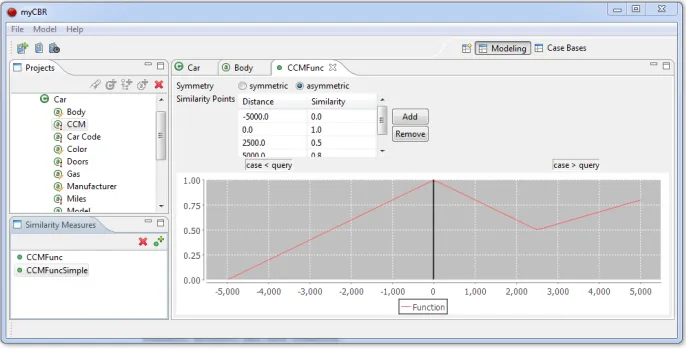
myCBR provides a workbench, themyCBR Workbench, that supports the cre-ation and maintenance of the vocabulary and similarity measures used within a CBR system and thus provides control over the knowledge model of a CBR system developed or maintained usingmyCBR. ThemyCBR Workbench is im-plemented as using theRich Client Platform(RCP) of theEclipseJDE.myCBR Workbench offers two different perspectives on a CBR system being developed - a perspective for the knowledge modeling and another perspective to develop and maintain the case-base(s). Figure 1 provides an overview of the modeling perspective within themyCBR Workbench. The conceptual idea behind the
mod-Fig. 1.The modeling perspective ofmyCBR Workbenchwith the case structure (left), a list of available similarity measures (left bottom) and a view of their structure (center)
of aconcept can contain one or more attribute descriptions as well as references to other concepts as well thus allowing the user to create object-oriented case representations. A description of an attribute can be formulated using one of the following data types: Boolean, Double, Integer, Interval, String or Symbol. For each data typemyCBRprovides a default similarity function that supports their definition and individual functionalities to further define more sophisti-cated similarity functions with regard to the specific data types chosen for an attribute. To ease the prototyping of CBR systems one single attribute descrip-tion can have more than one similarity measure, allowing for rapid testing and experimentation to find the most suitable similarity functions.
As already described the modeling of the similarity measures in myCBR Workbench takes place first on the attribute level, defining the local similarity measures and then moves on to the concept level to define the global similar-ity measure(s) of a case representation. When the attributes are defined, the data types and value ranges are also given in the process. Depending on the chosen data type of an attribute the myCBR Workbench provides graphically supported modeling of: Numerical data, providing predefined distance functions along with predefined similarity behaviour (constant, single step or polynomial similarity decrease). For the definition of similarity measures for symbolic values, myCBR Workbench provides table functions and taxonomy functions. A table function allows defining for each value pair the similarity value, while a taxon-omy subsumes similarity values for subsets of values. Depending on the size of a vocabulary, table similarity measures are hard to maintain and taxonomies allow an easier overview. For symbolic values, also set similarities are provided in order to compare multiple value pairs [6]. The aim of the research presented in this paper was it to further implement withinmyCBRthe new functionality to provide similarity measures for the new data type of event sequences. Therefore the highly modularised code structure of the myCBR project was extended to allow for the new attribute and the computation of similarities for its new data type being event sequences.
3
Implementation of the Similarity Measures in
myCBR
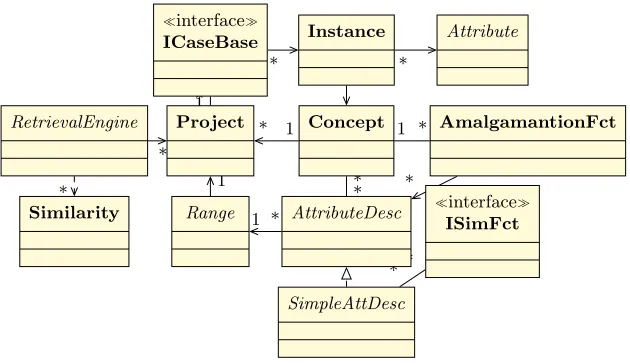
The major goal of myCBR is to minimize the effort for building CBR applica-tions that require knowledge-intensive similarity measures[6], so the structure and design of themyCBR software is ready for being extended with new func-tionalities. The software is implemented in Java, so it follows an object oriented approach. In this work we are only showing the set of classes that are related with the representation of the case-base and the processes to retrieve cases. The figure 2 depicts the class diagram of the classes realising the retrieval process and the case representation in a case-base.
Where each class has its own role:
* *
1
* 1
* * 1
* * 1
* 1
* *
*
* *
interface
ICaseBase Instance Attribute
RetrievalEngine
Similarity
Project
Range
Concept AmalgamantionFct
AttributeDesc
SimpleAttDesc
interface
ISimFct
Fig. 2.Main classes ofmyCBRSDK related to the similarity computation process.
Instance: Represents values occurring in either query and cases. It contains a set of attributes that conforms to the case structure.
Attribute: This is an interface with the basic operations of all types of at-tributes. Each attribute must have an implementation of this class. For in-stance, DoubleAttribute, StringAttribute, etc.
ICaseBase: An interface that represents the set of retained cases.
RetrievalEngine: Implementation of the process to retrieve the most similar cases to a query.
Concept: Vocabulary of the problem domain.
Range: Possible values of a particular implementation of an attribute.
AttributeDesc: Contains details about the description of one attribute of the case. For instance, there are descriptions for numbers, symbols, dates, etc.
SimpleAttDesc: This class extends the AttributeDesc class with new fields and methods for being used by a ISimFct.
ISimFct: Implementation of the similarity between two attributes with the same description, i.e. between attributes of the same data-type.
AmalgamationFct: Implementation of the global similarity function to com-pute the similarity between two instances / cases, considering all the existing ISimFct to create a Similarity object.
Similarity: The value that represent the similarity between two instances.
Our approach was it to create a new attribute that represents event se-quences. From the definitions given before in section 2, we have set the following string representation:
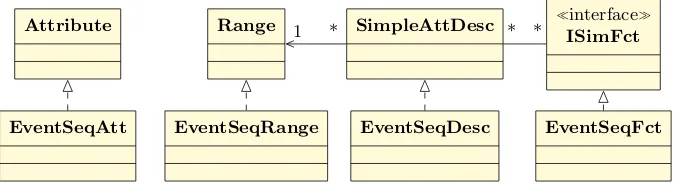
The figure 3 depicts the new classes that we have implemented. With them we can represent an event sequence within as an attribute of a case which allows myCBR to compute the similarity between two different event sequences.
*
1 * *
Attribute Range SimpleAttDesc interface ISimFct
EventSeqAtt EventSeqRange EventSeqDesc EventSeqFct
Fig. 3.Sequence of operations to compute the similarity between two cases.
EventSeqAtt: Contains the information of particular event sequence.
EventSeqRange: Contains the possible values of event sequences. It is respon-sible of creating newEventSeqAtt.
EventSeqDesc: Contains the details about how the event sequences are imple-mented.
EventSeqFct: This corresponds to the implementation of the similarity mea-sures that we have worked on in the present paper. When an object of this class is created it is mandatory to specify with type of measure it should employ.
The implementations of the measures are expressed in algorithms 1 and 2. The algorithms are in pseudo-code to ease their comprehension; however they are implemented using Java.
4
Initial Experiments
For our experiments we have created a synthetic case-base that represents the knowledge related to the operation of an industrial furnace. The purpose of the evaluation was to analyse whether the CBR system was able to predict unsafe situations from cases that represent the operation of the furnace. Thus, the cases consisted of event sequence describing the event data of a whole day of furnace operation and a label to classify the event sequence as a “normal” or “not normal” with reragrd to the final safety situation of the event sequence. Each event sequence had up to four different event activities: LL, L, H and
HH, that represented the temperature of the furnace, where the activity type
Algorithm 1 Calculate the edit distance dS(Sx, Sy) between two sequences
Sx, Sy
Input: Two event sequences Sx =
h(ex1, tx1), . . . ,(exn, txn)i and Sy =
h(ey1, ty1), . . . ,(ey
m, tym)i, with ex, ey ∈
E, the costsw(ex), w(ey) of the inser-tionanddeletionoperations.
Output: Edit distance dS(Sx, Sy)
be-tween the two given sequences. 1: r← matrix ofn×mdimensions 2: r(0,0)←0
3: fori←0tomdo
4: r(i,0)←r(i−1,0) +w(ex) 5: end for
6: forj←0tondo
7: r(0, j)←r(0, j−1) +w(ey)
8: end for
9: fori←1tomdo
10: forj←1tondo
11: updateSx←r(i−1, j) +w(ex)
12: updateSy ←r(i, j−1) +w(e y
) 13: align←r(i−1, j−1) 14: if ex=ey then
15: align←align+(0.5×|txi−t y j|)
16: else
17: align←align+w(ex) +w(ey) 18: end if
19: r(i, j)←min updateSx, updateSy, align
20: end for
21: end for
22: return r(n, m)
Algorithm 2Calculate the M&M distanceM M(Sx, Sy) between two sequences Sx, Sy
Input: Two event sequences Sx =
h(e1, tx1), . . . ,(en, txn)i and Sy =
h(e1, ty1), . . . ,(em, tym)i.
Output: Match & Mismatch similarity between the two given sequences. 1: T D←0, N M ←0, N E←0, N S←0
2: fore∈Tdo
3: sece
x ←the set of events of type e
inSx
4: sece
y ←the set of events of type e
inSy
5: if |sece
x| ≤ |secey|then
6: N E←N E+|secex| − |secey|
7: aux←sece x
8: secex←secey
9: secey←aux
10: else
11: N M←N M+|secex| − |secey|
12: end if
13: n ← |secex|, m ← |secey|, dif f ←
n−m
14: c←matrix ofn×m
15: c(0,0)←0
16: forj←0tom−1do
17: fori←0todif f do
18: cost← |tx j+i−t
y j|
19: if j >0then
20: cost←cost+c(i, j−1) 21: end if
22: if i >0then
23: c(i, j) ← min(cost, c(i − 1, j))
24: else
25: c(i, j)←cost
26: end if
27: end for
28: end for
29: T D←T D+c(dif f erence, m−2) 30: end for
31: N S ← number of swamping events {L}os autores no dicen como hacerlo
32: return 4−wT DT D −wnmN M −
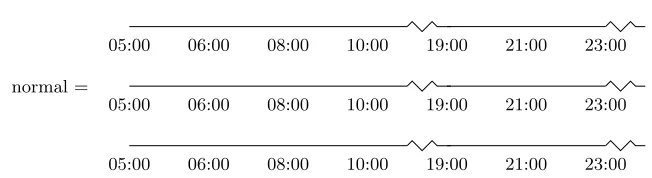
05:00 06:00 08:00 10:00 19:00 21:00 23:00 05:00 06:00 08:00 10:00 19:00 21:00 23:00 05:00 06:00 08:00 10:00 19:00 21:00 23:00
normal = LL L L H H H H H L LL LL
normal = LL L L H H H H L LL
not normal = LL L H H H HH
Fig. 4.Examples of three event sequences
The cabase contained 1000 cases, where each case contained an event se-quence of one day duration. In order to analyse if the system predicted unsafe situations correctly, we built a test set with different event sequences that may appear during the operation of the furnace within a window of time. The size of this window or in other word the duration of the ’partial’ query sequence was always smaller than any entire event sequence in any case.
The modifiedmyCBRsystem which we experimented with uses a K-Nearest Neighbours to retrieve the most similar case to an input case. As adaptation mechanism, the most common solution between the nearest neighbours is the returned solution to the input event sequence. The system is evaluated using a Cross-Validation approach, with the number of neighbours (k) within the set {1,3,5,7,9}. The values that the evaluation computes are the error rate, the false positives of “non normal” event sequences and the number of times that the CBR system predicted unsafe situations in advance. Detecting unsafe situations in advance meant that the retrieved case contained the event sequence of a “non normal” or unsafe situation and was detected (retrieved) before the risky HH
event arised.
Edit M&M Edit M&M Edit M&M
Neighbours Error rate False Positives Predicted
1 0.3200 0.2060 0.0145 0.0290 0.7536 0.7391 3 0.0220 0.0190 0.0435 0.0290 0.5942 0.5942
5 0.0020 0.0040 0.0290 0.0580 0.5942 0.5942 7 0.0030 0.0040 0.0435 0.0580 0.5942 0.5942
9 0.0060 0.0060 0.0870 0.0870 0.5942 0.5942
Table 1.Results of the experiments with the Edit Distance and M&M measures. The best results are highlighted in bold.
the number of predicted “not normal” situations are the highest. Consequently, the experiments with one neighbour were the most suitable configuration choice while the main interest was to predict and thus avoid unsafe situations. Further-more a higher number of neighbours means a worsening of the false positives, although it seems that values over three or more neighbours do not affect the ability of predicting unsafe situations.
5
Conclusions
In this paper we have introduced the implementation of two similarity measures for event sequences within themyCBRsoftware. Our objective was to provide the necessary functionalities to enable myCBR to develop CBR systems in problem domains where event sequences are of importance. Those domains often contain activities that follow sequences, such as work flows or sensor data logs. For now we have implemented two similarity functions in themyCBRsoftware: the Pirjo’s Edit Distanceand theMatch & Mismatchmeasures for event sequences. In order to demonstrate the usefulness of these measures, we have built a synthetic case-base that contained cases representing the “normal” and “not normal” activities of an industrial furnace. We then performed a set of experiments on this case-base which showed low error rates with both measures. Furthermore, despite the fact that this initial experimentation is based on synthetic data, the results showed that it is possible to predict unsafe situations in advance, employing either the Edit distance or the Match & Mismatch measures.
However, even though getting good results in our experiments, the remaining future work has to use data from real scenarios, such as surveillance of elderly people at home or monitoring of patients in the hospital to predict the his/her future health status. Next to these testing of our approach on real world data it is also still necessary to compare the results from our approach with those achieved by other technologies, such as for instance rule-based systems.
Acknowledgements. This work was partially funded by the Seneca Research Foundation of the Region of Murcia under project 15277/PI/10, and by the Spanish Ministry of Science and Innovation+European FEDER+PlanE funds under the project TIN2009-14372-C03-01.
References
1. OddErik Gundersen. Toward measuring the similarity of complex event sequences in real-time. InCase-Based Reasoning Research and Development. Springer Berlin Heidelberg, 2012.
2. Vladimir I. Levenshtein. Binary codes capable of correcting deletions, insertions, and reversals. Soviet Physics Doklady, 10:707–710, 1966.
4. Pirjo Moen. Attribute, Event Sequence, and Event Type Similarity Notions for Data Mining. PhD thesis, University of Helsinki, 2000.
5. H. Obweger, M. Suntinger, J. Schiefer, and G. Raidl. Similarity searching in se-quences of complex events. InResearch Challenges in Information Science (RCIS), 2010 Fourth International Conference on, 2010.
6. Armin Stahl and ThomasR. Roth-Berghofer. Rapid prototyping of cbr applications with the open source tool mycbr. InAdvances in Case-Based Reasoning. Springer Berlin Heidelberg, 2008.
7. Katerina Vrotsou.Everyday mining: Exploring sequences in event-based data. PhD thesis, Department of Science and Technology Linkoping University, 2010. 8. Katerina Vrotsou and Camilla Forsell. A qualitative study of similarity measures
in event-based data. In Human Interface and the Management of Information. Interacting with Information. Springer Berlin Heidelberg, 2011.