COMPREHENSIVE RISK MANAGEMENT USING FUZZY FMEA AND MCDA
TECHNIQUES IN HIGHWAY CONSTRUCTION PROJECTS
Mohsen Ahmadi
1, Kourosh Behzadian
2, Abdollah Ardeshir
3, Zoran Kapelan
4 1,3Department of Civil and Environmental Engineering, Amirkabir University of Technology, Tehran, Iran 2,4College of Engineering, Mathematics and Physical Sciences, University of Exeter, Exeter, EX4 4QF, UK Emails: 1[email protected]; 2[email protected] (corresponding author);3[email protected]; 4[email protected]
Submitted Day Month Year; accepted Day Month Year
Abstract: This paper presents a comprehensive framework to manage the main risk events of highway construction projects
within three stages: (1) identification of potential risks, (2) assessment and prioritisation of identified risks based on fuzzy FMEA; (3) identification of appropriate response. The main criteria analysed for prioritising potential risk events are cost, time and quality which are quantified and combined using fuzzy AHP. A new expert system is suggested for identifying an appropriate risk response strategy for a risk event based on risk factor, control number and risk allocation. The best response action for a risk event is then identified with respect to the same criteria using “scope expected deviation” (SED) index. The proposed methodology is demonstrated for management of risk events in a construction project of Bijar-Zanjan highway in Iran. For the risk event of “increase in tar price”, deviation from the target values of the criteria is analysed for business-as-usual state plus two risk response actions using SED index. The results show that the response action of “changing paving construction technology from asphalt pavement to RCC pavement” can successfully cope with the risk event of “increase in tar price” and have the minimum deviation.
Keywords: risk management, response actions, risk strategy, fuzzy AHP, fuzzy FMEA.
1. Introduction
Occurrence of events with negative impacts on a project objective is usually known as “risk” (PMI, 2008). Risk generally exists in construction projects due to uncertain events which are inevitable and may impose delays, incur additional costs and decline the quality of the projects (Mahamid, 2011). Expansion of the size and complexity of a construction project would lead to increase in the amount
of associated risk events rapidly (Diab et al., 2012).
In particular, highway construction projects are subject to higher risks and uncertainties than other construction projects due to higher capital investments and more complexity and their dependency on economic, societal, and political challenges (Wilson and Molenaar, 2009). Researchers could reveal the main causes of delays and additional costs in these projects using analysis of risk events. For instance, a study on 219 highway projects in Illinois found that the main causes of cost overruns (~4% above the bid price) were due mainly to unpredicted
additions and balanced final field measurements (Nassar et
al., 2005). The results of a study in highway construction
projects in Queensland indicated a correlation between the reciprocal of project budget size and percentage cost
overrun (Creedy et al., 2010). Another research divided the
main risks in highway projects into two scales including company level (i.e. political and financial risks) and project level (i.e. emerging technology and resource risks) (Zayed and Amer, 2008).
Furthermore, one of the main issues for risk management of highway projects especially in developing countries is the lack of documented inventory of the relevant data for the finished projects and thus the key parameters of relevant statistical distributions are mainly unknown. This would lead to an increased uncertainty for
occurrence of any risk events which cause to make more conservative decisions for all involved parties such as contractors, insurance companies and employers. Therefore, risk management of these projects, though faced with a lot of challenges, is still vital in order to reveals the critical risk events and take some proper measure for alleviation of their consequences over the construction period.
The main purpose of this paper is to propose a new comprehensive framework to manage risk events in highway construction projects. This framework comprises identification, assessment and eventually selection of an appropriate response to each risk event. A brief literature review of the methodologies used in this paper is first given in the next section. The proposed framework steps and applied techniques are then described. These techniques include Fuzzy Failure Mode and Effects Analysis (FMEA), fuzzy Analytical Hierarchy Process (AHP) and scope expected deviation (SED) index. Then, the results of demonstrating risk management to a real highway construction project are presented and discussed.
Finally, the conclusions are drawn and some
recommendations are made for future studies.
2. Background
Over the last decades, various risk analysis techniques have been generally developed by researchers and practitioners in construction industry based on Risk Matrix
(RM) (Mahamid, 2011; Ashley et al., 2006), Monte Carlo
Simulation (MCS) (Maher and smith, 2006), Sensitivity Analysis (SA) (Jouandou, 2010), Event Tree (ET)
(Jouandou, 2010; Nývlt et al., 2011), Fault Tree (FT)
(Nývlt et al., 2011; Abdelgawad and Fayek, 2011), AHP
(Zayed et al., 2008), TOPSIS grey (Zavadskas et al.,
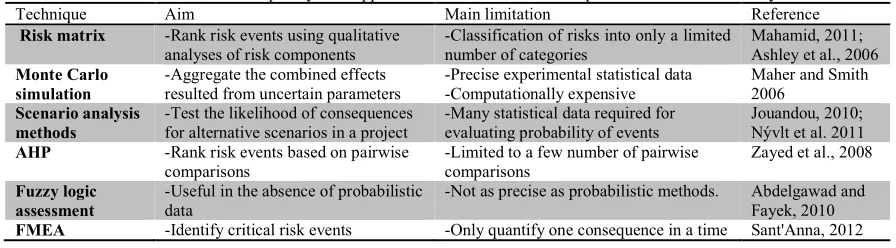
and limitations for some of the most frequently used techniques have been listed in Table 1. FMEA is recognised as one of the effective risk analysis techniques suggested by international standards such as MIL-STD-1689A (U.S. Department of Defence, 1980). This method has been widely used for identifying and removing the main causes for failure and the relevant consequences before occurrence and thus improving the reliability of productions or processes (Sant'Anna, 2012). Carbone and Tippett (2004) applied Risk Failure Mode and Effects
Analysis(RFMEA) for project risk management.
Application of multi-criteria decision analysis (MCDA) techniques such as fuzzy AHP has been developed by researchers in the recent decades in construction management projects (Abdelgawad and Fayek, 2010; Torfi and Rashidi, 2011). Abdelgawad and Fayek (2010) employed fuzzy FMEA and fuzzy AHP for risk identification and assessment of high risk events. They finally suggested some strategies for response to risk events based on partitioning the risk critical number into nine limits. However, these strategies have not applied risk owners and their ability to manage risk events. Some others have suggested better responses for managing risk
events. Fan et al. (2008) applied this methodology for
selecting a response to a particular risk event based on minimum cost criterion only and thus other factors (e.g., time and quality) were ignored. Beyond the identifications and evaluations of risk events in highway projects, some
researchers stepped forward into analysing allocate risk among contractual parties in order to facilitate risk handling strategies. For instance, the result of a risk allocation analysis in highway projects in Taiwan concluded the consequence of inappropriately allocated risk would result in the tendency of the relevant parties for handling risk changing from actively transferring the risk to passively retaining the risk (Wang and Chou 2003). Another research carried out for several highway projects stressed the need for identifying the risk responsibilities of contractual parties and allocating in a well-defined manner
in order to improve their risk handling strategies (Perera et
al., 2009).
Despite a plethora of useful and applicable studies related to risk management, there are still some outstanding issues which need to be addressed. To the best knowledge of the authors, there was no study that demonstrates the entire aspects of risk management simultaneously. More specifically, a comprehensive, holistic framework for risk management in the road construction projects including identification of potential hazards, assessment of associated risks and identification of appropriate response needs to be developed. Moreover, the best response needs to be identified with respect to risk allocation, proper risk response strategy and different aspects of the influencing criteria (i.e. time, cost and quality). This paper aims to fill this gap based on highlighting the aforementioned issues.
Table 1. The most frequently used applications of risk-related techniques in construction industry Technique Aim Main limitation Reference
Risk matrix -Rank risk events using qualitative
analyses of risk components
-Classification of risks into only a limited number of categories
Mahamid, 2011; Ashley et al., 2006
Monte Carlo simulation
-Aggregate the combined effects resulted from uncertain parameters
-Precise experimental statistical data -Computationally expensive
Maher and Smith 2006
Scenario analysis methods
-Test the likelihood of consequences for alternative scenarios in a project
-Many statistical data required for evaluating probability of events
Jouandou, 2010; Nývlt et al. 2011
AHP -Rank risk events based on pairwise comparisons
-Limited to a few number of pairwise comparisons
Zayed et al., 2008
Fuzzy logic assessment
-Useful in the absence of probabilistic data
-Not as precise as probabilistic methods. Abdelgawad and Fayek, 2010
FMEA -Identify critical risk events -Only quantify one consequence in a time Sant'Anna, 2012
3. Methodology
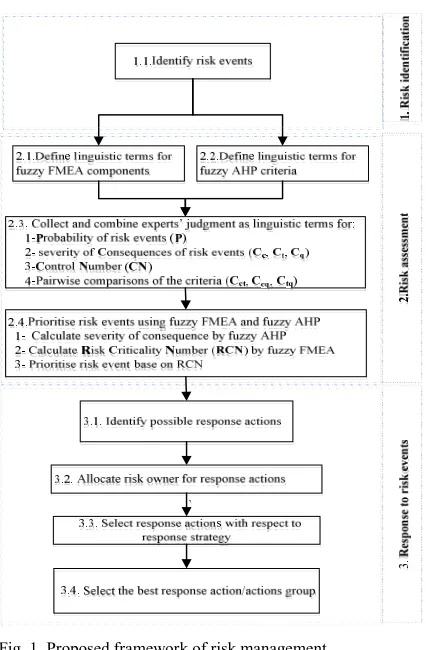
Fig. 1 represents the proposed framework of risk management in a road construction project used in this paper, comprising three main steps: (1) risk identification, (2) risk assessment, (3) response to risk events. All potential risk events in construction projects are identified in the first step followed by analysing them in the second step using fuzzy FMEA and fuzzy AHP which prioritise the risk events. In the third step, responses to the high risk events are analysed and the appropriate response actions for handling risk events are identified and ranked using a MCDA technique. Further details of the main steps in this framework are described below.
Step 1: Risk identification
Various methods and tools are used in the first step to identify the main risk events. When direct access to the relevant documents is limited or there is no documented
inventory of the main parameters of risk events, necessary information can be collected through other methods such as interview, questionnaires, physical survey of the project site or other relevant documents such as contract agreements, correspondence and so on.
Step 2: Risk assessment
This step requires analysing, comparing and finally prioritising the risk events. The FMEA technique is used here to quantify the risk magnitude. Based on the FMEA technique, Abdelgawad and Fayek (2010) introduced risk criticality number (RCN) and employed control number (CN) as the ability of the project team to identify a risk event (the greater value for CN indicates less ability to identify a risk event). Hence, RCN is calculated based on
probability of occurrence (P), consequence (C) and CN as:
CN C P
RCN (1)
quantifying risk components due to lack of sufficient data. To overcome these difficulties, a fuzzy FMEA and fuzzy AHP approach suggested by Abdelgawad and Fayek (2010) is used here. Fuzzy logic has been widely used in the recent decades to represent linguistic judgement of
experts (Rashidi et al., 2010). The fuzzy logic is also used
here to quantify the linguistic variables of risk components. Risk consequence is analysed here in three dimensions including time, cost and quality which are handled by fuzzy AHP as a MCDA technique.
Step 2.1: Linguistic terms for risk components
This step entails defining linguistic variables and their membership functions (MFs) related to the three components of fuzzy FMEA. Based on some interviews and previous studies (PMI, 2008; Jazebi and Rashidi, 2013), linguistic terms for the three dimensions of severity
of consequence , i.e. cost (Cc), time (Ct) and quality (Cq),
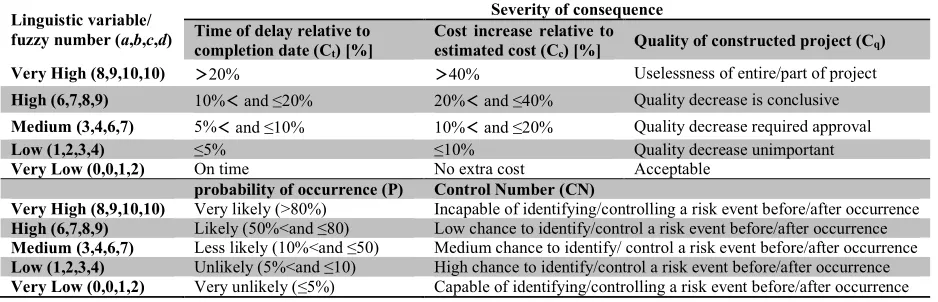
probability of occurrence (P), and control number (CN) are defined in five levels (very high, high, medium, low, very low) as described in Table 1. According to some recommendations made by PMI (2008) and Abdelgawad and Fayek (2010), a trapezoidal shape MF is suggested for all levels of the fuzzy numbers in Table 1. For each fuzzy
number in this Table, a, b, c and d represent low, middle
lower, middle upper and up bounds of the trapezoidal fuzzy MFs, respectively.
Step 2.2: Linguistic terms for pairwise comparisons of the criteria
Given the three criteria for severity of consequence, pairwise comparisons of the criteria need to be defined as
cost vs time (Ctq), cost vs quality (Ccq) and (c) time vs
quality (Cct) as linguistic terms. Therefore, pairwise
comparisons of the relative preferences (importance) between the criteria are defined in five linguistic terms (strongly more, more, equal, less and strongly less). Based on the experiences obtained from saaty (1982), the corresponding MFs of fuzzy numbers are suggested in five triangular shapes i.e., (3,5,5), (1,3,5), (0.33,1,3), (0.2,0.33,1) and (0,0.2,0.33), respectively.
The fuzzy AHP technique initially developed by Saaty (1982) is used here to compare the three dimensions of consequence of the risk events. Fuzzy AHP enables a
pairwise comparison between these criteria by using linguistic terms and finally provides a relative weight for each criterion which will be used for making a single severity of consequence for a risk event.
Step 2.3: Combine the judgment of experts
For each risk event, all linguistic variables of risk
components (i.e. Cc, Ct, Cq and CN) defined in Table 1
need to be assessed by a number of experts in the project. The pairwise comparisons of the three criteria also need to be assessed only once by experts using linguistic terms defined in step 2.2. All these assessments can be made through questionnaires or interviews. The judgements made by different experts need to be combined into a single judgement which was done here by using the α–cut method. Thus, a relative weight is calculated for each expert based on job position (5 scores from simple worker to manager), professional experience (5 scores from less than 5 years to over 30 years) and educational level (4 scores from secondary education to master degree). The relative weight of each expert is calculated by dividing the absolute weight of the expert (sum of the scores related to the three specifications) by sum of absolute weights of all
experts. Therefore, the single judgment of variable i (Ei)
can be calculated as a fuzzy number by a linear combination of all experts’ judgements as:
n
j ij j
i F W
E
1 (2)
where Fᵢj= judgement of variable i by expert j (fuzzy
number), Wj= relative weight of expert j (real number) and
n=number of experts participated in the survey. Also note
that as grouping decision making have been used in this study using completely independent experts, any biased opinions will be moderated and combined average judgements. Furthermore, in order to validate the consistency of the pair-wise judgements by a group of experts, the metric of inconsistency ratio was finally checked. The inconsistency ratio provides useful guidance about how to interpret information coming back from an individual or a group. The inconsistency ratio greater than about 0.1 is generally viewed as worthy of concern while the ratio smaller than 0.1 reflects a pretty coherent set of assessments (Saaty, 1982).
Table 1. Linguistic variables of risk components
Linguistic variable/
fuzzy number (a,b,c,d)
Severity of consequence Time of delay relative to
completion date (Ct) [%]
Cost increase relative to
estimated cost (Cc) [%] Quality of constructed project (Cq)
Very High (8,9,10,10) 20% 40% Uselessness of entire/part of project
High (6,7,8,9) 10% and ≤20% 20% and ≤40% Quality decrease is conclusive
Medium (3,4,6,7) 5% and ≤10% 10% and ≤20% Quality decrease required approval
Low (1,2,3,4) ≤5% ≤10% Quality decrease unimportant
Very Low (0,0,1,2) On time No extra cost Acceptable
probability of occurrence (P) Control Number (CN)
Very High (8,9,10,10) Very likely (>80%) Incapable of identifying/controlling a risk event before/after occurrence
High (6,7,8,9) Likely (50%<and ≤80) Low chance to identify/control a risk event before/after occurrence
Medium (3,4,6,7) Less likely (10%<and ≤50) Medium chance to identify/ control a risk event before/after occurrence
Low (1,2,3,4) Unlikely (5%<and ≤10) High chance to identify/control a risk event before/after occurrence
Fig. 1. Proposed framework of risk management
Step 2.4: Prioritise risk events using fuzzy FMEA and fuzzy AHP
This step entails calculations of fuzzy values and defuzzification within three consecutive stages:
1) Calculate severity of consequence: After combining different experts’ judgement, a single fuzzy number is obtained for each pairwise comparison of the three dimensions of consequence. Fuzzy AHP is used to convert the fuzzy numbers of pairwise comparisons into three fuzzy numbers of the relative weights. These fuzzy numbers are then converted into crisp values (defuzzification) by using centre of gravity (COR)
technique (Ardeshir et al. 2014). These crisp (real) values
are the relative weights of each consequence dimension,
i.e. cost (Wc), time (Wt) and quality (Wq).
Finally, a single fuzzy number is derived for severity of consequence C from a linear–weighted combination of
the three fuzzy numbers of the consequence (i.e. Cc, Ctand
Cq) using the α–cut method as:
(3)
Wc Cc
Wt Ct
Wq Cq
C
This single fuzzy number is used in Eq. (1) as severity of consequence combining the three dimensions in a risk event.
2) Calculate risk criticality number: After incorporating
the fuzzy numbers of experts’ judgements into single fuzzy numbers for the probability of occurrence (P), severity of consequences (C) and control number (CN), the fuzzy number of risk criticality number (RCN) is calculated for each risk event according to Eq. (1) using the α–cut method. Then, the fuzzy number of RCN is converted into a crisp (real) value by using the COR method.
3) Prioritise risk events: To prioritise the risk events, they are ranked based on the calculated RCN. Therefore, high ranked risk events are those which need to be considered by decision makers as high priority for any immediate action to respond risk events. Response to each risk event should be done by the risk owner and should be proportional to the relevant risk strategy.
Step 3: Response to risk events
To identify a proper response to a risk event, four consecutive stages described below are proposed here. These stages ensure the screening of all possible response actions which eventually lead to identifying the best response for a risk event.
Step 3.1: Identify possible response actions
Possible actions in response to each risk event are identified at this stage using various methods and techniques such as brainstorming, interview, information from databases and previous experiences. This would form a list of possible actions for each risk event.
Step 3.2: Allocate risk owner for response actions
Each response action of a risk event is allocated a risk owner who takes the responsibility of the risk event and
has an ability to manage and control it (Ashley et al, 2006).
A risk owner can be one of the contractual parties (e.g. contractor, employer or consultant). Risk owner may have several definitions (Uff, 1995) but risk owner here is assumed to be someone who is responsible for control and management of risk events plus any financial losses incurred by risk events. Furthermore, the allocated risk owner for a response action must be the same as the risk owner specified in contract documents. Otherwise that response action should be discarded from the list.
Step 3.3: Select response actions with respect to response strategy
Risk response actions should be selected proportional the appropriate response strategy. Generally, a risk response strategy can be divided into four categories (Wang and
chou, 2003; Ashley et al., 2006) as: (1) risk avoidance (i.e.
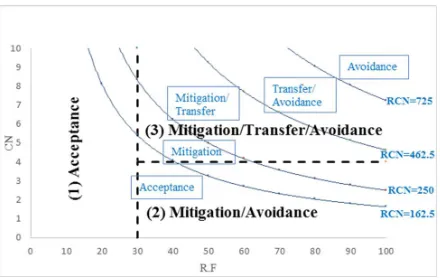
as solid lines with five regions). In the Abdelgawad-Fayek (AF) expert system, a response strategy is proposed within five ranges as acceptance for RCN<162.5, Mitigation for
162.5<RCN<250, Mitigation/Transfer for
250<RCN<462.5, Transfer/Avoidance for
462.5<RCN<725 and Avoidance for 725<RCN<1000. However, a new expert system is suggested here for selecting a proper risk response strategy based on the effect of the two components of the RCN value (i.e. control number CN and risk factor RF) separately (shown in Fig. 2 as dashed lines with three regions). Note that the RF
value is calculated based on P and C (Cooper et al., 2005):
(4)
C P
RF
In this approach, a risk event with a low CN (i.e. high control capability) such as technical problems can be managed by using risk mitigation or risk avoidance strategies. For handling a risk event with high CN (i.e. low control capability) such as political issues and economic crisis, the response strategies of risk mitigation, transfer
and avoidance can be considered (Fan et al., 2008).
Furthermore, response actions are also dependent to the RF value. For instance, a risk event with low RF in which both probability of occurrence and severity of consequence are small, risk acceptance strategy can be considered (Ashley
et al., 2006). Therefore, in the suggested expert system, risk acceptance strategy is proposed for the risk events with RF less than 30 (region 1) whilst risk mitigation/ avoidance strategies can be considered for the risk events with RF above 30 and control number below 4 (region 2). Finally, risk events with RF greater than 30 and CN above 4 will be handled by risk avoidance/ transference/ mitigation strategies (region 3). Note that RF and CN values in this figure are real (crisp) values resulted from defuzzification of the equivalent fuzzy values. Also, as the P and C values in Eq. (4) are within the limit of 0 and 10, the RF value would be within 0 and 100. By comparing these two expert systems, the following can be noted: (1) in region 2 where risk factor is high and CN is low (high ability of the project team to identify and handle risk), the AF system mainly proposes the risk acceptance strategies while the suggested system strictly rejects the risk acceptance due to high risk factor. However, since risk control ability is high, the suggested system adopts mitigation strategy if the avoidance strategy cannot be conducted. This is partially in agreement with the AF system; (2) all three strategies including mitigation and transfer and avoidance can be selected in both systems in region 3; and (3) the AF system adopts partially mitigation strategy in addition to considerable portion of acceptance strategy in the region 1 while the suggested system always select an acceptance strategy owing to low amount of risk factor.
Fig. 2. Suggested expert system (dashed lines with three regions) and Abdolgawad-Fayek (AF) expert system (solid lines with five regions) for selection of response strategy
Step 3.4: Select the best response action/actions group
Having selected several response actions with respect to a proper risk response strategy, the most appropriate response action/actions group needs to be selected. This selection is carried out based on three criteria including cost, time and quality. To select the best response action with respect to these criteria, the index of “scope expected deviation” (SED) derived from TOPSIS method is used as
a MCDA technique (Seyedhosseini et al., 2009). The SED
index minimising the deviations from target values of project is expressed as:
0 0
0 0
0 0
C C C W Q
Q Q W T
T T W
SED t q c (5
)
where T0, Q0, C0 = target values for completion time,
quality and budget of the project, respectively; T, Q, C=
actual expected completion time, quality and cost of the
project, respectively; Wt , Wq , Wc = relative weights factor
for time, quality and cost, respectively. These relative weights are obtained from fuzzy AHP in step 2.4. Both expected and actual values of the criteria need to be estimated for both risk events and response actions. For a better estimation of these values, work breakdown structure (WBS) of projects is used here. The following typical six phases are considered here for WBS of highway construction projects: (Ph1) Site acquisition and preparation; (Ph2) Structural works; (Ph3) Cleaning, basic earthworks; (Ph4) Paving 1 (sub-base and base layers); (Ph5) Paving 2 (finishing layers); (Ph6) Installation of signs, guards and line marking. Each of these phases is allocated a relative weight equal to 0.08, 0.22, 0.08, 0.25, 0.33 and 0.04 for Ph1, Ph2, Ph3, Ph4, Ph5 and Ph6,
respectively. The value of each criterion (e.g. T0 or T) is
4. Case study
The proposed methodology outlined above is
demonstrated in a real-world case study of a four-lane highway construction project of Zanjan-Bijar shown in Fig. 3 as blue line. The highway is 23 Km long and 24.6 metres wide, starting from Bijar city in Kordistan province until the border of the province towards Zanjan city. This project aims to increase the transportation capacity through Bijar-Zanjan highway and remove accident-prone points of the way and thus reduce the likelihood of accidents. The project is carried out within three phases with a budget of 1.05 million Euros. The duration of implementing the project is planned to be 240 days.
Fig. 3. Layout of the case study (Bijar-Zanjan highway construction project)
5. Results and discussion
The required data for the risk events of this highway construction project were collected from different sources such as similar project reports, project agreements, interview and previous project experiences. The analysis of all collected data resulted in highlighting 30 critical risk events for this project (only five top risk events are shown in Table 2). In the risk assessment phase, the risk
components (i.e. P, Ct, Cc, Cq and CN) and pairwise
comparisons of the criteria (i.e. Cct, Ccq and Ctq) are
obtained by experts through linguistic terms defined in step 2.1 and 2.2. This assessment was performed by distributing 35 questionnaires to experts in the three involved parties of the project (i.e. employers, contractors and consultants). 10 questionnaires were finally filled and returned by 10 experts. The relative weight of each expert is also calculated based on educational level, job position and professional experience outlined in step 2.3.
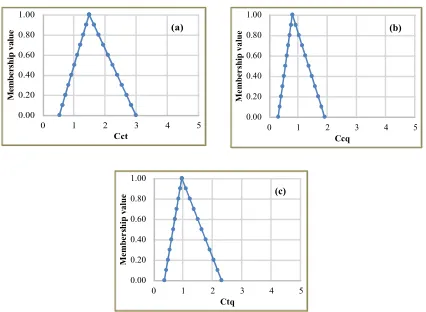
The relative weights of the three criteria are calculated first by fuzzy AHP from pairwise comparisons of the criteria. Fig. 4 shows the single fuzzy numbers of pairwise comparisons each combining the experts’ judgement together using the α–cut method and Eq. (2). To calculate the relative weight of the criteria, these fuzzy numbers are first converted to the equivalent real values
(i.e. Ctq=1.216, Ccq=1.006 and Cct=1.668) using the COR
technique. Then, the relative weights obtained are
calculated using fuzzy AHP as Wc=0.39 for cost, Wt=0.30
for time and Wq=0.31 for quality. The inconsistency ratio
of these pairwise comparisons was 0.047 which is within the acceptable range of below 0.1.
Fig.4. Fuzzy numbers of pairwise comparisons between (a) cost vs time (Ctq); (b) cost vs quality (Ccq) and (c) time vs quality (Cct)
Having combined the fuzzy numbers of experts’
judgements for each of the criteria (i.e. Cc, Ct and Cq), the
single fuzzy number of the consequence C is then calculated for each risk event by Eq. (3). Here, the single fuzzy numbers related to the three criteria for consequence of the risk event of “increase in tar price” is shown Fig. 5(a), 5(b) and 5(c). The combination of these three criteria using relative weights in Eq. (4) and the α–cut method represent the severity of consequence shown in Fig. 5(d) for this risk event. This fuzzy number is used to calculate RCN in Eq. (2) along with the fuzzy numbers of P and CN. These fuzzy values are also calculated by combining the experts’ judgement for this risk event shown in Fig. 6(a)-(c).
Fig. 5. Fuzzy numbers of the consequence for the risk event of “Increase in tar price” with respect to (a) cost; (b) time; (c) quality and (d) combination of the three criteria.
0.00 0.20 0.40 0.60 0.80 1.00
0 1 2 3 4 5
Me
mber
ship va
lue
Ccq
(b)
0.00 0.20 0.40 0.60 0.80 1.00
0 1 2 3 4 5
M
em
b
e
rs
h
ip
v
a
lu
e
Cct
(a)
0.00 0.20 0.40 0.60 0.80 1.00
0 1 2 3 4 5
Memb
er
ship v
alue
Ctq
(c)
0.00 0.20 0.40 0.60 0.80 1.00
4 6 8 10
Memb
e
rship
v
alue
Cc
(a)
0.00 0.20 0.40 0.60 0.80 1.00
4 6 8 10
Memb
e
rship
v
alue
Ct
(b)
0.00 0.20 0.40 0.60 0.80 1.00
0 2 4 6 8
Memb
e
rship
v
alue
Cq
(c)
0.00 0.20 0.40 0.60 0.80 1.00
4 6 8 10
Me
mbe
r
sh
ip v
a
lue
C
Fig. 6. Fuzzy numbers of risk parameters for the risk event of “Increase in tar price” for (a) P; (b) C; (c) CN and (d) RCN.
By multiplying three fuzzy numbers of P, C and CN in Eq. (2) and using the α–cut method, the fuzzy number of RCN is calculated for this risk event which is shown in Fig. 6(d). The real value of RCN for this risk event after defuzzification is equal to 396. Thus, the analysed 30 risk events are ranked based on the RCN values. Here, the list of the top five highly ranked risk events are only shown in Table 2. This list in the descending order of RCN presents prioritised risk events as a guide for key decision makers of the project to follow the appropriate actions.
Table 2. Top five risk events in the highway construction project in the descending order of RCN
Risk allocation RCN Risk event No contractor 463
Budget deficit or insufficient allocation of budget 1
employer 429
Lack of timely budget allocation 2
employer 396
Increase in tar price 3
Contractor & employer 363
Financial problems of the contractor and inability to provide enough self-fund between payment intervals 4
employer 355
Unexpected increase in price of materials (except tar), fuel and labours wage
5
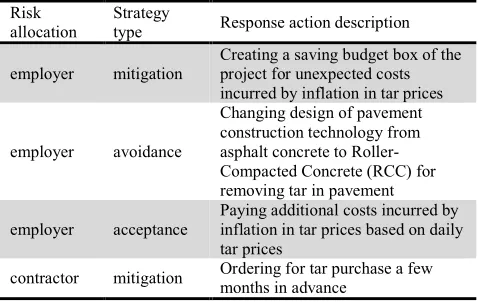
As a result of the third step of risk management, a list of all possible response actions proportional to the proper risk response strategy and risk allocation is provided for all risk events (not shown here due to limited space). In order to describe how the best response action is selected, the risk event of “increase in tar price” is analysed here in further details as a critical risk in road construction projects in Iran. This risk event is ranked third in Table 2 with RCN=396, RF=59 and CN=6.35. Table 3 presents four suggested possible response actions and the relevant risk allocation and strategy type for this risk event. According to the contractual documents, the employer is the risk owner of this risk event and is responsible for any
additional costs incurred for tar during the project. Therefore, the first three response actions in the Table remains and the forth is discarded. The appropriate risk response strategy with respect to the values of CN and RF in Fig. 2 does not include the risk acceptance. Therefore, the third response action in Table 3 removes and only the first two response actions remain for final selection.
Table 3. Possible response actions to the risk event of “increase in tar price”
Response action description Strategy
type Risk
allocation
Creating a saving budget box of the project for unexpected costs incurred by inflation in tar prices mitigation
employer
Changing design of pavement construction technology from asphalt concrete to Roller-Compacted Concrete (RCC) for removing tar in pavement avoidance
employer
Paying additional costs incurred by inflation in tar prices based on daily tar prices
acceptance employer
Ordering for tar purchase a few months in advance
mitigation contractor
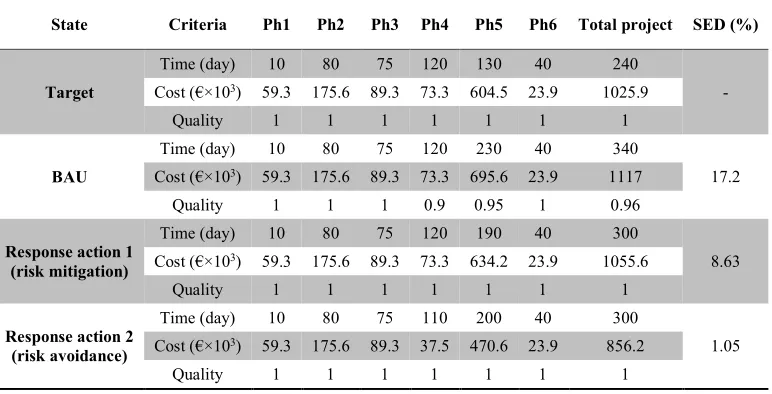
To select the best response action, the SED index of this risk event for the business-as-usual (BAU) state and the two remaining response actions is calculated using Eq. (5) based on the six WBS phases outlined in step 3.4. The target values of the criteria (costs, time and quality) for each WBS phase are extracted from the available contractual documents given in Table 4. The similar parameters for actual expected values in the BAU and response action 1 are estimated by using interview and previous reports and experiences (see Table 4). Note that the actual quality is estimated based on the relative actual
quality with respect to the target quality (Q0) which is
equal to 1. Thus, the actual quality (Q) would be within the
range of [0.1].
Actual expected values for cost and time for response action 2, “using Roller-Compacted Concrete (RCC)”, is estimated based on a typical design (Abdul and ASI, 1995). The time required for implementing a RCC pavement is around 15 percent longer than asphalt concrete pavement due to concrete curing process. However the costs of RCC pavement is almost 25 percent less than of asphalt concrete pavement. Therefore, the cost of designed asphalt concrete pavement is used for the BAU and the response action and the cost of a typical equivalent RCC pavement is used for response action 2 in Table 4.
Table 4 represents the detailed calculations of SED index for this risk event. As it can be seen from this Table, SED obtained from the risk event in the BAU (i.e. 17.2%) can successfully be reduced by the two response actions. More specifically, response action 2 (RCC technology) seems to have a better response as it could almost approach the actual expected criteria to the target values (SED=1.05%). In addition, other benefits of this technology compared with asphalt concrete pavement method are minor maintenance costs, more life time
0.00 0.20 0.40 0.60 0.80 1.00
4 6 8 10
Me mbe r sh ip v a lue P (a) 0.00 0.20 0.40 0.60 0.80 1.00
4 6 8 10
Me mbe r sh ip v a lue C (b) 0.00 0.20 0.40 0.60 0.80 1.00
4 6 8 10
Membership v alue CN (c) 0.00 0.20 0.40 0.60 0.80 1.00
0 200 400 600 800
Membership v
alue
RCN
expectancy, more environmentally friendly due to less material used in pavement layers and less contaminant production. Despite of these benefits, some weak points are also attributed to this technology such as less experience and technical knowledge of contractors and thus need more advanced machinery and certain technical skills and experiences which make the use application of this method more complicated.
This suggested framework demonstrated in this paper provides a comprehensive risk management methodology. However, there might exist some reasons that construction industry is reluctant to adopt such computational models. The following can be noted in this regard: one of the main limitations is probably the complexity of the decision support/expert systems which require enough knowledge and understanding for handling risk by practitioners in the construction industry. Instead, practitioners usually prefer to rely on their own professional experience for dealing with risk events. This analysis of risk management sometimes suggests a new efficient technology/method for handling risk, while practitioners are reluctant to apply them due to the fact that such new technologies/methods may accompany some new risks for construction industry which might have been overlooked by research aspects. Furthermore, data collection for a comprehensive risk management is sometime hard or impossible for some construction projects which result in an unwillingness for practitioners to follow this approach. Hence, this would cause researchers to resort some equivalent estimations based on qualitative approaches. One way to compensate this shortcoming is to develop, test and validate such models/methodologies for several different projects with a more comprehensive perspective to various risks.
6. Conclusions
A comprehensive risk management methodology
including identification, assessment and response actions was presented and verified/demonstrated on a real-world case study of a road construction project in Iran. After identifying thirty risk events, they were ranked based on the RCN values using fuzzy FMEA and fuzzy AHP. Fuzzy FMEA technique was used to quantify parameters of risk events (i.e. P, C and CN) by a group of experts’ judgements. Fuzzy AHP technique was used to quantify and combine the three aspects of consequence (cost, time and quality). Appropriate risk response strategy for a risk event was then selected based on RF and CN values. When demonstrating strategy selection for the risk event of “increase in tar price”, two risk responses were finally selected and compared with the risk event of the BAU using the SED index. The results showed that the risk response of “change of paving technology into RCC pavement” can considerably mitigate the relevant risk event and provide the minimum deviations from the project targets.
Based on the case study results obtained, it can be concluded that the suggested methodology can provide a holistic framework for all three aspects of risk management in a highway construction project. In addition, the suggested risk response strategy provides an expert system for screening appropriate response actions. Different parameters of a risk event with a number of criteria from a group of experts’ perspective can be quantified, analysed and combined by using some fuzzy MCDA technique. Finally, the risk response actions can be analysed with respect to a number of criteria using a MCDA technique.
Table 4. SED index calculations for the BAU and two response actions for the risk event of “increase in tar price”
State Criteria Ph1 Ph2 Ph3 Ph4 Ph5 Ph6 Total project SED (%)
Target
Time (day) 10 80 75 120 130 40 240
- Cost (€×103) 59.3 175.6 89.3 73.3 604.5 23.9 1025.9
Quality 1 1 1 1 1 1 1
BAU
Time (day) 10 80 75 120 230 40 340
17.2 Cost (€×103) 59.3 175.6 89.3 73.3 695.6 23.9 1117
Quality 1 1 1 0.9 0.95 1 0.96
Response action 1 (risk mitigation)
Time (day) 10 80 75 120 190 40 300
8.63 Cost (€×103) 59.3 175.6 89.3 73.3 634.2 23.9 1055.6
Quality 1 1 1 1 1 1 1
Response action 2 (risk avoidance)
Time (day) 10 80 75 110 200 40 300
1.05 Cost (€×103) 59.3 175.6 89.3 37.5 470.6 23.9 856.2
One of the limitations of the proposed methodology is that it is useful if only one contract party is identified as the risk owner. However, if a risk event is shared between more than one party, risk allocation percentage to each involved party and their cooperative response actions can be divided through “cooperative game theory”. This needs to be investigated in the future research work. Also, when responding to a risk event, some secondary risk events may be generated which need to be considered in the future researches. In addition, the impact of two simultaneous response actions or more for a risk event needs to be analysed in the future.
References
Abdelgawad, M.; Fayek, A. 2010. Risk Management in the Construction Industry Using Combined Fuzzy FMEA and Fuzzy AHP, Journal of Construction Engineering and Management, 136(9): 1028-1036.
Abdelgawad, M.; Fayek, A. 2011. Fuzzy Reliability Analyzer: Quantitative Assessment of Risk Events in the Construction Industry Using Fuzzy Fault-Tree Analysis,
Journal of Construction Engineering and Management, 137(4): 294-302.
Abdul Wahhab, h.i.; ASI, I.M. 1995. Optimization of Roller Compacted Concrete for Local Application, Transportation Research Record 1458.
Ardeshir, A.; Mohseni, N.; Behzadian, K.; Errington, M. 2014. Selection of a Bridge Construction Site Using Fuzzy Analytical Hierarchy Process in Geographic Information System. Arabian Journal for Science and Engineering, 1-16.
Ashley, D.B.; Diekmann, J.E.; Molenaar, K.R. 2006. Guide to Risk Assessment and Allocation for Highway Construction Management, Federal Highway Administration, US Department of Transportation, Report No. FHWA-PL-06-032, october 2006
.
Carbone, T.D.; Tippett, D.D. 2004. Project Risk Management Using the Project Risk FMEA, Engineering Management Journal, 14(4): 28-35.
Cooper, D.F.; Grey S.,Raymond G.; Walker, P. 2005. Project Risk Management Guidelines: Managing Risk in Large Projects and Complex Procurements, Wiley.
Creedy, G., Skitmore, M. and Wong, J. 2010. “Evaluation of Risk Factors Leading to Cost Overrun in Delivery of Highway Construction Projects”, Journal of Construction Engineering and Management, 136(5), p.p. 528-537, 2010. Diab, M.F.; Varma, A.; Nassar, K.2012. Using Risk Assessment to Improve Highway Construction Project Performance,
48th ASC Annual International Conference Proceedings2012, Birmingham City University, Birmingham, UK, 2012
.
Fan, M., Lin N.P.; Sheu, C. 2008. Choosing a project risk-handling strategy: An analytical model, International Journal of Production Economics, 112(2): 700-713. Jazebi, F.; Rashidi A. 2013. An automated procedure for
selecting project managers in construction firms, Journal of Civil Engineering and Management, 19(1): 97-106. Jouandou, R. 2010. Dealing with uncertainty: selecting a risk
analysis tool on the basic project characteristics and phases. Master Thesis, Department of Civil, Environmental and Architectural Engineering. University of Colorado.
Mahamid, I.2011. Risk matrix for factors affecting time delay in road construction projects: owner’s perspective.
Engineering, Construction and Architectural, 18(6): 609 – 617.
Maher, M.L.J.; Smith, A.D. 2006. Risk-based cost and schedule estimation for large transportation projects, Annual European Transport Conference, Strasbourg, France, 2006.
Nassar, K., Nassar, W. and Hegab, M., 2005. “Evaluating Cost Overruns of Asphalt Paving Project Using Statistical Process Control Methods”, Journal of Construction Engineering and Management, 131(11), p.p. 1173-1178. Nývlt, O.; Prívara S.; Ferkl, L. 2011. Probabilistic risk
assessment of highway tunnels, Tunnelling and Underground Space Technology, 26(6): 71-82.
Perera, B.A.K.S.; Dhanasinghe, I.; Rameezdeen, R. 2009. Risk management in road construction: The case of Sri Lanka,
International Journal of Strategic Property Management, 13(2): 87-102.
Project Management Institute (PMI) 2008, “A Guide to the Project Management Body of Knowledge: PMBOK Guide”.
Rashidi, A.; Jazebi F.; Brilakis I. 2010. Neurofuzzy genetic system for selection of construction project managers,
Journal of Construction Engineering and Management,
137(1): 17-29.
Saaty, T. L. 1982. Decision making for leaders: The analytical hierarchy process for decision in a complex world. Lifetime Learning, Belmont. Calif. 75–92.
Sant'Anna, A.P. 2012. Probabilistic priority numbers for failure modes and effects Analysis, International Journal of Quality & Reliability Management, 29(3): 349-362. Seyedhosseini, S.M.; Noori, S.; Hatefi, M.A. 2009. An Integrated
Methodology for Assessment and Selection of the Project Risk Response Actions, Risk Analysis, 29(5): 752-763. Torfi, F.; Rashidi A. 2011. Selection of project managers in
construction Firms using analytic hierarchy process (AHP) and fuzzy Topsis: a case study, Journal of Construction in Developing Countries, 16(1): 69-89.
Uff, J. 1995. Management and Procurement in Construction, London, Centre of Construction Law and Management. U.S. Department of Defence 1980. Procedures for performing a
failure mode effects and criticality analysis, MILSTD-1929A: Military standard, Washington, D.C.
Wang, M.; Chou, H. 2003. Risk Allocation and Risk Handling of Highway Projects in Taiwan, Journal of Management in Engineering, 19(2): 60-68.
Wilson, C.R. and Molenaar,K.R., 2009 “A Risk-Based Approach to Contingency Estimation in Highway Project Development”, Construction Research Congress, p.p. 786-795, 2009.
Zavadskas, E. K., Turskis, Z., & Tamošaitiene, J. 2010. Risk assessment of construction projects. Journal of civil engineering and management, 16(1), 33-46.
Zayed, T.; Amer, M.; Pan, J. 2008. Assessing risk and uncertainty inherent in Chinese highway projects using AHP,
International Journal of Project Management, 26(4): 408-419.
Appendix I
List of acronyms used in this paper
AHP analytic hierarchy process
BAU business-as-usual
C actual expected cost
Cc Cost consequence
Ct Time consequence
Cq Quality consequence
CN Control number
Ei single judgment of variable i (fuzzy number)
Fᵢj judgement of variable i by expert j (fuzzy
number)
FMEA Failure mode and effect analysis
MCDA Multi-Criteria decision analysis
P Probability
Q actual expected quality
Q0 target value of quality
RCC Roller-compacted concrete
RCN Risk critical number
R.F Risk factor
T actual expected completion time
T0 target value of completion time
SED scope expected deviation
Wj relative weight of expert j
Wc relative weight of cost
Wt relative weight of time
Wq relative weight of quality
WBS Work breakdown structure
Mohsen AHMADI: Research Graduate at Amirkabir University of Technology, He received his Master’s degree in Construction Engineering and Management from Amirkabir University of Technology, Tehran, Iran. His research focuses on the risk management and fuzzy theory and their applications in the project management domain.
Kourosh BEHZADIAN: Researcher at the Centre for Water Systems in the University of Exeter, UK. Prior to joining Exeter, he worked as an assistant professor at Environmental Research Centre in Amirkabir University of Technology, Iran. His research focuses on risk management and uncertainty analysis in civil and environmental engineering.
Abdollah ARDESHIR: Associate Professor, Department of Civil and Environmental Engineering, Amirkabir University of Technology, Tehran, Iran. He is the head of the Environmental Research Centre at Amirkabir University of Technology. His research focuses on construction and safety management and applications of risk events.