United Kingdom ISSN 2348 0386 Vol. VIII, Issue 2, February 2020
Licensed under Creative Common Page 46
http://ijecm.co.uk/
THE ANALYSIS OF TECHNOLOGY ACCEPTANCE MODEL (TAM)
ON USE BEHAVIOR MOBILE BANKING TO BCA CUSTOMER
Helena Damayanti Siregar
Faculty of Economics, Gunadarma University
Jl. Margonda Raya No. 100 Depok 16424, West Java, Indonesia
Emmy Indrayani
Faculty of Economics, Gunadarma University
Jl. Margonda Raya No. 100 Depok 16424, West Java, Indonesia
Abstract
The development of technology and information in Indonesia currently gives a lot of benefits.
Nowadays in almost every aspect of human life using information technology, for instance in the
economic, social, education, politics and many other aspects. The one industry that is adapting
technology and information is the banking industry. Adaptation of technology and information
used in the banking industry is the presence of service facilities for customers in the form of
mobile banking that can be accessed by customers’ Smartphones. The purpose of this research
is to analyze The Technology Acceptance Model on use behavior mobile banking model for
BCA customers. The research method is a quantitative method using Structural Equation
Modeling (SEM) analysis. The results of this research were obtained that the variable perceived
ease of use, perceived usefulness, attitude towards using, behavior intention, use behavior, had
a significant and positive effect on bank BCA mobile banking behavior with the attitude towards
using variable having the highest t value.
Keywords: Technology Acceptance Model, Mobile Banking, Use behavior, Technology
Licensed under Creative Common Page 47 INTRODUCTION
Nowadays, almost every single aspect of human life use the information technology, such as
aspects in the economics, social, educational, politics and many others. The emergence of
technology and information as well as the various benefits presented are the ability of
technology to facilitate users to communicate, contribute, participate, discuss, give feedback
and even share knowledge, (Kraut: 2002). One of industry that is adapting technology and
information is the banking industry. Technology and information itself are present in the banking
industry, one of which emerged as a competitive advantage of companies where banks can
compete with other competitors and reach distant and diverse markets. It is the presence of
service facilities for customers in the form of mobile banking that can be accessed by customers
via smartphones.
Mobile banking is an innovative bank services that allows customers to conduct banking
transaction activities via smartphones. Mobile banking itself is here to facilitate customers in
carrying out banking activities more effectively and efficiently because it can be done anytime,
anywhere and without having to come to the bank/ATM. (Riswandi, Budi and Agus : 2005). But
in the emergence of this mobile banking service, there is several problem where not every
banking customer has the same perception and knowledge about mobile banking services.
Technology and information can be said to be successful if they can be well received by
customers, therefore it is necessary to identify the determinants of technology and information
acceptance. With the adaptation of technology and information in the banking industry, one
example is the mobile banking service, The purpose of this research to analyze Technology
Acceptance Model (TAM) and find out the factors of customers to accept the use of mobile
banking of BCA consumer.
LITERATURE REVIEW
Information Technology (IT)
The information technology is the study or the way yo use of electronic equipment, especially
computers, to store, analyze and distribute anything including words, numbers and images.
According to Alter (1992) Information technology includes hardware, software to carry out one
or a number of data processing such as capturing, transmitting, storing, retrieving and
manipulating or displaying the data.
Mobile Banking
Mobile banking is the way to conduct online financial transactions with the mobile
Licensed under Creative Common Page 48 can access financial and non-financial services such as account management, balance
information, transfers, bill payments, PIN changes and check book requests (Dahlberg, Mallat,
Ondrus & Zmijewska, 2008; Luarn & Lin, 2005; Shaikh & Karjaluoto, 2015).
Technology Acceptance Model (TAM)
Technology Acceptance Model (TAM) was introduced by Fred D. Davis in 1986, is an
adaptation of TRA that was made specifically for modeling user acceptance of information
systems. According to Davis (1989), the purpose of the Technology Acceptance Model (TAM) is
to explain the determinants of information based technology acceptance in general and to
explain the behavior of end-users of information technology with a wide enough variation and
the user population to provide a basis in order to find out the influence of the factors external to
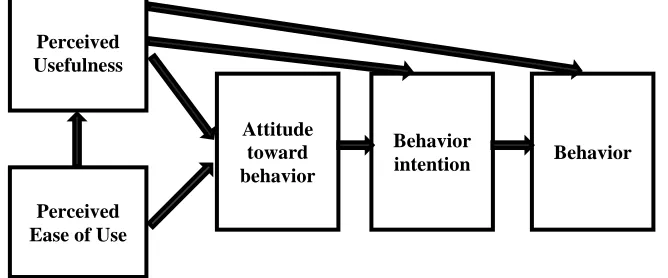
the psychological foundation. The first unmodified Technology Acceptance Model (TAM) used
five main constructs such as Perceived Ease Of Use, Perceived Usefulness, Attitude Towards
Using, Behavior Intention, Behavior.
Figure 1 Technology Acceptance Model (TAM)
Perceived Ease Of Use
Perceived ease of use is how far someone believes that using a technology will be free from
effort (Jogiyanto, 2007). Based on the definition it can be concluded that ease of use will reduce
the effort (both time and energy) of a person in learning computers. IT users believe that is more
flexible, easy to understand and to operate (compatible) as a characteristic of ease of use.
Indicators of perceived ease of use (Davis et al. 1989) consist of :
1) Easy to learn, which means consumers can clearly understand how to learn the banking
transaction system through BCA's mobile banking application,
2) Can be controlled, which means facilities and features provided in Bank BCA mobile banking
to function properly,
Perceived Usefulness
Perceived Ease of Use
Attitude toward behavior
Behavior
Licensed under Creative Common Page 49 3). Clear & understandable, which means that BCA bank mobile banking facilities or features
are appropriate for their use, features presented are complete and do not cause other
perceptions,
4). Flexible transactions, which means can be carried out without a hitch and can be done
anytime without being limited by place and time,
5). Easy to become skilled / proficient, that is in subsequent use, consumers can access BCA’s
bank mobile banking easily according to their wishes after one use.
Perceived Usefulness
Perceived usefulness is the extent to a person who believes that using a technology will
improve the performance of his work. (Jogiyanto: 2007). The benefits of using IT can be known
from the trust of IT users in deciding IT acceptance. With one belief that the use of IT is making
a positive contribution to its users. Indicators of perceived usefulness according to (Davis: 1989)
such as:
1. Accelerating work, BCA‘s mobile banking can shorten the time used in the process of
completing a work activity;
2. Improving performance that can increase transactions conducted by customer;
3. Increase productivity, by using BCA’s mobile banking can increase consumer productivity in
banking transactions;
4. Effectiveness, by using BCA’s mobile banking can speed up time for consumers to conduct
banking transactions;
5. Make work easier, by using BCA Mobile banking consumers can easily carry out banking
transactions;
6. Give benefits, by using BCA’s mobile banking is beneficial for customer to make
transactions.
Attitude Toward Behavior
Attitude towards behavior is defined by Davis et al. (1989) as a positive or negative feelings
from someone if they have to do the behavior that will be determined. Attitude towards using
indicators according to (Davis et al. 1989) consists of good ideas, wise ideas, liking the use of
the system and feeling happy about using the system.
Behavioral Intention
Behavioral intention is a someone desire to do a certain behavior. Somebody will do a behavior
Licensed under Creative Common Page 50 according to (Venkatesh et al., 2003) consists of the intention to continue to use, the desire to
use, the plan to continue to use. Behavioral intention indicators according to (Davis et al. 1989)
consists the desire to use the system and the desire to use the system frequently or periodically.
Use Behavior
Use behavior is an action taken by someone. In the context of the use of information technology
systems, behavior is the actual usage of technology (Jogiyanto, 2007). indicators of use
behavior according to (Venkatesh et al., 2003) consist of the actual use of technology in
practice, frequency of use and number of hours of system use.
RESEARCH METHOD
In this research, the object that studied by the author is a comparative analysis of The
Technology Acceptance Model (TAM) method on the use of mobile banking behavior on BCA
customers. The way the authors obtain the data for research uses interviews, questionnaires,
observation, library research, and web public sites. Where respondents in this research are
BCA customers who use mobile banking services. The sampling method of this research used
non probability sampling technique that is purposive sampling. Sampling of this research used
the theory of Roscoe (1975) by means of the number of variables multiplied by 10. The
variables used in this study are 14. Then 14 x 10 = 140 Respondents rounded of to 200
respondents. The analytical method used in this study is Structural Equation Model (SEM) by
using SMARTPLS software. The measurement scale in this research used a likert scale.
RESULTS AND DISCUSSION
Validity Test
Validity tests were conducted to determine the ability of research instruments to measure what
should be measured (Jogiyanto and Abdillah 2009) .
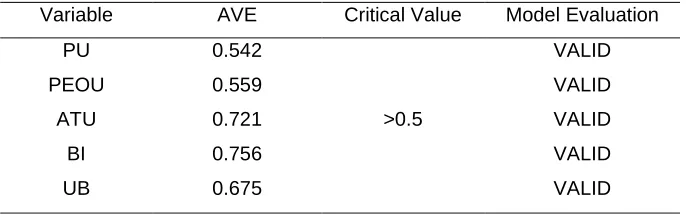
Table 1 Result of Validity Test
Source: SmartPLS Output
Variable AVE Critical Value Model Evaluation
PU 0.542
>0.5
VALID
PEOU 0.559 VALID
ATU 0.721 VALID
BI 0.756 VALID
Licensed under Creative Common Page 51 Based on the Table 1, it is known that each indicator variable is considered valid because it has
a AVE value of more than 0.5 so that it can be stated that the indicator used in this study has a
good convergent, so that it can be used for further analysis.
Reliability Test
Reliability test is used to measure the consistency of measuring instruments in measuring a
concept or can also be used to measure the consistency of respondents in answering statement
items in a questionnaire or research instrument
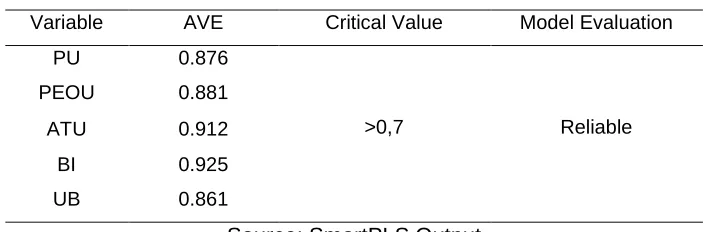
Table 2 The Results of Reliability Test
Variable AVE Critical Value Model Evaluation
PU 0.876
>0,7 Reliable
PEOU 0.881
ATU 0.912
BI 0.925
UB 0.861
Source: SmartPLS Output
Based on Table 2, each construct of the TAM method has a composite reliability value of more
than 0.7, with the behavior intention construct having the highest composite reliability of 0.925
so that it can be concluded that all variables have the highest level of reliability.
R-Square Analysis
R-Square or the coefficient of determination is one of the simple measures and is often used to
test the quality of a regression line equation (Gujarati, 2004: 81). The R-Square value provides
an overview of the suitability of the independent variable in predicting the dependent variable.
Table 3. R- Square Analysis
Variabel R-Square
Perceived Ease of Use
Perceived Usefulness 0.319 Attitude toward Using 0.434 Behavioral Intention 0.421
Use Behavior 0.216
Licensed under Creative Common Page 52 a. R-square value (R2) of the endogenous construct Perceived Usefulness in the first model
was 0.319. This indicated that the construct of the perceived ease of use in the first model could
only explain the construct of the perceived usefulness of 31.9% and the remaining 68.1% was
explained by other variables outside the research.
b. R-square value (R2) of the endogenous construct Attitude toward Using in the second model
was 0.434. This indicated that the construct of perceived ease of use and perceived usefulness
in the second model can only explain the construct of attitude toward using of 43.4% and the
remaining 53.6% is explained by other variables outside the research.
c. R-square value (R2) of the endogenous construct of behavioral intention in the third model
was 0.421. Perceived usefulness and attitude toward using in the third model can only explain
the construct of behavioral intention of 42.1% and the remaining 57.9% is explained by other
variables outside the research.
d. R-square value (R2) of the endogenous construct of use behavior in the fourth model was
obtained at 0.216. behavioral intention in the fourth model can only explain the construct of use
behavior of 21.6% and the rest 78.4% is explained by other variables outside the research.
Hypothesis Test
The hypothesis is a temporary conclusion to a problem that is still presumptive because it still
must be proven. Hypothesis test is intended as a way to determine whether a hypothesis should
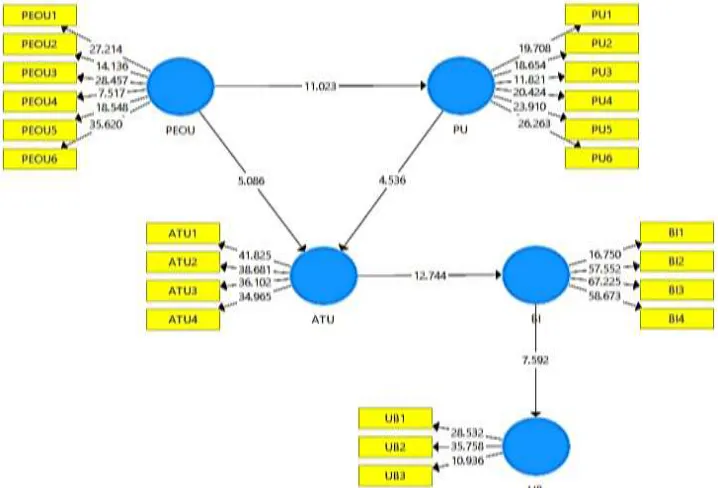
be accepted or rejected. Following are the outputs created with the help of Smart-PLS software:
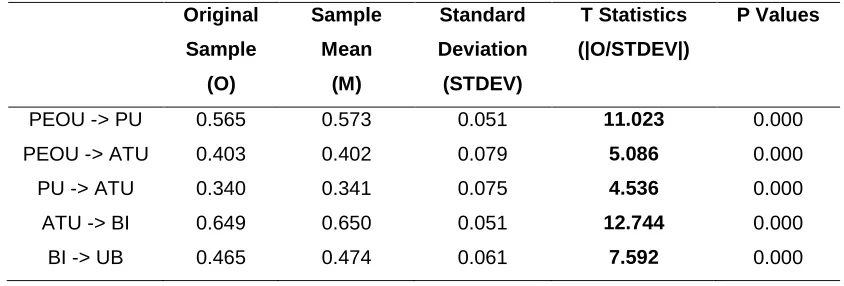
Licensed under Creative Common Page 53 Table 4 Hypothesis test output
Source: SmartPLS Output
H1: Perceived ease of use had a significant positive effect on the perceived usefulness of
BCA mobile banking.
Based on the Table 4, it shows the positive and significant effect between the construct of
PEOU on PU with a coefficient value of 0.565 and significant at the 5% level. This is proven by
the high value of statistics for the PEOU construct over PU over 1,97220, which is 11,023 and
the p-value is 0,000. So it can be concluded that Ha is acceptable. BCA customers will feel
greater benefits if they feel the ease of using the mobile banking system. When the perceived
ease of the customer is positive, the perceived usefulness will also increase. In conclusion, the
better perceived ease of use felt by customers, the higher the perceived usefulness of
customers for BCA's mobile banking. This is consistent with the results found by Davis et al
(1993) and David Kurniawan (2013).\
H2: Perceived ease of use had a significant positive effect on attitude toward using BCA
mobile banking
Based on the Table 4, it shows the positive and significant effect between the PEOU construct
on ATU with a coefficient value of 0.403 and significant at the 5% level. This is evidenced from
the magnitude of the t statistic value for the PEOU construct of ATU above 1,97220 which is
equal to 5,086 and the p-value of 0,000. So it can be concluded that Ha is acceptable.
Confidence in the convenience felt by customers will automatically bring a positive attitude to
choose to use mobile banking as a way for banks to facilitate customers in meeting their
transaction needs. This means that the convenience provided by Instagram makes customers
feel that mobile banking can ease their work in banking transactions. A good system in mobile
banking can be seen from the speed of the system in controlling an input or request for
information and user friendly system, easy for customers to become skilled when the BCA
Original Sample
(O)
Sample Mean
(M)
Standard Deviation (STDEV)
T Statistics (|O/STDEV|)
P Values
PEOU -> PU 0.565 0.573 0.051 11.023 0.000
PEOU -> ATU 0.403 0.402 0.079 5.086 0.000
PU -> ATU 0.340 0.341 0.075 4.536 0.000
ATU -> BI 0.649 0.650 0.051 12.744 0.000
Licensed under Creative Common Page 54 mobile banking system, Customers easily to access mobile banking anytime and anywhere so it
is very flexible. The instructions on Instagram are clear and easy to understand so that
customers do not feel difficulties when using mobile banking. This is consistent with the results
found by David Kurniawan (2013).
H3: Perceived usefulness has a significant positive effect on attitude toward using BCA
mobile banking
Based on the Table 4, it shows the positive and significant influence between the constructs of
PU on ATU with a coefficient value of 0.340 and significant at the 5% level. This is evidenced
from the magnitude of the t statistic for the construct of PU to ATU above 1.97220 which is
4.536 and the p-value is 0.000. So it can be concluded that Ha is acceptable. In this research,
customers have trusted that BCA mobile banking is beneficial to be used and can meet
customer needs, namely transaction settlement more quickly, improve performance and
productivity, increase effectiveness so that customers will show a positive attitude to receive
and use mobile banking services. This positive attitude can be seen in the frequency of using
mobile banking by customers, where the greater the frequency of use the greater the benefits
felt by customers when using mobile banking services. The high frequency of use also has a
positive impact in the form of optimizing the benefits of using mobile banking. This is consistent
with the results found by David Kurniawan (2013).
H4: Attitude toward using has a significant positive effect on behavior intention using
BCA mobile banking
Based on the Table 4, it shows the positive and significant influence between the construct of
ATU on BI with a coefficient value of 0.649 and significant at the 5% level. This is evidenced
from the magnitude of the statistical value for the ATU construct of ABI above 1.97220 which is
12.744 and the p-value is 0,000. So it can be concluded that Ha is acceptable. In this research,
whether or not the attitude towards using customers about the acceptance of mobile banking
technology will have a significant effect on whether or not the customer's intention to use mobile
banking services. The relationship between attitude towards using mobile banking to behavior
intention has a strong influence. Customers who have a positive attitude towards mobile
banking will bring up the behavioral intention to buy later. When customers feel happy using
mobile banking, it will bring up the customer's intention to make a purchase. This is really
Licensed under Creative Common Page 55 H5: Behavior intention using had a significant positive effect on use behavior
Based on the Table 4, it shows that there is a positive and significant influence between the BI
construct on UB with a coefficient value of 0.465 and significant at the 5% level. This is
evidenced from the magnitude of the t statistic value for the ATU construct of BI above 1,97220
which is equal to 7,592 and the p-value of 0,000. So it can be concluded that Ha is acceptable.
This shows that the higher the intention of the customers to use mobile banking, the higher the
use behavior. This is consistent with the results found by Ito (2018).
CONCLUSION
Through the TAM method of BCA bank mobile banking behavior can be explained by the
construct of perceived ease of use affects the perceived usefulness, perceived ease of use
affects the attitude towards using, perceived usefulness affects the attitude towards using,
attitude towards using affects behavior intention and behavior intention influence on use
behavior. By the attitude towards using variable has the largest t-statistic value of 12, 744 which means that the influence of customer attitudes towards BCA’s mobile banking is huge to the real
behavior of using mobile banking. This proven that BCA customers already have a good attitude and have an awareness that the presence of BCA’s mobile banking is very helpful for customers
in conducting banking transactions.
REFERENCES
Alter, Steven. (1992). Information systems : A Management Perspective. Benjamin/Cummings, California. Budi, Agus Riswandi, (2005). Aspek Hukum Internet Banking, Jakarta : Raja Grafindo Persada.
Dahlberg, T., Mallat, N., Ondrus, J. and Zmijewska, A. (2008). Past, present and future of Mobile payments research: a literature review. Electronic Commerce Research and Applications 7 (2) 165–181.
Davis,F.D. (1989). ”Perceived Usefulness, Perceived Ease of Use, and User Acceptance of Information Technology”. MIS Quarterly.Vol. 13 No. 5: pp 319-339.
Gujarati,Damodar. (2004). Basic Econometrics (Ekonometrika Dasar). Translated by Sumarno Zain.Jakarta:Penerbit Erlangga.
Jogiyanto, H.M. (2007). Metode Penelitian Bisnis: Salah Kaprah dan Pengalaman–Pengalaman. Yogyakarta: BPFE. Kraut, R., et al., Internet Paradox Revisited. Journal of Social Issues, (2002). 58(1): p. 49-74.
Kurniawan, david, (2013), Analisis Penerimaan Nasabah Terhadap Layanan Mobile Banking Dengan Menggunakan Pendekatan Technology Acceptance Model Dan Theory Of Reasoned Action, Jurusan Manajemen Pemasaran,Universitas Kristen Petra, Vol. 1, No. 1, (2013) 1-13.
Luarn, Pin dan Hsin-Hui Lin. (2005). Toward an Understanding Of The Behavioral Intention to Use Mobile Banking . Elsevier. Journal of Computers in Human Behavior, 21, 873-891
Setiawan, ito, Banu dwi putranto, Eka wahyu purwaningsih (2018), Analisis Perbandingan Metode TAM Dan UTAUT Terhadap Penerimaan Pengguna E-Office Di DPRD Banyumas, Jurnal teknovasi, Volume 05, 14 – 25.