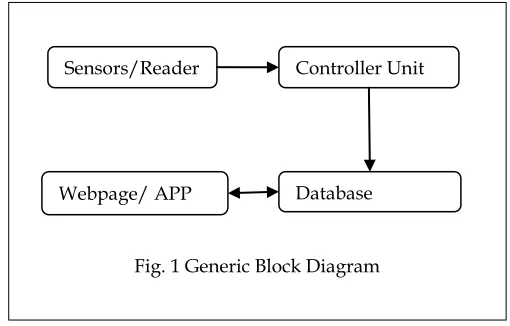
5426 Sensors/Reader
s Controller Unit
Database Webpage/ APP
Fig. 1 Generic Block Diagram
A COMPREHENSIVE STUDY ON ACADEMIC
AND INDUSTRY AUTHENTICATION AND
ATTENDANCE SYSTEMS
Vibin Mammen Vinod, Thokaiandal S, Sindhuja C S, Mekala V, Manimegalai M, Prabhuram N
Abstract— Attendance process has a difficult role in the classroom because it involves proper labeling of attendance for each candidate against their own roll call. The time and resources to be expended for the complete process is also the main scrutinizing consideration for attendance labeling in classrooms. A lot of research has been done to simplify the procedure using different technologies such as RFID tags, barcode scanning, biometric scanners, face detection, etc. This paper provides the in-depth analysis of the literature for the different historically applied systems and analyzes each one's vulnerabilities to consider the advanced system's deployment viability. The study identifies the biometric features as a standard for authentication. Fingerprint, face and iris recognition are far superior than other techniques in existence.
Index Terms— Authentication, automation, barcode, biometrics, RFID tags, face detection, IRIS recognition, QR codes. —————————— ——————————
1 INTRODUCTION
Paper-based attendance control is used to maintain attendance records in most academic institutions in developing countries. The benefits of developing technology have been numerous, making the implementation of these systems increasingly important. This technological improvement is definitely conducive to improving the economy in the education and industry sectors of our country. Adequate attendance and management are very important in the world today. The attendance management system must therefore be standardized to calculate performance of the company. With reference to the context of the corporate, it helps to stay track of attendance for every person in several fields like staff, employees and students. Within the educational sector, attendance monitoring and management will help to extend the will to attend on-time, contributing to an improvement within the level of education. Several downsides have proclaimed using traditional attendance management methods such as more time consumption, and while they are absent, attendance fields may be signed by fellow students. The presence of individuals in every area, such as schools, universities, workplaces, etc., has now become an important aspect of assessment.Generally the attendance is marked using many technologies as RFID, Biometric, Barcode, online attendance system etc. This paper provides an in depth analysis of the various technologies in force for attendance monitoring. A thorough analysis of the advantages offered by each scheme and the limitations of them are also discussed. The paper is arranged as follows. Section II discusses the various literatures associated with the different technologies. Section III deals
with the discussions on the various techniques and the comparison of various methods with others.
2
LITRERATURE
SURVEY
2.1 Barcode Based Technology
A Barcode is a means of visualizing machine-readable content. This composed of adjacent, overlapping spaces and walls. For Attendance Program Systems based on barcode, a barcode is at the backside of the identity card of the person. The bar code is made up of an individual's specific details such as roll number, rank, division and year etc. To mark their presence in college, a person must check their barcode printed identity card.Y.K.Saheed et al., have introduced a barcode-based attendance management system to be printed on the student's identity card. By checking their card in the app, the student's attendance is modified, which decreases the focus on paper work and saves precious time [1]. K. Lakshmi Sudha et al., developed a student attendance control as they joined the classroom using a barcode scanner to help the teacher maintain a register book [2]. P Rahmah Al Sheik et al., suggested barcode-based attendance control using a single modeling language that helps to maintain student details [3].
————————————————
Vibin Mammen Vinod, Assistant Professor, Department of ECE, Kongu Engineering College
Thokaiandal S, UG Scholar, Department of ECE, Kongu Engineering College
Sindhuja C S, UG Scholar, Department of ECE, Kongu Engineering College
5427 Based technology barcodes removes the possibility of
erroneous attendance labeling. The employee time will be reduced by using this system training. The design of bar codes and printing are not so costly. Barcodes are highly flexible and enhance inventory control. Barcodes offer better data and fast availability of barcode data.Only a few data can be stored by linear barcodes. It must be horizontally extended with additional vertical lines and gaps to store large quantities of data, resulting in large bar codes. However, barcode cannot be checked properly if corrupted.
2.2 Fingerprint based technology
The Biometric System is based on fingerprints, iris, facial gesticulation, etc., which are distinctive for each individual and are stored in the database. When a person scans his or her fingerprint on or face in front of the biometric device, he or she checks with the database to confirm an individual's identity. The person's presence will be immediately identified as soon as the fingerprint or face fits the database.Gupta et al., developed a portable attendance program using the GSM Network with Fingerprint Technique to control and monitor a student attendance in the classroom and to give a copy to the student parent through the GSM mobile network [4]. Talaviya et al., suggested a wireless attendance monitoring system for the automated inspection, management and documentation of student attendance at a university institute focused on biometric fingerprint and Zigbee technology [5]. Using biometric fingerprint technology and Arduino microcontroller [6] Zainal et al., proposed a safe and compact attendance device by designing and developing attendance tracking and management method. Yadav et al., presented and implemented a fingerprint recognition system as a main component of an easy handheld attendance marker system [7]. Potadar et al., proposed a fingerprint enabled attendance system for the schools and colleges to record, monitor and track student attendance through the utilization of fingerprinting techniques to scale back the danger of false attendance recording [8]. Kamaraju et al., showcased a real-time attendance logger and monitoring system to make it simple and time-saving for workers to attend any company using Zigbee and attendance dependent on fingerprints [9]. Biometric systems provide a lot of correct identification, reducing the risk of unwanted infringements. With this kind of security system, entry is provided by biological characteristics such as iris scans or fingerprints that square measure difficult to replicate or fake, rather than by passwords or decent cards. The atmosphere and continuous use will impact the calculations. Systems are not always 100% accurate and require additional hardware and/or installation. Once corrupted, the device cannot be reset.
2.3 QR Code based Technology
A QR code works essentially in the same way as a barcode on the market. It's a scannable machine image that you will navigate with a Smartphone camera instantly. Each QR code is made up of several black squares and dots which contain certain knowledge items.B.Dinesh Kumar et al., have suggested a smartphone-based employee attendance program in which the QR Code is used as a proof of identification. In the future, this approach may be used by academics for proper management of attendance recording
[10]. Emmanuel C et al. submitted an offline Identity Card authentication system using QR code; smartphone is proposed as a solution for authenticating the bonafide student of tertiary institutions, resulting in faster authentication [11]. Rakhi Joshi et al., by implementing on the server using .Net and visual lab, suggested a smart learning and attendance program when implementing the smartphone using Java script. The program is tested on the Lollipop 5.0.1 version of the Android smartphone. Students can learn from anywhere, according to their own convenience, through this technique. Students and their parents will provide prompt updates [12]. Noor et al. introduced an Android-based program to take, maintain student attendance records by using camera system as a sensor [13]. Jacob et al., Using the NFC handheld attendance system [14], implemented attendance management system for university students. Nath & Mukhopadhyay suggested an electronic attendance program that is mobile-enabled [15]. Buddhiwant, submitted a student attendance tracking program based on Android and GPS [16].
The versatility is the major advantage of a QR code. QR Code can be used for anything. It's also good for customers and business. You need to use a camera phone as well as an appropriate reader kit to scan the QR code file. Not everyone has a sensitive phone, an insufficient awareness and a familiarity between people with the QR code. QR code may or may not be corrupted. Potential design bugs, pages that are not the best for use by mobile phones, application mistreatment.
2.4 Bluetooth based Technology
Bluetooth is used to connect a device with your mobile phone, smartphone or laptop by using radio waves rather queuing wire or cables. In many products that uses regular Bluetooth as well as headphones, tablets, laptops and transportable speakers could be a growing wireless engineering solution. The Group Action Program is used to track this system.Vishal Bhalla et al. introduced a Bluetooth-based attendance system that uses the mobile telephone of the professor to assist. It's paperless, quick, and it can validate student entries [17]. RiyaLodhaa et al., suggested a system that uses microchip technology and radio frequency to create a secure network that can be used to recognize, track and manage inventories of artifacts. The benefits of the device are low power consumption and high data transmission rates [18]. Idachaba F.E et al. developed a system that tags the user using a fingerprint and transmits the data to a central database using Bluetooth communication technologies for large halls and auditorium [19]. Kumar & Kumar designed a system for recording, tracking and positioning student attendance on campus for Bluetooth Face Identification [20].The Bluetooth is used to transmit voice & information. Bluetooth devices are provided at the lower level of rock, so no line of visuality can link through barriers and hence no interference from any wireless device. It is easily upgradable with lower power consumption. Such specific restrictions are intended to prevent the battery from rapidly depleting, while the Bluetooth signal is able to work walls, the less the device can interact with many items that are in between the devices.
2.5RFID based Technology
5428 and mapped in a unique way. In order to confirm the incident,
the RFID sticker is to be flashed on the RFID scanner. When you match the unique RFID tag with the data stored in the database.Patel et al. proposed an intelligent real-time system to record the attendance of students resulting in a low time consumption [21]. Singhal & Gujral introduced a RFID remote monitoring program by sending GSM cellular network-based SMS approach [22]. In Suleyman Demirel University, Kazakhstan, Saparkhojayev & Guvercin proposed a RFID-based attendance system [23]. Arulogun O. T et al., by combining hardware and software architecture handshaking data exchange between the RFID tag and the RFID reader serially interfaced with the digital computer system [24], offered a solution for lecture attendance problem. Yadav et al., proposed an autonomous system capable of updating the parents about their wards whereabouts over a messaging platform [25]. Arbain et al., created RFDUINO based attendance logger which was ultra portable. It had been specifically designed for a laboratory setting and provisions were made for web based monitoring [26]. Tiwari et al., made use of GPRS and GSM to keep track of the students over the weband this has enabled monitoring attendance with ease [27]. With a web-based approach of RFID to control student attendance at an Indonesian higher education institution, Kurniali developed a student attendance management system [28]. The Chiagozie & Nwaji Groups proposed a door unit-based RFID-unit-based time-attendance management system [29]. Yuru et al., developed an ARM and RFID embedded class attendance control system [30].The key characteristics of the system include: automatic attendance, collection of attendance reports for a course, error-free recognition of the mark, simple quantification, honesty and reliability in data storage. Signals will influence materials such as metal and liquid and are not as true or reliable as barcode scanners in general. RFID readers' costs are often more costly than Barcode Scanners. Implementing of an RFID system is often challenging and frustrating to the end user.
2.6 Face Recognition based Technology
The device to distinguish a person from a composite image or the video frame from video sources is a tool that can recognize or validate an individual. Various methods work, however, as facial recognition program compares selected
facial features in a given picture with faces in a database. It is also referred to as the framework for biometric artificial intelligence, which recognizes an individual by examining patterns based on face textures and form.Behara et al., made use of facial parameters employing Principal Component Analysis to mark attendance and manage the same in real time [31]. For classroom attendance Wagh et al., proposed a novel face recognition algorithm. Eigenface features and PCA provides for improved accuracy in image classification [32]. Khatun et al., developed and introduced an innovative iris recognition system. Compared against the face recognition method, this provides for improved uniqueness of feature. This improvement comes at the cost of an increased complexity in design [33]. A. Cathrine Joe Silvia et al., introduced a facial recognition dependent attendance framework utilizing digital image processing (DIP) and a Euclidean distance filtering system [34]. Sayanekar et al., developed NFC technology and proposed biometric attendance control technique for face recognition to monitor and document the attendance of students at different campus locations [35]. Combining the Faster-R-CNN face sensor algorithm and the SeetaFace algorithm, Wang et al. developed an automated attendance system [36]. Mekala V et. al., [37] have proposed an automated attendance system that employs cognitive face API and Principal Component Analysis method of face recognition. As a consequence, automatic attendance systems based on face recognition technologies have proved time-saving and safe. This technology can also be used to recognize an unfamiliar entity. LBPH outperforms other algorithms with higher detection rates and low false positive rates in real-time scenarios. Compared to distance classifiers, SVM and Bayesian are also better classifiers.Many are making an attempt to build wearable biomedical sensors for attendance systems by researchers. We focused primarily on developing technical solutions that address issues and problems in capturing, reporting, placing, managing students or staff relative to traditional systems that introduce redundant work and effort and raise demands for human resources. Such technologies tend to be just as effective, established, legally approved, accessible, simple and safe.
TABLE 1
COMPARISON ON VARIOUS ATTENDANCE MANAGEMENT SYSTEM
Ref
No Technology Key Findings Application
[1] Barcode A complete management system employing the bar code details of
individual student. Academic
[2] Barcode Replacement for lab entry register using bar code Academic [3] Barcode Bar code along with UML (Unified Modeling Language) based web design. Academic
[4] Fingerprint-GSM
Portable attendance system using a fingerprint and GSM network to monitor and record students attendance in the classroom and to send a report to the students’ parents via a GSM mobile network
Academic
[5] Fingerprint-Zigbee
A framework for tracking attendance in wireless mode to automatically control and record student attendance in a college/school based on Zigbee and biometric fingerprint technologies
Academic
[6] Fingerprint -Arduino
A secure, portable support system by designing and developing a monitoring and management system using Arduino microcontroller and bio-fingerprint technology
Organization
[7] Fingerprint Biometric attendance recording, monitoring and tracking by fingerprinting
5429 [8] Fingerprint Student attendance logger system based on fingerprint recognition by the
GSM network Academic
[9] Fingerprint- Zigbee Real time monitoring of attendance and tracking using fingerprint characters.
Relaying of information over Zigbee. Enterprise
[10] QR Code Smart phone based attendance system for employees in which the QR
Code is used as an identification proof Academic [11] QR Code Smart learning and attendance system by implementing on the server and Smartphone Academic
[12] QR Code
An offline Identity Card authentication System using QR code, Smartphone is presented as solution to authenticate the bonafide student of tertiary institutions which results in faster authentication
Academic
[13] Android-based Android app via a camera device sensor to log and manage student
attendance records Academic
[14] Android-based An app based attendance logger using NFC medium of communication, Academic [15] Android-based Mobile enabled online attendance system Academic
[16] Android-based Mobile Android based and GPS application for attendance monitoring of
students[ Academic
[17] Bluetooth Method of taking attendance using instructor's mobile telephone. It is
paperless, quick, and the student entries can be confirmed Academic
[18] Bluetooth
Employs microchip technologies and radio frequency to create a secure system which can be used for identification, monitoring and for maintenance of object inventories
Academic
[19] Bluetooth Identifies the user using his fingerprint and the data is transmitted to a
central database for large halls and auditorium Academic
[20] Bluetooth and Face Identification
Monitor, follow and position student participation in campuses on the basis
of Bluetooth identification technologies Academic
[21] RFID An intelligent system based on RFID for real time attendance monitoring Academic
[22] RFID Provisions to send SMS over GSM to parents. RFID employed to monitor
attendance of wards. Academic
[23] RFID Low cost and closed user group implementation of RFID. Academic [24] RFID and GSM Microcontroller based attendance system using RFID and GSM Academic
[25] RFID,WSN and Arduino Uno
The system provides flexibility in administration and management of attendance procedures and thus increases productivity and the growth of employees.
Academic
[26] RFID -GSM Autonomous system wherein messaging option is provided to keep track of
the attendance. Academic
[27] RFDUINO Arduino platform and Web enabled solutions to monitor and keep track of
attendance. Academic
[28] RFID An online solution for attendance logging and monitoring. Logging of
attendance using RFID and relaying over GPPRS network Academic [29] RFID Web platform for monitoring of day to day and archived reports. RFID to log
attendance. Academic
[30] RFID Novel implementation on a faster performance ARM for improved timeliness. Academic
[31] Face recognition
Automatic monitoring and management of the attendance and attendance application in the real-time environment using the biometric visual recognition system.
Organization
[32] Face Recognition Usage of PCA and Eigenface algorithms improves the accuracy of image
classification by 5% Academic
[33] Iris Recognition Improvement over face recognition algorithms. Cost of implementation and
design complexity is high. Academic
[34] Face Recognition A face-recognition system based on digital image processing (DIP) and an
Euclidean filter system Academic
[35] Face detection and recognition
The integration of two deep learning algorithms Faster R-CNN facial detection and SeetaFace face recognition algorithms to develop an automated attendance system
Academic
[36] Face detection and
recognition Implementation of improved SeetaFace and PCA techniques. Academic
[37] Face detection and
recognition Employs Cognitive face API and Principle Component Analysis Academic
3
DISCUSSIONS
Many biometric authentication schemes can be introduced
5430 shortcomings in the mobile phone. However, mobile
devices are more likely to be attacked due to the accessibility of mobile communication signals, so the reliability of the biometric authentication method should be seriously considered. We can see that the overall performance of static authentication systems, especially fingerprint authentication systems, is relatively high. Throughout our daily lives, fingerprint recognition and verification schemes have been implemented almost anywhere. The biometric authentication systems pose severe risks for security and privacy. As biometric authentication based on a dynamic function can achieve high usability and reliability, it has exciting potential since such systems can easily be used by consumers. There is still a need to improve the performance of bioauthentication systems. The accuracy of other types of systems (e.g. biometric voiceprint and facial verification) can be increased, except for the widely implemented fingerprint authentication method. Our study proposes or evaluates the biometric systems as having better accuracy as compared against the traditional methods of authentication.
4
CONCLUSION
The survey presents the use of different barcode-based technologies, based on RFID and biometric or facial recognition, which have little benefit and have few limitations/ drawbacks. Many current literature schemes suggested a program requiring additional equipment to achieve the desired result. And the system does not give an efficient working model that does not need extra hardware. Therefore, it needs an efficient system that not only reduces the participation time, but also saves paper and also makes it more effective.
REFERENCES
[1] Y. K. Saheed, A. Moshood Hambali, Abdulmumeen A. Adedeji, and I. A. Adeniji,“Attendance Management System Using Barcode Identification on Students’ Identity Cards”,ThePacific Journal of Science and Technology, Vol. 17,No.2, 2016.
[2] K.LakshmiSudha, ShirishShinde, TitusThomas, ArisAbdugani,“Barcode based attendance system” International Journal of Computer Applications, Vol. 119, No.2, 2015.
[3] Rahmah Al Sheikh, Raghad Al-Assami, Maryam Albahr, Muntaha Al Suhaibani, Mutasemk Alsmadi,MuneerahAlshabanah, DaniahAlrajhi, Ibrahim Al-Marashdeh, SanaaAlsmadi and HayamAbouelmagd and Mohammed Tayfour, “Developing and implementing a barcode based student attendance system”,International Research Journal of Engineering and Technology (IRJET)Vol. 06, Issue.1,2019.
[4] Gupta PVN, “Fingerprint Based Student Attendance System Using GSM”, International Journal of Science and Research, Vol.1, 2013.
[5] G. Talaviya et. al., “Wireless fingerprint based college attendance system using Zigbee technology” International Journal of Engineering and Advanced Technology, Vol.1, 2013.
[6] N. I. Zainal et. al., “Design and development of portable classroom attendance system based on Arduino and fingerprint Biometric” 5th International Conference on
Information and Communication Technology for the Muslim World, pp. 1-4, 2014 .
[7] R.Yadav, and S. Nainan, “Design of RFID based student attendance system with notification to parents using GSM”, International Journal of Engineering, Vol.3, 2014.
[8] M. P. Potadar et. al., “Biometric Attendance Recording and Communication System” International Journal of Innovations in Engineering and Technology Vol.5, Issue.2, pp.230-234, 2015.
[9] M. Kamaraju and P. A. Kumar, “Wireless fingerprint attendance management system”, IEEE International Conference on Electrical, Computer and Communication Technologies (ICECCT), pp. 1-6, March 2015.
[10] B. Dinesh Kumar, S. Kareemulla, “Smart mobile attendance system for employees”, Asian Journal of Applied Science and Technology,Vol.1,Issue 5, 2017. [11] C.Emmanuel, A. Ayeleso, A. Adebanjo Adekiigbe, C.
Ndidi, A. Onyeka, Mathias O.Oladeleb, “Identity card authentication system using QR Code and smartphone”. International Journal of Science, Engineering & Environmental Technology (IJOSEET), Vol 2,no 9,2017.
[12] Rakhi Joshi, V.V.Shete, S. B. Somani, “Android Based Smart Learning and Attendance Management System”, International Journal of Advanced Research in Computer and Communication Engineering, Vol. 4, Issue 6, 2015.
[13] S. A. M. Noor et. al., “Android-based attendance management system”, IEEE conference on Systems, Process and Control (ICSPC), December 2015.
[14] J. Jacob, et. al., “Mobile attendance using Near Field Communication and One-Time Password”, International Conference on Green Computing and Internet of Things (ICGCIoT), IEEE,October 2015. [15] A. Nath andA.Mukhopadhyay, “A Novel Student
Attendance Tracking System Using Android Mobile Phone”, IEEE International Conference, October 2017. [16] A. Buddhiwant et. al., ”Smart Attendance Application”, International Journal of Engineering and Management Research (IJEMR), Vol.7. Issue 2, pp. 221-224, 2017. [17] Vishal Bhalla,et. al., “Bluetooth based attendance
system”, International Journal of Innovations in Engineering and Technology, Vol. 3, Issue 1, 2013.
[18] Riya Lodhaa, et. al., “Bluetooth Smart based Attendance Management System”, International Conference on Advanced Computing Technologies and Applications (ICACTA), 2015.
[19] F. E. Idachaba and O. O. Oni, “Development of a Bluetooth-Based Contactless Automated Attendance Capture System for Large Halls and Auditoriums”, International Conference on African Development Issues (CU-ICADI) Information and Communication Technology Track, 2015.
[20] J. Kumar and A. Kumar, ”Automatic Attendance Monitoring and Tracking System Using Bluetooth and Face Identification”, International Journal of Advanced Research in Electronics and Communication Engineering, Vol.5, Issue 4, pp. 1116- 1170, 2015. [21] U. A. Patel, and S. Priya, “Development of a student
attendance management system using rfid and face recognition”, International Journal of Advance Research in Computer Science and Management Studies, Vol.2, Issue8, pp. 109-119 , 2014.
[22] Z. Singhal, and R. K. Gujral, “Anytime anywhere-remote monitoring of attendance system based on RFID using GSM network”, International Journal of Computer Applications, Vol. 39, Issue 3, pp. 37-41, 2012.
5431 International Journal of Computer Science Issues, Vol.
9, Issue 3, pp. 1694-0814, 2012.
[24] O. T. Arulogun, et. al., “RFID-Based Students Attendance Management System”, International Journal of Scientific & Engineering Research Volume 4, Issue 2, 2013.
[25] R. Yadav, and S. Nainan, “ Design of RFID based student attendance system with notification to parents using GSM”, International Journal of Engineering, Vol. 3, Issue 2, 2014.
[26] N. Arbain et. al., “ LAS: Web-based laboratory attendance system by integrating RFID-ARDUINO technology”, International Conference on Electrical, Electronics and System Engineering (ICEESE), pp. 89-94, December, 2014.
[27] A. S. Tiwari, et. al., “Optimized design of student attendance system using rfid”, International Conference on Machine Learning, Electrical and Mechanical Engineering, pp. 8-9, January, 2014.
[28] S. Kurniali, “The Development of a Web-Based Attendance System with RFID for Higher Education Institution in Binus University”, EPJ Web of Conferences, Vol. 68, EDP Sciences, 2014.
[29] O. G. Chiagozie, and O. G. Nwaji, ”Radio frequency identification (RFID) based attendance system with automatic door unit”, Academic Research International, Vol. 2, Issue 2, pp. 168-170, 2012. [30] Z. Yuru, C. Delong, and T. Liping, “The Research and
Application of College Student Attendance System based on RFID Technology”, International Journal of Control and Automation, Vol. 6, Issue2, pp. 273-282, 2013.
[31] A. Behara and M. V. Raghunadh, “Real time face recognition system for time and attendance applications”, International Journal of Electrical, Electronics and Data Communication, Vol. 1, 2013. [32] P. Wagh et. al., “Attendance system based on face
recognition using eigen face and PCA algorithms”, International Conference on Green Computing and Internet of Things (ICGCIoT), pp. 303-308, October,2015.
[33] A. Khatun et. al., ”Design and implementation of iris recognition based attendance management system”, International Conference on Electrical Engineering and Information Communication Technology (ICEEICT), pp. 1-6, May 2015.
[34] A.Cathrine Joe Silvia and M.Mekala M.Dhevaki and E.Mohanapriya,”Multi-face authentication-based digital image processing automatic classroom attendance management system”, International journal of advance science and engineering research, 2014.
[35] P. Sayanekar, et. al., “Customized NFC enabled ID card for Attendance and Transaction using Face Recognition”, International Research Journal of Engineering and Technology, Vol. 3, Issue 9, pp. 1366- 1368, 2016.
[36] D. Wang, R. Fu, and Z. Luo, ”Classroom Attendance Auto-management based on Deep Learning”, 2017. [37] V. Mekala, Vibin Mammen Vinod, M. Manimegalai , K.
Nandhini , “Face Recognition Based Attendance System”, International Journal of Innovative Technology and Exploring Engineering (IJITEE), Vol. 8 Issue 12, pp. 520-525, 2019.
[38] K. Shengli, Z. Jun, S. Guang, W. Chunhong, Z. Wenpei, and L. Tao, “The Design and Implementation of the Attendance Management System based on Radio Frequency Identification Technology”, IEEE,2014.
[39] N. S. Ali, and Z. A. A. Alyasseri,” Wireless Sensor Network and Web Application Hybrid Scheme for Healthcare Monitoring”, Journal of Soft Computing and Decision Support Systems, 4(5), 1-7,2017.
[40] M. Shakil, and R. N. Nandi,” Attendance Management System for Industrial Worker using Finger Print Scanner”, Global Journal of Computer Science and Technology, 2013.
[41] H. Walia, and N. Jain, “Fingerprint Based Attendance Systems-A Review”, International Research Journal of Engineering and Technology (IRJET) Volume, 3, 2016. [42] S. C. Kohalli, R. Kulkarni, M. Salimath, M. Hegde, and R. Hongal,” Smart Wireless Attendance System”, International Journal of Computer Sciences and Engineering, 4(10), pp. 131-137, 2016.
[43] N. S. Ali,Z. A. A. Alyasseri, and A. Abdulmohson,” Real-Time Heart Pulse Monitoring Technique Using Wireless Sensor Network and Mobile Application”, International Journal of Electrical and Computer Engineering, 8(6),2018.
[44] Abhilash Bhise, Radhika Khichi, Amol Korde, Prof. Deepali Lokare,”Attendance System Using NFC Technology with Embedded Camera on Mobile Device”, International Journal of Advanced Research in Computer and Communication Engineering, 4(2), pp 350-353,2015.
[45] S. Pranali, S. Mayuri, T. Manisha, and J. Varsha,” An Intruder Tracking and Attendance Monitoring System Using Mifare Technology”,2015.
[46] D. Sunehra and V. S. Goud,”Attendance recording and consolidation system using Arduino and Raspberry Pi”, In Signal Processing, Communication, Power and Embedded System (SCOPES), International Conference on (pp. 1240-1245) IEEE,October 2016. [47] H. D. Rjeib, N. S. Ali, A. Al Farawn, B. Al-Sadawi, H.
Alsharqi ,”Attendance and Information System using RFID and Web-Based Application for Academic Sector”, International Journal of Advanced Computer Science and Applications, 9(1), 2018.
[48] B. Benyo, B. Sodor, T. Doktor, and G. Fördős, ”Student attendance monitoring at the university using NFC”, In Wireless Telecommunications Symposium (WTS), (pp. 1-5), IEEE, April 2012.
[49] R. Patel, N. Patel, and M. Gajjar, “Online students’ attendance monitoring system in classroom using radio frequency identification technology: a proposed system framework”, International Journal of Emerging Technology and Advanced Engineering, 2(2), 61-66, 2012.
[50] M. H. M. Baban, “Attendance checking system using quick response code for students at the University of Sulaimaniyah”, Journal of Mathematics and Computer Science (JMCS), 2014.
[51] Zainab Hussein Arif et al, “International Journal of Computer Science and Mobile Computing”, Vol.7 Issue.8, , pg. 60-66 , August 2018.
[52] S. Farpat, D. Vyas, and S. Chavan, ”Monitoring Of Attendance Using RFID and GSM Technology”, 3(2), pp. 1-8, 2015.
[53] L. Y. Hui, K. H. Seok, and K. B. Hwan, ”A Study on the Location Based Automatic Attendance Check System with Smart Devices”,IEEE, 2014.
[54] Y. Mishra, G. K. Marwah and S. Verma,” Arduino Based Smart RFID Security and Attendance System with Audio Acknowledgement”, International Journal of Engineering Research and Technology, 4(1), pp 363-367, 2015.
[55] H. Walia andN. Jain, “Fingerprint Based Attendance Systems”, International Research Journal of Engineering and Technology, 3(5), pp. 1166- 1171, 2016.
5432 [57] K. Jaikumar, M. S. Kumar, S. Rajkumar and A.
Sakthivel, ” Fingerprint Based Student Attendance System with SMS Alert to Parents”, International Journal of Research in Engineering and Technology,2015.
[58] H. F. Abdulsada, “Design and Implementation of Smart Attendance System Based on Raspberry pi”, Journal of University of Babylon”, 25(5), 1610-1618, 2017.
[59] M. B. Srinidhi and R. Roy, ” A web enabled secured system for attendance monitoring and real time location tracking using Biometric and Radio Frequency Identification (RFID) technology”, In Computer Communication and Informatics (ICCCI), International Conference on (pp. 1-5),IEEE,January2015.
[60] M.Praveen Kumar and B. Mani Kumar, ” RFID based Attendance monitoring system Using IOT with TI CC3200 Launchpad”, International Journal & Magazine of Engineering, Technology, Management and Research, 2(7), pp. 1465-1467, 2015.
[61] N. Ya’acob, S. F. S. Adnan, A. L. Yusof, A. E Azhar, N. F. Naim, N. Mustafa and N. A. Mahmon, N , ” RFID lab management system using Arduino microcontroller approach associate with webpage”, IEEE,2016.
[62] Zainab Hussein Arif et al, “ International Journal of Computer Science and Mobile Computing, Vol.7 Issue.8, pg. 60-66 , August 2018.
[63] H. H. Mady and S. M. Hilles, “Efficient Real Time Attendance System Based on Face Detection Case Study “MEDIU Staff”, International Journal on Contemporary Computer Research (IJCCR), 1(2), 21-25,2017.
[64] A. K. Shukla, “Microcontroller Based Attendance System Using RFID and GSM”, International Journal of Emerging Technologies in Engineering Research (IJETER), 5(8),2017.
[65] N. Prince, A. Sengupta, and M. K. Unni), ”Implementation of IoT Based Attendance System on a Dedicated Web-Server”, International Journal of Scientific & Engineering Research, 7(6), pp. 351- 355,2016.
[66] Siddiqui, F., Naik, M., Yadav, S., & Sunesara, M,” Wireless Attendance System Using Fingerprint”, Imperial Journal of Interdisciplinary Research, 3(5), 2017.
[67] S. B. Devamane, K. P. Ramesh,” Automatic Tracking and Attendance Analytics Using Bluetooth and Face Detection”, 2017.
[68] M. G. Dhope and D. L. Bhombe, ” Face Recognition Based Attendance System using SIFT Algorith,2017. [69] Q. Wang, “Small Office Attendance System Based on
EEG Signals”. Boletín Técnico, ISSN: 0376-723X, 55(12),2017.
[70] Hendry, M. R. M., Rahman, M. N. A., & Seyal, A. H. Smart Attendance System Applying QR Code.
[71] P. Kumar, K. Suresh, and T. Indumati, “ Smart Attendance System using Raspberry Pi”.