Performance Analysis of FSO Link Using
OVSB Modulation Based On Coherent and
Direct Detection OFDM
Kavya Prasanth1, S. Aswathy Chandran2
PG Scholar, Dept. of ECE, TKM Institute of Technology, Kollam, Kerala, India1
Asst. Professor, Dept. of ECE, TKM Institute of Technology, Kollam, Kerala, India2
ABSTRACT: Wireless communication is an important development in the field of communication system. Free space
optical (FSO) system transmits the signal by using light. This provides high modulation bandwidth. Since it uses the light travelling through free space to wirelessly transmit the data, it is seriously affected by two factors. They are free space path loss and atmospheric turbulences. Other important problems in FSO communication system is the multipath fading and frequency selective fading. The optical vestigial sideband modulation (OVSB) based on direct and coherent detection orthogonal frequency division multiplexing (OFDM) mitigates the problems in FSO system. The quality factor of both the coherent and direct detection OFDM based OVSB technique was analyzed and comparison of both schemes done on the basis of Q factor variation against link distance under various atmospheric conditions. The simulation was carried out in optisystem(version 12) software.
KEYWORDS: Coherent detection OFDM, Direct detection OFDM, Free space optics, Frequency selective fading, Multipath fading, OVSB modulation, Quality factor.
I. INTRODUCTION
Free space optical communication transmits the data using light propagating through free space. Free space means vacuum or air. License free long range performance and high modulation bandwidth are two important advantages of free space optical communication. Various atmospheric turbulences seriously affect the performance of FSO system and it reduces the signal strength. As long as the light travels through the unguided channel, the chance of free space path loss [3] also increases. The free space path loss minimizes the output power of the signal. These are the various challenges faced by the FSO system. Modulation is one of the important techniques used to mitigate the atmospheric turbulences. Various analog and digital modulation techniques reduce the effect of free space path loss and increase the signal strength. In the case of FSO networks [1], inter symbol interference, frequency selective fading and multipath fading[5] are the serious issues. Due to this, mismatching of information and crosstalk occurs. The efficiency of free space communication reduces due to these conditions.
The necessity of improving the signal strength increase the demand for a suitable modulation technique called optical vestigial modulation based on the coherent and direct detection orthogonal frequency division multiplexing. The OFDM technique eliminates the condition of interfering one symbol with the subsequent signal. The OFDM works on the basis of multiple subcarrier modulation and orthogonality principle [3]. In the case of conventional single carrier modulation technique, signal representing each bit uses the entire available spectrum but OFDM divides data in to available parallel data streams. These signals transmitted on separate bands. Therefore the signal corresponds to each bit sue the entire available spectrum for communication. The addition of guard interval in the case of this technique eliminates the time spreading and hence the interference due to the adjacent signals.
ISSN(Online): 2320-9801 ISSN (Print): 2320-9798
I
nternational
J
ournal of
I
nnovative
R
esearch in
C
omputer
and
C
ommunication
E
ngineering
(An ISO 3297: 2007 Certified Organization)
Website: www.ijircce.com
Vol. 5, Issue 3, March 2017
sideband and a portion of other and efficiently utilizes the channel. Both OFDM and OVSB technique reduce the information loss and increase the efficiency of FSO system. The combination of both the techniques implemented on the FSO system increase the signal strength.
II. LITERATURE SURVEY A. General background
Orthogonal frequency division multiplexing generally uses the principle of both the multi carrier modulation and orthogonality. In this case the receiver and the transmitter must be perfectly synchronized. The information transmitted over carriers which are separated with each other improve the signal strength by eliminating the inter symbol interference. The OVSB modulation mitigates the problems affected on the FSO system by combining with the OFDM techniques.
B. Orthogonal Frequency Division Multiplexing
The conventional single carrier modulation techniques all the available spectrum are utilized by the transmitted signal. In the case of orthogonal frequency division multiplexing spectrum available is divided in to narrow bands and separate bands are used to transmit the data. The conventional modulation techniques are used to modulate the data stream in the FSO system. Firstly parallel streams are generated from the encoded data and it is then modulated on to subcarriers by the use of Inverse Fast Fourier Transform (IFFT) [7]. Serialized data streams are formed from the parallel data streams and it can be modulated. Orthogonal spacing between the subcarriers allows the receiver to separate out each subcarrier.
Parallel streams are generated from the received data. The cyclic prefix addition in the case of orthogonal frequency division multiplexing meant by adding a guard interval. The main problem due to the inter symbol interference is get eliminated by the addition of guard interval.
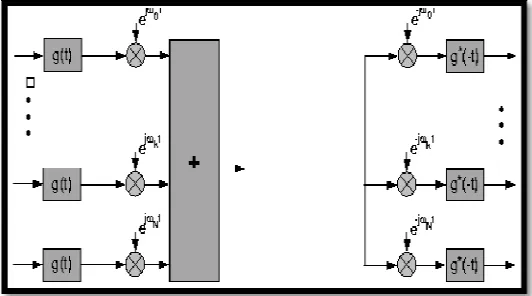
Figure 1: Multi carrier modulation technique.
Figure 1. shows the multi carrier modulation scheme. The OFDM generally works on the principle of this multi carrier modulation. The OFDM exhibit frequency diversity by dividing each wideband signals in to many slowly modulated narrow band subcarriers. Here signal energy is not spread out in time. Lower data rate has the advantage that interference from reflection is much less critical. The data is only sampled when the signal is stable. The nulls caused due to the multipath effect is also eliminated in OFDM based FSO system. Mainly the OFDM technique includes two detection techniques. They are coherent and direct detection methods. Both the technique increase the signal strength and coherent detection is found to be has much more advantages than that of direct detection scheme.
C. Optical vestigial sideband modulation
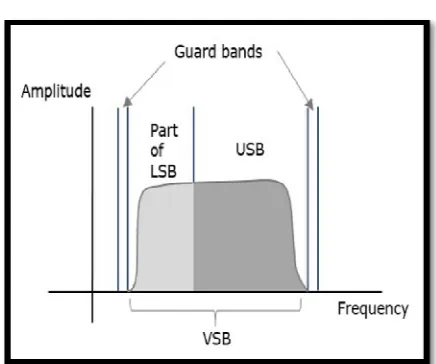
Figure 2: Complementary detection technique
Figure 2 shows the image of optical vestigial sideband modulation technique. This modulation technique more efficiently uses the amplifier and extracts the whole signal. The reception is also simplified in the case of optical vestigial sideband modulation technique.
.D. OVSB modulation based on direct detection OFDM technique.
The OVSB modulation based on direct detection OFDM technique in FSO system improve the performance and signal strength. The receiver is not able to track the phase of transmitted signal, therefore the phase and frequency information are not extracted. In the direct detection method the random sequence generated by the pseudo random bit sequence generator is mapped into points and then these signals are modulated using an OFDM modulator. Only one Mach-Zehnder Modulator (MZM) and single detector are used in the case of direct detection method.
E. OVSB modulation based on coherent detection OFDM technique
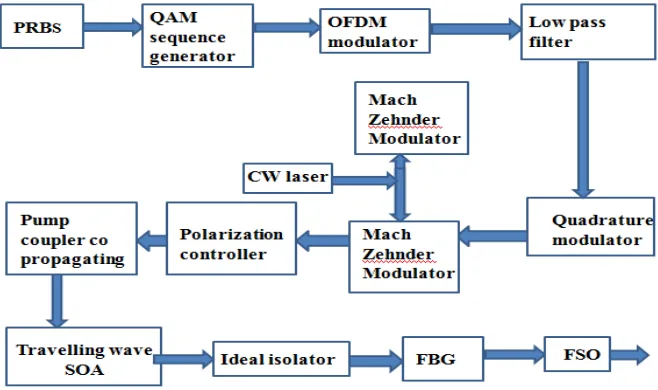
The OVSB modulation based on coherent detection OFDM technique in FSO system is different from that of direct detection technique. The combining effect of OVSB modulation, orthogonality and the effect of coherent detection makes the system more effective than any other method. The coherent detection means that the receiver can track the phase of the transmitter so that the extraction of phase and frequency information is possible. The multipath fading and frequency selective fading are the two important problems that are seriously affect the performance of FSO system.
The frequency selective fading means that this occur mainly due to the partial cancellation of radio signal by itself. In the case of FSO system, the light is propagated through the atmospheric channel. The atmospheric channel is an unguided channel. The frequency selective fading mainly occur due to the combining and separating effect of ionosphere. Due to this the siganal arrive at receiver through various paths and hence bandwidth of channel is smaller than the bandwidth of the signal. The signal consists of different frequency component and these components experience fading.
Both the multipath fading and frequency selective fading are eliminated by the coherent detection principle. In the case of OVSB modulation, the spectral efficiency also improves by using a coherent detection method. The coherent detection is performed mainly by using a series of Mach-Zehnder Modulator (MZM), local oscillator and a series of photo detectors. The local oscillator tunes its frequency with the received signal frequency through an optical coherent mixer and the receiver.
III. PROPOSED METHODOLOGY
ISSN(Online): 2320-9801 ISSN (Print): 2320-9798
I
nternational
J
ournal of
I
nnovative
R
esearch in
C
omputer
and
C
ommunication
E
ngineering
(An ISO 3297: 2007 Certified Organization)
Website: www.ijircce.com
Vol. 5, Issue 3, March 2017
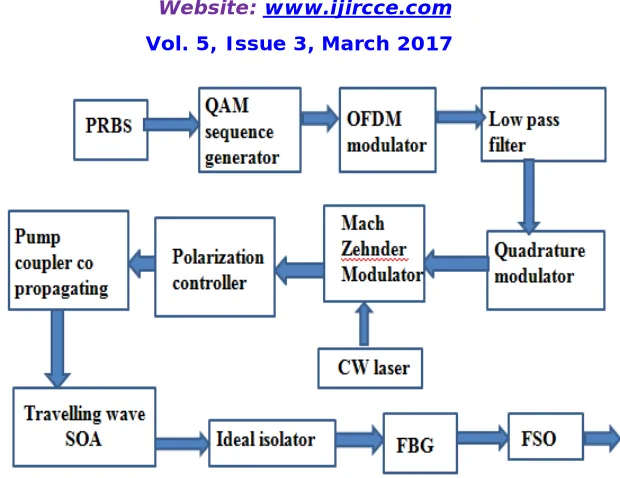
Figure 3. Block diagram of transmitting section of FSO link using the OVSB modulation based on direct detection.
Figure 3 shows the block diagram of transmitter section of optical vestigial sideband modulation based on direct detection orthogonal frequency division multiplexing. It mainly consists of a transmitter, channel and the receiver section. The pseudo random bit sequence generator generates the random sequence which is difficult to predict and it is generally a binary sequence. Here the main purpose of the coder is to generate the signal which contains the data.
The quadrature encoder map these sequence into points in the constellation diagram. These are usually arranged in a square grid with equal vertical and horizontal spacing. The modulation section generally consists of orthogonal frequency division multiplexing technique. The encoded data streams are converted in to parallel streams and are modulated using Inverse Fast Fourier Transform (IFFT). The outputs of IFFT are then serialized to form a data stream. The main purpose of quadrature modulator is to convey the message signals by changing the amplitude of two carrier waves.
The Mach Zehnder Modulator modulates the data signal with the carrier signal. Generally the continuous wave laser is used as the carrier signal. The pump coupler couples both the signal and the pump. Since the travelling wave semiconductor optical amplifier is polarization sensitive, polarization controller is used in the case of OVSB technique. The optical isolator prevents unwanted noise addition and it allows the light signal to travel only in a single direction. The main component in the transmitter section of OVSB based on direct detection OFDM technique is the Fiber Bragg Grating (FBG) since OVSB transmit one sideband and a potion of other sideband.
The receiving section of direct detection technique of OVSB modulation consist of an amplifier, the photo detector, QAM demodulator, OFDM demodulator, QAM decoder and visualiser. The amplifier [9] amplifies the signal which is received from the FSO channel. Then the received data is detected using a suitable photo detector and then it is demodulated using OFDM demodulator and quadrature demodulator.
The data is decoded using QAM decoder and then noise in the signal that are given to the system is eliminated using the low pass filter, which eliminate the high frequency noise from the low frequency signal. The direct detection OFDM is simply the basic OFDM technique using the advantage of OVSB modulation.
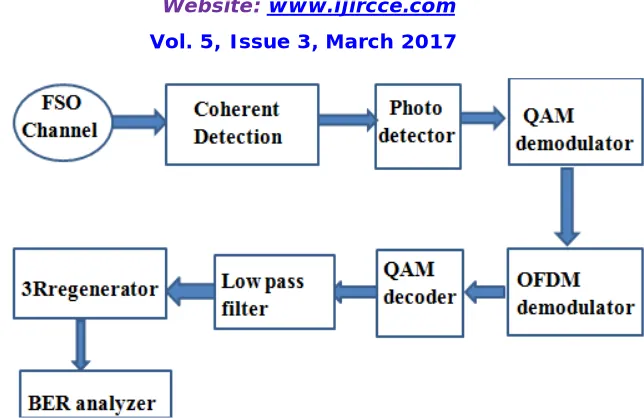
Figure 4. Block diagram of transmitting section of FSO link using the OVSB modulation based on direct detection.
Figure 4 shows the receiving section of FSO link using OVSB based on direct detection OFDM. This technique is simple compared to the coherent detection method.
Figure 5. Block diagram of transmitting section of FSO link using the OVSB modulation based on coherent detection.
ISSN(Online): 2320-9801 ISSN (Print): 2320-9798
I
nternational
J
ournal of
I
nnovative
R
esearch in
C
omputer
and
C
ommunication
E
ngineering
(An ISO 3297: 2007 Certified Organization)
Website: www.ijircce.com
Vol. 5, Issue 3, March 2017
Figure 6. Block diagram of transmitting section of FSO link using the OVSB modulation based on coherent detection.
Figure 6 shows the receiving section of FSO link using OVSB based on coherent detection OFDM. This is similar to the direct detection receiver section. The only difference is that it contain the coherent detection section. The coherent detection reception is performed mainly by the series of photo detectors and a local oscillator. The receiving section of coherent detection technique of OVSB modulation also consist of an amplifier, the photo detector, QAM demodulator, OFDM demodulator, QAM decoder and visualiser. Then the received data is detected using a suitable photo detector and then it is demodulated using OFDM demodulator and quadrature demodulator. The data is decoded using QAM decoder and then noise in the signal that are given to the system is eliminated using the low pass filter, which eliminate the high frequency noise from the low frequency signal.
Table 1: Parameters used for the simulation.
The design parameters of the system is shown in table 1. This indicate the common devices used for the above method and their setting value.
IV SIMULATION AND RESULTS
This section describes the simulation set up of FSO link using OVSB based on the direct and coherent detection OFDM technique. The simulation is mainly carried out by using optisystem (Version 12). The performance of each of the FSO system is analysed on the basis of eye diagram. The eye diagram shows the value of quality factor and the graph created using the value of Q factor.
Devices Parameters value
CW Laser
Frequency Power
193.1 THz 70 dBm
PRBS Rate of data 1.5 GBits/s
A.OVSB based on direct detection OFDM
The simulation diagram mainly consists of a transmitter, the FSO channel and the receiver.
Figure. 7. Simulation set up of FSO link using OVSB based direct detection OFDM technique.
Figure.7 shows the simulation of FSO link using OVSB technique based on the direct detection OFDM. The data signal from the PRBS generator is modulated using the OFDM technique and then the state of polarization of the signal is controlled using polarization controller. Then at the receiver section the original is recovered from the OFDM signal.
(a) (b) (c)
Figure 8 shows the eye diagrams of FSO link using OVSB based direct detection OFDM technique under a) Clear condition b) Light haze c) Heavy haze.
Figure 8 shows the eye diagrams of FSO link using OVSB based direct detection OFDM technique under various atmospheric conditions. Here the haze variation is used to perform the simulation. From the eye diagram, it is clear that the Q factor of the FSO system under clear condition is maximum compared to light haze and heavy haze.
A.OVSB based on coherent detection OFDM
The simulation of FSO link using OVSB based on coherent detection OFDM technique is similar to that of direct
detection technique. The only difference is that it contains a series of MZM and photo detectors. The coherent detection was performed using the tunable local oscillator. The local oscillator is the main component used for the simulation of the above technique. The local oscillator frequency is tuned to the frequency of the receiver so that the receiver can track the phase of the transmitter.
ISSN(Online): 2320-9801 ISSN (Print): 2320-9798
I
nternational
J
ournal of
I
nnovative
R
esearch in
C
omputer
and
C
ommunication
E
ngineering
(An ISO 3297: 2007 Certified Organization)
Website: www.ijircce.com
Vol. 5, Issue 3, March 2017
Figure. 9. Simulation set up of FSO link using OVSB based coherent detection OFDM techniques.
Figure 9 shows the simulation of OVSB based on coherent detection OFDM. The Transmitting section contains the random sequence generator, basic OFDM modulator and MZM series. Receiving section of coherent detection technique of OVSB modulation also consist of an amplifier, the photo detector, QAM demodulator, OFDM demodulator, QAM decoder and visualiser.
(a) (b) (c)
Figure 10. shows the eye diagrams of FSO link using OVSB based coherent detection OFDM technique under a) Clear condition b) Light haze c) Heavy haze.
Figure 10 shows the eye diagrams of FSO link using OVSB based coherent detection OFDM technique under various atmospheric conditions. From this eye diagram also, it is clear that the Q factor of the FSO system under clear condition is maximum compared to light haze and heavy haze.
Figure 11. shows the graphical analysis of FSO link performance using OVSB modlation technique. From the graph it is clear that OVSB based on coherent detection OFDM is better than that of direct detection in an FSO system.
VI. CONCLUSION
The FSO system was implemented using optical vestigial sideband modulation technique based on direct and coherent detection orthogonal frequency division multiplexing. Coherent detection OVSB technique was found to be better than that of direct detection scheme. The analysis was done on the basis of eye diagram. On analysing the eye diagram, the quality factor of coherent detection OVSB technique is higher than that of the direct detection method. The comparison of both of the technique was done using the graph by taking Q factor against the link distance at various atmospheric conditions. The clear condition, light haze and heavy haze are the three atmospheric conditions taken for the comparison. The performance of FSO system is improved using the optical vestigial sideband modulation based coherent detection OFDM system.
REFERENCES
[1]RAMINDEJIT SINGH,GAURAV SONI, “REALIZATION OF OFDM BASED FREE SPACE OPTICS”.IEEE,978-1-4673-7910,2015.
[2] Rakibul Alam, Saleh Faruque, “Comparison of Different Modulation for Free Space Laser Communication”. IEEE, pp- 637-640, 2015. [3] Pravindra kumar,Anand Srivastava, “Performance improvement of OFDM-FSO multiuser communication system with combined transmit
frequency diversity”, Science direct,pp-406-411, 2015.
[4] Konstantinos Eleftherios Zarganis “ Performance analysis of coherent optical OFDM applied to UAV mobile FSO system”, Science PG, 2330-8486, 2015.
[5] Heena goyal, Jyothi sameena, “ Performance analysis of optical communication system using different channel”, IJARCCE, Vol. 4, issue 9, 2015. [6] Mazin Ali. A. Ali. “Performance analysis of fog effect on FSO communication system”, IOSR-JAP vol 7, issue 2, pp 16-24, 2015.
[7] Poonam Singal, Saloni Rai, “ Comparison of different transmitters using 1550 nm and 1000 nm in FSO system “ IJCSIT, Vol 17, No. 3, June 2015.
[8] Vishal sharma , “ High speed CO-OFDM-FSO transmission system”,Optik- Int, 2776-2779, p 509 .2014.
[9] J. Perez, S. Zvanovec, Z. Ghassemlooy, and W. O. Popoola, "Experimental characterization and mitigation of turbulence induced signal fades within an ad hoc FSO network," Optics Express, vol. 22, pp. 3208-3218,2014.
[10] Vishal Sharma,Gurimandeep Kaur,“High speed, long reach OFDM-FSO transmission link incorporating OSSB scheme”. Optik, pp- 6111-6114, 2013.
[11] Manpreet singh, Karamjit Kaur, “Coherent detection optical OFDM system”.International journal of research on computer applications ,vol 2, Issue 12 ,2013.
[12] W. Zixiong, Z. Wen-De, F. Songnian, and L. Chinlon, "Performance comparison of different modulation formats over free-space optical (FSO) turbulence links with space diversity reception technique," Photonics Journal, IEEE, vol. 1, pp. 277- 285, 2009.
BIOGRAPHY
Kavya Prasanth received her B.Tech degree in Electronics and Communication Engineering from cochin university
of science and technology in 2015. She is currently pursuing second year M.Tech in Optoelectronics and Communication systems at TKM Institute of Technology
S Aswathy Chandran received her B.Tech degree in Electronics and Communication Engineering from Cochin