S T U D Y P R O T O C O L
Open Access
ICT-based system to predict and prevent falls
(iStoppFalls): study protocol for an international
multicenter randomized controlled trial
Yves J Gschwind
1†, Sabine Eichberg
2†, Hannah R Marston
2, Andreas Ejupi
3, Helios de Rosario
4, Michael Kroll
2,
Mario Drobics
3, Janneke Annegarn
5, Rainer Wieching
6, Stephen R Lord
1, Konstantin Aal
6and Kim Delbaere
1*Abstract
Background:Falls are very common, especially in adults aged 65 years and older. Within the current international European Commission’s Seventh Framework Program (FP7) project‘iStoppFalls’an Information and Communication Technology (ICT) based system has been developed to regularly assess a person’s risk of falling in their own home and to deliver an individual and tailored home-based exercise and education program for fall prevention. The primary aims of iStoppFalls are to assess the feasibility and acceptability of the intervention program, and its effectiveness to improve balance, muscle strength and quality of life in older people.
Methods/Design:This international, multicenter study is designed as a single-blinded, two-group randomized controlled trial. A total of 160 community-dwelling older people aged 65 years and older will be recruited in Germany (n = 60), Spain (n = 40), and Australia (n = 60) between November 2013 and May 2014. Participants in the intervention group will conduct a 16-week exercise program using the iStoppFalls system through their television set at home. Participants are encouraged to exercise for a total duration of 180 minutes per week. The training program consists of a variety of balance and strength exercises in the form of video games using exergame technology. Educational material about a healthy lifestyle will be provided to each participant. Final reassessments will be conducted after 16 weeks. The assessments include physical and cognitive tests as well as questionnaires assessing health, fear of falling, quality of life and psychosocial determinants. Falls will be followed up for six months by monthly falls calendars.
Discussion:We hypothesize that the regular use of this newly developed ICT-based system for fall prevention at home is feasible for older people. By using the iStoppFalls sensor-based exercise program, older people are expected to improve in balance and strength outcomes. In addition, the exercise training may have a positive impact on quality of life by reducing the risk of falls. Taken together with expected cognitive improvements, the individual approach of the iStoppFalls program may provide an effective model for fall prevention in older people who prefer to exercise at home.
Trial registration:Australian New Zealand Clinical Trials Registry Trial ID: ACTRN12614000096651. International Standard Randomised Controlled Trial Number: ISRCTN15932647.
Keywords:Fall prevention, Fall risk assessment, Older adults, Exercise, Strength, Balance, Exergames, Video games
* Correspondence:[email protected] †Equal contributors
1
Neuroscience Research Australia, University of New South Wales, Barker Street, Randwick, Sydney, New South Wales 2031, Australia
Full list of author information is available at the end of the article
Background
In the next decades a rise in the proportion of people aged 65 years and older is expected [1,2]. Successful independent living in older people can be compromised by a number of key health conditions including heart disease, stroke, dia-betes, and falls [3]. About one third of community-dwelling older people falls at least once a year [4], increasing to half of people aged 80 years and over [5]. Falls can be devastat-ing, contributing to a considerable increase in mortality and morbidity [6]. It is therefore crucial to invest in re-search aimed at dealing with health challenges of an ageing population such as fall prevention. The prevention of falls and its serious consequences (e.g., hip fracture) may enable older people to live independently, maintain their quality of life, and reduce health care costs [7].
Several systematic reviews and meta-analyses have pro-vided robust evidence to support interventions for prevent-ing falls in older people [8,9]. Exercise interventions are one of the single most effective strategies for preventing falls [10]. Systematic review evidence suggest that, to be effective in preventing falls, exercise programs must include at least moderately-challenging and progressive balance exercises and be performed frequently (i.e., for more than 50 hours over the course of the intervention period) [10]. Despite evidence of the benefits of exercising, several barriers have been identified that affect participation such as unsuitable schedules of group sessions, insufficient means of transport to get to training facilities, lack of time to exercise due to other social commitments, and feelings of loneliness and isolation [11]. More research on alternative approaches for delivery of exercise programs is needed to address the chal-lenges and improve adherence to exercise programs, espe-cially for older people and more soespe-cially deprived people who are at the highest risk of falling. Novel and engaging methods have great potential to enhance long-term motiv-ation and adherence without increasing costs.
The proposed intervention will investigate the effects of an individually tailored ICT-based exercise program deliv-ered through the home television set, called iStoppFalls (www.istoppfalls.eu). The results will allow evaluation of the intervention regarding feasibility and acceptability, quality of life, as well as effectiveness on fall risk factors in older people.
Methods/Design Participants
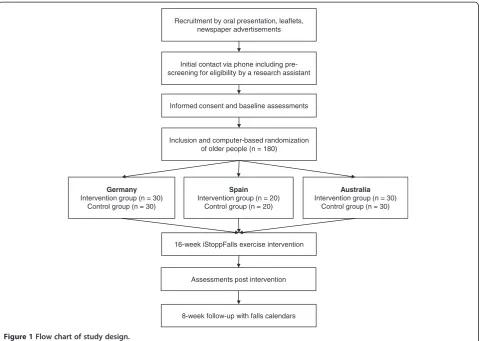
One hundred sixty community-dwelling older people aged 65 years and older will participate in this international, multicentre, single-blinded, two-group randomized trial (Figure 1). Study sites are located in Cologne, Germany (n = 60), Valencia, Spain (n = 40), and Sydney, Australia (n = 60). Participants will be recruited between November 2013 and May 2014. Older people will be enrolled if they meet the following eligibility criteria: (1) aged 65 years and
older, (2) living in the community, (3) able to walk 20 m without a walking aid, (4) able to watch television (TV) with or without their glasses from 3 m distance, and (5) have enough space for system use (3.5 m2). The exclusion criteria are: (1) insufficient language skills to understand the study procedures, (2) cognitive impairment (Mini-Cog: 1–2 recalled words and abnormal clock drawing test) [12], and (3) medical conditions (i.e., uncontrolled hyper-tension, severe neurological disorder, acute cancer, psychi-atric disorder, acute infections) that prevent participation in a regular exercise program. A medical clearance form has to be issued by the participant’s medical doctor to confirm medical suitability for the intervention program.
Randomization and blinding
Following successful baseline assessments, participants will receive a unique computer-generated random number for identification (ID). A research assistant will then allocate the participants’ ID to the intervention or control group (ratio 1:1) by using permuted block-randomisation (soft-ware available from https://apps.neura.edu.au/blinders/). Couples (participants living in the same household) will be treated as one unit and randomised into the same block. Reassessment will be performed by experienced and trained research assistants (RA) who are blinded to group allocation. To avoid unblinding of the RA, partic-ipants will be reminded not to talk about their user ex-perience during the reassessments.
Study design
The iStoppFalls system consists of a technology-supported fall prevention program and a fall risk assessment. Based on discrete measuring technologies the system predicts the individual fall risk, offers a tailored and targeted exer-cise program, and provides individual feedback to the par-ticipant. For the iStoppFalls project, custom fall prevention software has been developed. The iStoppFalls software platform consists of new video game-based exercises and exergames focussing on balance and muscle strength, and a fall risk assessment. After randomization, the partici-pants in the intervention group will be provided with a personal computer (Shuttle Barebone Slim-PC), a Google TV set top box (STB) by Sony, a Microsoft Kinect, a Senior Mobility Monitor (SMM) by Philips, and a Nexus 7 Android tablet.
exercise routine. Each participant will be provided with an educational booklet about general health and falls. Partici-pants will be assessed at baseline (0 weeks), after 8 weeks, and at the end of the intervention period (16 weeks).
Adherence will be monitored by the iStoppFalls system which tracks the exercise activity of each participant. Falls frequency will be monitored with monthly fall diaries in control and intervention participants for 6 months after randomisation. A fall will be defined using the internation-ally derived consensus definition of ‘an unexpected event in which the participant comes to rest on the ground, floor, or lower level’[13]. If the calendars are not returned, filled out incorrectly, or show non-adherence, participants will be contact by phone by a blinded (falls) and unblinded (adherence) RA, respectively. Participants will receive indi-vidual training reminders in the middle and the end of each week via the iStoppFalls system. Additionally, partici-pants will be reminded by an unblinded RA to perform at least one interactive fall risk assessment (including ques-tions about fall history and self-administered physical tests of balance, reaction time, and strength) each month.
Participants will be required to give written informed consent prior to inclusion. Ethical approval was obtained by the ethics committees of the German Sport University
Cologne (24.09.2013), the Polytechnic University of Valencia (19.12.2013), and the Human Research Ethics Committee of the University of New South Wales (refer-ence number HC12316, 19.12.2013). This trial will be con-ducted according to the ethical standards of the Helsinki Declaration.
The iStoppFalls system
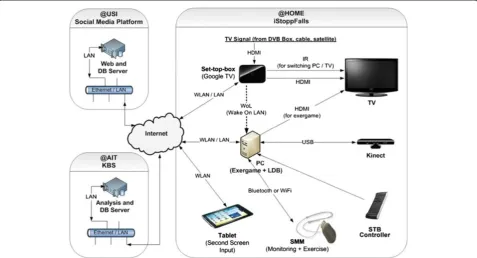
Participants interact with the system via the TV which is functionally extended by an android-based STB and a cus-tom iStoppFalls application. The STB communicates with the iStoppFalls exergame software installed on the PC (Figure 2). The application was designed using an exer-game approach, and will be used for the exercises and fall risk assessments. The Microsoft Kinect (3D depth sensor) and the custom-made SMM (3D accelerometer, barom-eter), which is worn as a necklace, will monitor the partici-pant’s performance during the assessments and exercises. In addition, the SMM is used for continuous mobility monitoring (i.e., walking distance, sit-to-stand transfer per-formance) [14].
Participants control the movements of a virtual avatar with the Microsoft Kinect. The posture of the avatar is defined by the skeleton model of the Kinect Software
Initial contact via phone including pre-screening for eligibility by a research assistant
Germany Intervention group (n = 30)
Control group (n = 30)
Spain Intervention group (n = 20)
Control group (n = 20)
Australia Intervention group (n = 30)
Control group (n = 30) Recruitment by oral presentation, leaflets,
newspaper advertisements
Informed consent and baseline assessments
16-week iStoppFalls exercise intervention
Assessments post intervention
8-week follow-up with falls calendars Inclusion and computer-based randomization
of older people (n = 180)
Development Kit after applying filters to avoid jerky movements [15]. Tracked motions, joint angles, and pos-tures will be further used to define the real-time feed-back for the users who will be informed about the distance walked (in meters) equivalent to their body movements [16,17]. All aggregated data are transmitted to a knowledge-based system (server) for automatic data analysis and feedback generation. The participants will be able to monitor their results continuously via the STB over their interactive TV or tablet at home. An in-tegrated social media platform will enable users to inter-act with each other and share their results.
Design of intervention
Following system installation, participants allocated to the intervention group will conduct a 16-week exercise program focusing on improving static balance, dynamic balance, and muscle strength for the lower extremities. The training content is based on best practice recom-mendations for exercise to prevent falls in older people by Sherrington et al. [10,18]. It will be recommended that the participants perform at least three balance ses-sions of about 40 min each (including each of the exer-games) and at least three muscle strength sessions of about 15 to 20 min each (including all strength exer-cises) per week. Participants are recommended to per-form 10 min of balance exercises before each strength
training session. The weekly training duration should therefore total to about 120 min for balance training and 45 to 60 min for strength training (resulting in approxi-mately 50 h over 16 weeks). Participants will be re-commended not to do strength training sessions on consecutive days. When balance and strength training is combined, participants will be instructed to start with the balance session. The prescribed exercise intensity is moderate to high varying according to the level of diffi-culty, number of repetitions, and additional ankle cuff weights (1 kg or 2 kg) used. Participants in the interven-tion group who decide to discontinue the exercise pro-gram may still continue to send in the monthly falls calendars and perform the reassessments.
General training principles
A sheet of ‘Exercise Safety Guidelines’is provided to each intervention group participant. In order to maximize training effect and safety, participants are advised to hy-drate well before, during, and after the exercise sessions. They should not exercise on an empty stomach or just after a big meal. It is recommended to participants to wear comfortable, well-fitted clothes, and non-slippery shoes. Participants initially start exercising at an easy level to be-come familiar with training and technology use. For safety reasons participants should have a chair placed to each side when exercising. Participants are advised to stop
exercising and immediately consult their doctor if they feel unwell (i.e., due to a temporary illness, not taking their regular prescribed medications, having signs of angina pectoris; having difficulty breathing; and/or feeling dizzy, lightheaded or faint).
Training content
Balance exercises
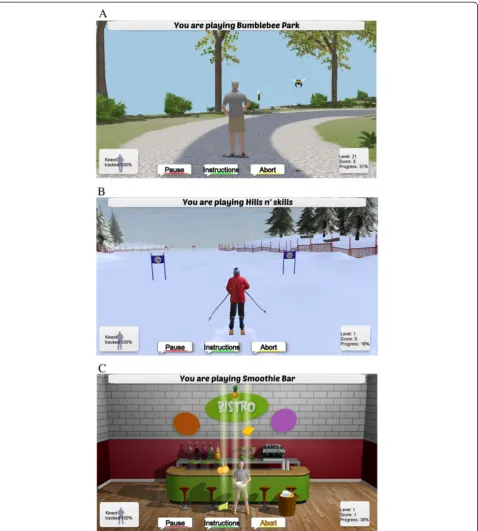
The principles of balance exercises are based on the Otago Exercise Program [19,20] and the Weight-bearing Exercise for Better Balance (WEBB) program (www.webb.org.au). The iStoppFalls program aims to improve static balance, leaning balance and stepping ability by practicing activities relevant to ADL. Three balance exergames were specific-ally developed for the iStoppFalls project‘Bumble Bee Park’, ‘Hills & Skills’, and ‘Balance Bistro’(Figure 3). All games target motor skills related to postural control including walking, weight shifting, knee bending, and/or stepping in different directions. Additionally, cognitive tasks are added once participants reach higher exergame levels (dual-tasking). In the cognitive tasks, users have to identify, memorize, and remember items, or perform mathematical calculations which randomly appear on screen. Progres-sion of balance exergames is achieved by reducing upper limb support (from two chairs to one chair to none), nar-rowing the base of support, adjusting speed of movement, increasing gaming duration, and proceeding to a higher difficulty level. Proceeding to a higher level depends on a participant's high score calculated as the sum of points of the different tasks (i.e., passed gates, collected fruits, mem-orized items). The users will get direct (real-time) feed-back about their progress by duration, score, and progress information (i.e., time, missed gates, correctly identified items) displayed on the screen.
Muscle strength exercises
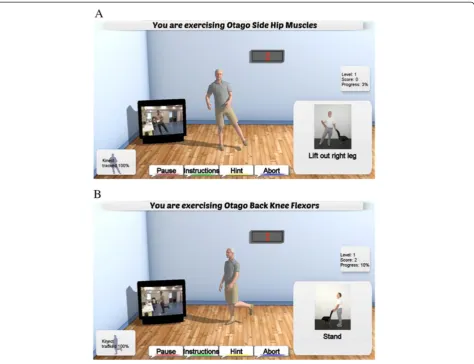
The Ambient Assisted Exercise Program (AAEP) for iStoppFalls is based on the strength exercise component of the Otago exercise program [19]. It incorporates exer-cises for muscle strength of the lower extremities used in ADL and balance recovery: knee extension, knee flexion, hip abduction, calf raises, and toe raises. For muscle strength training, 2 to 3 sets of 10 to 15 repeti-tions and rest periods of 2 min will be recommended. To ensure technically correct movements and maximal range of motion all users will be provided with visual and verbal instructions. Progression is achieved by in-creasing the number of repetitions, the number of sets, and the difficulty level (e.g., by using the provided ankle cuff weights ranging from 1 kg to 3 kg). Participants will reach the next level if they correctly perform 3 sessions. Users will get direct (real-time) feedback about their progress by duration, number of repetitions, adequacy of
movements, and progress information (e.g., percentage of completed task) displayed on the screen (Figure 4).
Education material
The educational booklet contains information about fall prevention, exercise, healthy eating, general health, foot-wear, medication, environmental hazards, and emergency procedures. It also includes a home safety checklist and a fall quiz. This content is based on well-known risk factors for falls, evidence-based fall prevention interventions, and guided by good practice principles [21]. The educational booklet aims to promote self-management, and offers sim-ple and effective strategies to reduce fall risk.
Outcome measures
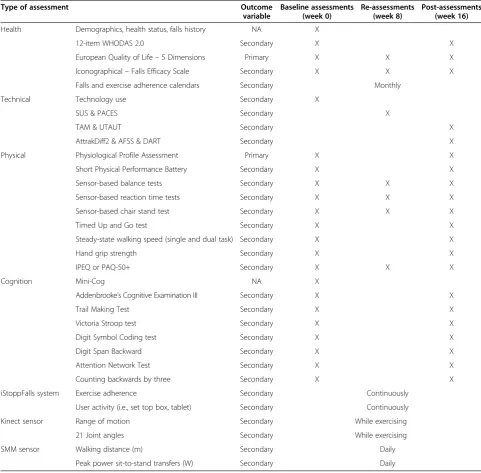
Participants will be assessed at baseline (0 weeks), in the middle (8 weeks), and at the end of the intervention period (16 weeks). The assessments will be conducted under standardized conditions at the study centres or in rooms provided by the retirement villages. Table 1 outlines the assessments performed at different time points. Each assessment will take about two hours to complete. When a stopwatch is used, time will be recorded to the nearest 0.01 s. For the Timed Up and Go (TUG), walking, and sensor-based assessments, participants will be wearing a SMM device as a necklace at the height of the sternum.
Demographic and general health
Participants will be sent a self-report questionnaire by post and will be requested to complete it prior to the baseline assessment. We will collect information on socio-demographic characteristics (age, gender, marital status, ethnicity, housing situation, economic status, pre-vious occupation, education) and medical history (pres-ence of medical conditions, medication use, history of falls). In addition, the following outcome measures will be assessed at baseline and 16 weeks follow-up.
The 12-item World Health Organization Disability As-sessment Schedule (WHODAS) 2.0 is a generic asAs-sessment instrument for six domains of general health: understand-ing and communicatunderstand-ing, mobility, self-care, interpersonal interactions, household and work activities, and participa-tion in society (www.who.int/classificaparticipa-tions/icf/whodasii/ en/). This self-administered questionnaire is short, simple, and easy to administer. It produces standardized disability levels and profiles linked to the International Classification of Functioning, Disability and Health (ICF) [22].
depression. The PHQ-9 showed excellent internal reli-ability (Cronbach’s alpha = 0.86) and discriminant valid-ity (area under the curve = 0.95) [23].
The European Quality of Life – 5 Dimensions (EQ-5D-5-L) questionnaire was developed to generate a basic
health index (www.euroqol.org/eq-5d-products/eq-5d-5l.html). Participants will describe their health status in five dimensions: mobility, self-care, usual activities, pain/discomfort, and anxiety/depression. Each dimension has three possible levels: (i) no problem, (ii) moderate
problems, or (iii) extreme problems. Thus, 243 health states represented by a 5-digit combination can be de-fined according to the relevant level within each dimen-sion (e.g., 11111 represents no problems on any dimension). In addition, participants will report their over-all health during the past 30 days on a continuous scale (0 to 100, higher score equals better health perception) [24].
The Iconographical– Falls Efficacy Scale (Icon-FES) is an innovative way of assessing concern about falling [25]. As part of the baseline assessments, the Icon-FES will be used to investigate the participants’concerns about falling (www.neura.edu.au/apps/iconfes). Thirty pictures of daily activities, each within a specific environmental context as-sociated with different probabilities about falling (i.e., tak-ing the escalator, gotak-ing downstairs), will be graded by the participant on a 4-point Likert scale (1 = not at all con-cerned, 4 = very concerned). The Icon-FES has excellent psychometric properties and shows close continuity with the Falls Efficacy Scale International (Spearman’s rho = 0.742, P < .001) [25,26].
Physical and functional assessments
The Physiological Profile Assessment (PPA) short version will be applied to generate an overall fall risk score based on tests which directly assess sensorimotor abilities: con-trast sensitivity (Melbourne edge test (MET), peripheral sensation (proprioception), balance (sway when standing on medium-density foam with eyes open), lower extremity muscle strength (knee extension), and hand reaction time [27]. In multivariate models these variables provide an overall falls risk score, and can predict those at risk of fall-ing with 75% accuracy in community and retirement vil-lage settings. A PPA score indicates mild (<1), moderate (1–2), and marked (≥2) fall risk in relation to a normative database. In addition, two PPA long version tests for lean-ing balance will be applied (coordinated stability test and maximal balance range test).
The Short Physical Performance Battery (SPPB) will be used to assess lower extremity function based on the fol-lowing tests: static balance (side-by-side, semi-tandem, and tandem stance), walking speed over 4 m (at normal
pace), and the five times chair stand test [28]. Each test will be assigned a score from 1 (worst) to 4 (best). Sum-ming the category scores for the three tests can be used to create a SPPB summary performance scale.
The TUG by Podsiadlo and Richardson [29] will assess a combination of basic functionality, physical mobility, and dynamic balance [30,31]. On the word ‘go’, participants will have to stand up from a chair, walk to a three meter mark, come back, and sit down in the chair again. Time
will be recorded with a stopwatch from the word‘go’until the participant sits down. Test-retest reliability of the TUG in older people is excellent (ICC = 0.99) [29].
Steady-state walking speed will be measured over a 10 m distance (plus 2 m for acceleration and 2 m for de-celeration) by using a stop watch [32]. At the start and the finish there will be a standard chair with arm rests posi-tioned. All walks will be performed barefoot. The partici-pants will be instructed to walk at their comfortable Table 1 Study assessments by time point
Type of assessment Outcome
variable
Baseline assessments (week 0)
Re-assessments (week 8)
Post-assessments (week 16)
Health Demographics, health status, falls history NA X
12-item WHODAS 2.0 Secondary X X
European Quality of Life–5 Dimensions Primary X X X
Iconographical–Falls Efficacy Scale Secondary X X X
Falls and exercise adherence calendars Secondary Monthly
Technical Technology use Secondary X
SUS & PACES Secondary X
TAM & UTAUT Secondary X
AttrakDiff2 & AFSS & DART Secondary X
Physical Physiological Profile Assessment Primary X X
Short Physical Performance Battery Secondary X X
Sensor-based balance tests Secondary X X X
Sensor-based reaction time tests Secondary X X X
Sensor-based chair stand test Secondary X X X
Timed Up and Go test Secondary X X
Steady-state walking speed (single and dual task) Secondary X X
Hand grip strength Secondary X X
IPEQ or PAQ-50+ Secondary X X X
Cognition Mini-Cog NA X
Addenbrooke’s Cognitive Examination III Secondary X X
Trail Making Test Secondary X X
Victoria Stroop test Secondary X X
Digit Symbol Coding test Secondary X X
Digit Span Backward Secondary X X
Attention Network Test Secondary X X
Counting backwards by three Secondary X X
iStoppFalls system Exercise adherence Secondary Continuously
User activity (i.e., set top box, tablet) Secondary Continuously
Kinect sensor Range of motion Secondary While exercising
21 Joint angles Secondary While exercising
SMM sensor Walking distance (m) Secondary Daily
Peak power sit-to-stand transfers (W) Secondary Daily
normal walking speed [33]. Time is recorded with a stop watch when the participant’s limb crosses the first marker until the participant’s limb crosses the second marker. During the second walk, participants will be asked to count backwards by three starting from a random 3-digit number (dual-tasking) [34]. The potential resulting dual task interference will give an indication of the extent to which older people slow down when simultaneously walk-ing and countwalk-ing [35].
A hydraulic hand grip dynamometer (Europe: Jamar Dynamometer, Lafayette Instrument, Lafayette, IN, USA; Australia: North Coast Hydraulic Hand Dynamometer, North Coast Medical, Inc., Morgan Hill, CA, USA) will be used to assess hand grip muscle strength. Participants will sit in a comfortable chair with the elbow flexed to 90 de-grees, the wrist in a neutral position, and the shoulder adducted and neutrally rotated. After the participant ex-erts maximal force, strength is recorded to the nearest 1 kg. Each participant has three attempts while the highest score is used for analysis. Low muscle strength will be classified as hand grip strength <30 kg in men and <20 kg in women according to the European Working Group on Sarcopenia in Older People consensus paper [31].
To assess the participants’level of physical activity, the Incidental and Planned Activity Questionnaire (IPEQ) [36] will be used in the Australian and Spanish study arm. The IPEQ consists of a self-report questionnaire which fo-cusses on the frequency and duration of several levels of planned and incidental physical activity in older people. This questionnaire focuses on weekly physical activity in-cluding planned exercises or walks, and more casual day-to-day activities. The total duration of physical activity is summed across all components and expressed as hours per week. Measurement properties and concurrent validity for the IPEQ have been reported to be excellent [36]. In the German study arm the Physical Activity Questionnaire for the population aged 50 years and older (PAQ-50+) [37] will be applied. It evaluates physical activity during an average week of the past month. This questionnaire esti-mates physical activity of older people based on exercise, housework, gardening, job, and leisure activities. By multi-plying the metabolic equivalent of an activity by the dur-ation of performing the physical activity an estimate of total energy expenditure can be obtained. The PAQ-50+ showed an acceptable test-retest reliability of 0.52 to 0.60 [37].
Sensor-based physical assessments
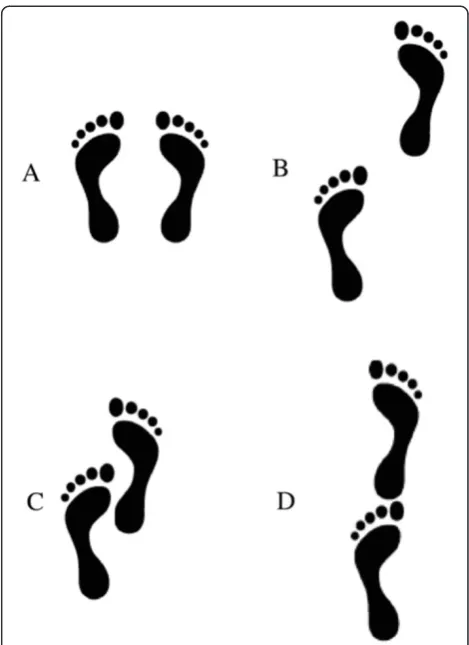
Four sensor-based physical assessments using the iStopp-Falls software, the Microsoft Kinect, and the SMM will be performed barefoot in front of a TV: (1) Balance tests in-clude comfortable-bipedal, semi-tandem, near-tandem, and tandem stance (Figure 5). Each balance task will be re-peated twice for a maximum duration of 30 s with the
preferred foot in front (no changes allowed between the different stances) and eyes open. After the countdown ‘ready, set, go’, time will be stopped when the participant moves his/her feet, touches the chair for support, or suc-cessfully reaches 30 s. (2) The hand reaction time test will require participants to use their hands to hit two randomly flashing lights positioned to the left and right on a virtual table. Two sets of 20 repetitions will be performed. (3) For the stepping reaction time test, two randomly flashing lights will be positioned to the left and right on a virtual floor. Participants will need to perform a lateral step onto the flashing light as fast as possible. Stepping should in-clude weight-shifting rather than only foot tapping to the side. Two sets of 20 repetitions will be performed. (4) The sit-to-stand test is a functional measure for lower extrem-ity strength, power, and balance. Participants will be instructed to cross their arms over the abdomen, and rise from a chair for five times as quickly as possible. Time measured by a stop watch indicates insufficient (≥16.7 s), sufficient (13.7 s to 16.6 s), good (11.2 s to 13.6 s), and very good strength performance (≤11.1 s) [38].
User activity and adherence
Based on the real-time user activity tracking inside the exergame (biomechanical model of the Kinect sensor) and overall iStoppFalls system (SMM and all human computer interactions), this study will be able to measure adherence to the protocol and correlate these results with the assess-ment outcomes. This will include the datasets of all exer-cises for each participant including complete biomechanical analysis of the range of motion as well as the quality of exercises performed in the balance games and strength training.
Neuropsychological assessments
The Mini-Cog will be used as a screening tool for cogni-tive impairment which forms part of the exclusion cri-teria [12]. It consists of a 3-item recall and a clock drawing test (CDT). Participants recalling none of the words will be classified as cognitively impaired, those recalling all three words will be classified as cognitively healthy, and those with intermediate word recall (1 to 2) will be classified based on the CDT (abnormal = im-paired, normal = healthy). For reasons of copyright pro-tection, approval for the use of the Mini-Cog has been obtained by Dr Soo Borson.
The Addenbrooke’s Cognitive Examination III (ACE-III) is a brief cognitive assessment including five domains: at-tention, memory, verbal fluency, language, and visuospatial abilities (http://www.neura.edu.au/frontier/research/test-downloads/). The total score is 100 with higher scores indicating better cognitive functioning. The ACE-III re-places the previous Addenbrooke’s Cognitive Examination-Revised (ACE-R) showing high sensitivity and specificity at cut-offs previously recommended: 88 (sensitivity = 1.0; spe-cificity = 0.96) and 82 (sensitivity = 0.93; spespe-cificity = 1.0) [39]. Internal reliability using Cronbach’s alpha was good for the ACE-III (0.88) [39].
The Trail Making Test (TMT) serves as a measure of executive function (divided attention), processing/motor speed, and mental flexibility [40,41]. The participants will be asked to connect 25 encircled numbers (Part A) randomly arranged on an A4-sized paper in the correct order by using a pencil. In Part B, the participants will have to draw lines alternating between a total of 25 numbers and letters. For each part there will be a prac-tice trial consisting of eight circles. The TMT is scored by measuring the time for the completion of each part, and by calculating ratio [Part B / Part A] and difference [Part B–Part A] scores [42].
Cognitive control will be assessed by the Victoria Stroop Test (VST) [41]. Participants will have to main-tain a goal in mind and supress habitual responses to correctly perform the task. The VST consists of 24 items on each of three tasks: (1) identifying the colour of dots displayed in blue, green, red, or yellow; (2) identifying
the colour of common words and disregarding their verbal content; and (3) identifying the ink colour of displayed colour words (e.g.,‘blue’is written in red ink). A PC using the Psychology Experiment Building Language (PEBL) software version 0.13 in combination with a custom-made button device will be applied to perform the VST. The number of errors and time taken for each task will be re-corded and stored locally on a PC.
The Digit Symbol Coding Test (DSC) is a multifaceted task (i.e., motor speed and incidental learning) from the Wechsler Adult Intelligence Scale (WAIS) III and will be used to investigate processing speed [43]. It consists of nine symbols that are paired with numbers. Participants will be required to copy as many symbols as possible within 120 s. The primary measure of this test is the number of correct symbols.
The Digit Span Backward (DSB) from the WAIS-III is a measure of working memory, attention, and concentration [43]. Participants will be required to repeat 2- to 9-digit numbers in the reverse order as stated by the investigator [41]. Every task consists of two sets of numbers. If the par-ticipant fails to repeat both sets of numbers, the test will be terminated. Each correctly repeated set of numbers will be scored with one point.
The Attention Network Test (ANT) will be used to quantify the processing efficiency within three tional networks: alerting, orienting, and executive atten-tion [44]. In this study a computer-based version of the ANT will be applied (PEBL software version 0.13) [45]. The ANT requires participants to determine whether a central arrow points to the left or right. Efficiency of the three attentional networks (alerting, orienting, and ex-ecutive function) is assessed by measuring how response times are influenced by alerting cues, spatial cues, and flankers. All data will be recorded and stored locally on a PC.
A single task measure of counting backwards by three will have to be obtained to measure the amount of inter-ference caused by simultaneously walking and counting backwards by three (dual-tasking) [35]. In this single task, participants will sit in a chair and start counting back-wards by three from a random 3-digit number. The time stopped will be equal to the time used for the 10 m walk. To quantify interference, ratios between the correct num-ber of answers during single-tasking will be compared to the number of correct answers during dual-tasking (dual task costs = [100 * (single task score – dual task score)/ single task score] [46]. If the participant continues to count correctly after making a mistake, this will only be counted as one mistake.
Feasibility, usability, and user acceptance surveys
survey created by H. R. Marston [47]. It includes ques-tions on ownership of technological devices (i.e., type of computer, games console, tablet, and mobile phone), self-perceived ability to learn how to play digital games, internet use, intergenerational relationships, length of time and frequency of digital game playing, preference of digital game genres, intention to play digital games in the future, purchasing habits of digital games, purpose for buying the digital games, and social activities.
Usability and enjoyment will be assessed in the inter-vention group using the System Usability Scale (SUS) and the Physical Activity Enjoyment Scale (PACES). The PACES [48,49] will assess enjoyment of the exercises, and the SUS [50] will assess the usability of the iStopp-Falls system.
The Activity Flow State Scale (AFSS) created by Payne et al. [51] was adapted from an earlier scale called the Flow State Scale (FSS) created by Jackson and Marsh [52]. The AFSS comprises of 26 items which are mea-sured on a 5-point Likert scale ranging from 1 (strongly disagree) to 5 (strongly agree).
The AttrakDiff2 questionnaire initially created and fur-ther developed by Hassenzahl et al. [53,54] will be used to examine the usability of the exergames by addressing he-donic and pragmatic qualities, attractiveness, as well as identification with and stimulation through the iStoppFalls program. The questionnaire comprises 28 items which are measured on a 7-point Likert scale.
The Technology Acceptance Model (TAM) [55] is ap-plied to measure the user acceptance of a system or technology. In its original form the TAM provides two dimensions of technology acceptance ‘perceived benefit’ and ‘perceived ease of use’. In this study an extended version as suggested by F. Davis [56] was used, including the dimensions ‘perceived effort’ and ‘perceived design’. Constructs of the Unified Theory of Acceptance and Use of Technology Model (UTAUT), as well as computer self-efficacy and trust will be added to the original TAM. The analyses will show the validity of this acceptance model in regard to the user acceptance of iStoppFalls.
Mid-term assessments
After eight weeks, participants will be sent the following questionnaires by mail: Icon-FES, IPEQ or PAQ-50+, and EQ-5D-5-L. For the intervention group, the sensor-based physical assessments will be repeated at the partic-ipants’homes.
Statistical analyses and sample size
A priori power analysis has been conducted for PPA as the primary outcome by using data from a previous study. The estimated sample size of 52 participants for the individual study sites in Cologne and Sydney is based on a large effect (f = 0.40) for the PPA (ANCOVA, alpha
5%, power 80%, numerator df 1, number of groups 2, number of covariates 1) [57]. With an anticipated drop-out of 15%, 60 participants will be recruited. The sample size will be sufficient for determining clinically signifi-cant between-group and within-group differences as well as main interaction effects in the continuously-scaled physical and cognitive outcome measures. For this study the intention-to-treat method will be used. Data on feasibility will be analysed using descriptive techniques. Student t-tests (for continuous variables with normal distribution), Fisher's exact test (for nominal data, small sample size), and Mann–Whitney U test (for ordinal or continuous data without normal distribution) will be used to determine differences between the intervention and control group at baseline. Analysis of covariates (ANCOVA) will be used to determine the intervention effect on outcome measures at follow-up adjusting for baseline values. Negative binomial regression will be used to test for differences in fall rates between groups. Paired t-tests and repeated measures ANOVA will be used to analyse changes within groups and to explore subgroups (e.g., different doses) in the intervention group. The alpha level will be set at 5%. Analyses will be performed with SPSS version 23 for Windows (SPSS, Inc., Chicago, IL). Reporting of the trial will follow CONSORT [58] statement for non-pharmacological in-terventions and the SPIRIT [59] guidance for protocols of clinical trials.
Discussion
This study is designed to evaluate the feasibility and ef-fectiveness of an easy to administer ICT-based system for fall prevention in older people living independently at home. In a large recent meta-analysis, home-based ex-ercise has shown the potential to reduce the rate of falls (rate ratio 0.68, 95% CI 0.58 to 0.80) and fall risk (risk ratio 0.78, 95% CI 0.64 to 0.94) [8]. Previous studies showed that exercise positively affecting physical, cogni-tive, and functional performance comprises of a combin-ation of balance and strength [60,61]. The iStoppFalls program has been developed to offer simple and enjoy-able exercises to older people in their home environ-ment. Particularly those older people who do not like to participate in traditional exercise programs (i.e., group training, gym workouts), are not willing to leave their house (e.g., caring for their partner), or struggle to get to the training grounds (e.g., insufficient public transport services) may benefit from exercising on the iStoppFalls system at home.
interactive environments have potential to stimulate phys-ical, cognitive, and sensory measures crucial to maintain postural control and thus prevent falls [63]. The current trial will provide data on how the iStoppFalls ICT-based exercise intervention affects balance (e.g., sway), strength (e.g., lower extremity strength), ADL (e.g., gait velocity), cognition (e.g., attention), health (e.g., quality of life), and rate of falls.
Virtual reality and gaming technology for older people have the potential to be incorporated into the clinical and home environment in the near future [64]. However, current commercially available systems are not tailored for use in older people. Our current trial will address these is-sues and provide data on feasibility (e.g., individual use at home), usability (e.g., navigating through a program), safety (e.g., adverse events), adherence, and enjoyment of using ICT-based systems to facilitate successful ageing. The iStoppFalls program and this trial will provide insights into older people’s attitudes and practices regarding ICT use and support of self-management of health (falls) by means of continuous monitoring of their own fall risk and associated measures like a daily activity profile, balance games, and evidence-based strength training to prevent falls. We hypothesize that ICT-systems such as iStoppFalls have the potential to provide effective means for reducing fall risk in older people.
Competing interests
The PPA (NeuRA FallScreen) is commercially available through Neuroscience Research Australia. The Incidental and Planned Exercise Questionnaire (IPEQ) is available as a not-for-profit iPad application through Neuroscience Research Australia (NeuRA). The authors declare that they have no other competing interests. Funding sources are declared in the acknowledgements and did not influence the design or the implementation of the study.
Authors’contributions
Study concept and design: all authors. Drafting of the manuscript: HRM, KD, RW, SE, YJG. Critical revision of the manuscript for important intellectual content: all authors. Obtained funding: KD, RW. Administrative, technical, and material support: JA. Study supervision: KD, RW, SE. All authors read and approved the final manuscript.
Authors’information
Yves J Gschwind and Sabine Eichberg are joint first authors.
Acknowledgements
The authors are members of the iStoppFalls project. This project has received funding from the European Union’s Seventh Framework Programme for research, technological development, and demonstration under grant agreement no [287361]. The Australian arm is funded by an Australian National Health and Medical Research Council (NHMRC) EU collaboration grant (#1038210). The content of the manuscript does not represent the opinion of the European Community or NHMRC. The funding sources have no role in any aspects of this study.
Yves J. Gschwind has been financially supported by a research grant from the Margarete and Walter Lichtenstein Foundation, Basel, Switzerland. Stephen R. Lord is supported by NHMRC as a Senior Principal Research Fellow and Kim Delbaere as a NHMRC Career Development Fellow. All other authors are supported by the iStoppFalls project, European Community Grant Agreement 287361. On behalf the iStoppFalls consortium, we would like to thank all the participants who take part in the study.
Author details
1
Neuroscience Research Australia, University of New South Wales, Barker Street, Randwick, Sydney, New South Wales 2031, Australia.2Institute of
Movement and Sport Gerontology, German Sport University Cologne, Am Sportpark Muengersdorf 6, 50933 Cologne, Germany.3Assisted Healthcare
Information Technology Safety and Security Department, AIT Austrian Institute of Technology GmbH, Donau-City-Strasse 1, 1220 Vienna, Austria.
4
Institute of Biomechanics of Valencia, University Polytechnic of Valencia, Edificio 9C Camino de Vera s/n 46022, Valencia, Spain.5Personal Health
Department, Philips Research Europe, High Tech Campus 34, 5656AE Eindhoven, The Netherlands.6Institute for Information Systems, University of
Siegen, Hölderlinstrasse 3, 57076 Siegen, Germany.
Received: 30 June 2014 Accepted: 14 August 2014 Published: 20 August 2014
References
1. Berchicci M, Lucci G, Di Russo F:Benefits of physical exercise on the aging brain: the role of the prefrontal cortex.J Gerontol A Biol Sci Med Sci2013,
68(11):1337–1341.
2. World Health Organization:WHO Global Report on Falls Prevention in Older Age.Geneva: World Health Organization (WHO); 2007.
3. Michael YL, Whitlock EP, Lin JS, Fu R, O'Connor EA, Gold R, U. S. Preventive Services Task Force:Primary care-relevant interventions to prevent falling in older adults: a systematic evidence review for the U.S. Preventive Services Task Force.Ann Intern Med2010,153(12):815–825. 4. Tinetti ME, Speechly M, Ginter SF:Risk factors for falls among elderly
persons living in the community.N Engl J Med1988,319(26):1701–1707. 5. Blake AJ, Morgan K, Bendall MJ, Dallosso H, Ebrahim SB, Arie TH, Fentem PH,
Bassey EJ:Falls by elderly people at home: prevalence and associated factors.Age Ageing1988,17(6):365–372.
6. Rubenstein LZ:Falls in older people: epidemiology, risk factors and strategies for prevention.Age Ageing2006,35:ii37–ii41.
7. Salkeld G, Cameron ID, Cumming RG, Easter S, Seymour J, Kurrle SE, Quine S:
Quality of life related to fear of falling and hip fracture in older women: a time trade off study commentary.BMJ2000,320(7231):341–346. 8. Gillespie LD, Robertson MC, Gillespie WJ, Sherrington C, Gates S, Clemson
LM, Lamb SE:Interventions for preventing falls in older people living in the community.Cochrane Database Syst Rev2012,9, CD007146. 9. Panel on Prevention of Falls in Older Persons, American Geriatrics Society,
British Geriatrics Society:Summary of the updated American Geriatrics Society/British Geriatrics Society clinical practice guideline for prevention of falls in older persons.J Am Geriatr Soc2011,59(1):148–157.
10. Sherrington C, Whitney JC, Lord SR, Herbert RD, Cumming RG, Close JC:
Effective exercise for the prevention of falls: a systematic review and meta-analysis.J Am Geriatr Soc2008,56(12):2234–2243.
11. Dergance JM, Calmbach WL, Dhanda R, Miles TP, Hazuda HP, Mouton CP:
Barriers to and benefits of leisure time physical activity in the elderly: differences across cultures.J Am Geriatr Soc2003,51(6):863–868. 12. Borson S, Scanlan J, Brush M, Vitaliano P, Dokmak A:The mini-cog: a
cognitive 'vital signs' measure for dementia screening in multi-lingual elderly.Int J Geriatr Psychiatry2000,15(11):1021–1027.
13. Lamb SE, Jørstad-Stein EC, Hauer K, Becker C, Prevention of Falls Network Europe and Outcome Consensus Group:Development of a common outcome data set for fall injury prevention trials: the Prevention of Falls Network Europe Consensus.J Am Geriatr Soc2005,53(9):1618–1622. 14. Zhang W, Regterschot GR, Schaabova H, Baldus H, Zijlstra W:Test-retest
reliability of a pendant-worn sensor device in measuring chair rise performance in older persons.Sensors2014,14(5):8705–8717. 15. De Rosario H, Belda-Lois JM, Fos F, Medina E, Poveda-Puente R, Kroll M:
Correction of joint angles from Kinect for balance exercising and assessment.J Appl Biomech2013,30(2):294–299.
16. Ralston HJ, Lukin L:Energy levels of human body segments during level walking.Ergonomics1969,12(1):39.
17. McArdle WD, Katch FI, Katch VL:Energy expenditure at rest and during physical activity. InEssentials of exercise physiology.3rd edition. Philadelphia: Lippincott Williams & Wilkins; 2006.
19. Campbell AJ, Robertson MC, Gardner MM, Norton RN, Tilyard MW, Buchner DM:Randomised controlled trial of a general practice programme of home based exercise to prevent falls in elderly women.BMJ1997,
315(7115):1065–1069.
20. Robertson MC, Devlin N, Gardner MM, Campbell AJ:Effectiveness and economic evaluation of a nurse delivered home exercise programme to prevent falls. 1: randomised controlled trial.BMJ2001,322(7288):697–701. 21. American College of Sports M, Chodzko-Zajko WJ, Proctor DN, Fiatarone
Singh MA, Minson CT, Nigg CR, Salem GJ, Skinner JS:American College of Sports Medicine position stand. Exercise and physical activity for older adults.Med Sci Sports Exerc2009,41(7):1510–1530.
22. Grimby G, Smedby B:ICF approved as the successor of ICIDH.J Rehabil Med2001,33(5):193–194.
23. Kroenke K, Spitzer RL, Williams JB:The PHQ-9: validity of a brief depression severity measure.J Gen Intern Med2001,16(9):606–613.
24. Brooks R:EuroQol: the current state of play.Health policy1996,37(1):53–72. 25. Delbaere K, Smith ST, Lord SR:Development and initial validation of the
iconographical falls efficacy scale.J Gerontol A Biol Sci Med Sci2011,
66(6):674–680.
26. Yardley L, Beyer N, Hauer K, Kempen G, Piot-Ziegler C, Todd C:Development and initial validation of the Falls Efficacy Scale-International (FES-I).Age Ageing2005,34(6):614–619.
27. Lord SR, Menz HB, Tiedemann A:A physiological profile approach to falls risk assessment and prevention.Phys Ther2003,83(3):237–252. 28. Guralnik JM, Simonsick EM, Ferrucci L, Glynn RJ, Berkman LF, Blazer DG,
Scherr PA, Wallace RB:A short physical performance battery assessing lower extremity function: association with self-reported disability and prediction of mortality and nursing home admission.J Gerontol1994,49(2):M85–M94. 29. Podsiadlo D, Richardson S:The timed "Up & Go": a test of basic functional
mobility for frail elderly persons.J Am Geriatr Soc1991,39(2):142–148. 30. Schaubert KL, Bohannon RW:Reliability and validity of three strength
measures obtained from community-dwelling elderly persons.J Strength Cond Res2005,19(3):717–720.
31. Cruz-Jentoft AJ, Baeyens JP, Bauer JM, Boirie Y, Cederholm T, Landi F, Martin FC, Michel JP, Rolland Y, Schneider SM, Topinkova E, Vandewoude M, Zamboni M, European Working Group on Sarcopenia in Older People:
Sarcopenia: European consensus on definition and diagnosis: report of the European Working Group on Sarcopenia in Older People.Age Ageing 2010,39(4):412–423.
32. Fritz S, Lusardi M:White paper:“walking speed: the sixth vital sign”. J Geriatr Phys Ther2009,32(2):46–49.
33. Gschwind YJ, Bischoff-Ferrari HA, Bridenbaugh SA, Hardi I, Kressig RW:Association between serum vitamin D status and functional mobility in memory clinic patients aged 65 years and older.Gerontology2014,60(2):123–129. 34. Granacher U, Bridenbaugh SA, Muehlbauer T, Wehrle A, Kressig RW:
Age-related effects on postural control under multi-task conditions. Gerontology2011,57(3):247–255.
35. Sheridan PL, Hausdorff JM:The role of higher-level cognitive function in gait: executive dysfunction contributes to fall risk in Alzheimer's disease. Dement Geriatr Cogn Disord2007,24(2):125–137.
36. Delbaere K, Hauer K, Lord SR:Evaluation of the incidental and planned activity questionnaire for older people.Br J Sports Med2010,
44(14):1029–1034.
37. Huy C, Schneider S:Instrument for the assessment of middle-aged and older adults' physical activity: design, eliability and application of the German-PAQ-50+.Z Gerontol Geriatr2008,41(3):208–216.
38. Whitney SL, Wrisley DM, Marchetti GF, Gee MA, Redfern MS, Furman JM:
Clinical measurement of sit-to-stand performance in people with balance disorders: validity of data for the Five-Times-Sit-to-Stand test. Phys Ther2005,85(10):1034–1045.
39. Hsieh S, Schubert S, Hoon C, Mioshi E, Hodges JR:Validation of the Addenbrooke's Cognitive Examination III in frontotemporal dementia and Alzheimer's disease.Dement Geriatr Cogn Disord2013,36(3–4):242–250. 40. Reitan RM:The relation of the trail making test to organic brain damage.
J Consult Psychol1955,19(5):393–394.
41. Strauss E, Sherman EMS, Spreen O, Spreen O:A Compendium of Neuropsychological Tests: Administration, Norms, and Commentary.3rd edition. Oxford, New York: Oxford University Press; 2006.
42. Lamberty GJ, Putnam SH, Chatel DM, Bieliauskas LA, Adams KM:Derived Trail Making Test indexes - a preliminary report.Neuropsy Neuropsy Be 1994,7(3):230–234.
43. Wechsler D:Manual for the Wechsler Adult Intelligence Scale-III.San Antonio, Texas: Psychological Corporation; 1997.
44. Fan J, McCandliss BD, Sommer T, Raz A, Posner MI:Testing the efficiency and independence of attentional networks.J Cogn Neurosci2002,
14(3):340–347.
45. Mueller ST:The PEBL Attentional Network Test (PANT).2011, Computer software retrieved from http://pebl.sf.net/battery.html. 46. Beurskens R, Bock O:Age-related deficits of dual-task walking: a review.
Neural plasticity2012,2012:131608.
47. Marston HR:Older adults as 21st century game designers.The Computer Games Journal2012,1(1):90–102.
48. Mullen SP, Olson EA, Phillips SM, Szabo AN, Wojcicki TR, Mailey EL, Gothe NP, Fanning JT, Kramer AF, McAuley E:Measuring enjoyment of physical activity in older adults: invariance of the physical activity enjoyment scale (PACES) across groups and time.Int J Behav Nutr Phys Act2011,
8:103.
49. Kendzierski D, Decarlo KJ:Physical-Activity Enjoyment Scale - two validation studies.J Sport Exerc Psychol1991,13(1):50–64. 50. Borsci S, Federici S, Lauriola M:On the dimensionality of the system
usability scale: a test of alternative measurement models.Cogn Process 2009,10(3):193–197.
51. Payne BR, Jackson JJ, Noh SR, Stine-Morrow EA:In the zone: flow state and cognition in older adults.Psychol Aging2011,26(3):738–743.
52. Jackson SA, Marsh HW:Development and validation of a scale to measure optimal experience: the Flow State Scale.J Sport Exerc Psychol 1996,18(1):17–35.
53. Hassenzahl M:The effect of perceived hedonic quality on product appealingness.Int J Hum-Comput Int2001,13(4):481–499.
54. Hassenzahl M, Tractinsky N:User experience - a research agenda.Behav Inform Technol2006,25(2):91–97.
55. Chuttur M:Overview of the technology acceptance model: origins, developments and future directions.Sprouts: Working Papers on Information Systems2009,9:37.
56. Davies F:A Technology Acceptance Model for Empirically Testing New End-user Information Systems - Theory and Results.Cambridge, Massachusetts: Massachusetts Institute of Technology; 1985.
57. Schoene D, Lord SR, Delbaere K, Severino C, Davies TA, Smith ST:A randomized controlled pilot study of home-based step training in older people using videogame technology.PLoS One2013,8(3):e57734. 58. Moher D, Hopewell S, Schulz KF, Montori V, Gotzsche PC, Devereaux PJ,
Elbourne D, Egger M, Altman DG, Consort:CONSORT 2010 explanation and elaboration: updated guidelines for reporting parallel group randomised trials.Int J Surg2012,10(1):28–55.
59. Chan AW, Tetzlaff JM, Gotzsche PC, Altman DG, Mann H, Berlin JA, Dickersin K, Hrobjartsson A, Schulz KF, Parulekar WR, Krleza-Jeric K, Laupacis A, Moher D:SPIRIT 2013 explanation and elaboration: guidance for protocols of clinical trials.BMJ2013,346:e7586.
60. Granacher U, Muehlbauer T, Zahner L, Gollhofer A, Kressig RW:Comparison of traditional and recent approaches in the promotion of balance and strength in older adults.Sports Med2011,41(5):377–400.
61. Granacher U, Muehlbauer T, Bridenbaugh S, Bleiker E, Wehrle A, Kressig RW:
Balance training and multi-task performance in seniors.Int J Sports Med 2010,31(5):353–358.
62. Kharrazi H, Lu AS, Gharghabi F, Coleman W:A scoping review of health game research: past, present, and future.Games Health J2012,1:2. 63. de Bruin ED, Schoene D, Pichierri G, Smith ST:Use of virtual reality
technique for the training of motor control in the elderly. Some theoretical considerations.Z Gerontol Geriatr2010,43(4):229–234. 64. Lange BS, Requejo P, Flynn SM, Rizzo AA, Valero-Cuevas FJ, Baker L, Winstein
C:The potential of virtual reality and gaming to assist successful aging with disability.Phys Med Rehabil Clin N Am2010,21(2):339–356.
doi:10.1186/1471-2318-14-91