Geschke Center
Doctoral Dissertations Theses, Dissertations, Capstones and Projects
2018
Use of Multimedia Games for Biology Vocabulary
Instruction
Ian Murray
University of San Francisco, [email protected]
Follow this and additional works at:https://repository.usfca.edu/diss Part of theScience and Mathematics Education Commons
This Dissertation is brought to you for free and open access by the Theses, Dissertations, Capstones and Projects at USF Scholarship: a digital repository @ Gleeson Library | Geschke Center. It has been accepted for inclusion in Doctoral Dissertations by an authorized administrator of USF Scholarship: a digital repository @ Gleeson Library | Geschke Center. For more information, please [email protected].
Recommended Citation
The University of San Francisco
USE OF MULTIMEDIA GAMES FOR BIOLOGY VOCABULARY INSTRUCTION
A Dissertation Presented
to
The Faculty of the School of Education
Department of Learning & Instruction
In Partial Fulfillment
of the Requirements for the Degree
Doctor of Education
By
Ian Murray
San Francisco
ii
THE UNIVERSITY OF SAN FRANCISCO
Dissertation Abstract
Use of Multimedia Games for Biology Vocabulary Instruction
Vocabulary knowledge is considered fundamental to learning. However, students
typically find learning scientific vocabulary quite difficult, and that is especially true for
biology vocabulary. Games are well established as effective tools for vocabulary
instruction. Multimedia instruction is likewise recognized as aiding vocabulary learning.
To date, however, there seems have been little examination of the use of multimedia
games in biology vocabulary instruction. This study, therefore, compared the
effectiveness of digital multimedia games and traditional instruction in teaching biology
vocabulary.
A two-group, quasi-experimental study was carried out over the course of 61
days. Participants were a convenience sample of 10 high school biology classes (N =
276). Fixed-effects multivariate analysis of covariance (MANCOVA) was used for three
dependent variables: 1) scores on tests of biology vocabulary; 2) scores on tests of
biology concepts; and 3) vocabulary feedback and Reduced Instructional Materials
Motivation Survey (RIMMS) scores.
The multimedia group put more work into the vocabulary practice at Time 1 (27
days) and Time 2 (59 days) than did the traditional-instruction group, to a degree that was
statistically significant. In addition, at Time 2 the multimedia group indicated a greater
iii
that was statistically significant. RIMMS data collected after the end of instruction also
showed that the multimedia instruction group scored higher on measures of learner
satisfaction than the traditional instruction control group, to a statistically significant
degree.
Contrary to what previous research would predict, there was no statistically
significant difference in vocabulary learning between groups using multimedia games
and those using traditional instruction. In keeping with previous research, use of
multimedia games for instruction led to higher learner motivation, expressed as a greater
level of satisfaction with the instructional materials and a greater willingness to spend
more time on task when compared to learners receiving traditional instruction. Thus one
implication of this study is that the use multimedia games for biology vocabulary
iv
This dissertation, written under the direction of the candidate‘s dissertation committee
and approved by the members of the committee, has been presented to and accepted by
the Faculty of the School of Education in partial fulfillment of the requirements of the
degree of Doctor of Education. The content and research methodologies presented in this
work represent the work of the candidate alone.
_Ian Murray____________________________________ _ May 2, 2018
Candidate Date
Dissertation Committee
_Robert Burns, Ph.D._____________________________ May 2, 2018
Chairperson Date
_Mathew Mitchell, Ph.D.__________________________ May 2, 2018 Date
v Dedication
The work herein is dedicated to my wife, Yoko Otomi, who made this all
possible; and to my son, Eric Otomi Murray, who made this – and so many other things –
vi
Acknowledgements
I want to gratefully acknowledge my colleagues at Albany High School, Mr.
Loring Barker and Ms. Patricia Fujiwara, whose help was essential to this study. I should
also point out that their help has been essential to me throughout the fourteen years we
have worked together.
This dissertation would not have been possible without the wisdom and guidance
of my advisor, Dr. Robert Burns. I am incredibly grateful for his help, and I suspect he
has helped me even more than I am able to realize. I am also extremely thankful for the
good nature, flexibility and insight of my dissertation committee members, Dr. Walter
Gmelch and Dr. Mathew Mitchell.
I also need to thank my family, starting with my late father, Elwood Murray, and
my mother, Ardene Anderson. As a teacher, I have seen enough parents and children over
the years to be grateful beyond words for what my parents gave me. By the same token, I
need to apologize to my son, Eric Otomi Murray, for what I have not given him – that is,
for not being the parent I should have been for at least the last five years. I also want to
thank him for giving me the motivation to accomplish far more than I ever would have
without him. Finally, I will always be grateful to my wife, Yoko Otomi, for giving me the
chance to complete my doctoral studies, as she has given me the opportunity to do so
vii
TABLE OF CONTENTS
ABSTRACT …………...ii
SIGNATURE PAGE …...iv
DEDICATION …………...v
ACKNOWLEDGEMENTS ...vi
TABLE OF CONTENTS ...vii
LIST OF TABLES ...xi
LIST OF FIGURES ... xii
CHAPTER ONE STATEMENT OF THE PROBLEM ...1
Purpose of the Study ...6
Significance of the Study ...8
Theoretical Framework ...9
Background and Need ...10
Research Questions ...11
Definition of Terms ...13
CHAPTER TWO LITERATURE REVIEW...16
Vocabulary Learning ...16
Some Influential Approaches to Vocabulary Learning ...16
Science Vocabulary Learning ...21
Use of Multimedia Games in Vocabulary Learning ...22
Use of Multimedia Games in General Vocabulary Learning ...24
Use of Multimedia Games in Science Vocabulary Learning ...30
viii
Multimedia Learning ...31
Paivio’s Dual Coding Theory ...32
Baddeley’s Theory of Working Memory ...32
Cognitive Load Theory ...33
Wittrock’s Generative Learning Theory ...37
Mayer’s Cognitive Theory of Multimedia Learning ...39
Moreno’s Cognitive-Affective Theory of Learning with Media ...50
Summary ...53
CHAPTER THREE METHODOLOGY...55
Research Design ...55
Sample ...57
Setting ...57
Participants ...59
Protection of Human Subjects ...60
Instrumentation ...60
HMH Reading Inventory ...62
Biology Vocabulary Tests ...62
Biology Concept Tests ...63
Surveys ...63
Procedures ...64
Treatment Description ...66
Vocabulary Game Development ...67
ix
Scoring ...67
Missing Data ...70
Data Analyses ...72
Research Question One ...72
Research Question Two ...74
Research Question Three ...74
Summary ... 74
CHAPTER FOUR RESULTS ...76
Analysis Related to Research Question One ...77
Analysis Related to Research Question Two ...78
Analysis Related to Research Question Three ...80
Summary ...83
CHAPTER FIVE DISCUSSION OF RESULTS ...87
Summary of Study ...87
Summary of Findings ...90
Limitations ...92
Discussion of Findings ...95
Vocabulary Learning ...96
Concept Learning ...97
Motivation ...97
`Conclusions ...99
Implications for Research ...103
x
References ...108
Appendix A District Approval Letters ...118
Appendix B HMH Reading Inventory Sample Test Item ...121
Appendix C Vocabulary Tests ...123
Appendix D Biology Concept Tests ...132
Appendix E Vocabulary Practice Feedback Survey ...193
Appendix F Reduced Instructional Materials Motivation Survey ...195
xi
LIST OF TABLES
Table Page
1 Overview of Influential Vocabulary Learning Theorists and
Their Approaches .………...……..16
2 Main Approaches to the Use of Digital Games to Promote Vocabulary Learning .………..………..25
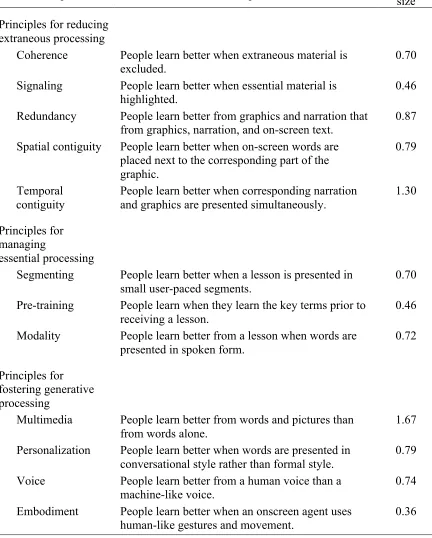
3 Three Fundamental Principles of CTML ……….……...39
4 Types of Processing in Working Memory According to CTML (Mayer, 2014a, p. 54) .……….…...…...43
5 Demands on Cognitive Capacity During Learning in CTML (Mayer, 2014a, p. 60) .……….…...………...44
6 CTML Principles for Instructional Design .……….………...………...46
7 Demographic Characteristics of School Population .……….…….…...…56
8 Instruments and Timing ………...60
9 Means, Standard Deviations (SD), Reliabilities, and Sample Sizes for All Instruments ……….64
10 Missing Data Per Variable as a Percentage of Total Scores …………...…..….70
11 Means and Standard Deviations for Treatment and Control Groups .…...…....72
12 Adjusted and Unadjusted Means for Vocabulary Test Scores by Time and Instructional Method ………....77
13 Adjusted and Unadjusted Means for Feedback Survey Question 1 at Time 1 (Work1) by Instructional Method ………...…....78
14 Adjusted and Unadjusted Means for Feedback Survey Questions 1 (Work2) and 3 (Motivate2) at Time 2 by Instructional Method ……….……….…....78
15 Adjusted and Unadjusted Means for RIMMS Satisfaction by Instructional Method ……….………....79
xii
LIST OF FIGURES
Figure Page
1 Comparison of vocabulary load for high school textbooks .……….………...12
2 Lubliner’s Pyramid of Vocabulary Learning
(Lubliner & Scott, 2008, p. 1) .……….…………...19
3 Baddeley and Hitch’s original model of working memory
(Baddeley, 2010, p. R137).….……….………...33
4 Baddeley’s multicomponent model of working memory
(Baddeley, 2010, p. R138).….……….………...34
5 Examples of higher and lower extraneous cognitive load .……….……….…..37
6 The Cognitive Theory of Multimedia Learning (CTML) .……….…….……..40
7 The Cognitive-Affective Theory of Learning with Media (CATLM)
(Moreno, 2006, p. 15) ………..….52
8 Experimental Design .……….…...…57
9 Example of vocabulary matching game content being entered .……….…...…67
CHAPTER ONE
STATEMENT OF THE PROBLEM
Learning scientific vocabulary can constitute a tremendous burden for science
students, (Hakuta, Santos, & Fang, 2013), and particularly for biology students (Grillo &
Dieker, 2013). Imagine that your child has just started high school. She needs to study a
foreign language, so she signs up for first-year French. The two of you were a little
worried about all the vocabulary she would need to learn in her French class – but when
she comes home with her first round of high school homework assignments, you discover
that she has ten times as much new vocabulary to learn for her biology class as she does
for her French class. This might be the stuff of nightmares, but it has its basis in reality:
one researcher found that a typical high school French textbook introduced 1750 new
words; a high school physical science textbook introduced 2,173; and a high school
biology textbook introduced 17,130 (Groves, 1995).
The tremendous burden that vocabulary places on biology students is the focus of
this study – but that is not to ignore the fact that vocabulary has a major impact on every
part of our lives, helping to determine, according to some researchers, “academic success,
economic opportunity, and societal well-being” (Gardner & Davies, 2014). It has been
widely recognized that difficulties with vocabulary can cause problems for learners in all
areas (Blachowicz & Fisher, 2004; Gray & Yang, 2015; National Institute of Child
Health & Human Development, 2000). “Learning,” it has been said, “as a language based
Simmons, & Kame’enui, 1998), and researchers have long been focused on how “to
narrow the gap between the vocabulary learners know and the vocabulary they need”
(Laufer, 2016). In recent years, more and more attention has also been focused on what
has been termed the “vocabulary gap” between many students of color and/or lower
socioeconomic status and their more privileged peers, and the role that the vocabulary
gap plays in the widely recognized achievement gap (David, 2010; Hart & Risley, 1995).
Not surprisingly, given the degree of interest in vocabulary, a number of
approaches to vocabulary learning have been developed. Two especially influential
methodologies are those of Nation Nation & Gu, 2007; Nation & Meara, 2002), and Stahl
and Nagy (Stahl & Nagy, 2006).
Nation has proposed an approach to vocabulary learning that consists of four
“strands” that work synergistically to maximize vocabulary learning (Nation, 2006, 2008;
Nation & Gu, 2007; Nation & Meara, 2002). The first of Nation’s four strands is
meaning-focused input, which involves listening and reading with materials containing
only 2% to 5% unfamiliar vocabulary. His second strand, meaning-focused output, entails
learning new vocabulary through speaking and writing. The third strand is
language-focused learning, which involves a conscious focus by the learner on strategies
such as the use of word roots to discover word meanings. The fourth and final strand is
fluency development. This strand does not involve learning new vocabulary; instead, it
focuses on practicing to make best use of vocabulary already acquired.
Another multipronged approach to fostering vocabulary learning has been
developed by Stahl and Nagy (Stahl & Nagy, 2006). Their method involves three
component is increasing learner exposure to rich written and oral language. Stahl and
Nagy’s third and final component is increasing learners’ skill in using definitions, word
roots, and context, and their interest in and awareness of words.
A major difference between Nation’s and Stahl and Nagy’s approaches is in their
level of tolerance for techniques, such as word cards, that separate vocabulary from its
context (Nation, 2006, 2008; Stahl & Nagy, 2006). For Nation, use of tools like word
cards is a central part of his four-strand approach (Nation, 2001, 2006); Stahl and Nagy,
by contrast, emphasize the centrality of developing an understanding of how vocabulary
items fit into a context (Stahl & Nagy, 2006). This difference in approach has led to a
great deal of heated debate over many decades (e.g., Cobb, 2016; McQuillan, 2016;
Nation, 2016).
Despite their differences in approach, both Nation and Stahl and Nagy recognize
the usefulness of teaching morphemes (word roots) to allow learners to deconstruct the
vocabulary they encounter (Nation, 2006, 2008; Stahl & Nagy, 2006). It has been pointed
out that this strategy (e.g., the morpheme bio, “living,” can be combined with the morpheme logy, “study of,” to form biology – “the study of life”) is particularly useful for learning scientific vocabulary (Fang, 2006).
Researchers like Nation or Stahl and Nagy may differ in their degree of tolerance
for decontextualized vocabulary instruction, but there has been general agreement for
some time that one valuable tool for vocabulary learning is the use of games (Andrade,
2009; Lubliner & Scott, 2008; Manyak, 2012; Stahl & Nagy, 2006).
Games are well-established as instructional tools, and have been used for at least
of – their long history, there is no single definition of what constitutes a game (Kamil &
Taitague, 2011; Plass, Homer, & Kinzer, 2015). Most researchers agree, however, that a
game is an activity that involves a goal, rules, and competition – even if that competition
is with oneself (Dempsey et al., 2002; Jin & Low, 2011; Mayer, 2011; Randel, Morris,
Wetzel, & Whitehill, 1992).
Games seem to aid vocabulary learning in a number of ways (Andrade, 2009;
Hitosugi, Schmidt, & Hayashi, 2014). However, despite the obvious need to help science
students with the vocabulary load they face, there has been relatively little investigation
of the use of games in learning scientific vocabulary. When one turns to the use of games
for the learning of biology vocabulary, the lack of research is even worse, as there appear
to be almost no investigations done as yet. This is despite the fact that, of all areas of
science vocabulary instruction, biology is the discipline where the need for aid in learning
vocabulary seems to be the greatest (Grillo & Dieker, 2013; Groves, 1995, 2016;
Wandersee, 1988).
There is also a great deal of evidence to support the idea that the use of
multimedia, i.e., a combination of words and pictures (Mayer, 2014a), can aid learning in
many areas, including the learning of vocabulary (Castek et al., 2012; Clark & Mayer,
2016; Kennedy, Deshler, & Lloyd, 2013; Mayer, 2014a). Mayer’s multimedia principle,
part of his cognitive theory of multimedia learning (CTML), states that “people learn
more deeply from words and pictures than from words alone” (Mayer, 2014a, p. 43). The
multimedia principle has been found to hold true for learning in a wide variety of
applications, including learning vocabulary, and so it seems logical to think that the use
Mayer’s principles of multimedia learning is the modality principle - “that the words in a
multimedia lesson should be spoken rather than printed” (Mayer, 2010, p. 548). Like the
multimedia principle, the modality principle has also been shown to be highly beneficial
to learning (Clark & Mayer, 2016; Mayer, 2011).
It has been proposed that one way that the use of multimedia can aid in learning is
by increasing learner motivation (Mayer, 2010; Mayer, 2014b; Moreno, 2006; Plass et
al., 2015; Pedra, Mayer, & Albertin, 2015). Moreno points to what she has termed
“affective mediation – the idea that motivational factors mediate learning by increasing or
decreasing cognitive engagement” as a possible explanation for this interaction of
motivation with multimedia learning (Moreno, 2006). Mayer has theorized that increased
motivation may benefit multimedia learning by fostering generative processing (Mayer,
2014b).
Among the various applications of multimedia, the use of multimedia games as an
aid to learning has been studied extensively (Tobias, Fletcher, Bediou, Wind, & Chen,
2014). The use of such games in learning vocabulary has been much less thoroughly
studied, but what little research has been done is generally encouraging (e.g., Bakar &
Nosratirad, 2013; Hitosugi et al., 2014; Vahdat & Behbahani, 2013).
Turning to the use of multimedia games in learning scientific vocabulary, there
has been very little research done. One – and perhaps the only – example is Salazar and
Carballo’s investigation of the use of the digital Spanish-English vocabulary translation
game Vocabulary, a Spanish-English vocabulary translation game with students in a nursing program at the Universidad de Costa Rica (Salazar & Carballo, 2009).
Purpose of the Study
When we narrow our focus to the use of multimedia games in learning biology
vocabulary, there seems to be have been even less research done than for scientific
vocabulary in general – that is to say there is apparently none. Given that research
indicates that multimedia games can be very effective aids for vocabulary learning, and
given the extensive body of research showing that learning science vocabulary – and
biology vocabulary in particular – presents a tremendous problem for a large number of
students, it seems logical to investigate their use in biology vocabulary learning. As yet,
however, this field of inquiry does not seem to have been the subject of any formal
research. This study, therefore, reviewed the literature on multimedia gaming and
examined the effectiveness of using digital multimedia games to help high school
students learn biology vocabulary.
A two-group, quasi-experimental study was used, consisting of one treatment and
one control group. The study employed a fixed-effects multivariate analysis of covariance
(MANCOVA) for a series of three types of dependent variables. Multivariate analysis of
covariance lets the researcher attempt to adjust participants’ results for differences in
initial level on a relevant variable, or covariate, when random assignment to treatment
and control groups has not been possible. The three types of dependent variables
examined using MANCOVA were: 1) scores on tests of biology vocabulary; 2) scores on
tests of biology concepts; and 3) vocabulary feedback and instructional materials
motivation survey scores. These three types of dependent variables were chosen for three
reasons: 1) student scores on the tests of biology vocabulary were used because it was
statistically significant increase in vocabulary scores; 2) student scores on the tests of
biology concepts were used because it was hoped that any increase in vocabulary scores
would not occur at the expense of concept learning; and 3) vocabulary feedback and
instructional materials motivation survey scores were used because theory predicts that
the use of appropriate multimedia will increase student motivation. Participant HMH
Reading Inventory (formerly Scholastic Reading Inventory – SRI) Lexile reading scores
were used as the covariate for all three analyses of covariance. Lexile reading scores were
chosen as the covariate because of the strong relationship between reading ability and
vocabulary (Lubliner, 2005; National Institute of Child Health & Human Development,
2000; Shanahan & Shanahan, 2008), which allowed Lexile reading scores to be used as a
proxy for participants’ initial level of vocabulary knowledge.
Participants were a convenience sample of 10 college preparatory high school
biology classes with a total of 276 students. The classes were taught by three different
teachers, one of whom was the researcher. Each teacher taught half of his or her classes
using a multimedia game for vocabulary instruction and half using traditional vocabulary
instruction. The students, in grades 9 through 12, attend a comprehensive high school in a
medium-size suburban school district where all students are required take and pass
biology in order to graduate high school.
Data collection included standardized test scores, curriculum-based
measurements, and surveys with Likert-type rating scale. The standardized test was the
HMH Reading Inventory, administered to almost all students in the district, which
provided the Lexile reading scores used a covariate in data analysis. The
concept tests constructed by the researcher’s colleagues; and a final examination,
produced by the researcher’s colleagues, from which several questions were selected for
use as a posttest. The surveys with rating scale that were given to participants were of
two types: one was a short vocabulary feedback survey developed by the researcher; the
other was a version of Keller’s Instructional Materials Motivation Survey (IMMS), which
has been used extensively to measure learners’ motivation in response to instructional
materials (Keller, 2010; Loorbach, Peters, Karreman, & Steehouder, 2015; S. Park &
Lim, 2007).
Significance of the Study
The problem investigated in this study has both theoretical and practical
significance. In terms of theoretical significance, it seemed worthy of examination in part
because it could provide further evidence for the validity of Mayer’s multimedia principle
as it relates to vocabulary learning, science vocabulary learning, and most particularly,
biology vocabulary learning.
The practical significance of this study lies in the guidance may provide for the
effective teaching and learning of biology vocabulary, especially in a secondary school
setting. It also may provide insight into the training of all science teachers – and biology
teachers in particular – in more effective vocabulary instruction strategies. As one
researcher puts it, “Teachers are already under the gun to cover more material than time
permits and they are stymied by the need to devote extra time to vocabulary” (David,
2010). Few if any studies to date have examined whether using a multimedia game for
vocabulary instruction is a more effective and efficient use of instructional time than
students move towards a more humane match between the material to be covered and the
time available to do so.
Theoretical Framework
Mayer’s cognitive theory of multimedia learning (CTML) and the principles
derived from it serve as the primary theoretical underpinnings of this study. CTML uses
ideas originating in cognitive load theory and dual processing theory to predict and
explain how words and pictures can be used most effectively to aid learning (Mayer,
2014a).
CTML is based on three assumptions about learning. The first of those
assumptions is that our mind has an information processing system that includes two
channels, one for visual/pictorial processing, and the other for auditory/verbal processing.
CTML’s second assumption is that each of those two channels has a limited processing
capacity; only a few words can be held in a listener’s auditory working memory at any
one time, for example. The third assumption of CTML is that active learning requires that
the learner construct a mental model based on new information, and connect that model
with prior knowledge stored in the learner’s long-term memory (Mayer, 2014a).
CTML posits three types of demands that are placed on a learner’s cognitive
capacity during learning: a) extraneous processing, i.e., processing not related to the goal
of instruction, b) essential processing – that is, processing that is necessary to mentally
represent the essential material being presented, and c) generative processing, which has
the goal of making sense of the material that is being presented (Mayer, 2014a).
According to CTML, one way to facilitate learning is to facilitate generative
Mayer has termed this principle, that “people learn more deeply from words and pictures
than from words alone,” the multimedia principle (Mayer, 2014a, p. 43). CTML, and
specifically the multimedia principle, predicts that learners should acquire vocabulary
more successfully when materials used incorporate the multimedia principle than when
they do not. Given the pressing need to reduce the vocabulary burden for biology
students, a main goal of this research study is to see to what extent if any application of
CMTL and the multimedia principle aids in the learning of biology vocabulary.
Background and Need
Vocabulary learning has been studied for many years, and by many researchers
((Kame’enui & Baumann, 2012; Lubliner, 2005; Nation, 1990; Stahl & Nagy, 2006) .
This is not surprising, given the central role of vocabulary in learning any discipline. It is
knowledge of vocabulary that gives one access to membership in a community of
practice (Hakuta et al., 2013), and that same knowledge of the vocabulary of a discipline
is often used as a proxy for competence in that discipline (Nation & Gu, 2007). Some
authors have even extended that idea beyond the level of discipline to say that vocabulary
knowledge is a requirement for being a competent participant in our society – that
vocabulary knowledge is thus a prerequisite for true citizenship (Blachowicz & Fisher,
2004; Larson, 2014).
The intensive study of vocabulary learning by numerous researchers has revealed
that vocabulary learning can present a tremendous problem for many learners,
particularly when learning academic vocabulary, and particularly when that learning is in
the medium of English (Kame’enui & Baumann, 2012; Nation, 1990, 2005, 2008; Stahl
as great a demand for an extensive vocabulary on its users as English (Nation & Meara,
2002). What is more, as Stahl and Nagy (2006, p. 41) point out, the academic version of
English differs dramatically from the spoken language, so that “literate or academic
English... is likely to be a foreign language to the student whether or not the student
comes from a home in which English is spoken.”
In scientific fields, the burden of vocabulary learning can be even greater (Fang,
2006; Graesser, Léon, & Otero, 2002; Hakuta et al., 2013; Snow, 2010; Zhang &
Lidbury, 2012). This is largely due to the complexity of the vocabulary that must be
learned and the sheer volume of that vocabulary (Fang, 2005; Seifert & Espin, 2012).
This vocabulary burden presents what can be an almost insurmountable barrier for many
learners (Fang, 2005, 2006; Graesser et al., 2002; Groves, 1995; Zhang & Lidbury,
2012), including both English Language Learners, or ELLs, (Hakuta et al., 2013; Janzen,
2008) and individuals identified as having learning disabilities (Seifert & Espin, 2012).
The issue of learner problems with vocabulary learning is common to all
scientific disciplines, but seems to be greatest in biology ( Grillo & Dieker, 2013; Groves,
1995), due to the tremendous vocabulary load it presents to learners. For example, an
examination by Groves (1995) of the vocabulary load (number of new words presented to
the learner) of secondary school science texts found (as shown in Figure 1 below) the
lowest load to be 2,173 words for a physical science textbook, and the highest load to be
17,130 words for a biology textbook. By comparison, a high school French text examined
had a vocabulary load of less than1800 new words.
Research Questions
Vocabulary Load (Words)
Figure 1. Comparison of vocabulary load for secondary school textbooks (Based on Groves, 1995
1. Are there statistically significant differences in scores on tests of biology
vocabulary knowledge for students using a multimedia game to learn biology
vocabulary compared to students using traditional vocabulary learning
methods?
2. Are there statistically significant differences in scores on tests of biology
concept knowledge for students using a multimedia game to learn biology
vocabulary compared to students using traditional vocabulary learning
methods?
3. Are there statistically significant differences in ratings of motivation
engendered by the learning materials used by students using a multimedia
game to learn biology vocabulary compared to students using traditional
vocabulary learning methods?
Definition of Terms
Cognitive Load Theory is a theory of instructional design that maintains that we
have a very limited working memory, which holds information for a very limited period and processes just a few pieces of that information at a time, and a long-term memory that is basically infinite in size and able to store information on a lasting basis (Kalyuga,
2011; Mousavi, Low, & Sweller, 1995; Sweller et al., 2011).
The element interactivity of a learning task is the extent to which it forces the
learner hold several related chunks of the information to be learned in working memory
at the same time (Moreno, 2006).
Essential processing is cognitive processing that is needed for the learner to
construct a representation of the crucial material to be learned in working memory. This
has been described as primarily a process of selection: the learner decides what is worth
incorporating in his or her mental representation and what can be safely left out (Mayer,
2010).
Extraneous processing is cognitive processing that does not support learning
(Mayer, 2010). For example, if a learner is reading a text in which a diagram appears on
the front side of a sheet and the text that refers to that diagram appears on the back of the
sheet, the learner wastes cognitive processing resources repeatedly flipping from one side
of the sheet to the other.
A game can be defined as an activity that typically involves a goal, rules, and
competition – including competition with oneself (Dempsey, Haynes, Lucassen, &
Casey, 2002; Jin & Low, 2011; Mayer, 2011).
Generative processing is cognitive processing that is focused on making sense of
what is being learned. It has been described as consisting of organizing and integrating
information, “and is caused by the learner’s motivation to understand the material”
(Mayer, 2010, p. 546).
A morpheme is defined as the smallest unit of meaning in words (Kieffer &
include prefixes and suffixes, like “dis-“ in “disinterested,” or “-able” in “likeable.”
Typical unbound morphemes include word roots such as “aqua” in “aquatic.”
Multimedia learning has been defined as “learning from words and pictures”
(Mayer, 2010, p. 544). The text can be written, like in a textbook, or spoken, as in a
lecture presentation. The pictures may be unmoving or static, like a photograph, or they
can be moving or dynamic, as with a video.
The multimedia principle states that individuals learn more effectively from a
combination of words and pictures than they do from words alone – that is, that
multimedia learning is more effective than learning solely from text (Mayer, 2014a). It is
the most fundamental of the principles that together constitute Mayer’s Cognitive Theory
CHAPTER TWO
LITERATURE REVIEW
This section reviews the literature for this study of the effect of biology vocabulary instruction using a multimedia game versus using a traditional vocabulary instruction. The first section explores the research on vocabulary learning in general, and science vocabulary learning in particular. The second section looks at the research on the use of games in vocabulary learning, and the third section examines relevant theories of multimedia learning. The chapter finishes with a summary of these three areas of inquiry their significance to the proposed study.
Vocabulary Learning
Some Influential Approaches to Vocabulary Learning
A number of influential theorists have developed approaches to vocabulary
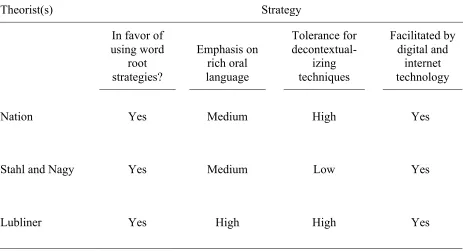
learning that are summarized in Table 1 and discussed in more detail below.
Nation (2001, 2006) has proposed an approach to vocabulary learning that consists of
four “strands” that work synergistically to maximize vocabulary learning. According to
Nation, each of these strands should receive equal attention. The first of the four strands
is meaning-focused input, which involves listening and reading with materials containing
only 2% to 5% unfamiliar vocabulary. The second strand, meaning-focused output,
entails learning new vocabulary through speaking and writing. The third strand is
language-focused learning, which involves a conscious focus by the learner on strategies
such as the use of word roots to discover word meanings. The fourth and final strand is
focuses on practicing to make best use of vocabulary already acquired (Nation, 2006,
2008; Nation & Gu, 2007; Nation & Meara, 2002).
Table 1
Overview of Influential Vocabulary Learning Theorists and Their Approaches
Theorist(s) Strategy
In favor of using word root strategies? Emphasis on rich oral language Tolerance for decontextual- izing techniques Facilitated by digital and internet technology
Nation Yes Medium High Yes
Stahl and Nagy Yes Medium Low Yes
Lubliner Yes High High Yes
One concern for those following Nation’s approach is how to ensure that
materials used for meaning-focused input contain only 2% to 5% vocabulary that is
unfamiliar to an individual learner. Thankfully, the use of computers and other digital and
web-connected learning devices promises to make this a simpler matter than it has been
in the past.
Stahl and Nagy (2006) have developed a three-part approach to fostering
vocabulary learning: teaching specific words; increasing learner exposure to rich written
context, and their interest in and awareness of words – what Stahl and Nagy have termed
generative word knowledge (Stahl & Nagy, 2006).
Whereas it may have been difficult in the past to provide the range of materials
that would increase exposure to rich written and oral language and capture the interest of
a wide range of learners, digital and web-connected learning devices are once again
making this simpler with each passing day.
A major difference between Nation's (2006, 2008) and Stahl and Nagy's (2006)
approaches is in their level of tolerance for decontextualizing instructional techniques,
such as word cards, that separate vocabulary from its context. For Nation, use of tools
like word cards is a central part of his four-strand approach (Nation, 2001, 2006); by
contrast, Stahl and Nagy emphasize the centrality of developing an understanding of how
vocabulary items fit into a context, as well as of how vocabulary items with very similar
denotations may have very different connotations – and therefore very different effects
when used (Stahl & Nagy, 2006).
Such differences in approach become important considerations when picking
tools to aid in learning vocabulary: according to Nation’s thinking, it may be productive
to teach vocabulary divorced from context through such means as flashcards or games
such as Concentration (Nation, 2001, 2006); Stahl & Nagy (2006), on the other hand,
might say that such vocabulary would be better taught using an activity, such as a
simulation or role play, that introduced the words or terms to be learned in context.
A third influential approach is that of Lubliner (Lubliner & Scott, 2008), who sees
vocabulary learning as being like a pyramid (see Figure 2 below). The base of Lubliner’s
From Lubliner & Scott, 2008, p. 1
conversation. Immediately above that base level of the pyramid is wide reading and
reading aloud, both of which expose learners to language that does not generally form a
part of oral communication. Above the level of wide reading and reading aloud is the
level of word consciousness – developing an awareness of the impact of word choice as
well as sensitivity to issues of denotation versus connotation. The penultimate level of
Lubliner’s (Lubliner & Scott, 2008) pyramid is problem solving, which involves
strategies such as breaking down words into their component parts (use of morphemes) as
an aid to understanding their meanings, using context clues, and effective dictionary use.
At the apex of the pyramid is the explicit teaching of single words (Lubliner & Scott,
2008).
Similar to the approaches of Nation (2001, 2006) and Stahl and Nagy (2006)
described above, Lubliner's (Lubliner & Scott, 2008) approach involves teachers and
learners approaching vocabulary learning in multiple ways at the same time. Lubliner,
however, has a greater emphasis on rich oral language than Nation (2006 , 2008) or Stahl
and Nagy (2006). Her positioning of rich oral language and wide reading and reading
aloud at the base of her pyramid shows that, like Stahl and Nagy (2006), she emphasizes
learning vocabulary in context; however, unlike Stahl and Nagy (2006) – and like Nation
(2001, 2006) – her approach makes use of decontextualizing instructional techniques,
which she incorporates into the explicit instruction that sits at the top level of her
pyramid.
As they did with the approaches of Nation (2001, 2006) and Stahl and Nagy
(2006), it is clear to see how the advent of the Internet and digital, web-connected devices
2008) approach to vocabulary learning. With the use of digital technology, the wide
reading that forms such an important part of her approach is far easier to implement and
customize to the needs of individual learners than was the case in the past.
Science Vocabulary Learning
Over the years, a number of researchers have investigated the effective learning of
science vocabulary (Fang, 2005, 2006; Graesser et al., 2002; Snow, 2010; Stevenson,
1937; Taboada, 2012). Taboada (2012) has developed a text-based questioning approach
that relies on learners’ interactions with text, particularly learners’ self-generated,
text-based questions. Learners generate their questions after eight to ten minutes of
browsing the text. This is followed by a twenty-minute period during which they write
questions about thing they want to know concerning the topic or topics of the text. This
seems to increase learners’ science comprehension, perhaps by fostering more thinking
about text topics and content prior to reading. This leads to students being more focused
on the text as a whole, as well as on key concepts within topics.
Taboada's (2012) emphasis on having learners interact with vocabulary in situ is very much in keeping with Stahl & Nagy's (2006) stress on not decontextualizing
vocabulary. Her approach could also be incorporated as part of Lubliner and colleagues’
(Lubliner & Scott, 2008) problem-solving or word-consciousness steps in vocabulary
learning. While Taboada's (2012) approach does not depend on access to digital
technology, such access might make it somewhat easier to implement.
Fang (2006) has extensively investigated the language demands of science
reading, and techniques he recommends as aids to learning science vocabulary include
developing awareness of signposts. In noun expansion, learners perform elaboration
exercises, in which a simple noun is expanded into longer noun phrases by adding pre-
and/or post-modifiers. Sentence completion involves learners carrying out a
fill-in-the-blanks exercise that requires them to synthesize information in a portion of a
text into a noun or noun phrase that can be used as the subject of the next sentence in the
text. In paraphrasing, learners translate back and forth between scientific and everyday
language. Sentence stripping involves the teacher and students analyzing the ways
clauses are combined in scientific text to form complex sentences.
Fang (2006) also recommends direct instruction of learners in the use of Latin-
and Greek-derived morphemes – showing students how scientific vocabulary is made by
joining together morphemes. For example, the morpheme bio (“living”) can be combined with the morpheme logy (“study of)” to form biology – “the study of life.”
Fang's (2006) approach fits well with the thinking of researchers such as Nation
(2005), who readily accept the sort of decontextualized vocabulary learning Fang (2006)
is promoting. It could also be used as part of Lubliner’s (Lubliner & Scott, 2008)
problem-solving or word-consciousness steps in vocabulary learning. As with Taboada's
(2012), Fang's (2006) approach does not depend on access to digital technology; it is easy
to see, though, how access to such technology would make it much easier to implement,
especially with any sizeable number of learners.
Use of Multimedia Games in Vocabulary Learning
As mentioned earlier, it can be difficult to arrive at a universally-accepted
definition of exactly what constitutes a game (Plass et al., 2015). One of the simplest
interactive, mentally/physically challenging exercise by one or more players” (Jin &
Low, 2011, p. 395). Similarly terse is Mayer’s description of games as “artificial
environments that are rule-based, responsive, challenging, and cumulative” (Mayer,
2011, p. 282). Somewhat more involved is Randel and colleagues’ definition of games as
“competitive interactions bound by rules to achieve specific goals that depend on skill
and often involve chance and an imaginary setting (Randel et al., 1992, p. 262). At a
similar level of complexity is the National Research Council’s statement that "…games
are played spontaneously in informal contexts for fun and enjoyment… In addition,
games generally incorporate explicit goals and rules" (National Research Council (U.S.),
2011, p. 9). More complicated yet is the definition given by Dempsey and
co-researchers. A game, they say, is a “set of activities involving one or more players. It
has goals, constraints, payoffs, and consequences. A game is rule-guided and artificial in
some respects. Finally, a game involves some aspect of competition, even if that
competition is with oneself” (Dempsey et al., 2002, p. 159). For the purposes of this
study, a game will be defined simply as an activity that involves a goal, rules, and
competition.
Some researchers go to great pains to distinguish games from simulations, which
“model a process or mechanism relating input changes to outcomes” (Randel et al.,
1992). This, like coming up with a widely accepted definition of a game, can be difficult
to do. The National Research Council points out that in contrast to the informal settings
in which games are typically played, simulations are usually encountered in a more
formal context (National Research Council (U.S.), 2011). Tobias and Fletcher stress that
2011b). Games, in their analysis, emphasize competition, interaction, and entertainment,
while simulations prioritize realism, accuracy, and task completion (Tobias & Fletcher,
2011b).
Regardless of how games are defined and distinguished, there has been general
agreement for many years now that they can be a valuable tool for vocabulary learning
(Andrade, 2009; Castek, Dalton, & Grisham, 2012; Huyen & Nga, 2003; Lubliner &
Scott, 2008; Manyak, 2012; Stahl & Nagy, 2006; Wright, Betteridge, & Buckby, 2006) .
One way games seem to help in vocabulary learning is by reducing inhibition, anxiety,
and self-doubt, all of which can function as an “affective filter” (Hitosugi, Schmidt, &
Hayashi, 2014; Krashen, 1981), impeding language learning of all kinds, including the
learning of vocabulary. Games lower that affective filter, giving learners license for the
sort of experimentation and risk-taking that fosters vocabulary learning (Andrade, 2009).
Games can also make possible the integration of multiple learning modalities,
such as drawing, drama, and movement, into the learning process (Andrade, 2009;
Blachowicz & Fisher, 2012; Lubliner & Scott, 2008). In many respects, the most
important way that games help with vocabulary learning is that “games are fun, and word
games are no exception” (Castek et al., 2012, p. 316). They can be so entertaining, in
fact, that learners may not realize how much learning is taking place, and teachers may
often need to make their rationale for using games explicit, warns Andrade (2009) – or
risk having their students view those games as a meaningless waste of their time.
Use of Multimedia Games in General Vocabulary Learning
It should not be surprising, given the longstanding acceptance of games as a tool
use of digital multimedia games for vocabulary learning. Among the attractions of digital
multimedia games is that, in addition to the possible supports for learning that regular
games have, they also present new ways to foster interaction and the possibility of
essentially unlimited repetition (Hitosugi et al., 2014).
Investigations of the use of digital technologies in vocabulary learning games take
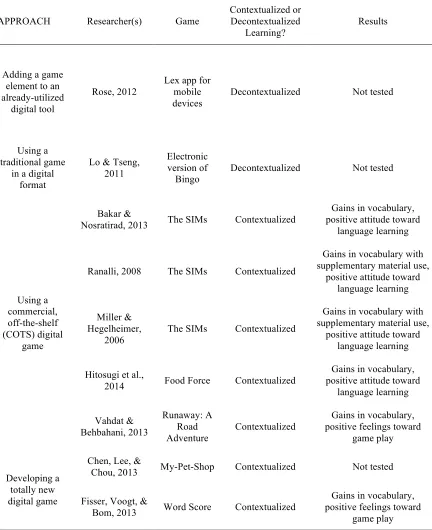
four main approaches, which are summarized in Table 2 and discussed in more detail
below.
One approach involves adding a game element to an already-utilized digital tool for
vocabulary learning. A second approach involves using a traditional game in a digital
format to aid in vocabulary learning. Another approach is to use a commercial,
off-the-shelf (COTS) digital game to teach vocabulary. A fourth and final approach is to
develop a totally new digital game to help with vocabulary learning.
An example of an approach that adds a game element to an already-utilized digital
tool for vocabulary learning is the Lex app for mobile devices (Rose, 2012). The Lex app
builds on the omnipresence of digital flashcard tools by letting learners import flashcard
vocabulary lists from sites such as Quizlet, which has thousands of pre-made lists, and
also gives learners the ability to make custom lists as needed. The Lex app can then
display vocabulary items from the imported list in a game interface that is cognitively
much more engaging than a flashcard interface, such as that of Quizlet. The Lex app also
includes multiple ways to track learner progress. No study has been carried out to date to
Table 2
Main Approaches to the Use of Digital Games to Promote Vocabulary Learning
APPROACH Researcher(s) Game
Contextualized or Decontextualized
Learning?
Results
Adding a game element to an already-utilized
digital tool
Rose, 2012
Lex app for mobile devices
Decontextualized Not tested
Using a traditional game
in a digital format
Lo & Tseng, 2011
Electronic version of Bingo
Decontextualized Not tested
Using a commercial, off-the-shelf (COTS) digital game Bakar &
Nosratirad, 2013 The SIMs Contextualized
Gains in vocabulary, positive attitude toward
language learning
Ranalli, 2008 The SIMs Contextualized
Gains in vocabulary with supplementary material use,
positive attitude toward language learning
Miller & Hegelheimer,
2006
The SIMs Contextualized
Gains in vocabulary with supplementary material use,
positive attitude toward language learning
Hitosugi et al.,
2014 Food Force Contextualized
Gains in vocabulary, positive attitude toward
language learning Vahdat & Behbahani, 2013 Runaway: A Road Adventure Contextualized
Gains in vocabulary, positive feelings toward
game play
Developing a totally new digital game
Chen, Lee, &
Chou, 2013 My-Pet-Shop Contextualized Not tested
Fisser, Voogt, &
Bom, 2013 Word Score Contextualized
Gains in vocabulary, positive feelings toward
An example of an approach that uses a traditional game in a digital format to aid
in vocabulary learning is an electronic version of the traditional game Bingo (Lo &
Tseng, 2011). In this electronic version, players answer vocabulary questions to win
squares. Just like traditional Bingo, the electronic version allows multiple learners to play
at the same time. It also lets the players customize the game’s level of difficulty. No
research has yet been done to gauge the effectiveness of this electronic version of Bingo.
An example of using a commercial, off-the-shelf (COTS) digital game to teach
vocabulary is the utilization of The SIMsfor self-directed vocabulary learning by adult
English as a Second Language (ESL) students (Bakar & Nosratirad, 2013). The three
participants were simply told to play The SIMs, a game in which players organize and
manage a neighborhood of 10 houses, create the people living in the houses, and try to
keep those people happy. Participants were told to play any time they wanted, for as long
as they wanted. The researchers found that the participants exhibited both gains in
vocabulary and a positive attitude toward language learning.
The SIMs were also used by Miller and Hegelheimer (2006) in a study that
compared the effectiveness of adding support materials to regular game play. The
researchers found that only the players for whom use of the support materials was
mandatory showed any statistically significant gain in vocabulary scores. They also found
that all 18 of the participants had very positive feelings about playing the game.
Ranalli (2008) also used The SIMs in an investigation with nine participants
designed to repeat and expand on the findings of Miller and Hegelheimer (2006). He also
found, as they had, that support materials were necessary for a statistically significant
Another investigation of the use of a COTS digital game to aid vocabulary
learning was carried out by Hitosugi et al. (2014). They examined the use of the United
Nations’ Food Force videogame to increase vocabulary learning and improve learner
affect in university Japanese as a Second or Other Language students. In Food Force the
player takes on the role of a new member of a United Nations World Food Project
mission to fight hunger. Two studies were carried out. In the first, with 11 participants for
whom results of testing had no effect on their grades, the students used vocabulary
worksheets as an adjunct to game use. In the second study, with nine participants for
whom results of testing were part of their grade in the class, the students were given lists
of new vocabulary prior to game use, a quiz during game use, and a unit test at the end of
game use. Participants in both studies were given vocabulary pre- and posttests and an
attitudinal survey after completion of the posttest. The researchers found that use of Food
Force seemed to have a positive effect on student vocabulary learning and retention. The
effect was greater for those students in the second study. The researchers also found that
students exhibited a positive affect regarding the use of Food Force in instruction,
although feelings were less positive for those students in the second study, for whom it
counted as part of their grade.
Vahdat and Behbahani (2013) also made use of a COTS digital game, Runaway:
A Road Adventure, to foster vocabulary learning by adult English as a Foreign Language
(EFL) students. In Runaway: A Road Adventure, players must find certain objects within
the game, and then use them to build a tool to help the game’s protagonist get out of
trouble. There were 40 participants, half of whom received traditional lessons that
followed by worksheets to teach the new vocabulary. The other participants were simply
asked to play the game. The researchers’ results indicated that participants who learned
vocabulary through game play acquired more vocabulary than those receiving traditional
instruction. The researchers also found that students generally had very positive feelings
about the experience of learning vocabulary through video game play.
Instances of the development of digital games for vocabulary learning that are not
reworkings of an existing game, do not have a connection with some preexisting
application like Quizlet, or a connection with a preexisting digital game, like The Sims,
are few and far between. Two examples of such original games are My-Pet-Shop (Chen
et al., 2013) and Word Score (Fisser et al., 2013). My-Pet-Shop is a digital management
game designed to foster self-regulated learning as well as incidental vocabulary learning
from meaningful context (Chen et al., 2013). In the game, the student plays the part of the
manager of a pet shop. My-Pet-Shop has not, as yet, been tried with students. Word Score
is an online game that is designed to improve players’ vocabulary. In the game, the
student acts as the manager of a soccer team. In the study, 82 students used the Word
Score game, 46 of whom did so during regular class time, and 36 of whom did so as part
of “Educational Time Extension” (ETE), a program in which class time is extended
beyond the regular school hours so as to improve learning outcomes for underperforming
students. The results on vocabulary pre-and posttests for students using Word Score were
compared with a control group of 60 students who did not use Word Score and did not
participate in ETE. All participants in the study, including teachers and supervisors, also
completed an attitudinal survey when study was completed. The investigators also found
compared to the control group that had both statistical and practical significance. They
also found that student users, teachers, and supervisors were all very enthusiastic about
the use of Word Score.
Use of Multimedia Games in Science Vocabulary Learning
If one examines the use of digital games in learning scientific vocabulary, there is
very little research at present, despite the fact that, as discussed previously, vocabulary
learning is a particularly pressing problem in the sciences.
One example of the use of a digital game specifically for learning scientific
vocabulary is the digital game Vocabulary, a Spanish-English vocabulary translation
game. Salazar and Carballo (2009) investigated the use of the Vocabulary game, which
was designed by an unnamed graduate student working on the research project, with eight
students in their fifth and final year of a nursing program at the Universidad de Costa
Rica. Sadly, the results of the investigation were inconclusive. They were, however,
interpreted by the researchers as an indication that it is possible for learners to
successfully acquire vocabulary using a context-free computer game.
Use of Multimedia Games in Biology Vocabulary Learning
When one turns to the use of digital games for the learning of biology vocabulary,
there appears to be no research done as yet, despite the fact that, as mentioned previously,
there is an overwhelming need for more effective and efficient ways to teach the
enormous amount of vocabulary that biology students need to acquire (Groves, 1995;
Grillo & Dieker, 2013). This gap in the research would seem to argue for the need for
Given such a need, the question then arises as to what type of digital game should
be used for the investigation. If one feels, as Stahl and Nagy (2006) do, that vocabulary
should not be learned divorced from context, then the answer is a game such as The
SIMs, as employed by Miller and Hegelheimer (2006), Ranalli (2008), and Bakar and
Nosratirad (2013). It is worth bearing in mind that, as Miller and Hegelheimer (2006)
have pointed out, the cost of obtaining enough copies of the game to use with a sizeable
number of individuals can be quite prohibitive. A free game such as Food Force, used by
Hitosugi and colleagues (2014) might be a reasonable alternative in some circumstances.
Those who believe, as do Nation (2006) and Lubliner (Lubliner & Scott, 2008),
that it can be effective to teach vocabulary independent of context, might prefer to use a
digital game such as Rose's (2012) Lex app, which is easily customizable, and although
not free, is relatively inexpensive. It is, however, confined to use on mobile devices such
as cell phones, which may limit its application in many classrooms.
A third option exists that is potentially suitable for those of any school of thought,
which is to build a game from scratch. That, however, requires a skill set not many
educators possess, can be extremely time-consuming and labor-intensive, and may yield
little payback on that investment of time and energy (Adams, Mayer, MacNamara,
Koenig, & Wainess, 2012).
Multimedia Learning
The theoretical foundation for the proposed research is Mayer’s cognitive theory
of multimedia learning (CTML), which seeks to explain how we learn from words and
pictures – that is, from multimedia (Mayer, 2010, 2014a). The theoretical foundation for
include Paivio’s Dual Coding Theory, the Cognitive Load Theory of Sweller and
colleagues, and Wittrock’s Generative Learning Theory. All of these will be discussed in this section in regard to their influence on CTML. This section will also look at ideas regarding the relationship between motivation and multimedia learning, including Moreno’s Cognitive-Affective Theory of Learning with Media (CATLM).
Paivio’s Dual Coding Theory
Paivio’s Dual Coding Theory (DCT) is a general theory of cognition that holds that there are two separate cognitive systems: a verbal system for dealing with language in all its forms, and a nonverbal system for dealing with everything else (Paivio, 1971, 1986, 1991; Sadoski, 2005; Sadoski, Goetz, & Fritz, 1993). The verbal system codes verbal information into units Paivio calls logogens (Paivio, 1986). The nonverbal system is often referred to as the imagery system since it codes information in the form of image units, which Paivio has termed imagens, but it is important to note that the information it codes can be anything nonverbal, such as the smell of a rose or the anger associated with a parking ticket (Paivio, 1986; Sadoski et al., 1993). “All knowledge, meaning, and memory,” says DCT, “is explained by representation and processing within and between the two codes” (Sadoski, 2005, p. 222).
According to DCT, coding is additive – something that has been coded both verbally and nonverbally (dual coding) is twice as likely to be recalled as something coded in only one form. This leads to a particular focus in DCT on the concreteness of language (or lack thereof) as a determiner of its memorability. The quite concrete phrase “buxom blonde” is much more likely to conjure up an image than the less concrete phrase “heuristic algorithm,” and therefore, according to DCT, much more likely to undergo dual coding – with the result that it should be much more memorable.
Baddeley’s Theory of Working Memory
systems. This model is shown in Figure 3 below. One of those short-term storage systems, which they named the visuo-spatial sketchpad, was believed to store visual material; the other, termed the phonological loop, stored verbal-acoustic material
(Baddeley, 2007; 2010). Baddeley and Hitch chose to use the term “working memory” to emphasize that its role extended beyond simply a storage function to influence cognition in general (Baddeley, 2010).
The model has subsequently been supplemented by the addition of another component, the episodic buffer. This updated model is shown in Figure 4. In Baddeley’s words, the episodic buffer holds “multidimensional episodes or chunks, which may combine visual and auditory information possibly also with smell and taste” (Baddeley, 2010, p. 138). In the episodic buffer, it is theorized, various components of working memory can interact with each other and with information from the senses and from long-term memory. The capacity of the episodic buffer is thought to be limited – about four chunks or episodes (Baddeley, 2007, 2010).
Cognitive Load Theory
Cognitive Load Theory (CLT), as developed by Sweller and colleagues, is a theory of
instructional design based on a series of assumptions about human cognitive architecture
(Sweller et al., 2011). One of those assumptions is that we have a very limited working
memory, which can hold information for a very limited period and process just a few pieces of information at a time (Kalyuga, 2011; Mousavi, Low, & Sweller, 1995; Sweller
et al., 2011). By contrast, CLT maintains, we have a long-term memory that is essentially unlimited in size, and which, true to its name, is able to store information on a long-term basis (Kalyuga, 2011; Mousavi et al., 1995; Sweller et al., 2011). According to CLT, information is stored in long-term memory in cognitive constructs called schemata
will be used, and reduce the load on our working memory by allowing us to treat multiple pieces of a information as a single item (Kalyuga, 2011; Mousavi et al., 1995; Sweller et al., 2011). CLT sees acquisition of schemata and the automation of cognitive processes
such as the automatic use of schemata as primary mechanisms of learning (Kalyuga, 2011; Mousavi et al., 1995; Sweller et al., 2011). Based on these assumptions regarding our cognitive architecture, CLT sees the limitations of our working memory as being the bottleneck that limits our learning (Kalyuga, 2011; Mousavi et al., 1995; Sweller et al.,
2011). As Sweller and colleagues put it, “Once appropriate information is stored in long-term memory, the capacity and duration limits of working memory are transformed
and indeed, humans are transformed. Tasks that previously were impossible or even inconceivable can become trivially simple” (Sweller et al., 2011).
In CLT’s most current incarnation, many theorists see the constraints on working memory as consisting of two separate and additive types of cognitive load – intrinsic and extraneous (Kalyuga, 2011; Sweller et al., 2011). Intrinsic cognitive load is inherent in the learning materials, and is a function of the degree of interconnectedness between information items needing to be considered in working memory simultaneously
(Kalyuga, 2011; Sweller et al., 2011). This interconnectedness in referred to as element
interactivity (Kalyuga, 2011). An example of low element interactivity would be a learning task that involved memorizing the location of the brake, gas pedal, and steering
wheel; an example of high element interactivity would be a learning task that involved
mentioned than someone who had never been behind the wheel before. Extraneous cognitive load is cognitive load that is not necessary for learning, and can be considered an artifact of less-than-ideal instructional design (Kalyuga, 2011; Mousavi et al., 1995;
Sweller et al., 2011). An example might be sheet music for beginning guitar students that puts the chord diagrams for all the chords to be used in the song at the top of the first page (as seen on the left-hand side of Figure 5 below), rather than placing the diagrams over the chords as they appear in the music (as seen on the right-hand side of Figure 5).
Many descriptions of CLT contain a third category of cognitive load – germane
cognitive load. This category of cognitive load is defined as cognitive load necessary for
learning by means of schema acquisition and automation (Kalyuga, 2011). This is
currently seen by many theorists as effectively indistinguishable from intrinsic load
(Sweller et al., 2011).
Wittrock’s Generative Learning Theory
Wittrock’s Generative Learning Theory states that learning is based on four components:
generation, motivation, attention, and memory (Wittrock, 1989). In Wittrock’s view, our
brains actively work to construct meaning and respond to perceived realities. “Learning,”
says Wittrock, “consists of the active generation of meaning, not the passive recording of
information" (Wittrock, 1992, p. 537). “The brain,” he insists, “is a model builder. It does
not transform input into output” (Wittrock, 1992, p. 532). Attention and motivation guide
a learner’s choice of cognitive strategies and selection of the sensory information to
which the learner will attend. That information is then related to memory, and meaning is
Higher extraneous cognitive load – chord diagrams at top only
Lower extraneous cognitive load – chord diagrams at every chord change