Social evaluation of innovative drugs: A method based on
big data analytics
Genghui Dai1, Xinshuang Fu2, Weihui Dai3, and Shengqi Lu4
1
School of Marine Sciences, Sun Yat-Sen University, Guangzhou 200433, China [email protected]
2
School of Management, Shanghai University, Shanghai 200444, China [email protected]
3
School of Management, Fudan University, Shanghai 200433, China [email protected]
4
School of Information Management and Engineering, Shanghai University of Finance and Economics, Shanghai 200433, China
Abstract. The evaluation of drugs is a professional and time consuming process which involves a series of clinical trials and evidence-based verifications. How-ever, an innovative drug may still suffer from unpredictable risks after coming into market due to the complex circumstances in practical utilization. Owing to the pop-ularization of information networks and social media, big data analytics exhibits a new perspective of social evaluation as the supplementary means on this issue. This paper designed a Hadoop platform for data collection and processing, and explored the social evaluation of innovative drugs based on big data analytics. Through the analysis of mined data and affective computing on online comments, a new Chi-nese drug extracted from marine organisms can be evaluated comprehensively by the proposed method. Furthermore, the potential utilization of fullerene materials may be considered for improving its curative effects. Research work of this paper provides a big data analytics method for social evaluation of innovative drugs as well as their promising improvements.
Keywords:Big data analytics, social media, innovative drug, social evaluation, ma-rine biology, fullerene materials.
1.
Introduction
As we known, current post-marketing evaluation of innovative drugs is mainly based on the statistical analysis of investigated samples or depends on special reporting chan-nels such as the reporting system of health care institutions [25]. Nevertheless, a lot of disadvantages have been found in the existing method, such as limited samples, poor timeliness, inefficiency and the influence of uncertainty factors [2]. Actually, the practical curative effects and adverse reactions of drugs are mostly related to patients’ individual conditions, living habits, and environmental factors. Especially for Chinese drugs, a reli-able evaluation usually requires the comprehensive reviews from complex circumstances because there are important differences in different cases. It is difficult to be implemented through the current evaluation system.
Owing to the development of information technology and popularization of mobile applications, more and more people share their experiences of daily life by social media, such as shopping, tourism, medical treatment, and so on. In the meantime, the network of social media has appeared as a new platform and provides the valuable repository for scientific research and social study. As one of the most popular topics on social networks, health care and medical treatment attracts extensive concerns, and thereupon expedites the flourishing of various medical and health forums. The valuable information about innovative drugs in practical utilization can be mined from multifarious online comments and posts on the above forums through big data analysis. Therefore, big data analytics exhibits a new perspective of social evaluation of innovative drugs, which can be applied as the supplementary means to post-marketing evaluation. This paper aims to propose a Hadoop platform for data collection and processing from social media, and explore the social evaluation of innovative drugs based on big data analytics. It is organized as follows: Section 2 introduces the related works; Section 3 designs a Hadoop platform and studies the big data analytics from social media; Section 4 proposes the social evaluation method of innovative drugs; and Section 5 is the discussion and conclusion of this paper.
2.
Related works
In recent years, big data analytics has been successfully applied in various fields such as financial markets, social management, production and manufacturing, as well as precision medicine, and shows superiorities over traditional methods in many aspects. In modern medicine and pharmacy, the classification of drugs is becoming more complicated than before, beyond the limitations to diseases or symptoms. As well, the ingredients of drugs are no longer invariants [25]. Those circumstances bring new difficulties and risks on the evaluation of innovative drugs.
provides a new research methodology in medical and health fields, such as the analysis of diabetes cases, the study of regional characteristics of infectious diseases, the mining of disease causing factors, and so on. Zhu et al. summarized the research status and progress on the data mining of DNA sequence, and pointed out its significance in biological appli-cation [35]. Yue et al. applied data mining technology to study the classifiappli-cation of DNA sequences, and proposed a new judgment method to explore their classifications [33]. Li designed a health risk model for the assessment of Chinese people from the analysis of big data [16]. Karaolis et al. developed a data mining system to study the pathogenic factors of heart disease using association analysis algorithm [12]. Chang et al. adopted artificial neural networks to predict the outcome in the diagnosis of Parkinson’s disease [3]. Drei-seit et al. proposed an improved method which combined artificial neural networks with regression analysis and decision tree to estimate the mortality in diseases [7].
In regard to big data analytics of health and medical information from social media, Zhou et al. used machine learning techniques to realize the automatic retrieval of online text information, and established a social medical terminology dictionary [34]. Ye et al. built a corpus of Chinese medicine, and studied the social evaluation of Chinese medicines in United States from the news reports and social media. Their research showed the social trend of increasing interest and attentions to Chinese medicines by American society and people [31]. Sampathkumar et al. applied Hidden Markov Model to analyze the adverse drug reactions based on the information of online healthcare forums, and provided an effective method for early warning of pharmacovigilance [21]. Existing research findings have indicated that the social evaluation of innovative drugs based on big data analytics can timely reveal the underlying influences and undiscovered effects of the above drugs from patients’ feeling and their comments, which are hard to be reflected in the regular post-marketing evaluation.
3.
Hadoop platform for data collection and processing
Through an analysis of the related works, we found that affective computing on text in-formation is the useful big data analytics for the study of online comments [1][8][32] .In order to establish the big data environment for social evaluation of innovative drugs, we designed a Hadoop platform [14] to complete the data collection and processing, which can efficiently implement subject extraction and sentiment analysis from online com-ments. Its framework is designed as in Fig.1.
It includes three layers namely information collecting layer, data storage layer and business analysis layer. Firstly, the related text information are collected by web crawlers and sent to the text server group for preprocessing in information collecting layer. Sec-ondly, the above data will be stored in MapReduce and HDFS in the data storage layer through the interface of HDFS [9]. Finally, text subject extraction, sentiment analysis, and other data analysis will be carried out in the business analysis layer, and all of data changes are executed by calling the data interface system such as HDFS and Hive.
3.1. Run mechanism for big data collection and processing
Information collecting layer
Text server group
Text Preprocessing Data
storage layer
Data Node Job
Tracker Job Tracker
HDFS MapReduce
Business analysis layer
Hadoop Cluster Data interface
Web Text of Social
Evaluation Sentiment analysis
Text subject extraction
Interface of HDFS file
Other data analysis
Interface of Hive
Web
Crawler Name node
Interface of HDFS file
Fig. 1.Hadoop platform for social evaluation of innovative drugs
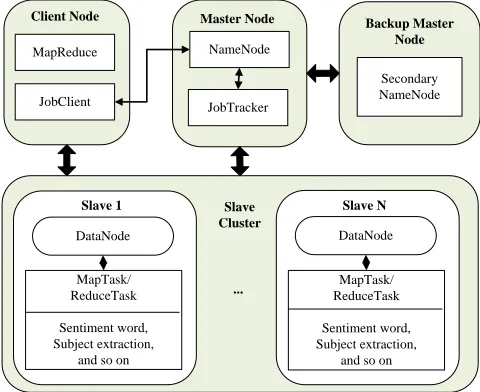
storage and parallel co-processing. However, its performance depends on the design of an effective run mechanism [22]. The platform includes three main components: master node, client node, and slave cluster, all of which coordinate with each other through the run mechanism to accomplish tasks. In our solution, we designed the run mechanism for big data collection and processing as in Fig. 2.
It can be seen from Fig.2, the Master Node is responsible for job management and resource scheduling, and slave cluster includes a lot of map tasks or reduce tasks for dividing sentiment words, subject extraction and so on. The above run mechanism can be described as follows.
Running mechanism. The running mechanism for data processing includes the follow-ing steps.
Step 1. Job submission, Firstly, the client node of the Mapreduce start a JobClient, and send a job with request ID to the JobTracker in Master Node by the JobClient, such as the job of dividing sentiment words.
Step 2. Job initialization, JobTracker puts the job into an internal queue, and hand over the scheduler job for scheduling, and then complete its initialization.
Client Node Master Node
Slave 1
DataNode
MapTask/ ReduceTask
Sentiment word, Subject extraction,
and so on
... Slave Cluster
Backup Master Node
Secondary NameNode
Slave N
DataNode
MapTask/ ReduceTask
Sentiment word, Subject extraction,
and so on MapReduce
JobClient
NameNode
JobTracker
Fig. 2.The run mechanism for big data collection and processing
Step 4. Perform tasks, The TaskTracker node reads the input data stored on the HDFS, at the same time, the TaskRunner task will be created by MapTask and RedcueTask respec-tively, and the above two tasks will run until the end of task.
In the Hadoop platform, HDFS is responsible for the distributed storage of files in Hadoop cluster, which contains three major parts namely NameNode, DataNode, and Client.
NameNode. It acts as the management role in HDFS and is used to provide a name query service. It is responsible for managing the namespace of the file system, backup and the configuration of the cluster. In addition, the Metadata information stored in NameNode will be loaded into the memory after the NameNode starts.
DataNode. It is the basic unit of file storage, mainly used to save the information block, and will report to NameNode block when the DataNode thread is started, at the same time, it send a heartbeat in every fixed seconds to keep in touch with NameNode. Once NameNode hasnt received heartbeat within a fixed minutes, it means that the DataNode has been lost, and its block should be copied to the other DataNode.
communication are errors, then Client tries to connect to the next data node. At the same time, the failure of the DataNode will be recorded.
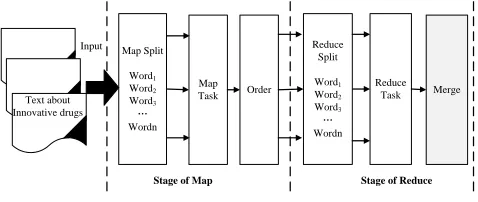
MapReduce. It is responsible for the decomposition of tasks and the summary of the results. The tasks are distributed and completed by each individual node, and all the above nodes belong to a master node, and the final results come from each node through an integration of their intermediate results. The running mechanism of MapReduce is shown as in Fig. 3.
Map Task Order
Reduce Task Merge
Stage of Map Stage of Reduce
Map Split
Word1
Word2
Word3
… Wordn
Reduce Split
Word1
Word2
Word3
… Wordn Text about
Innovative drugs Input
Fig. 3.The processing of the MapReduce
It can be seen from Fig.3, the mechanism of MapReduce include the map and reduce of tasks. In the process of map, data will be split into<key, value>according to the definition of Map function, and will be merged after completing the reduce tasks. It’s worthy of mentioning that the Map process and Reduce process can run in parallel.
Task execution. The algorithm of task execution can be described as follows.
program Execution of task (Output)
Init analysis task and hive database connection pool tp; begin
(1) Get the connection from the hive database connection tool;
(2) Connect to Hive, read the task of HQL, and send HQL query request to Hive;
(3) Hive compiles and executes HQL, returns the execution result;
(4) Write the result to local file and upload to HDFS path which is assigned by the analysis task;
(5) Read result of the analysis task configuration, create new table in the Hive according to the configuration;
create in step 6; end.
3.2. Data analytics for social evaluation
The information about practical utilization of innovative drugs are scattered on micro-blogs or healthcare forums such as http://www.dxy.com, tieba.baidu.com, 91160.com, and so on in China. The above information are all unstructured texts, for example, the questions and answers, comments on the treatment of a disease or the curative effects of a drug, which are from the patients, family members, and doctors, and usually contain valuable information to be used for social evaluation.
The data analytics for social evaluation of innovative drugs includes text classification and affective computation. The purpose of text classification is to separate and keep the subjective text information for affective computation. It is realized by the subject extrac-tion with a LDA model and the classificaextrac-tion based on SVM (Support vector machine) and Bayes classifier. The purpose of affective computation is to calculate the trend and intensity of the above subjective text information for social evaluation. It is realized based on an emotional dictionary, and will be discussed in Section 4 of this paper. The outlined process of data analytics is shown as in Fig. 4.
It can be seen from Fig.4 that the data will be collected from various related websites by crawlers and preprocessed by filter and subject extraction. The specialized subjects will be extracted by LDA algorithm, and then classified by SVM and Bayes classifiers. If it is a subjective text, the affective intensity will be calculated for social evaluation. Otherwise, if it is an objective text, this text will not be processed.
LDA model. In order to extract the related subjects more efficiently, we used LDA model to fulfill this task. LDA model is also called the three layers Bayesian probability model, which includes the layers if words, subjects, and document structures. We hereby divide the above layers into: words, probable subject, and document sets. The matrix model of LDA can be shown in Fig.5 [6].
In Fig. 5,SErefers to the all of social evaluations on innovative drugs, andφrefers to the probability distribution of each subject on all terms.Θexpresses the subject distri-bution of each social evaluation.dmis themsocial evaluation, andwnis the word ofn term, andzkis thekimplicit subject.
In order to obtain the appropriate parameters of LDA model, the preprocessing data are used for training by the following steps:
Step 1. Initialization, randomly assign a subject numberz to each of wordwfrom pre-pared data. Generally, setαis 50/Ntheme, where,Nthemeis the number of subject, andβ is 0.01.
Whether it is subjective evaluation?
Calculate the affective intensity
Y
N
Emotion dictionary
Output Classification
(subjective or objective evaluation by classifier) Data preprocessing
(Filter, Subject extraction, and so on) Collect data by web crawler
Related Websites
Fig. 4.Process of data analytics for social evaluation
SE d1
d2
… dm
w1,w2,…,wn
=
Word Subject
Document
Φ d1
d2
… dm
z1
z2
… zk
z1,z2,…,zk
Document
Χ
Subject θ w1,w2,…,wn
Word
Step 3. Repeat step 2 until Gibbs Sampling converges, that is to say, both subject distri-bution of each comment and word items of each subject are all convergence. After that, the probability distribution function is calculated as follows [19].
p(Zi=k|
− →
Zqi,−→w)∞ n
k
m,qi+αk
PK
k=1(n
k
m,qi+αk)
• n
t k,qi+βt
PK
k=1(n
t
k,qi+βt)
(1)
In 2, the probability distribution of subject-topic vector can be described as follows.
θ= n
k
m,qi+αk
PK
k=1(n
k
m,qi+αk)
(2)
As well, the probability distribution of subject-word can be described as follows.
ϕ= n
t k,qi+βt
PK
k=1(n
t
k,qi+βt)
(3)
Step 4. Calculate the co-occurrence frequency matrix of document-subject-word, and construct the LDA model.
Classified by SVM. Support vector machine (SVM) is a statistical machine learning classification method based on VC dimension theory and structural risk minimization principle. It has been widely used in affective computing on texts and vocal recognition for its superior performance on classification [4][23]. The classification method of subjective or objective comments by SVM is shown as in Fig. 6.
Normalization Text sets Training corpus
Normalization Text sets Testing corpus
Preprocessing for training
Preprocessing for testing
Training SVM Classifier
Hadoop
Subjective or Objective evaluation by SVM
Feature sets
The classification algorithm can be described as follows. Set{xi, yi}n
i=1as the set of data sample, where the input dataxibelongsRd, and the
output datayi∈(-1,1), then the linear discriminant function indspace isf(x) =ω·x+b, and the classification hyperplane equation isω·x+b= 0. So the method of SVM in a high dimensional space can be described as:
yi[ω·x+b] = 1−ei, i= 1, ..., n (4)
Here,ωis the weight, and inputxiis the high dimensional space,bis the error con-stant, Therefore , the computation of the optimal classification can be converted into dual problem as long as the Lagrange optimization method is used. And the optimal classifi-cation function can be expressed as follows
f(x) =sgn( N
X
i=1
α∗iyiK(xi, X) +b∗) (5)
Where,b∗is the threshold of classification, K(xi, X)is kernel function and it was used the four forms as follows.
RBF kernel function:
K(x, y) =exp−||x−y||
2
σ2 (6)
Linear kernel function:
K(x, y) =xT ·y (7)
Polynomial kernel function:
K(x, y) = [(x·y) + 1]m (8)
Sigmod kernel function:
K(x, y) =tanh(u(x·y) +c) (9)
Here, the RBF kernel function was used in the SVM in our study.
4.
Evaluation method based on big data analytics
4.1. Collection rules and word frequency calculation
Collection rules. The valid data can be used for social evaluation should include the complete items: title, content, date of publication, and replying posts. Besides, the data promulgator must be identified, such as patient, family member, or doctor. Table 1 lists the samples of collection data.
Table 1.Sample of data collected
No Title Content publicationDate of promulgatorType of replying postsCount of
1 cerebral infarction Butylphthalide is good for the disease· · ·
2017-02-25
13:37:28 Patient 17
2 Haishengsu Will it affect patient’s condition?· · ·
2017-02-24
15:08:42 Family member 22
3 Butylbromide InjectionScopola mine gastrointestinal tractIt is used in the acute· · · 2017-02-2115:08:42 Doctor 16 4 Domperidone Tablets Lead to elevated serum
prolactin levels· · ·
2017-02-21
16:08:42 Doctor 15
· · · ·
Part-of-Speech. The segmentation methods for Chinese words commonly include for-ward maximum matching method [29], bidirectional maximum matching method [26] and reverse maximum matching method [20]. We adopted the NLPIR segmentation sys-tem [15] for word segmentation and extended it with the POS tagging. Therefore, each word is assigned by a Part-of-Speech as the samples shown in Table 2.
Table 2.Samples assigned by Part-of-Speech
No Title Annotation format
1 Nouns /n
2 Verbs /v
3 Adjectives /a
4 Adverb /d
5 Numerals /m
6 Punctuation mark /w
· · · ·
prepositions, determiners, auxiliary, conjunctions, interjections and onomatopoeic words. The above words can’t help to extract subjects, but maybe reduce the calculation effi-ciency of LDA model, and need to be filtered out.
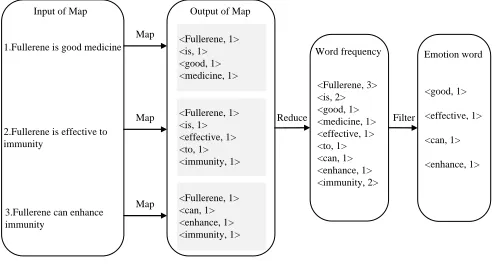
Word frequency calculation. Word frequency calculation is ready for affective compu-tation and evaluation, and fulfilled by the parallel computing on Hadoop platform. Firstly, the type of input and output are built to class Mapper(), and their expressions are as fol-lows: input type is<Object, Text>, and the output type is<Text, IntWritable>. If a task comes up, parallel computing is performed by calling the processes of Map() and Re-duce() to complete the word frequency calculation. For example, Fig. 7 shows the word frequency calculation about the comments on fullerene materials.
Input of Map
1.Fullerene is good medicine
2.Fullerene is effective to immunity
3.Fullerene can enhance immunity
Output of Map
<Fullerene, 1> <is, 1> <good, 1> <medicine, 1>
<Fullerene, 1> <is, 1> <effective, 1> <to, 1> <immunity, 1>
<Fullerene, 1> <can, 1> <enhance, 1> <immunity, 1> Map
Map
Map
Reduce
<Fullerene, 3> <is, 2> <good, 1> <medicine, 1> <effective, 1> <to, 1> <can, 1> <enhance, 1> <immunity, 2>
<good, 1>
<effective, 1>
<can, 1>
<enhance, 1> Word frequency Emotion word
Filter
Fig. 7.Word frequency based on parallel computing of MapReduce
It can be seen from Fig.7, there are three tasks about the comments on fullerene ma-terials in the Input of Map, and one task in Reduce. The above three text sections are independently assigned to three map tasks for processing firstly, and then the expression will be transformed into<’word’, count value>by the specific function in intermediate process of Output in Map. Among which, count value refers to the total number of a cer-tain word in the text section. Thereafter, the values will be used as input to the Reduce task, and the Reduce task will complete the computation of the total number of occur-rences of each word. Finally, the three text sections will be merged into, and output the expression<’word’, count value>, such as<immunity, 2>in the case about fullerene materials.
4.2. Subject extraction from online social media
well, we setαequals ten,β is 0.01, and the number of iterations for Gibbs sampling is 2000.
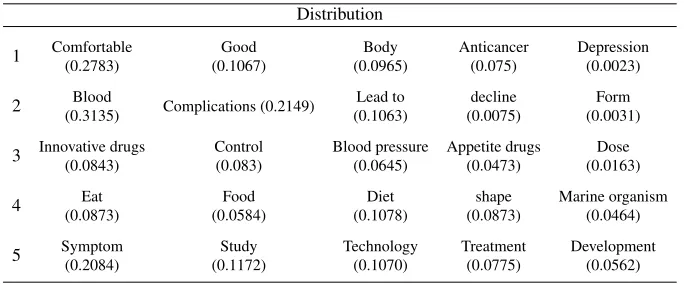
After 2000 iterations of Gibbs sampling, we can get the optimal extraction of the feature words on the five topics. Furthermore, five keywords are extracted respectively on each topic, and the distributions of the above keywords on each topic are shown as in Table 3.
Table 3.Distributions of the keywords on each topic
Distribution 1 Comfortable (0.2783) Good (0.1067) Body (0.0965) Anticancer (0.075) Depression (0.0023) 2 Blood
(0.3135) Complications (0.2149)
Lead to (0.1063) decline (0.0075) Form (0.0031)
3 Innovative drugs
(0.0843) Control (0.083) Blood pressure (0.0645) Appetite drugs (0.0473) Dose (0.0163) 4 Eat (0.0873) Food (0.0584) Diet (0.1078) shape (0.0873) Marine organism (0.0464) 5 Symptom (0.2084) Study (0.1172) Technology (0.1070) Treatment (0.0775) Development (0.0562)
It can be seen from Table 3 that promulgators on social media pay more attentions to the above five types of subjects. The first subject is ’Effect description’, which includes words such as comfortable, anticancer, and so on. At the same time, the other subjects have also been extracted. In addition, the number in the bracket of each word indicates the contribution of the word to this subject.
4.3. Emotional intensity analysis
To facilitate the evaluation, we divide the intensity of emotion into five levels, and assign to the value of 1, 3, 5, 7, and 9 respectively according to previous research [28]. As well, the emotional tendency is also assigned a polarity value. The positive tendency is expressed as 1, and the negative tendency is expressed as -1. The neutral tendency is expressed by 0. After quantized by the above values, the emotions becomes easy to be identified.
Table 4.Emotional tendency and intensity about fullerene materials and ’Haishengsu’
First Keywords Second Keywords Third Keywords Emotional intensity
Emotional tendency
Fullerene Immunity Lose weight 5 0
Feel sleepy 3 -1
Increased resistance 7 1
Shortness of breath 5 -1
Vulnerable to the cold 7 -1
Haishengsu anti-tumor Significant effect 9 1
Affect physiological balance 3 -3
Restrain the disease 5 1
· · · ·
It can be seen from Table 4, the value of the emotional tendency include three values (-1, 0, 1). From the value of 1, for example, we can deduce that fullerene has the posi-tive function to increase resistance. The value of 0 means it is not associated with weight loss. As well, ’Haishengsu’ has significant anti-tumor effects, and can restrain Heptocel-lular. However, its effects on physiological balance obtained a weak negative evaluation. The above studies show that social evaluations based on big data analytics may offer supplementary information about the innovative drugs in their practical utilization. It is very helpful for taking a comprehensive review on the innovative drugs, as well as for the improvement of the above drugs. Furthermore, the correlative analysis of evaluations indicates that curative effects of ’Haishengsu’ are expected to be promisingly improved if combined with the utilization of fullerene. Therefore, big data analytics exhibits a new perspective of not only the new method for social evaluation of innovative drugs, but also the valuable information for promising development and application of the above drugs.
5.
Discussion and Conclusion
Innovative drugs play the important role on promoting the progress of medicine and med-ical treatments. However, the traditional evaluation method of innovative drugs is a time consuming process, and has a lot of defects such as limited samples, poor timeliness, inef-ficiency, and the influence of uncertainty factors, especially in the face of sudden outbreak of diseases [13].
This paper designed a Hadoop platform and explored the social evaluation method of innovative drugs based on big data analytics. It aimed to provide the supplementary information for a comprehensive review on innovative drugs, as well as to make up the defects of a regular post-marketing evaluation. The main role of big data analytics is reflected in the following two aspects: new findings of the drug in practical utilization, and feeling and experiences of the drug in practical utilization. Research work of this paper provides a big data analytics method for the evaluation of innovative drugs, and as well, the valuable information for improving their promising development and application.
big data analytics for improving the precision of evaluations and providing more valuable details. In addition, how to use artificial intelligence to enhance the intelligent analysis ability is of great significance in the future researches.
Acknowledgments.This research was supported in part by Qtone Education of Ministry of Edu-cation of China (No. 2017YB115) and Shanghai Pujiang Program (No.16PJC007). Many thanks to Dr. Hongzhi Hu for her assistance to Prof. Weihui Dai and Xinshuang Fu who are the joint corresponding authors of this paper.
References
1. Ahmad, K.: Affective computing and sentiment analysis. emotion, metaphor and terminology. IEEE Intelligent Systems 31(2), 102–107 (2016)
2. Buyck, J.M., Tulkens, P.M., Bambeke, F.V.: Pharmacodynamic evaluation of the intracellu-lar activity of antibiotics towards pseudomonas aeruginosa pao1 in a model of thp-1 human monocytes. Antimicrobial Agents & Chemotherapy 57(5), 2310–2318 (2013)
3. Chang, C.W., Gao, G.D., Chen, H., Li, W.X.: Study on the diagnosis of parkinson’s disease with artificial neural network. Chinese Journal of Clinical Rehabilitation 7(28), 3818–3819 (2003) 4. Dai, W., Han, D., Dai, Y., Xu, D.: Emotion recognition and affective computing on vocal social
media. Information & Management 52(7), 777–788 (2015)
5. Davis, C., Abraham, J.: The socio-political roots of pharmaceutical uncertainty in the evalua-tion of ’innovative’ diabetes drugs in the european union and the us. Social Science & Medicine 72(9), 1574–1581 (2011)
6. Di, L., Du, Y.P.: Application of lda model in microblog user recommendation. Computer Engi-neering 40(5), 1–6 (2014)
7. Dreiseitl, S., Ohno-Machado, L., Kittler, H., Vinterbo, S., Billhardt, H., Binder, M.: A com-parison of machine learning methods for the diagnosis of pigmented skin lesions. Journal of Biomedical Informatics 34(1), 28–36 (2001)
8. Fleuren, W.W., Alkema, W.: Application of text mining in the biomedical domain. Methods 74, 97–106 (2015)
9. Ghazi, M.R., Gangodkar, D.: Hadoop, mapreduce and hdfs: A developers perspective. Procedia Computer Science 48, 45–50 (2015)
10. Ghobrial, O., Derendorf, H., Hillman, J.D.: Pharmacokinetic and pharmacodynamic evaluation of the lantibiotic mu1140. Journal of Pharmaceutical Sciences 99(5), 2521–2528 (2010) 11. G´omez, E., Torres, M.J., Mayorga, C., Blanca, M.: Immunologic evaluation of drug allergy.
Allergy Asthma & Immunology Research 4(5), 251–263 (2012)
12. Karaolis, M., Moutiris, J.A., Papaconstantinou, L., Pattichis, C.S.: Association rule analysis for the assessment of the risk of coronary heart events. In: IEEE International Conference on Engineering in Medicine and Biology Society. pp. 6238–6241 (2009)
13. Koukol, O., Kelnarov´a, I., Cern´y, K.: Recent observations of sooty bark disease of sycamore maple in prague (czech republic) and the phylogenetic placement of cryptostroma corticale. Forest Pathology 45(1), 21–27 (2015)
14. Lee, T., Lee, H., Rhee, K.H., Shin, U.: The efficient implementation of distributed indexing with hadoop for digital investigations on big data. Computer Science & Information Systems 11(3), 1037–1054 (2014)
15. Li, X., Zhang, C.: Research on enhancing the effectiveness of the chinese text automatic cate-gorization based on ictclas segmentation method. In: 2013 IEEE 4th International Conference on Software Engineering and Service Science. pp. 267–270 (2013)
17. Magnusson, M., Jonsson, L., Villani, M., Broman, D.: Parallelizing lda using partially collapsed gibbs sampling. Statistics 24(2), 301–327 (2015)
18. Moch´on, M.C.: Social network analysis and big data tools applied to the systemic risk super-vision. Ijimai 3(6), 34–37 (2016)
19. Porteous, I., Newman, D., Ihler, A., Asuncion, A., Smyth, P., Welling, M.: Fast collapsed gibbs sampling for latent dirichlet allocation. In: ACM SIGKDD International Conference on Knowl-edge Discovery and Data Mining, Las Vegas, Nevada, Usa, August. pp. 569–577 (2008) 20. Qu, H.Y., Zhao, W.: A revised bmm and rmm algorithm of chinese automatic words
segmenta-tion. Advanced Materials Research 267, 199–204 (2011)
21. Sampathkumar, H., Chen, X.W., Luo, B.: Mining adverse drug reactions from online healthcare forums using hidden markov model. BMC Medical Informatics and Decision Making 14(1), 1–18 (2014)
22. Seo, Y.D., Ahn, J.H.: Hadoop-based integrated monitoring platform for risk prediction using big data. Applied Mechanics & Materials 826, 113–117 (2016)
23. Silva, C., Ribeiro, B.: On text-based mining with active learning and background knowledge using svm. Soft Computing 11(6), 519–530 (2007)
24. Stegenga, H., Chambers, M., Jonsson, P., Thwaites, R., Garner, S.: A framework to guide the use of real-world evidence to support evaluation of relative effectiveness of new medicines. Value in Health 19(7), A488–A488 (2016)
25. Wang, M.: Progress and attention of new drug evaluation research. Journal of Chifeng Univer-sity 24(4), 19–21 (2008)
26. Wei, X.U., Zhang, M.J., Xiong, Z.H.: Feature point matching based on bidirectional maximal correlation and parallactic restriction. Computer Engineering & Applications 44(28), 155–157 (2008)
27. Woodard, J.: Big data and ag-analytics: An open source, open data platform for agricultural & environmental finance, insurance, and risk. Agricultural Finance Review 76(1), 15–26 (2016) 28. Xu, L.H., Lin, H.F., Pan, Y., Ren, H., Chen, J.M.: Constructing the affective lexicon ontology.
Journal of the China Society for Scientific & Technical Information 27(2), 5–7 (2008) 29. Yang, C.C., Luk, J.W.K., Yung, S.K., Yen, J.: Combination and boundary detection approaches
on chinese indexing. Journal of the Association for Information Science & Technology 51(4), 340–351 (2000)
30. Yao, X., Ding, J., Liu, Y., Li, P.: The new drug conditional approval process in china: Chal-lenges and opportunities. Clinical Therapeutics 39(5), 1040–1051 (2017)
31. Ye, Q., Wu, Q.: Study on report of american media of traditional chinese medicine situation and key words. AMIA Symposium proceedings 7(8), 626–629 (2014)
32. Yu, H.: Analysis on the subject and emotion of the medical forum of cerebrovascular disease. Beijing Jiaotong University, Beijing, China. (2016)
33. Yue, X., Jing, Y.: Research based on the algorithm of dna sequences data mining. Journal of Biomathematics 24(2), 363–368 (2009)
34. Zhou, L., Srinivasan, P.: Concept space comparisons: Explorations with five health domains. AMIA Symposium proceedings 2005, 874–878 (2005)
35. Zhu, Y.Y., Yun, X.: (dna) sequence data mining technique. Journal of Software 18(11), 2766– 2781 (2007)
Xinshuang Fu, is currently a lecturer at the School of Management, Shanghai University, China. She received her Ph.D. in Management Science and Engineering from Shanghai University, China in 2013. Her research interests include knowledge management and information science. Contact her at [email protected].
Weihui Daiis currently a professor at Department of Information Management and In-formation Systems, School of Management, Fudan University, China. He received his Ph.D. in Biomedical Engineering from Zhejiang University, China in 1996. He serves as a committee member of Shanghai Chapter, China Computer Society, and deputy director of Research and Translational Expert Council, Professional Committee of Endovascol-ogy, Chinese Medical Doctor Association. His recent research interests include complex system modeling and simulation, social media and intelligent information processing, so-cial neuroscience and emotional intelligence, etc. Dr. Dai became a member of IEEE in 2003, a senior member of China Computer Society in 2004, and a senior member of Chi-nese Society of Technology Economics in 2004. His works have appeared in international journals with more than 130 papers. Contact him at [email protected].
Shengqi Lu is currently a Ph.D. candidate at the School of Information Management and Engineering, Shanghai University of Finance and Economics, China. He received his master degree in Software Engineering from Fudan University, China in 2006. His current research interests include Artificial Intelligence and Business Intelligence. Contact him at [email protected].