www.nonlin-processes-geophys.net/15/695/2008/ © Author(s) 2008. This work is distributed under the Creative Commons Attribution 3.0 License.
Nonlinear Processes
in Geophysics
Projection of compact fractal sets: application to diffusion-limited
and cluster-cluster aggregates
F. Maggi
Berkeley Water Center, Civil and Environmental Engineering, 413 O’Brien Hall, University of California, Berkeley, CA 94720-1710, USA
Received: 4 March 2008 – Revised: 14 July 2008 – Accepted: 25 July 2008 – Published: 26 August 2008
Abstract. The need to assess the three-dimensional fractal dimension of fractal aggregates from the fractal dimension of two-dimensional projections is very frequent in geophysics, soil, and atmospheric sciences. However, a generally valid approach to relate the two- and three-dimensional fractal di-mensions is missing, thus questioning the accuracy of the method used until now in practical applications. A math-ematical approach developed for application to suspended aggregates made of cohesive sediment is investigated and applied here more generally to Diffusion-Limited Aggre-gates (DLA) and Cluster-Cluster AggreAggre-gates (CCA), show-ing higher accuracy in determinshow-ing the three-dimensional fractal dimension compared to the method currently used.
1 Introduction
Fractal aggregates occur very commonly at many scales in geophysical observations such as, for instance, in cosmology (e.g., galaxy distribution and patterns at large scales, Cole-man and Pietronero, 1992; Thieberger and Spiegel, 2000), physics of the atmosphere (e.g., clouds, aerosols, contam-inant dusts, Friedlander, 1977; Shaw, 2003), soil sciences (e.g., soil water retention properties, Perrier et al., 1996), and sedimentology (e.g., flocculation of cohesive sediment, Kranenburg, 1994; Winterwerp, 1999; Maggi, 2007). De-termining the three-dimensional (3-D) capacity dimension of geophysical fractal aggregates is particularly beneficial to scale geometrical properties (e.g., effective density, porosity, strength, mass density distribution, etc.) with a characteristic length scale (Meakin, 1991). However, direct assessment of the 3-D capacity dimension is rare in practice due to techni-cal limitations of observational instruments. More likely, 2-D projections can be assessed from optical measurements. The
Correspondence to: F. Maggi
2-D capacity dimension has been used up to now to estimate the 3-D capacity dimension as follows. Given a 3-D frac-tal set (aggregate)S3 ⊆R3and its 2-D projectionS2 ⊆R2
obtained by application of the linear transformation (projec-tion)P : R3 → R2 the capacity dimensions d0 ofS2 and S3are assumed to relate asd0(S2)=min{2, d0(S3)}(Vicsek, 1992; Meakin, 1998).
The inverse form
d0(S3)= (
d0(S2) ford0(S2)<2, undetermined∈ [2,3] ford0(S2)=2.
(1)
is commonly used to estimate d0(S3) from d0(S2). How-ever, there are three major limitations using Eq. (1): (i) it assumes that S2 and S3 are indefinitely extended sets; (ii) for d0(S2)=2 the 3-D capacity dimension d0(S3)is unde-termined; (iii) for projectionsP : Rn→Rmwithn>m, the generalized dimensionality dq (Grassberger and Procaccia,
1983) is dimension-preserving only for 1<q≤2, whereas for the capacity dimension d0, which equals dq for q=0,
the transformationP is not dimension-preserving (Hunt and Kaloshin, 1997; Thieberger and Spiegel, 2000).
These aspects rather suggest that, for compact (finite and closed) sets like the ones obtained by empirical observation, d0(S3)6=d0(S2)also whend0(S2)<2. This analysis questions the applicability of Eq. (1) to geophysical observations. Er-rors introduced using Eq. (1) were shown in Maggi and Win-terwerp (2004) when applied to kaolinite aggregates formed in water suspensions. In the same instance, an empirical rela-tion that used the perimeter-based fractal dimensiondP was
proposed to compute d0(S3) from projectionsS2, thus cir-cumventing the use of the 2-D capacity dimensiond0(S2)in favor of alternative information not belonging to the general-ized dimensionalitydq. This approach yielded the following
1 1.2 1.4 1.6 1.8 2 1
1.5 2 2.5
d 0
(S
3
)
dP(S2)
l = 256 l = 1024 l = oo
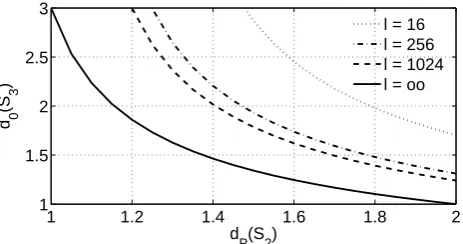
Fig. 1. Representation of the 3-D capacity dimensiond0(S3)as a
function of the perimeter-based fractal dimensiondp(S2), Eq. (2),
for different resolutions`=L/, whereLis the length scale of the aggregate andis the box size of the-covering.
d0(S3)=
a(`)
dP(S2)−b(`) 1/2
, (2)
wheredp=2 log[P]/log[A]is the perimeter-based fractal
di-mension (Meakin, 1998), withP andA the dimensionless perimeter and area ofS2, respectively, anda(`)andb(`) de-fined as
b(`)=2[k(`)]
2−9z(`)
[k(`)]2−9 , a(`)=9[z(`)−b(`)], with
z(`)=log[4`−4]
log[`] , k(`)=z(`)[z(`)−1] +1,
known for any given resolution`=L/, withLthe size ofS2 andS3, andthe box size of the-covering ofS2(Maggi and Winterwerp, 2004). Equation (2) is not resolution-limited as far as the disequality(4`−4) ≤ `(1+
√
4d0(S3)−3)/2 is sat-isfied (Maggi and Winterwerp, 2004). A representation of Eq. (2) is given in Fig. 1 for various values of`, showing that the accuracy in estimatingd0(S3)fromdP(S2)increases whendP(S2)can range over the full interval[1,2], that is, for increasing`.
The aim of this work is threefold. First, we derive the con-dition that any relationship betweend0(S2)andd0(S3)must satisfy for compact fractal sets. Second, we show that both Eqs. (1) and (2) satisfy such a condition. Third, we show that Eq. (2) produces better results than Eq. (1), and that its va-lidity extends to DLA (diffusion-limited) and CCA (cluster-cluster) aggregates, typologies which occur commonly in a variety of situations in geophysics.
2.1 Relationship betweend0(S2)andd0(S3)
A general relationship betweend0(S2)andd0(S3)can be de-rived as follows. For a compact fractal aggregateS3 ⊂ R3
of length scaleL, the volume, V, scales asV=Ld0(S3) with 0≤ d0(S3)≤ 3 the 3-D capacity dimension ofS3(Meakin, 1991). In analogy, the projected area,A, scales asA=Ld0(S2) with 0≤d0(S2)≤2 the 2-D capacity dimension of the pro-jected setS2ofS3. Under the assumption thatLis the length scale for bothS2andS3, the volumeV must be
V ≤A·L. (3)
Substituting the scalings forV andAinto Eq. (3) we obtain Ld0(S3)≤Ld0(S2)+1, which implies
d0(S3)≤d0(S2)+1. (4)
This inequality sets the condition that must be respected whatever the function relating d0(S2)and d0(S3). Condi-tion (4) can be generalized for projecCondi-tionsP : Rn → Rm of compact fractal sets in any embedding dimensionsn>m as
d0(Sn)≤d0(Sm)+(n−m). (5)
Note thatd0(Sn)=d0(Sm)+(n−m)represents the
relation-ship betweend0(Sn)andd0(Sm)of an aggregate inRn and
its cross-section inRm(Vicsek, 1992).
2.2 Validation of Eq. (1) to related0(S2)andd0(S3) Upon substitution of Eq. (1) into condition (4) ford0(S2)<2 we obtain
d0(S3)=d0(S2)≤d0(S2)+1,
which always satisfies the disequality. In analogy, substitut-ing Eq. (1) ford0(S2)=2 into condition (4) we obtain d0(S3)∈ [2,3] ≤d0(S2)+1=3,
which always satisfies the disequality.
2.3 Validation of Eq. (2) to relatedP(S2)andd0(S3) Assuming that disequality(4`−4)≤`(1+
√
4d0(S3)−3)/2is al-ways satisfied (see Sect. 1), and for the case of infinite resolu-tion`→∞(Fig. 1), the functionsa(∞)andb(∞)in Eq. (2) becomea=9/8 andb=7/8 (Maggi and Winterwerp, 2004). By introducing Eq. (2) into condition (4) we obtain
d0(S3)=
9/8
dP(S2)−7/8 1/2
≤d0(S2)+1, 9/8
[d0(S2)+1]2
Set B Set C
d0= log[8]log[4] = 1.5 d0= log[8]log[4] = 1.5
dP = 2log[8]log[8] = 2 dP = 2 log[8]
log[12] = 1.67
Fig. 2. Examples of sets with identical capacity dimensiond0and
different perimeter segmentation. Computation of the perimeter-based fractal dimension dP has been done neglecting the inner voids, according to Maggi and Winterwerp (2004).
that can be analyzed analytically for the two extreme cases of massive and linelike projections. For fully massive projec-tions (i.e.,d0(S2)=2 anddP(S2)=1, Maggi and Winterwerp, 2004), Eq. (6) becomes
9/8
(2+1)2+7/8=1≤1,
which satisfies the disequality. Analogously, for linelike pro-jections (i.e.,d0(S2)=1 anddP(S2)=2), and Eq. (6) becomes
9/8
(1+1)2+7/8= 37 32 ≤2, which satisfies the disequality.
While Eq. (2) satisfies condition (4) for massive and line-like projections, it is not known whether this holds also for projected irregular sets withd0(S2)anddP(S2)in the range (1,2). To this end, we test Eq. (2) to computed0(S3)of aggre-gates of different nature and geometrical properties, and we compare the results with those obtained using Eq. (1) with the aim to assess which approach enables better reconstruc-tions ofd0(S3)fromS2.
3 Results
3.1 Application to diffusion-limited and cluster-cluster ag-gregates
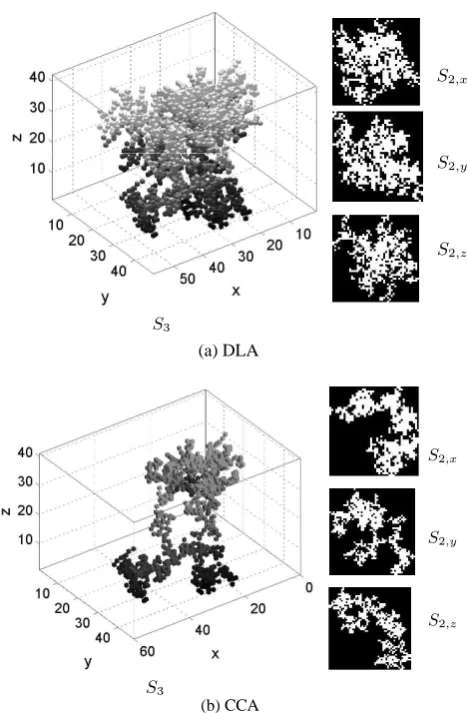
Geophysical fractal aggregates produced by various kine-matic processes generally show different geometrical orga-nization. For instance, DLA aggregates, which are formed by attachment of individual particles that move in space by diffusion, are featured by radial development of stellar-like branchings. Instead, CCA aggregates, which are formed by clusters of particles that recursively attach to each other and move in space by diffusion, display clustered masses con-nected by bridges, forming (sometimes closed) rings. Fully
S3
S2,x
S2,y
S2,z
(a) DLA
S3
S2,x
S2,y
S2,z
(b) CCA
Fig. 3. Examples of DLA and CCA aggregates. Their 2-D
projec-tions are shown beside the 3-D views.
developed DLA and CCA aggregates usually have differ-ent capacity dimensions inR3, that isd0(DLA)≈ 2.5 and d0(CCA)≈ 1.8, respectively (Vicsek, 1992). However, pro-jectionsP of those aggregates may have similar capacity di-mensionsd0(S2)inR2, thus preventing to discerning
aggre-gate type and 3-D capacity dimension from the capacity of S2. A conceptual example is given in Fig. 2, where two sets B andC of different outlook (ramified the former and ring-shaped the latter) have identical capacity dimensiond0 but different perimeter-based fractal dimensiondP inR2.
For this test, we have constructed 10 DLA aggregates and 10 CCA aggregates of 1000 seeds according to the al-gorithms described in Vicsek (1992) and Meakin (1998) (Fig. 3). Next, 2-D projections in the three principal di-rections have been computed. From these we have calcu-lated the averagedP(S2)andd0(S2), terms used in Eqs. (1) and (2) to computed0(S3). When Eq. (2) has been used, an additional computation has been carried out to make sure that the disequality(4`−4)≤`(1+
√
1.6 1.8 2 1.6
1.8
Effective d0(S3)
Computed d
0
(S
3
DLA
Eq. (1)
1.6 1.8 2 1.6
1.8
Effective d0(S3)
CCA
Eq. (1)
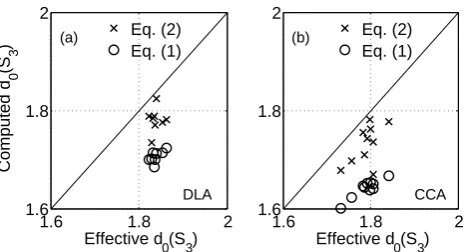
Fig. 4. Comparison between the effective 3-D capacity dimension d0(S3)obtained by construction and the one calculated from Eq. (1)
and Eq. (2) for (a) DLA aggregates and (b) CCA aggregates.
been compared to the ones obtained by construction (effec-tived0(S3)in Fig. 4).
The results in Fig. 4 show that application of Eq. (2) al-ways gives better estimations ofd0(S3)from the projections compared to Eq. (1). The loss of information induced by
P on the sets affects their capacity, but preserves the in-formation at the boundary of the projections. Because the perimeter-based fractal dimension dP(S2)is representative of the boundary segmentation rather than the set capacity, Eq. (2) allows better prediction ofd0(S3). These results show that the geometrical organization of the boundary of the sets S3 can be consideredP-invariant, and that this aspect can be fruitfully exploited to estimated0(S3)of real geophysical fractal aggregates.
3.2 Exceptions
Two particular cases exist for which Eq. (2) is biased: regu-lar solids with porous structure (sponge-like) and Euclidean solids with fractal surface (rock-like).
For the former (sponge), consider as hypothesis a regu-lar cube with a high level of fine porosity so thatd0(S3)<3 (Fig. 5a). The projected imageS2appears fully massive and its contour does not present segmentation. Consequently, dP(S2)=1 for`→ ∞, and from Eq. (2) we obtaind0(S3)=3, which contradicts the hypothesis.
For the latter (rock), consider as hypothesis a fully mas-sive solid with capacity dimensiond0(S3)=3 and with a frac-tal (rough and irregular) surface (Fig. 5b). Its projected im-ageS2is fully massive but the contour shows a high level of perimeter segmentation. As a consequence,dP(S2)>1 and from Eq. (2) we obtaind0(S3)<3, which again contradicts the hypothesis.
Fig. 5. (left) regular solid with porous (fractal) structure and
mas-sive (non-fractal) projection and, (right), Euclidean solid with frac-tal surface and massive projection with highly segmented contour. Light gray means porous structure, while dark gray means Eu-clidean structure.
4 Summary
A simple method to compute the three-dimensional capac-ity dimension from two-dimensional projections of compact fractal sets is tested on DLA and CCA aggregates, and com-pared to the approach more commonly used in geophysics. The method presented here makes use of the perimeter-based fractal dimension and does not obey the mathematical limi-tations that apply to the capacity dimension and the gener-alized dimensionality. The numerical simulations presented here show that this method produces better predictions of the three-dimensional capacity dimension in the two aggregate typologies (DLA and CCA) analyzed here compared to the current state-of-the-art method.
Acknowledgements. The author is particularly grateful to William
Riley for his comments on the contents and presentation of this work.
Edited by: U. Feudel
Reviewed by: two anonymous referees
References
Coleman P. and Pietronero L.: The fractal structure of the Universe, Phys. Rep. 213, 311–389, 1992.
Friedlander S. K.: Smoke, Dust and Haze, fundamentals of aerosol behavior. Wiler, New York, 1977.
Grassberger H. G. E. and Procaccia I.: Characterization of strange attractors, Phys. Rev. Lett. 50(5), 346–349, 1983.
Hunt B. R. and Kaloshin V. Y.: How projections affect the dimen-sion spectrum of fractal measures, Nonlinearity 10, 1031–1046, 1997.
Kranenburg C.: On the fractal structure of cohesive sediment ag-gregates, Continental and Shelf Science, 39, 451–460, 1994.
Maggi F. and Winterwerp J. C.: Method for computing the
projections of fractal aggregates, Phys. Rev. E, 69, 011405, doi:10.1103/PhysRevE.69.011405, 2004.
Maggi F.: Variable fractal dimension: a major control for floc struc-ture and flocculation kinematics of suspended cohesive sediment, J. Geophys. Res., 112, C07012, doi:10.1029/2006JC003951, 2007.
Meakin P.: Fractal aggregates in geophysics, Reviews of Geo-physics, 29, 317–354, 1991.
Meakin P.: Fractals, Scaling and Growth far from Equilibrium, Cambridge University Press, Cambridge, England, 1998.
Perrier E., Rieu M., Sposito G., and de Marsily G.: Models of the water retention curve for soils with a fractal pore size distribu-tion, Wat. Res. Res., 32(10), 3025–3031, 2002.
Shaw R. A.: Particle-turbulence interactions in atmospheric clouds, Annu. Rev. Fluid Mech. 35, 183–227, 2003.
Thieberger R. and Spiegel E. A.: Luminosity effects in projected fractals, Bull. of Astron. Soc. India 30, 461, 2000.
Vicsek T.: Fractal growth phenomena, World Scientific, Singapore, 1992.