https://doi.org/10.5194/amt-10-2271-2017 © Author(s) 2017. This work is distributed under the Creative Commons Attribution 3.0 License.
Characterization of three new condensation particle counters for
sub-3 nm particle detection during the Helsinki CPC workshop:
the ADI versatile water CPC, TSI 3777 nano enhancer
and boosted TSI 3010
Juha Kangasluoma1, Susanne Hering2, David Picard3, Gregory Lewis2, Joonas Enroth1, Frans Korhonen1, Markku Kulmala1, Karine Sellegri3, Michel Attoui1,4, and Tuukka Petäjä1
1Department of Physics, P.O. Box 64, 00014, University of Helsinki, Helsinki, Finland 2Aerosol Dynamics Inc., Berkeley, CA, USA
3Laboratoire de Météorologie Physique, UMR6016, Observatoire de Physique du Globe de Clermont-Ferrand,
CNRS, Université Blaise Pascal, Clermont-Ferrand, France
4University of Paris Est Créteil, University of Paris Diderot, LISA, UMR CNRS 7583, France
Correspondence to:Juha Kangasluoma ([email protected]) Received: 14 December 2016 – Discussion started: 17 January 2017 Revised: 15 May 2017 – Accepted: 16 May 2017 – Published: 19 June 2017
Abstract.In this study we characterized the performance of three new particle counters able to detect particles smaller than 3 nm during the Helsinki condensation particle counter (CPC) workshop in summer 2016: the Aerosol Dynamics Inc. (ADI; Berkeley, USA) versatile water condensation par-ticle counter (vWCPC), TSI 3777 nano enhancer (TSI Inc., Shoreview, USA) and modified and boosted TSI 3010-type CPC from Université Blaise Pascal called a B3010. The performance of all CPCs was first measured with charged tungsten oxide test particles at temperature settings which resulted in supersaturation low enough to not detect any ions produced by a radioactive source. Due to similar mea-sured detection efficiencies, additional comparison between the 3777 and vWCPC were conducted using electrically neu-tral tungsten oxide test particles and with positively charged tetradodecylammonium bromide. Furthermore, the detection efficiencies of the 3777 and vWCPC were measured with boosted temperature settings yielding supersaturation which was at the onset of homogeneous nucleation for the 3777 or confined within the range of liquid water for the ADI vWCPC. Finally, CPC-specific tests were conducted to probe the response of the 3777 to various inlet flow relative hu-midities, of the B3010 to various inlet flow rates and of the vWCPC to various particle concentrations. For the 3777 and vWCPC the measured 50 % detection diameters (d50s) were
in the range of 1.3–2.4 nm for the tungsten oxide particles, depending on the particle charging state and CPC temper-ature settings, between 2.5 and 3.3 nm for the organic test aerosol, and in the range of 3.2–3.4 nm for tungsten oxide for the B3010.
1 Introduction
The work of Stolzenburg and McMurry (1991) started a new chapter in aerosol research with their prototype laminar flow condensation particle counter (CPC) capable of detect-ing 3 nm aerosol particles via condensation of butanol vapor. Compared to the previous CPC designs, the significant im-provements in the instrument included minimized diffusion losses in the sampling line and a sheath flow in the condenser to focus the particle beam to the maximum butanol super-saturation region in the middle of the condenser (Wilson et al., 1983). This instrument is the predecessor of the ultrafine CPC 3025A and 3776 (TSI Inc., Shoreview, USA), which are currently widely used in various fields of aerosol science to study particle dynamics at particle sizes larger than 3 nm (e.g. Weber et al., 1996; Aalto et al., 2001).
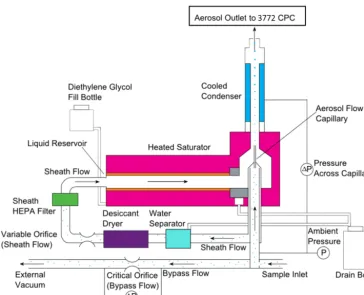
Figure 1.TSI 3777 nano enhancer (courtesy of TSI Inc.).
published their design on the particle size magnifier (PSM) used to study heterogeneous nucleation of dibutyl phthalate vapor onto small ions. Their advances were made possible by the development of a new differential mobility analyzer (DMA) combined to an electrospray source, allowing the CPC testing with well-characterized monomobile samples. Their CPC was based on the design of Okuyama et al. (1984), which is a mixing-type CPC. It took until 2011 to commer-cialize the diethylene glycol (DEG)-based mixing-type CPC technology, when Vanhanen et al. (2011) published their ver-sion of the DEG-based PSM, today sold as the Airmodus A10 PSM (A11 nano condensation nuclei counter when com-bined to Airmodus A20 butanol CPC).
The first use of DEG as a CPC working fluid was reported by Iida et al. (2009), who studied sub-3 nm particle detection via heterogeneous nucleation with many different working fluids theoretically and experimentally. They modified the TSI 3025A to operate with DEG and showed particle acti-vation and growth starting from 1 nm in mobility diameter. Because the grown DEG droplets are too small for direct op-tical detection, a traditional butanol-based CPC was used as the droplet detector. The idea of modifying the commercial TSI instrument to operate with DEG has been followed by several other researchers (Jiang et al., 2011a, b; Kuang et al., 2012a, b; Wimmer et al., 2013). In 2016 TSI commercialized the DEG-based laminar-type CPC based on the work of Iida
et al. (2009). This instrument, the TSI 3777 nano enhancer (3777), is one of the three instruments characterized in this study (Fig. 1).
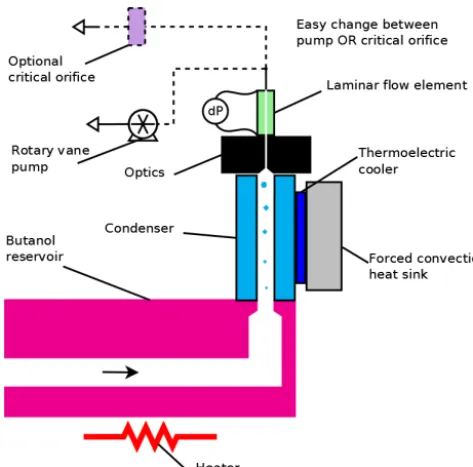
Generally, laminar flow ultrafine CPCs use a sheathed con-denser, which makes the CPC design more complex com-pared to non-sheathed CPCs. Yet recent efforts have shown comparably low detection limits with unsheathed laminar flow instruments. Particle detection with the butanol-based TSI 3010 has been shown down to 2.5 nm from the fac-tory settings d50 (diameter at which 50 % of sampled par-ticles are detected) of 10 nm (Mertes et al., 1995; Russell et al., 1996; Wiedensohler et al., 1997). Kangasluoma et al. (2015a) showed 1 nm particle detection with the commer-cial unsheathed laminar-type CPCs TSI 3772 and Airmodus A20 by increasing the temperature difference (dT) between the saturator and condenser up to 40◦C. The second CPC characterized in this study is a boosted TSI 3010 (B3010), which is a modification of the commercial TSI 3010 devel-oped at the Université Blaise Pascal (Fig. 2). In this instru-ment the temperature control of the saturator and condenser is decoupled to allow free selection of the temperatures, and the critical orifice is replaced with a flow meter and a minia-ture rotary vane pump.
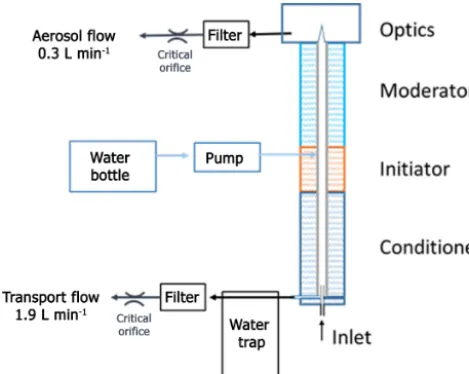
va-Figure 2.ADI vWCPC.
por phase. Hering et al. (2005) addressed this issue by devel-oping a water-based, laminar flow technology (Hering and Stolzenburg, 2005), which was commercialized as the TSI WCPC models 3785 (Hering et al., 2005) and 3786 (Iida et al., 2008) and subsequently as the models 3783, 3787 and 3788. In the model 3786, and later in the model 3788 (Kupc et al., 2013), 3 nm particle detection was enabled by intro-ducing a similar sheathed condenser as in the butanol-based CPCs.
The Aerosol Dynamics Inc. (ADI) versatile water CPC (vWCPC), which is the third CPC characterized in this study (Fig. 3), advances the laminar flow water-based CPC through a three-stage design that reduces the water vapor saturation and temperature in the growth tube after the peak super-saturation is achieved and yet allows for continued particle growth (Hering et al., 2016). This three-stage approach fa-cilitates higher temperature differences between the first two stages and can produce higher peak supersaturation values than the ultrafine TSI 3786 or TSI 3788. The vWCPC is an unsheathed instrument operating at an aerosol flow rate of 0.3 L min−1 and at more extreme temperatures than all of the current commercial TSI WCPCs. In contrast to the DEG-based instruments, which require a separate CPC as a detec-tor due to the small size of the DEG droplets, the droplets formed in the growth tube of the vWCPC are sufficiently large for direct optical detection.
The aim of this study is to make intercomparison experi-ments for the three new particle counters. Each of the CPCs are operated with different working fluids utilizing differ-ent geometries, and first we find the d50 for tungsten oxide test particles for each CPC at temperature settings where do not detect ions from a radioactive source. As the 3777 and vWCPC exhibited very similar performance in terms of d50, we conduct a further comparison to the two CPCs by testing their response at a higher supersaturation than the factory
set-tings, to electrically neutral particles, to organic test particles and to urban ambient particles. Furthermore, we conducted CPC-specific experiments to probe the response of 3777 to varying sample flow relative humidity, of B3010 with vari-ous inlet flow rates and of vWCPC to sampled particle con-centration.
2 Experimental
2.1 Condensation particle counters
A flow diagram of the 3777 is presented in Fig. 1. The de-sign is largely similar to the TSI ultrafine 3776. The inlet flow rate (Qinlet) is 2.5 L min−1, with 1.5 L min−1 of that being transport flow and 1 L min−1 split as the sheath flow (0.85 L min−1) and aerosol flow (Qaerosol, 0.15 L min−1).
The sheath flow passes through a desiccant drier to remove most water vapor entering the condenser. Downstream of the drier the sheath flow is saturated with DEG before entering the condenser around the aerosol flow, which is guided in the center line of the condenser. The saturator has a mean-dering path in a metal block instead of a porous wick used in ultrafine butanol-based CPCs. The 3777 does not have its own optics head, as the droplets formed by DEG condensa-tion are too small for direct deteccondensa-tion. Instead the detector is a TSI 3772 CPC, which further enlarges and then counts the droplets pre-grown by DEG in the condenser. The factory settings of the 3777 are as follows: the saturator at 62◦C and condenser at 12◦C (low temperature difference settings). At these settings the 3777 did not detect any ions produced by an aerosol neutralizer whose bipolar ion source is a 185 MBq radioactive241Am source. It was also operated at boosted settings so that the supersaturation was at the onset of homo-geneous nucleation. With the boosted settings the saturator temperature was set to 70◦C and condenser to 7◦C (high dT settings).
Figure 3.B3010.
the outlet of the growth tube. Further detail is presented by Hering et al. (2016). The vWCPC was tested at two differ-ent temperature settings: the conditioner at 8◦C and initiator at 90◦C (low dT settings), corresponding to supersaturation low enough to not detect any ions from the 185 MBq ra-dioactive241Am source, and boosted settings with the condi-tioner at 1◦C and initiator at 95◦C (high dT settings), which is close to the extremes attainable without freezing or boil-ing. In both instances the moderator was operated at 22◦C
and the optics head at 40◦C. At the high dT settings both
3777 and vWCPC are able to detect ions from the 241Am source.
The B3010 is based on the robust TSI 3010 (Fig. 3), from which everything except the saturator block, the condenser and the optical detector are removed. The original electron-ics have been replaced with custom-made boards to han-dle the higher power consumption and operate off 28 VDC, the primary power supply in aircrafts. The whole system is controlled by a credit-card-sized ARM computer running a tailor-made embedded Linux operating system. It features a touchscreen, a TSI-like serial port protocol, and digital pulse output. With these modifications the saturator heat-ing and condenser coolheat-ing are decoupled. In addition, the critical orifice and external heavy pump are replaced by a laminar flowmeter and a miniature rotary vane pump. The user may set the temperature of the saturator, condenser and optics as well as the flow rate independently from one another. The B3010 was operated at saturator temperature 55◦C, optics head 56◦C and condenser 11◦C. The B3010 will be described in more detail in a dedicated article, which is presently in preparation. Table 1 summarizes the instru-ment operation conditions.
2.2 Direct comparison of all CPCs
Two methods were used to generate the test aerosol: glowing wire generator (GWG) and electrospray source. In the GWG (Peineke et al., 2006), a thin, 0.4 mm in diameter, tungsten wire is heated resistively in a metal chamber. The wire is flushed with 5.0 N2 flow, and it has been shown that
neg-atively charged tungsten oxide clusters are formed into the N2 flow without additional charging (Kangasluoma et al.,
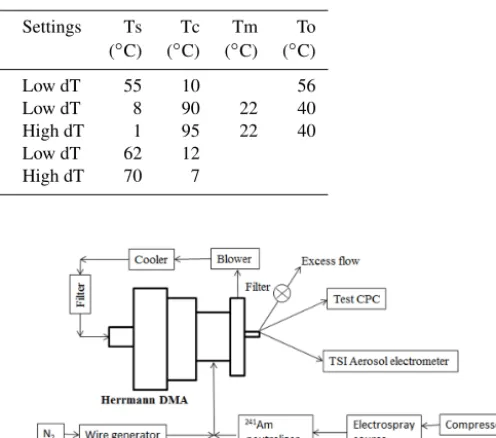
2015b). Positively charged clusters contain some hydrocar-bon molecules clustered with tungsten oxide, explaining why the measured d50 is usually larger for positively than nega-tively charged clusters (Kangasluoma et al., 2016b). Eighteen different sizes of particles between 1 and 4.5 nm were se-lected with the Herrmann-type high-resolution DMA (Kan-gasluoma et al., 2016a; Fig. 4) and guided to a test CPC and TSI aerosol electrometer (3068B). The tubing lengths down-stream of the DMA were selected based on the inlet flow rates so that the particle penetration through the tubes can be assumed equal. The d50 for all three CPCs at low dT settings was measured with tungsten oxide particles.
2.3 Comparison between the 3777 and the vWCPC
The dT of the 3777 and the vWCPC was increased to the extent possible, and the d50 was measured similarly as de-scribed in Sect. 2.2 for tungsten oxide particles. The max-imum dT of the 3777 is limited by the onset of homoge-neous nucleation, while the maximum dT for the vWCPC is restricted by the freezing and boiling points of water.
Table 1.Instrument operation conditions.
Instrument Qinlet Qaerosol Settings Ts Tc Tm To
(L min−1) (L min−1) (◦C) (◦C) (◦C) (◦C)
B3010 1 1 Low dT 55 10 56
vWCPC 2.2 0.3 Low dT 8 90 22 40
vWCPC 2.2 0.3 High dT 1 95 22 40
3777 2.5 0.15 Low dT 62 12
3777 2.5 0.15 High dT 70 7
difference being that they used bipolar neutralizer. Neutral d50 was measured for both instruments with high and low dT by neutralizing both negatively and positively charged parti-cles.
To test the response of the 3777 and the vWCPC to organic test particles, tetradodecylammonium bromide (TDDABr; Ude and Fernández de la Mora, 2005) particles were gen-erated with an electrospray source. The electrospray source produces droplets, which contain the sample molecules, by spraying liquid at high voltage out of a capillary needle against a grounded electrode. The charged droplets are close to the Rayleigh limit and produce charged sample molecules and clusters to the gas flow by series of Coulomb explo-sions and ion and solvent evaporation from the droplet. The highly charged droplets can be close to 2 nm in mobility di-ameter (Ude and Fernández de la Mora, 2005), for which we neutralized the flow exiting the electrospray with a ra-dioactive241Am source to also be able to sample the singly charged clusters which are larger than 2 nm (Kangasluoma et al., 2016a). d50 was measured for the 3777 and vWCPC for positively charged TDDABr with the low dT settings and for the vWCPC at the high dT settings. For the 3777 we could not measure the d50 at high dT settings due to the fact that the aerosol-to-sheath flow ratio is very sensitive to the CPC inlet pressure, and TDDABr was produced by drawing the flow out of the DMA, leading to a pressure drop of approximately 5 kPa at the CPC inlets. This pressure drop was enough to alter the aerosol-to-sheath flow ratio in the 3777 and cause homogeneous droplet formation at high dT settings.
Finally, the 3777 and vWCPC were placed to sample atmospheric aerosol from the Helsinki city area. The in-struments were sampling from the same inlet for approxi-mately 18 h to compare the measured concentrations from atmospheric aerosol. The vWCPC data were dead time cor-rected using the dead time correction factor derived from the concentration-dependent response for 4.4 nm (see next sec-tion).
2.4 CPC-specific tests
As previous literature has reported that water vapor in the sample flow can affect the detection efficiency of a DEG-based CPC (Iida et al., 2009; Kangasluoma et al., 2013), we measured the d50 of the 3777 at various sample flow dew
Figure 4.Experimental setup to measure d50 for charged particles.
points. Water vapor was added to the sample flow with a hu-midified dilution flow downstream of the DMA. The d50 of the 3777 was measured at four different sample flow dew points with negatively charged tungsten oxide particles.
Based on previous literature (Kangasluoma et al., 2015a), the detection efficiency of the laminar-type butanol CPCs can be increased by increasing the inlet flow rate. We tested the performance of the B3010 at four different inlet flow rates. The d50 for the B3010 was measured at inlet flow rates, 0.5, 1.0, 1.4 and 1.6 L min−1, by varying the rotary vane pump speed.
Table 2.All measured d50s (nm).
Conditions Aerosol Charging state ADI vWCPC TSI-3777 B3010
High dT WOx negative 1.4 1.3 NA
High dT WOx positive 1.5 1.4 NA
High dT WOx neutral from− 1.6 1.5 NA
High dT WOx neutral from+ 2.2 2.1 NA
Low dT WOx negative 1.7 1.8 3.4
Low dT WOx positive 1.9 2 3.2
Low dT WOx neutral from− 2 1.9 NA
Low dT WOx neutral from+ 2.4 2.3 NA
High dT TDDAB positive 2.8 NA NA
Low dT TDDAB positive 3.3 2.5 NA
Figure 5.Detection efficiency of the CPCs as a function of size for negatively and positively charged tungsten oxide particles at low dT settings.
3 Results
3.1 Direct comparison of all CPCs
Figure 5 presents the d50 curves for the B3010, 3777 and vWCPC at low dT settings for positively and negatively charged tungsten oxide particles. The standard deviation in the detection efficiency data was in most cases < 5 %, which is why we do not plot detection efficiency error bars. Thex axis uncertainty can be taken from the Herrmann DMA res-olution of approximately 20, leading to relative uncertainty of±2 %, which is the square root of variance of the normal distribution fitted to the tetraheptylammonium bromide posi-tively charged monomer peak. Therefore, uncertainties in the data arise mostly from other sources, such as possibly un-equal sampling line penetration or possibly changing particle chemical composition as a function of size. At these settings none of the CPCs detect the ions generated by a bipolar ion source. We find that the vWCPC exhibits slightly lower d50
than the 3777, while the d50 of the B3010 is clearly the high-est. The d50 of 3.2–3.4 nm for the B3010, however, shows that the conventional TSI 3010 can be boosted to similar per-formance as the TSI ultrafine 3776, just with a shallower d50 curve due to larger particle diffusion losses, by decoupling the heating and cooling of the saturator and condenser. Re-spective d50 values for the B3010, vWCPC and TSI-3777 are 3.4, 1.7 and 1.8 nm, for negatively charged tungsten ox-ide, and 3.2, 1.9 and 2.0 nm, for positively charged ones.
3.2 Comparison between the 3777 and the vWCPC
At high dT settings the d50 curves are presented in Fig. 6. For the 3777 the temperatures were selected as those that are just below the limit of homogeneous nucleation of the DEG working fluid. For the vWCPC, the temperatures are simply the largest extremes attainable without freezing or boiling the water working fluid. Unlike the DEG instrument, the high dT operation of the vWCPC is not near the homogeneous nucleation limit, as no evidence of homogeneous nucleation was observed even at reduced inlet pressures. At these higher dT settings, we find somewhat more efficient detection of smaller particles by the 3777 than the vWCPC. The d50s are lowered to 1.4 and 1.3 nm for negatively charged and to 1.5 and 1.4 nm for positively charged for the vWCPC and 3777, respectively.
Figure 6.Detection efficiency of the CPCs as a function of size for positively and negatively charged tungsten oxide particles at high dT settings.
with this study. Similarly, the d50 values reported here for the vWCPC are close to those observed by Hering et al. (2016), who measured d50 of 1.6 and 1.9 nm for high dT and low dT operation, respectively, for particles from a heated NiCr wire.
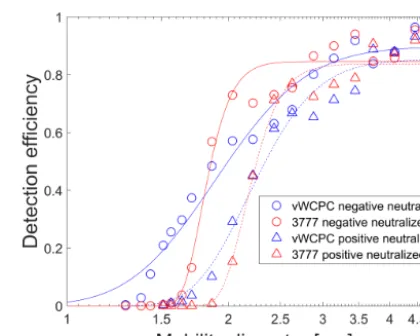
Figure 7 presents the d50 curves measured with the neu-tralized tungsten oxide particles for 3777 and vWCPC. The data is normalized so that the mean detection efficiency at three largest diameters is 90 % based on the assumption that at those sizes the particle charge does not affect the detection efficiency anymore. It is also assumed through the normal-ization that the neutralnormal-ization efficiency does not change as a function of the particle size. Further uncertainties arise from the unknown processes that take place during neutralization. Due to these uncertainties, the curves are not as smooth as for the charged particles. However, an estimate for the neu-tral d50 will be obtained from these experiments, which are 1.6 and 1.5 nm for vWCPC and 3777 at high dT and 2.0 and 1.9 nm at low dT settings, respectively, for neutralized negatively charged tungsten oxide. For neutralized positively charged particles the respective values are 2.2 and 2.1 nm at high dT settings and 2.4 and 2.3 nm at low dT settings (Fig. 8). The difference in the d50s between the negatively and positively charged particles after neutralization are pos-sibly mostly explained by their differences in the chemical composition. Positively charged particles contain more con-taminant species than the negatively charged particles, which is still observed in the d50 when they both are neutralized. For more details, refer to Kangasluoma et al. (2016b). The neutral d50s are greater than for charged d50 values by ap-proximately 0.1–0.5 nm at low dT settings, similar to the val-ues obtained in Kangasluoma et al. (2016b) for water tung-sten oxide and DEG tungtung-sten oxide system.
Figure 7.Detection efficiency of the CPCs as a function of size for negatively and positively charged tungsten oxide particles that are neutralized at low dT settings.
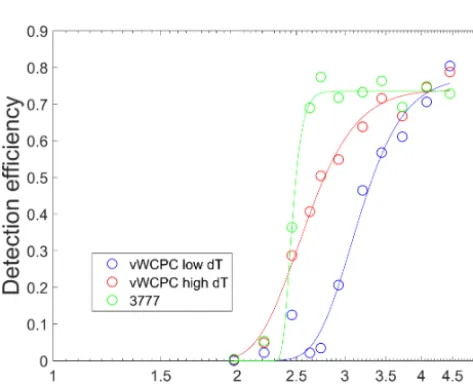
The d50 curves for positively charged TDDABr for the 3777 and vWCPC are presented in Fig. 9. For both instru-ments the d50 values are higher than for tungsten oxide par-ticles, but this is most pronounced for the vWCPC. At the low dT settings d50 values are 3.3 and 2.5 nm for the vWCPC and 3777, respectively, and 2.8 nm for the vWCPC at high dT. At the high dT and the reduced inlet pressure for these TDDABr tests, the 3777 produced homogeneously nucleated particles, and hence its high dT d50 value could not be measured. To obtain accurate particle concentration measurements, these differences in the d50 imply that the CPCs should be cali-brated with the same aerosol composition as the real experi-ment is conducted.
A fraction of the data measured from atmospheric aerosol is presented in Fig. 10. The measurement location is above a bus stop, through which several busses pass daily. The bus stop times are marked in the figure. The background aerosol concentration during that morning was around 3000– 10 000 cm−3. Clear spikes up to 200 000 cm−3 in the mea-sured concentrations are observed throughout the morning. The number concentration is generally high during traffic hours, and both CPCs reacts instantaneously to the occa-sional spikes in the number concentration. From the data of Fig. 10, a correlation plot between the vWCPC and 3777 is presented in Fig. 11 for concentrations below 50 000 cm−3. With an R2 of 0.99 the two CPCs show remarkably good agreement with a slope of 1.02 and an offset of 340 up to concentrations of 50 000 cm−3.
3.3 CPC-specific tests
Figure 8.Detection efficiency of the CPCs as a function of size for negatively and positively charged tungsten oxide particles that are neutralized at high dT settings.
Figure 9.Detection efficiency of the CPCs as a function of size for positively charged TDDABr particles at low and high dT settings for vWCPC and at low dT settings for the 3777.
dew point is presented in Fig. 12. The observed variation with dew points ranging from completely dry gas to 20◦C in the d50 is only approximately 0.1 nm. The apparently increased plateau value for the highest dew point can be due to slightly higher inlet pressure, increasing the aerosol flow of the in-strument. The variation in the d50 due to changing dew point is less than, for example, the 0.3 nm reported in Kangaslu-oma et al. (2013) for the Airmodus A09 PSM. This is due to the smaller amount of sample flow water vapor reaching the condenser in the 3777, since 85 % of the condenser flow is dried, as compared to 0 % of the condenser flow of the PSM of that time.
Figure 10.Concentration measured by the 3777 and vWCPC from urban atmospheric air.
Figure 11.Correlation of the concentrations below 50 000 cm−3 measured by the CPCs for the same data as in Fig. 10.
Figure 12. Detection efficiency of the 3777 as a function of the particle diameter and sample flow dew point.
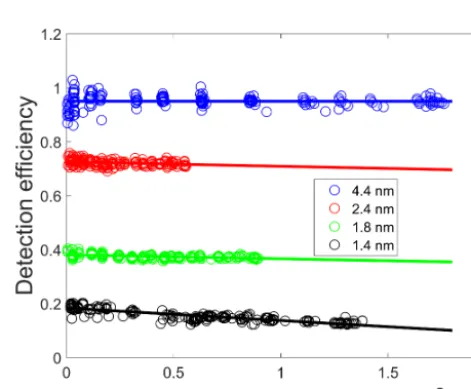
As with all CPCs, the peak supersaturation, and hence the lowest detectable particle size, can be affected by the pres-ence of other particles in the flow due to a combination of condensational heat release and vapor depletion. These ef-fects for the original WCPCs were explored by Lewis and Hering (2013) and are evaluated here for the vWCPC. Fig-ure 14 shows the concentration-dependent response at four particle sizes for the vWCPC. The maximum concentration at each size was determined by the maximum concentration we were able to pass through the DMA. The data are cor-rected for dead time, as described by Hering et al. (2005), and as is standard for most of the commercial CPCs. This approach uses the instrument dead time multiplied by a dead time correction factor, which accounts for the increase in ef-fective dead time due to overlapping tails in pulses below the threshold. For this data set the dead time correction factor was set to 1.23 to yield a linear response to concentration at 4.4 nm. Then this same dead time correction factor was ap-plied to measurements at other sizes. The curves of the three smallest particle sizes have a negative slope due to the re-duction in supersaturation at high concentrations caused by condensational heating (Lewis and Hering, 2013). However, the effect is relatively small, with the detection efficiency at 1.8 nm dropping from 36 % at a concentration of 3000 cm−3 to 33 % at a concentration of 90 000 cm−3.
4 Conclusions
Three new sub-3 nm CPCs, the boosted 3010-type CPC, ADI versatile water CPC and the TSI 3777 nano enhancer, were characterized for the d50 diameter. The boosted 3010-type CPC was shown to be able to detect tungsten oxide parti-cles smaller than 3 nm. The vWCPC and 3777 were char-acterized with similar test aerosols with two different
set-Figure 13.Detection efficiency of the B3010 as a function of the inlet flow rate.
Figure 14.Ratio of the vWCPC to the electrometer as function of the particle concentration.
same atmospheric aerosol the two CPCs showed a very good agreement with regression slope of 1.02 andR2of 0.99.
From the results we can make the following conclusions. The TSI 3010 hardware can be tuned to accomplish 3 nm par-ticle detection by increasing the dT but not by increasing the inlet flow rate, which is in line with Buzorius (2001). This is possibly due to imperfect flow saturation in the reservoir-type saturator as opposed to the multi-hole saturator of TSI 3772 and planar-type saturator of Airmodus A20 (Kangaslu-oma et al., 2015a). Due to the variations in the d50 with test particle composition for the vWCPC and 3777, a careful CPC calibration should be conducted with the same particle com-position as of the sampled particles. If the comcom-position of the sampled particles is completely unknown, the obtained particle concentrations at the size range of the d50 can have significant uncertainties. The effect of particle charge on the d50 was shown to be up to approximately 0.5 nm, which has implications for system characterizations where the fraction of charged particles can be expected to be high (Wang et al., 2017), or CPC calibration is conducted with charged parti-cles, sampled particles are neutral and high precision d50 is required.
Data availability. Data are available from the corresponding au-thor.
Competing interests. The laminar flow, water condensation tech-nology presented here is covered by multiple patents assigned to Aerosol Dynamics Inc., who is the employer of two of the authors, Susanne Hering and Greg Lewis.
Acknowledgements. The authors acknowledge TSI Inc. who provided the control boards and optics for the vWCPC and who loaned the TSI 3777 for these experiments. The research was partly funded by the European Research Council (ATMNUCLE, 227463), Academy of Finland (Center of Excellence Program projects 1118615 and 139656), European Commission Seventh Framework Programme (ACTRIS2 contract no. 654109, PPP and EUROCHAMP-2020), Labex ClerVolc contribution no. 228 and Maj and Tor Nessling Foundation (grant 201700296).
Edited by: P. Herckes
Reviewed by: three anonymous referees
References
Aalto, P., Hameri, K., Becker, E., Weber, R., Salm, J., Makela, J. M., Hoell, C., O’Dowd, C. D., Karlsson, H., Hansson, H. C., Vakeva, M., Koponen, I. K., Buzorius, G., and Kulmala, M.: Physical characterization of aerosol particles during nucleation events, Tellus B, 53, 344–358, 2001.
Buzorius, G.: Cut-off sizes and time constants of the CPC TSI 3010 operating at 1-3 L min−1flow rates, Aerosol Sci. Tech., 35, 577– 585, 2001.
Hering, S. V. and Stolzenburg, M. R.: A method for particle size amplification by water condensation in a laminar, thermally dif-fusive flow, Aerosol Sci. Tech., 39, 428–436, 2005.
Hering, S. V., Stolzenburg, M. R., Quant, F. R., Oberreit, D. R., and Keady, P. B.: A laminar-flow, water-based condensation particle counter (WCPC), Aerosol Sci. Tech., 39, 659–672, 2005. Hering, S. V., Spielman, S. R., and Lewis, G. S.: Moderated,
Water-Based, Condensational Particle Growth in a Laminar Flow, Aerosol Sci. Tech., 48, 401–408, 2014.
Hering, S. V., Lewis, G. L., Spielman, S. R., Eiguren-Fernandez, A., Kreisberg, N. M., Kuang, C., and Attoui, M.: Detection near 1-nm with a Laminar-Flow, Water-Based Condensation Particle Counter, Aerosol Sci. Tech., 51, 354–362, 2016.
Iida, K., Stolzenburg, M. R., McMurry, P. H., Smith, J. N., Quant, F. R., Oberreit, D. R., Keady, P. B., Eiguren-Fernandez, A., Lewis, G. S., Kreisberg, N. M., and Hering, S. V.: An ultrafine, water-based condensation particle counter and its evaluation under field conditions, Aerosol Sci. Tech., 42, 862–871, 2008.
Iida, K., Stolzenburg, M. R., and McMurry, P. H.: Effect of Work-ing Fluid on Sub-2 nm Particle Detection with a Laminar Flow Ultrafine Condensation Particle Counter, Aerosol Sci. Tech., 43, 81–96, 2009.
Jiang, J. K., Chen, M. D., Kuang, C. A., Attoui, M., and McMurry, P. H.: Electrical Mobility Spectrometer Using a Diethylene Glycol Condensation Particle Counter for Measurement of Aerosol Size Distributions Down to 1 nm, Aerosol Sci. Tech., 45, 510–521, 2011a.
Jiang, J. K., Zhao, J., Chen, M. D., Eisele, F. L., Scheckman, J., Williams, B. J., Kuang, C. A., and McMurry, P. H.: First Mea-surements of Neutral Atmospheric Cluster and 1-2 nm Particle Number Size Distributions During Nucleation Events, Aerosol Sci. Tech., 45, 2–5, 2011b.
Kangasluoma, J., Junninen, H., Lehtipalo, K., Mikkilä, J., Van-hanen, J., Attoui, M., Sipilä, M., Worsnop, D., Kulmala, M., and Petäjä, T.: Remarks on Ion Generation for CPC Detection Effi-ciency Studies in Sub-3-nm Size Range, Aerosol Sci. Tech., 47, 556–563, 2013.
Kangasluoma, J., Kuang, C., Wimmer, D., Rissanen, M. P., Lehti-palo, K., Ehn, M., Worsnop, D. R., Wang, J., Kulmala, M., and Petäjä, T.: Sub-3 nm particle size and composition dependent re-sponse of a nano-CPC battery, Atmos. Meas. Tech., 7, 689–700, https://doi.org/10.5194/amt-7-689-2014, 2014.
Kangasluoma, J., Ahonen, L., Attoui, M., Vuollekoski, H., Kulmala, M., and Petäjä, T.: Sub-3 nm Particle Detection with Commercial TSI 3772 and Airmodus A20 Fine Condensation Particle Coun-ters, Aerosol Sci. Tech., 49, 674–681, 2015a.
Kangasluoma, J., Attoui, M., Junninen, H., Lehtipalo, K., Samod-urov, A., Korhonen, F., Sarnela, N., Schmidt-Ott, A., Worsnop, D., Kulmala, M., and Petäjä, T.: Sizing of neutral sub 3 nm tung-sten oxide clusters using Airmodus Particle Size Magnifier, J. Aerosol Sci., 87, 53–62, 2015b.
Kangasluoma, J., Samodurov, A., Attoui, M., Franchin, A., Junni-nen, H., KorhoJunni-nen, F., Kurtén, T., Vehkamäki, H., Sipilä, M., Lehtipalo, K., Worsnop, D., Petäjä, T., and Kulmala, M.: Het-erogeneous nucleation onto ions and neutralized ions – insights into sign-preference, J. Phys. Chem. C, 120, 7444–7450, 2016b. Kuang, C., Chen, M., Zhao, J., Smith, J., McMurry, P. H., and Wang, J.: Size and time-resolved growth rate measurements of 1 to 5 nm freshly formed atmospheric nuclei, Atmos. Chem. Phys., 12, 3573–3589, https://doi.org/10.5194/acp-12-3573-2012, 2012a. Kuang, C., Chen, M. D., McMurry, P. H., and Wang, J.:
Modifi-cation of Laminar Flow Ultrafine Condensation Particle Coun-ters for the Enhanced Detection of 1 nm Condensation Nuclei, Aerosol Sci. Tech., 46, 309–315, 2012b.
Kupc, A., Bischof, O., Tritscher, T., Beeston, M., Krinke, T., and Wagner, P. E.: Laboratory Characterization of a New Nano-Water-Based CPC 3788 and Performance Comparison to an Ul-trafine Butanol-Based CPC 3776, Aerosol Sci. Tech., 47, 183– 191, 2013.
Lewis, G. S. and Hering, S. V.: Minimizing Concentration Effects in Water-Based, Laminar-Flow Condensation Particle Counters, Aerosol Sci. Tech., 47, 645–654, 2013.
Mertes, S., Schroder, F., and Wiedensohler, A.: The Particle-Detection Efficiency Curve of the Tsi-3010 Cpc as a Function of the Temperature Difference between Saturator and Condenser, Aerosol Sci. Tech., 23, 257–261, 1995.
Okuyama, K., Kousaka, Y., and Motouchi, T.: Condensational Growth of Ultrafine Aerosol-Particles in a New Particle-Size Magnifier, Aerosol Sci. Tech., 3, 353–366, 1984.
Peineke, C., Attoui, M. B., and Schmidt-Ott, A.: Using a glow-ing wire generator for production of charged, uniformly sized nanoparticles at high concentrations, J. Aerosol Sci., 37, 1651– 1661, 2006.
Russell, L. M., Zhang, S. H., Flagan, R. C., Seinfeld, J. H., Stolzen-burg, M. R., and Caldow, R.: Radially classified aerosol detec-tor for aircraft-based submicron aerosol measurements, J. Atmos. Ocean. Technol., 13, 598–609, 1996.
Seto, T., Okuyama, K., de Juan, L., and Fernández de la Mora, J.: Condensation of supersaturated vapors on monovalent and diva-lent ions on varying size, J. Chem. Phys., 107, 1576–1585, 1997. Sipilä, M., Lehtipalo, K., Attoui, M., Neitola, K., Petäjä, T., Aalto, P. P., O’Dowd, C. D., and Kulmala, M.: Laboratory Verification of PH-CPC’s Ability to Monitor Atmospheric Sub-3 nm Clusters, Aerosol Sci. Tech., 43, 126–135, 2009.
Stolzenburg, M. R. and McMurry, P. H.: An Ultrafine Aerosol Con-densation Nucleus Counter, Aerosol Sci. Tech., 14, 48–65, 1991. Ude, S. and Fernández de la Mora, J.: Molecular monodisperse mo-bility and mass standards from electrosprays of tetra-alkyl am-monium halides, J. Aerosol Sci., 36, 1224–1237, 2005. Vanhanen, J., Mikkilä, J., Lehtipalo, K., Sipilä, M., Manninen, H.
E., Siivola, E., Petäjä, T., and Kulmala, M.: Particle Size Mag-nifier for Nano-CN Detection, Aerosol Sci. Tech., 45, 533–542, 2011.
Wang, Y., Kangasluoma, J., Attoui, M., Fang, J., Junninen, H., Kul-mala, M., Petäjä, T., and Biswas, P.: The high charge fraction of flame-generated particles in the size range below 3 nm mea-sured by enhanced particle detectors, Combust Flame, 176, 72– 80, 2017.
Weber, R. J., Marti, J. J., McMurry, P. H., Eisele, F. L., Tanner, D. J., and Jefferson, A.: Measured atmospheric new particle forma-tion rates: Implicaforma-tions for nucleaforma-tion mechanisms, Chem. Eng. Commun., 151, 53–64, 1996.
Wiedensohler, A., Orsini, D., Covert, D. S., Coffmann, D., Cantrell, W., Havlicek, M., Brechtel, F. J., Russell, L. M., Weber, R. J., Gras, J., Hudson, J. G., and Litchy, M.: Intercomparison study of the size-dependent counting efficiency of 26 condensation parti-cle counters, Aerosol Sci. Tech., 27, 224–242, 1997.
Wilson, J. C., Blackshear, E. D., and Hyun, J. H.: An Improved Continuous-Flow Condensation Nucleus Counter for Use in the Stratosphere, J. Aerosol Sci., 14, 387–391, 1983.
Wimmer, D., Lehtipalo, K., Franchin, A., Kangasluoma, J., Kreissl, F., Kürten, A., Kupc, A., Metzger, A., Mikkilä, J., Petäjä, T., Riccobono, F., Vanhanen, J., Kulmala, M., and Curtius, J.: Performance of diethylene glycol-based particle counters in the sub-3 nm size range, Atmos. Meas. Tech., 6, 1793–1804, https://doi.org/10.5194/amt-6-1793-2013, 2013.