Journal Chemical Engineering and Industrial Biotechnology (JCEIB)
Open Access
Volume 2 pp. 47-58; September 2017 ©Universiti Malaysia Pahang Publisher DOI: https://doi.org/10.15282/JCEIB-V1-16.29/9/2017/2.2
MATHEMATICAL MODELLING OF BACKWARD EXTRACTION
MIXED REVERSE MICELLE OF AMOXICILLIN BY SURFACE
RESPONSE METHODOLOGY (RSM)
Siti Norazimah Mohamad Aziza, Mimi Sakinah Abdul Munaima,*,
a Faculty of Technology, Universiti Malaysia Pahang,
26300 Kuantan, Pahang, Malaysia
* Corresponding author: E-mail: [email protected] Tel.: +609-5492825 Fax.: +609- 5492889
ABSTRACT
One of important factor in reverse micelle extraction is backward transfer. It is important to investigate the favourable conditions for backward transfer from reverse micellar phase to an organic phase. The back extraction of amoxicillin was studied using mixed reverse micelle with combination sodium bis(2-ethylhexyl) sulfosuccinate (AOT) and TWEEN 85. Backward extraction was optimized via response surface methodology (RSM). For mathematical modelling, Central Composite Design (CCD) was used to studies the significant of independent variables: pH of stripping solution (5-8), KCl concentration (2.0 -16.0 g/L) and backward extraction time (5-35 minutes) on the response of the process. Optimized backward extraction for maximized final mass of amoxicillin extracted into aqueous were pH of stripping solution (6.58), backward time (19.8 minutes) and concentration of KCl (11.02 g/L) on the response of the process. Result showed that the experimental data was fitted well to a second-order polynomial model.
Keyword: Backward extraction, amoxicillin, mixed reverse micelle, response surface methodology
1.0INTRODUCTION
Amoxicillin is a semi synthetic β-lactam antibiotic used for the treatment of bacterial infections such as bronchitis, gonorrhoea and pneumonia caused by Gram-positive and Gram-negative bacteria (Ahmadi et al., 2017). Amoxicillin is usually combined with β -lactamase inhibitor potassium clavulanate for commercial antibiotic drugs (Bejjani et al., 2016). In industry, amoxicillin is produce via a chemical coupling process by a β -lactam nucleus and appropriate acyl donors (Chuo et al., 2014). Therefore a powerful extraction method needed for separation by-product.
water molecules dispersed in a continuous organic solvent phase. Biomolecules are able to solubilize into water core in reverse micelle and provide microenvironment and sheltered from organic medium hence maintaining the functional properties of biomolecules (Tonova et al., 2008; Xiao et al., 2013). RME have been recognized for its benefits since it able to operate in large-scale and continuous operation and it can be carried out by using the existing liquid–liquid extraction system (Kumar et al., 2011; Chen et al.,2006).
Reverse micelle consist two steps of extraction forward and backward extraction (Sun et al., 2009). In forward extraction, biomolecules solubilize in reverse micelle phase while for backward extraction the biomolecules will stripped back from reverse micelle solution (Leser et al., 1993). However, the backward extraction received less interest in the literature. A number of problems had been reported from previous researches regarding backward extraction (Mohd-Setapar et al., 2012; Mohd-Setapar et al., 2009; Sun et al., 2009; Ono et al., 1996), including need a sufficient amount of water to recover biomolecules (Sun et al., 2009) and easy to form emulsion between two phase (Lee et al., 2004) therefore, an improvement in backward extraction is necessary.
RSM is originally introduced by Box and Wilson (1951), which this method are provide a way to evaluate the effect of process variables and interactions on the response. Swamy and Muthukumarappan (2017) stated that RSM is an effective statistical approach to optimize a complex processes. Response surface methodology was employed in order to optimize the backward extraction of amoxicillin and enhance the recovery of amoxicillin. All data were implemented by CCD using STATISTICA 8.0 software.
2.0EXPERIMENTALS
Reagents and Materials
Analytical-grade amoxicillin, AOT and non-ionic TWEEN 85 surfactant were supplied from Sigma Aldrich and used without further purification. Isooctane and KCl were purchased from Merck, Germany. All chemicals used for the experiments were analytical grade. All aqueous solutions were prepared by using deionized. A stock solution of 5 gL-1 of amoxicillin was prepared by dissolving 5 g of the reagent in 1 L of deionized water in a volumetric flask.
Backward Extraction
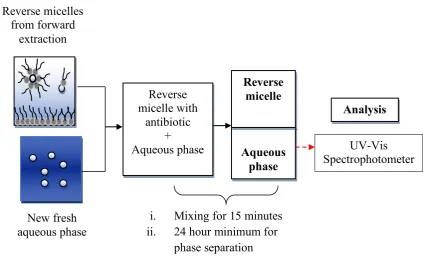
Figure 1: Flow chart of the experimental procedure for backward extraction
3.0 RESULT AND DISCUSSION Model Fitting
The significance of the backward extraction model was examined by Fisher’s F-test (Sun et al., 2009). The mathematical model represents the backward extraction of amoxicillin by mixed AOT/TWEEN 85 micelles in the experimental region considered here as follow:
For response final mass of amoxicillin extracted into aqueous, Y1:
Y = -121.15077 + 28.03931 X1 - 2.12772 X12 + 4.28307 X2 - 0.19435 X22 + 2.28857 X3 - 0.05793 X32
(1)
Where X1 is stripping pH, X2 is concentration of KCl (g/L) and X3 is backward time (minute). The analysis of variance results is presented in Table 1 and the value of the coefficient determination (R2) was identified as 0.94144. This implies that the data variation of 94.144% for the backward extraction of amoxicillin was attributed to the independent variables and only 5.856% could not be explained by using the model.
New fresh aqueous phase
i. Mixing for 15 minutes ii. 24 hour minimum for
phase separation (settling process)
Analysis
Aqueous phase
UV-Vis Spectrophotometer Reverse
micelle with antibiotic
+ Aqueous phase
Reverse micelle Reverse micelles
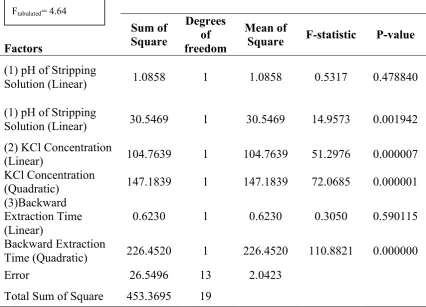
Table 1: Analysis of variance (ANOVA) for the final mass of amoxicillin extracted into aqueous phase in backward extraction
Factors
R2=0.94144; Mean Square of Residual=2.042278
Sum of Square
Degrees of freedom
Mean of
Square F-statistic P-value
(1) pH of Stripping
Solution (Linear) 1.0858 1 1.0858 0.5317 0.478840
(1) pH of Stripping
Solution (Linear) 30.5469 1 30.5469 14.9573 0.001942
(2) KCl Concentration
(Linear) 104.7639 1 104.7639 51.2976 0.000007
KCl Concentration
(Quadratic) 147.1839 1 147.1839 72.0685 0.000001
(3)Backward Extraction Time (Linear)
0.6230 1 0.6230 0.3050 0.590115
Backward Extraction
Time (Quadratic) 226.4520 1 226.4520 110.8821 0.000000
Error 26.5496 13 2.0423
Total Sum of Square 453.3695 19
From the calculation, the statistical significance of the quadratic model was revealed by using the F-test since the Fcalculated >> Ftabulated was indicated in ANOVA table, therefore, implying that the model was significant at the 1% significance level. This suggests that the backward model accurately represented the data in the experimental region and the second-order term was sufficient to express the data.
Influence of Independent Variables
In order to observe the significance of various effects on the process parameter on the response, the regression analysis was carried out by using statistical software. Table 2 indicates the magnitude of P-values and it clearly shows that the quadratic and linear term for all process variables have significant effect on the amoxicillin recovery at 5% significant level except for linear pH of stripping solution and linear backward extraction time since the value of p is 0.590115 and 0.478840 respectively (p>0.05). In addition, the positive sign of coefficient for X1, X2 and X3 for Y1 showed linear effects to the final mass of amoxicillin extracted into aqueous phase in backward extraction.
Fcalculated= 250.0394
Table 2: Significance of regression coefficients for responses Y1 Response Y1
Coefficients Values P-Values
Constant -121.15077
X1 28.03931 0.478840
X2 4.28307 0.000007
X3 2.28857 0.590115
X1 X1 - 2.12772 0.001942
X2 X2 - 0.19435 0.000001
X3 X3 - 0.05793 0.000000
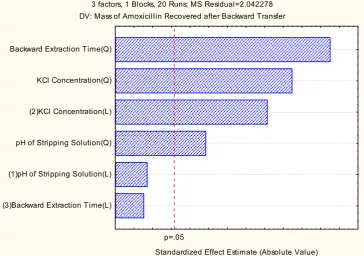
As stated before, anionic surfactants (in this research is AOT), the maximum extraction efficiency had been observed at pH of stripping solution above the pI value (4.7). As the pH was increased, the amount of amoxicillin recovery would increase through the result of electrostatic repulsion between surfactant head group and amoxicillin molecules. Meanwhile, for KCl concentration variables, Hemavathi et al. (2010) clarified that the efficiency of backward extraction increases when salt concentration is raised, due to the decrease of reverse micelles size, hence proteins are easily to expel out from the micelles (in their case). In addition, by increasing the backward extraction time (between 5 until 15 minutes), it was found that the amount of amoxicillin was enhanced because the amoxicillin molecules had enough time to be in contact with the aqueous solution and transfer back from reverse micelle core. A Pareto chart in Figure 2 also can be used to graphically summarize and display the relative importance of the independents variables on the amoxicillin recovered in backward extraction.
Pareto Chart of Standardized Effects; Variable: Mass of Amoxicillin Recovered after Backward Transfer 3 factors, 1 Blocks, 20 Runs; MS Residual=2.042278
DV: Mass of Amoxicillin Recovered after Backward Transfer
p=.05
Standardized Effect Estimate (Absolute Value) (3)Backward Extraction Time(L)
(1)pH of Stripping Solution(L) pH of Stripping Solution(Q) (2)KCl Concentration(L) KCl Concentration(Q) Backward Extraction Time(Q)
The contributing factors in descending order are identified as quadratic backward extraction time > quadratic KCl concentration > linear KCl concentration > quadratic pH of stripping solution. Therefore, the most contributing factors in order to maximize the recovery of amoxicillin in backward extraction are the backward extraction time and KCl concentration. However from another point of view if the time extraction was too long, it might have increased the chance for the amoxicillin to be in contact with the iso-octane solvent, leading to the damage the amoxicillin and affecting the performance of backward transfer.
Response Surface and Contour Plot
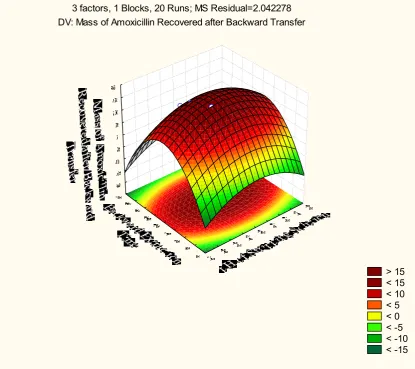
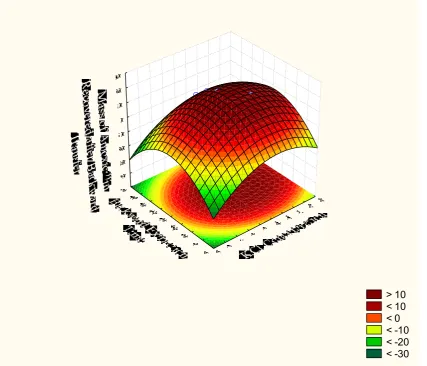
The response surface methodology was applied for backward extraction of amoxicillin in order to develop, improve and optimize the processes and was used to evaluate the relative significance of several affecting factors. The contour plots of response surface described by the regression model were developed to demonstrate the effects of the independent variables and effects of each independent variable on the response Y as shown in Figure 3-5.
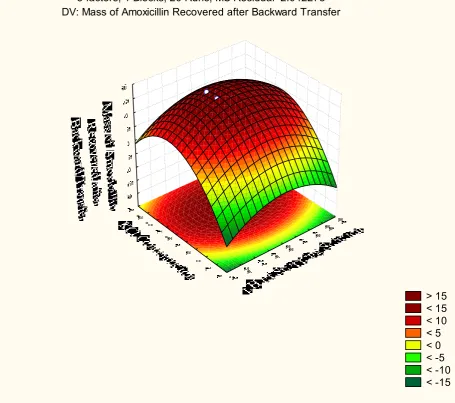
The surface plot presents the final mass of amoxicillin extracted into aqueous phase response as a function of two factors and keeping another one as constant. At a definite pH of stripping solution, the recovery of amoxicillin increased with the increasing KCl concentration. However, the aqueous pH had a positive linear effect on the amoxicillin extracted at low pH level.
When the pH of the stripping aqueous phase exceeded the pI of amoxicillin (pI=4.7), the final mass of amoxicillin increased because of the electrostatic interaction between the amoxicillin and AOT/TWEEN 85, where the reverse micelles were weakened and more amoxicillin molecules were released from the reverse micelles into the aqueous phase. In addition, Zhao et al. (2010) asserted that high aqueous pH more than pI combined with increased salt concentration might have destabilized the reverse micelles resulting in higher back transfer efficiency.
Fitted Surface; Variable: Mass of Amoxicillin Recovered after Backward Transfer 3 factors, 1 Blocks, 20 Runs; MS Residual=2.042278
DV: Mass of Amoxicillin Recovered after Backward Transfer
> 15 < 15 < 10 < 5 < 0 < -5 < -10 < -15
Figure 3: Response surface plots of aqueous stripping pH and KCl concentration on amoxicillin recovery at 20 minutes backward extraction time
Fitted Surface; Variable: Mass of Amoxicillin Recovered after Backward Transfer 3 factors, 1 Blocks, 20 Runs; MS Residual=2.042278
DV: Mass of Amoxicillin Recovered after Backward Transfer
> 15 < 15 < 10 < 5 < 0 < -5 < -10 < -15
Figure 4: Response surface plots of aqueous stripping pH and backward extraction time on amoxicillin recovery at 12 g/L of KCl concentration
Fitted Surface; Variable: Mass of Amoxicillin Recovered after Backward Transfer 3 factors, 1 Blocks, 20 Runs; MS Residual=2.042278
DV: Mass of Amoxicillin Recovered after Backward Transfer
> 10 < 10 < 0 < -10 < -20 < -30
Figure 5: Response surface plots of KCl concentration and backward extraction time on amoxicillin recovery at pH 7
In order to optimize the processing conditions for final mass of amoxicillin extracted into aqueous phase, the first partial derivatives of the regression model were equated to zero according to δY/δX1, δY/δX2, δY/δX3 respectively:
!"
!#$ = 28.03931 – 4.25544 X1 = 0
(2)
!"
!#% = 4.28307 - 0.38870 X2= 0
(3)
!"
!#& = 2.28857 – 0.11586 X3= 0
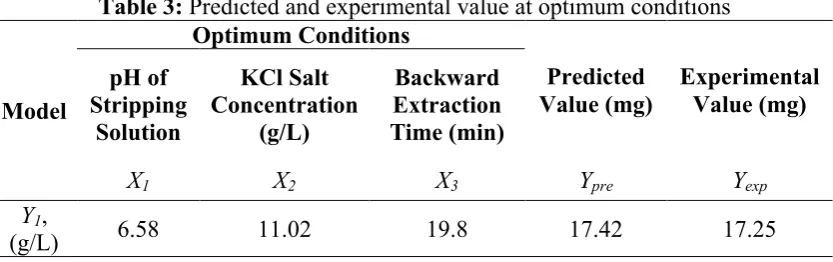
The optimal condition for backward extraction of amoxicillin by using mixed AOT/TWEEN 85 was determined. The experimental value was compared with the predicted in order to determine the validity of the model. From the model, the stationary point giving a maximum backward transfer of amoxicillin by using mixed reverse micelle of AOT/TWEEN 85, following the critical values as the pH of stripping solution, X1 = 6.58, KCl concentration, X2 = 11.02 g/L and backward extraction time, X3 = 19.8 min. The predicted and experimental value at optimum conditions is shown in Table 3.
Table 3: Predicted and experimental value at optimum conditions
Model
Optimum Conditions
Predicted Value (mg)
Experimental Value (mg) pH of
Stripping Solution
KCl Salt Concentration
(g/L)
Backward Extraction Time (min)
X1 X2 X3 Ypre Yexp
Y1,
(g/L) 6.58 11.02 19.8 17.42 17.25
The predicted final mass of amoxicillin in backward in these conditions by using STATISTICA analysis was 177.42 mg (91.68%), while the experimental value for these conditions was 17.25 mg (90.79%). Therefore, the results indicated that the experimental value was found to be in agreement with the predicted one. The extraction method by using mixed reverse micelle can be considered as a novel method since the recovery of amoxicillin was able to reach up to 90%.
4.0 CONCLUSIONS
The objective of this study was to provide mathematical model which would be able to describe mixed reverse micelle amoxicillin effectively. Based on the results, the experimental data was fitted well mathematical models. Model exhibited R2 value of 0.94144 with a significant lack of fit. The optimum conditions were obtained by experimental are closed with mathematical modelling with the predicted final mass of amoxicillin was 177.42 mg (91.68%), while the experimental value was 17.25 mg (90.79%).
5.0 ACKNOWLEDGEMENTS
REFERENCES
Ahmadi, M., Madrakian, T. & Afkhami, A. (2016). Solid phase extraction of amoxicillin using dibenzo-18-crown-6 modified magnetic-multiwalled carbon nanotubes prior to its spectrophotometric determination. Talanta, 148, 122–128.
Bejjani, A. Roumié, M. Akkad, S. El-Yazbi F. & Nsouli B (2016). Simultaneous quantification of amoxicillin and potassium clavulanate in different commercial drugs using PIXE technique. Nuclear Instruments and Methods in Physics Research B, 371, 392–395.
Brandani, V., Giacomo, G. D. & Spera, L. (1996). Recovery of Α-Amylase extracted by reverse micelles. Process Biochemistry. 31, 125-128.
Chen, Y. –L., Su, C. -K., & Chiang, B.-H. (2006). Optimization of reversed micellar extraction of chitosanases produced by Bacillus Cereus. Process Biochemistry, 41, 752–758.
Ding, X., Cai, J. & Guo, X. (2016). Extraction of ovalbumin with gemini surfactant reverse micelles – Effect of gemini surfactant structure. Separation and Purification Technology, 158, 367–373. Box, G. E. P. & Wilson K.B. (1951). On the experimental attainment of optimum conditions. Journal of
the Royal Statistical Society, 13, 1–45
Swamy, G. J. & Muthukumarappan, K. (2017). Optimization of continuous and intermittent microwave extraction of pectin from banana peels. Food Chemistry. 220, 108–114.
Gaikaiwari, R. P., Wagh, S. A. & Kulkarni, B. D. (2012). Efficient lipase purification using reverse micellar extraction. Bioresource Technology, 108, 224-230.
Goto, M., Ishikawa, Y., Ono, T., Nakashio, F. & Hatton, T. A. (1998). Extraction and activity of chymotrypsin using AOT-DOLPA mixed reversed micellar systems. Biotechnology Progress, 14, 729-734.
He, S., Shi, J., Walid, E., Zhang, H., Ma, Y. & Xue, S. J. (2015). Reverse micellar extraction of lectin from black turtle bean (Phaseolus vulgaris): Optimisation of extraction conditions by response surface methodology. Food Chemistry, 166, 93-100.
Hemavathi, A. B., H. Umesh Hebbar, K. S. & Raghavarao, M. S. (2010). Mixed reverse micellar systems for extraction and purification of β-glucosidase. Separation and Purification Technology. 71, 263-268.
Kumar, S. Hemavathi, A. B. & Hebbar, H. U. (2011). Affinity based reverse micellar extraction and purification of bromelain from pineapple (Ananas comosus L. Merryl) waste. Process Biochemistry, 46 1216-1220.
Lakshmi, M. C. & Raghavarao, K. S. M. S. (2010). Downstream processing of soy hull peroxidase employing reverse micellar extraction. Biotechnology and Bioprocess Engineering, 15, 937-945. Lee, B.-K., Hong, D.-P., Lee, S.-S. & Kuboi, R. Analysis of protein back-extraction processes in alcohol-
and carboxylic acid-mediated AOT reverse micellar systems based on structural changes of proteins and reverse micelles. Biochemical Engineering Journal, 22, 71–79.
Leser, M. E., Mrkoci, K., & Luisi, P. L. (1993). Reverse micelles in protein separation: The use of silica for the back-transfer process. Biotechnology and Bioengineering, 41, 489–492.
Mohd-Setapar, S. H., Mat, H. Mohamad-Aziz S. N. (2012). Kinetic study of antibiotic by reverse micelle extraction technique. Journal of the Taiwan Institute of Chemical Engineers, 43, 685–695.
Mohd-Setapar, S. H., Wakeman, R. J. & Tarleton, E. S. (2009). Penicillin G solubilisation into AOT reverse micelles. Chemical Engineering Research and Design, 87, 883-842.
Nandini, K. E. & Rastogi, N. K. (2009). Reverse micellar extraction for downstream processing of lipase: effect of various parameters on extraction. Process Biochemistry, 44, 1172-1178.
Ono, T., Goto, M., Nakashio, F. & Hatton, T. A. (1996). Extraction behavior of hemoglobin using reversed micelles by dioleyl phosphoric acid. Biotechnology Progress, 12, 793-800.
Chuo, S. C., Mohd-Setapar, S. H, Mohamad-Aziz, S. N. & Starov, V. M. A new method of extraction of amoxicillin using mixed reverse micelles. Colloids and Surfaces A: Physicochem. Eng. Aspects, 460, 137–144.
Sun, X., -H, Zhu, K. –X. & Zhou, H. –M., (2009). Optimization of a novel backward extraction of defatted wheat germ protein from reverse micelles. Innovative Food Science and Emerging Technologies, 10, 328–333.
Tonova, K. & Lazarova, Z. (2008). Reversed micelle solvents as tools of enzyme purification and enzyme-catalyzed conversion. Biotechnology Advance, 26, 516-532.
Xiao, J., Cai, J. & Guo, X. (2013). Reverse micellar extraction of bovine serum albumin – a comparison between the effects of gemini surfactant and its corresponding monomeric surfactant. Food Chemistry, 136 1063–1069.