
Research Article 209
Simulation Study of Ionic Liquid Utilization
for Desulfurization of Model Gasoline
Kazmi, Syed Muhammad Bilal; Awan, Zahoor Hussein*
+; Hashmi, Saud
Department of Chemical Engineering, Ned University of Engineering and Technology, Karachi, PAKISTAN
ABSTRACT: With the increased amount of focus is being put towards reducing the emissions results from fossil fuel usually composed of hydrocarbons and impurities. The study aim at utilizing the ability of 1-octyl-3-methylimidazolium tetrafluoroborate [OMIM][BF4]. Ionic liquid as the suitable solvent for the extraction of the thiophene and its derivatives from the model gasoline. The process simulation was performed on the ASPEN plus(V8.8) with the help of UNIFAC as the thermodynamic model, previously NRTL was used as the method to calculate the interaction. The different parametric analysis was calculated for the removal of thiophene-based compounds from model gasoline. Outcomes acquired shows the significance of imidazolium-based ionic liquid(ILs) 1-octyl-3-methylimidazolium tetrafluoroborate towards the separation about S-contents from the liquid fuels at an optimum process condition of 30ᵒC and 2 bar pressure with the 1:1 ratio of ionic liquid and model gasoline which confirms the experimental outcomes obtained previously in the literature. By using these mild conditions, easy phase separation, high reusability and various other process parameters have been established based on the process simulation model using ASPEN plus.
KEYWORDS Imidazolium based ionic liquid; Unifac; Gasoline; Desulfurization; Thiophene.
INTRODUCTION
Presently greater accentuation is begun to be put towards the control of environmental contamination [1-7, 33-34]. The significant wellspring of contamination is due to the consumption of petroleum derivative which is principal because of the excessive demand for energy [2-7, 29, 31]. So, at the same time, it has turned out to be imperative to battle the energy emergency and in addition environmental effects [30]. These measures are needed to be taken in light of the new world's ecological strategies regarding the diminishing of the sulfur-containing mixes from the fuel products [1]. In this way, the various nations have built up an extremely stringent
the approach in order to control the emission and environmental problems. The European Union likewise connected an exceptionally stringent strategy in 2005 which expressed that the sulfur content in the fossil fuel to be at most 50 ppm [8-9, 33-34]. The primary purpose of embracing these strict rules is a result of the way that sulfur discharges from various fuel items influences human well-being and furthermore greatly alter the general ecological conditions as well [4]. This sulfur content causes acid rain, ozone consumption and influences the human respiratory system [4]. Sulfur present in these fossil fuels causes the controlling system to not operate
*To whom correspondence should be addressed. +E-mail: [email protected]
efficiently. Considering pollution causing components refining sector needs to work towards the removal of these impurities and carry out optimization in the process which would ensure the least amount of contamination [3]. The standard technology utilized by the refineries for the sulfur expulsion is the hydrodesulphurization (HDS technology) [7, 14, 33]. This process uses the hydrogenation for the treatment of the aromatic compounds (for example, benzothiophene, dibenzothiophene, thiophene, 2-butyl benzothiophene, and their subsidiaries) since they are the ones which are available at the most astounding focus in the refinery streams contrasted with the aliphatic compounds[5-7]. These days the conditions utilized by the refineries for sulfur, content removal are usually at the elevated temperature and pressured conditions. Some alkylated components of thiophene are very impervious to hydrotreatment and hard to expel by the HDS technology which results in a decrease in the octane number of the fuel product [14, 33-34]. So, the removal of the sulfur substance from the fuel results in increasing the cost of the process. Sulfur removal by HDS technology as of now needs up gradation to the present system. Unconventional new choices have been considered for the profound desulphurization, for example, oxidative desulphurization, adsorption, etc. as an alternative to the non-hydro treating technology[2-7, 14, 33-34]. So to overcome these issues a new class of solvents has been studied widely known to be as “ionic liquids”. With their unique ability to work as an environmentally friendly solvent, the Ionic liquid is generally termed as the “green solvents”. This name was given due to their unique ability both physically and chemically. Ionic liquids (ILs) are the heterocyclic compounds belong to the molten salt group and mostly composed of asymmetric and bulky cations (organic) and anions (Organic/inorganic) groups [10]. They generally possess the unique property of non-flammability which makes them non-hazardous for the industrial scale. Generally, most of their ionic liquids exhibit negligible vapor pressure under common process conditions in this way they can go to regeneration easily and negligible loss to the environment so fewer pollution hazards. Generally, ionic liquid has a unique property of being thermally stable and chemically stable. They are normally in the liquid state over the wide temperature range [8, 33, 34]. They have the solvation capacity for organic and inorganic types of compounds, also
with the proper selection of the cation and anion for the IL synthesis, this unique feature can allow the scientists and engineers to tailor their solvation ability for the number of solutes. Due to their unique property of non-volatility and good stability, they are being considered for the separation process. For these properties shown by the ionic liquid emphasis is started to be put towards the use of this special class of liquids for the extraction of the sulfur impurities from the gasoline or diesel. So the efforts are being put in order to remove thiophene and its derivatives from the fuel by utilizing ionic liquid and using the extraction process. A large number of ionic liquids have been synthesized over the period and choosing a particular ionic liquid for investigating its properties are important previously the authors have utilized the same ionic liquid but with varying anions like (NTF2, SCN, PF6, etc)[34]. Most of the authors in their analysis of the process that ionic liquids consisiting of imidazolium base cation and tetrafluoroborate [BF4] based anion are the most effective in extracting sulfur impurities from the gasoline[33].
Advantages of desulfurization using ionic liquids lead us to the performance under mild conditions, easy phase separation, high reusability, and adjustable extraction ability. So a process model is designed for the selective removal of sulfur based impurities from the model gasoline [33]. In the context of this article, the aim is to incorporate the recently proposed and calculation of the ionic liquid on experimental bases into the process simulation software and thus enabling us to design the process scheme to be used industrially and study various feasibility and the process constraints to scale up the process and its viability for the industry.
THEORITICAL SECTION Selection of the ionic liquid
Research Article 211 it forms the π-π interaction between the aromatic and the
thiophene ring of the sulfur-containing compound [10-12]. Also while selecting ionic liquid hydrophobic and hydrophilic nature of the solvent is also important to be known because it affects the solvation capacity of the ionic liquid. The other reason for the selection of specific this ionic liquid is because of the fact that to model ionic liquid on software ASPEN Plus (v8.8) various physical and chemical properties are required as well as the binary interaction parameter. So based on all these factors this class of ionic liquid was chosen. The process was modeled on the ASPEN plus software using the thermodynamic model UNIFAC. To validate the experimental results previously obtained using [OMIM][BF₄] for the extraction of impurities from the gasoline [13].
Thermodynamics properties prediction
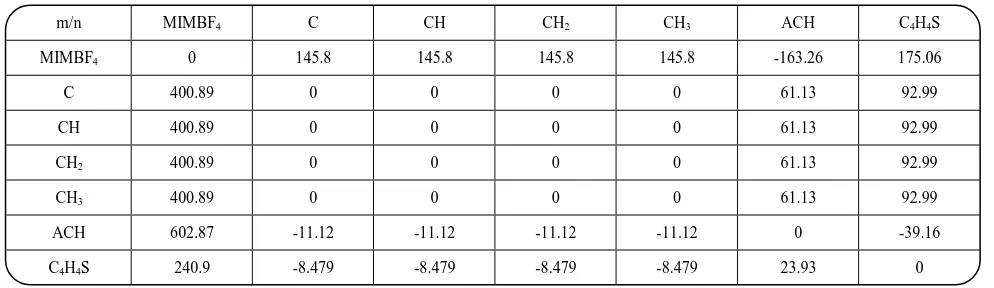
The thermodynamic properties of the ionic liquid are modeled on the basis of the UNIFAC. Such a model has generally described the ionic liquid well. They depend on the binary interaction parameters for each part of he species present in the system. UNIFAC is a thermodynamic model which computes the activity coefficient of liquid in terms of the constants which shows the area and size of the different functional groups present in the liquid mixture. The size and area data are usually obtained from the molecular structure data as shown in Table 3, and binary interaction parameters are calculated from the equilibrium data are shown in Table 2 which is based on the functional groups incorporated to make the molecule. Table 1 highlights the different functional groups contributed (representation of each group in the molecule) for the molecules used in this simulation work for the UNIFAC model [12]. Since we are using the UNIFAC functional group based approach so the functional groups contributed to the molecules also need to be specified on the ASPEN plus(v8.8) platform since mostly the UNIFAC model works on the functional group contributions.
The ionic liquid is decomposed into various functional groups and there binary interaction parameters were established which is already defined in the UNIFAC model [12]. The volume parameter and surface area parameters are also specified in Table 3 which depends on the molecular van dar Waals volume and surface area [12].
Since ionic liquids are not yet included in the database of the ASPEN plus platform. So to perform
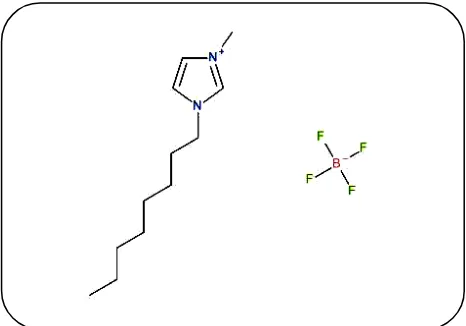
Fig. 1: structural representation of [OMIM][BF4].
simulation the scalar and temperature dependent properties of the ionic liquid need to be specified into the software platform.
Scalar properties
Scalar properties include the critical and the volumetric properties of the model gasoline as well as an ionic liquid, the normal boiling, accentric factor which then can be utilized in various thermodynamics relations. The detailed scalar properties of the [OMIM][BF₄] is illustrated in Table 5. These properties are calculated using the group contribution method as described by Valderrama [15] as follows.
Tb 198.2
n TbM (1)
2T b T c
0. 5703 1. 121 n T M n T M
(2)
c 2
M P
0. 2573 n T M
(3)c M
V 6.75
n T (4)
T c T b 0. 7T c 43T b 43 T c 43
log P cP b
(5)
T c T bT c 43
log P bP c log P bP c 1
Table 1: Different functional group present in each of the components involved in the simulation based on UNIFAC MODEL12. Function groups
Components C CH CH2 CH3 ACH C4H4S MIMBF4
Hexane 0 0 4 2 0 0 0
i-Octane 1 1 1 5 0 0 0
Cyclohexane 0 0 4 2 0 0 0
Toulene 0 0 0 1 6 0 0
Pentane 0 0 3 2 0 0 0
Thiophene 0 0 0 0 0 1 0
Dibenzothiophene 0 0 0 0 8 1 0
OMIMBF4 0 0 7 1 0 0 1
Table 2: Binary interaction between the functional groups involved in this simulation according to UNIFAC model12.
m/n MIMBF4 C CH CH2 CH3 ACH C4H4S
4
MIMBF 0 145.8 145.8 145.8 145.8 -163.26 175.06
C 400.89 0 0 0 0 61.13 92.99
CH 400.89 0 0 0 0 61.13 92.99
2
CH 400.89 0 0 0 0 61.13 92.99
3
CH 400.89 0 0 0 0 61.13 92.99
ACH 602.87 -11.12 -11.12 -11.12 -11.12 0 -39.16
S
4
H
4
C 240.9 -8.479 -8.479 -8.479 -8.479 23.93 0
VM is a contribution to the critical volume, Pb is normal boiling pressure and is an accentric factor. The values of TbM, TM, PM and VM are listed in Table 4.
Temperature dependent properties
Usually, the temperature dependent properties are evaluated with the set of empirical equations which are based on the experimental evaluations. These properties are important in simulation on the ASPEN plus (v8.8) as these will guide us to analyze the different energy necessity of the system. The temperature dependent properties of the ionic liquid are extracted from the NIST database for ionic liquids and then incorporated into the simulation platform Table 5 [17-28].
Process simulation
Selection of model gasoline and sulfur species
Real gasoline contains a wide range of chemical constituents mainly are the hydrocarbons in the range of
C₅-C₁₀ with a negligible amount of further other organic components. Since the availability of the data for all the components is impossible so we selected hexane, cyclohexane, i-octane, toluene as the constituents to represent the model gasoline for the simulation because not all the functional groups' interaction parameters are available to be incorporated into the ASPEN Plus. These compounds are most commonly been used for the representation of the gasoline. There are also many types of thiophene-based derivatives that can be found in the gasoline but for this simulation study, we have chosen thiophene and dibenzothiophene (DBT) as the key compound to target during the extraction process.
A thermodynamic model for simulation
Research Article 213
Table 3: Volume and surface area parameters of the functional groups according to UNIFAC12.
Functional Group R Q
MIMBF4 6.5669 4.005
C 0.2195 0
CH 0.4469 0.228
CH2 0.6744 0.54
CH3 0.9011 0.848
ACH 0.5313 0.4
C4H4S 2.8569 2.14
Table 4: Parameters in group contribution method.
group ΔTbM ΔTM ΔPM ΔVM
Without rings
-CH3 23.58 0.0275 0.3031 66.81
-CH2 22.88 0.0159 0.2165 57.11
-B -24.56 −0.0264 0.0348 22.45
-F- −0.03 0.0228 0.2912 31.47
With rings
=CH- 26.73 0.0114 0.1693 42.55
>N- 68.16 0.0063 0.0538 25.17
=N- 57.55 −0.0011 0.0559 42.15
Table 5: some scalar properties calculated of [OMIM][BF4].
Scalar properties of [OMIM][BF₄]
Molecular weight Mw 282.1 -
Normal boiling point Tb 313.55 C
Critical temperature Tc 463.85 C
Critical pressure Pc 16.02 bar
Critical volume Vc 883.4 cmᵌ/mol
Acentric factor ω 1.0287 -
Specific gravity S.G 1.11088 -
the idea and the UNIQUAC idea for the estimation of the binary interaction parameters[12]. UNIFAC additionally gives us the comprehension of the size and surface range of the individual components identified with the atomic structure of the parts. The anticipated movement coefficients can be utilized to produce double cooperation parameters in any abundance Gibbs energy model. In expansion to this, UNIFAC parameters are accessible
for a large portion of the utilitarian gatherings in the blends so it can be chosen over the COSMO-RS display as it has better outcomes and the model can without much of a stretch be connected with the ASPEN plus®.
Simulation details
Table 6: Temperature dependent properties of IL [OMIM][BF₄]
COMPONENT [OMIM][BF4] [OMIM][BF4] [OMIM][BF4] [OMIM][BF4] [OMIM][BF4]
Physical property Ideal gas heat capacity Liquid molar density Liquid heat capacity Liquid thermal
conductivity Liquid viscosity
Temperature units C C C C C
Property name CPIG DNLTMLPO CPLTMLPO KLTMLPO MULNVE
Property units cal/mol-K mol/cc cal/mol-K kcal-m/hr-sqm-K cP
Polynomials for equation
-1.0540031 0.003968 115.5946 0.143098 -12.0742
0 -2.23E-06 0.129243 -8.56E-05 11060.3
0 -7.47E-10 0.000357 0 -3486590
0 0 -5.02E-06 0 5.31E+08
0 3 3.63E-08 2 -0.15
0 -0.15 5 21.05 90
-273.15 120 -77.27 61.25
726.85 94.74
from the liquid fuels using an ionic liquid in the form of aromatics impurities located in the fuels and assist to achieve the focused separation of the extremely low sulfur gasoline. The principle concept of this simulation is to take a look at the impact of the usage of an ionic liquid for the elimination of sulfur impurities and to compare the experimental data with the simulation results. Since the ionic liquid is not available on the database of the ASPEN Plus (v8.8) so we need to rigorously define the structural aspects of the ionic liquid which include the volume and the surface area of the functional groups involved in the ionic liquid. The functional group numbers of the various functional groups of which ionic liquid constituents showed in Table 8 needs to be input into the ASPEN Plus due to the fact that ionic liquids are not present so every aspect needs to be specified in detail.
The temperature dependent properties for the selected ionic liquid such as ideal gas heat capacity parameters “CPIG-1”, the heat of vaporization “DHVLDP-1”, liquid viscosity “MULNVE”, thermal conductivity “KLTMLPO-1”, liquid vapour pressure “PLXANT-1/PLTDEPOL” calculated based on the experimental results [17-28]. Since ionic liquids are nonvolatile there Antoine equation should represent that value so for this, we are setting a value of -1x10¹⁰. In addition of defining the temperature dependent properties some other physical property information are also needed to be specified such as normal boiling point “Tb”, critical temperature “Tc”, critical pressure “Pc”, critical volume “VC”, andacentric
Table 7: Composition of the model gasoline used in the simulation.
Feed Components COMPOSITION (wt %)
Hexane 30
Cyclohexane 25
i-octane 29
Toluene 10
Thiophene 100 ppm
DBT 100 ppm
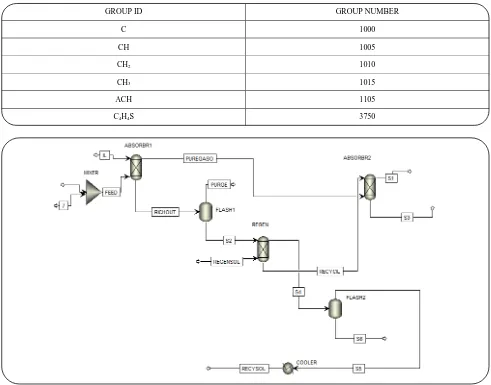
factor “ω”. These properties were calculated by the group contribution method as shown in Table 5 [13]. After defining the properties and binary interactions of the components, we will move towards the simulation environment and uses the extraction column with 10 stages working at 30⁰C and 2 bar Fig. 2. The effect of varying process parameters such as no of stages, temperature and pressure have also been studied and discussed later on The compositionsof the model gasoline selected for this simulation are as shown in Table 7.
RESULT AND DISCUSSION: Sensitivity analysis
Number of stages in the extractor and ionic liquid
Research Article 215
Table 8: UNIFAC group ID and group number of the functional groups in the database of Aspen plus.
GROUP ID GROUP NUMBER
C 1000
CH 1005
CH2 1010
CH3 1015
ACH 1105
C4H4S 3750
Fig. 2: Process simulation of gasoline desulfurization with ionic liquid [omim][bf4] at 30⁰C ,2 bar and 1:1 of IL to gasoline.
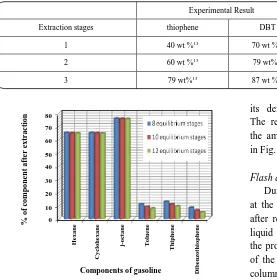
the counter currently interacting liquid also increases. This was also evident from the simulation results obtained and the same pattern could be seen in the graphical Fig. 3. The results correspond well with the experimental results performed as shown in Table 9 [13]. So it was observed that adding more trays has an effect on the separation of the sulfur based impurities from the model gasoline up to a certain limit. So ultimately an adequate 8 stages absorber column is selected which would result in an efficient stage for separation as shown by the simulation result around 10% thiophene and <10% of dibenzothiophene remains in the stream after absorption with the ionic liquid shown in Fig. 3. Further increasing the stages would add up to increase the cost of the absorber while the removal efficiency does not improve significantly.
Table 9: Comparison between the experimental and simulation result of %wt reduction in the thiophene and dibenzothiophene at various stages.
Experimental Result Simulation Result
Extraction stages thiophene DBT thiophene DBT
1 40 wt %13 70 wt %13 60 wt% 20 wt%
2 60 wt %13 79 wt%13 87 wt% 40 wt%
3 79 wt%13 87 wt %13 94 wt % 55 wt%
Fig. 3: Represents the % composition of the components of the model gasoline and impurities after absorption with ionic liquid [OMIM][BF4] at 30⁰C ,2 bar and 1:1 of IL to gasoline.
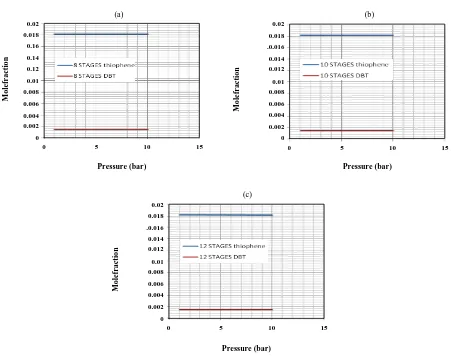
can be considered as an optimal temperature to work with. Pressure has a very little effect on the extraction efficiency of the impurities so it does not account for affecting the process efficiency as shown in Fig. 5a, 5b & 5c at various equilibrium stages.
Regeneration of [OMIM][BF₄]:
Ionic liquid used during this simulation after extraction needs to be regenerated to be reused and recycled back into the process. Regeneration column with 5 equilibrium stages is selected and the solvent is chosen for the regeneration of [OMIM][BF₄] is pentane due to its favorability and immiscibility with the ionic liquid. Also, it has been stated previously in the literature that on a mass basis pentane has a better performance and there is not much difference between the other solvents [16]. So pentane was chosen as the better choice for the regeneration process. The solvent was simulated and the performance of the pentane was evaluated at different ratios with the ionic liquid to remove the thiophene and
its derivatives from the model gasoline efficiently. The result is evaluated at different equilibrium stages the amount of IL regenerated in the process as shown in Fig. 6.
Flash drum pressure
During the process, we require two flash columns one at the top stream of the extraction column and another after regeneration column for the recovery of the ionic liquid and the solvent for it to be recycled back into the process. It was observed that increasing the pressure of the flash column at the top stream of the extraction column the number of ionic liquid falls which is being regenerated using the flash column. The same effect can also at the flash column after the regeneration column.
Effect of alkyl cation length
Since the UNIFAC parameters were available so we checked the performance of [OMIM][BF4] against the other ionic liquids by changing the cations of the imidazolium based ionic liquids having the same type of anion. We can see the performance of the EMIMBF4 and BMIMBF4 against the ionic liquid we used for the simulation i.e. OMIMBF4. The simulation's results revealed that as the alkyl chain of the ionic liquid increases the sulfur removal ability of the ionic liquid also further enhances the potential efficiency of the extraction of sulfur to reach the ultra-low sulfur gasoline i.e. >10ppm Fig. 8.
Comparison between experimental and simulation results
A comparative analysis was done against the simulation results of the model gasoline for the UNIFAC simulation model and the experimental outcomes obtained by NRTL model [13]. The results in Fig. 8 show that the simulation findings support the experimental
Hexane
Cyclohexane
j-octane
Toluene
Thiphe
ne
Dibenzothiop
hene
Components of gasoline
%
o
f
co
mp
o
n
en
t
a
ft
er
e
x
tr
a
ct
io
n 80
70
60
50
40
30
20
10
Research Article 217
Fig. 4: (a) Effect of the temperature on the extraction of DBT(dibenzothiophene) at different temperatures as well as different equilibrium stages operating at 2 bar with an IL:gasoline ratio of 1:1. (b) Effect of the temperature on the extraction of thiophene
at different temperatures as well as different equilibrium stages operating at 2 bar with an IL: gasoline ratio of 1:1.
Fig. 5: (a) Effect of the pressure on the extraction of thiophene and dibenzothiophene(DBT) at different pressure at 8 equilibrium stages with an IL: gasoline ratio of 1:1. (b) Effect of the pressure on the extraction of thiophene and dibenzothiophene(DBT)
at different pressure at 10 equilibrium stages with an IL: gasoline ratio of 1:1. (c) Effect of the pressure on the extraction of thiophene and dibenzothiophene(DBT) at different pressure and at 12 equilibrium stages with an IL: gasoline ratio of 1:1.
Temperature (°C) % o f D B T ( d ib en zo th io p h en e) a ft er e x tr a ct io n 35 30 25 20 15 10 5 0
30 40 50 100 150
Temperature (°C) % o f th io p h en e a ft er e x tr a ct io n 18 16 14 12 10 8 6 4 2 0
30 40 50 100 150
Pressure (bar) M o le fr a ct io n 0.02 0.018 0.16 0.14 0.12 0.01 0.008 0.006 0.004 0.002 0
0 5 10 15
Pressure (bar) M o le fr a ct io n 0.02 0.018 .0.016 0.014 0.012 0.01 0.008 0.006 0.004 0.002 0
0 5 10 15
Pressure (bar) M o le fr a ct io n 0.02 0.018 .0.016 0.014 0.012 0.01 0.008 0.006 0.004 0.002 0
0 5 10 15
(a) (b)
(a) (b)
Fig. 6: Effect of the ratio of the ionic liquid and solvent on the regeneration ability of [OMIM][BF₄ ] at 30⁰C and 2 bar.
Fig. 7: effect of the pressure in flash column 1 and flash column 2 at different pressures for the recovery of ionic liquid and solvent.
Fig. 8: Comparison between different ionic liquids for the removal of sulfur components at 30⁰C, 2bar and 8 theoretical equilibrium stages.
Fig. 9: comparison between the experimental and simulation results using ionic liquid [OMIM][BF4] at 25oc with 1:1 ration
between IL and gasoline.
conclusions and it is reasonably accurate within the selected experimental conditions. For the components, we have studied in this simulation model the ionic liquid desulfurization efficiency is higher around 10-15% comparative to the experimental results. This would suggest that the number of extraction stages is somewhat higher than indicated by the experimental results. As it was previously been stated that by raising the alkyl chain length the sulfur removal ability increases and this result can be seen and both the simulation results as well as shown in Fig. 8 [16]. So, by observing the outcomes of the simulation model it is concluded that the selected UNIFAC model is not only accurate but also, validates the experimental findings. The experimental result uses NRTL as the thermodynamic model whereas
the simulation model is based on the UNIFAC model [13]. So, the unifac approach used here is reasonably comparable and it turns to be a suitable predictive method for the design of the desulfurization process using ionic liquid.
CONCLUSIONS
It was successfully established in this study that 1-octyl-3-methylimidazolium tetrafluoroborate [OMIM][BF4] ionic liquid be used for the efficient desulfurization of the gasoline. The process shows that almost 90% of thiophene has been removed by the ionic liquid, although it has a little effect in the removal of DBT but with the further experimental study and the calculation of the binary interactions between the DBT and ionic liquid
Ratio of solvent to ionic liquid
% o f il ( OM IM B F4 ) A ft er r eg en er a ti on 98 96 94 92 90 88 86 84 82
0.5:1 0.67:1 0.7:1 1:01
Ionic liquid with different cations
EMIM BMMIM OMIM
% o f impu ri ti es re m o v ed 90 80 70 60 50 40 30 20 10 0 Pressure (bar) % R em o v er ed 180 160 140 120 100 80 60 40 20 0
3 4 5 6 7 8 10
Research Article 219 it can also be possible to increase the removal of DBT.
Results in this study show that the selected process can be used for the desulfurization of gasoline in accordance with the legislative requirement imposed by the authorities. UNIFAC thermodynamic model for process calculation is successfully validated in agreement with the experimental result evaluated by NRTL model. It is concluded that UNIFAC is the suitable thermodynamic model for process simulation of Gasoline desulfurization. Further rigorous study on the UNIFAC model and economic aspects of the process can enhance the efficiency of the selected process scheme can enhance the efficiency of the process and could lead us to an economically feasible process model for its commercial scale implemented in the future.
Nomenclature
UNIFAC UNIVERSAL functional group activity coefficient method OMIMBF4 1-octyl-3-methylimidazolium tetrafluoroborate RK UNIFAC volume parameter of the functional groups of components QK UNIFAC surface area parameter of the functional groups of components IL Ionic liquid DBT Dibenzothiophene Tb Normal boiling point TC Critical temperature Pc Critical pressure VC Critical volume Pb Normal boiling pressure TbM Contribution to normal boiling temperature TM Contribution to critical temperature M Molecular mass PM Contribution to critical pressure VM Contribution to critical volume ω Eccentric factor
Received : Oct. 11, 2017 ; Accepted : Jun. 10, 2018
REFERENCES
[1] Directive of the European Parliament and of the Council 2003/17/EC
[2] Song C., An Overview of New Approaches to Deep Desulfurization for Ultra-Clean Gasoline, Diesel
Fuel and Jet Fuel, Catalyst Today, 86: 211–63 (2003).
[3] Chongpin Huang., Biaohua Chen., Jie Zhang., Zhichang Liu and Yingxia Li., Desulfurization of
Gasoline by Extraction with New Ionic Liquids,
J. Energy & Fuels, 18: 1862-1864 (2004).
[4] Brunet SMay D., Perrot G., Bouchy C., Diehl F.,
On the Hydrodesulphurization of FCC Gasoline:
A Review, Appl. Catal. A., 278: 143-172 (2005).
[5] Babich I.V., Moulin J.A., Science and Technology of Novel Processes for Deep Desulfurization of Oil
Refinery Streams: A Review, Fuel, 82: 607–631
(2003).
[6] Lin L., Zhang Y., Kong Y., Recent Advances in Sulfur Removal from Gasoline Bypervaporation,
Fuel,88: 1799–1809 (2009).
[7] Kulkarni P.S., Afonso C.A.M., Deep Desulfurization
of Diesel Fuel Using Ionicliquids: Current Status
and Future Challenges, Green Chem., 12: 1139–
1149 (2010).
[8] EU-Directives: 1998/70/EC, OJ L 350, 28.12.1998, p.
58 (Directives Amended by Commission Directive
2000/71/EC OJ L 287, 14.11.2000, p. 46), and 2003/17/EC OJ L 76, 22.3.2003, p. 10.
[9] Ferreira A.R., Freire M.G., Ribeiro J.C., Lopes F.M., Crespo J.G., Coutinho J.A.P., Ionic Liquids for Thiols Desulfurization: Experimental Liquid–Liquid
Equilibrium and COSMO-RS Description, Fuel 128:
314-329 (2014).
[10] Borja Rodríguez-Cabo, Héctor Rodríguez, Eva
Rodil, Alberto Arce, Ana Soto, Extractive and
Oxidative-Extractive Desulfurization of Fuels with
Ionicliquids, Fuel, 117: 882–889(2014).
[11] Dharaskar S.A., Wasewar K.L., Varma M.N., Shende D.Z., Yoob C.K., Synthesis, Characterization
and Applicationof 1-butyl-3-methylimidazolium
Tetrafluoroborate for Extractive Desulfurization of
Liquid Fuel, Arabian Journal of Chemistry, 9(4):
578-587 (2016).
[12] Lei Z., Zhang J., Li Q., Chen B., UNIFAC Model for
Ionic Liquids, Ind. Eng. Chem. Res., 48: 2697–2704
(2009).
[13] Alonso L., Arce A., Francisco M., Rodrı´guez O.,
Soto A., Gasoline Desulfurization Using Extraction
with [C8mim][BF4] Ionic Liquid, AIChE Journal,
[14] Eßer J., Wasser scheidb P., Jessa A., Deep Desulfurization of Oil Refinery Streams by Extraction
with Ionic Liquids, Green Chem., 6: 316–322 (2004).
[15] Valderrama J., Sanga W.W., “Critical Properties and Vapor Pressure of Twenty Imidazolium Based Ionic
Liquids Used in Extraction Bioprocesses”
2nd International Symposium on Biothermodynamics. February (2008), Frankfurt-Germany.
[16] Nancarrow P., Mustafa N., Shahid A., Varughese V., Zaffar U., Ahmed R., Akther N., Ahmed H., AlZubaidy I., Hasan A., Elsayed Y., Sara Z.,
Technical Evaluation of Ionic Liquid-Extractive
Processing of Ultra Low Sulfur Diesel Fuel, Ind.
Eng. Chem. Res.,54:10843-10853 (2015).
[17] Tomida D., Kenmochi S., Tsukad, T., Qiao K., Bao Q., Yokoyama, C., Viscosity and Thermal
Conductivity of 1-Hexyl-3-methylimidazolium
Tetrafluoroborate and 1-Octyl-3-methylimidazolium
Tetrafluoroborate at Pressures up to 20 MPa, Int. J.
Thermophys., 33: 959-969 (2012).
[18] Stoppa A., Zech O., Kunz W., Buchner, The Conductivity of Imidazolium-Based Ionic Liquids from (-35 to 195) deg C. A. Variation of Cations
Alkyl Chain, R. J. Chem. Eng. Data, 55: 1768-1773
(2010).
[19] Sanmamed Y.A., Gonzalez-Salgado D., Troncoso J., Romani L., Baylaucq A., Boned, Experimental Methodology for Precise Determination of Density of RTILs as a Function of Temperature and Pressure
Using Vibrating Tube Density Meters, C. J. Chem.
Thermodyn., 42: 553-563 (2010).
[20] Sanchez L.G., Espel J.R., Onink F., Meindersma G.W., De Haan A.B., Density, Viscosity, and Surface Tension of Synthesis Grade Imidazolium,
Pyridinium, and Pyrrolidinium Based Room
Temperature Ionic Liquids, J. Chem. Eng. Data, 54:
2803-2812 (2009).
[21] Gu Z., Brennecke J.F., Volume Expansivities and Isothermal Compressibilities of Imidazolium and
Pyridinium-Based Ionic Liquids, J. Chem. Eng.
Data, 47: 339-345 (2002).
[22] Seddon K.R., Stark A., Torres M.-J., Viscosity
and Density of 1-Alkyl-3-methylimidazolium
Ionic Liquids, ACS Symp. Ser., 819: 34-49
(2002).
[23] Paulechka Y.U., Kabo A.G., Blokhin A.V., Kabo G. J., Shevelyova M.P., Heat Capacity of Ionic Liquids: Experimental Determination and Correlations with
Molar Volume, J. Chem. Eng. Data, 55: 2719-2724
(2010).
[24] Sanmamed Y.A., Navia P., Gonzalez-Salgado D., Troncoso J., Romani L., Pressure and Temperature Dependence of Isobaric Heat Capacity for [Emim][BF4], [Bmim][BF4], [Hmim][BF4], and
[Omim][BF4], J. Chem. Eng. Data, 55: 600-604
(2010).
[25] Tomida D., Kenmochi S., Tsukada T., Qiao K., Bao Q., Yokoyama C., Viscosity and Thermal
Conductivity of 1-Hexyl-3-methylimidazolium
Tetrafluoroborate and 1-Octyl-3-methylimidazolium
Tetrafluoroborate at Pressures up to 20 MPa, Int. J.
Thermophys., 33: 959-969 (2012).
[26] Harris K.R., Kanakubo M., Woolf L.A.,
Temperature and Pressure Dependence of the Viscosity of the Ionic Liquids Methyl-3-octylimidazolium Hexafluorophosphate and
1-Methyl-3-octylimidazolium Tetrafluoroborate,
J. Chem. Eng. Data, 51: 1161-1167 (2006).
[27] Mokhtarani B., Mojtahedi M.M., Mortaheb H.R., Mafi M., Yazdani F., Sadeghian F., Densities, Refractive Indices, and Viscosities of the Ionic Liquids 1-Methyl-3-octylimidazolium Tetrafluoroborate and 1-Methyl-3-butylimidazolium Perchlorate and Their Binary Mixtures with Ethanol at Several
Temperatures, J. Chem. Eng. Data, 53: 677-682 (2008).
[28] "NIST Standard Database for Ionic Liquids"
[29] Ghouri Z.Kh., Al-Meer S., Barakat N.A.M., Kim H.Y., ZnO@C (core@shell) Microspheres Derived from Spent Coffee Grounds as Applicable Non-precious Electrode Material for DMFCs”
Scientific Reports, 7:1738-1746 (2017). doi:10.1038/s41598-017-01463-3
[30] Ghouri Z.Kh., Nasser A.B., Barakatbc A.M.,Al-Mahmnur, Mohammad A., Tahani S.A., BawazeereAhmed M., Hak F.M., Kimab Y.,
Synthesis and Characterization of Nitrogen-Doped
&CaCO3-Decorated Reduced Graphene Oxide
Nanocomposite for Electrochemical
Supercapacitors, Electrochimica Acta, 184: 193-202
Research Article 221 [31] Ghouri Z.Kh., Barakat NA.M., Kim H.Y.,Influence
of Copper Content on the Electrocatalytic Activity Toward Methanol Oxidation of CoχCuy Alloy
Nanoparticles-Decorated CNFs, Scientific Reports,
5:16695-16707(2015). doi:10.1038/srep16695
[32] Ghouri Z. Kh., Barakat N.A.M., Kim H.Y., Park M., Khalil Kh.A., El-Newehy M.H., Al-Deyab S.S.,
Nano-Engineered ZnO/CeO2 Dots@CNFs for Fuel
Cell Application, Arabian Journal of Chemistry, 9:
219-228 (2016).
[33] Le Bui T.T., Nguyen D.D., Van Ho S., Nguyen B.T., Ngoc Uong H.T., Synthesis, Characterization and Application of Some Non-Halogen Ionic Liquids as Green Solvents for Deep Desulfurization of Diesel
Oil, Fuel, 191: 54–61 (2017).
[34] Zhao H., Baker G.A., Zhang Q., Design Rules of Ionic Liquids Tasked for Highly Efficient Fuel
Desulfurization by Mild Oxidative Extraction, Fuel,
![Table 5: some scalar properties calculated of [OMIM][BF4].](https://thumb-us.123doks.com/thumbv2/123dok_us/8448291.1704082/5.595.51.553.457.598/table-scalar-properties-calculated-omim-bf.webp)
![Table 6: Temperature dependent properties of IL [OMIM][BF₄]](https://thumb-us.123doks.com/thumbv2/123dok_us/8448291.1704082/6.595.310.542.365.488/table-temperature-dependent-properties-il-omim-bf.webp)
![Fig. 9: comparison between the experimental and simulation results using ionic liquid [OMIM][BF4] at 25oc with 1:1 ration between IL and gasoline](https://thumb-us.123doks.com/thumbv2/123dok_us/8448291.1704082/10.595.65.269.304.453/comparison-experimental-simulation-results-using-liquid-ration-gasoline.webp)
