Published online February 20, 2013 (http://www.sciencepublishinggroup.com/j/ajsea) doi: 10.11648/j.ajsea.20130201.11
A Modified fingerprint image thinning algorithm
Davit Kocharyan
Digital Signal and Image Processing Laboratory
Institute for Informatics and Automation Problems of NAS RA, Yerevan, Armenia
Email address:
[email protected] (D. Kocharyan)
To cite this article:
Davit Kocharyan. An Efficient Fingerprint Image Thinning Algorithm, American Journal of Software Engineering and Applications. Vol. 2, No. 1, 2013, pp. 1-6. doi: 10.11648/j.ajsea.20130201.11
Abstract:
Most fingerprint recognition applications rely heavily on efficient and fast image enhancement algorithms. Image thinning is a very important stage of image enhancement. A good thinning algorithm preserves the structure of the original fingerprint image, reduces the amount of data needed to process and helps improve the feature extraction accuracy and efficiency. In this paper we describe and compare some of the most used fingerprint thinning algorithms. Results show that faster algorithms have difficulty preserving connectivity. Zhang and Suen’s algorithm gives the least processing time, while Guo and Hall’s algorithm produces the best skeleton quality. A modified Zhang and Suen’s algorithm is proposed, that is efficient and fast, and better preserves structure and connectivity.Keywords:
Image Thinning; Fingerprint Recognition; Minutiae; Image Enhancement1.Introduction
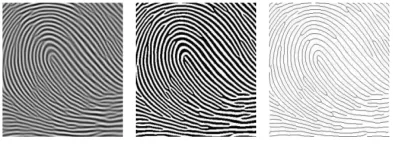
Fingerprint image thinning is a very important step in fingerprint recognition algorithms. In this step the ridge lines of the fingerprint image are transformed to a one-pixel thickness. This process is fundamental for finger-print recognition algorithms [1], as thinned images are easier to process, and reduce operations processing time. As thinning does not change the structure of the finger-print image and preserves the locations of the fingerfinger-print ridge and valley features, it makes easier to identify the global and local features of the fingerprint image (such as Core, Delta, Minutiae points) that are used for finger-print classification, recognition and matching [2].
An example of thinned fingerprint image is shown in Figure 1 below:
Fig. 1. From left to right: original fingerprint image, binarized image and corresponding thinned image.
An effective and accurate thinning algorithm directly affects the fingerprint feature extraction and matching
accuracy and results.
Most known thinning algorithms fall into the follow-ing two categories [3]:
• Iterative
• Non-iterative
Iterative algorithms delete pixels on the boundary of a pattern repeatedly until only unit pixel-width thinned image remains. Non-iterative distance transformation algorithms are not appropriate for general applications since they are not robust, especially for patterns with highly variable stroke directions and thicknesses. Thin-ning based on iterative boundary removal can be divided into sequential and parallel algorithms.
and connectivity preservation,”, Communications of the ACM, vol. 32, pp. 124–129, Jan 1989.), understand their strengths and weaknesses and propose a modified and more efficient algorithm.
2. Concepts
The binary image I is described as a matrix MxN, where x(i, j) represents the binary value of the pixel (i, j), equal to 1, if the pixel is black, or 0, if the pixel is white.
Any pixel which is at distance of 1 from the pixel (i, j) is considered a neighbor for that pixel.
Connectivity is defined as the number of neighbors to which the pixel is connected:
• 4-connectivity: The pixel is connected to every horizontal and vertical neighbor (Fig. 2).
Fig. 2. 4-connectivity: P1 is is connected to every horizontal and ver-tical neighbor.
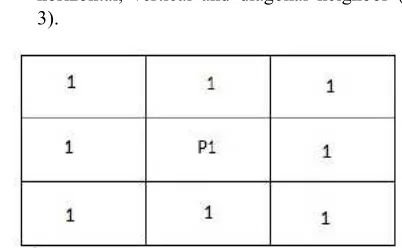
• 8-connectivity: The pixel is connected to every horizontal, vertical and diagonal neighbor (Fig. 3).
Fig. 3. 8-connectivity:P1 is connected to every horizontal, vertical and diagonal neighbor.
3. Known Thinning Algorithms
In this chapter some known fingerprint thinning algo-rithms are described.
3.1. Zhang-Suen’s Algorithm
The algorithm works using a 3x3 sized block. It is an iterative algorithm and it removes all the contour points of the image except those that belong to the skeleton. The algorithm is divides into two sub-iterations [4].
The algorithm is describes below: 1. While points are deleted, do 2. for all p(i, j) pixels, do
3. if(a)
2 B 6
(b) A(P1) = 1
(c) One of the following is true: 1. P2 x P4 x P6 = 0 in odd iteration, 2. P2 x P4 x P8 = 0 in even iteration, (d) One of the following is true: 1. P4 x P6 x P8 = 0 in odd iteration, 2. P2 x P6 x P8 = 0 in even iteration, then
4. Delete pixel p(i, j).
where A(P1) is the number of 0 to 1 transitions in the clockwise direction from P9, B(P1) is the number of non-zero neighbors of P1:
P1is not deleted, if any of the above conditions are not met.
The algorithm is fast, but fails to preserve such pat-terns that have been reduced to 2x2 squares. They are completely removed. It also has problems preserving connectivity with diagonal lines and identifying line end-ings.
3.2. Guo-Hall’s Algorithm
The algorithm works using a 2x2 sized block. C(P1) is defined as the number of distinct 8-connected compo-nents of P1. [2]B(P1)is defined as the number of non-zero neighbors of P1. , ˄ and ˄ symbols are defined as logical completing, AND and OR, respectively. N(P1) is defined as:
, where:
and divideneighbors of into four pairs and calculated the number of pairs that contain one or two non-zero elements.
The algorithm is describes below: 1. While points are deleted, do 2. for all p(i, j) pixels, do 3.if(a) C(P1) = 1 (b)
2 N 3
(c) One of the following is true: 1.
in odd iteration, 2.
! 0
in even iteration, then
4. Delete pixelp(i, j).
WhenB P 1, P is an ending point and N P 1. But whenB P 2, Pcould also be a non-ending point. The definition ofN P preserves the ending points and remove redundant pixel in the middle of the curve.
Guo-Hall [5]algorithm is more precise than Zhang-Suen’s [4] algorithm, but needs more computational time to execute.
3.3. Abdulla et al’s Algorithm
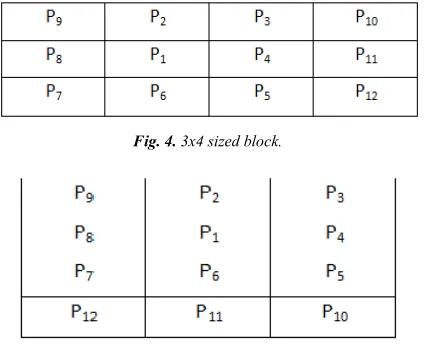
The algorithm uses a 3x3 sized block and consists of two sub-iterations [5]. The first sub-iteration scans the image horizontally using a 3x4 sized block (Fig. 4). Any two points which are horizontally adjacent to each other and horizontally isolated from other pixels are deleted. The second sub-iteration scans the image vertically using a 4x3 sized block (Fig. 5). Any two points which are vertically adjacent to each other and vertically isolated from other points are deleted.
Fig. 4. 3x4 sized block.
Fig. 5. 4x3 sized block.
The algorithm is describes below: 1. While points are deleted, do 2. for all pixels p(i, j) do 3.First iteration: 4.if(a)
% .
!!!!!! = 1
or (b)
% .
!!!!!! = 1
or (c)
!
! ' ' ! =1
then
5.Deletepixel P1. 6.where
% . , % .
, ˄ and ˄ are defined as logical completing, AND and OR, respectively.
7. ifP1 is not deleted then
8.if
! ( ! = 1
then
9. Deletepixel P4.
10. Second iteration: 11. if(a)
% .
!!!!!! = 1
or (b)
% .
!!!!!! = 1
or
(գ) !
! ' ' ! = 1
then
12. Delete pixel P1.
13.where
% . , % .
, ˄ and ˄ are defined as logical completing, AND and OR, respectively:
14. ifP1 is not deleted then
15.if
! ! ( = 1
then
16. Delete pixel P6.
3.4. R. W. Hall’s Algorithm
The algorithm [6] consists of two parallel sub-iterations, functions by first identifying in parallel all deletable pixels and then in parallel deleting all of those deletable pixels except certain pixels which must be maintained to preserve connectivity in an image.
2. for all pixels p(i, j) do
3. Determine whether p(i, j) should be deleted 4. if (a)
1 ) ) 7
(b) ’s 8-neighborhood contains exactly one 4-connected component of 1s.
then
5. p(i, j) should be deleted 6. for all p(i, j) pixels, do 7.if(a)
1 and is deletable,
(b)
1 and is deletable,
(c)
, , are deletable, then
8. Do not delete pixelp(i, j).
The above mentioned conditions preserve local con-nectivity, end-points and 2x2 sized patterns.
4. Comparison
During the comparison the evaluation is based on the following criteria: connectivity, spurious branches, con-vergence to unit width and data reduction efficien-cy/computational cost.
Connectivity preservation of a fingerprint pattern is crucial fingerprint recognition, as disconnected patterns may produce false minutiae points.
Spurious branches also produce false minutiae points. Some post processing operations may be applied to
re-move spurious branches, but it will cost extra processing operations and execution time.
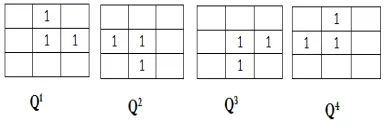
A perfect skeleton must be unitary, meaning that it does not contain any of the patterns given in Figure 6:
Fig. 6. Patterns of non-unitary skeletons.
Jang and Chin [7] introduced a measure +,to compute the width of the thinned %-skeleton:
+, 1 ./012 3/012 %454 %-65
-where Area[] is the operation that counts the number of pixels with the value of 1. If +, 1, then%- is a per-fect unitary skeleton [7].
An effective thinning algorithm must be also fast. A measure to evaluate both the data reduction efficiency and the computational cost was defined by Jang and Chin [7] as:
+7 +89 1,/012 % . /012 %9 : /012 %
-where n is the number of parallel operations required to converge, and S is the original input image. This measure has a value between 0 and 1. The larger the val-ue, the higher the efficiency [7].
To compare the above described algorithms, they have been applied to thin five different images, shown in Fig-ure 7.
Fig. 7. Five different fingerprint images used for comparing the thinning algorithms.
1) 276x408 pixels
2) 408x480 pixels
3) 264x264 pixels
4) 336x336 pixels
5) 420x600 pixels
Table 1. Results of the tests.
Image Algorithm Results mt md
1
• Abdulla et.al • Guo-Hall • Hall • Zhang-Suen 0.996 0.998 0.991 0.698 0.117 0.062 0.083 0.129 2
• Abdulla et.al • Guo-Hall • Hall • Zhang-Suen 0.974 0.997 0.988 0.790 0.120 0.065 0.085 0.137 3
• Abdulla et.al • Guo-Hall • Hall • Zhang-Suen 0.997 0.998 0.999 0.864 0.122 0.061 0.084 0.130 4
• Abdulla et.al • Guo-Hall • Hall • Zhang-Suen 0.978 0.993 0.993 0.747 0.105 0.056 0.079 0.115 5
• Abdulla et.al • Guo-Hall • Hall • Zhang-Suen 0.985 0.997 0.993 0.695 0.118 0.064 0.085 0.134
The results show that Guo-Hall’s algorithm best pre-serves the structure of the image, but the efficiency and speed is low, giving the result of
+
7 = 0.062, a compa-ratively low value.Zhang-Suen’s algorithm is the most used in literature and shows an average
+
7 0.129.But in some cases it does not preserve the structure of the image and even removes some ridges and end-points [8].
5. Proposed Modification
We propose a slight modification to the Zhang-Suen’s algorithm to improve and preserve structure of the image and stop unwanted removal of lines and end-points.
End-points are detected by the A(P1) = 1, but it does
not apply to diagonal ridges that have 2 pixel thickness, as in that case A(P1) = 2. The following conditions can be
added to Zhang-Suen’s algorithm to eliminate those problems:
In odd iterations: when A(P1) = 2, the following
condi-tions are checked:
1. P4 x P6 = 1 and P9 = 0 or 2. P4 x P2 = 1 and ! : ! : ! 1
In even iterations: when A(P1) = 2, the following
con-ditions are checked:
1. P2 x P8 = 1 and P5 = 0 or 2. P6 x P8 = 1 and ! : ! : ! 1
These conditions are added to avoid deleting diagonal lines and preserve connectivity.
The modified algorithm is described below: 1. While points are deleted, do
2. for all p(i, j) pixels, do
3. if2 B 6
4. ifA(P1) = 1 and
(a) One of the following is true:
1. P2 x P4 x P6 = 0 in odd iteration,
2. P2 x P4 x P8 = 0 in even iteration,
(b) One of the following is true:
1. P4 x P6 x P8 = 0 in odd iteration,
2. P2 x P6 x P8 = 0 in even iteration,
then
5. Delete pixel p(i, j). 6. else if A(P1) = 2 and
(a) One of the following is true:
1. P4 x P6 = 1 and P9 = 0,in odd iteration,
2. P2 x P8 = 1 and P5 = 0,in even iteration,
(b) One of the following is true:
1. P4 x P2 = 1 and ! : ! : ! 1in odd iteration,
2. P6 x P8 = 1 and ! : ! : ! 1, in even iteration,
then
5. Delete pixel p(i, j).
where A(P1) is the number of 0 to 1 transitions in the
clockwise direction from P9, B(P1) is the number of
non-zero neighbors of P1:
P1is not deleted, if any of the above conditions are not
met.
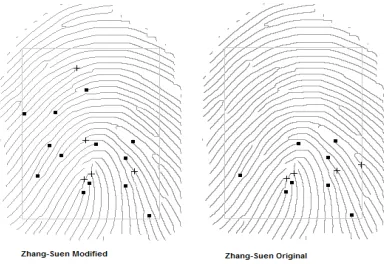
After adding the above mentioned conditions, Zhang Suen’s algorithm preserved structure and fairly maintains connectivity. A comparison of skeletons produces by the original algorithm and the modified version is shown in Figure 8, where the corresponding minutiae points are also shown:
A noticeable improvement in maintaining structure and connectivity can be seen.
The modified algorithm has been applied to thin five different images, shown in Figure 7.
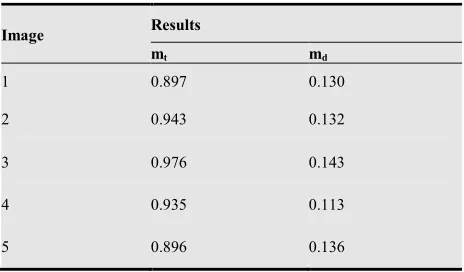
The results of the values +, and +7are given in the table below:
Table 2. Results of the tests.
Image Results
mt md
1 0.897 0.130
2 0.943 0.132
3 0.976 0.143
4 0.935 0.113
5 0.896 0.136
The modified algorithm shows a noticeable improve-ment, with average mt= 0.929 and an average
+
7 0.130.6. Conclusion and Future Work
In this paper we discussed the most used fingerprint thinning algorithms and showed their comparisons. Zhang Suen’s [4]. algorithm proves to be the most effi-cient and with the proposed modification shows the best result among all with regards to the comparison criteria.
As the next step, creation of a fingerprint recognition software solution based on minutiae matching and the proposed thinning algorithm is planned.
Fingerprint recognition is the most widely used biome-tric authentication and identification technology[10], and heavily relies on efficient image processing algorithms and techniques[11]. It has many applications, from con-sumer to commercial sectors.
References
[1] Davide Maltoni, Dario Maio, Handbook of Fingerprint Recognition, Springer, 2009.
[2] Z. Guo and R. Hall, “Parallel thinning with two-subiteration algorithms,”Communications of the ACM, vol. 32, pp. 359–373, Mar 1989.
[3] R. Gupta and R. Kaur, “Skeletonization algorithm for numerical patterns”, International Jornal of Signal Processing, Image Processing andPattern Recognition, vol. 01, pp. 63–72, Dec 2008.
[4] T. Zhang and C. Suen, “A fast parallel algorithm for thin-ning digital patterns,” Communications of the ACM, vol. 27, pp. 236–239, Mar 1984.
[5] W. Abdulla, A. Saleh, and A. Morad, “A preprocessing algorithm for hand-written character recognition”,Pattern Recognition Letters 7, pp. 13–18, 1988.
[6] R. Hall, “Fast parallel thinning algorithms: Parallel speed and connectivity preservation,” Communications of the ACM, vol. 32, pp. 124–129, Jan 1989.
[7] B. Jang and T. Chin, “One-pass parallel thinning: Analy-sis, properties, and quantitative evaluation,” IEEE Trans-actions on Pattern Analysis andMechine Intelligence, pp. 1129–1140, 1992.
[8] G. Raju and Y. Xu, “Study of parallel thinning algo-rithms,” IEEE International Conference on Systems, Man, and Cybernetics, vol. 01,pp. 661–666, Dec 1991.
[9] S. Prabhakar, A. K. Jain and S. Pankanti, “Learning fin-gerprint minutiae location and type”, Pattern Recognition, 36(8): 1847–1857, 2003.
[10] Kalyani Mali, Samayita Bhattacharya, Fingerprint Rec-ognition Using Global and Local Structures, International Journal on Computer Science and Engineering, Vol. 3 No. 1 Jan 2011.Ratha, Nalini; Bolle, Ruud, “Automatic Fin-gerprint Recognition Systems”, Springer, XVII, 458 p. 135.
[11] James L. Wayman (Editor), Anil K. Jain, “Biometric Sys-tems”, Springer, 2004.