Lincoln University Digital Thesis
Copyright Statement
The
digital
copy
of
this
thesis
is
protected
by
the
Copyright
Act
1994
(New
Zealand).
This
thesis
may
be
consulted
by
you,
provided
you
comply
with
the
provisions
of
the
Act
and
the
following
conditions
of
use:
you
will
use
the
copy
only
for
the
purposes
of
research
or
private
study
you
will
recognise
the
author's
right
to
be
identified
as
the
author
of
the
thesis
and
due
acknowledgement
will
be
made
to
the
author
where
appropriate
you
will
obtain
the
author's
permission
before
publishing
any
material
from
the
thesis.
Designing a Framework
for End User Applications
A thesis
submitted in partial fulfilment of the requirements
for Degree of Doctor of Philosophy
in Software and Information Technology
at
Lincoln University
By
Yanbo Deng
i
Abstract of a thesis submitted in partial fulfilment of the requirements for the Degree of Doctor of Philosophy in Software and Information Technology
Designing a Framework for End User Applications
by Yanbo Deng
End user developers (i.e. non-professional developers) often create database applications to
meet their immediate needs. However, these applications can often be difficult to generalise
or adapt when requirements inevitably change. As part of this thesis, we visited several
research institutions to investigate the issues of end user developed databases. We found that
different user groups in the same organisation might require similar, but different, data
management applications. However, the very specific designs used in most of these systems
meant it was difficult to adapt them for other similar uses.
In this thesis we propose a set of guidelines for supporting end user developers to create more
flexible and adaptable data management applications. Our approach involves professional and
end user developers working together to find a “middle way” between very specific and very
generic designs. We propose a framework solution that allows the data model to have several
co-existing variations which can satisfy the requirements of different user groups in a
common domain. A “framework provider” (IT professional) will create the initial framework
and data model. Configuration tools are then provided for a “framework manager” to easily
customise the model to the specific needs of various user groups. The system also provides
client toolkits and application generators to help end user developers (EUDs) to quickly create
and customise applications based on the framework.
The framework approach was applied to a case study involving a Laboratory Information
Management System (LIMS) for data on research experiments. We demonstrated that the
framework developed could be successfully applied to several groups working in the same
domain and could be extended to include new or changed requirements.
We also evaluated the framework through software trials at several research organisations. All
participants successfully used the configuration tools to extend the LIMS framework within
an average of 40 minutes. EUDs were also able to easily create basic applications within an
average of 25 minutes. The overall feedback was that the framework approach was a useful
ii
participants were able to immediately see how the framework could be applied to their own
laboratory data.
iii
Acknowledgements
First, I want to acknowledge my supervisors, Clare Churcher and Walt Abell, for their support
and guidance. They made significant efforts to provide detailed comments and suggestions for
this research. Without them, I could not have completed this thesis.
Secondly, I would like to express my thanks to my external advisor, John McCallum (from
New Zealand Institute of Plant & Food Research Ltd), for his contribution to the research. I
would also like to acknowledge the support from a FRST sub-contract.
Thirdly, I would like to acknowledge all those who helped me with this research. I wish to
thank all participants from: the Department of Applied Computing, Lincoln University; the
New Zealand Institute of Plant & Food Research Ltd; the Faculty of Agriculture and Life
Sciences, Lincoln University; the IT Department, AgResearch Ltd; Diversity Arrays
Technology Pty Ltd, Australia; the Research School of Chemistry, Australian National
University; the Department of Environmental Engineering, China University of Mining and
Technology; the Department of Psychology, Peking University ; the College of Life Science,
Peking University; and the Beijing Institute of Genomics (BIG), Chinese Academy of
Sciences.
Special thanks go to Caitriona Cameron for improving my thesis writing skills, and Douglas
Broughton for his excellent help in ensuring all services, resources and facilities were
available for my study.
Finally, I would like to thank Aimei Xiong and Rong Shang for their encouragement and
iv
Table of contents
Abstract ... i
Acknowledgements ... iii
Table of contents ... iv
List of figures ... ix
List of tables ... xi
Chapter 1 Introduction ... 1
1.1 End user development issues ... 1
1.2 Aims and scope of the research ... 1
1.3 Structure of the thesis ... 2
Chapter 2 Flexible software development ... 3
2.1 Flexible software development ... 3
2.1.1 Object Oriented (OO) techniques ... 3
2.1.2 Software components ... 5
2.1.3 Model View Controller (MVC) and Layered architecture ... 6
2.1.4 Software application generator ... 8
2.1.5 Object Oriented frameworks ... 9
2.1.6 Software Patterns ... 10
2.2 Flexible data storage ... 11
2.2.1 Schema evolution ... 11
2.2.2 Metadata model ... 12
2.2.3 Ontology-based system ... 13
2.2.4 Application and database co-evolution ... 13
2.3 Web services ... 14
2.4 Summary ... 15
Chapter 3 End User Development ... 16
3.1 End user development ... 16
3.2 Potential end user development tools ... 17
3.2.1 Spreadsheet ... 17
3.2.2 Reporting tools ... 17
3.2.3 End user databases ... 18
3.2.4 Web development ... 18
3.3 Application customisation and implementation ... 19
3.3.1 Approaches ... 19
v
3.4 Evolution of end user applications and databases ... 22
3.4.1 Collaborative design to evolve applications ... 22
3.4.2 Database evolution tools for EUDs ... 22
3.4.3 Unresolved challenges ... 23
Chapter 4 Proposed Research ... 24
4.1 Exploratory case study ... 24
4.1.1 In-house software and end user development ... 25
4.1.2 IT professionals ... 27
4.1.3 End user developers ... 28
4.2 Research Methodology... 29
4.2.1 Problem ... 30
4.2.2 Proposal ... 30
4.2.3 Implementation ... 31
4.2.4 Evaluation ... 31
4.3 Research case study... 32
4.3.1 NZPFR LIMS ... 32
4.3.2 Problems and development challenges ... 33
4.4 Summary ... 34
Chapter 5 Framework and System Design ... 36
5.1 Review of problems and guidelines ... 36
5.2 Framework Rationale: Middle Way ... 37
5.3 Types of developers ... 39
5.4 Framework Design ... 40
5.4.1 Domain model design ... 41
5.4.2 Framework API ... 43
5.4.3 End User Development toolkit ... 44
5.4.4 End user application development ... 46
5.4.5 Framework configuration tool ... 47
5.5 Summary ... 48
Chapter 6 Framework Implementation ... 50
6.1 Responsibilities of framework providers ... 50
6.1.1 Domain model and persistent data implementation ... 51
6.1.2 API implementation ... 52
6.1.3 Summary ... 53
6.2 LIMS domain model implementation ... 54
vi
6.2.2 Database ... 57
6.2.3 Class and database schema generation ... 58
6.2.4 ORM files ... 59
6.2.5 Constraint files ... 61
6.3 Framework API implementation ... 64
6.3.1 Web service API for PFR ... 64
6.3.2 HibernateValidator ... 65
6.3.3 Hibernate DAO ... 66
6.3.4 Web service API configuration ... 68
6.3.5 Web service API methods ... 69
6.4 Summary ... 72
Chapter 7 Framework development tools ... 73
7.1 Overview of development tools ... 73
7.2 Framework development tools ... 75
7.2.1 Defining the configuration template ... 76
7.2.2 Framework code generator ... 76
7.2.3 Toolkit generator ... 77
7.3 Example code for end user applications... 79
7.3.1 Inserting data ... 79
7.3.2 Inserting data across tables ... 80
7.3.3 Retrieving and updating data... 81
7.3.4 Retrieving associated classes ... 82
7.4 End user application generator ... 83
7.4.1 Application generator ... 84
7.4.2 Generated user interface and code ... 84
7.5 Summary ... 86
Chapter 8 Framework User Trials ... 87
8.1 Framework Manager User Trials ... 87
8.1.1 Framework Manager Trial Task 1: Adapting Schema for Existing Samples ... 89
8.1.2 Framework Manager Trial Task 2: Extending Schema for New Samples ... 90
8.1.3 Framework Manager Trail Results ... 91
8.1.4 Interview feedback summary ... 92
8.2 EUD trials ... 94
8.2.1 End User Development Trial Task1: Generating application ... 95
8.2.2 End User Development Trial Task 2: Customising the application ... 96
vii
8.2.4 Interview feedback summary ... 99
8.3 Summary ... 100
Chapter 9 Framework Evaluation ... 101
9.1 Framework extension ... 101
9.1.1 Add base level and organisational level classes ... 103
9.1.2 Add new constraints ... 105
9.1.3 Extend the web service ... 106
9.1.4 Discussion of framework extension process ... 107
9.2 Framework generalisation ... 108
9.3 Summary ... 109
Chapter 10 Future work ... 111
10.1 Database and web services performance... 111
10.2 Web service performance ... 112
10.3 System reliability ... 113
10.3.1 Ensuring consistent updates ... 113
10.3.2 Handle conflicting updates ... 114
10.4 Retrieving data ... 115
10.5 System authentication and authorisation ... 117
10.5.1 Authentication ... 117
10.5.2 Authorisation ... 117
10.6 Application generator ... 118
10.7 Different client application platforms ... 118
10.8 More complex data models ... 119
10.9 Summary ... 120
Chapter 11 Conclusions ... 121
11.1 Guidelines and the Middle Way ... 121
11.2 Framework evaluation ... 122
11.3 Final remarks ... 124
References... 126
Appendix 1: Interview questions for in-house development ... 135
Questions for end user developers ... 135
Questions for professional developers ... 136
Appendix 2: Framework manager instructions ... 137
Introduction ... 137
Instruction A: Creating a new configuration file and database ... 138
Instruction B: Creating the toolkit and prototype applications... 140
viii
Instruction A: Creating prototype VB applications for Excel ... 141
Instruction B: Accessing the generated VBA code ... 142
Appendix 4: Framework manager user trial tasks ... 143
Task 1: updating the existing Apple sample ... 143
Task 2: Defining a new Orange sample ... 144
Example Data (worksheet FrameworkTrial2) ... 145
Appendix 5: End user developer trial tasks ... 146
Task 1: Generating an Excel application ... 146
Example Data (ExcelDevelopmentTrial1) ... 146
Task 2: Customising the Excel application ... 147
Example Data (ExcelDevelopmentTrial2) ... 148
Appendix 6: Interview questions for framework manager ... 149
ix
List of figures
Figure 2-1 Class diagram for a simplifed library management system ... 4
Figure 2-2 Two sub classes inherited from the Item class ... 5
Figure 2-3 Software components – LoanManager ... 6
Figure 2-4 Model View Contoller ... 7
Figure 2-5 An example of multi-layered architecture ... 7
Figure 2-6 Simplified metadata model for managing different types of objects ... 12
Figure 3-1 Imbalance of development tools and schema evolution tools ... 23
Figure 4-1 Specific attributes for different sample types ... 33
Figure 4-2 Specific cardinality constraints ... 34
Figure 5-1 Middle Way ... 37
Figure 5-2 Example of a Middle Way chosen for the plant samples ... 38
Figure 5-3 Framework design... 40
Figure 5-4 Three level hierarchy shown for the PFR example... 41
Figure 5-5 Example of a three level hierarchy for vehicle rental ... 43
Figure 5-6 End User Development Toolkit ... 45
Figure 5-7 Data management workflow ... 46
Figure 6-1 Framework Implementation ... 50
Figure 6-2 Three level design ... 55
Figure 6-3 Interactions between specific samples ... 56
Figure 6-4 Database tables ... 58
Figure 6-5 System build script ... 59
Figure 6-6 ORM file for Class Sample ... 59
Figure 6-7 ORM file for the entire Sample hierarchy ... 60
Figure 6-8 Adding a new individual level Apple Sample ... 61
Figure 6-9 Constraint file for base class Sample ... 61
Figure 6-10 Constraint file for the entire Sample hierarchy ... 63
Figure 6-11 Cardinality Constraint ... 64
Figure 6-12 Web sevice Implementation... 65
Figure 6-13 workflow of validation logic ... 66
Figure 6-14 Workflow of insert data ... 67
Figure 6-15 object relational mapping... 67
Figure 6-16 Work flow of data retrieving ... 68
x
Figure 6-18 Example code of insertSample ... 70
Figure 7-1 Framework development tools... 75
Figure 7-2 Framework configuration template ... 76
Figure 7-3 inserting data from spreadsheet into the database ... 79
Figure 7-4 inserting assay objects with assosiated samples ... 81
Figure 7-5 Example of retrieving a single sample into an Excel spreadsheet ... 82
Figure 7-6 Example of retrieving all samples for futher processing ... 82
Figure 7-7 Example of retrieving an assay and its samples ... 83
Figure 7-8 Comparsion between the Onion and Apple data entry applications ... 83
Figure 7-9 Application generator ... 84
Figure 7-10 Generated Excel data entry template ... 84
Figure 7-11 Generated code for loading Apple data ... 85
Figure 8-1 Generated client applications ... 90
Figure 8-2 Time spend on trial tasks ... 93
Figure 8-3 Application generator ... 95
Figure 8-4 Generated Excel data entry worksheet... 96
Figure 8-5 Customised date entry worksheet ... 96
Figure 9-1 Framework base class extension ... 102
Figure 9-2 Example Reagent ORM file (base level) ... 104
Figure 9-3 Adding a new ReagentSet class ... 105
Figure 9-4 Example Reagent ORM file (organisational level)... 105
Figure 9-5 Constraint configuration file ... 106
Figure 9-6 Web service sample code ... 107
Figure 9-7 The framework approach applied to a vehicle rental application domain ... 109
Figure 10-1 Elapsed time to insert 50 sequences records ... 112
Figure 10-2 Transaction saving an Assay record in the database ... 114
Figure 10-3 Example code of retrieving and update data ... 115
Figure 10-4 Example code for retrieving subset of the data... 116
Figure 10-5 Proposed Queryobject and Criteria class ... 116
Figure 10-6 Use a query object to retrieve records ... 117
Figure 10-7 Assay data management application generator ... 118
xi
List of tables
Table 4-2 In-house develoment ... 25
Table 4-3 Software evolution issues ... 26
Table 6-1 Summary of the framework components ... 72
Table 8-1 Participants in the framework manager trial ... 89
Table 8-2 Apple sample configuration template provided to participants ... 90
Table 8-3 Participant defined atributes and related validation rules ... 91
Table 8-4 Participant defined configureation file for Task 2 ... 89
Table 8-5 The time spend on trial tasks ... 91
Table 8-6 Customised code for End User Development Task 2 ... 98
Table 8-7 Time spend on trial tasks... 99
Table 9-2 Tasks needed to include a new entity in the end user applications ... 103
1
Chapter 1 Introduction
There are a number of challenges involved with the development of data management
applications, especially in small organisations. Small organisations may not have the budget
to buy commercial off-the-shelf software nor the expertise to create specialist software from
scratch. Open source applications, which can be adapted to meet specific needs, are a
possibility. However, there is often a big learning curve to understand how to customise and
use these systems effectively.
In many organisations, end user developers (non-professional developers) create small
applications for their own use (or that of their immediate colleagues). One of the major
disadvantages of end user developed applications (EUDAs) is that they are often focused on
meeting immediate needs and not designed to be easily modified or extended in the future.
1.1 End user development issues
Scientific domains are a good example of where end user development often occurs. Many
small-scale information systems (e.g. spreadsheets and small databases) have been developed
by scientists acting as end user developers (EUDs) to manage the specialist data from their
research. Basic EUDAs are often developed quickly and simply to meet current needs (e.g. to
manage experimental records). However, these applications are often difficult to generalise or
adapt when requirements inevitably change.
As part of this study, we visited several research institutions in New Zealand, Australia and
China to investigate the issues involved in end user development. We found that different user
groups in the same organisation might require similar, but different, database systems to
support their research. However, the very specific designs used in most of these systems
meant that it was simpler for EUDs to create separate systems when new requirements arose.
While this may have met immediate needs, it caused long-term problems with data integration
and application maintenance. There is a critical need to help EUDs develop applications that
can be modified or extended to meet similar requirements in the same application domain.
1.2 Aims and scope of the research
In this thesis, we investigate ways to support EUDs to create flexible data management
applications. A key part of this study is how to allow a basic data model to have several
2
domain. The results of this research should provide both guidelines and software tools to
support end user developers to easily create and adapt data management applications. In
addition, we will apply the guidelines and approach developed in a case study of a scientific
organisation working in the genetic research domain.
1.3 Structure of the thesis
Chapter 2 reviews the literature on software engineering techniques and summarises how
these assist professional developers to design flexible applications to support changing
requirements. Chapter 3 looks at studies relating to end user development that, in general,
does not use sophisticated software engineering techniques. These studies cover approaches to
educate and enable EUDs to create flexible applications.
Chapter 4 summarises our exploratory case studies of application development in the research
laboratories we visited and discusses common issues that arise in EUDAs. It also describes
the proposed research and suggests guidelines for developing flexible EUDAs.
Chapter 5 presents our approach to solving the flexibility issues in EUDAs. This involves
cooperation between professional and end user developers to produce a framework based
system to enable the easy creation and modification of applications. Chapters 6 and 7 describe
the implementation of these ideas at the chosen case study research organisation.
In Chapter 8, we discuss the evaluation of framework via software trials with EUDs.
Participants assessed both the concept of the system as well as the software tools created to
support it. Chapter 9 contains a self-evaluation that extended the case study framework to
explore how well the approach provides flexibility of design.
Chapter 10 discusses framework implementation issues and outlines future work to address
3
Chapter 2 Flexible software development
The Computer Society of the Institute of Electrical and Electronics Engineers (IEEE) (IEEE,
1990) defines software flexibility as “the ease with which a system or component can be
modified for use in applications or environments other than those for which it was specifically
designed.” In order to improve software quality and minimise the effort required for software
evolution, software flexibility and extensibility are high priorities when IT professionals
design and implement software (Gamma, 1995). It is more cost-effective to spend extra effort
on software flexibility and extensibility during the design and implementation stage
(Sommerville, 2007) because software changes are more expensive to make after the software
is developed. Using good software engineering techniques can maximise flexibility to
effectively add new functionality to existing software.
Techniques are used by software engineers promote software flexibilities and adaptabilities. Software flexibility and adaptability are often overlooked by end user developers
(non-professional developers); however, software engineering techniques can be also applied to the design and implementation of end user applications. This chapter presents a review of a number of related software engineering techniques. Section 2.1 reports how current software engineering techniques help in the development of flexible and reusable applications. Section 2.2 reviews current approaches to developing flexible data storage in order to ensure effective data persistence. Section 2.3 introduces generator-based development approaches to simplify schema evaluation processes and development efforts. Section 2.4 introduces communication techniques that allow data to be exchanged among different implementation platforms.
2.1 Flexible software development
In order to increase software flexibility, software engineering techniques are used to develop
flexible and reusable applications for effectively supporting software extension. We describe
some of these techniques in this section.
2.1.1 Object Oriented (OO) techniques
OO techniques are based on the idea of classes, which are templates for creating objects (an
object is an instance of a class) (Booch, 1994). A class definition includes attributes and
methods: the attributes store the object information and the methods perform data process
4
change particular objects to satisfy new requirements without affecting other objects in the
system.
Figure 2-1 is a class diagram designed for a simple library system to manage library items and
user account information. The library users need an account for borrowing library items, so
the library system has account objects and item objects. Each account object has an account
number and a status attribute. The class defines borrow and return methods. In Figure 2-1 the
rectangles represent the two classes and the association/relationship (the line) between them.
A particular account can borrow many library items (the * at the right under the line), while a
particular library item object can also be borrowed by many accounts (the * at the left under
the line). This is referred to as a many-many relationship (during different time periods).
Relationship
Name
+borrow() +return() -number -status -. . .
Account
+changeDetails() -barcode -title -. . .
Item
* *
Method Attribute
Figure 2-1 Class diagram for a simplifed library management system
Inheritance is an important OO concept to promote flexibility and reusability. The inheritance
concept allows a software system to be “open for extension, closed for modification” (Meyer,
1998). This means that the new software functionalities should be able to be added to the
existing systems without changing the existing applications. In Figure 2-2, a Book sub class is
inherited from the Item class. This means the book subclass not only has all the attributes and
methods of the generic Item but also has additional attributes and methods specific to a book.
It is possible to add the additional subclasses based on the new requirements at later stages. A
good example is shown in Figure 2-2, where a DVD class is added. This keeps a time
(attribute) rather than the number of pages. The new class is quite independent of the existing
Book class and does not affect any Book data or applications using the Book objects. OO
design, particularly in the use of inheritance, minimises the impacts to the overall system
5 Name
+borrow() +return()
Account
-number -status -. . .
+changeDetails() Item -barcode -title -. . .
* *
«inherits»
Book
-pages
DVD
-minutes Method
Attribute
Inheritance
New Class can be added
Figure 2-2 Two sub classes inherited from the Item class
2.1.2 Software components
As the number of classes in a software application increases, it can become difficult for
developers to understand the whole system. A software component based approach can assist
with reducing the complexity and enable the reuse of code. There are many definitions for the
software components. In this thesis, a component is considered as a set of classes that provide
common functionality through a well defined interface. More importantly, it works with other
objects or components in order to perform more specific tasks based on the users’
requirements. Well designed component interfaces also allow developers to extend or replace
the existing components when new functionality is required (Sommerville, 2007).
A component is larger than an individual class but smaller than a software application (see
Figure 2-3). If the developers (component users) understand the interface, they do not worry
about the underlying implementation details and can quickly reuse the component in different
applications.
The middle part of Figure 2-3 shows a LoanManager component. The LoanManager provides
an interface to associate the item objects with user account objects in order to manage the
book borrowing application logic. The component can then be used within an application
6 Object
Component Application
Book001 DVD001
Account001
LoanManager
Items Account
loanManager.borrowItems (new List (Book0001, DVD001), Account001)
Figure 2-3 Software components – LoanManager
2.1.3 Model View Controller (MVC) and Layered architecture
Software application changes are mainly caused by alterations in requirements and
environments. Model View Controller and Layered architectures are recognised techniques
that make software flexible and maintainable. Both decouple the related functionality into its
individual parts. This minimises the impact to the overall applications when a specific
individual part changes (Evans, 2003) (Alur, Crupi, & Malks, 2003). The following content
briefly describes these two architectures.
Model View Controller
Model View Controller (Krasner & Pope, 1988) is a commonly used software architecture
that separates the dependencies between the data model, presentation logic or user interface.
An example is shown in Figure 2-4.
The model includes the domain logic, data and methods (i.e. the Loan manager, Book
and DVD objects).
The view is the presentation logic that produces the UI to enable end users to retrieve
and update the domain object data. For example, a HTML table lists all available
books for users to borrow while a button is provided to borrow the books.
The controller handles requests from the view (e.g. borrow a book), updates the
domain objects (e.g. using the Loan Manager to assign the books to the user’s
7 -HTML -. . . View -books -dvds -loanManager Model
+HandleRequest(in request : Request) : Response
-Controller
3 send response message to info users
E.g. “your loan has been approved”
1 send Request
E.g. The user uses Account001 to borrow book001 & dvd 001
2 update data
E.g. loanManager.borrow(new List(book001,dvd001),account001)
Figure 2-4 Model View Contoller
This architecture increases system flexibility and reusability. The key goal of MVC is to
separate the data model and the presentation logic. This separation supports multiple
presentations of the domain data. When the requirements are changed (e.g. need a new
windows form UI to represent books), the developers only need to add a new UI (View) and a
controller for handling the inputs from the windows UI and querying the domain objects. The
domain classes do not need to be altered. The MVC separation makes the software structure
more flexible and the code reusable (Fowler, 2003).
Multi-layered architecture
MVC separates the domain logic and the UI logic. The software can be further divided into
many small units in order to decouple the complexity of the applications. For example, Figure
2-5 shows a multi-layered architecture based application (Fowler, 2003). In Figure 2-5, the
information system is divided into five logical units: presentation, application, domain model,
data access and data storage layers.
Presentation logic
Domain Model
Persistence Data Store
1
3
Application Logic
Data Access Logic
2
5 4
User Interface
Process data in the domain model
Objects common to the problem domain, such as library account and item objects for the library domain
Database access code, such as SQL
E.g. database or XML data
8
1. Presentation logic layer: This is used to present information to users and receive input. (e.g. UI forms, text fields, buttons and data entry fields) For example, a web page or
Windows Form can be provided for users to check items on loan in a library system.
2. Application logic layer: This layer encapsulates specific data process tasks. First, this layer could be implemented to include common methods in order to retrieve and
manipulate objects data in the domain model based on the requirements for the
presentation layer (Fowler, 2003). In the layered architecture, the application layer often
encapsulates common data process operations with an Application Programming Interface
(API). For example, the LoanManager can be provided as an API to include methods for
displaying or borrowing books or DVDs. The API implementation accesses the domain
layers in order to use an account object for retrieving all its associated items.
3. Domain layer: The domain layer encapsulates the logic for a particular area of interest such as a library, manufacturer, finance company or healthcare organisation. It consists of
fundamental classes, business rules and methods to address specific problems (Evans,
2003). For our library example, this includes the definition of items and accounts as well as
the rules that exist in the relationships between them. Other layers, such as application
logic layer, data access logic and data storage, are all created based on the domain model.
A good design of the domain layer (domain model) will make software applications more
extensible and flexible (Fowler, 1997).
4. Data access layer: The domain objects need to be stored in a persistent data store like a database. The data access layer maintains the persistence logic for how this is done. Some
object databases, such as JADE (Clarke, 2010), can store the domain objects directly. In
contrast, if a relational database is used, there is a mismatch between data represented in
the domain object model and the relational data model. The data access layer is used to
map between the domain objects and the tables in the relational database.
5. Persistence data store: This is software that ensures domain object information is
maintained. For example, databases and XML files are common persistence data stores to
keep object information. Developers save and retrieve the domain object information in
these data stores via the data access layer.
2.1.4 Software application generator
In order to accelerate software development and adaptation, application generators help
developers to automate skeleton information. Developers define the data model, such as
entities/classes, attributes and associations. The generated applications apply MVC (see
9
view is generated to represent the data for end users, and a controller is generated to handle
requests from the view as well as manipulate the model. As a result, a skeleton application
can be generated to update and retrieve the information in the database. Developers then only
need to focus on their own specific application's logic development. For example, Ruby on
Rails (RubyonRails, 2009), Django (Django, 2008) and Spring Roo (Alex & Schmidt, 2009)
are web application generators to aid in the development of database driven web sites.
Application generators help IT professionals to quickly develop and adapt applications.
However, developers still need to design the domain data model in order to generate the rest
of the applications. With a poor data model, the generator cannot produce flexible
applications. In order to design a useful data model and application logic, developers require a
strong knowledge of both the problem domain and of OO techniques. The next section
introduces OO frameworks and software patterns that assist IT professionals to design and
implement reusable applications.
2.1.5 Object Oriented frameworks
In Section 2.1.1, we discussed how OO facilities, such as inheritance, allow software to adapt
to changing situations (we added a DVD class at a later stage without affecting the existing
code for Book objects). A framework provides an overall design that can be reused in
different, but similar, situations (Fayad & Schmidt, 1997; Oscar & Dennis, 1995). Johnson
and Foote said, “A framework is a semi-complete application that can be specialized to
produce custom applications”(Johnson & Foote, 1988). This means that the framework not
only provides a high level abstract class and interface design but also includes concrete
subclasses that can be used directly in an application (Gamma, 1995). In this thesis, we use a
framework to mean a comprehensive set of high level reusable abstract classes (or interfaces)
and a library of concrete subclasses which developers can use directly in their applications.
In layered architectures, each layer might have its own framework. The frameworks and
components are provided for general use and can be applied to many different applications.
Large complex software applications are usually developed using many frameworks, such as
UI, application and persistence frameworks (Fayad & Schmidt, 1997). For example,
developers often reuse UI frameworks, such as Windows Foundation Class (WFC) and Mac
OSX Cocoa (Stevenson, 2010) to develop GUI in the presentation layer. The Spring
framework (Spring, 2009; Walls & Breidenbach, 2008) or Microsoft Enterprise library
(Fenster, 2006; Microsoft, 2011c) can be used to manage application logic for completing
10
management. In order to manage persistence logic in a data store, persistence frameworks like
Hibernate and ADO.NET can be used to implement the data access layer to update or retrieve
domain objects from the database.
Application, UI and persistence frameworks can be used in application development across
many problem domains. However, it is difficult to create a standard data model that is valid
across many different domains because, “No one had defined a schema sufficiently broad,
deep and flexible enough to support transaction processing on all key business entities and
serve as a master superset to all other data models deployed in heterogeneous IT
environments” (Oracle, 2010).
Frameworks and commercial off-the-shelf (COTS) components are provided for some
problem domains to improve productivity for users performing common tasks; these include
Customer Relation Management or Enterprise Resources Planning systems. However, work
will be needed to customise the data model and processes to meet individual requirements.
For example, ERP components for a university would need to be customised to meet the
requirements for student management, researchers and research funding. This customisation
would be quite different for a commercial organisation. As a result, although frameworks and
components can be provided for the domain model, developers still need to spend
considerable time to customise and extend them according to the users’ specific requirements
(Sommerville, 2007). Moreover, learning how to use an application framework can require a
considerable effort. Even professional developers might need several months to become
highly productive with a framework (Fayad & Schmidt, 1997).
2.1.6 Software Patterns
Software patterns are provided to analyse, design and implement software. They provide
useful approaches to common problems. Software patterns minimize the software changes for
the application itself when new requirements are introduced. Patterns “help make software frameworks suitable for many different applications without redesign” (Gamma, 1995). For
example, a factory pattern is a creational pattern that suggests code for creating objects and is
easily amended as new types of object are introduced. The factory pattern could be used in
our example of a library management application to create different types of items. The
pattern allows programming code to be written in such a way that minimises changes when
new types of items (e.g. magazines or CDs) are added. The patterns employ OO techniques to
guide developers to extend the application functionality by subclassing without modifying the
11
Understanding and applying software patterns not only makes an application flexible but are
also useful for IT professionals when modelling domain problems. In order to design a
flexible domain model, IT professionals need to understand the problem domain and discover
the key domain concepts and classes. Software patterns, such as data model patterns (Hay,
1996) and analysis patterns (Fowler, 1997) guide IT professionals to develop a high level
domain model that can underpin a variety of software requirements within a particular
problem domain. For example, the Quantity Pattern represents values for both their amounts
and units. If we want to represent the size of a book in our library the Quantity Pattern
suggests separating the value and dimension into different classes (i.e. a value of 100 and the
number of pages). When we add DVDs we can easily represent their size as a value of 120
and a dimension of minutes. These patterns make the domain model more flexible to meet
new requirements without the need for redesigning.
2.2 Flexible data storage
A database schema (or a data model) defines the structure for storing information in a
database management system. The schema is the key part of an information system for storing
important data. An information system will also have processes for managing the data and
carrying out tasks. Providing support for the evolution of a schema (changes to data types,
attributes and relationships to meet new requirements) is a challenge, because the schema
underpins the rest of the information system, e.g. the UI, data access and process logic
(Curino, Moon, Tanca, & Zaniolo, 2008; Fowler & Sadalage, 2004).
2.2.1 Schema evolution
When software requirements are changed, the domain data model and backend database need
to be changed as well. As a consequence, all system dependent components must be changed
to reflect the changes in the database schema. Roddick (1995) suggests schema modification
for database systems should require the minimal changes to the existing database schema and
applications (Roddick, 1995).
Many studies have provided solutions and tools for IT professionals to analyse schema
evolution and its impact on applications. These tools support database IT professionals to
analyse the relational database schema evolution in order to detect possible flaws in the
database design (Curino et al., 2008) and evaluate the impacts of schema changes to current
applications. Database tools (Hick & Hainaut, 2006) allow IT professionals to modify
12
biological databases. Some evolution tools (Carlo Curino 2009) not only help IT professionals
to evolve the databases but also allow historical data to be stored in a data archive. Therefore,
end users can still access important information from the legacy databases. In addition, many
researchers have suggested ways to improve Object Oriented database flexibility and manage
schema evolution (Galante, dos Santos, Edelweiss, & Moreira, 2005; Rashid, 2001).
2.2.2 Metadata model
Some researchers (Mungall & Emmert, 2007) suggest that “stable schemas must be provided
to support rapidly evolving schemas”. To design an evolutionary data schema, a metadata
model and a runtime attribute pattern are often applied to the relational database
implementation to provide greater flexibility (Wendl et al., 2007) (Diestelkamp & Lundberg,
2000; Mungall & Emmert, 2007) (GMOD, 2008). A metadata model can be implemented as a
relational data schema. The purpose is so developers can add, modify or remove entities and
attributes without changing other existing entities at runtime.
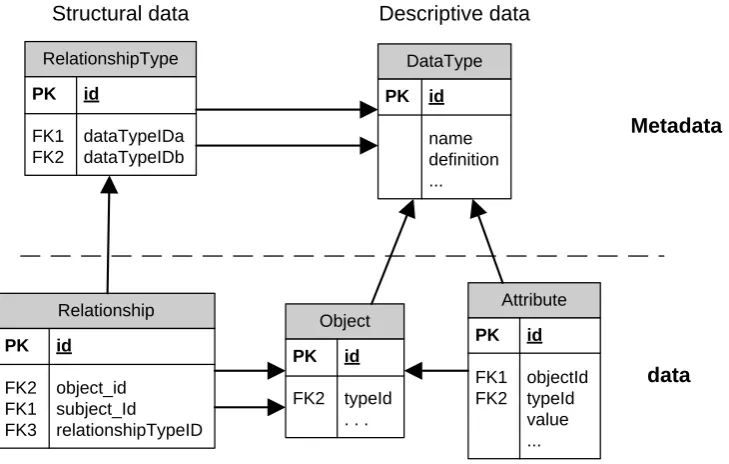
A metadata model based implementation includes tables to represent the key domain objects
and their complex relationships. For example, Figure 2-6 shows the metadata which includes
a RelationshipType and a DataType. The DataType table contains data defining the name of
objects while the RelationshipType table defines how the objects are related to each other.
Object PK id FK2 typeId . . . Relationship PK id FK2 object_id FK1 subject_Id FK3 relationshipTypeID Attribute PK id FK1 objectId FK2 typeId value ... DataType PK id name definition ... Metadata data RelationshipType PK id FK1 dataTypeIDa FK2 dataTypeIDb
Structural data Descriptive data
Figure 2-6 Simplified metadata model for managing different types of objects
The “real” data are stored in the Relationship, Object and Attribute tables. The Object table is
used to store any types of data that are defined in the DataType table. The Relationship table
13
Type, such as a relationship between two different types of domain object. The Attribute table
stores the values of the attributes, which are defined in the Data Type table.
The benefit is that this design provides flexibility to support requirement changes after the
software system is delivered. Returning to our library example, the Object table could be used
to store any type of library item (e.g. books, DVDs, journals, CDs). Different types of items
have different attributes; therefore, the Attribute table allows developers to add additional
attributes. In addition, any new relationship between objects can be also added in the
Relationship table via the Relationship Types. For example, some books (e.g. software
development books) may include digital content, e.g. a CD with an example code. The design
allows us to add the new relationship between a Book and CD object.
2.2.3 Ontology-based system
Ontology is a technique to define a knowledge base for all existing object types, object
attributes, and relationships (between individual objects) in a particular problem domain (Liu
& Özsu, 2009). An ontology will also include all terms to describe the names of entities
attributes and relationships.
In order to use the metadata model based database system according to different requirements,
IT professionals need to provide the metadata, e.g. entity types, valid relationship types
between individual objects and attribute types (see Section 2.2.2). In an ontology based
database system, the ontology is the metadata. The ontology based system can also store a
broad range of domain object data; new objects types and attributes types as well as their
relationships can be added in the ontology (metadata level) to meet new requirements.
Developing and maintaining ontology is difficult and time consuming. It requires database
developers, domain experts and ontology designers. The aim of these databases is to define all
existing entities in a problem domain. For our library, for example, all types of items in a
library (e.g. journals, music, anthologies) would be defined and include details such as how to
catalogue them. An ontological approach is not suitable for small scale projects.
2.2.4 Application and database co-evolution
Database schema evolution tools help database administrators to evaluate the impacts of
relational schema changes based on existing OO applications and also help to migrate existing
data to the new database schema. Schema evolution tools, metadata models and ontologies
help IT professionals to evolve databases and manage data. However, schema evolution does
14
This is the focus of many studies in software application evolution, such as reengineering
(Demeyer, 2008), system migration (Hainaut, Cleve, Henrard, & Hick, 2008) and architecture
evolution (Heckel et al., 2008).
Database evolution and software application evolution are often studied separately (Lin &
Neamtiu, 2009), with only a few studies investigating both evolution issues. Lin (2009)
indicates that the key problem of schema evolution is due to having different schema for the
persistent data and for the applications. An example is an OO application using a relational
database to store data. The problems are most evident where the applications have hard coded
references to the database schema. Changes to the database and applications must be carefully
synchronized. Studies discussing the challenges of applications and databases co-evolution
include (Bhattacharya & Neamtiu, 2010).
Some researchers have experimented with automating the adaptation of existing applications
to be consistent with a newly evolved database (Cleve, 2010). However, the researchers
argued that full automation of the application adaptation is unattainable so some work still
needs to be done manually.
2.3 Web services
Web services can improve application component flexibility and reusability. The World Wide
Web Consortium(W3C)defines a web service as an industry standard to support distributed
communication across diverse platforms via the network. For example, in our library
example, the loan manager component could be published as a web service; the service can
then be used by .NET applications or by Java applications. Web services play an important
role in increasing software flexibility for different types of implementation.
A web service dramatically increases the flexibility of the software to handle new
requirements. Many web services are provided for developers to address common
requirements with minimal effort, such as language translation and weather forecasts. For
example, Google Translate (Google, 2012) is a language translation web service that can be
used in our Library system to support multiple languages. It dramatically reduces
development effort for providing new functionality. IT professionals only need to reuse these
services in their own applications to meet new requirements; they do not need to worry about
how to implement them. As a result, web services can make it easier to include new
15
2.4 Summary
If not designed with flexibility in mind, applications can be expensive or impossible to adapt
or extend to meet new requirements. When changes are required such applications need to be
redesigned and the redesign has impacts on the entire implementation, including persistence
data stores, data access logic and the User. More importantly, all these aspects must be
re-implemented.
The goal of flexible software development is to avoid needing an entire system redesign and
so minimise the software maintenance costs. In this chapter we have discussed a number of
flexible software development techniques that help produce flexible and reusable software
applications. These techniques help software engineers design and implement applications
that can be reused in a range of applications which address similar domain problems.
However, end user developers (non-professional developers) without extensive software
design and implementation skills will have difficulty applying these techniques. The
following chapters will consider how to create more flexible applications for end user
16
Chapter 3 End User Development
Chapter 3 describes end user development studies and related approaches for improving end
user development flexibility. Section 3.1 provides a background of end user development. It
also points out that end users often do not have the skills to design flexible databases and
applications and find it difficult to evolve (extend and modify) their existing databases and
applications to meet new requirements.
Section 3.2 reviews potential end user development tools and Section 3.3 discusses
approaches that help end users implement and customise their applications to meet specific
needs. Section 3.4 reviews approaches and tools that can help end users evolve their
applications and databases. It also highlights that while developing flexible databases and
applications is hard, evolving them to meet future requirements can even be harder.
3.1 End user development
There are a number of challenges involved in end user development for small organizations
that tend not to be faced by large organisations. Large organisations may have the funds to consider commercial off-the-shelf (COTS) software to meet their data management needs. These organisations may also have the budget and resources to develop specific software from scratch. However, small organizations may not be able to afford the costs of purchasing COTS software.
Some reusable applications, such as COTS or open source applications allow customisation, but they may not be suitable for small scale projects. Apart from the cost, there is often a steep learning curve for non-professional developers to understand how to customise and use these systems effectively. As a result, many software development tools are provided to allow end users to act as non-professional developers and create their own applications.
Two types activities were identified by Lieberman, Paternò, and Wulf (2006):
1) Parameterisation and customisationallows users to alter the application's behaviour. For example, users could customise what content should be displayed in a web site based on their requirements, for example, customising the UI layout, modifying and deleting web page contents.
17
applications. For example, EUDs could develop new applications from scratch or add code to extend current applications for new requirements.
End user developed applications (EUDAs) are often created to perform a specific task for an individual group of users (Costabile et al., 2003). These are usually developed using one or more of following tools: databases, spreadsheets, templates, scripts and application
generators. They may be used to store and process data for specialists groups of users. Due to limitations of time and development expertise and knowledge of suitable software engineering
techniques, EUDAs are often very specific and unable to be generalised or extended when
requirements inevitably change.
3.2 Potential end user development tools
There are many potential end user development tools available to most organisations. EUDs
use these tools to develop applications to meet their requirements.
3.2.1 Spreadsheet
A spreadsheet is one of the most popular tools used by end users to develop data management
applications. Spreadsheet products such as Microsoft Excel and Open Office Calc provide
built-in programming languages that allow end users to manipulate and analyse data. EUDs
use spreadsheets to store data, perform calculations and generate reports. Spreadsheets have
been viewed as programming environments for non-professional developers for many years
(Nardi, 1993). However, there can be problems with debugging errors and maintaining data
integrity for EUDs.
Many studies have focused on these problems. In order to reduce spreadsheet development
errors, Panko (2008) suggested providing software tools to help end users find development
errors, for example, formula errors. Studies have been carried out to improve spreadsheet
maintenance, such as tools for testing and debugging Excel formula errors (Burnett,
Rothermel, & Cook, 2006) and improving spreadsheet data integrity (Cunha, Jo, Saraiva, &
Visser, 2009).
3.2.2 Reporting tools
There are many software tools to help end users analyse data with less effort. Tools such as
Crystal Reports (Peck & ebrary Inc., 2004) and R (RDevelopmentCoreTeam, 2011) assist end
users to perform data manipulation, analysis, visualisation and reporting. Most of these tools
18
importantly, some of the tools allow advanced users to develop additional functionality by
programming.
3.2.3 End user databases
Small databases, created with software such as Microsoft Access and Open Office Base, are
often used by end user developers to store their daily work data. However, without strong data
modelling skills, EUDs often create inflexible data models. These increase the risk of having
to be significantly restructured when new types of data are introduced. Over recent decades
attempts have been made to help end users improve database design. Approaches include
teaching end users how to design databases (Ahrens & Sankar, 1993) and software tools
developed to evaluate end user designs. Some researchers (Churcher, McLennan, &
McKinnon, 2001) provide a conceptual data model approach to support data model extension
and evolution for EUDs.
These approaches help end users to gain database modelling skills rather than assist them to
create flexible and extensible databases. As a result, software tools are still required to help
end users implement database.
3.2.4 Web development
There are some web development tools suitable for end user developers to create database
driven web sites, such as Microsoft Expression Web and Macromedia Dreamweaver.
However, these tools assume that the database design has been completed. Built in wizards
are used to select what tables and fields are to be used, e.g. for creating a web form for
viewing or entering data. However, these tools only provide predefined application logic,
such as adding, removing and editing records. If more complex processing is required, EUDs
have to add their own code, for example, by such as using SQL to generate specific reports.
In addition, the database design problems mentioned above can still occur (Rode, Howarth, &
Pérez-Quiñones, 2003; Rode, Rosson, & Qui˜nones, 2006). Many end user development
studies focus on how to provide tools to create web applications for managing their databases.
Although tools can be provided to simplify application development, many researchers report
that EUDs do not create flexible databases due to their limited development skills. Segal
(2009) points out that end user developers focus on modelling their team or individual data
rather than general requirements for similar teams or institutions. This can lead to major
19
3.3 Application customisation and implementation
The lack of software flexibility causes problems when software requirements change. Some
researchers (EUD-Net, 2003; Klann, Paternò, & Wulf, 2006) suggest that substantial
adaptability should be an important goal of all EUDAs. Therefore, the adaptability of
applications is an important criterion to measure EUDAs success.
3.3.1 Approaches
In this section we will discuss studies about how to support EUDs to create customisable
applications based on their specific requirements.
Reusable applications and databases
Some professionally developed applications are designed for a generic purpose based on a
specific problem domain and can be customised and extended based on customers’
requirements (Sommerville, 2007). There are many good examples, such as payroll or
personnel management applications in an Enterprises Resource Planning (ERP) system. These
COTS applications are designed as a base system that supports business processes in a general
way. The same base system can be reused and customised to create a family of applications
for different companies who are carrying the similar data processing. For example, many ERP
modules are configurable for different business processes and rules.
Many end users are looking for reusable applications (especially open source versions) and
would like to customise the application for their specific needs. However, customisation often
requires advanced database and programming skills. This issue been studied for many years
(Mackay, 1990). For example,(Cushing et al., 2007) provided domain specific database
templates for managing data. However, the study found that the database entities were too
generic to be understood by end users. As a result, database customisation still needs to be
carried out by IT professionals. In addition, it also has some limitations in supporting the
definition of data field constraints and user friendly data entry.
Component based approach
Component based application development involves component creation and component
assembling. Professional developers create components as well as define the interactions
between components. End users use composition tools to assemble components together to
form applications based on their specific needs. A number of studies have focused on helping
20
particular tasks, such as assembling a document searching tool (Anders et al., 2004; Wulf,
Pipek, & Won, 2008).
The advantage of this approach is that assembling predefined components can make creating
end user applications quick. However, a lack of support for end users to extend existing
components and integrate external components can limit the usefulness of this approach
(Anders et al., 2004).
Software shaping workshop
Software Shaping Workshops (SSWs) help end users to extend and tailor application
functionality. (Costabile et al., 2003) claim that SSWs allow applications to be extended and
redesigned by end users after the software is completed by professional developers. SSWs are
used in many application domains to help end users enhance application functionality. For
example, a toolbox was provided for radiologists to create and share annotations for X-rays
(Costabile et al., 2006) . Another example is tools provided for end users to perform basic
content management tasks, such as tailoring web site contents and layout for different user
groups.(Costabile et al., 2008)
Software modification tool for end users
Customisable applications can only be customised among predefined options (Letondal,
2006) . It is hard to meet rapidly changing data management requirement, such as new data
queries and algorithms. A solution must be provided for non-professional developers to
directly modify existing applications to include new data and functionality. In order to help
end users to modify existing software functionalities, Letondal (2006) provided an end user
development environment that helps users locate and modify methods (in the source code)
from the UI.
Both SSWs and end user development environments can help end users customise and extend
software applications. However these studies only allowed end users to create applications or
customise functionality based on an existing data model. If the underlying data model needs
to be evolved, it is still difficult for end users to modify the database and update exiting
applications to reflect the database changes.
Service based approaches
Web services are a platform and language independent way to expose application
functionality to other, external, applications. Common functions (e.g. database access) are
21
provide great flexibility for application interaction, data integration and data exchange in
different programming environments.
There are some studies about using web services to provide software functionality for
extending and customising end user applications. For example, a web service approach is used
to provide database access methods in order to help EUDs create customised data entry
applications in a familiar development environment, such as Excel (Deng, Abell, Churcher, &
McCallum, 2007) (Deng, McCallum, Churcher, & Abell, 2009). Researchers discuss the
potential of using web services to exchange data between end user and enterprise applications
(Christian et al., 2008). In addition, some web services help end users tailor applications to
their specific needs (Nestler, Namoun, & Schill, 2011) and allow workflow customisation
(Wajid, Namoun, & Mehandjiev, 2011) .
Web Mash-ups applications
One of the aspects of Web 2.0 (O'Reilly, 2005) is that it provides a way for end users to
participate in web application development, such as creating mash-up applications to combine
data from many different sources. For example, Yahoo Pipes (Yahoo, 2011) provide web
based development tools for creating mash-up applications. End users can simply select data
from different sources (such as web sites, news feeds and web services) and create a new
application with the data. Mash-up tools are designed to make it easy for end users to
integrate data and filter data without programming skills. Many researchers (Cappiello,
Daniel, Matera, Picozzi, & Weiss, 2011; Floch, 2011; Ghiani, Paternò, & Spano, 2011) have
provided mash-ups tools for inexperienced users to create applications with minimal effort.
However, mash-up applications mainly provide data retrieval functionality. They do not
easily support end users to populate or update their databases.
3.3.2 Challenges
This section covered a number of approaches to help end users to develop and customise
applications. However, there are still many difficulties facing EUDs. The biggest challenge is
how to help end users understand and use customisation systems. A good example is
discussed by Dittrich, Lindeberg and Lundberg (2006), who provided a prototype database
with tailoring capabilities that allowed end users to customise data entities. However, the
study reported that end users were not confident to make changes to the application and
database; they preferred to leave the changes to IT professionals. Even though a system may
be designed to be highly flexible, there still needs to be supporting tools as well as proper
22
3.4 Evolution of end user applications and databases
End user development studies reviewed provide approaches and tools to support more flexible
end user applications. However, end users still need tools to evolve their applications for
future needs. Some studies have focused on how to provide adaptable EU applications and
databases.
3.4.1 Collaborative design to evolve applications
Some researchers suggest that end users should work with IT professionals as co-designers in
order to evolve applications. Meta-design is an approach that suggests providing software
tools to enable collaborative design between IT professionals and end users (G. Fischer,
Giaccardi, Ye, Sutcliffe, & Mehandjiev, 2004; G. Fischer, Nakakoji, K., & Ye, Y, 2009). The
tools enable all potential users to participate in the software design, such as specifying
requirements and objectives as well as contributing ideas and feedback. IT professionals then
design the applications based on these requirements. (Koehne & Redmiles, 2011; Zhu, Vaghi,
& Barricelli, 2011) Eriksson (2008) provides tools for end users to specify their software
tailoring requirements, i.e. what types of customisations to implement (by professional
developers) in order to provide a system that allows for future evolution.
This approach is similar to agile software development methods in that end users and IT
professionals work together as a team, refining requirements and modifying the system in
iterations. However, this does not actually help end users learn how to evolve the applications,
because IT professionals need to be involved through the entire development process.
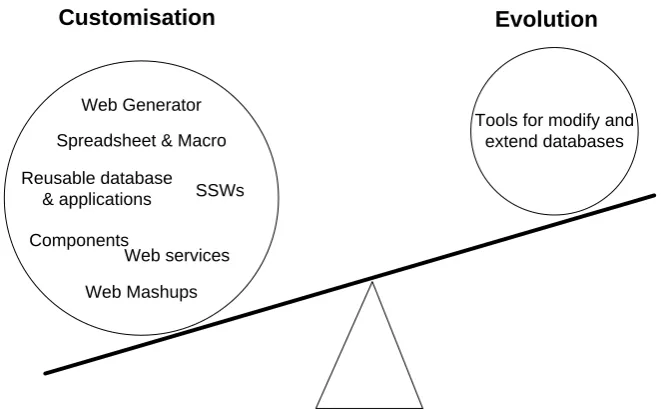
3.4.2 Database evolution tools for EUDs
End user development and evolution problems have been investigated for many years. End
users need evolution tools to easily extend and modify their databases and applications (Qing
& McLeod, 1994). Evolution studies of end user developed databases are comparatively rare
and only a few investigated what kind of tools should be provided for extending existing
databases. For example, Diestelkamp and Lundberg (2000) provided tools for end users to
modify and add database entities but there have been few evaluation and usability studies
done for these tools.
These studies overlook how to support co-evolution of databases and applications (i.e. when a