AN ANN BASED APPROACH FOR
OPTIMAL PLACEMENT OF
DSTATCOM FOR VOLTAGE SAG
MITIGATION
D.K. TANTI1, BRIJESH SINGH2, DR. M.K. VERMA3, DR. O. N. MEHROTRA4 1,4Department of Electrical Engineering, BIT, Sindri-828123, Dist.-Dhanbad, Jharkhand, INDIA 2,3
Department of Electrical Engineering, Institute of Technology, BHU, Varanasi-221005, Uttar Pradesh, INDIA
Abstract:
Voltage sag has been considered as one of the most harmful power quality problem as it may significantly affect industrial production. This paper presents an Artificial Neural Network (ANN) based approach for optimal placement of Distribution Static Compensator (DSTATCOM) to mitigate voltage sag under faults. Voltage sag under different type of short circuits has been estimated using MATLAB/SIMULINK software. Optimal location of DSTATCOM has been obtained using a feed forward neural network trained by post-fault voltage magnitude of three phases at different buses. Case studies have been performed on IEEE 14-bus system and effectiveness of proposed approach of DSTATCOM placement has been established.
Keywords: Power quality: Voltage sag mitigation: DSTATCOM: ANN.
1. Introduction
Consumer awareness regarding reliable power supply has been growing day by day. Power quality is most common concern for power utilities as well as for consumers. Today, the world needs increased amount of quality power for its growing population and industrial growth. Voltage sag is a frequently occurring power quality problem. Voltage sag has been defined as reduction in the root mean square (RMS) voltage in the range of 0.1 to 0.9 per unit (p.u.) for duration greater than half a cycle and less than one minute [1]. It may be caused by faults, increased load demand and transitional events such as large motor switching [2], [3]. Voltage sags (also known as voltage dips) can cause loss of production in automated processes, since a voltage sag can trip a motor or cause its controller to malfunction. Such a loss can be substantial for semiconductor industries. Voltage sag can also force a computer system or data processing system to crash [4]. An outage is worse than a voltage sag for an industry, but voltage sag occur more often and cause severe problems and economical losses. The voltage sags cause adverse effects on the performance of sensitive loads.
Development of compensator to enhance power quality has been an area of active interest for the past few decades [4]-[7]. Passive compensators like shunt reactors and capacitors are uncontrolled devices and incapable of continuous variation in parameters. The emergence of custom power devices has led to development of new and fast compensators [4]. The custom power devices include compensators like Distribution Static Compensator (DSTATCOM), Dynamic Voltage Restorer (DVR), Unified Power Quality Conditioner (UPQC), Battery Energy Storage System (BESS), and many more such controllers. These devices may be quite helpful in solving power quality problems. However, due to high cost, and for effective control, they are to be optimally placed in the system.
mitigate voltage sag and other power quality disturbances. Placement of DSTATCOM and DVR has been considered in [16] to mitigate voltage sag and swell. A pulse width modulation (PWM) based scheme has been considered in this work to control electronic valves used in DSTATCOM and DVR. A cascade converter based DVR has been considered in [17], [18] for mitigation of voltage sag. Implementation of discrete wavelet transforms using LC filters has been suggested in [19] for operation of DVR to mitigate voltage sag. A DVR based on a five-level flying-capacitor operated by a repetitive control scheme has been suggested in [20]. Placement of DVR in a small radial distribution system was considered in [21]. In phase voltage injection by DVR was considered in this work. A novel sag detection method for the line-interactive DVR has been presented in [22]. Placement of UPQC with minimum active power injection has been considered in [23]. A novel compensation and control strategy for Series Power Quality Regulator (SPQR) for voltage sag/swell and steady-state voltage variation reduction has been proposed in [24]. Two topologies for DVR based on direct converters without direct current (DC) link have been presented in [25]. These topologies are effective in control of voltage disturbances such as sag/swell.
The works presented in [8]-[25] have considered placement of custom power devices in small radial distribution systems. Very limited attempt seems to be made in optimal placement of custom power devices in interconnected power systems. Placement of Static VAR Compensator (SVC), Static Compensator (STATCOM) and DVR for voltage sag mitigation in a predominantly meshed sub-transmission network and a predominantly radial distribution network has been considered in [26]. However, placement of Flexible AC Transmission System (FACTS) controllers have been considered at an arbitrarily selected bus and no specific criterion has been suggested to determine optimal location of such controllers. Optimal placement of FACTS devices based on Nichiang Genetic Algorithm (NGA) has been suggested in [27] to minimize financial losses in the network due to voltage sag. Optimal placement of FACTS controllers using genetic algorithm (GA) based optimization has been suggested in [28] to mitigate voltage sag in a meshed distribution system.
The Artificial Neural Network (ANN) based methodologies have been successfully applied in several areas of the Electrical Engineering, including detection of voltage disturbances, voltage and reactive power control, fault detections [29]-[31]. In this paper, the ANN based approach has been applied to find the optimal location of DSTATCOM for voltage sag mitigation. The ANN was trained with Levenberg Marquardt back-propagation algorithm. Since most of the sags in the power system are caused by short-circuit faults in transmission and distribution network, fault simulations/studies have been historically the most popular tool for voltage sag estimation [2]. Classical symmetrical component analysis, phase variable approaches, and complete time domain simulations are among widely used methods for fault simulation in power system [32]. In the present work, time domain simulations have been done using MATLAB/SIMULINK software [33] and voltage sags have been estimated under different type of faults. Case studies have been performed on IEEE 14-bus system [34].
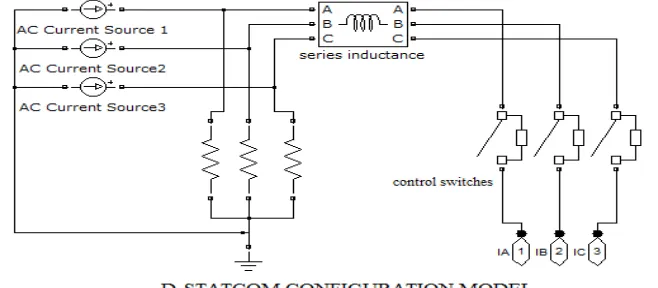
2. DSTATCOM Model
3. Methodology
The simulation model of the power system network under study is developed using MATLAB/SIMULINK [33]. This model is used to find the three phase per unit (p.u.) voltages of all the buses of the network under different type of short-circuits viz. single line to ground (L-G), line to line (L-L), double line to ground (L-L-G) and three phase (L-L-L or L-L-L-G) faults. Post-fault voltages have been used to train a feed forward neural network with back-propagation algorithm. The training process is carried out with large no. of input and output target data. The normal p.u. voltages of the different buses have been considered as output target data. Once the network is trained, some data are used to test the network. The testing result provides information about most insecure bus of the system based on highest deviation from the target. The bus having highest deviation from the target data has been considered as the optimal location for the placement of DSTATCOM to mitigate the voltage sag problem.
4. Case Studies
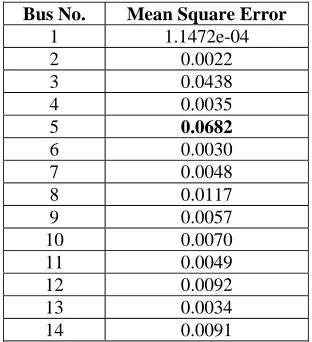
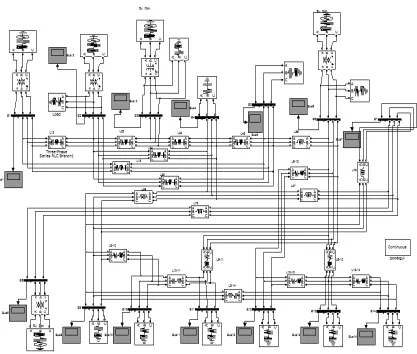
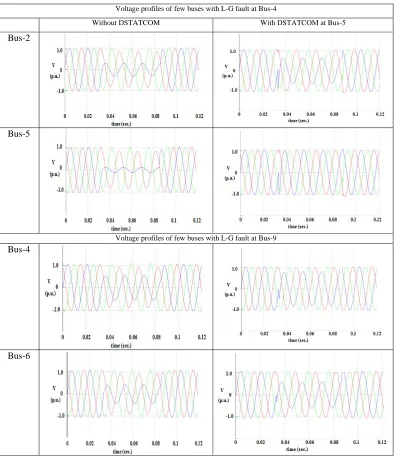
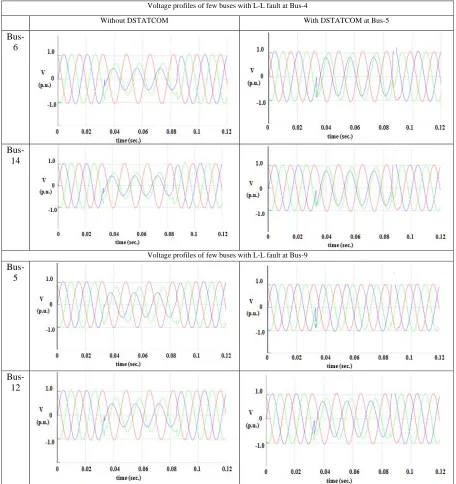
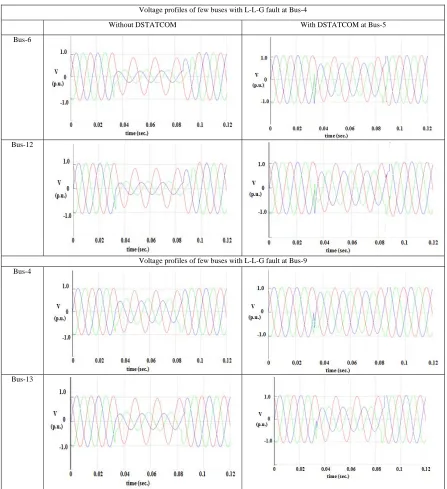
The simulation model of IEEE-14 bus system [34] composed of 14 buses and 20 lines was developed using MATLAB/SIMULINK software [33]. The system consists of 5 generator buses including three synchronous condensers and 9 load buses. The total real and reactive power demand of the system are 259 MW and 81.3 MVAR, respectively. The simulation block diagram of the system has been shown in Fig. 2. This plant model has been used for finding three phase bus voltages under different type of faults, and for the database collection to train the artificial neural network. The voltage database was prepared by creating L-G, L-L, G and L-L-L-G fault at different buses during the period 33.33 milliseconds to 83.33 milliseconds. The normal p.u. voltages of different buses (taken as 1.0 p.u. in this work) were considered as output target data. Some data were used to test the network and mean square errors (mean of squared deviation of post-fault bus voltages from target value) were calculated at different buses. The ANN training performance has been shown in Table 1. It is observed from Table 1 that bus-5 has the highest value of mean square error. Hence, bus-5 was considered as the optimal location for the placement of DSTATCOM. The DSTATCOM model proposed in section-2 of this paper was considered and its SIMULINK model was developed. Post-fault three phase voltages were plotted using MATLAB/SIMULINK software [33] without DSTATCOM and with DSTATCOM at the optimal location (i.e. bus-5). Plots of voltage vs. time at some of the buses with faults at bus-4 and at bus-9, respectively, have been shown in figures 3, 4, 5 and 6 for L-G, L-L, L-L-G and L-L-L-G fault, respectively. It is observed from figures 3, 4, 5, 6 that placement of DSTATCOM at bus-5 results in significant reduction of voltage sag under all type of short circuits.
Table 1. Training performance of ANN at different buses
Bus No. Mean Square Error
1 1.1472e-04 2 0.0022 3 0.0438 4 0.0035
5 0.0682
Fig. 2. IEEE-14 bus system (MATLAB/SIMULINK) model
5. Conclusion
Voltage profiles of few buses with L-G fault at Bus-4
Without DSTATCOM With DSTATCOM at Bus-5
Bus-2
Bus-5
Voltage profiles of few buses with L-G fault at Bus-9
Bus-4
Bus-6
Fig. 4. Voltage profiles of few buses with L-L fault at Bus-4 and at Bus-9, respectively Voltage profiles of few buses with L-L fault at Bus-4
Without DSTATCOM With DSTATCOM at Bus-5
Bus-6
Bus-14
Voltage profiles of few buses with L-L fault at Bus-9
Bus-5
Voltage profiles of few buses with L-L-G fault at Bus-4
Without DSTATCOM With DSTATCOM at Bus-5
Bus-6
Bus-12
Voltage profiles of few buses with L-L-G fault at Bus-9 Bus-4
Bus-13
Voltage profiles of few buses with L-L-L-G fault at Bus-4
Without DSTATCOM With DSTATCOM at Bus-5
Bus-5
Bus-13
Voltage profiles of few buses with L-L-L-G fault at Bus-9
Bus-2
Bus-3
References
[1] IEEE StandardsBoard (1995), “IEEE Std. 1159-1995” IEEE recommended practice for monitoring electric power quality, IEEE Inc.
NewYork.
[2] Bollen. M , “Understanding power quality problems: Voltage sags and interruptions,”Piscataway, NJ, IEEE Press, 2nd
edition 2000.
[3] Pirjo Heine and Matti Lehtonon , “Voltage sag distributions caused by power system faults”, IEEE Transactions on Power Systems,
Vol. 18, No.4, pp. 1367-1373, November 2003.
[4] Ghosh and G. Ledwich, “Power quality enhancement using custom power devices,” Kluwer Academic Publisher, London 2002.
[5] L. Gyugyi , “Reactive power generation and control by thyristor circuits,” IEEE Transactions on Industry applications, Vol IA-15,
No.-5, pp. 521-532, Sept/Oct 1979.
[6] Y H. Song and A.T.Johns, “ Flexible AC Transmission Systems ( FACTs) ,” IEE Power and Energy Series, London, UK, 1999.
[7] R. Arnold, “Solutions to the Power quality problems,” Power Engineering Journal, Vol. 15, No.-2, pp. 65-73, April 2001.
[8] Olimpo Anaya-Lara and E. Acha, “Modeling and analysis of custom power systems by PSCAD/EMTDC”, IEEE Transactions on
Power Delivery, Vol. 17, No. 1, pp. 266-272, January 2002.
[9] Arindam Ghosh and Gerard Ledwich, “Compensation of distribution system voltage using DVR”, IEEE Transactions on Power
Delivery, Vol. 17, No. 4, pp. 1030-1036, October 2002.
[10] D. Mahinda Vilathgamuwa, A.A.D. Ranjith Perera and S. S. Choi, “Voltage sag compensation with energy optimized Dynamic
Voltage Restorer”, IEEE Transactions on Power Delivery, Vol. 18, No. 3, pp. 928-936, July 2003.
[11] H. Masdi, N. Marium, S. Mahmud, A. Mohamed, S. Yusuf , “Design of a prototype D-STATCOM for voltage sag mitigation”, IEEE
National Power and Energy Conference 2004, PECon 2004, pp. 61-66, Kuala Lumpur (Malaysia), November 29-30, 2004.
[12] Elandy and Magady M.A. Salama, “Mitigation of voltage disturbances using adaptive perceptron-based control algorithm”, IEEE
Transactions on Power Delivery, Vol. 20, No. 1, pp. 309-318, January 2005.
[13] Elnady and Magdy M.A. Salama ,” Unified approach for mitigating voltage sag and voltage flicker using the D-STATCOM ,” IEEE
Transactions on Power Delivery, Vol. 20, No.2, pp. 992-1000, April 2005.
[14] S. S. Choi, J. D. Li and D. Mahinda Vilathgamuwa, “A generalized voltage compensation strategy for mitigating the impacts of
voltage sags/swells”, IEEE Transactions on Power Delivery, Vol. 20, No.3, pp. 2289-2297, July 2005.
[15] Han, B. Bae, H. Kim and S. Baek, “Combined operation of Unified Power-Quality Conditioner with Distributed Generation”, IEEE
Transactions on Power Delivery, Vol. 21, No. 1, pp. 330-338, January 2006.
[16] Ravi Kr. S. V. and S. Siva Nagaraju, “Power quality improvement using D-STATCOM and DVR,” International Journal Medwell of
Electrical Power Engg.1: pp. 368-376, 2007.
[17] H. K. Al-Hadidi, A. M. Gole and David A. Jacobson, “Minimum power operation of cascade inverter-based Dynamic Voltage
Restorer”, IEEE Transactions on Power Delivery, Vol. 23, No. 2, pp. 889-898, April 2008.
[18] H. K. Al-Hadidi, A. M. Gole and David A. Jacobson, “ A novel configuration for a cascaded inverter-based Dynamic Voltage Restorer
with reduced energy storage requirements”, IEEE Transactions on Power Delivery, Vol. 23, No. 2, pp. 881-888, April 2008.
[19] S. A. Saleh, C. R. Moloney and M. Azizur Rahman, “Implementation of a Dynamic Voltage Restorer system based on discrete wavelet
transform”, IEEE Transactions on Power Delivery, Vol. 23, No. 4, pp. 2366-2375, October 2008.
[20] Pedro Roncero-Sanchez and Enrique Acha, “Dynamic Voltage Resorer based on flying capacitor multilevel converters operated by
repetitive control”, IEEE Transactions on Power Delivery, Vol. 24, No. 2, pp. 951-960, April 2009.
[21] Benachaiba and B. Ferdi, “Power quality Improvement using DVR, American Journal of Applied Sciences, Vol. 6, No. 3, pp.
396-400, 2009.
[22] B. Bae, J. Jeony, J. Lee and B. Han, “Novel sag detection method for line-interactive Dynamic Voltage Resorer”, IEEE Transactions
on Power Delivery, Vol. 25, No. 2, pp. 1210-1211, April 2010.
[23] Woo Cheol Lee, Dong Myung Lee and Taeck Kie Lee, “New control scheme for a Unified Power Quality Compensator-Q with
minimum active power injection”, IEEE Transactions on Power Delivery, Vol. 25, No.2, pp. 1068-1076, April 2010.
[24] Liu Yingying, Xu Yonghai, Xiao Xianging, Zhu Yongqiang, Guo Chunlin, “A stages comensation and control strategy for series
Power-Quality regulator”, IEEE Transactions on Power Delivery, Vol. 25, No. 4, pp. 2807-2813, October 2010.
[25] Ebrahim Babaei, Mohammad Farhadi Kangarlu and Mehran Sabahi, “Mitigation of voltage disturbances using Dynamic Voltage
Restorer based on direct converters”, IEEE Transactions on Power Delivery, Vol. 25, No. 4, pp. 2676-2683, October 2010.
[26] J. V. Milanovic and Y. Zhang , “ Modeling of FACTS Devices for voltage sag mitigation studies in large power systems ,” IEEE
Transactions on Power Delivery , Vol. 25, No. 4, pp. 3044-3052, October 2010.
[27] Jovica V. Milanovic and Yan Zhang, “Global minimization of financial losses due to voltage sags with FACTS based devices”, IEEE
Transactions on Power Delivery, Vol. 25, No. 1, pp. 298-306, January 2010.
[28] Yan Zhang and Jovica V. Milanovic, “Global voltage sag mitigation with FACTS based devices”, IEEE Transactions on Power
Delivery , Vol. 25, No. 4, pp. 2842-2850, October 2010.
[29] E.A.Mohamed , N.D. Rao, “Artificial Neural Network based fault diagnostic system for electric power distribution feeders,” Electric
Power System Research, Vol. 35, No. 1, pp. 1-10, 35 October 1995.
[30] Ernesto Vazquez, Hector J. Altuve, Oscar L. Chacon, “Neural network approach to fault detection in electric power systems”, IEEE
International conference on Neural Networks, Vol. 4, pp. 2090-2095, June 3-6, 1996, Washington, DC, USA.
[31] F.J. Alcantare, J. R. Vazquez, P. Salmeron, S.P. Litran, M.I. Arteaga Orozco, “On line detection of voltage transient disturbances using
ANNs,” International Conference on Renewable Energies and Power Quality (ICREPQ 09) 15th
to 17th
April 2009, Valencia, Spain.
[32] S. M. Halpin and L. L. Grigsby, “A comparison of fault calculation procedures for industrial power distribution systems: The past, the
present, and the future”, IEEE International Conference Industrial Technology, Guangzhon, China, 1994.
[33] MATLAB 7.0 User’s Guides for SIMPOWER SYSTEMS and Neural Network Toolbox.