Design And Development Of Elbow Disarticulation
Unit Using Advance Interlocking Mechanism
Abhilash K P, Puneeth Kumar M V*,
Abstract: Out of all the upper limb disability, the amputation in elbow restrict majority of hand movement which not only challenge for patient for carrying its day to day work such as eating, picking of object etc. In this study, an attempt is made to design and develop interlock mechanism based elbow disarticulation prosthesis in this design the focus is given on the locking mechanism. The available mechanical elbow joints are made up of externally locked which cosmetically not acceptable, it may come in contact with body which will cause tear and load carrying capacity also got deteriorated. In the interlock mechanism based joint , it enables the amputee patient to perform the sound gate motion of the hand moreover it is cosmetically suitable and user friendly, initially cad model of the design is carried out followed by fabrication and present trial the feedback from the patient are incorporated for fine tuning of the design.
Index Terms: Amputation, Prosthesis, Disarticulation.
—————————— ——————————
I.
INTRODUCTION
The upper limb amputation is a serious problem for human as it causes hindrance to various daily activities. Especially for the elbow amputation, it causes severe damage to the movement of the hand for a different common purpose. The available prosthetic elbow and disarticulation prosthesis are very costly and cannot be afforded by the common and economical backward people in India. By realizing the extreme requirement of elbow amputee people’s usability and affordability, the design and development are carried out for interlock mechanism-based bio-compatible, user-friendly and cost-effective elbow disarticulation prosthesis. There is no complicated electronics and motorized actuation involved therefore it makes this design simple. This design incorporates the internal slot mechanism which will provide an adequate motion of the artificial hand connected to the elbow joint. The joint is developed mechanically which helps the prosthesis to bring back sound gait of elbow and hand similar to the normal elbow. The design is very compact and not exposed outside of the hand so that normal clothing for the patient is not hampered. The design of an elbow joint incorporates a simple machining and manufacturing process for easy fabricated. Most importantly, the cost of the prosthetic joint is around Rs.1500-2000/unit by machining of a single unit. However, the cost can be further reduced by mass production. Since the innovation is focused on the mechanical linkage based low-cost prosthesis, this innovation will certainly benefit the elbow amputee people to bring back their normal hand gait cycle. Commercialization of this innovation is going to serve the majority of the elbow amputees. As the development is specified for a very unique group of specially-abled people, the implementation of this will have a positive impact on society [1]. AMPUTATION-the word amputation is derived from the Latin word “amputare”, meaning a “cutting around” & was originally used to describe the removal of limbs or portion of limbs by the knife. Though amputation surgery is a destructive
type of surgical procedure but it is mainly used for life saving procedure. A proper prosthetic fitting followed by amputation surgery is complete the treatment procedure.
Mainly amputation surgery is performed in two part of body
1. Upper extremity 2. Lower extremity
The ratio of incidence of lower extremity amputation to upper extremity amputation is 5:1.
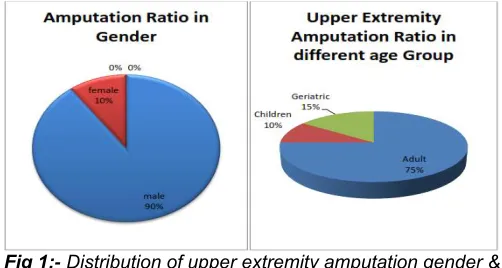
Fig 1:- Distribution of upper extremity amputation gender & age wise
As per the rough estimate, upper extremity amputee population in India rise by 15% to 20% of the total amputations that have taken place in that calendar year, of which 90% are male . It has also been found that 75% of the upper extremity amputations takes place in the adults, 10% in children, 15% in older age persons. These prostheses are designed specifically for each individual and factors that go into that decision are the patient’s residual limb, their activity level, prognosis, employment and extracurricular activities as well as the patient’s specific goals for a prosthetic device. While each experience of limb loss is unique, many individuals have successfully overcome the loss or absence of a limb and regained function and positive outlook. Basically, lower limb prostheses are required to do two things: enable a person to stand and walk. But the demands of upper limb prostheses are different. Hand performs a wide variety of tasks, from the delicate and complex to the strong and forceful. An ideal prosthetic hand would do these entire things. Unfortunately, we have not yet created a device that can perform tremendous array routinely done by our natural hands. The hand is also ————————————————
Abhilsh K P. currently pursuing M.Tech in Design engineering in Nitte
Meenakshi Institute of Technology Bengaluru, India, PH-9481540488. E-mail: [email protected]
Mr.Puneeth Kumar M V. Assistant Professor Department of Mechanical
one of the most important elements of our self-image, second only to our face. Our hands are a tremendous part of how we present ourselves to others. In addition to interacting with the environment in so many functional ways, our hands are a significant part of our psychological and social selves and are vital element in our sense of feeling whole. Far more than lower-limb prosthetic, an ideal upper-limb prosthesis would have a life-like appearance, including skin tone , veins, hair texture and colour , even wrinkles and creases , in addition to life-like power and functional ability. Movement of the elbow joint: - there is two type of movement is seen at elbow joint. FLEXION: - Brachilis is the main muscle used when the elbow is flexed slowly. During rapid and forceful flexion all three muscles are brought into action assisted by the superficial forearm flexors originating at the medial side of the elbow. The efficiency of the flexor muscles increase dramatically as the elbow is brought into mid flexion (flexed 90 degree). Biceps reaches its angle of maximum efficiency at 80-90 degree and brachialis at 100-110 degree. Active flexion is limited to 145 degree by the contact between the anterior muscles of the upper arm and forearm, more so because they are hardened by the contraction during flexion. Passive flexion (forearm is pushed against the upper arm with flexors relaxed) is limited to 160 degree by the bony projections on the radius and the ulna as they reach to the shallow depressions on the humorous; i.e. the head of radius being pressed against the coronoid fossa. Passive flexion is further limited by tension in the posterior capsular ligament and in triceps brachia. EXTENSION: - Triceps is maximally efficient with the elbow flexed 20-30 degree. As the angle of flexion increases, the position of the olecranon approaches the main axis of the humerus which decreases muscle efficiency. In full flexion, however, the triceps tendon is rolled up on the olecranon as on a pulley which compensates for the loss of efficiency. Because triceps long head is bi-articular (acts on two joints) its efficiency is also dependent on the position of shoulder joint
Fig 2:- Movements of the elbow joint
1.3 General consideration:-
Characteristics of a successful prosthesis:
Ideally, prosthesis must be comfortable to wear, easy to put on and remove, light weight, durable, and cosmetically pleasing. Furthermore prosthesis must function well mechanically and require only reasonable maintenance. Finally, prosthetic use largely depends on the motivation of individual, as none of the above characteristics matter if the patient will not wear the prosthesis.
The following are consideration when choosing prosthesis:
1. Amputation
2. Contour of the residual limb 3. Expected function of the prosthesis 4. Cognitive function of the patient
5. Vocation of the patient (e.g. Desk job vs. manual labour) As amputation surgery principle suggests the amputation surgery should perform as much as possible distal level. In case of children disarticulation surgery is more preferred than transverse amputation of bone to prevent revise amputation because of bony growth. But there is a controversy exist over elbow disarticulation perform. Because when elbow disarticulation allows enhanced suspension, rotation control, but at the same time it will create problem to fit in prosthetic elbow joint.
II.
LITERATURE
SURVEY
Elizabeth Speltz et al. [1] in this paper authors discussed about the new design of socket for elbow disarticulation amputee. Here they showed what are the problems faced by a prosthetist during socket fitting in elbow disarticulation amputee and how it can be solved. Maurice A et al. [2] in this article the author compared the clinical evaluation in between some externally powered elbows in the year 1971. To acquire additional clinical experience with the elbows, J. E. Hanger, Inc. of Georgia was later added. Ober J. K. et al. [3] in this design, the researcher developed new mechanical endo-skeletal elbow which could be controlled with only one cable. The flexion-extension and locking actions were carried out with only one movement of the single control harness. The separation of elbow extension and locking was possible due to the inherent difference in inertia of the forearm and the lock.
deficiency, trauma and amputation of cancers and disorders in the United States. Alberto Esquenazi [9] this self-learning module introduces new developments in this area. Part of the Affiliate Rehabilitation chapter in Physical Medicine and Rehabilitation includes a self-directed physical education program for physicians and coaches. This article reviews the stages of amputation rehabilitation for community reunification and long-term adherence to preventative steps. Laura A et al. [10] Targeted reconstruction is the surgical procedure developed to increase the number of molecular entry sites available to control affiliate mail affiliation. Nervous signals related to specific movements are used to control the independence of independent degrees, since prosthetic control is more physically appropriate than conventional control using this method. The process was successfully completed with the level of shoulder disability and mutation of the transhumal stage of three people.
III.
TECHNICAL
GAP
Information obtained from the past reviews of literature, very few research are been done for the development of mechanical internal locking elbow joint for elbow disarticulation prosthesis. May be it is because the case of elbow disarticulation amputee is very less. In developing country like India, where cost is a main factor during prosthesis fitting, all patients cannot go for high cost myoelectric or hydraulic control prosthesis. In that case only mechanical elbow joint remains as only option for fitting. But as we know standard elbow joint could not fit elbow disarticulation patient because of lack of availability of fitting length, we maximum time go for external locking elbow joint. But this type of joint itself creates problem for the patients. As it is attached laterally and medially, it increases medio-lateral width of the prosthesis making it cosmetically less acceptable. And another disadvantage is it also increases the weight of the prosthesis, which is the main cause of rejection of prosthesis. External locking joint with rod and spring loaded also creates problem in clothing. Another problem is also seen in case of Elbow disarticulation patient is socket fitting. Because of lack of research in the socket design, we generally go for normal above elbow socket design covering the shoulder joint, which is unnecessary. Rather it covers the shoulder joint and restricts the shoulder joint motion, which creates problem in day to day activity. Also because of having very long stump and bulbous shape at the end of stump, patient faces a lot of problem during donning and duping
IV.
METHODOLOGY
Operational mechanism of prosthetic elbow jointThe prosthesis needs a mechanism to maintain the forearm on a certain position without moving even when it is subject to an external force. Prosthesis can have a defined number of positions to lock on or it could stop at any point within the range of motion, normally due to a friction system. When the locking mechanism has predefined positions, it could decrease the versatility and overall performance of the prosthesis since the patient has to comply with those positions. This work will incorporate a frictional locking mechanism, so the user can freely decide the best position they want to set their prosthesis on and accomplish their activities with comfort and ease. This design incorporates the internal slot mechanism which will provide an adequate motion of the artificial hand connected to the elbow joint. The joint is developed mechanically which
helps the prosthesis to bring back sound gait of elbow and hand similar to the normal elbow. The design is very compact and not exposed outside of the hand so that normal clothing for the patient is not hampered.
Fig 3: CAD designed interlock mechanism based elbow prosthesis
Fig 4: CAD designed interlock mechanism with handle
Fig 5: Fabricated elbow disarticulation prosthesis
Method of selection of comparison/control group:
Subjects fulfilling the inclusion criteria will be fitted with the new design of socket and prosthetic elbow joint. The study parameters will be assessed and compared with the values obtained by assessing the existing design.
PARAMETERS OF STUDY:
Elbow flexion Range of prosthetic joint
Range of motion at shoulder joint
Axial Load test
Block - Box test
Live - lift test
OPUS satisfaction scale
RESEARCH HYPOTHESIS:-
a. Null Hypothesis:- New socket and prosthetic elbow joint design for elbow disarticulation prosthesis will not improve the functional envelope and cosmesis of the prosthesis
b. Alternate Hypothesis: - New socket and prosthetic elbow joint design for elbow disarticulation prosthesis will improve the functional envelope and cosmesis of the prosthesis.
INSTRUMENTATION:-
a. Goniometer b. Block & box
c. Spring scale (digital) d. Stop watch
e. Opus satisfaction scale
GONIOMETER: - A Goniometer is a device used to measure the range of motion around a particular joint in the body. The word Goniometer is derived from the Greek terms “Gonia” and “Metron”, which mean “Angle” and “To measure” respectively. A Goniometer is usually made of plastic and often transparent. And in some case it is made out of metal also. There are two arms of Goniometer: (a) The stationary arm & (b) the movable arm.
Fig 6: Goniometer
BLOCK BOX TEST: - Matheiowetz et al. (1985) describes the standardized dimensions for test materials, procedures and scoring. Individuals are seated at a table, facing the examiner. A rectangular box divided into 2 compartments by a wooden partition is in front of the individual, and coloured wooden blocks are placed in one compartment. The individual is instructed to move as many blocks as possible, one at a time, from one compartment to another for the duration of 1 minute. a. The individual’s hand must cross over the partition for the block to be counted towards total score
b. Bocks may be dropped once the hand passes the partition. c. Approximately 5 minutes are required for set up, explanation of the instructions to the patient and administration of the test.
Fig 7: block & box test
Scoring:-
a. Scored by counting the number of blocks carried over by the individual from one compartment to other.
b. If the individual carries multiple blocks at a time, this only counts as 1
c. If the individual brings the block over partition and drops it outside the box, then still it counts.
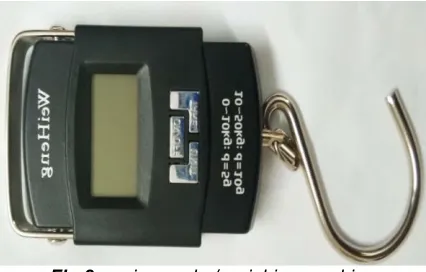
SPRING SCALE: - spring scale is an instrument that measures weight/ force holding capacity of any object. It helps to weigh the prosthesis, measure the axial load test, live-lift test of the prosthesis.
Fig 8: spring scale / weighing machine
STOP WATCH: - Stop watch is used for block box test. It gives us the exact time alarm for block box test as per seconds consumed. According to set time we calculate the wooden block per second.
PARAMETER ASSESSMENT OUTCOMES:-
i. MEASURING SHOULDER JOINT OF MOTION: - ROM is defined as the distance and direction a joint can move between the flexed position and the extended position. Each specific joint has different type of motion and different amount of range of motion.
The unit of range of motion is degree and it is measured by goniometer.
As shoulder joint is a ball and socket type of synovial joint it has highest no of mobility possible. Movements possible around the shoulder joint are,
a. FLEXION: Forward bending of the arm at the shoulder joint. b. EXTENSION: Backward movement of the arm at the shoulder joint
d. ABDUCTION: Moving the whole arm away from the midline of the body.
Fig 9: movement around shoulder joint
ii. MEASURING PROSTHETIC ELBOW RANGE OF MOTION: -Like normal elbow flexion and extension here the flexion of prosthetic elbow joint, which can be observed at maximum, is measured. The forearm shell is move towards the arm shell/ socket by patient itself and the angle is measured by placing goniometer at the elbow joint.
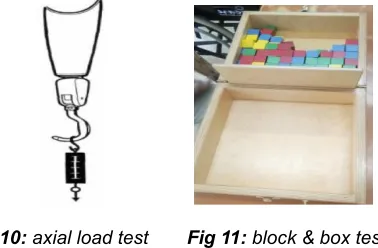
iii. AXIAL LOAD TEST: -In this test, mainly the efficiency of socket fitting is test. Patient after fitted with prosthesis instructed to stand erectly. Prosthetic elbow is unlocked and prosthesis should be in neutral position. An axial load perpendicular to the ground is given at the distal end of the prosthesis i.e. either hook or hand, till the patient feels the socket slips. And the maximum weight patient can take is measured. This weight is known as the axial load.
Fig 10: axial load test Fig 11: block & box test
iv. BlOCK & BOX TEST: -By using the standardized block & box equipment as mentioned previously the test was done for one minute to test the efficiency of prosthesis with patient.
v. CONTROL SYSTEM EFFICIENCY TEST: -
a) Disconnect the control cable from the terminal device, and attach the scale to hook - operating lever or hand-operating cable. Place a 3/4-in. block between the fingers and pull until the block slips out of a voluntary-opening hook or until the fingers of a voluntary-closing hook or hand just close on the block. Note the force at this instant.
b) Reconnect the control cable to the terminal device, and apply the scale to the T-bar, or terminal, at the other end of the control cable. Pull along the line of the harness until the block slips or the fingers touch, as before. Note the force at the instant this occurs.
c) Multiply the force measured at the terminal device by 100. Then divide by the force measured at the cable terminal as in the following formula:
Efficiency =force measured at terminal devices x 100/force measure at cable terminal
Standard: The control-system efficiency should be at least 70 percent.
Fig 12: control system efficiency test
vi. WEIGHT OF THE PROSTHESIS: The total weight of the prosthesis including all the parts is measured with the help of the digital spring scale.
vii. OPUS STISFACTION SCALE: It is a standardized questioner for the patient on the overcome result of the prosthesis. After the fitting of the prosthesis patient is asked the questions over the prosthesis fitting and functioning, patient has to answer the question as per the grade 1 to 5.
FABRICATION PROCEDURE:-
An elbow disarticulated patient is selected and taken as the subject for the study procedure. Same procedure is followed for all the five patients. Each patient is to be fitted with two type of prosthesis. One is old i.e. existing design and the 2 nd one is the new design of elbow disarticulation prosthesis. If the patient is an old user of the patient then only new design of prosthesis is need to be fabricated, and if the patient is of new user both design of prosthesis is to be fabricated for him/her.
The procedures followed for the fabrication of prosthesis is as followed:-
a. Casting b. Modification c. Socket fabrication d. Joint fabrication e. Forearm shell fabrication f. Assembly of all the components g. Patient training h. Parameter study
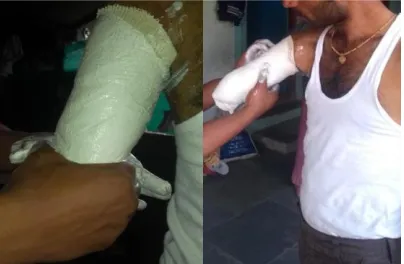
A. Casting: - In wrap cast method cast was taken for both the design i.e. old and new design of prosthesis. First wet stockinet was applied over the patient stump as an interference medium and cast was taken over it.
OLD DESIGN OF SOCKET:
In this design the socket is same like as above elbow socket. It covers the shoulder joint i.e. it extends till the acromion of the shoulder joint, covering decto-pectoreal groove area anteriorly and half of the scapula posteriorly. Cast was taken, maintaining shoulder at normal hanging procedure.
Pop bandage is wrapped over patient’s stump from the distal end to the laterally and superiorly covering the acromion.
The cast is total contact and a tolerable amount of pressure is given at pectoreal groove to get a good contact socket.
After cast became hard it was taken out.
.
Fig 13: casting procedure for old design of socket
NEW DESIGN OF SOCKET:
This design of socket does not cover the shoulder joint. But at the same times it provide the supra condylar suspension. It also having anterior cut-out, so it provide active expansion and contraction of biceps muscle.
For taking cast patients’ shoulder is maintained at neutral position. A rubber strap is given in the anterior side of the stump from shoulder joint to distally the end of the stump. Pop bandage wrapped over patient’s stump covering from the distal part of the stump to till the axilla. Laterally the cast is maintained slightly higher to the axilla but lower to the shoulder joint.
Now pressure was given superior to the epicondyle of medio-laterally to get the suspension.
The distal end of the stump is tried to maintain flat as it a bony end it will not create any problem and we can attach the elbow joint.
After the cast became hard the cast is cut and taken out.
Fig 14: casting procedure for new design of socket
B. Modification: - Modification is the process in which the pop mold is modified to get the positive replica of the patients stump followed by the pouring of cast. At first the cast is poured with Pop solution and a mandrel is placed inside it. After it became hard the cast is removed and the mold is ready for modification. The same procedure is followed for both the case.
OLD DESIGN OF SOCKET:
In this design as we get the mold the measurement check was done, both in cericumferencially and length wise. And the material is removed/ added wherever necessary to get the exact measurement.
Both in anterior and posterior area of shoulder area some material is removed to get close fit of socket.
And then the mold is smoothened and ready for socket fabrication.
NEW DESIGN OF SOCKET:
In this design after we get the mold, measurement check was done and matched with the required one.
The distal end of the mold is maintained flat for the attachment of elbow joint.
In the supra-condylar area, material is reduced to get the suspension in the socket itself.
After that mold is smoothened and ready for socket fabrication.
Fig 15: modification procedure for new design of socket
C. Socket fabrication: - Both the socket is fabricated using the hand lamination method.
The materials used in this method are:- 1. Epoxy resin,
2. Stockinet (3 Layers), 3. Accelerator,
4. Catalyst & Sealed PVC bag.
But in the new design of socket before the lamination procedure there was an inner soft liner was made over mold using Evazote material, which will help the patient in easy donning and duping of prosthesis especially in supracondylar area. After the socket is set, the mold is removed and socket is trimmed as per the patient’s need And its trim line discussed before.
Fig 16: old & new socket design
The new design of the socket in middle side cut till the axilla and in lateral side slightly higher than this. In anterior side it was cut till the supracondylar area as a bicep open so that patient can easily don or dup the prosthesis. In the older design it was cover the shoulder joint and trim line was given as mentioned before during casting time.
external locking elbow joint or elbow hinges and internal locking elbow joint. Normally in Indian contest Hosmer internal locking elbow joint is used, which need 2.5 - 3.5 inch of fitting length for the elbow joint. But in case of elbow disarticulation amputee the total length of humerus is present, so when we have to attach the internal locking elbow joint, at that time prosthetic elbow axis does not matched with normal side elbow axis. And another problem is faced that, the length of prosthesis is increase. So to adjust that we have to reduce the forearm length, this creates problem in hand to mouth activity. To avoid such problems in case of elbow disarticulation prosthesis, normally outside locking elbow joints are given. But these are cosmetically not good and also creates problem in clothing.
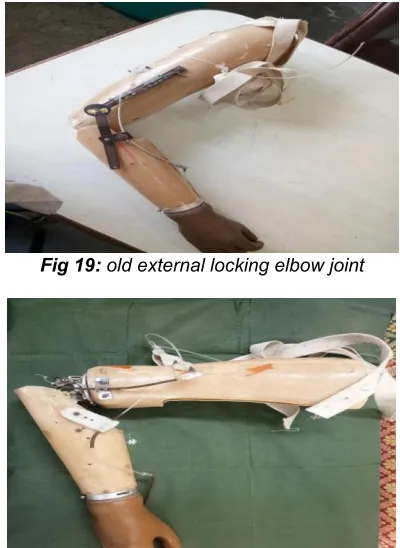
EXISTING EXTERNAL LOCKING ELBOW JOINT:
In this type of joint there is one lateral side locking hinges and another is medial side free hinge. In lateral side there is a spring loaded dial lock type of joint is given. In which inside the joint there is a dial is given having hole in equal angle and outside there is a spring loaded rod is there. By pulling the rod the joint is unlocked and elbow can easily flexed and extended. And when we leave the rod, by means of spring action it enters to the notch of inside disc and locks it. In the medial side only a free hinge is given which allows the flexion and extension at the joint.
Fig 17: conventional external locking elbow joint
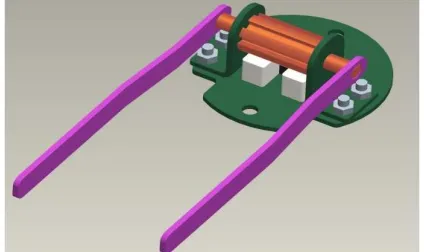
NEW INTERNAL LOCKING ELBOW JOINT: This is my design of joint. In case of the normal used internal locking elbow joint the problem is the joint axis placed more distal or away from the end of the stump. So if we can reduce the length then it can easily fit to the elbow disarticulation amputee also. So targeting the above principle we changed the Hosmer Elbow Joint. Instead of large drum in case of Hosmer elbow joint, we attached a small diameter drum having notch in equal interval at a very low height from the base plate of the joint. Then we attached two lock pin directly to the cam bar of the joint. We removed the Nut and bolt attached in the end of joint and directly fixed the joint to the end of socket.
When medial or lateral placed cable is once pulled the joint became free and patient can flex its forearm and when second time he pull the cable the joint is locked in its desired position. And two extended plates are directly attached to the drum so that it can attach to fore arm and the forearm can flex and extend.
Fig 18: new internal locking elbow joint
E. Forearm shell fabrication: - Fore arm shell is nothing but the extension of the prosthesis which is attached proximally with the elbow joint and distally to the terminal device. It is just the replacement of amputated forearm. It is conical laminated shell in both of the case. Laterally it was cut in such a way that it will not allow further extension after 0° of extension. And medially it is cut to get full flexion.
F. Assembly of all components: - After the fabrication of all the components all the parts are assembled together with control cable and harness system. Figure 8 harness system is given in both the design. In case of existing design single control cable system is used and elbow locking and unlocking is controlled by the pull rod but in case of new design dual control cable is used, one for the operation of terminal device another is for the elbow locking and unlocking.
Fig 19: old external locking elbow joint
Fig 20: new internal locking design of prosthesis
H. Parameter Study: - After the proper training to the patient all the parameters are study in the process as discussed previously.
V.
RESULT
AND
DISCUSSION
The results of the study can guide the practitioners to design appropriate prosthesis for elbow disarticulation prosthesis which varies from person to person and is influenced by body contours, climate, activity level and personal preferences. All the data are analysed by “paired t test” using GraphPadInStat Software.
1. PROSTHETIC ELBOW FLEXION RANGE (in Degree):
From the all five subject the ROM at prosthetic elbow joint is described in below table.
Table 5.1:- prosthetic elbow flexion range (in Degree)
SUBJECT 1st 2nd 3rd 4th 5th
EXISTING DESIGN
100 120 115 118 130
NEW DESIGN
120 130 130 127 130
Now applying the data in the above mentioned software,
Table 5.2:- statistics of prosthetic elbow flexion
MEAN SD SE N
t-value
p-value Existing
Design
100 120 115 118 3.236 0.0318 New design 120 130 130 127
Here p value<0.05, that means test is significant.
From the table No:-5.2, it is clear that t value 3.236 is significant at 0.05 level with degree of freedom 4. It indicates that the mean value of shoulder flexion with existing design and new design differ significantly. Further the mean value of new design is 127.4° which is significantly higher than that of existing design mean flexion angle 116.6° (table no. 5.2). It may therefore be said that new design has found more to be significantly superior to existing design in terms of prosthetic elbow flexion.
GRAPH 3:- PROSTHETIC ELBOW FLEXION
2. ROM AT SHOULDER JOINT (in Degree): -
Here we study four ROM of the shoulder joint in the prosthetic side with prosthesis.
ii. FLEXION AT SHOULDER JOINT:-
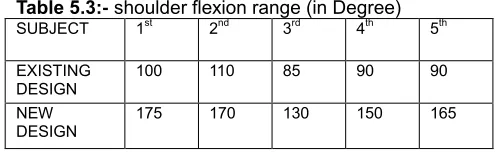
From the all five subject the flexion at shoulder joint is described in below table.
Table 5.3:- shoulder flexion range (in Degree)
SUBJECT 1st 2nd 3rd 4th 5th
EXISTING DESIGN
100 110 85 90 90
NEW DESIGN
175 170 130 150 165
Now applying the data in the above mentioned software,
Table 5.4:- statistics of shoulder flexion MEA
N
SD SE N t-value p-value Existing
Design
95 10 4.42 5 11.225 0.0004 New design 158 18.235 8.155 5
Here p value<0.05, that means test is significant.
From the table No:-5.4, it is clear that t value 11.225 is extremely significant at 0.05 level with degree of freedom 4. It indicates that the mean value of shoulder flexion with existing design and new design differ significantly. Further the mean value of new design is 158°significantly higher than that of existing design mean extension angle 95° (table no. 5.4). It may therefore be said that new design has found more to be significantly superior to existing design in terms of prosthetic side shoulder flexion.
GRAPH 4:-SHOULDER FLEXION
iii. EXTENSION AT SHOULDER JOINT:-
From the all five subject the extension at shoulder joint is described in below table.
Table 5.5:- shoulder extension range (in Degree)
SUBJECT 1st 2nd 3rd 4th 5th
EXISTING DESIGN
50 48 30 50 45
NEW DESIGN
Now applying the data in the above mentioned software,
Table 5.6:- statistics of shoulder extension
MEAN SD SE N
t-value
p-value Existing
Design
44.6 8.414 3.763 5 4.093 0.0149
New design 60 0 0 5
Here p value<0.05, that means test is significant.
From the table No:-5.6, it is clear that t value 4.093 is significant at 0.05 level with degree of freedom 4. It indicates that the mean value of shoulder extension with existing design and new design differ significantly. Further the mean value of new design is 60° which is significantly higher than that of existing design mean extension angle 44.6° (table no. 5.6). It may therefore be said that new design has found more to be significantly superior to existing design in terms of prosthetic side shoulder extension.
GRAPH 5:- SHOULDER EXTENSION
iv. ADDUCTION AT SHOULDER JOINT:-
From the all five subject the adduction at shoulder joint is described in below table.
Table 5.7:- shoulder adduction range (in Degree)
SUBJECT 1st 2nd 3rd 4th 5th
EXISTING DESIGN
35 30 40 35 30
NEW DESIGN
40 45 45 40 45
Now applying the data in the above mentioned software,
Table 5.8:- statistics of shoulder adduction
MEAN SD SE N
t-value p-value Existing
Design
34 4.183 1.875 5 3.674 0.021 New
design
43 2.739 1.225 5
Here p value<0.05, that means test is significant.
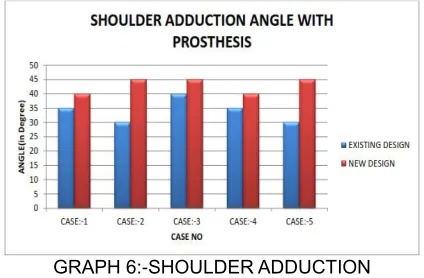
From the table No:-5.8, it is clear that t value 3.674 is significant at 0.05 level with degree of freedom 4. It indicates that the mean value of shoulder adduction with existing design and new design differ significantly. Further the mean value of new design is 43° which is significantly higher than that of existing design mean extension angle 34° (table no. 5.8). It may therefore be said that new design has found more to be significantly superior to existing design in terms of prosthetic side shoulder adduction.
GRAPH 6:-SHOULDER ADDUCTION
v. ABDUCTION AT SHOULDER JOINT:-
From the all five subject the abduction at shoulder joint is described in below table.
Table 5.9:- shoulder adduction range (in Degree)
SUBJECT 1st 2nd 3rd 4th 5th
EXISTING DESIGN
70 80 80 75 95
NEW DESIGN
115 120 130 10 120
Now applying the data in the above mentioned software,
Table 5.10:- statistics of shoulder adduction MEA
N
SD SE N t-value
p-value Existing
Design 76 4.183 1.871 5 28.460 <0.0001 New
design 121 5.477 2.449 5
Here p value<0.05, that means test is significant.
GRAPH 7:- SHOULDER ABDUCTION 3. AXIAL LOAD TEST (in Kgs): -
From the all five subject the axial load is mentioned in the below table.
Table 5.11:- axial load (in Kgs)
SUBJECT 1st 2nd 3rd 4th 5th
EXISTING
DESIGN 7.40 9.20 8.80 11.80 9.94
NEW DESIGN
7.900 9.600 8.950 12.200 10.200
Now applying the data in the above mentioned software,
Table 5.12:- statistics of axial load test
MEAN SD SE N
t-value p-value Existing
Design
9.42 1.61 0.72 5 5.574 0.005 1 New
design 9.77 1.60 0.71 5
Here p value<0.005, that means test is significant.
From the table No:-5.12, it is clear that t value 5.574 is significant at 0.05 level with degree of freedom 4. It indicates that the mean values of axial load with existing design and new design differ significantly. Further the mean value of new design is 9.77 kg which is significantly higher than that of existing design mean value 9.42 kg (table no. 5.12). It may therefore be said that new design has found more to be significantly superior to existing design in terms of axial load lifting.
GRAPH 8:- AXIAL LOAD TEST
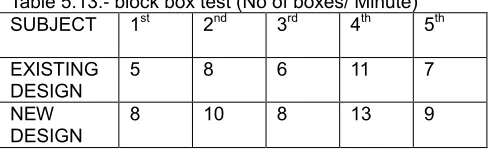
4. BLOCK BOX TEST (No of boxes/ Minute): -
From the all five subject the boxes/minute is mentioned in the below table.
Table 5.13:- block box test (No of boxes/ Minute)
SUBJECT 1st 2nd 3rd 4th 5th
EXISTING DESIGN
5 8 6 11 7
NEW
DESIGN 8 10 8 13 9
Now applying the data in the above mentioned software,
Table 5.14:- statistics of block & box test MEA
N
SD SE N
t-value p-value Existing
Design 7.4 2.302 1.030 5 11 0.0004 New
design
8.6 2.07
4
0.92 7
5
Here p value<0.05, that means test is significant.
From the table No:-5.14, it is clear that t value 11 is significant at 0.05 level with degree of freedom 4. It indicates that the mean values of axial load with existing design and new design differ significantly. Further the mean value of new design is 8.6 which is significantly higher than that of existing design mean value 7.4 (table no. 5.14). It may therefore be said that new design has found more to be significantly superior to existing design in terms of axial load lifting.
GRAPH 9:- BLOCK & BOX TEST
5. LIVE LIFT TEST (in Kgs): -
From the all five subject the live lift test is mentioned in the below table.
Table 5.15:- live lift test (in Kgs)
SUBJECT 1st 2nd 3rd 4th 5th
EXISTING DESIGN
4.500 4.300 3.380 3.400 4.400
NEW
DESIGN 4.700 4.800 3.500 3.740 4.200
Table 5.16:- statistics of live lift test MEA
N SD SE N t-valu
e p-valu e Existing
Design 3.996 0.557 0.249 5 1.627 0.179 New
design
4.18 6
6.57 4
0.25 6
5
Here p value>0.005, that means test is insignificant.
From the table No:-5.16, it is clear that t value 1.627 is insignificant at 0.05 level with degree of freedom 4. It indicates that the mean values of live lift with existing design and new design differ insignificantly. but the mean value of new design is 4.186kg which is insignificantly higher than that of existing design mean value 3.996kg (table no. 5.16). It may therefore be said that new design has found more to be insignificantly superior to existing design in terms of live lifting.
GRAPH 10:- LIVE LIFT TEST
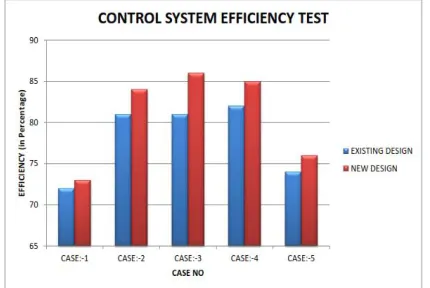
6. CONTROL SYSTEM EFFICIENCY TEST (in
Percentage): -
From the all five subject the control system efficiency test is mentioned in the below table.
Table 5.17:- control system efficiency test (in Percentage)
SUBJECT 1st 2nd 3rd 4th 5th
EXISTING DESIGN
72 81 82 82 74
NEW DESIGN
73 84 86 85 76
Now applying the data in the above mentioned software,
Table 5.18:- statistics of control system efficiency test MEA
N SD SE N t-value p-value Existing
Design 78 4.637 2.074 5 4.221 0.013 New
design 80.8 5.891 2.634 5
Here p value<0.005, that means test is significant.
From the table No:-5.18, it is clear that t value 4.221 is significant at 0.05 level with degree of freedom 4. It indicates that the mean values of control system efficiency with existing design and new design differ significantly. Further the mean value of new design is 80.8% which is significantly higher than that of existing design mean value 78% (table no. 5.18). It may therefore be said that new design has found more to be significantly superior to existing design in terms of efficiency.
GRAPH 11:- CONTROL SYSTEM EFFICIENCY TEST
7. WEIGHT OF THE PROSTHESIS (in Kgs): -
From the all five subject the weight of prosthesis is mentioned in the below table.
Table 5.19:- Weight of the prosthesis (in Kgs)
SUBJECT 1st 2nd 3rd 4th 5th
EXISTING DESIGN
1.400 1.320 1.460 1.650 1.600 NEW
DESIGN
1.100 1.100 1.010 1.200 1.100
Now applying the data in the above mentioned software,
Table 5.20:- Statistics of prosthesis weight
MEAN SD SE N
t-value
p-value Existing
Design
1.480 0.13 0.06 5 4.425 0.0115 New design 1.100 0.06 0.03 5
Here p value<0.05, that means test is significant.
GRAPH 12:- WEIGHT OF THE PROSTHESIS
Information obtained from the past reviews of literature, very less research has been done on the development of mechanical internal locking elbow joint for elbow disarticulation prosthesis, due to the cases reporting with elbow disarticulation amputation being very less. In a developing country like India, where cost is the main factor during prosthesis fitting, all patients cannot go for high cost myoelectric or hydraulic control prosthesis. In that case only mechanical elbow joint remains a viable option for fitting. But as we know standard elbow joint could not fit elbow disarticulation patient because of lack of availability of fitting length, most of the times we go for external locking elbow joint. But this type of joint itself creates problem for the patients. As it is attached laterally and medially, it increases medio-lateral width of the prosthesis making it cosmetically less acceptable. And another disadvantage is it also increases the weight of the prosthesis, which is the main cause of rejection of prosthesis. External locking joint with rod and spring loaded also creates problem in clothing. Another problem is also seen in case of Elbow disarticulation patient is socket fitting. Because of lack of research in the socket design, we generally go for normal above elbow socket design covering the shoulder joint, which is unnecessary. Rather it covers the shoulder joint and restricts the shoulder joint motion, which creates problem in day to day activity. Also because of having very long stump and bulbous shape at the end of stump, patient faces a lot of problem during donning and duping After the study in this work, I was able to design a new low cost, elbow disarticulation prosthesis and collected data in both new design and existing one to get its advantages and disadvantages. I have taken study sample size 5 and compared both the design in each patient. According to the study using various test it was found that new design is more efficient functionally than the older design and more acceptable by the patient. First aim of the study is to design a present good solution for elbow disarticulation amputee with lower cost. And the second aim is to create a platform for further study and design more efficient design for the elbow disarticulation amputee, which will help the society.
Stastical analysis:-
1. Prosthetic Elbow Flexion Angle: - From the data analysis, using paired T test it is clear that elbow flexion angle differs significantly in both the design and it is better in the new design. So functionally the new design works better than existing design.
2. Shoulder ROM: - All the four motions around shoulder joint i.e. Flexion, Extension, Abduction, & Adduction perform better with the new design of prosthesis as it does not cover the shoulder joint. The socket design is helpful to make the shoulder free so that patient can able to do his ADL activity more efficiently with the prosthesis.
3. Axial Load Test: - It also showed better in the new design. Though the shoulder joint made free by lowering trim line with the new prosthesis but due to good supracondylar suspension, patient can able to take more weight axially without any discomfort or slipping of socket.
4. Block-Box Test: - In block-box test new design also performs significantly better than the existing design. Because the shoulder was kept free and light weight of the prosthesis enabled the patient to perform better.
5. Live Lift Test: - In this test though the result doesn’t differ significantly but the mean value of new design is more than that of the old design. But due to less difference among them it is not significantly differ.
6. Control System Efficiency Test: - New design efficiency is significantly higher than the existing design making it more functional.
7. Weight of the Prosthesis: - It is an important factor as it is the main cause of rejection of prosthesis. And the new design of prosthesis is significantly light in weight than the existing design making it more acceptable by the patients.
8. OPUS Satisfaction Scale:-It is a user questioner for the patient about the satisfaction level of the patient with prosthesis. Which shows the patient is happy with the new design because of its light weight, easy to use and easy donning and duping. Though it is cosmetically better than the existing one but patients want more cosmetically acceptable prosthesis.
VI.
CONCLUSION
The study was performed in between existing outside locking elbow disarticulation prosthesis with ne inside locking elbow disarticulation prosthesis design with 5 patients. After the study all the test shows there is a significant deference in all the parameters taken in between both design except one parameter i.e. Live Lift Test. Again in all test the mean of the new design shows the better result than that of the existing design. Also the mean weight of the existing design is higher than the new design making it heavier than the new design. So the Paired T test shows the test is significant, so that the null hypothesis is rejected and alternate hypothesis is accepted. The OPUS satisfaction scale also shows that the prosthesis is more acceptable by patient.
Hence it is proved that, “New socket and prosthetic elbow joint design for elbow disarticulation prosthesis will improve the functional envelope and cosmesis of the prosthesis.”
REFERENCES
[1] Babhani, Design of Appropriate Prosthesis for Elbow Disarticulation Amputees
[2] Garcia Sanchez M. M. Design of pneumatic prosthesis for patients with Elbow disarticulation amputation
[3] Thomas Andrew J. CP, FAAOP, Transhumeral and
[4] LeBlanc, M., Give Hope - Give a Hand, Standford University.
[5] Hughes. G., Biden, E., Olive, M., Young, W., Wedderburn, Z., Caldwell, R., Stocker, D., University of New Brunswick. Online,
[6] Edwards, S. G., Elbow and above-elbow amputations technique Medscape,
[7] Hosmer, Products & Features, 2016, Online, http://hosmer.com
[8] Liberating Technologies, Inc. Boston Digital Arm. Online, http://www.liberatingtech.com/ 2016.
[9] Otto Bock, 2016, Online, http://www.ottobock.co.uk/ [10]Brown, N. J. and Daugherty, R. K., Prosthetic locking