© Global Society of Scientific Research and Researchers
http://ijcjournal.org/
An Algorithm for Ranking Web Pages Based on Links and
Ant Colony Algorithm
Asma Khonji
a*, Dr. Ali Harounabadi
ba
Department of Computer , Kish International Branch, Islamic Azad University, Kish Island
bProfessor at Islamic Azad University ,Central Tehran Branch
aEmail: [email protected]
bEmail: [email protected]
Abstract
With the exponential web growth, techniques of recommender systems and pages ranking algorithms have
gained importance over time. Web mining, which is considered as a subset of data mining, is being emphasized
in three categories: web mining based on application, web mining based on content and web mining based on
structure. Pages ranking algorithms operates mainly based on structure-based web mining. In the current study it
has been tried to maximize accuracy of pages ranking with combining function and structure-based techniques.
Improvement of Page Rank algorithm is performed using user profiles and important attributes to page ranking
algorithm (number of inbound and outbound links to pages). Due to the problem broadness, the use of
meta-heuristic algorithms (such as ant colony algorithm) has been highlighted in the current study and the fitness
function is set so that the increase of iterations will increase the accuracy of PageRank algorithms. The results of
the study explain accuracy of the proposed method compared to other methods.
Keywords: PageRank algorithm; ant colony algorithm; structure-based web mining.
1.Introduction
Nowadays, the Web is a popular and dialogic medium for disseminating information. Traditional web search
engines return lots of results for a search which is very time consuming for users to surf. Web mining is used to
overcome these problems. Web mining is a data mining technique which automatically extract information from
Web documents and is divided into three categories of web structure search, web content search and web using
search. Web content search talks about usable and useful information discovery and knowledge extraction from
web content deals.
---
Discovery of interesting and useful patterns from web users data usage are in the web usage discovery field.
Web structure mining is a process that uses the patterns of the graphs to analyze nodes and structural
connections on a website. To support users who move in search engine results, numerous ranking algorithms
have been applied on web pages so far. In fact, pages ranking algorithms are a fundamental component of web
search engines. They aim to provide a rating for each web page which is a measure that predicts how important
and valid the page that users will see is. Ranking algorithms greatly reduce the search space [1]. One of the most
important web pages ranking algorithm is PageRank algorithm which is considered by Google to calculate the
relative importance of Web pages. In this article we will focus on this algorithm and will provide an extended
version of it. In this article, The rest of this paper is organized as follows: In the second section the research
background has been described. In the third part the previous ranking algorithm will be investigated and in the
fourth, the suggested method of this study is to be introduced The fifth section explains the details regarding the
implementation and analysis of the suggested method and eventually on the sixth part, the result and the strong
points of the suggested method are going to be explained.
2.Backgrounds
In this section the PageRank and the ant colony algorithm used in this article is explained.
2.1 PageRank algorithm
PageRank algorithm which is presented by Page and Brin's for the first time [2] is used by Google as one of the
factors to calculate the relative importance of Web pages. The value of PageRank of a web page depends on
PageRank values of pages pointing to it and the number of outgoing links from those pages [2]. The
performance of this algorithm is that pages with further references are more important. PageRank algorithm is
superior as it does not suffice to the number of citations alone to determine the importance but also considers the
importance of the referral page [2].
PageRank of a page is calculated as:
1) PR(u) = (1-d) + d *∑
v ε B(u) PR(V) / NV
Where u represents a web page, B(u) is the set of pages that point to u. PR(u) and PR(v) are rank scores of page
u and v, respectively. Nv denotes the number of outgoing links of page v. is the damping factor that is set to a
value between 0 and 1. It is usually set to 0.85 for the web graph. d can be thought of as the probability of users’
following the links and could regard (1 − d) as the page rank distribution from non-directly linked pages.
2.2 Ant colony algorithm
Ant algorithm was presented for the first time by Durygu and colleagues as multi-factor solution for
optimization problems. In fact, ant colony algorithm is a sub-field of swarm intelligence. Swarm intelligence
an ant moves alone and by accident and faces the path that has more pheromones, most likely chooses that
pathway and with the pheromones which leaves behind itself in the same direction reinforces that pathway.
Pheromone evaporates over time and therefore less pheromones accumulate on the less frequently used routes.
If the amount of pheromone of some routes are the same, randomly selects a route. Pheromones update is based
on the following equation:
2) τij(t+1) = (1-ρ). τij(t) + Δτij(t)
τij shows the amount of pheromone between nodes i and j. ρ is the pheromone evaporation (0 <ρ ≤1). Δτij is the
amount of pheromone that ant k leaves on the routes that has passed.
3.Related works
Xing and Ghorbani represented the Weighted PageRank algorithm, which is an extended version of the
PageRank. The Weighted PageRank takes into account the importance of both the in links and the out links of
the pages and distributes rank scores based on the popularity of the pages. The Weighted PageRank is able to
identify a larger number of relevant pages to a given query compared to the standard PageRank [3]. Tyagi and
Sharma proposed the Weighted PageRank algorithm based on Visits of Links (VOL), for the search engines [4].
Dinkar and Kumar have considered the time factor for the ranking of each web page. The rank of each page is
calculated based on the unit per time page ranking algorithm [5]. Peng and and his colleagues first off, analyze
the traditional PageRank algorithm of the search engine deeply. Afterwards, According to its topic drift and
putting emphasis on old web pages, suggest an improved PageRank algorithm which is based on the text content
analysis and the time factor [6]. Scarselli and and his colleagues used the neural network model graph to
calculate the PageRank amounts for the web pages. The neural network graph could learn the ranking function
via examples, and is capable of generalizing over unseen data [7]. Sara Setayesh, Ali Haroonabadi and Amir
Masoud Rahmani present a developed version of PageRank algorithm, in which the interest level of web page
users and ant’s colony algorithm are used [1].
4.The proposed method
The suggested method in this article is based upon the features of web search algorithm founded on structure
and usage. First we get the users interest in web pages, then inspiring from ants colony algorithm and using the
suggested version of ranking algorithm, we obtain each page’s rank.
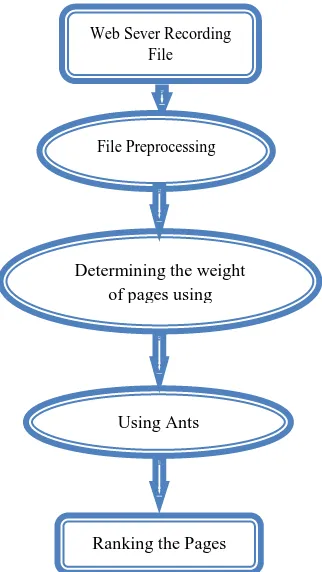
The structure of the suggested method is illustrated in Figure 1. In this research we have used NASA’s web
server recording file. There is raw data in recording files, in order to use them, they should be preprocessed. In
this article we use data refinement, user distinguishing and recognizing each user’s settlement. After the
preprocessing and distinguishing each user’s settlements, we determine each user’s interest level to vectorize the
settlements using the following equation:
After determining the average of each user’s interest level in each page in its settlements, inspiring from ants
colony algorithm we act as follows:
• We consider each user as an ant. We take the users interests in pages as the ants’ pheromones. • We consider pages, the routs which ants pass.
After all ants tours are finished, we use the amount of pheromones placed on each page in the developed version
of PageRank, to calculate the page ranks. We add a new parameter to the suggested algorithm, named the ratio
of number of entry and exit links to a page. The higher number of entry and lower number of exit to a page, the
more desirable results. We take the pheromones changes, which is the user’s interest, equal to the weight of the
pages multiplied by the ratio of entry to exit links. The developed version of the PageRank algorithm is as
follows:
3) PR(U) = (1-d) + d * (∑v𝜖𝜖 B (u) PR(V)/Nv) +Pu * Nv / Nu)
Pu is the amount of pheromones or user interest, and Nv and Nu are entry and exit links of page, respectively.
The ther components are the main PageRank.
Figure 1: Structure of the suggested algorithm
5.Evaluation and implementation of the proposed method
In this section implementation details of the suggested method is explained. MATLAB and C# programs are Web Sever Recording
File
File Preprocessing
Determining the weight of pages using
Using Ants
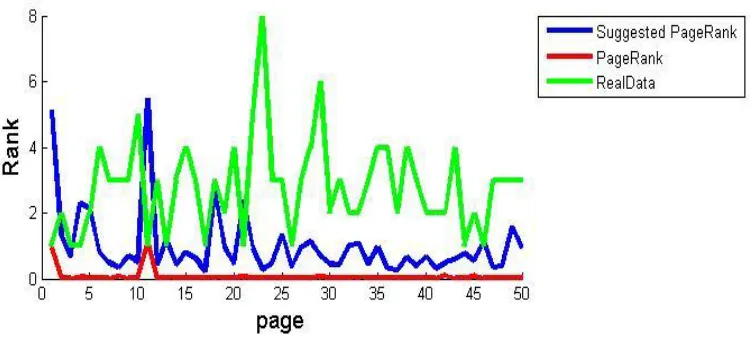
To evaluate the suggested system, we compared the PageRank algorithm to the suggested method and real data
which represents the users’ interest in each page. We selected the PageRank algorithm as the base method since
we suggested a developed version of this algorithm. The results from analysis of the suggested method and
PageRank algorithm and real data are shown for 50 pages in the Figure.
Figure 2: comparison of ranking of 50 pages in the suggested method and PageRank algorithm
In the suggested method, number of individual ranks of the pages are so many, and this is from advantages of
the suggested method. In fact, with the higher ratio of the entry to exist links, we see improvement of the
algorithm. For 100 pages subjected to ranking, 94 different ranks were generated for the pages. While in the
PageRank method, 25 different ranks were generated for 100 pages.
6.Conclusion
In this paper, combination of structural web mining and ant colony algorithm is used to rank web pages. First
calculated the frequency of page views and page view duration by different users then inspired by ant algorithm
and used updates pheromone part of the algorithm to update out to users' interests. We calculated rank of each
page at a time based on previous times and also calculated the ratio of number of incoming links to outgoing as
new parameter added to the proposed algorithm. Simulation results show that the proposed method produces
more distinguished ranks compared to the PageRank algorithm. When some pages have the same rank, they do
not have any preference to each other and one of them will be placed randomly in the results list. Generated
rankings in the proposed procedure are closer to real data. The error of our approach is less than main PageRank
method.
References
[1] Sara Setayesh , Ali Harounabadi, Amir Masoud Rahmani, 2014, Presentation of an Extended Version
of the PageRank Algorithm to Rank Web Pages Inspired by Ant Colony Algorithm, International
Journal of Computer Applications (0975 – 8887) Volume 85 – No 17
the 7th International World Wide Web Conference. Briabane, Australia, Apr 14-18, pp.107-117.
[3] Xing, W., Ghorbani, A. 2004. Weighted PageRank Algorithm. Proceedings of the Second Annual
Conference on Communication Networks and Services Research (CNSR’04), IEEE, pp. 305- 314.
[4] Tyagi, N., Sharma, S. 2012. Weighted PageRank Algorithm Based on Number of Visits of Links of
Web Page. International Journal of Soft Computing and Engineering (IJSCE), vol.2, pp. 441- 446.
[5] Dinkar, S.K., Kumar, H. 2012. Interaction Information Retrieval and Improved Page Rank Algorithm
Based on Aceess Duration of Page. International Journal of Engineering Research & Technology
(IJERT), vol.1, pp.1-5..
[6] Peng, Z., Xiu, X., Ming, Z. 2011. An Efficient Improved Strategy for the PageRank Algorithm.
International Conference on Management and Service Science (MASS), IEEE, pp. 1-4.
[7] Scarselli, F., Liang Yong, S., Gori, M., Hagenbuchner, M., Tsoi, A.C., Maggini, M. 2005. Graph Neural
Networks for Ranking Web Pages. International Conference on Web Intelligence. Proceedings. The