Enhanced QoE-oriented packet scheduling scheme for
HTTP video streaming in LTE networks
Yiqi Bai
Beijing Key Laboratory of Network System Architecture and Convergence, Beijing, China
+86 10 62282289
[email protected]
Danpu Liu
Beijing University of Posts and Telecommunications
Beijing, China +86 10 62282289
[email protected]
Zhilong Zhang
Beijing University of Posts and Telecommunications
Beijing, China +86 10 62282289
[email protected]
ABSTRACT
Hypertext transfer protocol (HTTP) video streaming is a growing and increasingly important data traffic type in wireless and mobile networks. Experiments have shown that the quality of experience (QoE) of this service strongly depends on the number of playback interruptions. This paper proposes a QoE-oriented packet scheduling algorithm to reduce the pauses during video playback in a wireless environment. Both channel quality and the amount of video data stored in the player buffer are considered in the process of resource allocation. The proposed scheme is simulated and examined in an LTE mobile network. Simulation results show a significant improvement of the QoE, and the number of pauses during video playback decreases by 50% in the proposed scheme compared with that in the other solutions.
Categories and Subject Descriptors
C.2.1 [Computer-Communication Networks]: Network Architecture and Design – centralized networks, wireless communication.
General Terms
Algorithms, Performance, Design, Experimentation.
Keywords
HTTP video streaming, quality of experience (QoE), playback interruptions, scheduling.
1.
INTRODUCTION
With the rapid development of smart phones and other portable media devices, video traffic accounts for a large proportion of mobile applications. According to forecast [1], mobile video transmission will generate 66% of the global mobile data traffic by 2015. Emerging wireless technologies, such as the 3rd Generation Partnership Project (3GPP) Long Term Evolution (LTE) [2], are expected to cater to the high bandwidth and low latency demands of video applications. However, the allocation of limited wireless resources among users in Orthogonal Frequency Division Multiple Access (OFDMA) based networks remains a challenge. Meanwhile, the criteria used for resource assignment have gradually changed. Although the majority of solutions adopt objective quality of
service (QoS) metrics such as delay, jitter, or throughput, researchers have begun to pay more attention to the subjective quality perception of end users, that is, quality of experience (QoE) [3]. Subjective QoE metrics are more precise in evaluating customer satisfaction with a specific service, and thus are more effective as criteria for network optimization compared with other metrics. Generally speaking, QoE is closely related to network and application QoS, but more often expressed by a mean opinion score [4]. The preliminary work that considers QoE requirements in resource allocation includes [5]-[8].
Hypertext transfer protocol (HTTP) video streaming currently dominates the mobile video traffic. It employs the progressive download technique, and the number of playback interruptions due to a low buffer level is regarded as the main factor that affects the QoE of such service [9]. To the best of our knowledge, most existing literature on QoE-oriented scheduling is not applicable for HTTP video streaming. The only related work is the Sigmoid-rule with buffered data (SBD) scheduler proposed by Navarro-Ortiz et al. [10]. This scheduler is based on the conventional multicarrier proportional fair (MPF) scheduling algorithm [11], which considers the amount of video data in the player buffer in resource assignment. Thus, re-buffering occurs less frequently, and viewing experience of end users is improved.
Further investigation on the SBD scheme has revealed that the scheduler makes an excessive sacrifice in the throughput of users for good channel quality. This behavior conversely prevents further improvement on the QoE of HTTP video streaming. Therefore, an enhanced QoE-oriented scheduler is proposed in this paper. The new scheduling scheme simultaneously considers both the channel quality and buffer level (CQBL) in the player to minimize the occurrences of pauses. Simulation in an LTE network reveals that the CQBL scheduler can noticeably improve the QoE of end users by reducing the number of playing interruptions and the duration of playing pauses in comparison with SBD and MPF.
The rest of the paper is organized as follows. Section II briefly describes the characteristics of HTTP progressive video. The CQBL scheduling scheme is proposed in Section III. Section IV describes the simulation scenario and parameters. The performances of the CQBL scheduling scheme are evaluated and compared with the MPF and SBD in Section V. Finally in Section VI, we summarize our work and conclude the paper.
2.
HTTP
PROGRESSIVE
VIDEO
STREAMING
HTTP progressive video has become dominant among all video services. It uses progressive download technique, which enables
MOBIMEDIA 2015, May 25-27, Chengdu, People's Republic of China Copyright © 2015 ICST
video playing before the content is completely downloaded. The HTTP connection for this application is established over Transmission Control Protocol (TCP) rather than User Datagram Protocol (UDP). The reliability of TCP ensures packet delivery and avoids video quality degradation from missing frames. However, TCP transmission introduces unwarranted latency and variable throughput to the HTTP connection. Therefore, a client buffer is used to store a certain amount of received data before the playback starts. Furthermore, the number of buffered packets should always be kept above a certain threshold during the play so that the player can maintain a continuous playback.
When the amount of data stored in the player buffer is below the threshold because of an unexpected delay, re-buffering occurs and causes playback interruption in a video clip. Experimental evaluations have revealed that the number of playback interruptions is the main factor influencing the QoE of HTTP video streaming. The initial buffering duration and the average duration of pauses also affect the user-perceived quality, but their effects are not significant [4]. Users are generally annoyed by playback interruptions, but tolerate it for a time to obtain a better video-watching experience. A higher re-buffering frequency will significantly lower the QoE perceived by users. Thus, reducing the number of interruptions during video streaming becomes the main task of QoE-oriented scheduling and resource assignment for HTTP video streaming.
3.
Q
OE-ORIENTED
SCHEDULING
Resource allocation and scheduling among end users is critical to an OFDMA-based wireless network such as LTE downlink. This process decides which user is to be scheduled at each time slot and resource block. Some scheduling strategies focus on maximizing user throughput or minimizing latency, whereas others focus more on user fairness. Furthermore, the novel QoE-oriented scheduling uses the user-perceived quality as the optimization criteria to increase customer satisfaction directly.
We introduce two related scheduling algorithms applicable for HTTP video streaming in the beginning of this section and then propose the enhanced CQBL scheduler with better QoE performance for a better elaboration of our work.
3.1
MPF Scheduler
A widely used scheduler with reasonable trade-off between throughput and fairness is the MPF algorithm proposed by Kim and Han [11]. This scheduling scheme aims to maximize the logarithmic sum of user rate, and a proportional fairness is implemented by assigning the transmission time interval (TTI) n to user i, which meets
i=argmaxi Ri!"n,k#$
λi
( )
n% & '
(' ) * '
+'
, (1)
where Ri!"n,k#$ is the instantaneous transmittable rate of user i at
time instant n and resource block k; and λi
( )
n is the averagethroughput of user i defined by
λi
( )
n = 1−1 τ ! "
# $
%
&⋅λi
(
n− Δn)
+ 1τ⋅Ri
( )
n , (2)where
τ
>
1
andΔ
n
is equal to the length of each TTI.3.2
SBD Scheduler
The SBD scheduler introduces a new metric in scheduling (i.e., the amount of data stored in the player buffer) to increase the QoE of HTTP video streaming by reducing playback interruptions. This metric is denoted by buffer level Bi!"n#$ in time units, which can be estimated at the video server as
Bi!"n#$=Di!"n#$
Vi − Pi!"n#$
Vi = Di!"n#$
Vi −n, (3)
where Di!"n#$ is the total amount of data scheduled to user i until
instant n, Pi!"n#$ is the total played data at instant n and Vi is the play rate of the video clip. The priority of the user i in each TTI and resource block k is defined as
Pi!"n,k#$=F B
(
i"!n#$)
×Ri!"n,k#$ λi!"n#$, (4)
where the term Ri!"n,k#$ λi!"n#$
is the priority used by the MPF
scheduler, and F B
(
i!"n#$)
is a lower- and upper-bounded sigmoidfunction of Bi!"n#$:
F B
(
i!"n#$)
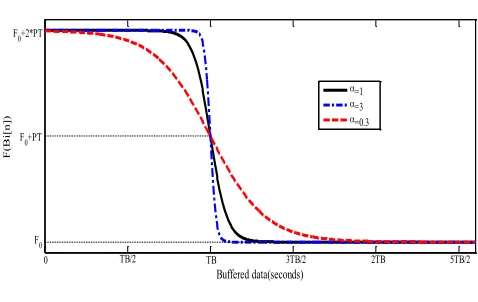
=F0+2×PT× 1 1+e−α(TB−Bi!"n#$)(
)
, (5)where TB is the buffer level threshold to trigger a re-buffering event, and F0, PT and α are the constants to control the
minimum, maximum, and slope of the curve, respectively. As shown in Fig.1, the minimum of the sigmoid function is F0, and the maximum is F0 +2*PT.
The function represents the priority related to the
user’s buffer level Bi!"n#$. The lower the buffer level is, the larger the value of the function. Accordingly, the priority Pi!"n,k#$ of the users with less buffered data is relatively increased; thus, the chance for them to be scheduled is higher.
Figure 1. Sigmoid curve of
3.3
CQBL Scheduler
F B
(
i!"n#$)
Buffered data(seconds)
F
(B
i[
n]
)
F0 F0+PT F0+2*PT
0 TB/2 TB 3TB/2 2TB 5TB/2
α=1
α=3
α=0.3
SBD scheme successfully reduces the number of pauses and improves the users’ QoE by considering the users’ buffer levels in scheduling. However, further investigation has revealed that the throughput of users with good channel quality in SBD scheduling sharply goes down by approximately 30%–40% compared with that in the case of MPF. This behavior is also shown in Fig. 2. It is certain that throughput will be sacrificed to some extent when the amount of buffered data is considered in resource allocation. However, such a large throughput loss has a negative effect on the improvement of QoE. The reason is that a much lower throughput may cause extra playback interruptions to occur on users with good channel quality, and these interruptions are supposed to be avoidable in a higher throughput scenario. Therefore, this work tries to find an approach to reduce the number of re-buffering events by applying a higher achievable throughput than that of SBD.
Similarly, the proposed CQBL scheduler aims to minimize the number of pauses during video playback as a QoE-oriented approach. Therefore, the amount of data stored in the player buffer is also accommodated as a metric during scheduling. However, CQBL scheduler incorporates another metric that represents the channel quality of each end user to mitigate the decline of the throughput. This metric is expressed as the normalized instantaneous rate Ri!"n,k#$/RMAX , where Ri!"n,k#$ is the
instantaneous rate of user
i
as defined in (1); RMAX is the maximum achievable instantaneous rate in the system, and used for normalization. Therefore, the better the channel quality for user i is, the higher the metricRi!"n,k#$/RMAX.The eventual priority of a user is defined as the product of the buffer level and channel quality metrics when they are both considered in scheduling. In each TTI, the CQBL scheduler will pick the users satisfying
i=arg maxi F B
(
i!"n#$)
∗ Ri( )
n,kRMAX
& ' (
)( * + (
,( &
' (
)(
* + (
,(
, (6)
where F B
(
i!"n#$)
is the same as (5).Equation (6) shows that users with lower buffer level and higher instantaneous transmittable rate will have a higher chance to be scheduled in a given TTI. The user throughput is improved because of the existence of the metric Ri!"n,k#$/RMAX in the user priority. A reasonable balance between users with good and bad channel qualities is made in scheduling by adjusting the parameters in
F B
(
i!"n#$)
, such as TB, F0, PT and α, thereby reducing playbackinterruptions. The optimal value of the parameters depends on the actual system configuration and can be obtained through experimental method. In the following simulation, the parameters are set as follows: F0 =1, PT = 20, α= 1 and TB = 15 seconds.
4.
SIMULATION
SCENARIO
A simulation platform on wireless HTTP progressive video streaming is established to evaluate the QoE performance of the proposed CQBL scheduler. More specifically, we choose the most representative HTTP video steaming service, that is, YouTube, and simulate this flow over an OFDMA-based LTE downlink network simulator. The setting details of LTE and YouTube simulation platform are presented in this section.
4.1
System-level Simulator of LTE Networks
Our simulations are conducted using a MATLAB-based LTE system-level simulator developed by University of Vienna. The simulator is widely used in research on network scheduling [12]. The video traffic transmission is simulated in the target sector to reduce the simulation time and complexity, and up to 20 users are distributed uniformly in the entire cell. The channel model includes path loss, shadow fading, and multipath fading. Exponential effective signal to interference and noise ratio mapping (EESM) method is used for the link to system mapping. The channel quality information (CQI) feedback over physical uplink control channel (PUCCH) is sent every 3 milliseconds from the user equipment (UE) to eNodeB.
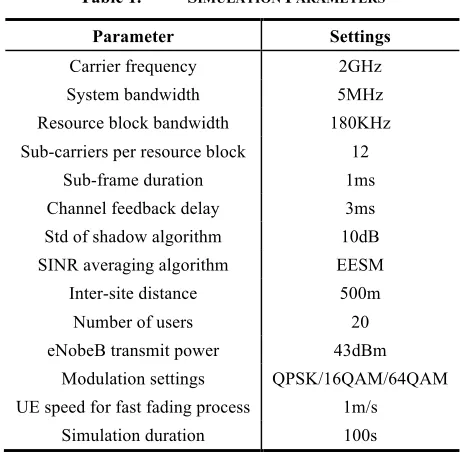
The main parameters and settings of the LTE system-level simulator are summarized in Table I. The details can be examined in [13].
Table 1. SIMULATION PARAMETERS
Parameter Settings
Carrier frequency 2GHz System bandwidth 5MHz Resource block bandwidth 180KHz Sub-carriers per resource block 12
Sub-frame duration 1ms Channel feedback delay 3ms Std of shadow algorithm 10dB SINR averaging algorithm EESM
Inter-site distance 500m Number of users 20 eNobeB transmit power 43dBm
Modulation settings QPSK/16QAM/64QAM UE speed for fast fading process 1m/s
Simulation duration 100s
4.2
A Re-buffering Model for YouTube Flows
YouTube plays a significant role and accounts for a large proportion of all the HTTP progressive video services. Studies have shown that YouTube commences by transferring an initial burst of about 40 seconds of video data at the network’s maximum available bandwidth [14] and then a periodic refilling of the buffer is done during the playback. The YouTube server controls the periodic refilling phase with a rate that depends on the total video playing rate.
player buffer before the playback begins and adopt a constant video playing rate (i.e., 527 kbps).
5.
PERFORMANCE
EVALUATION
We implement the CQBL scheduling scheme in this section by using the LTE simulator described in Section IV. MPF and SBD schedulers are also implemented in the same platform for comparison.
First, we observe the user’s throughput performance in the three cases. Fig. 2 presents the cumulative distribution function (CDF) of the users’ throughput. As previously mentioned, QoE-oriented SBD scheduler significantly increases the user throughput with good channel quality because scheduling priority is given to the users with good channel quality but very low buffer level. CQBL scheduler improves the performance as expected by considering the metric of instantaneous rate. The number of users with throughput greater than 472.6 kbps increases from 0% to 20% of the total users. However, increasing throughput is not the ultimate aim of a QoE-oriented scheduler. Therefore, we further check whether the improvement on throughput can provide the QoE enhancement of HTTP video users.
Fig. 3 and Fig. 4 depict the CDF of the number of playback interruptions and the duration of pauses during video playbacks, respectively. CQBL significantly reduces the number of re-buffering events compared with SBD. The situation is a little different with regard to the duration of pauses. The number of pauses with short duration increases in CQBL, but the number of pauses with long duration also increases. However, the average duration of pauses do not increase in most cases because the majority of the pauses have short durations.
Figure 2. CDF of users’ throughput
Figure 3. CDF of number of pauses
Figure 4. CDF of duration of pauses
Finally, the statistical average results are given in Table II. The percentage of users with pauses (1-CDF|pauses = 0) for the MPF, SBD, and CQBL are 44%, 35%, and 20%, respectively. The most important QoE index, that is, the number of pauses during video playback, is reduced by 50% in CQBL. In addition, the average duration of pauses in CQBL is the shortest. Therefore, CQBL improves the throughput performance of QoE-oriented scheduler by jointly considering player buffer level and channel quality, thus achieving the best QoE among the three scheduling schemes.
Table 2. COMPARISON OF THREE SCHEDULING
ALGORITHMS Scheduling algorithms Percentage of UEs with pauses Average number of pauses (times) Average duration of pauses (seconds) Cell capacity (Mbps)
MPF 44% 1.8 14.16 10.94 SBD 35% 1.1 8.63 6.69 CQBL 20% 0.55 8.33 8.89
6.
CONCLUSIONS
This paper proposes a novel QoE-oriented CQBL scheduling scheme for HTTP progressive video. The scheduler aims to improve the QoE of end users by reducing interruptions during video playback. Both the amount of video data in the player buffer and the channel quality are used as metrics to compute the priority of each user. The proposed algorithm is evaluated in an LTE simulator and compared with two other schedulers (i.e., MPF and SBD). The simulation results show that CQBL is able to reduce the number and average duration of pauses for video clips, thus improving the QoE of end users significantly.
7.
ACKNOWLEDGMENTS
This work was funded by NSFC under Grant 61171107 and 61271257.
8.
REFERENCES
[1] Cisco, “Cisco Visual Networking Index: Global Mobile Data Traffic Forecast Update”, 2010-2015.”
[2] 3GPP, TS 36.300 V10.5.0; Evolved Universal Terrestrial Radio Access (E-UTRA) and Evolved Universal Terrestrial Radio Access Network (EUTRAN); Overall description, 3GPP Std., Sep. 2011.
0 200 400 600 800 1000 1200 1400
0 0.1 0.2 0.3 0.4 0.5 0.6 0.7 0.8 0.9 1
User throughput (kbps)
C um ul a ti ve di st ri but ion func ti on MPF SBD CQBL
0 0.5 1 1.5 2 2.5 3 3.5 4 4.5 5
0 0.1 0.2 0.3 0.4 0.5 0.6 0.7 0.8 0.9 1
Number of pauses (times)
C um ul a ti ve di st ri but ion func ti on MPF SBD CQBL
0 10 20 30 40 50 60 70
0 0.1 0.2 0.3 0.4 0.5 0.6 0.7 0.8 0.9 1
Duration of pauses (seconds)
[3] O. Oyman and S. Singh, “Quality of experience for HTTP adaptive streaming services”, IEEE Commun. Mag., vol. 50, no. 4, pp. 20–27, Apr. 2012.
[4] R. K. P. Mok, E. W. W. Chan, and R. K. C. Chang, “Measuring the quality of experience of HTTP video streaming,” in Proc. 2011 IFIP/IEEE International Symposium on Integrated Network Management and Workshops, pp. 485–492.
[5] G. Song and Y. Li, “Utility-based resource allocation and scheduling in OFDM-based wireless broadband networks,” IEEE Commun. Mag., vol. 43, no. 12, pp. 127–134, Dec. 2005.
[6] P. Ameigeiras, J. J. Ramos-Munoz, J. Navarro-Ortiz, P. Mogensen, and J. M. Lopez-Soler, “QoE oriented cross-layer design of a resource allocation algorithm in beyond 3G systems,” Computer Commun., vol. 33, no. 5, pp. 571–582, Mar. 2010.
[7] M. Shehada, S. Thakolsri, Z. Despotovic, and W. Kellerer, “QoE-based cross-layer optimization for video delivery in Long Term Evolution mobile networks,” in Proc. 2011 International Symposium on Wireless Personal Multimedia Communications, pp. 1–5.
[8] U. Toseef, M. A. Khan, C. G¨org, and A. Timm-Giel, “User satisfaction based resource allocation in future heterogeneous wireless networks,” in Proc. 2011 IEEE Communication Networks and Services Research Conference, pp. 217–223.
[9] Alcock, S. and Nelson, R., “Application flow control in YouTube video streams,” ACM SIGCOMM Computer Communication Review, vol. 41, no. 2, pp. 24–30, 2011.
[10] Jorge Navarro-Ortiz and Pablo Ameigeiras, “A QoE-Aware Scheduler for HTTP Progressive Video in OFDMA Systems”, IEEE Commun. Lett., vol. 17, no. 4, Apr. 2013
[11] H. Kim and Y. Han, “A proportional fair scheduling for multicarrier transmission systems,” IEEE Commun. Lett., vol. 9, no. 3, pp. 210–212, Mar. 2005.
[12] Yao Cheng; Sheng Li; Jianshu Zhang; Roemer, F.; Bin Song; Haardt, M.; Yuan Zhou; Mingjie Dong. "An Efficient Transmission Strategy for the Multicarrier Multiuser MIMO Downlink", Vehicular Technology, IEEE Transactions on, On page(s): 628 - 642 Volume: 63, Issue: 2, Feb. 2014.
[13] J. C. Ikuno, M. Wrulich, & M. Rupp (2010), System level simulation of LTE networks. In Proc.2010 IEEE 71st Vehicular Technology Conference, Taipei, Taiwan, May 2010.pp. 1-5.
[14] P. Ameigeiras, J. J. Ramos-Munoz, J. Navarro-Ortiz, and J. Lopez-Soler, “Analysis and modeling of YouTube traffic,” Trans. Emerging Telecommun. Technologies, vol. 23, no. 4, pp. 360–377, Jun. 2012.
[15] P. Ameigeiras, A. Azcona-Rivas, J. Navarro-Ortiz, J. J. Ramos-Munoz, and J. M. Lopez-Soler, “A simple model for predicting the number and duration of re-buffering events for YouTube flows,” IEEE Commun. Lett., vol. 16, no. 2, pp. 278–280, Feb. 2012.