Cooperative Non-Orthogonal Multiple Access for
Future Wireless Communications
Sunyoung Lee
1H1Queen’s University Belfast, Belfast BT7 1NN, UK
Abstract
There is a huge demand for increased connectivity and reliability of devices in the fifth generation and beyond of wireless communications so as to ensure massive connectivity and high spectral efficiency. Recently, power-domain non-orthogonal multiple access (NOMA) has received considerable attention as a promising multiple access scheme to improve spectrum efficiency. It allows multiple users to share both time and frequency resources by adjusting the power allocation ratio. However, with ever-increasing mobile users and machines in future wireless environments, NOMA still suffers from some challenges such as a limited connectivity, channel uncertainty and a trade-offbetween throughput and user fairness. Therefore, an opportunity exists for developing NOMA features in a cooperation of such devices. In this paper, we focuses on exploring cooperative power-domain NOMA systems to maximize potential and develops an effective multiple access for next generation wireless systems. To explore the trade-off of the cooperative NOMA system between its performance and the network complexity, several NOMA systems along with various techniques are introduced. Firstly, a joint NOMA and partial relay selection is introduced to improve both system throughput and user fairness. Secondly, a cooperative NOMA scheme which uses a cognitive radio network as an underlay is also introduced. In this work, a cooperative scheme is used to enhance the outage performance at a cell-edge user for user fairness and NOMA aims to improve spectral efficiency. Finally, an opportunistic NOMA under unreliable wireless backhauls and fronthaul channel uncertainty is introduced and two opportunistic selection rules are applied to a joint NOMA scheme and cooperated transmission. In this work, the impact of unreliable wireless backhauls and fronthaul channel uncertainty on the coordinated NOMA system is examined.
Receivedon11 December 2018;acceptedon12 December 2018;publishedon19 December 2018
Keywords: Non-orthogonalmultipleaccess(NOMA),relay,cognitiveradio(CR),wirelessbackhaulreliability,channel estimationerror
Copyright © 2018Sunyoung Lee, licensedto EAI. Thisis anopen access article distributedunder theterms of the Creative Commons Attributionlicense (http://creativecommons.org/licenses/by/3.0/), which permits unlimited use,distributionandreproductioninanymediumsolongastheoriginalworkisproperlycited.
doi:10.4108/eai.19-12-2018.156078
1. Introduction
The demand for increased connectivity and reliability of mobile users and machine type devices in the fifth generation (5G) and beyond of wireless communica-tions indicates a string need for new technology that can ensure massive connectivity and high spectral effi -ciency. In particular, the fast growth in the number of mobile devices is set to generate a 1000 fold data traffic increase by 2020. Improving the spectral effi -ciency becomes one of the key challenges to handle such explosive data traffic [1–4], thus encouraging the
HSunyoung Lee is with School of Electronics, Electrical Engineering
and Computer Science, Queen’s University Belfast, UK (email: [email protected])
creation of new techniques which can improve such sys-tem performance is needed for future wireless commu-nications. Recently, the power-domain downlink non-orthogonal multiple access (NOMA) scheme has drawn significant attention as one of the promising multiple access schemes in the 5G and beyond wireless cellular communications [5–8]. Compared with the previous generations of wireless communication networks that rely on exploring features of the time, frequency and code domain, the concept in NOMA is to exploit the power-domain. The beneficial property of NOMA is its multi-user superposition transmission; this allows multiple users to be served at the same time and for frequency resources to be shared with different levels
Research Article
EAI Endorsed Transactions
of power for a given bandwidth. This offers consider-able potential to enhance the performance of 5G and beyond. NOMA achieves not only enhanced spectrum efficiency but also improved cell-edge user throughput at low transmit latency. The main advantages of NOMA can be summarized as follows:
• Spectrum efficiency: NOMA allows allocating one frequency channel to multiple users by exploiting the power domain. Compared to orthogonal multiple access (OMA) which allocates one channel to single user, NOMA can utilize the spectrum more efficiently.
• Improved system throughput: NOMA can achieve improved system throughput by enhanced cell-edge user’s throughput.
• Massive number of connected devices: Theoreti-cally, NOMA can convey superimposed messages of many users in each frequency channel.
• User fairness by improving cell-edge user’s throughput: The fairness for a cell-edge users under poor channel condition can be determined by adjusting the power allocation factors of NOMA users.
• Low latency: No scheduling request from users to base station (BS) is required [3].
2. Challenges and Objectives
Although NOMA can provide attractive advantages, there are several challenges and open issues to be dis-cussed, such as proper user pairing, optimal power allo-cation, impact of imperfect channel state information (CSI) and successive interference cancellation (SIC), a trade-off between performance and complexity, and a trade-offbetween system throughput and user fairness [3]. The main challenges of NOMA can be summarized as follows:
• Imperfect CSI: For SIC decoding order, BS needs to know all users’ perfect CSI which increases the CSI feedback overhead. In addition, imperfect CSI can result in user ordering ambiguities and limit users’ performance. Hence, investigating an impact of channel uncertainty on users’ performance is one of important factors in challenges of NOMA.
• Error propagation in SIC: SIC requires additional computational complexity and delay at users. In addition, if an error occurs in SIC at a user, the other users will likely obtain decoding errors. Therefore, a mathematical analysis of the impact of imperfect SIC on NOMA represents an interesting research direction.
• Optimal user grouping: If there are more than two users in a group, the users in the group are likely result in performance degradation due to SIC error. Therefore, finding an optimal user grouping in a given number of users is an important factor on NOMA performance.
• Trade-off between throughput and user fairness: NOMA addresses a balanced trade-off between throughput and user fairness. Therefore, maxi-mizing both throughput and user fairness is also one of NOMA challenges.
Recently, a lot of research has looked to address these issues by proposing solutions that involve relaying, multiple antennas, an energy harvesting scheme, a full-duplex system and the optimization of power allocation. For example, a performance analysis for NOMA in a multiple-input multiple-output (MIMO) setup has been investigated in [9–11] and NOMA with randomly deployed users has been carried out in [12]. In addition, NOMA was extended to a cooperative scenario in [13], and a cooperative NOMA with simultaneous wireless information and power transfer (SWIPT) was studied in [14–16]. A NOMA design for uplink transmission [17], proposed that multiple users can share the same sub-carrier without any coding or spreading redundancy. It achieved a bit error rate very close to that of orthogonal frequency division multiple access (OFDMA) systems but with higher spectrum efficiency. Recent work includes a full-duplex cooperative NOMA system [18] and a new MIMO-NOMA scheme for small packet transmission in the internet of things (IoT) [19].
However, with ever-increasing mobile users and machines in future wireless environments, opportunity for developing NOMA features in a cooperation to such devices has not been well studied. Therefore, in this paper, exploring cooperative NOMA systems is focused to maximize potential of NOMA and develop an effective multiple access alternative for the next generation wireless communications systems. In particular, several different cooperative system models are introduced such as cooperative relays between transmitter and NOMA receivers, cooperative NOMA receivers in a CR network and cooperative transmitters which support NOMA receivers.
3. NOMA with PRS
the cell-edge user is not served [2]. However, the NOMA scheme can provide a fair transmission for both users. Currently, NOMA uses a number of techniques that aim to improve the system throughput and user fairness for the cell-edge users.
Over the past few years, the performance of NOMA in relay networks has been widely investigated as the use of relays offers a promising solution to improve the reliability and extend the radio coverage of communication systems. In addition, cooperative diversity protocols which can be employed by several relaying schemes have been developed in [20]. NOMA was extended to a cooperative scenarios in [13], where users under good channel conditions can be used as relays for other users under poorer channel conditions. Unlike cooperative NOMA [13], a cooperative relay system employing the NOMA scheme to improve the spectral efficiency was proposed in [21, 22]. Very recently, a cooperative NOMA with SWIPT has been studied, where NOMA users located near the source act as energy harvesting relays to help further away NOMA users [14]. The design of NOMA with one relay was also studied [23]. All of this work shows the promise in jointly develop NOMA under a relay network context. However, previous work on the NOMA for cooperative relay systems has considered solely single-relay network so that the benefits of NOMA in multi-relay networks still remain to be investigated.
Therefore, in this section, we discuss our proposed scheme assuming NOMA scheme with cooperative works via multiple relays in [24] where a BS intends to transmit the signal to two users with the help of one fromKamplify-and-forward (AF) relays. In this paper, the outage performance of NOMA schemes with partial relay selection has been investigated. A joint NOMA and PRS is considered not only for enhanced system throughput, but also for user fairness. In this work, only a AF1 relay with PRS scheme is considered since it needs the knowledge of the CSI of only one-hop link. Thus, the use of AF relay in a PRS scheme is highly desirable in practice when complexity issues arise as a main concern.
In [24], closed-form expressions for the outage probabilities at two users have been derived, and for a given minimum desired SINR, it is shown that the outage probability can decrease significantly with a proper choice of the power allocation to users. In addition, an asymptotic analysis and the sum rate calculation are carried out to provide additional insights into the system performance in [25]. It is also shown that the outage probabilities at users scale
1Although the decode-and-forward (DF) relay gives better perfor-mance compared to the AF one, the former has higher complexity. Thus, due to complexity issues, only AF relays are considered here.
0 5 10 15 20 25 30 10−4
10−3 10−2 10−1 100
SNR (dB)
Outage Probability
User 1, NOMA with PRS User 2, NOMA with PRS
K = 1, 2, 10 K = 1, 2, 10
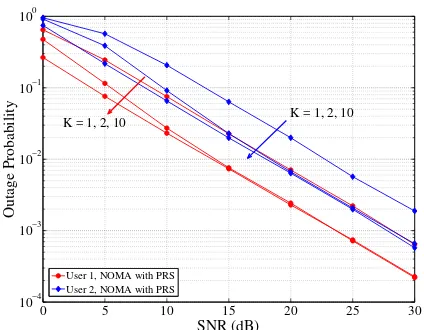
Figure 1. Outage probability of NOMA with PRS. Simulation
parameters are as follows: the number of relays, K = 1,2,10,
the power allocation parameters,a1= 0.8,a2= 0.2, the target
SINRs, γth = 1 dB, channel powers; ΩSR= 5 dB, ΩSD1 = 1
dB,ΩSD2 = 2dB,ΩRD1= 10 dB,ΩRD2= 10dB.
inversely with the product of the SNRs of the source-to-destination and relay-to-source-to-destination links. Compared to the traditional OMA which mainly focuses on the maximization of sum rate and compared to the conventional NOMA which addresses a balanced trade-off between sum rate and user fairness, this proposed scheme enhances both the sum rate and user fairness.
Fig. 1 depicts outage probabilities of two users in NOMA with PRS for various values of the number of relays, K. As shown in Fig. 1, it is interesting to see that a significant performance gain can be achieved by increasing the number of relays from one to two relays. For example, to achieve an outage probability of 10−2, two relays provide a power gain of 5 dB over the one relay case. However, note that the achievable power gain for the same outage probabilities is reduced to 1 dB by comparing the cases of K= 2 and K = 10. In particular, for high SNRs, there is almost no gain in outage performance when we increase the number of relays from two to ten. This important result implies that for the NOMA scheme with PRS, employing more than two relays is unnecessary.
4. Cooperative NOMA under CR network
As highlighted in the previous section, the use of relays for NOMA scheme has been proposed as a promising solution to improve the reliability and extend the radio coverage for wireless communication systems. Inspired by this, a cooperative NOMA scheme was considered to maximize potentials of NOMA in multi-user environments [13] where one of users acted as the relay role for an other user.
spectral efficiency [26–28]. An underlay CR network has been widely acknowledged as a promising solution for addressing the spectrum scarcity issue in future wireless communications [29]. Hence, to enhance the spectral efficiency for both users in the primary and secondary networks, the NOMA scheme has been recently incorporated into the CR scenario. In particular, the performance of NOMA scheme in CR networks with randomly deployed users was investigated in [30], although interference from the primary network was not considered. In another CR NOMA scheme in [31], a primary user as well as secondary users were served simultaneously by a BS such that the primary user was allocated with a higher power than that of the secondary users in order to guarantee the high priority of the transmitted message. The work was extended for Nakagami-m fading in [32]. The impact of user pairing on the performance of NOMA system inspired by CR with fixed power allocation was characterized in [33] and the sum rates of the primary and secondary systems were derived. In this work, a user with a stronger channel condition (viewed as a secondary user) was allowed to access the spectrum occupied by a user with a poorer channel condition (viewed as a primary user). Existing works show the potential in jointly developing CR network and NOMA scheme. In conventional approaches, the NOMA concept has been applied to both primary and secondary users in the CR networks. A major omissions is that the potential of employing the NOMA concept only to a group of secondary users, who are suffering from lack of much spectrum scarcity at massive deployments, have been overlooked in the literature and is important as it offers the potential to NOMA scheme in multi-user environments.
Motivated by the aforementioned gap which exists in the literature, in this section, we discuss our proposed scheme aiming to develop a cooperative NOMA scheme for a CR network subject to an underlay approach in [34] where a secondary BS which is equipped with M
antennas attempts to communicate with two groups of secondary users in the presence of one primary transmitter and one primary receiver. In this work, to overcome the connectivity problem for the secondary users, it is focused on employing a NOMA scheme only to the secondary users’ group whilst also taking into account the cooperative transmissions at higher outage performance. In particular, the two secondary users employing the cooperative NOMA scheme are considered; in this scenario, a user located near the BS was properly selected to act as a relay for assisting another user located far-away from the BS in the presence of a primary network. For this, NOMA aims to improve outage performance of the secondary users’ group. Furthermore, a cooperative scheme is employed to enhance a cell edge user’s outage performance. In
0 5 10 15 20 25 30
10−4 10−3 10−2 10−1 10
Ωh/N0 (dB)
Outage Probability
User 1, NOMA under CR network User 2, NOMA under CR network
User 1, Non−cooperative NOMA under CR network User 1, Non−cooperative OMA under CR network
NOMA CR and OMA CR (Non−co)
Cooperative and Non−cooperative M = 1, 2
M = 1, 2
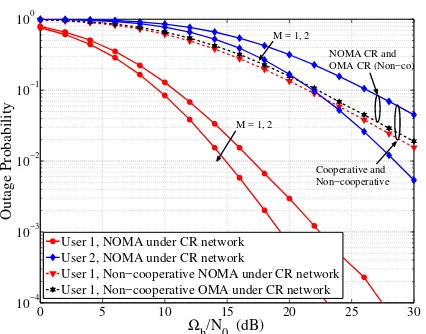
Figure 2. Outage probability of cooperative NOMA under CR
network. Simulation parameters are as follows: the number of
antennas at the BS,M= 1,2, the power allocation parameters,
|a1|2= 0.8, |a2|2= 0.2, the target SINRs, γth = 0 dB, the
transmit power at the primary transmitter, PP= 5 dB, the
maximum allowable transmit power at the BS,PSMax= 5dB, the
maximum tolerable interference power at the primary transmitter,
IP= 10dB.
addition, for more realistic environments, a multi-user secondary scenario is considered, where an efficient cooperative user selection scheme is developed. Asymptotic expressions for the outage probability of each secondary user were derived thereby providing a better understanding of its behavior and allowing a means for further insights. For example, a far-away secondary user can obtain a higher diversity order gain than a nearer secondary user because of its cooperative diversity effect, in cases where the maximum tolerable interference power tends to the infinity. It also shows that a floor may exist in the outage probability of the secondary users, determined by the interference constraint and the number of antennas at the base station. Furthermore, it is revealed that a cell-edge user under poor channel gains can benefit from both cooperative NOMA and the opportunistic relay transmission.
gap. It also clearly shows that the cooperative NOMA scheme outperforms the OMA scheme.
5. Cooperative Opportunistic NOMA under
Unreliable Wireless Backhaul and Fronthaul
Channel Uncertainty
In cellular networks, cell-edge users often experience worse performance than users nearer to a BS. For this reason, CoMP transmission techniques have been investigated for multiple BSs to jointly support cell-edge users in improving their data rates [35]. Inspired by the benefit of CoMP, the NOMA scheme for a CoMP network was proposed to support both near and cell-edge users from BSs simultaneously in [7,
36]. Therefore, it is interesting to explore the concept of cooperative multiple transmitters such as CoMP techniques for future NOMA designs. Furthermore, an opportunistic NOMA scheme where each user selects one access point (AP) or multiple APs in its preferred AP set to reduce the complexity of SIC has been demonstrated for a CoMP network in [37]. In particular, the authors have proposed an opportunistic NOMA scheme to reduce the complexity of SIC and improve the performance of NOMA in the CoMP network.
However, with need for a ultra-dense connectivity, randomly deployed, wireless small cells will require wireless backhauls to be connected to a core network. Wireless impairment inherent in these backhauls can then provide a key bottleneck to guarantee reliability and improve the overall system performance. In other words, wireless backhauls will be often unreliable due to the random nature of wireless channels [38]. In addition, heterogeneous cellular networks along with channel unreliability have emerged as an interesting research topic in the downlink CoMP networks, because unreliable backhauls can limit the performance gains of the CoMP cooperation. Wireless backhauls with guaranteed reliability are being considered to improve the overall system performance. Recently, both the impact of unreliable backhaul links on CoMP-based cellular networks [39–41] and the performance analysis of cooperative non-cellular system with unreliable backhauls [42], have been investigated. In [43], the authors investigated a secrecy performance of cooperative single carrier systems with unreliable backhauls, where the existence of performance limits of outage probability and rate were verified for various backhaul scenarios. The performance of cooperative systems with unreliable backhaul connections for non-identical Nakagami-m fading channels has been also investigated [38].
Due to the significant demand for a massive deploy-ment of wireless devices, various NOMA concepts with a range of 5G and beyond applications (e.g., heteroge-neous small cell networks) have emerged to increase the
0 5 10 15 20 25 30
10−4 10−3 10−2 10−1 100
Average SNR (dB)
Outage Probability
R
1, NOMA with unreliable backhauls
R2, NOMA with unreliable backhauls
K = 2, m 1 = 1, m2 = 3
K = 3, m
1 = 1, m2 = 3, m3 = 2 K = 1, m
1 = 1
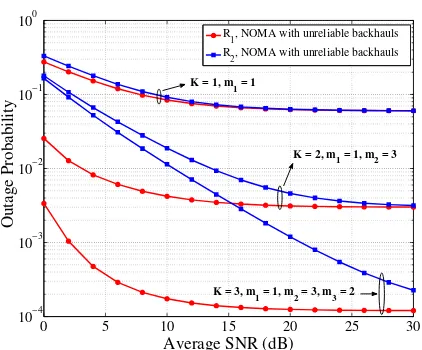
Figure 3. Outage probability of NOMA under unreliable
backhauls with opportunistic SS based on far-away receiver,R1.
Simulation parameters are as follows: the number of transmitters,
K = 1,2,3, the power allocation parameters, a1 = 0.7, a2=
0.3, the target SINRs, γth= 0.1 dB, the backhaul reliability,
pk = 0.94,0.95,0.96,mparameter of Nakagami-mfading for
thek-th transmitter,mk= 1,3,2
spectral efficiency. In particular, small cell base station with a randomly distributed deployment represents a critical development in the deployment of wireless backhauls for the connectivity with the core network [44]. There is little research into NOMA designs for such small cells that can be robust to uncertainties in wireless backhauls. To overcome this challenge, we have proposed a new scheme for NOMA and coordinated transmission in the presence of wireless backhauls’ unreliability in [45] where one central unit (CU), K
transmitters (T1-TK) and 2G receivers (R11-R1G, R21
-R2G). It is assumed that the 2Greceivers are split into
Ggroups of two receivers, each group being supported by only one from K transmitters via an orthogonal channel. Opportunistic selection rules are proposed for the reliability of wireless backhauls and fading effects of fronthauls. For the backhaul reliability, a Bernoulli process which can take into account a successful or failed transmission from the CU to the transmitters is adapted.
Fig. 3 plots outage probabilities of both receivers with opportunistic SS based on the far-away receiver,
with NOMA scheme, the outage performance of a far-away receiver obtains better outage performance due to its allocated higher power coefficient. In contrast, the outage performance of a dominant receiver based on the opportunistic selection rule obtains better outage performance as the number of transmitter increases in cooperative system.
In addition, the existing NOMA or cooperative system research into unreliable backhauls assume the perfect channel information at the receivers, but in a practical wireless network with a large number of receivers, this will not be feasible [46]. The effect of channel estimation error on bit error rate (BER) performance in AF relay assisted cooperative transmission was analyzed in [47]. Recently, a downlink NOMA network has been investigated with imperfect channel estimation error and uniformly deployed users [48]. A robust NOMA beamforming scheme for multiple-input multiple-output (MISO) channels under channel uncertainties has been proposed in [49]. Furthermore, the authors in [50] formulated energy efficient resource allocation algorithms for a downlink NOMA with imperfect channel information. However, in [48–50] they focused on a non-cooperative NOMA system with partial channel information, where the wireless backhaul connection was not considered.
Hence, we propose a new scheme for an opportunistic NOMA with unreliable wireless backhauls under fronthaul channel uncertainty. In particular, creation of new opportunistic NOMA schemes with coordinated transmission in the presence of unreliable wireless backhauls and imperfect channel information. This allow the impact of backhaul unreliability and fronthaul channel uncertainty to be assessed and this allows us to derive a benchmark for outage performance of NOMA scheme with unreliable wireless backhauls.
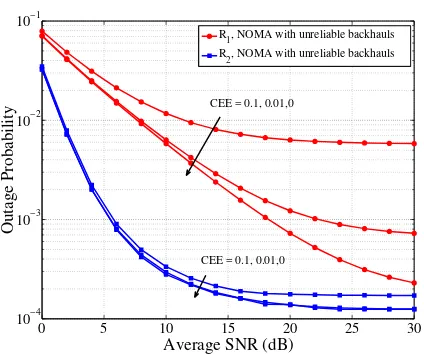
In order to see the impact of channel estimation error, Fig. 4 plots the outage probabilities of both receivers with opportunistic SS based on the nearer receiver,R2, whenK = 3 with various values of channel estimation error (CEE). The variance of CEE,εki2, varies from 0.01 to 0. For the outage probabilities of R1, it is clearly shown that the outage performance is significantly improved as the estimation error values decrease while the outage probabilities of R2 are not changed that much.
6. Conclusion
This paper has focused on exploring cooperative power-domain NOMA systems to maximize potential of NOMA and explore the strong and weak points of the cooperative NOMA systems for the next generation wireless communications. In particular, NOMA should be supported with advanced wireless communication techniques to overcome challenges such as limited
0 5 10 15 20 25 30
10−4 10−3 10−2 10
Average SNR (dB)
Outage Probability
R
1, NOMA with unreliable backhauls
R
2, NOMA with unreliable backhauls
CEE = 0.1, 0.01,0
CEE = 0.1, 0.01,0
Figure 4. Outage probability of NOMA under unreliable
backhauls and fronthaul channel uncertainty with opportunistic
SS based on nearer receiver,R2. Simulation parameters are as
follows: the number of transmitters,K= 3, the channel estimation
error, CEE = 0.1,0.01,0, the power allocation parameters, a1=
0.8, a2= 0.2, the target SINRs, γth= 0.1 dB, the backhaul
reliability,pk= 0.96,0.95,0.94,mparameter of Nakagami-m
fading for thek-th transmitter,mk = 1,2,3
connectivity and the trade-off between throughput and user fairness. Especially with increasing mobile users and machines in future wireless environments, opportunity for developing NOMA features in a cooperation to such mobile users or devices has not been well studied. Therefore, this paper is timely in addressing several new cooperative and cognitive radio techniques that can be applied to NOMA systems, with certain practical conditions.
References
[1] Dai, L.,Wang, B.,Yuan, Y.,Han, S.,I, C.L.andWang, Z.
(2015) Non-orthogonal multiple access for 5G: solutions, challenges, opportunities, and future research trends.
IEEE Commun. Mag.53(9): 74–81.
[2] Ding, Z.,Liu, Y.,Choi, J.,Sun, Q.,Elkashlan, M.,I, C.L.
and Poor, H.V. (2017) Application of non-orthogonal
multiple access in LTE and 5G networks.IEEE Commun. Mag.55(2): 185–191.
[3] Islam, S.M.R., Avazov, N., Dobre, O.A. and s. Kwak, K.(2017) Power-domain non-orthogonal multiple access
(NOMA) in 5G systems: Potentials and challenges.IEEE Commun. Surveys Tuts.19(2): 721–742.
[4] Ding, Z., Lei, X., Karagiannidis, G.K., Schober, R., Yuan, J.and Bhargava, V.K.(2017) A survey on
non-orthogonal multiple access for 5G networks: Research challenges and future trends.IEEE J. Sel. Areas Commun.
35(10): 2181–2195.
[5] Choi, J.(2013) On multiple access using H-ARQ with
SIC techniques for wireless ad hoc networks. Wireless Personal Commun.69: 187–212.
[6] Saito, Y.,Kishiyama, Y.,Benjebbour, A.,Nakamura, T., Li, A.andHiguchi, K.(2013) Non-orthogonal multiple
access (NOMA) for cellular future radio access. InProc. of IEEE 77th Veh. Technol. Conf. (VTC Spring)(Dresden, Germany): 1–5.
[7] Choi, J.(2014) Non-orthogonal multiple access in
down-link coordinated two-point systems.IEEE Commun. Lett.
18(2): 313–316.
[8] 3rd Generation Partnership Project (3GPP) (2015)
Study on downlink multiuser superposition transmis-sion for LTE.
[9] Ding, Z.,Adachi, F.andPoor, H.(2016) The application
of MIMO to non-orthogonal multiple access.IEEE Trans. Wireless Commun.15(1): 537–552.
[10] Choi, J. (2016) On the power allocation for
MIMO-NOMA systems with layered transmissions.IEEE Trans. Wireless Commun.15(5): 3226–3237.
[11] Nguyen, V., Tuan, H.D., Duong, T.Q., Poor, H.V.and Shin, O.(2017) Precoder design for signal superposition
in MIMO-NOMA multicell networks.IEEE J. Sel. Areas Commun.35(12): 2681–2695.
[12] Ding, Z., Yang, Z., Fan, P. andPoor, H.V. (2014) On
the performance of non-orthogonal multiple access in 5G systems with randomly deployed users.IEEE Signal Process. Lett.21(12): 1501–1505.
[13] Ding, Z., Peng, M.andPoor, H.V.(2015) Cooperative
non-orthogonal multiple access in 5G systems. IEEE Commun. Lett.19(8): 1462–1465.
[14] Liu, Y., Ding, Z., Elkashlan, M. and Poor, H.V.
(2016) Cooperative non-orthogonal multiple access with simultaneous wireless information and power transfer.
IEEE J. Sel. Areas Commun.34(4): 938–953.
[15] Do, T.N., Costa, D.B.D., Duong, T.Q. and An, B.
(2017) A BNBF user selection scheme for NOMA-based cooperative relaying systems with SWIPT. IEEE Commun. Lett.21(3): 664–667.
[16] Do, T.N., da Costa, D.B., Duong, T.Q. and An, B.
(2018) Improving the performance of cell-edge users
in MISO-NOMA systems using TAS and SWIPT-based cooperative transmissions. IEEE Trans. on Green Commun. and Networking2(1): 49–62.
[17] Al-Imari, M., Xiao, P., Imran, M.A.andTafazolli, R.
(2014) Uplink non-orthogonal multiple access for 5G wireless networks. In Proc. of Int. Symp. on Wireless Commun. Syst. (ISWCS)(Barcelona, Spain): 781–785. [18] Zhong, C. and Zhang, Z. (2016) Non-orthogonal
multiple access with cooperative full-duplex relaying.
IEEE Commun. Lett.PP(99): 1–1.
[19] Ding, Z., Dai, L.andPoor, H.V.(2016) MIMO-NOMA
design for small packet transmission in the internet of things.IEEE Access4: 1393–1405.
[20] Laneman, J.N., Tse, D.N.C.andWornell, G.W. (2004)
Cooperative diversity in wireless networks: Efficient protocols and outage behavior. IEEE Trans. Inf. Theory
50(12): 3062–3080.
[21] Kim, J.B. and Lee, I.H. (2015) Capacity analysis
of cooperative relaying systems using non-orthogonal multiple access.IEEE Commun. Lett.19(11): 1949–1952. [22] Do, T.N., da Costa, D.B., Duong, T.Q. and An, B.
(2018) Improving the performance of cell-edge users in NOMA systems using cooperative relaying.IEEE Trans. Commun.66(5): 1883–1901.
[23] Men, J.andGe, J.(2015) Performance analysis of
non-orthogonal multiple access in downlink cooperative network.IET Commun.9(18): 2267–2273.
[24] Lee, S., da Costa, D.B. and Duong, T.Q. (2016)
Non-orthogonal multiple access with partial relay selection. In Proc. IEEE Personal, Indoor, Mobile Radio Commun. (PIMRC)(Valencia, Spain): 1–6.
[25] Lee, S., da Costa, D.B., Vien, Q.T., Duong, T.Q. and de Sousa Jr., R.T.(2017) Non-orthogonal multiple access
schemes with partial relay selection.IET Commun.11(6): 846–854.
[26] Zou, Y., Zhu, J., Zheng, B. and Yao, Y.D. (2010) An
adaptive cooperation diversity scheme with best-relay selection in cognitive radio networks.IEEE Trans. Signal Process.58(10): 5438–5445.
[27] Li, L.,Zhou, X.,Xu, H.,Li, G.Y.,Wang, D.andSoong, A.
(2011) Simplified relay selection and power allocation in cooperative cognitive radio systems.IEEE Trans. Wireless Commun.10(1): 33–36.
[28] Hong, J.P., Hong, B., Ban, T.W. and Choi, W. (2012)
On the cooperative diversity gain in underlay cognitive radio systems.IEEE Trans. Commun.60(1): 209–219. [29] Goldsmith, A., Jafar, S.A., Maric, I. and Srinivasa,
S. (2009) Breaking spectrum gridlock with cognitive
radios: An information theoretic perspective. In Proc. IEEE, 97: 894–914.
[30] Liu, Y., Ding, Z., Elkashlan, M. and Yuan, J. (2016)
Non-orthogonal multiple access in large-scale underlay cognitive radio networks. IEEE Trans. Veh. Technol.
65(12): 10152–10157.
[31] Lv, L., Chen, J. and Ni, Q. (2016) Cooperative
non-orthogonal multiple access in cognitive radio. IEEE Commun. Lett.20(10): 2059–2062.
[32] Lv, L., Ni, Q., Ding, Z. andChen, J. (2017)
[33] Ding, Z., Fan, P. and Poor, V. (2016) Impact of user
pairing on 5G non-orthogonal multiple access downlink transmissions. IEEE Trans. Veh. Technol. 65(8): 6010– 6023.
[34] Lee, S., Duong, T.Q., da Costa, D.B., Ha, D.B. and Nguyen, S.Q.(2018) Underlay cognitive radio networks
with cooperative non-orthogonal multiple access. IET Commun.12(3): 359–366.
[35] Jungnickel, V., Thiele, L., Wirth, T., Haustein, T., Schiffermuller, S., Forck, A., Wahls, S. et al.(2009)
Coordinated multipoint trials in the downlink. InIEEE Globecom Workshops(Honolulu, HI, USA): 1–7.
[36] Shin, W., Vaezi, M., Lee, B., Love, D.J., Lee, J. and Poor, H.V. (2017) Non-orthogonal multiple access in
multi-cell networks: Theory, performance, and practical challenges.IEEE Commun. Mag.55(10): 176–183. [37] Tian, Y., Nix, A.R. and Beach, M. (2016) On the
performance of opportunistic NOMA in downlink CoMP networks.IEEE Commun. Lett.20(5): 998–1001.
[38] Kim, K.J.,Khan, T.A.andOrlik, P.V.(2017) Performance
analysis of cooperative systems with unreliable back-hauls and selection combining.IEEE Trans. Veh. Technol.
66(3): 2448–2461.
[39] Mayer, Z., Li, J., Papadogiannis, A. andSvensson, T.
(2013) On the impact of backhaul channel reliability on cooperative wireless networks. InIEEE Int. Conf. on Commun.(Budapest, Hungary): 5284–5289.
[40] Xia, P., Liu, C.H. andAndrews, J.G.(2013) Downlink
coordinated multi-point with overhead modeling in heterogeneous cellular networks. IEEE Trans. Wireless Commun.12(8): 4025–4037.
[41] Nguyen, H.T., Duong, T.Q. and Hwang, W.J. (2017)
Multiuser relay networks over unreliable backhaul links under spectrum sharing environment. IEEE Commun. Lett.21(10): 2314–2317.
[42] Khan, T.A.,Orlik, P.,Kim, K.J.andHeath, R.W.(2015)
Performance analysis of cooperative wireless networks with unreliable backhaul links. IEEE Commun. Lett.
19(8): 1386–1389.
[43] Kim, K.J.,Yeoh, P.L., Orlik, P.V.andPoor, H.V.(2016)
Secrecy performance of finite-sized cooperative single carrier systems with unreliable backhaul connections.
IEEE Trans. Signal Process.64(17): 4403–4416.
[44] Jaber, M.,Imran, M.A.,Tafazolli, R.andTukmanov, A.
(2016) 5G backhaul challenges and emerging research directions: A survey.IEEE Access4: 1743–1766.
[45] Lee, S.,Duong, T.Q.andWoods, R.(2018) Opportunistic
non-orthogonal multiple access scheme with unreliable wireless backhauls. InProc. IEEE Personal, Indoor, Mobile Radio Commun. (PIMRC)(Bologna, Italy).
[46] Yoo, T.andGoldsmith, A.(2006) Capacity and power
allocation for fading MIMO channels with channel estimation error. IEEE Trans. Inf. Theory 52(5): 2203– 2214.
[47] Han, S., Ahn, S., Oh, E. and Hong, D. (2009) Effect
of channel-estimation error on BER performance in cooperative transmission.IEEE Trans. Veh. Technol.58(4): 2083–2088.
[48] Yang, Z., Ding, Z., Fan, P. and Karagiannidis, G.K.
(2016) On the performance of non-orthogonal multiple access systems with partial channel information. IEEE
Trans. Commun.64(2): 654–667.
[49] Zhang, Q.,Li, Q.andQin, J.(2016) Robust beamforming
for nonorthogonal multiple-access systems in MISO channels.IEEE Trans. Veh. Technol.65(12): 10231–10236. [50] Fang, F.,Zhang, H.,Cheng, J.andLeung, V.C.M.(2017)