Environment Education: An Indian Perspective
`
Tauseef Z. Siddiqui1 and Anna Khan2
1Department of Management Studies, Indian School of Mines (ISM), Dhanbad, Jharkhand, INDIA 2Aligarh Muslim University, Aligarh, UP, INDIA
Available online at: www.isca.in, www.isca.me
Received 25th October 2014, revised 11th December 2014, accepted 11th January 2015
Abstract
This paper focuses in developing working model of Environmental Education in the formal sector and to evaluate and statically analyze the Environmental education knowledge perception of the different sectors of the society in India through structured questionnaire surveys of 500 teachers from India, out of which 250 were working at schools and 250 at colleges. This paper aims to study the importance of the environmental education with specific emphasis on sustainability and various environmental education patterns in the educational institutions in India. With the use of questionnaire survey among. In the end the research try to device the Strategies and Framework for promoting Environmental Education. Lastly, it can be concluded that though the existing Environmental Education programs do not seem to be satisfactory, the future looks promising. Moreover in planning to develop school curricula on conservation education at the national level. It is hoped that the steps mentioned in the research work will bring desirable results in the future in sustaining precious natural resources of India.
Keywords: Environment, environmental education, sustainability, waste management, indian education.
Introduction
Education has been recognized as a necessary constituent for sustainable development all over the world. The function of education could also optimistically manipulate the administration of the stressed out natural resources through the integration of victorious procedures of environmental education. The environmental education offers students with the skills, experience and knowledge that are necessary to turn out to be victorious community leaders, and also making clever decisions pertaining to the administration of their natural resources1.
The globally evolved concept of environmental education is a continuing lifelong procedure. As it is mentioned by Tbilisi2, environmental education is considered as an everlasting process. In that, the community and the individuals obtain awareness of their surrounding and acquire the skills, experiences, values, and knowledge. They also possess the willpower to act collectively and individually to resolve current and future environmental problems. Teaching the people at huge regarding the environment and its features would build up decisive thinking, problem solving and analytical capabilities in them. Also it would enhance insights and knowledge to progress the quality of human life on earth.
India being a diverse nation, geographically, economically, climatically and geologically, the environmental education here has to be necessarily location – specific. It is at the initial level, that major attention has to be paid to the school going children and women, (that is, around 50 % of the population). They are to be made conscious about family planning, rural development, sanitation, food and water contamination, fuel wood, nutrition, slum improvement, hygiene, fodder etc.
Barrier and Constraints in Indian Environmental Education: The widespread practices for the promotion of Environmental Education in India have been unsuccessful through the years in many ways. Unfortunately, to-date the subject of Environmental Education is linked with the subject of Environmental Studies’, which focuses on providing children with scientific facts and figures on global environmental problems. It addresses environmental issues from a viewer’s point of view by identifying the primary sources and proposing corrective measures needed to redress the symptoms, for example, ozone depletion and global warming. Therefore, students end up knowing what is wrong with the planet but do not understand what should be done by 'them' as individuals to prevent such damage, neither can they see how to become responsible for the environmental problems and hence, understand how they need to help solve issues by changing their own lifestyles.
The main problems thatIndia seems to be facing regarding Environmental Education can be summarized as follows:
Curriculum load: There is a tremendous pressure from parents and community regarding how heavy the school curriculum has become, which in turn is responsible for development of stress among students and thereby affecting their normal developments. Thisproblem of curriculum load seems to be complex and has its roots in many related issues.
number of teachers and geographical character of the country, management of in-service programmes is indeed a challenge.
Methodology
Methods of Assessment: The present assessment/evaluation system in education is a major bottleneck in bringing improvement in the education system of our country. Unfortunately, what is not relevant to examination is not considered relevant in teaching and learning. Framework of assessment used is not conducive to the development of problem-solving skill among the pupils – given the fact that instruction is mainly assessment-driven in India. Further, assessment of practical work is not attached much importance – resulting in utter neglect of practical work in school education.
The way Environmental Education is being dealt with in schools in India therefore, needs to be completely revamped and clearly-defined methods should be laid out for easy applicability in schools, bearing in mind the following aspects which have to be the foundation of this change.
Indian Environmental Education – The Study: The study population for the present survey consisted of 500 teachers from India, out of which 250 were working at schools and 250 at colleges. The respondents were picked on the basis of random sampling. The sampling location was the capital city of Delhi. The areas covered were North, South, East, West and Central Delhi. The research instrument used was the one developed by the researcher, after reviewing the literature and consulting the experts. The instrument was first pilot tested on a group of 52 persons, where the reliability of the scale was tested using chronbach’s alpha. In the words of Shuessler, 1971, a scale is said to be reliable if the alpha value is greater than 0.063 All the values were found to be satisfactory, falling within the range of 0.6 to 0.8. All the responses were recorded on a five point Liket scale, ranging from ‘Strongly Disagree’ to ‘Strongly Agree’.
Keeping in mind the barriers, the following research questions were framed:
RQ1: What are the flaws existing in the current environmental
education patterns adapted at present in Indian educational institutions.
RQ2: What is the various environmental education patterns
adapted at present in the educational institutions in India?
RQ3:How is environmental education important in the attainment of sustainability?
Research Analysis: For the purpose of this study, personal administration of questionnaires was carried out as it is one of the best ways for data collection when the survey is confined to limited region. Another reason for collecting data using a questionnaire was the application of the same methodology by previous researchers in the field of environmental education. On conducting the analyses, the following results were obtained.
Table-1 Age of the respondents Frequency Percent Valid
Percent
Cumulative Percent
21 - 25 Years 62 12.4 12.4 12.4
26 - 35 Years 149 29.8 29.8 42.2 36 - 45 Years 152 30.4 30.4 72.6
46 - 55 Years 80 16.0 16.0 88.6
55 - 60 Years 57 11.4 11.4 100.0
Total 500 100.0 100.0
The respondents’ age ranges from 21 years to 60 years. Nearly, 29.8% respondents participated in this study were in the age group of 26 and 35 years and 30.4% of them are in the age group of 36 and 45 years and 16% respondents were in the age group of 46and 55 years
Table-2 Gender
Frequency Percent Valid Percent
Cumulative Percent
Female 189 37.8 37.8 37.8
Male 311 62.2 62.2 100.0
Total 500 100.0 100.0
Nearly 62.2% respondents participated in this study were male respondents and 37.8% of them were female respondents.
Table-3
Respondent’s Designation Frequency Percent Valid
Percent
Cumulative Percent School Teacher 202 40.4 40.4 40.4
School
Headmaster 48 9.6 9.6 50.0
Lecturer 184 36.8 36.8 86.8
HOD 40 8.0 8.0 94.8
Directors 26 5.2 5.2 100.0
Total 500 100.0 100.0
Regarding the respondent’s designation, nearly 40.4% respondents participated in this study are school teachers and 36.8% of them were lecturers
Table-4 Years of Experience Frequency Percent Valid
Percent
Cumulative Percent
< 2 Years 86 17.2 17.2 17.2
2 – 5 Years 136 27.2 27.2 44.4
6 – 8 Years 200 40.0 40.0 84.4
> 8Years 78 15.6 15.6 100.0
Most of the respondents participated in this study are having good experience in the educational domain. Nearly 40% respondents said that they are having about 6 to 8 years of experience in educational domain and 27.2% respondents said that they are having about 2 to 5 years of experience in educational domain
ANOVA test: Nearly 38.2% respondents agree that their institution offers environmental education to all its students (F = 139.24, p – value = 0.000 < 0.05). This indicates that the present status of environmental education offered by the educational institutions is at higher standard and there also exists great awareness over the importance of environmental education.
Table-5
My institution offers environmental education to all its students
N
Strongly Disagree 41
Disagree 75
Neutral 69
Agree 191
Strongly Agree 124
Total 500
F value 139.24
Sig. .000
Table-6
Pursuing environmental education is mandatory N
Strongly Disagree 98
Disagree 50
Neutral 66
Agree 162
Strongly Agree 124
Total 500
F 80.800
Sig. .000
Nearly 32.4% respondents feel that pursuing environmental education is mandatory for all students studying at their institution (F = 80.80, p – value = 0.000 < 0.05). This indicates that, all educational institutions take possible steps to create the awareness over the environment and its uses to their students through their subject areas.
Regarding the resource that was used most frequently in imparting environmental education, most of the respondents said that internet resource was used most frequently in imparting environmental education. Nearly 39.2% respondents participated in this study said that Printed Material was used in their educational institution in imparting environmental education, 39.4% respondents participated in this study said that CD was used in their educational institution in imparting environmental education, 40.6% respondents said that Geographic Information Systems was used in their educational institution in imparting environmental education and 51.8% respondents said that internet or world wide web was used in their educational institution in imparting environmental education.
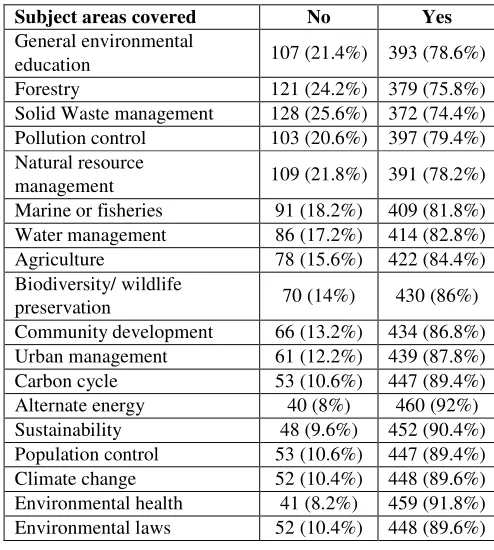
Majority of the respondents feel that their educational institution includes Alternate Energy (92%), Environmental Health (91.8%), Carbon Cycle (89.4%), Climate Change (89.6%), Community Development (86.8%), and Agriculture (84.4%) while imparting environmental education.
Nearly 82.8% respondents said that some the listed green activities adapted within their campus. Out of those, nearly 76.2% respondents said that Recycling program green activity
was adapted in their campus. In addition, nearly, 75.8%
respondents said that their campus adapted policies to ensure hygiene of premise and 76% respondents said that garden is available within the campus. Plantation of trees (73.6%), Pollution control activities (75.4%) and Policies against using toxic substances are the other activities that was adapted within the campus
Table-7
Most frequently used resources in educational institution in imparting environmental education
Resource Never been
used
Used very rarely
Used occasionally
Frequently used
Most frequently used
Printed material 42 (8.4%) 83 (16.6%) 83 (16.6%) 131 (26.2%) 196 (39.2%)
CD 59 (11.8%) 77 (15.4%) 77 (15.4%) 131 (26.2%) 197 (39.4%)
Diskette 79 (15.8%) 116 (23.2%) 116 (23.2%) 132 (26.4%) 40 (8%)
Geographic information
systems 52 (10.4%) 72 (14.4%) 72 (14.4%) 139 (27.8%) 203 (40.6%)
OHP sheets and projectors 62 (12.4%) 76 (15.2%) 76 (15.2%) 153 (30.6%) 37 (7.4%)
Table-8
Areas covered in the educational institution while imparting environmental education
Subject areas covered No Yes
General environmental
education 107 (21.4%) 393 (78.6%)
Forestry 121 (24.2%) 379 (75.8%)
Solid Waste management 128 (25.6%) 372 (74.4%) Pollution control 103 (20.6%) 397 (79.4%) Natural resource
management 109 (21.8%) 391 (78.2%)
Marine or fisheries 91 (18.2%) 409 (81.8%) Water management 86 (17.2%) 414 (82.8%)
Agriculture 78 (15.6%) 422 (84.4%)
Biodiversity/ wildlife
preservation 70 (14%) 430 (86%)
Community development 66 (13.2%) 434 (86.8%) Urban management 61 (12.2%) 439 (87.8%) Carbon cycle 53 (10.6%) 447 (89.4%)
Alternate energy 40 (8%) 460 (92%)
Sustainability 48 (9.6%) 452 (90.4%) Population control 53 (10.6%) 447 (89.4%) Climate change 52 (10.4%) 448 (89.6%) Environmental health 41 (8.2%) 459 (91.8%) Environmental laws 52 (10.4%) 448 (89.6%)
Table-9
Green Activities adapted in our Campus
Green activity No Yes
Recycling program 33 (6.6%) 381 (76.2%) Waste reduction program 45 (9%) 369 (73.8%) Pest management within
premise 45 (9%) 369 (73.8%)
Reduction of carbon emission 96 (19.2%) 318 (63.6%) Water resource management
activities 106 (21.2%) 308 (61.6%) Food waste management 111 (22.2%) 303 (60.6%) Policies to ensure hygiene of
premise 35 (7%) 379 (75.8%)
Pollution control activities 37 (7.4%) 377 (75.4%) Garden within campus 34 (6.8%) 380 (76%) Plantation of trees 46 (9.2%) 368 (73.6%) Policies against using toxic
substances 46 (9.2%) 368 (73.6%)
Nearly 44.4% respondents feel that the present environmental education in India contributes towards sustainability (Chi – Square test statistic = 34.468, p – value = 0.000 < 0.05). This means that the education institutions in India shows high importance over the environmental education with specific emphasis to sustainability and various environmental education patterns
Table-10(a)
Present_Environmental_Education
Observed N Expected N Residual
Yes 222 166.7 55.3
No 115 166.7 -51.7
Maybe 163 166.7 -3.7
Total 500
Table 10 (b) Test Statistics
Present_Environmental_Education
Chi-Square 34.468a
Df 2
Asymp. Sig. .000
a. 0 cells (0.0%) have expected frequencies less than 5. The minimum expected cell frequency is 166.7
Nearly 41.9% respondents feel that the present environmental education in India contributes towards sustainability. They also agree that lot of time is not allocated for teaching sustainable environment as a subject to students (Chi – Square test statistic = 16.820, p – value = 0.032 < 0.05).
Results and Discussion
The following are the answers to the proposed research questions about the study.
RQ1: What are the flaws existing in the current environmental education patterns adapted at present in Indian educational institutions: It was seen that in the educational institutions, a lot of time is not allocated for the teaching of sustainable environment as a subject to students. The management of the educational institutions finds it difficult to avail funds for offering high quality sustainable environmental education and they also find it difficult to access resources necessary for offering high quality sustainable environmental education. Some of the other challenges that exist in the current environmental education patterns present in the Indian educational institutions are that the teachers / lecturers are not at all offered with adequate resources by the management to impart sustainable environmental education and also most of the teachers / lecturers lack sufficient knowledge to impart sustainable environmental education. Added to that, students also do not give importance in learning environment as a subject since they consider it to add no academic value to them.
RQ2:What is the various environmental education patterns adapted at present in the educational institutions in India?: The environmental circumstances and the arrangement of India are very wide. India is a country that is to a great extent diversified on the foundation of geologically, edaphically,
Table-11 (a)
Crosstab for Present Environmental Education in India Time constraint
Total Strongly
Disagree Disagree Neutral Agree
Strongly Agree
P
re
se
n
t
E
n
v
ir
o
n
m
en
ta
l
E
d
u
ca
ti
o
n
Yes
Count 32 14 33 93 50 222
% within Present
Environmental 14.4% 6.3% 14.9% 41.9% 22.5% 100.0%
No
Count 10 11 7 57 30 115
% within Present
Environmental 8.7% 9.6% 6.1% 49.6% 26.1% 100.0%
Maybe
Count 13 20 27 62 41 163
% within Present
Environmental 8.0% 12.3% 16.6% 38.0% 25.2% 100.0%
Total
Count 55 45 67 212 121 500
% within Present
Environmental 11.0% 9.0% 13.4% 42.4% 24.2% 100.0%
Table-11(b) Chi-Square Tests
Value df Asymp. Sig. (2-sided) Pearson Chi-Square 16.820a 8 .032
Likelihood Ratio 17.848 8 .022 Linear-by-Linear Association .564 1 .453
N of Valid Cases 500
a. 0 cells (0.0%) have expected count less than 5. The minimum expected count is 10.35.
importance to environmental education and it is that in India,
the environmental education is conveyed in a greater part of
schools and colleges. Also it is found from the study that the quality of the current environmental education system in India is remarkably good, while in some areas the system of environmental education in India requires improvement. It is
very important to make conscious of family planning, rural
development, sanitation, food and water contamination, fuel wood, nutrition, slum improvement, hygiene, fodder etc.
RQ3: How is environmental education important in the attainment of sustainability?: The environmental education is the mechanism and a tool for the development of sustainability. The environmental education helps environment in a number of ways. Added to that, it helps the society by providing a critical likeness of the world. This is specifically its failings and awful injustices, and by the way of endorsing greater consciousness and awareness, analyzing new terms and vision and discovering fresh techniques and tools. It is that the environmental education is the superior expectation of humanity and the most efficient means to accomplish sustainable development. It is that the environmental education might not be associated with the schooling education or formal environmental education alone. This includes the non–formal and informal medium of instruction and learning and also comprises of the conventional knowledge that are obtained in the home and community.
Conclusions
The following are some of the suggestions that are recommended to improve the environmental education in India.
Content of environmental education should be modified: At present, the content of the Indian environmental education is not much attractive and informative for the students. It should be enhanced in such a way that it expresses a clear association to the environment and the environmental concerns. The content must help highlight an incorporated thematic or an interdisciplinary approach in which the ideas are uttered through big ideas and unifying themes rather than the isolated segments. The content should associate the learning with the actual world. Personally it has to be applicable to the learners and include issues that are significant to the society and also it should equip the learners with the adequate skills in order to continue learning all through the life.
Design of the course material: The course material should be intended so that it is practical by nature, specific to the locale and endorses a holistic understanding of the particular area’s environment. Also the material should establish an association among the day – to – day life and actions of the students and that of their environment.
Development of sustainability: The sustainability of the program depends on the recognition by the teachers and their capability to provide the course efficiently. The training of the teachers should be considered as a main concern within the proposal. Camps should be arranged in order to train the teachers from time to time. Also a manual should be offered to teachers in order to enable them to guide the students in their practical work and also the self - contained and self–explanatory workbooks should be provided.
References
1. Stevenson R.B., Schooling and Environmental Education: contradications in purpose and practice : Environmental education research, 13(2), 189-207 (2007)
2. Tbilisi UNESCO-UNEP, First Intergovernmental Conference of Environmental Education, Final Report, USSR, (1977)
3. Khan A., Khan M.N. and Siddiqui T.Z., Gauging attitudes towards the environment through NEP: A case study from India, International Journal of Social Entrepreneurship and Innovation, 2(1), 42–51 (2013) 4. Agarwal R., Awasthi A., Mittal S., Singh N. and Gupta
P.K., Effects of air pollution on respiratory parameters during the wheat-residue burning in Patiala, Journal of Medical Engineering and Technology, 34(1), 23–28 (2010)
5. Barnett M., Lord C., Strauss E., Rosca C., Langford H., Chavez D. and Deni L., Using the Urban Environment to Engage Youths in Urban Ecology Field Studies, The Journal of Environmental Education, 37(2), 3-11 (2006) 6. Barnett M., Lord C., Strauss E., Rosca C., Langford H.,
Chavez D. and Deni L., Using the Urban Environment to Engage Youths in Urban Ecology Field Studies, The Journal of Environmental Education, 37(2), 3-11 (2006) 7. Barraza L., Duque-Aristizabal A.M. and Rebolledo G.,
EE : From Policy to Practice, Environmental Education Research, 9(3), 347-357 (2003)
8. Barraza Laura and Alfredo D. Cuaron, How Values in Education Affect Children’s Environmental Knowledge, Journal of Biological Education, 39, 18- 23 (2004) 9. Chawla L. and Cushing D.F., Education for strategic
environmental behavior, Environmental Education Research, 13(4), 437–452 (2007)
10. Coddington W., Environmental marketing's new relationship with corporate environmental management, Environmental Quality Management, 2(3), 297–302 (1993)
11. Dick Walter, Lou Carey and James O. Carey, The Systematic Design of Instruction, Boston: Pearson, Education, 25(2), 183-187, (2005)
12. Ford M., Environmental Education in the Condor Bioreserve: Current Status and Recommendations for Future Work, Journal of Sustainable Forestry, (18)2/3, 257-275 (2004)
13. Haig-Brown C., Creating spaces: Testimonio, impossible knowledge, and academe, Qualitative Studies in Education, 16(3), 415-433 (2003)
14. Hamner S., Tripathi A., Mishra R.K, Bouskill N., Broadaway S.C., Pyle B.H. and Ford T.E., The role of water use patterns and sewage pollution in incidence of water-borne/enteric diseases along the Ganges river in Varanasi, India, International Journal of Environmental Health Research, 16(2), 113-132 (2006)
15. Hsu Shih-Jang, The Effects of an Environmental Education Program on Responsible Environmental Behavior and Associated Environmental Literacy Variables in Taiwanese College Students, The Journal of Environmental Education, 35, 37-48 (2004)
16. Hungerford H.R. and Volk T.L., Changing learner Behavior through environmental education, Journal of environmental education, 21(3), 8-22 (1989)
17. Pande A., Environmental Education in Rural Central Himalayan Schools, Journal of Environmental Education, 32(3), 47-53 (2001)
18. Pande L., Our Land, Our Life : An innovative approach to environmental education in central Himalayas, In D. Tilbury, R. B. Stevenson, J. Fienand D. Schreuder (eds.) Education and Sustainability : Responding to the Global Challenge (65-74). Cambridge, UK; IUCN, (2002)
19. Simmons D and Widmar R., Motivations and barriers to recycling: Towards a strategy for public education, The Journal of Environmental Education, 22(1), 13-18 (1990)
20. Singh A. and Jamal S, A study of risk factors associated with indoor air pollution in the low income households in Aligarh city, India, Journal of Environmental Research and Management, 3(1), 1-8 (2012)
21. Sonowa C.J., Environmental Education in Schools: The Indian Scenario, Tata Institute of Social Sciences, Sion-Trombay Road, Deonar, Mumbai 400 088, Maharashtra, India, J Hum Ecol, 28(1), 15-36, (2009)
22. Tognacci L.N., Weigal R.H., Wideen M.F. and Vernon D.T., Environmental quality : How universal is public concern, Environment and Behavior, 4(1), 73-86 (1972)
23. Williams J., Thinking as natural : Another look at human exemptionalism, Human Ecology Review, 14(2), 130-139 (2007)