University of Pennsylvania
ScholarlyCommons
Publicly Accessible Penn Dissertations
1-1-2014
Animacy in Morphosyntactic Variation
Brittany Dael McLaughlin
University of Pennsylvania, [email protected]
Follow this and additional works at:http://repository.upenn.edu/edissertations
Part of theAnthropological Linguistics and Sociolinguistics Commons
This paper is posted at ScholarlyCommons.http://repository.upenn.edu/edissertations/1365
Recommended Citation
McLaughlin, Brittany Dael, "Animacy in Morphosyntactic Variation" (2014).Publicly Accessible Penn Dissertations. 1365.
Animacy in Morphosyntactic Variation
Abstract
In this dissertation, I demonstrate that animacy of subject referents strongly conditions verbal
morphosyntactic variation in English varieties. Using three quantitative case studies, I investigate copula and subject verb agreement in two English varieties, Mainstream American English (MAE) and African American Vernacular English (AAVE). For each of the case studies -- (1) MAE auxiliary contraction, (2) AAVE copula contraction and dele- tion, and (3) AAVE verbal -s deletion -- human subjects like the boy significantly prefer the contracted or null form, while non-human subjects like the book prefer the full or overt form.
The first two case studies, MAE contraction and the parallel feature in AAVE, copula contraction and deletion, demonstrate that inanimate subjects predict the full form, while contracted and (AAVE) deleted forms are more likely with animate subjects. This finding supports Labov's 1969 analysis that AAVE contraction is similar to MAE contraction, and that AAVE contraction and deletion share conditioning constraints. The third case study, AAVE verbal -s, is widely considered not to be grammatically conditioned. However, I find that AAVE verbal -s is also conditioned by animacy, indicating that verbal -s is part of the underlying grammar. Taken together, I use these case studies to argue that animacy is a domain-general processing cue that
grammars can structurally reify.
These animacy effects in English shed new light on old variables. From a sociolinguistic perspective, we see that initially unintuitive and unexplored factors like animacy in English are robust predictors of variation. Furthermore, these results allow us to make progress on controversial aspects of grammatical analysis in AAVE, as well as refine our understanding of MAE morphosyntactic variation. These results may also be brought to bear in future discussions of the relationship between MAE and AAVE grammars. Finally, this dissertation contributes to the ongoing question in linguistic and psychological literature about the place of animacy in language, and how processing and grammar interact in linguistic conditioning. With animacy so significantly conditioning variation and having such profound theoretical implications, it is clear that future studies should give careful consideration to the role of animacy in language variation.
Degree Type Dissertation
Degree Name
Doctor of Philosophy (PhD)
Graduate Group Linguistics
First Advisor William Labov
Keywords
Subject Categories
ANIMACY IN MORPHOSYNTACTIC VARIATION
Brittany Dael McLaughlin
A DISSERTATION
in
Linguistics
Presented to the Faculties of the University of Pennsylvania
in
Partial Fulfillment of the Requirements for the Degree of Doctor of Philosophy
2014
Supervisor of Dissertation
_____________________
William Labov
Fassitt Professor of Linguistics
Graduate Group Chairperson
______________________
Eugene Buckley
Associate Professor of Linguistics
Dissertation Committee:
David Embick, Professor of Linguistics
ANIMACY IN MORPHOSYNTACTIC VARIATION
COPYRIGHT
2014
To Tara and Tim McLaughlin,
Acknowledgements
I have a whole village of friends, family, and mentors, and I am consistently struck by how lucky I am to have so many people as part of this experience. It’s not possible to thank all of them adequately here, but I’ll give it a go.
I would especially like to thank my advisor, Bill Labov, for showing that linguistics can do social good, and believing that I can make a contribution. He pushes me to find not only the theoretical but also the social value of my research questions, and is an inspiration in his search for innovations and applications. He has always challenged and supported me, and I can’t thank him enough for his generosity. My biggest success and source of pride is that I had the opportunity to work with him on developing the Penn Reading Initiative, and that, years later, the program is still growing.
My committee members have provided invaluable feedback and support over the years. Dave Embick has challenged my assumptions and helped me to convert my thinking pro-cess into actual written pages. He’s also a never-ending source of reassurance, tea, and, when the situation is particularly dire, stickers and Sesame Street characters. Florian Schwarz has encouraged me to hedge less and claim more, and especially has helped me talk through last-minute thoughts.
There are so many mentors who have been part of this process from the very beginning, before I even started at Penn. I want to thank John Rickford for his unfailing advice, encouragement, and mentorship. When I was an undergrad with so many ideas but no idea of how to channel them, he went out of his way to call me back and give me advice, and has been mentoring me ever since. Walt Wolfram has also gone out of his way, not only sharing the FPG corpus, but also checking in on my grad school career and getting me actively involved in teaching and community outreach. Anne Charity-Hudley met with me during my undergraduate thesis and encouraged me to pursue Penn, and has continued to be a valuable source of both inspiration and feedback.
I am indebted to the Frank Porter Graham Child Development Institute, Susan Zeisel, Jenn Renn, NCState, and many others for sharing their years of work, expertise, and data. I am also grateful to Laurel MacKenzie, Chris Cieri, the Philadelphia Neighborhood Corpus, and the Linguistic Data Consortium, for the opportunity to analyze their corpora.
Forsyth keeps the department running, and always makes sure I’m checking off the right boxes (and even pretended to believe me when I thought there was a pigeon in the office). Outside of the department, I am so grateful to have feedback and encouragement from Jen Smith and Peter Trudgill.
Through this process I’ve also been lucky to have opportunities to work with and learn from friends. There are so many that have been an integral part of my intellectual and personal growth. Meredith Tamminga has read and reread various drafts, and Aaron Ecay has worked and reworked Python programming and statistical models with me. Kobey Shwayder, Laurel MacKenzie, and Meredith Tamminga showed me how much fun joint research can be. My wonderful cohort, Bob Lannon, Caitlin Light, Satoshi Nambu, and Yanyan Sui, taught me not only syntax, but also how to win any argument with the word “crucially.” I would especially like to thank Aaron Dinkin, who helped me narrow in on this whole animacy thing to begin with. And of course, my wonderful work buddies and friends, both at Penn and not: Amy Goodwin Davies, Eric Doty, Sabriya Fisher, Duna Gylfadttir, Lauren Hall-Lew, Taylor Jones, Soohyun Kwon, Marielle Lerner, Constantine Lignos, Hilary Prichard, Betsy Sneller, Joel Wallenberg, Rob Wilder, David Wilson, and Georgia Zellou.
The Penn Reading Initiative has been a huge part of my experience in Philadelphia, and a driving force in my life goals. I would like to thank the Netter Center, especially Cory Bowman and Ira Harkavy, for their mentorship and support. PRI tutors, old and new, are a constant source of inspiration. I would especially like to thank the first PRI tutors and leaders, particularly Nia Crosley and Mo Metlen, for their steadfast commitment to the program and for helping keep me sane(ish), and David Back, for getting me through the hardest part of grad school.
I’ve had the joy of teaching at Swarthmore College, where I’ve enjoyed the support, mentorship, and friendship of David Harrison, Dorothy Kunzig, Donna Jo Napoli, Nathan Sanders, Anisa Schardl, and little Geordie. I would especially like to thank my students – your creativity and love of learning have been a constant reminder of why I love linguistics, and of how important linguistics is outside of academia.
This all began with my undergraduate advisor Emily Scida, who calmly saw me through my entire college experience, from inspiring me with the history of Spanish, to helping me go to Oakland for my thesis on Ebonics and education. Many thanks go to the contacts from my thesis, Toni Cook, Nabeehah Shakir, Carrie Secret, Carol Lee Tolbert, Ronald Williams, and Oscar Wright, for telling me about their experiences as activists during the Oakland Ebonics policy. Those conversations continue to inspire and ground me whenever I feel like my path is drifting.
there with an encouraging “go go go!” Dani and Craig, for being a warm home to talk about teaching, grad school, and rompers. Claudia and Tom (and Mojo) have lovingly fed me, board-gamed me, and hugged me through everything, and even though we hate each other during Catan, it’s the best little family ever. Brandon, Danni, Erin, Joseph, Julie, Mindy, Neil, Ren´e, Shakey, everyone at Good Karma Cafe, and so many more, have made this a sitcom life, with the best cast of characters I could imagine. Thank you to Philadelphia for being my starter city, and all the places and people here who’ve made this feel like a small town. And so many thanks to my lovely non-Philly friends, Kelly, Nathan, and Lauren, who’ve helped me focus, helped me move, and known about everything in my life for so many years. I’m taking every single one of you to Pittsburgh with me.
As I wrap up this chapter and move to a new city, I’m grateful to those who make the next chapter so exciting. I would like to thank Justine Cassell, for getting me involved in an innovative and educationally-motivated research program. Much appreciation also goes to Samantha Finkelstein for being a wonderful co-worker and friend, and Elijah Mayfield, for cheerleading me through the dissertation end-game. You make Pittsburgh look like it’ll be pretty great.
ABSTRACT
ANIMACY IN MORPHOSYNTACTIC VARIATION Brittany Dael McLaughlin
William Labov
In this dissertation, I demonstrate that animacy of subject referents strongly conditions verbal morphosyntactic variation in English varieties. Using three quantitative case stud-ies, I investigate copula and subject verb agreement in two English varietstud-ies, Mainstream American English (MAE) and African American Vernacular English (AAVE). For each of the case studies — (1) MAE auxiliary contraction, (2) AAVE copula contraction and dele-tion, and (3) AAVE verbal -s deletion — human subjects likethe boy significantly prefer the contracted or null form, while non-human subjects likethe bookprefer the full or overt form.
The first two case studies, MAE contraction and the parallel feature in AAVE, copula contraction and deletion, demonstrate that inanimate subjects predict the full form, while contracted and (AAVE) deleted forms are more likely with animate subjects. This finding supports Labov’s 1969 analysis that AAVE contraction is similar to MAE contraction, and that AAVE contraction and deletion share conditioning constraints. The third case study, AAVE verbal -s, is widely considered not to be grammatically conditioned. However, I find that AAVE verbal -s is also conditioned by animacy, indicating that verbal -s is part of the underlying grammar. Taken together, I use these case studies to argue that animacy is a domain-general processing cue that grammars can structurally reify.
Contents
Acknowledgements iv
Abstract vii
Contents viii
List of Tables xi
List of Figures xiv
1 Introduction 1
1.1 Overview . . . 2
1.2 Animacy . . . 3
1.2.1 Defining animacy . . . 3
1.2.2 Animacy effects on language . . . 4
1.3 Data and methods . . . 6
1.3.1 Language varieties . . . 6
1.3.2 MAE contraction . . . 6
1.3.3 AAVE copula and verbal -s . . . 7
1.3.4 Constraints on variation . . . 9
1.3.5 Animacy coding . . . 10
1.3.6 Statistics . . . 11
2 MAE Contraction 14 2.1 Introduction . . . 14
2.1.1 Overview . . . 14
2.2 Literature review . . . 15
2.2.1 Defining the variable . . . 15
2.2.2 Analysis . . . 17
2.2.3 Effects and non-effects . . . 18
2.3 Introduction to results . . . 21
2.3.1 Overview . . . 21
2.4 The animacy effect . . . 22
2.4.1 Animacy effects onis. . . 22
2.4.2 Not just the copula: Animacy effects onhasandwill . . . 23
2.5 Explaining previous anomalies through animacy . . . 25
2.5.1 Preceding segment: /r/ and kinship terms . . . 25
2.5.2 Pronoun differences inwill . . . 32
2.6 Ruling out alternative explanations . . . 34
2.6.1 Following constituent effects . . . 35
2.6.2 Subject length . . . 35
2.6.3 Frequency . . . 36
2.6.4 Proper nouns . . . 37
2.6.5 Prosodic factors . . . 37
2.7 Conclusion . . . 37
3 AAVE Copula Contraction & Deletion 38 3.1 Introduction . . . 38
3.2 Literature review . . . 39
3.2.1 Defining the variable . . . 39
3.2.2 Theoretical explanations . . . 40
3.2.3 Conditioning factors . . . 45
3.2.4 Social variation . . . 45
3.3 Introduction to results . . . 47
3.3.1 Methodology . . . 47
3.4 The animacy effect . . . 49
3.5 Animacy as a diagnostic for underlying structure . . . 50
3.6 Additional results: extra-grammatical effects . . . 59
3.6.1 Subject length . . . 59
3.6.2 Frequency . . . 60
3.7 Ruling out alternative explanations . . . 61
3.7.1 Style . . . 61
3.7.2 Age . . . 62
3.7.3 Following constituent . . . 62
3.7.4 Preceding segment . . . 64
3.7.5 Subject Type Constraint . . . 66
3.8 Conclusion . . . 68
4 AAVE Verbal -s 69 4.1 Introduction . . . 69
4.2 Literature review . . . 69
4.2.1 Defining the variable . . . 69
4.2.2 Theoretical explanations . . . 71
4.2.3 Effects and non-effects . . . 72
4.2.5 Summary . . . 77
4.3 Introduction to results . . . 78
4.3.1 Overview . . . 78
4.3.2 Methodology . . . 78
4.4 The animacy effect . . . 80
4.5 Additional results: grammatical effects . . . 81
4.5.1 Subject type: wh- words . . . 81
4.5.2 Non-effects: Relative clauses and conjunctions . . . 85
4.6 Additional results: extra-grammatical effects . . . 87
4.6.1 Subject length . . . 87
4.6.2 Non-effects: Subject frequency . . . 88
4.6.3 Non-effects: Verb frequency . . . 91
4.7 Ruling out alternative explanations . . . 92
4.7.1 Style . . . 92
4.7.2 Age . . . 93
4.8 Conclusion . . . 96
5 Implications of animacy conditioning 97 5.1 Semantic vs. syntactic animacy . . . 98
5.2 Animacy as more than universal processing . . . 100
5.2.1 Prototypicality . . . 100
5.2.2 Processing load . . . 105
5.2.3 Style . . . 109
5.2.4 Is structure necessary? . . . 110
5.3 Evidence for default variants . . . 111
5.4 Animacy and inverse frequency effects . . . 114
5.5 Making connections across variables and varieties . . . 118
5.6 Conclusion . . . 119
List of Tables
2.1 Mixed-effects model results for contraction ofis(N=1081) . . . 23
2.2 Comparison of two models for short allomorph selection for post NP is: without animacy (model0) and with animacy (model1) . . . 23
2.3 Fixed effects model forhasandwillshort allomorphy selection (N=524) . . 25
2.4 LRT between model without animacy as fixed effect (model0) vs. with animacy (model1) . . . 25
2.5 Raw data for manner by animacy . . . 26
2.6 Mixed-effects model results for contraction of isafter inanimate NP sub-jects (N=777) . . . 27
2.7 LLRT between model with preceding /r/ separate from preceding conso-nants (model0) vs. preceding /r/ and consonant collapsed (model1) . . . 28
2.8 LLRT between model with preceding /r/ separate from preceding vowels (model0) vs. preceding /r/ and vowels collapsed (model3) . . . 28
2.9 Mixed-effects model results for contraction of isafter inanimate NP sub-jects, with preceding /r/ collapsed into preceding vowel (N=777) . . . 29
2.10 Mixed-effects model results for contraction ofisafter animate NP subjects, with preceding segment manner uncollapsed (N=304) . . . 30
2.11 LLRT between model with preceding /r/ separate from preceding vowels (model0) vs. preceding /r/ and vowels collapsed (model1) . . . 30
2.12 Mixed-effects model results for contraction ofisafter animate NP subjects, with preceding /r/ collapsed into preceding vowel (N=304) . . . 31
2.13 Mixed-effects model results for contraction of is after animate NP sub-jects, with preceding /r/ collapsed into preceding vowel and preceding non-sibilant fricative collapsed into consonants (N=304) . . . 31
2.14 LLRT between model with preceding /r/ separate from preceding vowels (model0) vs. preceding /r/ and vowels collapsed (model1), vs. preceding /r/ and vowels collapsedandpreceding non-sibilant fricative and consonants collapsed (model2) . . . 32
2.15 Mixed-effects model results for contraction ofwill(N=1332) . . . 32
2.16 NP subjects by animacy and vowel vs. consonant (N=291) . . . 33
2.17 NP subjects by animacy and vowel vs. preceding /t, d/ (N=74) . . . 34
3.1 GLM (fixed effects only) for of contraction/deletion vs. full without
ani-macy (N=191) . . . 50
3.2 GLM (fixed effects only) for of contraction/deletion vs. full with animacy (N=191) . . . 50
3.3 Multinomial logistic regression with full form as treatment level (N=191) . 54 3.4 Multinomial logistic regression with contracted form as treatment level (N=191) . . . 57
3.5 GLM with subject length . . . 60
3.6 Token count of copula variant by subject length . . . 60
3.7 Percentage of following constituent by animacy of subject . . . 63
3.8 Percentage of animate and inanimate subjects by following constituent . . . 63
3.9 LLRT comparing a factor for animacy but without following constituent (model2) with a model with both (model1) . . . 64
3.10 Model including preceding segment . . . 65
3.11 Model without animacy, but with preceding segment . . . 65
3.12 Raw tokens of subject animacy by segment immediately preceding copula . 66 3.13 Percentage count of subject animacy by segment immediately preceding copula . . . 66
3.14 Multinomial model with full copula as treatment . . . 67
3.15 Multinomial model with zero copula as treatment . . . 67
4.1 Verbal -s selection by social and stylistic factors (N=1755) . . . 81
4.2 Verbal -s selection by animacy of subject, as well as social and stylistic factors (N=1755) . . . 81
4.3 LLRT where model1 includes animacy as a factor and model0 does not . . 81
4.4 Subject type effects on entire dataset . . . 82
4.5 LLRT comparing model1 without subject type to model2 with subject type . 82 4.6 Subject type effects on one-word subjects only (N=1703) . . . 83
4.7 LLRT comparing model1 without subject type to model2 with subject type in one-word subjects . . . 83
4.8 Subject type collapsed to binary levels: wh-word vs. other . . . 84
4.9 LLRT comparing model2, with full subject type categories, and model3, with subject type collapsed to wh-word vs. other . . . 84
4.10 Raw tokens of wh and wh-q verbal -s coding . . . 85
4.11 No subject type effects in wh- words . . . 85
4.12 LLRT between model0 with no factor for question contexts, and model1 with factor for question contexts . . . 85
4.13 Percentage of verbal -s by conjunction status . . . 86
4.14 Raw tokens of verbal -s by conjunction status . . . 86
4.15 Percentage of verbal -s by relative clause status . . . 86
4.16 Raw tokens of verbal -s by relative clause status . . . 86
4.17 Fixed effects, with animacy and subject length . . . 87
4.19 Animacy and NP subjects (N=443) . . . 88
4.20 LLRT on non wh- NP subjects: model0 without subject length, model1 with subject length . . . 88
4.21 Model without animacy, with subject frequency . . . 89
4.22 LLRT where model1 has subject frequency instead of animacy, while model0 has just animacy . . . 90
4.23 Subject frequency and animacy . . . 90
4.24 LLRT of model0 without subject frequency and model1 with subject fre-quency . . . 90
4.25 LLRT where model2 has verb frequency instead of animacy, while model0 has just animacy . . . 91
4.26 Verb frequency added to the model . . . 91
4.27 LLRT: model0 without verb frequency, model3 with verb frequency . . . . 91
4.28 Animacy effects in informal contexts (N=1398) . . . 93
4.29 LLRT: model0 without animacy, model1 with animacy, in informal contexts 93 4.30 Animacy effects in formal contexts (N=316) . . . 93
4.31 LLRT: model0 without animacy, model1 with animacy, in formal contexts . 93 4.32 Animacy effects in ages 4-9 (N=264) . . . 95
4.33 model0 without animacy, model1 with animacy . . . 95
5.1 Raw data distribution of one as a subject head by animacy of its referent and contraction rates . . . 99
5.2 Transitivity in model (N=1329) . . . 104
5.3 Token count of MAEisvariant by subject length . . . 107
5.4 Token count of copula variant by subject length . . . 108
5.5 Token count of verbal-s variant by subject length . . . 108
List of Figures
2.1 Long or short underlying allomorphs of surface representations [chart from
Lignos & MacKenzie 2014] . . . 17
2.2 Percent of animacy coding by preceding segment manner) . . . 27
3.1 Straight Contraction . . . 41
3.2 Straight Deletion . . . 41
3.3 Labov Contraction . . . 42
3.4 Labov Deletion . . . 42
3.5 (a) Labov Contraction/Deletion (from Labov, 1969:732); (b) Romaine Contraction/Deletion (from Labov 1969:733) [Formatted as cited in Rickford et al., 1991:122] . . . 43
3.6 Romaine Deletion . . . 44
3.7 Romaine Contraction . . . 45
3.8 Labov Contraction . . . 49
3.9 Straight Contraction . . . 51
3.10 Straight Deletion . . . 51
3.11 Labov Contraction . . . 52
3.12 Labov Deletion . . . 52
3.13 Romaine Contraction . . . 52
3.14 Romaine Deletion . . . 52
3.15 Testing points in conditioning effects on surface forms . . . 53
3.16 Conditioning on contracted versus full surface variants . . . 55
3.17 Conditioning on contracted versus null surface variants . . . 57
3.18 Alternate structure . . . 58
3.19 Percent absence of copula absence by animacy across age (N=191) . . . 62
4.1 Percent absence of verbal -s by animacy across age . . . 95
5.1 Equation for persistence strength . . . 113
5.2 Persistence of 3sg -s by lag distance . . . 114
5.3 Basic animacy -s rates (N=2345) . . . 116
5.4 Effect of an animate prime on 3sg -s . . . 117
5.5 Effect of an inanimate prime on 3sg -s . . . 117
Chapter 1
Introduction
necessity of including animacy conditioning in future studies of sociolinguistic variation.
1.1 Overview
In this introduction, I define animacy and give a background on animacy effects across languages and within English. I also introduce the varieties and variables in question, and describe the methodology used throughout this dissertation. In Chapters 2-4, I differentiate among grammatical, social, and processing constraints, to quantitatively analyze three case
studies (1-3). In each case study, I demonstrate this dissertation’s discovery of the
robust role of animacy in morphosyntactic variation in a language where animacy was previously thought to be unimportant. I present animacy effects in each variable, demonstrate that alternate explanations are untenable, and discuss ramifications for the analysis of each variable. In the final chapter, I discuss implications for AAVE, English, animacy, and grammatical versus processing constraints.
(1) Contraction in MAE(McLaughlin and MacKenzie, 2013)
a. Full: The problemishere.
b. Contracted: Her mom’sIrish.
(2) Copula & contraction in AAVE
a. Full: That showisfunny.
b. Contracted: My mom’skinda the same.
c. Absent: My daddy;talkin’ about ...
(3) Verbal -s in AAVE
a. Present: Our seasonstartsin the summer.
1.2 Animacy
1.2.1 Defining animacy
There is no single definition of animacy, but definitions can be separated into biological, semantic, or syntactic in nature. Biological animacy separates entities into living versus non-living. While animacy in language can be linked to biological animacy, it is not de-fined simply by biological status, but instead semantically or syntactically. In semantic
definitions of animacy, animacy is based on universal concepts, such as a privileging hu-mans as “more” animate than other living entities. As such, semantic animacy can be construed as a cognitive processing concept, which connects to findings in other domains. In developmental psychology, the ability to distinguish between animate and inanimate ob-jects has been argued to be an innate (or at least early-learned) cognitive categorization with broad ramifications across human behavior (Opfer and Gelman, 2010). For instance, animate nouns are memorized more reliably than inanimate nouns (Nairne et al., 2013).
In contrast, syntactic animacy is grammatical, lexically specific, and often arbitrary, functioning as a noun classification system like gender (although it can still make reference to intuitive concepts of animacy). In languages with syntactic animacy effects, grammatical diagnostics can be used to determine the animacy status of an entity. English, however, has no such diagnostics, and is more heuristic in its animacy applications, as I will discuss in Section 1.2.2.
pro-nouns/demonstratives>proper nouns>human>animate>inanimate (Silverstein 1976).
This hierarchy allows for typological generalizations about split ergative systems, and in its goal of appealing to a universal human cognition of animacy, is semantic in nature. There are also syntactic animacy hierarchies that are language-specific. For instance, in Navajo, entities are more to less animate on the following scale: Human >Infant/Big Animal >
Medium-sized animal>Small animal >Natural force >Abstraction (Young & Morgan
1987).
1.2.2 Animacy effects on language
Morphosyntactic effects
Linearization
Animacy can also affect language throughlinearization, or the “animate-first” effect, such that animate entities categorically or probabilistically occur earlier than less animate enti-ties. This is not considered to be encoded in the morphosyntax, but instead to represent preferences for ordering of argument structures. Navajo is one such language, such that nouns higher in its syntactic animacy scale occur earlier than less animate nouns. Another example of this is German. While animacy does not affect the case-marking or verbal agreement marking of German, the animacy hierarchy is apparent in optional linear or-dering of arguments, such that animate subjects are more likely to happen earlier in the structure (Grewe et al., 2006).
English is also considered a language where animacy is not encoded in the grammar, but can affect argument structure through linearization order (Becker 2014). English con-structions whose alternations are conditioned by animacy include the genitive (4) and the dative (5) constructions. In the genitive, theof construction is more infelicitous the more animate the possessor is (Rosenbach, 2002, Tagliamonte and Jarmasz, 2008). Similarly, in the dative, the prepositionalto construction is more dispreferred the more animate the object is (cf. Bock, Kathryn, and Irwin, David, 1980, Bresnan et al., 2007, Bresnan and Ford, 2010, Hay and Bresnan, 2006).
(4) Genitive:
the woman’sshadow>the shadowof the woman
(5) Dative(Bresnan and Ford, 2010):
givemethe backpack>give the backpackto me
In this dissertation, I demonstrate that animacyalsoaffects English morphosyntax
features whose variability is still not fully understood.
1.3 Data and methods
1.3.1 Language varieties
This dissertation analyzes variation in verb paradigms in two English language varieties:
MAEandAAVE. MAE here is defined as a broad, non-regionally specific variety of
En-glish that is shaped by the speech of middle-class, educated speakers. Specifically with regard to the case studies used here, MAE speakers variably use contracted forms for aux-iliaries, but do not use null copula or null verbal -s. AAVE likewise is defined as broad and non-regionally specific, and structurally containing core linguistic features associated with African American culture and community. These core features include copula absence and verbal -s absence (Labov et al., 1968, Rickford and McNair-Knox, 1994, Van Hofwegen and Wolfram, 2010). There are regionally-specific varieties of both MAE and AAVE, but this this is not critical for these results given that MAE is not known to regionally vary along these variables, and the AAVE data is from a single area in North Carolina.1
1.3.2 MAE contraction
For MAE auxiliary contraction, I use 1605 contracted and full tokens of auxiliariesis, has
and will from the Switchboard (Godfrey et al., 1992), Fisher Cieri, Christopher, David
Miller and Kevin Walker, 2004, and Philadelphia Neighborhood (Labov and Rosenfelder, 2011) corpora. This dataset is used in McLaughlin and MacKenzie, 2013, and is an ex-tended coding of the dataset used in MacKenzie, 2012 and 2013. Collected from 1990-1Especially for AAVE, there may be regionally-specific variation in animacy conditioning, similar to
1991,Switchboardconsists of 5-minute phone conversations between two randomly paired speakers about a provided topic. It has approximately 2,400 conversations from 543 speak-ers, which totals about 240 hours of speech (about 3 million transcribed words). The
Fisher Corpus, collected from 2002-2003, consists of similarly-collected phone
conversa-tions about given topics, and includes 12,000+ speakers. ThePhiladelphia Neighborhood
Corpus(PNC; Labov and Rosenfelder, 2011) has been collecting interviews since 1972 as part of the LING 560 speech communities class at the University of Pennsylvania. In this corpus, graduate students conduct sociolinguistic interviews (Labov, 1984) with native Philadelphians. Only speakers with 35+ minutes transcribed are included here, resulting in 43 interviews from PNC being used. From these combined corpora, there are 1081 tokens ofis(6), and 524 tokens ofhasandwill(7 and 8).
(6) Is
a. Full: The problemishere.
b. Contracted: Her mom’sIrish.
(7) Has
a. Full: I’m sure ithasbeen done.
b. Contracted: Well, I’m sure it’sbeen done!
(8) Will
a. Full: ... but itwilllast twenty minutes.
b. Contracted: If I walk, it’llbe ten degrees warmer ...
1.3.3 AAVE copula and verbal -s
children from age 6-12 months. 71% of participants were at or below the poverty line at the start of the study. I use the subset of data collected when speakers were ages 4-17. At around age 11, participants invited friends to join in natural conversations, supplementing the original speakers with an additional cohort. There are over 2,500 CDs of language data in the total corpus. Interview contexts are varied across grades, and are separated into “formal” versus “casual” by Renn, 2007 and 2010. These include informal contexts such as mother-child interactions and natural conversations among peers, often about specific prompts and goals. Formal contexts include mock speeches and narrative storytelling with the interviewer. The data was coded for copula and verbal -s presence as part of the FPG project in collaboration with NCState, which has been used in studies such as Van Hofwe-gen and Wolfram, 2010, Renn, 2007 and Renn, 2010.
(9) AAVE copula contraction & deletion
a. Full: That showisfunny.
b. Contracted: My mom’skinda the same.
c. Absent: My daddy;talkin’ about ...
(10) AAVE verbal -s
a. Present: Our seasonstartsin the summer.
b. Absent: My mommaget;over reactive.
performative codeswitching. The resulting tokens were coded to include subject character-istics like animacy and subject length, as well as verb charactercharacter-istics like contraction and transitivity. For the copula study, this process resulted in 272 non-pronominal noun phrase (NP) subject tokens from 155 total speakers. NP subjects were isolated in order to avoid the confound of pronouns, which are already known to prefer null copula (Labov, 1969). In the verbal -s case study, auxiliariesdoandhavewere excluded, resulting in 1716 tokens from 250 speakers are included.
1.3.4 Constraints on variation
Thetheoretical frameworkin this dissertation views variation as stemming from multiple possible sources. The task of the researcher is to identify which sources are influenc-ing variation (Chapters 2-4), and how/why they are doinfluenc-ing so (Chapter 5). These sources
are broadly defined as a binary between internal grammatical constraints, which are
dictated by a particular language’s grammar, andextra-grammatical constraints, which
are not grammar-specific (Wolfram, 1975). These extra-grammatical constraints include the stylistic constraints in the domain of sociolinguists, as well as processing constraints rooted in universal characteristics of human cognition (MacKenzie, 2013, Tamminga and MacKenzie, 2014).
To maximize comparability, I test as many of the same conditioning factors as possible across MAE contraction, AAVE copula, and AAVE verbal -s. These can be grouped into three basic domains: 1) social; 2) grammatical; and 3) processing. Social constraints in-clude basic demographic factors like age and sex2, as well as stylistic variation like contexts
designed to elicit formality or for casualness (note that formal/casual is only available in
the AAVE case studies). Grammatical constraintsinclude subject type (pronoun vs. NP,
and, for is in MAE contraction and AAVE copula, the grammatical category of the fol-lowing constituent (NP, adjective, or verb).Processing constraintsinclude subject length and frequency. Subject length is operationalized as the number of orthographic words in the subject (MacKenzie 2013). Frequency is calculated using SUBTLEX-US frequency norms, which assesses frequency using 51 million words from American English movie subtitles, and is considered the frequency measure best correlated with behavioral mea-sures (Brysbaert and New, 2009).
1.3.5 Animacy coding
Finally, and most importantly, I code all three variables foranimacy. It is unclear whether animacy is a grammatical effect, a processing effect, or both, which is a topic I return to in Chapter 5. Animacy is operationalized as human vs. inanimate, following findings that human is at the most animate end of the spectrum in English, and that inanimates are the least animate (Rosenbach, 2005). However, this is a binary representation of something that may be more complex, like the animacy hierarchies that pattern English dative and geni-tive selection (Rosenbach, 2002) and cross-linguistically (Comrie, 1981). For instance, in dative and genitive alternations, human entities are are the most animate, and organizations consisting of humans, such asthe companyare slightly less animate, in contrast to unam-biguously inanimate objects likethe table. In order to make this dataset as conservative as possible, human subjects are contrasted with non-human subjects; the few tokens of animal subjects are excluded.3
While most pronouns are unambiguously animate, there are several that are ambiguous without a full investigation into the discourse topic and context. They(which is only rele-vant for MAE contraction ofwillin Chapter 2) is the pronoun for any plural subject, and 3Preliminary investigations into further subcategories of the animacy hierarchy, such as human
thus could be expected to be a mix of both human and non-human references.Theyis there-fore kept as a separate factor group to ensure that it is not interfering with the modeling.It, which is relevant for all three case studies, is assumed to be inanimate or expletive in this dissertation. However,itcan also refer to animals, which have been explicitly excluded in NPs. In fact,it can also refer to humans, in the particular case of babies. However, this brings with it a strong connotation of non-humanness, and is even offensive. There may be a difference between the animacy of the grammatical word used, versus the animacy of the referent in the real world, and it is an empirical question which of these is the better predictor of linguistic variation.Ittokens would need to be coded for their reference in the real world, and then additional probabilistic models would need to be run to determine if the reference type predicted variation better than assuming that the pronounitis inanimate. However, a corpus study is not the best place to ask this question; instead, psycholinguistic research is necessary, as discussed in Chapter 5.
Similarly, NPs with number quantifiers are not immediately codable for animacy, and the animacy of the reference must be used. In these cases, is there still an animacy effect? There is a data sparsity problem with these as test cases, but chi-square tests indicate that animacy is determined semantically by the subject head’s referent. This is discussed further in Chapter 5. In the meantime, if the animacy of the subject head is ambiguous, that token is excluded.
1.3.6 Statistics
Mixed effects modeling
Whenever possible, I usemixed effects models, which allow for both fixed and random
effects. Mixed effects modeling is increasingly the state-of-the-art in sociolinguistic re-search, due to its ability to better control for the effect of specific speakers or lexical items on variation (Gorman, Kyle and Daniel Johnson, 2013). Mixed effects models are run using theglmer()function of thelme4R package, with allomorph selection as the dependent variable, random effects for speaker and subject head, and fixed effects specific to that variable.
In logistic regressions like those used here, the dependent variable is binary, and rep-resented as either a “hit” or a “miss.” Sociolinguists often code the variant of interest as the “hit.” However, I will reverse this in order to maintain an direction of coefficients are across variables (note that the only difference this makes is the polarity of the coefficient). This is particularly key in discussing full forms, contracted forms, and null forms in AAVE copula. Rather than code contraction as a hit (a positive coefficient) and null forms as a hit (also a positive coefficient), I code these as “misses”, intuitively matching the direction of the coefficient (now negative) to the amount of phonological substance in the variant. Thus, positive coefficients indicate more phonological substance across all variables and variants, and negative coefficients indicate less phonological substance across all variables and variants.
I use thelog likelihood ratio test (LLRT) for model-to-model comparisons with the
anova() function in R. If the LLRT produces a non-significant p-value, that indicates
Other methods
There are several cases where I do not use mixed effects models. For instance, because AAVE copula has three variants rather than a binary split, I use multinomial logistic
re-gressions in part of that case study. This is themultinom() function in the nnet R
package. In smaller subsets, mixed effects models sometimes fail to converge, so fixed
effects models are used rather than mixed (the glm() function). Model-to-model
Chapter 2
MAE Contraction
2.1 Introduction
2.1.1 Overview
2.2 Literature review
2.2.1 Defining the variable
Contraction as defined here is the reduction of the phonological form of auxiliaries (MacKen-zie, 2013). I limit my literature review to the auxiliaries that robustly vary and can be identified as contracted or full from the surface form, namely, is, has and will. In this section, I will first describe contraction in MAE, including the surface variants (full, in-termediate, and contracted) and where contraction cannot occur (Section 2.2.1). Then I present the underlying allomorphy and conditioning factors that produce the surface vari-ants (Section 2.2.2), namely, that there are two, not three, underlying allomorphs: the long allomorph and the short allomorph. Finally, I discuss extra-grammatical effects, which act on the output of the grammar, and thus affect only the surface rates of allomorphy selec-tion and not the condiselec-tioning of them (MacKenzie 2012). These extra-grammatical effects are potentially caused by memory and processing constraints, and as such are expected to be universal and not grammar-specific. Given that the results in this case study are based on the same corpus and coding used in Mackenzie 2012 and 2013, those are what I focus on in this literature review in order to maximize comparability between studies. This section also sets up the foundation for analyzing contraction and its conditioning by animacy in Section 2.4 by discussing several unexplained phenomena.
Before describing the underlying allomorphs, I first look at the surface level variation between contraction and full forms ofis, hasandwillin natural speech (example 11). The surface-level variation of contraction as tripartite, consisting of full (12), intermediate
(13), andcontracted(14) forms (MacKenzie, 2013).
(11) Variation in contraction in natural speech
b. has: Well, I’m sure it[s] been done! I’m sure it [h@z] been done.
c. will: If I walk, it [@l] be ten degrees warmer, but it [w@l] last twenty minutes.
(12) Full forms: no segments missing
a. is: [Iz], [@z]
b. has: [hæz], [h@z]
c. will: [wIl], [w@l]
(13) Intermediate forms: lacking an initial consonant
a. is: no intermediate form
b. has: [@z]
c. will: [@l]
(14) Contracted forms: lacking the initial consonant and vowel
a. is: [z], [s]
b. has: [z], [s]
c. will: [l]
Contraction categorically cannot occur before a gap (first noticed in Labov, 1969). Gaps can result from wh-movement (15a) or from VP ellipsis (15b). Full forms in these contexts are not within the envelope of variation, and are excluded from analysis of contraction variation. However, auxiliaries preceding wh- or VP remnants, such as in (16), are subject to possible contraction, and are included.
(15) No contraction before a gap[MacKenzie, 2012: 71-71]
a. Well, I have no idea what that [Iz]. / (*that’s.)
b. Atlanta’s a good city. It really [Iz]. / (*really’s.)
a. I don’t know how she[z] doing.
b. As rainy as it[s] been in the last couple of years, there’s a, uh, there’s a section in South Dallas that has had a whole lot of flooding problems because of the rain.
2.2.2 Analysis
I adopt the analysis from MacKenzie 2013 that MAE auxiliaries have two allomorphs, one long (the full form) and one short (the contracted form). These allomorphs are then affected by phonological rules, resulting in the three possible surface forms (Figure 2.1). The intermediate form [@z] for hasis underlyingly the long allomorph, but undergoes
h-deletion in natural speech. In contrast, the intermediate form [@l] for willis underlyingly
the short allomorph, but because of phonotactic constraints preventing certain types of consonant clusters in English, it undergoes schwa epenthesis.
Figure 2.1: Long or short underlying allomorphs of surface representations [chart from Lignos & MacKenzie 2014]
2.2.3 Effects and non-effects
Conditioning onis
Iscontraction is conditioned by Subject Type (pronoun vs. NP), phonological conditioning,
and following constituent.1 Each of these conditioning factors have also been reported
for AAVE copula deletion (Labov, 1969), providing unifying constraints with which to analyze and connect these case studies. With regard toSubject Type,iscontraction is near-ceiling after pronouns. Non-pronominal noun phrase (NP) subjects, however, are followed by auxiliaries that are 40% contracted, and are affected significantly by factors such as following constituent, subject length, and preceding vowel vs. consonant (MacKenzie, 2012). Other possible effects, like preceding syllable stressedness or the grammatical class of the preceding word are not significant.
Isallomorphy selection is also affected byphonological conditioning, such that short
allomorph selection is higher when the segment preceding the auxiliary is a vowel rather than a consonant (Labov, 1969, Baugh, 1979, Rickford et al., 1991, MacKenzie, 2013). Labov attributes this to a disfavoring effect of consonant clusters (1969). MacKenzie points out that this would predict that allomorphy selection forhasshould follow the same pattern, but vowel vs. consonant is not a significant factor forhas. To account for this, she proposes that instead of consonant cluster avoidance, the effect onisallomorphy selection is instead the result of vowel hiatus avoidance. Rather than disfavoring short allomorph selection after consonants to avoid consonant clusters, short allomorphy is favored after vowels to avoid vowel hiatus.
Preceding-ingand preceding non-sibilant fricatives also select more for the long allo-morph than the short alloallo-morph, which can also be attributed to vowel hiatus avoidance. However, preceding /r/ goes in the opposite direction, significantly favoring short allo-1There may also be social effects on contraction that have not been fully examined. For instance, males
morph selection even more than preceding vowels do. MacKenzie notes that many words ending in /r/ are kinship terms (likemother, daughter, brother, sister), and that when these are removed, the phonological effect of /r/ disappears. I will return to this anomaly in the results section, and propose that the explanation for these terms acting differently than oth-ers may not be their phonological shape at all. Instead, they all represent human subjects and thus are more likely to select the short allomorph.
In the following constituent effect, the grammatical category of the constituent im-mediately following the copula strongly predicts which allomorph is selected. Following constituents are separated into a hierarchy of grammatical categories, where verbal con-stituents promote highest contraction rates, followed by adjectival constituent, followed by noun phrases (Labov, 1969, Rickford et al., 1991, and Frank and Jaeger, 2008, among many others). Adjectival constituents are sometimes split into adjectival vs. locative, and are a key data point in the origins controversy of AAVE. However, these finer-grained dis-tinctions in following constituent categories do not improve statistical modeling in MAE contraction, therefore following constituents are collapsed into a three way hierarchy, from most likely to contract to least likely: verb>adj>NP (MacKenzie, 2012).
Conditioning onhasandwill
Likeis, Subject Typehas a strong effect on has, such that short allomorphy selection for
hasafter pronouns is near ceiling. Pronoun subjects ofwilldo not categorically select short
allomorphs, anditis significantly less likely to occur with the short allomorph ofwillthan any of the other pronouns. One possible reason is that the phonology of it, which is the only personal pronoun to end in a consonant, is driving this effect. Has, have, hadand is
the results section of this chapter, I propose a possible reason, animacy, for the seemingly special resistance thatit has toward contraction ofwill. The rest of this literature review only refers to previously demonstrated conditioning for NP subjects.
Preceding segment conditions contraction of has and will, but not along the vowel-consonant split that affectsis. Unlike is, the model forhasandwill is significantly better when the place, rather than manner, of articulation is a factor. However, none of the levels of place of articulation (vocalic, velar, labial, coronal) reaches significance. There is no effect for auxiliary identity, indicating thathasandwillare not acting significantly differ-ently from one another. Neither is there any interaction between auxiliary identity and any of the fixed effects.
Extra-grammatical effects
Contraction is also affected by extra-grammatical effects, such as subject length and subject frequency. The effect ofsubject length, counted as the number of orthographic words in a subject, is that the longer the subject, the less likely that the short allomorph will be selected (MacKenzie, 2013). Because there is no grammatical cut-off for how long a subject can be and still occur with the short allomorph, the gradient decline of short allomorphy selection by NP length is analyzed as the result of processing effects (MacKenzie, 2012). One expla-nation is that the longer a subject is, the more likely it is to be planned in a separate chunk from the auxiliary, which decreases the likelihood of a clitic (the short allomorph) being able to attach to the NP. In other words, if the subject is not planned in the same chunk as the auxiliary, it is unlikely to surface as one prosodic word.
MacKen-zie, 2014).
2.3 Introduction to results
22.3.1 Overview
Previous analyses leave open questions regarding how English is affected by semantic con-cepts like animacy, typically isolating them to effects on linearization of argument struc-tures. More specifically, previous research also leaves open whether animacy effects can be extended to morphosyntactic variation, such as MAE contraction, and how that compares and contrasts with AAVE contraction and deletion. In this section, I demonstrate a novel finding: subject animacy strongly conditions contraction. This effect also explains previ-ously observed anomalous conditioning factors on MAE contraction. Through the rest of this dissertation, I connect this effect to parallel effects in AAVE contraction/deletion, fur-ther bolstering the similarities between the two variables, as well as connecting to subject verb agreement through AAVE verbal -s.
2.3.2 Methodology
The findings presented here are based on a database of 1605 tokens from the Switchboard (Godfrey et al., 1992), Fisher (Cieri, Christopher, David Miller and Kevin Walker, 2004), and Philadelphia Neighborhood (Labov and Rosenfelder, 2011) corpora. Auxiliaries after pronoun subjects were excluded, as they nearly categorically display contraction forisand
has(MacKenzie, 2013), but will be discussed for will. Additional predictors coded were
those found significant in prior work on contraction: subject length in words, and preceding segment (consonant vs. vowel) and following constituent type (Labov, 1969; MacKenzie, 2The work presented here is based on joint work with Laurel MacKenzie, some of which is presented in
2012). Results are based on mixed-effects models onis (N=1081) with the factors listed above as fixed effects, plus random effects of speaker, preceding word, and following word.
Isandhastokens were coded as contracted when they surfaced as a single consonant with
no audible vowel; otherwise they were coded as full.Willtokens were coded as contracted when they were missing the initial consonant.
Mixed effects models were run using the lme4 R package, with allomorph selection
as the dependent variable, random effects of speaker and the word immediately preceding the auxiliary, and fixed effects of preceding segment, following constituent (foris only), subject length, speaking rate, subject frequency, and subject animacy. Demographic fixed effects of sex, year of birth, and education are also included, as well as a fixed effect from the source corpus.
The tokens were subsetted to those that were clear for animacy of the head noun, as well as clear on whether the subject was a proper name or not. This resulted in 1081 tokens of the auxiliaryiswith NP subjects and 524 tokens forhasandwill.
2.4 The animacy effect
2.4.1 Animacy effects on
is
(model1) is significantly improved from the model without (model0). This evidence that MAE contraction is conditioned by animacy is the first main point in this chapter. From there, is animacy located in the grammar, in processing, and/or is it epiphenomenal of a different conditioning factor? The rest of this chapter locates confounds with animacy, and demonstrates that controlling for them does not lessen the initial animacy effect presented here. The rest of this dissertation asks the question, given that animacy is having effects on morphosyntactic variation in English, can the interaction of animacy with other factors shed light on both the source of this effect, and the structures of the variables it is affecting?
Estimate Std. Error z value Pr(>|z|)
(Intercept) 1.22 0.35 3.46 0.00
Animate = Y -1.41 0.22 6.34 0.00
Foll: NP 1.33 0.31 -4.30 0.00
Foll: Adj 0.67 0.29 -2.35 0.02
Prec: Cons 0.60 0.22 -2.69 0.01
log(words) 1.43 0.21 -6.73 0.00
Table 2.1: Mixed-effects model results for contraction ofis(N=1081)
Df AIC BIC logLik Chisq Chi Df Pr(>Chisq)
model0 7 1265.3 1300.2 -625.67
model1 8 1227.6 1267.5 -605.82 39.703 1 0.00
Table 2.2: Comparison of two models for short allomorph selection for post NPis: without animacy (model0) and with animacy (model1)
2.4.2 Not just the copula: Animacy effects on
has
and
will
tokens with a preceding sibilant or lateral, because previous sibilants makehascontraction impossible, andwillcontraction is less likely after laterals. Due to convergence problems, I use only fixed effects (rather than mixed effects) modeling. Below I analyze the basics of modelinghasandwillwith and without animacy, and demonstrate that there are strong animacy effects.
First we see the same basic effect that we saw in is, where the model with animacy (Table 2.3) is significantly better than the model without animacy (as demonstrated by the LRT in Table 2.4). It is interesting to note that non-sibilant fricatives are trending toward significance in this model, butfavorthe short allomorphy forhas(whereas they favored the
longallomorph foris).
Bothisandhasare reduced to the segment /s/ when contracted; one possibility is that the animacy effect could be limited to this phonological form. To test this, I examine
will, which contracts to the short form /l/. If the phonological form were important for
the animacy effect, then I would predict an interaction between the animacy effect and an auxiliary identity factor. However, when run in a separate model, this interaction is not significant (p=0.13), and an additional LLRT indicates that this model does not significantly improve the model without the interaction (p=0.12).
Contraction ofhasandwilldemonstrates the same animacy conditioning found in
Estimate Std. Error z value Pr(>|z|)
(Intercept) 63.01 15.77 4.00 0.00
Animacy: Animate -0.62 0.24 -2.58 0.01
Prec: non-sib-fric -1.11 0.47 -2.35 0.02
Prec: nasal -0.25 0.32 -0.78 0.44
Prec: r -0.79 0.34 -2.30 0.02
Prec: stop -0.89 0.31 -2.85 0.00
Auxiliary: will -0.12 0.22 -0.52 0.60
log(subjlen) 0.99 0.22 4.48 0.00
Sex: M -0.29 0.21 -1.36 0.17
YOB -0.03 0.01 -3.97 0.00
Educ 0.06 0.07 0.84 0.40
Corpus: SWB 1.38 0.76 1.81 0.07
Table 2.3: Fixed effects model forhasandwillshort allomorphy selection (N=524)
Resid. Df Resid. Dev Df Deviance Pr(>Chi)
model0 512.00 583.42
model1 513.00 590.11 -1.00 -6.69 0.01
Table 2.4: LRT between model without animacy as fixed effect (model0) vs. with animacy (model1)
2.5 Explaining previous anomalies through animacy
2.5.1 Preceding segment: /r/ and kinship terms
Recall from the literature review that MacKenzie 2012 found that the kinship termsmother, brother, daughterandsisterwere significantly more likely to occur with contraction than
statistical model neutralizes the preceding segment effect for /r/, and if keeping mother, brother, daughter and sister in the model is possible as long as the model controls for
subject animacy.
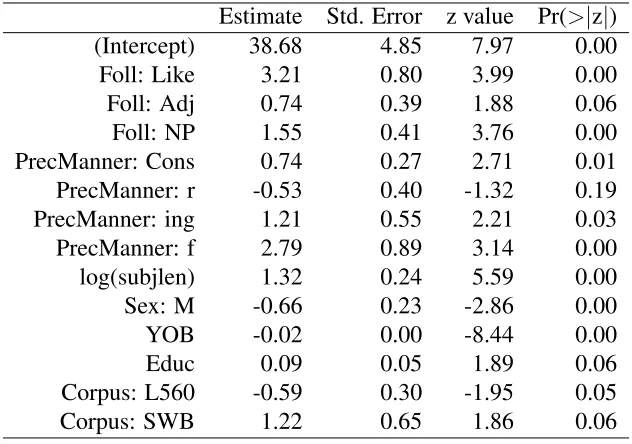
First, notice the skewed proportions of animate subjects in each of the preceding manner categories (Table 2.5, and represented visually in Figure 2.2). Preceding /r/ has the highest proportion of animate subjects (45%), and given that preceding /r/ is correlated with higher contraction rates, and animate subjects are also correlated with higher contraction rates, the preceding /r/ effect may be epiphenomenal of animacy (or vice versa). Also note that words ending in “-ing” areallinanimate.
Manner Percent animate Animate Inanimate Total
r (r) 48% 61 65 121
vowel (v) 35% 88 161 249
non sibiliant fricative (f) 32% 16 34 50
consonant (c) 23% 139 472 611
-ing (ing) 0% 0 45 45
Table 2.5: Raw data for manner by animacy
/r/ in inanimate subjects
Figure 2.2: Percent of animacy coding by preceding segment manner)
Estimate Std. Error z value Pr(>|z|)
(Intercept) 38.68 4.85 7.97 0.00
Foll: Like 3.21 0.80 3.99 0.00
Foll: Adj 0.74 0.39 1.88 0.06
Foll: NP 1.55 0.41 3.76 0.00
PrecManner: Cons 0.74 0.27 2.71 0.01
PrecManner: r -0.53 0.40 -1.32 0.19
PrecManner: ing 1.21 0.55 2.21 0.03
PrecManner: f 2.79 0.89 3.14 0.00
log(subjlen) 1.32 0.24 5.59 0.00
Sex: M -0.66 0.23 -2.86 0.00
YOB -0.02 0.00 -8.44 0.00
Educ 0.09 0.05 1.89 0.06
Corpus: L560 -0.59 0.30 -1.95 0.05
Corpus: SWB 1.22 0.65 1.86 0.06
Table 2.6: Mixed-effects model results for contraction of is after inanimate NP subjects (N=777)
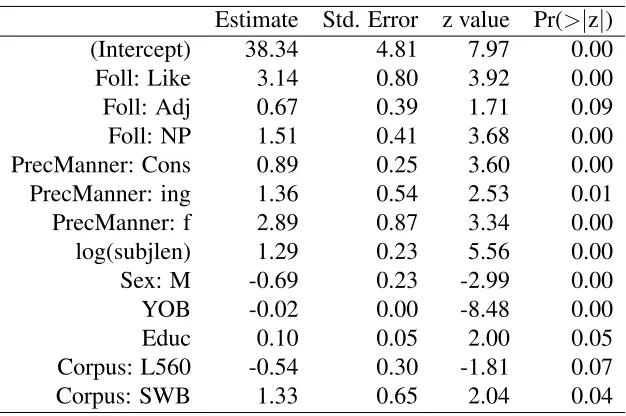
than animate tokens (N=61), so there is no indication of data skewing in this regard. Now that preceding /r/ is not significant, I test if it can be collapsed with another level in preceding segment without worsening the model. First I collapse it with consonants (model1), but the log likelihood ratio test in Table 2.7 demonstrates that this worsens the model. Next, I collapse it with vowels (model3), and the LLRT (in Table 2.8) is not signifi-cantly different for the new model, indicating that we are justified in this collapse. This new model, with /r/ and vowels collapsed, is in Table 2.9. /r/ patterning with vowels supports previous evidence that /r/ is non-consonantal in English (Veatch 1991).
Df AIC BIC logLik deviance Chisq Chi Df Pr(>Chisq)
model1 16 843.51 918.00 -405.76 811.51
model0 17 833.98 913.12 -399.99 799.98 11.53 1 0.00
Table 2.7: LLRT between model with preceding /r/ separate from preceding consonants (model0) vs. preceding /r/ and consonant collapsed (model1)
Df AIC BIC logLik deviance Chisq Chi Df Pr(>Chisq)
model3 16 833.58 908.06 -400.79 801.58
model0 17 833.98 913.12 -399.99 799.98 1.59 1 0.21
Estimate Std. Error z value Pr(>|z|)
(Intercept) 38.34 4.81 7.97 0.00
Foll: Like 3.14 0.80 3.92 0.00
Foll: Adj 0.67 0.39 1.71 0.09
Foll: NP 1.51 0.41 3.68 0.00
PrecManner: Cons 0.89 0.25 3.60 0.00
PrecManner: ing 1.36 0.54 2.53 0.01
PrecManner: f 2.89 0.87 3.34 0.00
log(subjlen) 1.29 0.23 5.56 0.00
Sex: M -0.69 0.23 -2.99 0.00
YOB -0.02 0.00 -8.48 0.00
Educ 0.10 0.05 2.00 0.05
Corpus: L560 -0.54 0.30 -1.81 0.07
Corpus: SWB 1.33 0.65 2.04 0.04
Table 2.9: Mixed-effects model results for contraction ofis after inanimate NP subjects, with preceding /r/ collapsed into preceding vowel (N=777)
/r/ in animate subjects
These results predict that the same patterns would be evident in a subset limited to animate NPs. I briefly go through the same steps as before, as well as discuss preceding non-sibilant fricatives. There are no animate tokens with preceding “-ing”, so these will not be discussed in this subsection.
/r/ has no effect in the general model, as shown in Table 2.10, so I test if /r/ should be merged with consonants or vowels. Again, merging /r/ with consonants is worse in an LLRT test than leaving it uncollapsed (p=0.002), but merging with vowels is not signifi-cantly different than leaving it uncollapsed (Table 2.11). The resulting model is below in Table 2.12.
Estimate Std. Error z value Pr(>|z|)
(Intercept) 24.41 8.19 2.98 0.00
Foll: NP 1.11 0.49 2.26 0.02
colladj 0.68 0.44 1.54 0.12
PrecManner: Cons 0.79 0.44 1.80 0.07
PrecManner: r -0.94 0.60 -1.56 0.12
PrecManner: f 0.61 0.94 0.65 0.52
log(subjlen) 1.94 0.51 3.81 0.00
Sex: M -0.03 0.38 -0.07 0.94
YOB -0.02 0.00 -3.56 0.00
Educ 0.15 0.07 2.03 0.04
Corpus: L560 0.10 0.45 0.23 0.82
Corpus: SWB 2.50 1.02 2.44 0.01
Table 2.10: Mixed-effects model results for contraction of is after animate NP subjects, with preceding segment manner uncollapsed (N=304)
Df AIC BIC logLik deviance Chisq Chi Df Pr(>Chisq)
model1 14 371.00 422.94 -171.50 343.00
model0 15 370.51 426.17 -170.26 340.51 2.48 1 0.12
Estimate Std. Error z value Pr(>|z|)
(Intercept) 20.85 7.96 2.62 0.01
Foll: NP 1.09 0.49 2.22 0.03
colladj 0.67 0.44 1.52 0.13
PrecManner: cons 1.13 0.39 2.93 0.00
PrecManner: f 1.01 0.90 1.12 0.26
log(subjlen) 1.88 0.50 3.75 0.00
Sex: M -0.01 0.37 -0.02 0.99
YOB -0.01 0.00 -3.26 0.00
Educ 0.16 0.07 2.17 0.03
Corpus: L560 0.12 0.44 0.26 0.79
Corpus: SWB 2.62 1.01 2.59 0.01
Table 2.12: Mixed-effects model results for contraction of is after animate NP subjects, with preceding /r/ collapsed into preceding vowel (N=304)
Below, I further collapse the model for animate subjects into just consonant vs. vowel, with preceding sibilant collapsed with consonant, and preceding /r/ collapsed with vowel (Table 2.13). The LLRT comparing this model to the model with nothing collapsed and the model with only /r/ and vowels collapsed demonstrates that there is no significant difference (Table 2.14).
Estimate Std. Error z value Pr(>|z|)
(Intercept) 21.19 8.09 2.62 0.01
Foll: NP 1.06 0.49 2.16 0.03
colladj 0.64 0.44 1.45 0.15
PrecManner: cons 1.11 0.38 2.92 0.00
log(subjlen) 1.89 0.50 3.75 0.00
Sex: M -0.03 0.37 -0.08 0.94
YOB -0.01 0.00 -3.25 0.00
Educ 0.16 0.07 2.18 0.03
Corpus: L560 0.10 0.45 0.22 0.83
Corpus: SWB 2.63 1.02 2.59 0.01
Df AIC BIC logLik deviance Chisq Chi Df Pr(>Chisq)
model2 13 369.03 417.26 -171.51 343.03
model1 14 371.00 422.94 -171.50 343.00 0.03 1 0.87
model0 15 370.51 426.17 -170.26 340.51 2.48 1 0.12
Table 2.14: LLRT between model with preceding /r/ separate from preceding vowels (model0) vs. preceding /r/ and vowels collapsed (model1), vs. preceding /r/ and vowels collapsedandpreceding non-sibilant fricative and consonants collapsed (model2)
2.5.2 Pronoun differences in
will
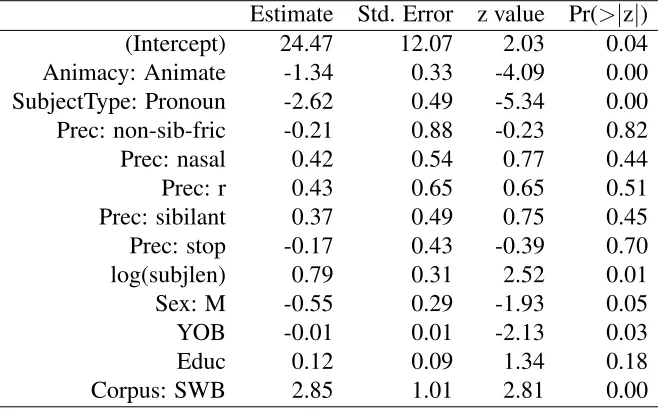
Contraction ofwillmay provide an additional insight into the animacy effect because, un-like is and has, will does not categorically contract after pronouns (MacKenzie, 2012). There are 1041 tokens of pronoun subjects beforewill, and 291 NP subjects, for a total of 1332 tokens in the entirewillmodel. Both animacy and pronominal status improve the model and are statistically significant. In separate models, there is no interaction between the two, indicating that animacy effects are not privileged to either NP or pronoun subjects.
Estimate Std. Error z value Pr(>|z|)
(Intercept) 24.47 12.07 2.03 0.04
Animacy: Animate -1.34 0.33 -4.09 0.00
SubjectType: Pronoun -2.62 0.49 -5.34 0.00
Prec: non-sib-fric -0.21 0.88 -0.23 0.82
Prec: nasal 0.42 0.54 0.77 0.44
Prec: r 0.43 0.65 0.65 0.51
Prec: sibilant 0.37 0.49 0.75 0.45
Prec: stop -0.17 0.43 -0.39 0.70
log(subjlen) 0.79 0.31 2.52 0.01
Sex: M -0.55 0.29 -1.93 0.05
YOB -0.01 0.01 -2.13 0.03
Educ 0.12 0.09 1.34 0.18
Corpus: SWB 2.85 1.01 2.81 0.00
are more likely to contract than subjects ending in consonants.3 Within the pronouns, the
phonological segment preceding the auxiliarywillis entirely collinear with the animacy of the pronouns, such that the pronouns ending in vowels are animate (you, he, sheandwe), and the pronoun ending in a consonant (it) is inanimate. Below I test out various predictions associated with this data. Note: in this smaller data set, the model does not converge unless the subject length factor and the demographic factors are excluded.
If its preceding segment being a consonant is the reason thatitis contracting less than other pronouns, then we would predict a similar vowel vs. consonant effect in NP subjects. However, when the 291 tokens ofwillafter NP subjects are run again in a model with just vowel (N=29) vs. consonant (N=262) as preceding segment, the preceding segment is not significant (Table 2.16), and the LLRT is not significantly different when the preceding segment is excluded. Due to convergence problems mentioned above, however, only two factors were included in this model: animacy and preceding segment.
Estimate Std. Error z value Pr(>|z|)
(Intercept) 1.77 0.59 3.00 0.00
Animacy: Animate -1.30 0.35 -3.75 0.00
PrecSeg: cons -0.10 0.54 -0.19 0.85
Table 2.16: NP subjects by animacy and vowel vs. consonant (N=291)
One could posit that this is a small data problem – there are far fewer NPs ending in vowels than ending in consonants. While the generalized linear model should account for this skewed data, it is possible that, given more NPs ending in vowels, there could be a different effect of preceding segment. To maximize similarities between the NP dataset and the pronoun dataset, I subset to NPs ending in alveolar stops (/t/ or /d/) (N=45) and 3There is also interesting work on “close” phonological relationships that could be causing subject type
vowels (N=29) and run a separate generalized linear model (Table 2.17). There is still no significant effect of vowel on contraction rates, while animacy continues to be a large and significant effect (p=0.01).
Estimate Std. Error z value Pr(>|z|)
(Intercept) 1.86 0.70 2.64 0.01
Animacy: Animate -1.70 0.67 -2.52 0.01
Prec: coronal -0.61 0.59 -1.03 0.30
Table 2.17: NP subjects by animacy and vowel vs. preceding /t, d/ (N=74)
If this is the result of the animacy effect, then I would predict to see it acting differ-ently than other pronouns for other auxiliaries. However, this is only the case for would
(MacKenzie, 2012). It is possible that the other auxiliaries have hit a ceiling effect for short allomorphy selection, such that there is so little variation to begin with that any additional effect of animacy does not change the outcome. This is not unprecedented, given that the strong and replicated following constituent effect onis is also apparent for noun phrase subjects but not for pronouns, which MacKenzie analyzes as result of the ceiling effect of short allomorphy selection forisafter pronoun subjects (2012).
Therefore, I propose that one possible reason forit’s special status is that it is inanimate, and therefore, like NP inanimate subjects, prefers the full form of the auxiliary.
2.6 Ruling out alternative explanations
effect. Proper names, intervening nouns, and prosodic factors have no effect.
2.6.1 Following constituent effects
First I turn to following constituent effects, which could conceivably be confounded with animacy effects, because animates may be more likely to be agents, and agents may be more likely to take verbs as arguments after copula. I compare models of following con-stituents and determine that the animacy effect does not change how the levels of following constituent should be collapsed. First, I check if animacy and following constituent type interact: there is no significant interaction, and including the interaction does not signifi-cantly improve the model. With regard to MacKenzie’s collapsing of locative and adjective, that remains non-significant in model-to-model comparisons, justifying the collapse. Any further collapses (such as only having two categories, verb vs. other), are significantly worse than the model with the NP, adjective, and verb, showing that MacKenzie’s analy-sis is robust to animacy in this respect. In other words, although including animacy as a factor significantly improves the model, it does not interact with or change the following constituent effect.
2.6.2 Subject length
Estimate Std. Error z value Pr(>|z|)
(Intercept) 0.36 0.38 0.95 0.34
Animate: Y -1.25 0.22 5.66 p<0.0001
Prec: Cons 0.56 0.27 -2.10 0.04
Foll: NP 0.72 0.34 -2.13 0.03
Foll: Adj 0.54 0.32 -1.67 0.09
Table 2.18: Animacy effects in 2-word subjects (N=610)
These effects are reminiscent of English genitive variation, which is also conditioned by NP weight and animacy. Although NP weight and animacy are highly correlated (Rosen-bach, 2005), such that animates are more likely to have low weight, Rosenbach teased apart these factors and determined that they are independent effects.4
2.6.3 Frequency
It is possible that the animacy effect could be the result of animate subjects being highly frequent. Under some theories, highly frequent lexical items are claimed to condition re-duction near them (Bybee 1997, Bybee, 2002). Thus, the animacy effect could be epiphe-nomenal of a larger frequency effect. Frequency is computed using SUBTLEX-US fre-quency norms. Proper nouns are excluded because their frefre-quency measurements are not reliable given that they are often socially- or geographically-constrained.
There is no significant effect of the log odds of lexical frequency for the word immedi-ately preceding the auxiliaryis(p=0.27), nor for the head noun of the the subject (p=0.40). There is also no evidence that a more abstract concept of frequency is at play. Frequency of animate subjects as a whole versus inanimate subjects as a whole could be predicted to affect variation. However, the frequency rates in this corpus are not compatible with this account: inanimate subjects are more frequent (72%), yet contract less.
4Note that Rosenbach also teased apart topicality and animacy in English, and found that, like weight and
![Figure 2.1: Long or short underlying allomorphs of surface representations [chart fromLignos & MacKenzie 2014]](https://thumb-us.123doks.com/thumbv2/123dok_us/9369051.1470542/34.612.225.433.401.498/figure-long-underlying-allomorphs-surface-representations-fromlignos-mackenzie.webp)