Optimization of Feedback Controller in
Restructured Power System Using
Evolutionary Genetic Algorithms
1
S.FAROOK Research scholar S.V.U College of Engineering
S.V University
Tirupathi, Andhra Pradesh, India. [email protected]
2
Dr. P.SANGAMESWARA RAJU Professor, EEE Department S.V.U College of Engineering
S.V University
Tirupathi, Andhra Pradesh, India. [email protected]
Abstract: In this paper an attempt is made to optimize the feedback controller to improve the dynamics of a restructured multiarea power system using Evolutionary Real coded Genetic Algorithm (RCGA). Optimization using state variables is a difficult task as the access to all variables is limited and also measuring all of them is impossible. To solve the problem Evolutionary Genetic algorithms were proposed to optimize the feedback gains of the controller, having access to few of the AGC variables. The feasibility and robustness of the algorithm is investigated on a two area interconnected power system consisting of two identical thermal plants in each areas in restructured environment. The dynamics of frequency deviations and tie-line power deviations were investigated by considering a demand of 0.1pu MW contracted by GENCOs in each area of the restructured power system. The results obtained by the proposed method are found to be quite encouraging when compared with those achieved using optimal controllers derived using Linear Quadratic Regulator (LQR) theory.
Keywords: Multi area AGC, Feedback controller, Bilateral contracts, ISO, LFC dynamics,
Restructuring, Real coded genetic algorithm. 1. Introduction *
ver decades Traditional electric utilities have been vertically integrated monopolies that have generation, transmission, and distribution as a single utility. For the past decade, the electric power industry has been going through a process of transition and restructuring by moving away from the vertically integrated monopolies and towards competitive markets. With restructuring the ancillary services are no longer an integral part of the electricity supply, as they used to be in the vertically integrated power industry structure. In a competitive environment, the provision of these services must be carefully managed so that the power system requirements and market objectives are adequately met. Automatic generation control is the one of the most important ancillary services required to be maintained for minimizing frequency deviations, imbalance of generation and load demand, and for regulating tie-line flows, facilitating bilateral contracts spanning over several control areas and to maintain a reliable operation of the interconnected transmission system.
2. Multi-area AGC in Restructured Power System
The first step in restructure is to unbundle the generation of power from the transmission and distribution however, the common LFC goals, i.e. restoring the frequency and the net interchanges to their desired values for each control area remains same. Thus in a restructured scenario generation, transmission and distribution is treated as separate entities [2], [12]. As there are several GENCOs and DISCOs in the restructured scenario, agreements/ contracts should be established between the DISCOs and GENCOs with in the area or with interconnected GENCOs and DISCOs to supply the regulation. The DISCOs have the liberty to contract with any available GENCOs in its own or with other areas. Thus, there can be various combinations of the possible contracted scenarios between DISCOs and GENCOs. A DISCO having contracts with GENCOs in another control area are known as “Bilateral transactions” and within same area is known as “POOL transactions”. The concept of DISCO Participation Matrix (DPM) [1], [2], [12] is utilized to express these possible contracts in the generalized model. DPM is a matrix with the number of rows equal to the number of GENCOs and the number of columns equal to the number of DISCOs in the overall system. The entities of DPM are represented by the contract participation factor (cpfij) which corresponds to the fraction of total load contracted by any DISCOj towards any GENCOi.
Fig.1. Block diagram representation of two area Restructured power system
The DPM matrix is given by:
DPM= [cpf11 cpf12 cpf1j . . cpf1n cpf21 cpf22 cpf2j . . cpf2n cpfi1 cpfi2 cpfij . . cpfin . . . . . .
cpfn1 cpfn2 cpfn3 . . cpfnn ] (1)
The sum of all entries in each column of DPM is unity.
∑ cpf = 1 (2) Under steady state the power equations in restructured environment are,
∆Pd i=∆PLOC i + ∆PUC I (3)
Where ∆PLOC i= ∑ ΔP (4)
The scheduled contracted power exchange is given by
The tie-line power exchanged between area 1 and area 2 is given by:
Δ = ( − ) (6)
At any time the tie-line power error is given by:
Δ = Δ - Δ (7)
Δ vanishes in the steady-state as the actual tie-line power flow reaches the scheduled power flow. This error signal is used to generate the respective command signals in each area; The ACE in each area is given by:
= ∆ +Δ (8)
= ∆ + a12*Δ (9)
Where a12=-Pr1/Pr2
The total power supplied by ith GENCO is given by:
ΔPgki = ∆ + apfki ∑ ΔP (10)
Where = ∑ ∆ (11)
ΔPgkiis the desired total power generation of a GENCO i in area k and must track the contracted and
un-contracted demands of the DISCOs in contract with it in the steady state.
3. Controller design
An optimal AGC strategy based on the linear state regulatory theory requires the feedback of all state variables of the system for its implementation, and an optimal control feedback law is obtained by solving the non-linear Riccati equation using suitable computational technique. In practical environment access to all variables is limited and also measuring all of them is impossible [3]. To solve the problem in the proposed paper some of the measurable variables are selected for the feedback control law. To illustrate the effectiveness of the proposed control design and the algorithm to tune the feedback gains to the controller, a two area Restructured power system having two GENCOs and two DISCOs in each area is considered. The two area power system, shown in Fig.1 can be described by the following controllable and observable time-invariant state space representation as:
=A. X + B .U (12)
Y=C.X (13)
Where X is the state vector and U is the vector of contracted and un-contracted power demands of the DISCOs.
X=[ Δf1 Δf2 ΔPg1 ΔPg2 ΔPg3 ΔPg4 ∫ACE1 ∫ACE2 ΔPtie12,act]T (14)
and U=[ ΔPL1 ΔPL2 ΔPL3 ΔPL4 ΔPd1 ΔPd2]T (15)
for the system defined by the Eq.(12) and (13), the feedback control law is given as,
U= -K.Y (16)
Where K is the feedback gain matrix. In this paper Evolutionary Genetic algorithms is used to optimize the feedback gains of the controller.
4. Evolutionary Algorithms
4.1. Real Coded Genetic algorithm
Genetic algorithm (GA) is an optimization method based on the mechanics of natural selection. In nature, weak and unfit species within their environment are faced with extinction by natural selection. The strong ones have greater opportunity to pass their genes to future generations. In the long run, species carrying the correct combination in their genes become dominant in their population. Sometimes, during the slow process of evolution, random changes may occur in genes. If these changes provide additional advantages in the challenge for survival, new species evolve from the old ones. Unsuccessful changes are eliminated by natural selection. In real-coded genetic algorithm (RCGA), a solution is directly represented as a vector of real parameter decision variables, representation of the solutions very close to the natural formulation of the problem [8], [4]. The use of floating-point numbers in the GA representation has a number of advantages over binary encoding. The efficiency of the GA gets increased as there is no need to encode/decode the solution variables into the binary type.
4.1.1 Chromosome structure
In GA terminology, a solution vector known as an individual or a chromosome. Chromosomes are made of discrete units called genes. Each gene controls one or more features of the chromosome [8]. The chromosome string comprises of all feedback gains encoded as a string of real numbers.
4.1.2 Fitness-Objective function evaluation
The objective here is to minimize the deviation in the frequency of two areas and the deviation in the tie line power flows and these variations are weighted together by a linear combination to a single variable called the ACE. The fitness function is taken as the Integral of time multiplied absolute value of ACE at every discrete time instant in the simulation [1], [2]. An optional penalty term is added to take care of the transient response specifications viz. transient response specifications on system frequency settling time, over shoots, etc. Integral of time multiplied absolute value of the Error (ITAE), is given by,
dt ) ( 0
= Tsim t e tITAE (17)
Where e(t)= error considered.
The fitness function to be minimized is given by
(
f f P)
dt FDJ Tsim Error Tie + Δ + Δ + Δ =
0 12 2 2 1 1 β β (18)Where FD=α1 OS+ α2TS (19)
Where Overshoot (OS) and settling time (TS) for 2% band of frequency deviation in both areas is considered for evaluation of the FD [9].
4.1.3 Selection
Selection is a method of selecting an individual which will survive and move on to the next generation based on the fitness function from a population of individuals in a genetic algorithm. In this paper tournament selection is adopted for selection [4], [7], [8]. The basic idea of tournament selection scheme is to select a group of individuals randomly from the population. The individuals in this group are then compared with each other, with the fittest among the group becoming the selected individual.
4.1.4 Crossover
The crossover operation is also called recombination. This operator manipulates a pair of individuals (called parents) to produce two new individuals (called offspring or children) by exchanging corresponding segments from the parents' coding [8]. In this paper simple arithmetic crossover is adopted.
4.1.5 Mutation
By modifying one or more of the gene values of an existing individual, mutation creates new individuals and thus increases the variability of the population [8]. In the proposed work Uniform mutation is adopted.
4.1.6 Elitism
4.2. Pseudo Code for the Proposed RCGA
Step 1: Initialization
Set gen=1. Randomly generate N solutions to form the first population, Pinitial. Evaluate the fitness of solutions in Pinitial. Initialize the probabilities of crossover (pc) and mutation (pm).
While (gen ≤ Max number of generations) Step 2: Selection
Select the individuals, called parents that contribute to the population at the next generation. In the proposed GA tournament selection is used.
Step 3: Crossover
Generate an offspring population Child, if pc >rand,
Choose one best solutions x from Pinitial based on the fitness values and random solution y from the population for crossover operation. Using a crossover operator, generate offspring and add them back into the population.
child1= r parent1 + (1 − r) parent2; child2= r parent2 + (1 − r) parent1; end if
Step 4: Mutation
Mutation alters an individual, parent, to produce a single new individual, child. if pm >rand,
Mutate the selected solution with a predefined mutation rate. end if
Step 5: Fitness assignment
The fitness function defined by Eq. (18) is minimized for the feasible solution. Step 6: Elitism
The selected number of Elite solutions (best solutions) is preserved in subsequent generations in the population.
Step 7: stopping criterion
If the maximum number of generations has reached then terminate the search and return to the current population, else, set gen=gen+1and go to Step 2.
end while
The values of GA operator used for optimization is presented in appendix B.
5. Simulation
To investigate the performance of the proposed RCGA, a two area power system consisting of two GENCOs and two DISCOs in each area is simulated by considering a load demand of 0.1puMW contracted by GENCOs in each area. The concept of a “DISCO participation matrix” (DPM) is used for the simulation of contracts between GENCOs and DISCOs. In a Restructured AGC system, a DISCO asks/demands a particular GENCO or GENCOs within the area or from the interconnected area for load power. Thus, as a particular set of GENCOs are supposed to follow the load demanded by a DISCO, information signals must flow from a DISCO to a particular GENCO specifying corresponding demands. The demands are specified by contract participation factors and the pu MW load of a DISCO. These signals will carry information as to which GENCO has to follow a load demanded by which DISCO. The bilateral contracts between the GENCOs and DISCOs is considered using the following DPM:
DPM=[ 0.5 0.25 0.0 0.3 0.2 0.25 0.0 0.0 0.0 0.25 1.0 0.7 0.3 0.25 0.0 0.0 ];
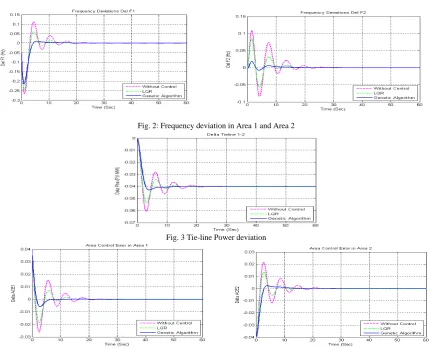
5.1. Case I: Step load of 0.1 pu MW demanded by GENCOs in area I
Fig. 2: Frequency deviation in Area 1 and Area 2
Fig. 3 Tie-line Power deviation
Fig. 4: Area Control Error (ACE) in Area 1 and Area 2
The Eigen values closed loop system computed for the above operating condition is tabulated in table 1.
Table 1: Eigen values of close loop system matrix
Mode Uncontrolled LQR RCGA
Δf1
Δf2
ΔPg1
ΔPg2
ΔPg3
ΔPg4
∫ACE1
∫ACE2
ΔPtie12
-13.96 + 1.26i -13.96 - 1.26i -14.03 -13.49 0.89 + 3.41i 0.89 - 3.41i -0.12 + 0.14i -0.12 - 0.14i 0.007
-13.45 -13.47 -13.34 -13.33 -0.31 + 0.99i -0.31 - 0.99i -1.80 -2.50 -2.50
-13.50 + 0.17i -13.50 - 0.17i -13.38 -13.36 -0.88 + 1.57i -0.88 - 1.57i -1.94 -2.46 + 0.06i -2.46 - 0.06i
Fig. 6: Tie-line Power deviation
Fig. 7: Area Control Error (ACE) in Area 1 and Area 2
The Eigen values closed loop system computed for the above operating condition is tabulated in table 2.
Table 2: Eigen values of close loop system matrix
Mode Uncontrolled LQR RCGA
Δf1
Δf2
ΔPg1
ΔPg2
ΔPg3
ΔPg4
∫ACE1
∫ACE2
ΔPtie12
-13.96+1.26i -13.96- 1.26i -14.03 -13.49 0.89 + 3.41i 0.89- 3.41i -0.12+ 0.14i -0.12- 0.14i 0.007
-13.45 -13.47 -13.34 -13.33 -0.31 + 0.99i -0.31 - 0.99i -1.80 -2.50 -2.500
-13.66 -13.40 -13.31 + 0.02i -13.31 - 0.02i -1.20 + 1.24i -1.20 - 1.24i -2.41 + 0.29i -2.41 - 0.29i -2.494
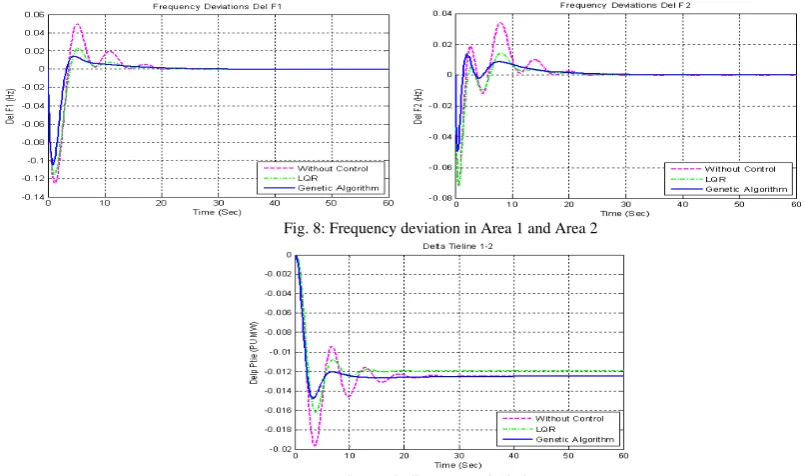
5.3. Case III:Step load of 0.05 pu MW demanded by GENCOs in both areas
Fig. 8: Frequency deviation in Area 1 and Area 2
Fig. 10: Area Control Error (ACE) in Area 1 and Area 2
The Eigen values closed loop system computed for the above operating condition is tabulated in table 3.
Table 3: Eigen values of close loop system matrix
Mode Uncontrolled LQR RCGA
Δf1
Δf2
ΔPg1
ΔPg2
ΔPg3
ΔPg4
∫ACE1
∫ACE2
ΔPtie12
-13.96+1.268i -13.96-1.268i -14.03 -13.49 0.89+3.412i 0.89-3.412i -0.12+0.145i -0.12-0.145i 0.007
-13.45 -13.47 -13.34 -13.33 -0.31+0.995i -0.31-0.995i -1.80 -2.50 -2.50
-12.880 -13.388 -13.360 + 0.031i -13.360 - 0.031i -0.531 + 0.911i -0.531 - 0.911i -2.964 -2.283 -2.489
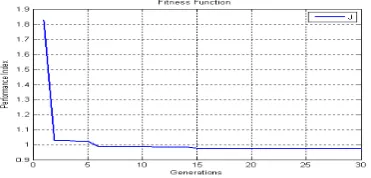
The convergence characteristic of the objective function given in Eq.(18) with the algorithm is shown in Fig. 11.
Fig.11. Convergence characteristic of the objective function
6. Conclusions
References
[1] Y.L.Karnavas,K.S.Dedousis, (2010)- Overall performance evaluation of evolutionary designed conventional AGC controllers for interconnected electric power system studies in a deregulated market environment- International journal of Engineering, Science and Technology,Vol. 2, pp150-166 ,
[2] Elyas Rakhshani , Javad Sadeh, (2010) - Practical viewpoints on load frequency control problem in a deregulated power system- Energy Conversion and Management 51,pp 1148–1156,
[3] Prabhat Kumar, Safia A Kazmi, Nazish Yasmeen,(2010) -Comparative study of automatic generation control in traditional and deregulated power environment- World Journal of Modelling and Simulation Vol. 6 No. 3, pp. 189-197,
[4] Pingkang Li1 Xiuxix Du ,(2009) - Multi-Area AGC System Performance Improvement Using GA Based Fuzzy Logic Control- The International Conference on Electrical Engineering,
[5] Janardan Nanda,S.Mishra, Lalit Chandra Saikia, (2009)- Maiden application of Bacterial Foraging based optimization technique in multiarea Automatic generation control,-IEEE Transactions on power systems, Vol. 24. No.2,pp 602-609,
[6] F. Yang and C. S. Chang (2009)-Multiobjective Evolutionary Optimization of Maintenance Schedules and Extents for Composite Power Systems- IEEE Transactions on power systems, Vol. 24, NO. 4, pp 1694 – 1702,
[7] K.S.S. Ramakrishna, T.S. Bhatti, (ICEE 2006),- Load frequency control of interconnected hydro-thermal power systems-International Conference on Energy and Environment 2006
[8] A. Konak et al, (2006) - Multi-objective optimization using genetic algorithms: A tutorial- / Reliability Engineering and System Safety 91 992–1007
[9] Bevrani, Hassan and Mitani, Yasunori and Tsuji, Kiichiro, (2003) Robust LoadFrequency Regulation In a New Distributed Generation Environment. In Proceedings IEEE Power Engineering Society General Meeting.
[10] V. Donde.M. A. Pai,I. A. Hiskens-Simulation of Bilateral Contracts in an AGC System After Restructuring,
[11] Hassan Bevrani, Yasunori Mitani and Kiichiro Tsuji, (2003)-A scenario on Load-Frequency Controller Design in a Deregulated Power System- SICE annual conference, August,
[12] V. Donde, M. Pai, I. Hiskens,(2001). Simulation and Optimization in an AGC System after Deregulation. IEEE Transactions on Power Systems, 16(3): 481–488,
[13] P. Kundur- Power system stability and control: Mc Graw Hill.
Appendix A: State space matrix
A=[-1/Tp1 0 Kp1/Tp1 Kp1/Tp1 0 0 0 0 0 0 0 0 -Kp1/Tp1 0 -1/Tp2 0 0 Kp2/Tp2 Kp2/Tp2 0 0 0 0 0 0 -a12*Kp2/Tp2 0 0 -1/Tt1 0 0 0 1/Tt1 0 0 0 0 0 0
0 0 0 -1/Tt2 0 0 0 1/Tt2 0 0 0 0 0 0 0 0 0 -1/Tt3 0 0 0 1/Tt3 0 0 0 0 0 0 0 0 0 -1/Tt4 0 0 0 1/Tt4 0 0 0
-1/(2*pi*R1*Tg1) 0 0 0 0 0 -1/Tg1 0 0 0 -apf1*Ki1/Tg1 0 0 -1/(2*pi*R2*Tg2) 0 0 0 0 0 0 -1/Tg2 0 0 -apf2*Ki1/Tg2 0 0 0 -1/(2*pi*R3*Tg3) 0 0 0 0 0 0 -1/Tg3 0 0 -apf3*Ki2/Tg3 0 0 -1/(2*pi*R4*Tg4) 0 0 0 0 0 0 0 -1/Tg3 0 -apf3*Ki2/Tg3 0 B1/(2*pi) 0 0 0 0 0 0 0 0 0 0 0 1
0 B2/(2*pi) 0 0 0 0 0 0 0 0 0 0 a12 T12/(2*pi) -T12/(2*pi) 0 0 0 0 0 0 0 0 0 0 0] ; B=[-Kp1/Tp1 -Kp1/Tp1 0 0 -Kp1/Tp1 0 0 0 -Kp2/Tp2 -Kp2/Tp2 0 -Kp2/Tp2 0 0 0 0 0 0
0 0 0 0 0 0 0 0 0 0 0 0 0 0 0 0 0 0
cpf11/(Tg1) cpf12/(Tg1) cpf13/(Tg1) cpf14/(Tg1) 0 0 cpf21/(Tg2) cpf22/(Tg2) cpf23/(Tg2) cpf24/(Tg2) 0 0 cpf31/(Tg3) cpf32/(Tg3) cpf33/(Tg3) cpf34/(Tg3) 0 0 cpf41/(Tg4) cpf42/(Tg4) cpf43/(Tg4) cpf44/(Tg4) 0 0 (cpf31+cpf41) (cpf32+cpf42) -(cpf13+cpf23) -(cpf14+cpf24) 0 0 a12(cpf31+cpf41) a12(cpf32+cpf42) -a12(cpf13+cpf23) -a12(cpf14+cpf24) 0 0
0 0 0 0 0 0];
Appendix B: Genetic algorithm parameters
Parameter Value No of population 100
Maximum no of generations 30 Crossover Arithmetic
Crossover probability (pc) 0.95
Mutation Uniform Mutation probability (pm) 0.1
Elitism Yes No. of Elite solutions 2
Appendix C: Parameters values of power system
Parameters Area 1 Area 2 Tti (sec) 0.4 0.4
Tgi (sec) 0.75 0.75
Ri (pu/Hz) 3 3
Kpi 127.5 127.5
Tpi (sec) 25 25
Bi (pu/Hz) 0.532 0.532
Ki 0.2 0.2
Appendix D: Nomenclature
B i Frequency bias
Ri Droop characteristic
Pmki Contracted power generated by GENCO
Pgki Total power generated by GENCO
Ki Integration controller gain
GENCO Generation company DISCO Distribution company ISO Independent system operator ACE Area control error
apf Area participation factor cpf Contract participation factor KP Power system equivalent gain
TP Power system equivalent time constant
Tg Time constant of governor
Tt Time constant of turbine
PLoc Total local contracted demand
PLC Contracted demand of DISCO
PLUC Un-contracted demand
Ptie,error Tie-line power error
Ptie,actual Tie-line actual power
Ptie,Scheduled Tie-line Scheduled power
Authors Biography
S. Farook received B.Tech degree in Electrical & Electronics engineering from SVNEC, Tirupathi in 2001 and M.Tech degree in power systems and High voltage Engineering from JNTU, Kakinada in the year 2004. He presently is working towards his Ph.D degree in S.V. University, Tirupathi. His areas of interest are in power system operation & control and stability.