ISSN (e): 2250-3021, ISSN (p): 2278-8719
Vol. 09, Issue 2 (February. 2019), ||V (I) || PP 74-79
Blind Channel Equalization Using Adaptive Signal Processing
Algorithms
Swastika Mishra and Jibendu Sekhar Roy
School of Electronics Engineering, Kalinga Institute of Industrial Technology (KIIT) Deemed to be University, Bhubaneswar-751024, Odisha, INDIA
Corresponding Author:Jibendu Sekhar Roy
Abstract
– The objective of this paper is to investigate the blind channel equalization using least mean square (LMS) algorithm and its variants. Digital transmission systems impose the application of channel equalizers with short training time, high tracking rate, high data rate and quality. Thus, it is necessary to define new and robust algorithms to equalize channels and reduce noise in communications. In this paper LMS algorithm and its variants normalized LMS (NLMS) and sign LMS (SLMS) algorithms are used for implementation of blind channel equalization. The performance of each algorithm is studied separately and results are compared. It is found that the convergence rate and error performance of NLMS and SLMS equalizers are better than LMS equalizer.Index Terms –Blind channel equalization, adaptive signal processing algorithm, constellation, convergence
--- --- Date of Submission: 26-01-2019 Date of acceptance:09-02-2019 ------I.
INTRODUCTION
Time dispersion in a communication channel is compensated by equalization techniques which ultimately minimizes inter-symbol interference (ISI) effect. The equalization technique provides an approximation to an ideal transmission medium. Bandwidth-efficient data transmission over telephone and radio channels is made possible by the use of adaptive equalization to compensate for the time dispersion introduced by the channel. Therefore to investigate an equalizer with high computational complexity and possible robustness in fixed-point implementation is very vital [1-3]. Digital signal processing (DSP)-based equalizer systems have become pervasive in many wide applications including voice, data, and video communications via various transmission media [4]. Equalization can reduce the ISI and noise effects for better demodulation. In telecommunication, equalization is the reversal of distortion incurred by a signal transmitted through a channel. Equalizers are used to render the frequency response for instance of a telephone line from end-to-end. A time-invariant channel is measured by a fixed equalizer and it compensates the frequency selectivity during the entire transmission of data [5, 6]. An adaptive equalizer adjusts its coefficients to track a slowly time-varying channel. Besides correcting for channel frequency-response anomalies, it can cancel the effects of multipath signal components, which can manifest themselves in the form of voice echoes, video ghosts or Rayleigh fading conditions in mobile communications channels. Adaptive equalizers assume channel is time varying channel and try to design equalizer filter whose filter coefficients are varying in time according to the change of channel, and try to eliminate ISI and additive noise at each time. The implicit assumption of adaptive equalizers is that the channel is varying slowly. Blind equalizers use properties in data format to recover the transmitted symbol. When the system in unknown and input is inaccessible this type of de-convolution is referred to as blind de-convolution. Non blind equalizers are data aided and use pilot sequences (training sequence) however since these results in occupation of the data package space, a reduction of system capacity occurs. A pre-known signal characteristic could be used to estimate the equalizer’s coefficients. Using this technique, problems concerning sparse pilot sequences and fast changing channels are avoided. Blind equalizers use signal symbols instead of pilot sequences [7, 8]. The LMS algorithm, as well as others related to it, is widely used in various applications of adaptive filtering due to its computational simplicity [8]. NLMS and SLMS are variants of the LMS algorithm with better performance and convergence behaviour [9, 10, 11].
II.
LMS, NLMS AND SLMS ALGORITHMS
LMS algorithm is an adaptive algorithm which incorporates an iterative procedure that makes successive corrections to the weight vector in the direction of the negative of the gradient vector which eventually leads to the minimum mean square error. Adaptive algorithm is used to reduce the error e(n) to minimum between desired signal d(n) and array output y(n), as [9]
𝑒 𝑛 = 𝑑 𝑛 − 𝑦(𝑛) (1) Weight updating equation of LMS algorithm is
𝑤 𝑛 + 1 = 𝑤 𝑛 + 𝜇𝑥 𝑛 𝑒∗(𝑛) (2) Where, μ is the step size parameter and e(n) is the error between output, e*(n) is the complex conjugate of e(n)
and x(n) = [x1(n), x2(n) ---xN(n)] is the signal received.
NLMS Algorithm can be formulated as a natural modification of the LMS algorithm based on stochastic gradient algorithm. Final weight vector updated NLMS algorithm equation is [10]
w n + 1 = w n + μ
∥x(n)∥2x n e
∗(n) (3)
Where the step size μ(n) is defined as
𝜇 𝑛 = 𝜇
∥𝑥(𝑛)∥2 (4)
SLMS Algorithm reduces the complexity of the LMS algorithm in which only the polarity information of the error signal or data signal or both data and error is used for the filter coefficients update. The adaptation equation of the SLMS algorithm is given by [10, 11]
w n + 1 = w n +μx n e∗ n sgn[x n ] (5)
Where,
sgn x n =
+1; x n > 0 0; x n = 0 −1; x n < 0
(6)
This algorithm deduces the error in terms of speed and hardware by assessing its gradient value in terms of its sign value as given in the above mentioned equations.
III.
BLIND CHANNEL EQUALIZATION USING ADAPTIVE SIGNAL PROCESSING
ALGORITHMS
In this paper, Gaussian communication channel which is random in nature is considered. The random transmitted signal is modulated by QPSK method.
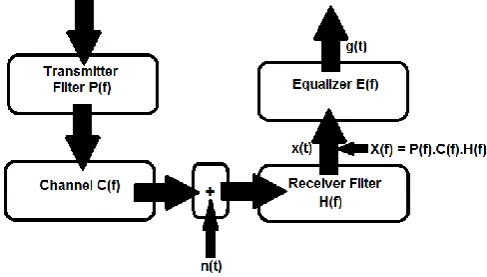
Fig. 1 . Block diagram of blind channel equalization
In QPSK the original data stream dk(t) = d0 , d1 , d2 ,… is divided into an in-phase stream, dI(t), and a quadrature
stream, dq(t) as
𝑑𝑞 𝑡 = 𝑑1, 𝑑3, 𝑑5, … (8)
dI(t) and dq(t) each have half the bit rate of dk(t). A convenient orthogonal realization of a QPSK waveform, S(t),
is achieved by amplitude modulating the in-phase and quadrature data streams as
𝑆 𝑡 = 1
2 [𝑑𝐼 𝑡 cos 2𝜋𝑓0𝑡 + 𝜋
4 + 𝑑𝑞 𝑡 sin 2𝜋𝑓0𝑡 + 𝜋
4 ] (9)
The channel is distorted by adding zero mean white Gaussian noise with a variance. Then the channel is equalized with adaptive LMS, NLMS.
The parameter values used for simulation are:
Number of data samples=3000, number of training symbols =2000, SNR=25dB, Step size (µ)=0.001
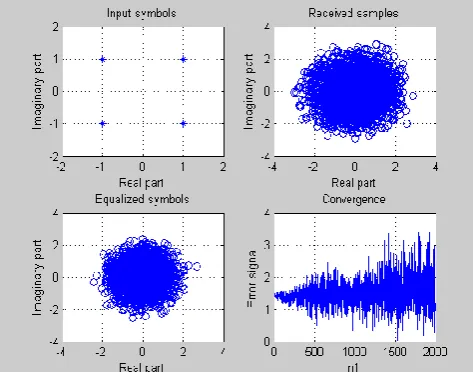
The simulation results of constellation, for blind channel equalization, using LMS, NLMS and SLMS are shown in Fig. 2, Fig. 3 and Fig. 4.
Fig. 2. Constellation diagram for blind equalization using LMS
Fig. 4.Constellation diagram for blind equalization using SLMS
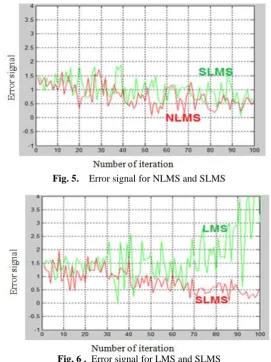
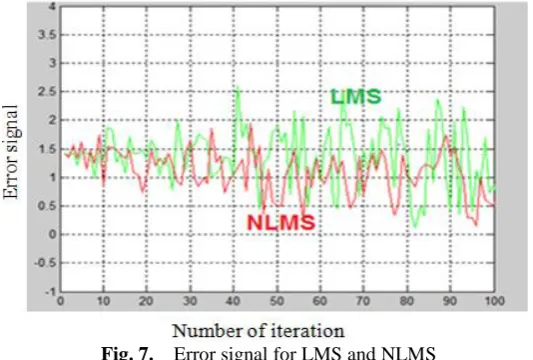
From the above output graphs it can be seen that they have four different sections for input symbol, received symbol equalized symbol and convergence plot respectively. It can be seen from the above figures that equalization of symbols is more prominently seen in case of equalization using NLMS algorithm while it is poor in case of LMS algorithm. Convergence graph of all three equalizers i,e LMS ,NLMS and SLMS are compared with each other. The convergence comparison is shown in Fig. 5, Fig. 6 and in Fig. 7.
Fig. 5. Error signal for NLMS and SLMS
Fig. 7. Error signal for LMS and NLMS
It can be examined from the convergence analysis that the equalized signal by NLMS and SLMS equalizer show better error convergence graph than LMS equalizer.
Symbol error rate (SER) is defined as error per symbol transmitted
SER=1 2𝑒𝑟𝑓𝑐
𝐸𝑠
𝑁0 (10) SER of the equalized signal is obtained for two different values of step size, i.e., 0.01 and 0.001 and the simulated results are tabulated in Table 1.
Table no 1:Simulated results for symbol error rate(SER) Step size (µ) SER (LMS) SER (NLMS) SER (SLMS) 0.01 0.6312 0.0034 0.0628 0.001 0.7758 0.0037 0.0185
It can be seen from the table that SER is less in case of NLMS and SLMS then in case of LMS.
IV.CONCLUSION
Adaptive channel equalization and blind equalization are among the most successful applications of adaptive filtering which ultimately minimizes ISI in digital communication. Adaptive equalizers give better performance for blind equalization. In this paper, the convergence of LMS, NLMS & SLMS are studied with graphical representations. Symbol error rate are also found out. It is seen that NLMS and SLMS algorithm show better performance and stability than LMS algorithm. So, these advanced LMS algorithms and other modified versions can be effectively used in various real-time communication problems. Here in simulation, it is assumed that the channel is distorted by adding zero mean white Gaussian noise with a variance and this is limitation of the present work.
REFERENCES
[1]. Qureshi SUH. Adaptive equalization. Proceedings of the IEEE, 1985, 73; 1349-1387.
[2]. Mourjopoulos JN. Digital equalization of room acoustics. Proceedings of J.Audio Eng.Soc, 1994,42(11); 67-98.
[3]. Dhamija S, and Tayal A. Adaptive filtering algorithms for channel equalization and echo cancellation. Int. J. Comp. Tech. Appl, 2011, 2(5); 1577-1581.
[4]. Anjum MAR. A new approach to adaptive signal processing. Journal of Electrical Engineering and Informatics (IJEEI), 2005, 3(2).
[5]. Moustakides GV. Locally optimum adaptive signal processing algorithms. IEEE transactions on signal processing, 1998, 46(12); 3315 – 3325.
[6]. Mahmood L, Shirazi SF, Naz S, Shirazi H, Razzak MI, Umar AI, and Ashraf SS. Adaptive filtering algorithms for channel equalization in wireless communication. Indian Journal of Science and Technology, 2015, 8(17); 1195-1245.
International organization of Scientific Research
79 | Page
Internet - Performance Comparison of Non-linear and Adaptive Equalization Algorithms for Wireless Digital Communication, Nepal, 2009, 1; 4570-4577.
[8]. Suthendran K, and Arivoli T. Performance comparison of adaptive and blind equalization algorithms for wireless communication. Bonfring International Journal of Research in Communication Engineering, 2013, 3(1); 1-6.
[9]. Senapati A, Ghatak K, and Roy JS. A comparative study of adaptive beamforming techniques in smart antenna using LMS algorithm and its variants. International Conference on Computational Intelligence and Networks (CINE-2015), IEEE Xplore, KIIT University, Bhubaneswar, 2015, 58-62.
[10]. Senapati A, and Roy JS. Adaptive beam formation in smart antenna using Tchebyscheff distribution and variants of Least mean square algorithm. Microwave Review, 2016, 22(1); 11-16.
[11]. Kundu D, and Jain MK. The comparative study of adaptive channel equalizer based on fixed and variable step-size LMS algorithm & its variants for non stationery wireless channel. International Journal of Engineering Trends and Technology, 2013, 4(6); 2447-2452.