ISSN (e): 2250-3021, ISSN (p): 2278-8719
Vol. 09, Issue 5 (May. 2019), ||S (XI) || PP 50-55
Language Translation using Predictive Dictionary and Corpus
Pinky Gangwani
1, Prof. Samir Ajani
21MTech Scholar, Computer Science Engineering, Jhulelal institute of technology, Nagpur, Maharashtra, India 2Asst. Professor, Computer Science Engineering, Jhulelal institute of technology, Nagpur, Maharashtra, India
Abstract :
Language is an effective medium of communication. It basically represents the ideas and expressions of human mind. There are more than 5000 languages exist in the world which reflects the linguistic diversity. It is difficult for an individual to know and understand all the languages of the world. Hence, the methodology of language translation (LT) was adopted to communicate the messages from one language to another language. Several online translation tools are now available which support translation of text into one or more languages such as Bing Translator of Microsoft, Google Translate from Google etc. Language Translation (LT) is one of the most important applications and research tasks of NLP which investigates the use of software to translate text or speech from one natural language to another natural language using computers with or without human assistance. Language Translation (LT) systems have been developed for translation from English to Indian Languages and from regional languages to regional languages. The LT system which generates translation between two specific languages are called bilingual LT systems. English is a SVO (subject-verb-object) language while Indian regional languages are SOV (subject-object-verb) and are relatively of free word-order. In this paper, we are presenting a Dictionary (unclassified) that contains English word to their corresponding Sindhi language word, Dictionary (classified: Animals, birds, colors, days of week etc.), Phrases, Proverbs, Parts of speech and Translation of some sentences from English to Sindhi language.Keywords: Language Translation (LT), Natural Language Processing (NLP), Dictionary, Phrases, Proverbs,
Parts of speech, Translation.I.
Introduction
Language Translation (LT) can be defined as an automated system that analyses text from a Source Language (SL), applies some computation on that input and produces equivalent text in a required target language (TL) ideally without any kind of human intervention. It is one of the most interesting and the hardest problem in the field of NLP (natural language processing).
We will develop a dictionary of vocabulary and grammar rules from English to Sindhi in MS.SQL Server. We will develop an app that will translate inputted English phrases into Sindhi by scanning through dictionary and programming language API’s. As much as comprehensive is dictionary the most accuracy will be shown. In short, Accuracy is based on training dictionary. Higher Training higher accuracy.
Language Translation (LT) is one of the most important applications and research tasks of NLP which investigates the use of software to translate text or speech from one natural language to another natural language using computers with or without human assistance. The LT system which generates translation between two specific languages are called bilingual LT systems. The bilingual LT system may be either one direction or both directions. The language translation is as old as that of computers and it was the first computer based applications related to NLP. The first non-military computers were developed in 1947, from that time the idea was proposed to translate text from a source language (SL) to a target language (TL) using a computer.
At present, it is a very challenging research tasks in the area of computational linguistics and NLP in the world as well as in India. The research scenario in India is relatively young and language translation gained momentum in India only from 1980 onwards with institutions like IIT Kanpur, IIT Bombay, IIIT Hyderabad, University of Hyderabad and NCST Mumbai. The Technology Development for Indian Languages (TDIL), Centre for Development of Advanced Computing (CDAC) and Ministry of Communications and Information Technology are playing a major role in developing the LT systems.
II.
Literature Review
provincial languages. Natural Language Processing (NLP) and Machine or Language Translation (LT) tools are upcoming areas of study the field of computational linguistics.
Machine or Language translation is the application of computers to the translation of texts from one natural language into another natural language. It is an important sub-discipline of the wider field of artificial intelligence. There are certain machine translation systems that have been developed in India for translation from English to Indian languages by using different approaches. It is this perspective with which we shall broach this study, launching our theme with a brief on the machine or language translation systems scenario in India through data and previous research on machine translation.
Language Translation (LT) is one of the most important applications and research tasks of NLP which investigates the use of software to translate text or speech from one natural language to another natural language using computers with or without human assistance. The LT system which generates translation between two specific languages are called bilingual LT systems.
A bilingual LT systems have dictionary comprising of words-dictionary, sentence-dictionary, phrases-dictionary and proverbs-phrases-dictionary is used for the language translation. Each of the above dictionaries contains parallel corpora of sentence, phrases and words. The basic premise is that, if a previously translated sentence occurs again, the same translation is likely to occur again. A sentence may be seen as a combination of phrases. To translate, each sentence is divided into its constituent phrases and words, and these smaller units are translated by looking up in the sentence, phrase and word dictionaries. So, we have dataset / corpus that contains some words i.e. dictionary, phrases, proverbs, sentences and a basic tutorial of parts of speech.
III.
Dataset / Corpus
Table: 1 English-Sindhi Dictionary (unclassified)
English Word Sindhi Word
Acquire हासिरकयण
Across आयऩाय
Act अभरकयण
Actual अिरी
Actuality अिसरमत Actually हक़ीक़तभें
Address ऩतो
Additional बफमोफे Adjacent रगोरग ्
Admit क़फूरण
Admire िायाहहण
Adult फासरग़
Table: 2 English-Sindhi Dictionary (classified: days of a week)
English Word Sindhi Word
Monday िूभय
Tuesday भंगर
Wednesday फुधय Thursday विस्ऩत
Friday जुभओ
Saturday छंछय
Sunday आयत्िाय
Table: 3 English-Sindhi Phrases
English Phrase Sindhi Phrase
Wear the clothes कऩड़ाऩाइ
See the rose गुराफडडि॒ि
Eat the apple िूफ़खा
Take the handkerchief रुभारिठ
See the picture पोटोडडि॒ि
Have fun भौजकय
Servant came नौकयआमो
Table: 4 English-Sindhi Proverbs
English Proverb Sindhi Proverb
Union is strength फ ्तफायहां
Every dog is valiant at its own door ऩहहंजेघयभेबफसरसबशेय
East or west, home is best ऩहहंजोघयगुरुअजोदय
When you are in Rome, do as Romans do जहहड़ोदेशतहहड़ोिेश
As you sow, so shall you reap जहहड़ीकयणीतहहड़ीबयणी
Table: 5 Translation of some sentences from English to Sindhi language
English Sentence Sindhi Sentence
How many potatoes? घणाऩटाटा?
Don’t pluck the flower. गुरनअऩट
Don’t always see the faults. हभेशाहऐफनअडडि॒ि
I am a girl. भांछोकयीआहहमां
I am a boy. भांछोकयोआहहमां
India is my country बायतुभुंहहंजोदेशुआहे
My name is Pinky. भुंहहंजोनारोवऩंकीआहे
Table: 6 Parts of Speech १) इस्भु (Noun)
कंहहंबफिाहिाये, भाण्हूअ, शइ, िक़्तु, जाइ, कभ, हारतमाखासिमत(गुण), जेनारेखेइस्भुचइफोआहे | २) ज़भीरू(Pronoun)
जुसभरेभेंकोफीरफ़्ज़, इस्भजेफहदयांकभुअचेतउनखेज़भीरूचइफोआहे | ३) िुपतत (Adjective)
जेकोरफ़्ज़ुइस्भमांज़भीयिांरगीि॒उनजोगुणु, अिगुणु, अंदाज़ु, यंगु, कदु, ककस्भु, खासिमत, भककदायमाहारतडेि॒खायेतंहहंखेिुपततचइफोआहे | ४) पइरु (Verb)
कभुफुि॒धाईंदड़रफ़्ज़खेपइरुचइफोआहे | पइरजीभानाआहेकभु | पइरभांहुअण, कयण,िहण, थथमणऐंऩिणजीखफयऩिेथी | ५) ज़पुु (Adverb)
उहोरफ़्ज़जेकोपइर, िुपतत, माबफि॒एज़पुिांरगि॒तनऐंजजनभांिक़्त, जाइ, यीतत, कदुरू, िुिार, मानाकायजीभानातनककयेतंहहंखेज़पुुचइफो आहे |
६) हपुुजरय (Preposition)
उहोरफ़्ज़जेकीइस्भमांज़भीयजेऩुहठमांकसभअचतनऐंउनजोबफि॒एकंहहंइस्भमांज़भीयिांराि॒गाऩोडेि॒खायीतनततनीखेहपुुजरयचइफोआहे | ७) हपुुजुसभरो (Conjunction)
जेकोरफ़्ज़बफि॒तनरफ़्ज़तनमाजुसभरतनखेगंि॒ढे, तंहहंखेहपुुजुसभरोचइजेथो | ८) हपुुतनदा (Interjection)
IV.
Implementation
Machine or Language Translation is the branch of computational linguistics deals with translating of one language to another or from source language (SL) to target language (TL) with or without assistance of human. There has been advanced research is going on in the field of computational linguistics that changes the way of dealing with the data as a means of effective communication in the society. In a multilingual country like India the demand for translation tool as a means of exchange of information between the regions [20].
Various methodologies have been developed to automate the translation process [17]. However, the objective has been “to restore the meaning of original text in the translated verse”. In general, the process of translation has two levels:
1. Meta-phrase (word)
Meta-phrase means “word-to-word” translation. It relates to “formal equivalence”, i.e., the translated version will have “literal” translation for each word in the text. However, the translated text may not necessarily convey the meaning of the original text. That means sometimes the semantics may differ from the original text.
2. Para-phrase (text)
Para-phrase means “dynamic equivalence”, i.e., the translated text would contain the central idea of the original text but may not necessarily contain the word-to-word translation.
Different methods of language translation are used to translate source text into target text. In this paper, we are using two methods such as:
Dictionary based:
This method of translation is based on entries of a language dictionary. The word’s equivalent is used to develop the translated verse. The first generation of translation was entirely based on machine-readable or electronic dictionaries. To some extent this method is still helpful in translation of phrases but not sentences.
Corpus based:
Corpus based approach for translation has emerged as one of the widely explored area in translation. Because of high level of accuracy achieved during the translation, this method has dominated over other approaches.
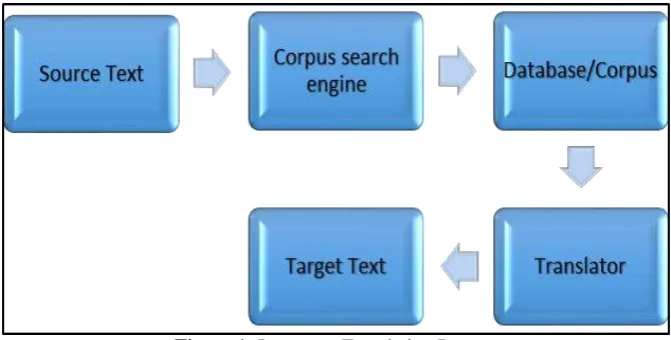
Below figure 1 shows translation process in which source text is translated into target language by using database/corpus. In this, firstly source text is searched in the database / corpus by simply checking each alphabet in English word dictionary and provides the corresponding Sindhi word in target text.
Figure 1: Language Translation Process
The LT system is very important for human for the following reasons:
Huge amount of text can be translated from one natural language to another natural language using a LT system.
It can be used to reduce the human efforts and to give the translation results quickly.
Manual translation for translating the huge amount of text document is not only time consuming, but also need a more expense. Therefore, LT system can be used to save time and reduce cost.
Hence, from a scientific point of view, machine or language translation remains the classic acid test of how much we understand about human language [16].
V.
Conclusions
Many of the translation software available are used to execute literal translation of the text. But none of the solutions is perfect to create dynamic equivalence between the translated and original text. Every method of language translation has its own advantages and drawbacks [17].
The different approaches for language translation suggest that the translation at meta-phrase level is attainable through the currently available translation software but achieving para-phrase level or dynamic equivalence between the source and target language still appears to be a far-fetched dream for computer linguists.
Language is evolutionary in nature; hence, it is difficult to say that one approach would be sufficient to handle the translation process. Knight [16] stated that translation as one of the elusive goals for computer science research. A decade has passed since the statement was made but it still appears to be relevant looking at the level of accuracy being achieved in translation. Linguistic irregularities, ambiguities, lack in universality of grammar and lexicon, are some of the reasons behind the failure of systems to achieve 100 percent accuracy in the translation.
Some of recommendations are made to achieve the utmost accuracy in translation are developing universal meta-language; standardization of lexical organization and content and development of translation oriented multilingual textual corpus. However, the suggested measures appear to be unachievable looking at vast number of variants of existing languages.
The process of translation involves a thorough analysis of the source text which require various course of action such as study of grammar; semantic and syntax analysis, etc. A thorough knowledge as well as understanding of the target language is also must for a translator (whether human or machine supported).
Thus, information professionals may depend upon these tools (Google Translate etc.) only to certain extent i.e. just to gather the central idea about the document. Then they can take help of language experts about the content of document before classifying or making it available for users. Thus, these tools may be helpful for initial sorting of the documents not as regular tools for analysis of the content of the other language document.
References
[1] Nirmala Chawla and Bharati Batheja, “Sindhi Devnagri”, 2019, pp. 50-52.
[2] Nadeem Jadoon Khan, Waqas Anwar & Nadir Durrani, “Machine Translation Approaches and Survey for Indian Languages”, 2017.
[3] ALPAC “Language and Machines: Computers in Translation and Linguistics”. A report by the Automatic Language Processing
Advisory Committee (Tech. Rep. No. Publication 1416), 2101 Constitution Avenue, Washington D.C., 20418 USA: National Academy of Sciences, National Research Council, 1966.
[4] Balajapally, P., Bandaru, P., Ganapathiraju, M., Balakrishnan, N., & Reddy, R., “Multilingual Book Reader: Transliteration,
Word-to-Word Translation and Full-text Translation”, 2006.
[5] Dwivedi, S. K., & Sukhadeve, P. P., “Machine Translation System in Indian Perspectives”, Journal of Computer Science, 6(10),
1111-1116, 2010.
[6] Antony P. J., “Machine Translation Approaches and Survey for Indian Languages”, Computational Linguistics and Chinese
Language Processing, Vol. 18, No. 1, March 2013, pp. 47-78.
[7] Hasler, E., Haddow B., and Koehn, P., “Sparse lexicalised features and topic adaptation for SMT”, In Proceedings of the seventh
International Workshop on Spoken Language Translation, pages 268–275, 2012.
[8] Och, F., “A systematic comparison of various statistical alignment models”, Computational Linguistics, 29(1):19–5, 2003.
[9] Kishore Papineni, Salim Roukos, Todd Ward, and Wei-Jing Zhu, “BLEU: a Method for Automatic Evaluation of Machine
Translation”, In Proceedings of 40th Annual meeting of the Association for Computational Linguistics (ACL), Philadelphia, July 2002, pp. 311–318.
[10] Bisazza, A. and Federico, M., “Chunk-based verb reordering in VSO sentences for Arabic-English statistical machine translation”,
In Proceedings of the Joint Fifth Workshop on Statistical Machine Translation and Metrics MATR, WMT ’10,15-16, july 2010, pp. 235–243.
[11] J. Eisner, “Learning non-isomorphic tree mappings for machine translation”, In Proceedings of the ACL Interactive
Poster/Demonstration Sessions, 2003, pp. 205–208.
[12] Dash, Niladri Sekhar, Chaudhuri, Bidyut Baran, “Why do we need to develop corpora in Indian languages?” A paper presented at
SCALLA 2001 conference, Bangalore.
[13] Rao, Durgesh, “Machine Translation in India: A Brief Survey”, SCALLA 2001 conference, Bangalore.
[14] Naskar, S., & Bandyopadhyay, S, “Use of Machine Translation in India: Current Status”, In Proceedings of MT SUMMIT X;
September 13-15, 2005, Phuket, Thailand.
[15] Bandyopadhyay S., “ANUBAAD - The Translator from English to Indian Languages” In proceedings of the VIIth State Science and
Technology Congress, Calcutta. India, 2000, pp. 43-51.
[17] Sneha Tripathi and Juran Krishna Sarkhel, “Approaches to machine translation”, Annals of Library and Information Studies, Vol. 57, December 2010, pp. 388-393
[18] SAIFUL ISLAM and BIPUL SYAM PURKAYASTHA, “A Review on Electronic Dictionary and Machine Translation System
Developed in North-East India”, Vol. 10, June 2017, No. (2): Pgs. 429-437.
[19] Richard Zens, Franz Josef Och, and Hermann Ney, “Phrase-Based Statistical Machine Translation”, 2002, pp. 18–32.
[20] Sindhu D.V and Sagar B M, “Study on Machine translation approaches for Indian languages and their challenges”, 2016, pp.