ISSN (Online): 2320-9364, ISSN (Print): 2320-9356
www.ijres.org Volume 4 Issue 10 ǁ
October. 2016 ǁ
PP.72-79
Finite Element Analysis on two Wheeler Alloy Wheel
Manjunath Batli
1, Md.Manazir
2,
N. Chitresh
3, Malatesh G
41,2,3,49Department Of Mechanical Engineering. B.V Bhoomraddi College Of Engineering And Technology,
Hubli-Karnataka, India
Abstract:
Aluminium7075 is an established material that is used in a variety of applications. Aluminium 7075 has replaced metals like Aluminium and brass for cost and weight. The design of a motorcycle wheel contains several complexes and attempt has been made to meet the requirements of original equipment manufacturers Itis also that material that can meet the needs of more demanding applications where very high or low temperatures or chemical resistance are key operational parameters Aluminium 7075 is an ideal replacement for Magnesium alloy and Titanium alloy as well as other types of metal tubing, and even glass for weight reduction, comparable strength/mass, chemical resistance, hardness, and low extractable. Aluminium 7075 is particularly useful in the automobile industry for its weight. In this project work the entire wheel design of two wheeler was chosen and analysed by applying different load and redesign the wheel again to minimize the deformation and material will be changed from titanium to aluminium7075.The composition of aluminium7075
are:-1)6%Zinc
2)2.4%Magnesium
3)1.5% Copper
4)0.4% Silicon, iron, manganese, titanium, chromium
Wheel design of two wheeler is made in SolidWorks 2015 and analysis is done in Ansys workbench 15.0 software to determine the various stresses, strain, and Impact and fatigue life of the wheel.
Keywords: Al7075, FEM, ANSYS
I.
INTRODUCTION
The design of a motorcycle wheel contains several complexes and attempt has been made to meet the requirements of original equipment manufacturers (OEMs) the design in 6 degree of freedom (DOF) for characteristics and durability has been developed. After designing of wheel, the material should be selected and to go through several analysis test on ANSYS software. By applying different loads in existing Magnesium alloy wheel and analyse the stresses, the material has been changed from Magnesium alloy to Aluminium 7075, Aluminium 7075 with 6%Zinc, 2.4%Magnesium, 1.5%Copper, 0.4%Silicon, iron, manganese, titanium, chromium for the study. In the same design the materials has been changed one by one and applying different loads, and analyse the stresses.
It is concluded that the existing design is not suitable for Magnesium alloy, structural steel. Magnesium alloy will deform at a maximum pressure of 2MPa. So change the design and the materials and analyse the stresses and finally conclude that Aluminium 7075 can be replaced by Magnesium alloy.
II.
EXPERIMENTAL
2.1General Procedures in Design
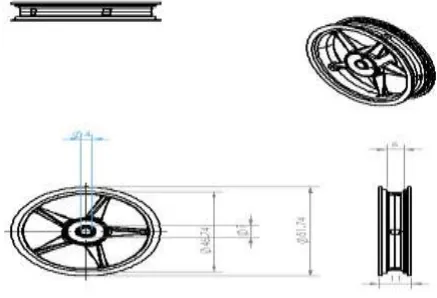
With the help of the measuring instrument -Vernier calliper, micrometre, radius Gauges and slip gauges, we have first taken all the dimension of the Aluminium alloy wheel.). After completing the draw the wheel model is then Import in the ANSYS 15 software. Before importing it is first save in IGES or STEP.
2D view of Aluminium Alloy Wheel
III.
ANALYSIS FOR ALUMINUM ALLOY
3.1Analysis Procedure
First of all we have taken the Aluminium 7075 material composition. The alloy contains 6%Zn, 2.4%Mg, 1.5%Cu, and 0.4% Si, Fe, Mn, Ti, Cr.
Design and Analysis of Aluminum7075 Alloy
Was prepared by dispersinghard particles in Aluminium matrix using stir-casting technique. From the design data book –Mechanical property.
Design and Analysis of Two WheelersWheel with Magnesium Alloy
Mechanical property
Value Unit
Density 1800 Kg m^-3
Coefficient of thermal expansion
2.6E-05 C^-1
Young’s modulus
4.5E+10 Pa
Poisson ratio 0.35
Bulk modulus 5E^+10 Pa Shear modulus 1.66E^+10 Pa Tensile yield
strength
1.93E^08 Pa
Compressive yield strength
1.93E^08 Pa
Tensile ultimate
strength 2.55E^08 Pa Compressive
ultimate strength
0 Pa
Table No.1 Properties of Magnesium Alloy
Fig. 2 Static Analysis
IV.STATIC ANALYSIS
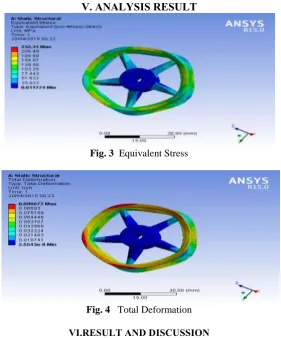
4.1 Magnesium alloy wheel (A)Under
(1) Maximum Inflation pressure on rim circumference 7MPa
(2) Hub fix
(3) Rotation velocity in Z –direction –200 rad/sec
V. ANALYSIS RESULT
Fig. 3 Equivalent Stress
Fig. 4 Total Deformation
VI.RESULT AND DISCUSSION
Total Deformation Equivalent Stress
Minimum 0.02576MPa 62MPa
Maximum 0.0966MPa 232Mpa
Table No.2 Results on Static analysis of Magnesium Alloy
VII.ANALYSIS DATA OF AL7075 MATERIAL
7.1 Analysis Procedure
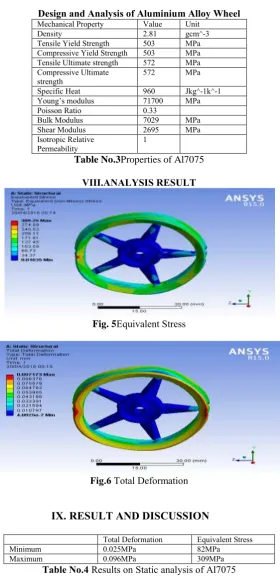
Under same maximum. Inflation pressure on wheel 7MPa, Hub fix and Rotation velocity in Z – direction –200 rad/sec and after defining the mechanical property of different grade of Al7075 on wheel if wheel does not deform thewe can easily replace Magnesium alloy wheel with Aluminium 7075wheel.
Design and Analysis of Aluminium Alloy Wheel
Mechanical Property Value Unit
Density 2.81 gcm^-3
Tensile Yield Strength 503 MPa Compressive Yield Strength 503 MPa Tensile Ultimate strength 572 MPa Compressive Ultimate
strength
572 MPa
Specific Heat 960 Jkg^-1k^-1
Young’s modulus 71700 MPa
Poisson Ratio 0.33
Bulk Modulus 7029 MPa
Shear Modulus 2695 MPa
Isotropic Relative Permeability
1
Table No.3Properties of Al7075
VIII.ANALYSIS RESULT
Fig. 5Equivalent Stress
Fig.6 Total Deformation
IX. RESULT AND DISCUSSION
Total Deformation Equivalent Stress
Minimum 0.025MPa 82MPa
Maximum 0.096MPa 309MPa
Table No.4 Results on Static analysis of Al7075
Compression only support on inside circumference of hub area:
Fig. 7 Compresson Support on circumference
X.Graphical Analysis on Al7075 in Static Structure
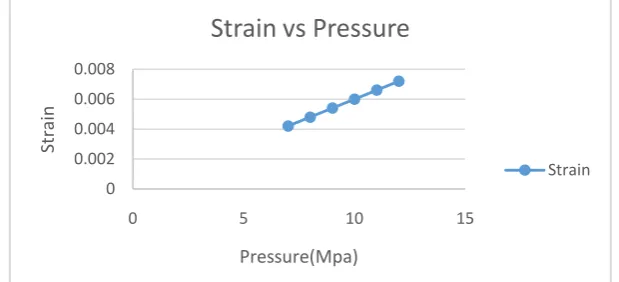
As the pressure increases, stress value goes on increases and from the graph we can interpret that the maximum bearing pressure that alloy wheel can sustain is 12MPa.
We can interpret that there is no radical change in deformation w.r.t increasing pressure.
XI. IMPACT ANALYSIS
0100 200 300 400 500 600
0 5 10 15
Stres
s(Mp
a)
Pressure(Mpa)
Stress vs Pressure
Stress
0 0.002 0.004 0.006 0.008
0 5 10 15
Stra
in
Pressure(Mpa)
Strain vs Pressure
Fig. 8 Impact analysis on Al7075 Wheel Actual height considered is 80mm but for analysis purpose we have taken it as 0.1mm for faster results .The velocity applied is 9720mm/sec in negative Z direction of a wheel as shown in the fig.8A square block made of concrete material is considered as fixed support.
Fig. 9Equivalent Stress
Fig.10Total Deformation
Fig. 11 Equivalent Elastic Strain
XII. Graphical Analysis on Impact Load
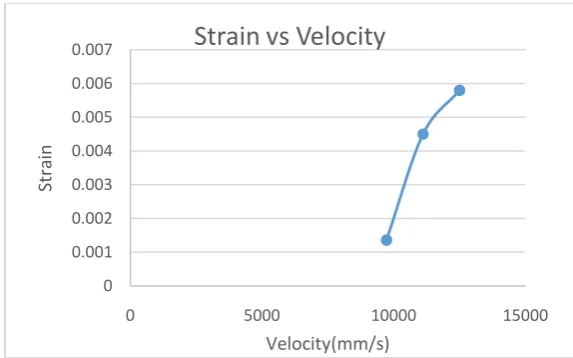
At higher velocity stress goes on increasing rapidly, after attaining saturation value the alloy wheel will fail. 90
92 94 96 98 100
0 5000 10000 15000
Stres
s(Mp
a)
Velocity(mm/s)
There is no radical change in the deformation w.r.t velocity.
XIII.FATIGUE ANALYSISLife
Fig. 12 Fatigue analysis on LifeLife of the wheel is10^6 cycles.
Damage:
Fig. 13 Fatigue analysis on damageStress vs. Number of cycles(S-N) Curve:
0 0.001 0.002 0.003 0.004 0.005 0.006 0.007
0 5000 10000 15000
Strain
Velocity(mm/s)
Aluminium7075 do not have a distinct limit and will eventually fail even for large stress amplitudes. In these cases, a number of cycles (usually 107) is chosen to represent the fatigue life of the material.
XIV.COMPARISON ON ANALYSIS DATA
It is observed thatAluminium 7075(Yield Strength=503MPa) has high strength to weight ratio when compared with Magnesium Alloy (230MPa).
Al7075 is less expensive than magnesium alloy
As Magnesium is reactive in nature it undergo “metallic reaction” early than Al7075.
Aluminium 7075 is more durable and long lasting whereas it’s false in magnesium alloy.
Magnesium alloy cannot be easily brought into its original shape once it is deformed, but not in case of Al7075.
XV. CONCLUSION
From the above table it is clear that Aluminium7075 is best material than Magnesium alloy
REFERENCES
[1]. International Journal of Recent Technology and Engineering (IJRTE), ISSN: 2277-3878, volume-3 Issue-4, September2014-Design and Analysis of Two Wheelers wheel with the Replacement of Aluminium Alloy.
[2]. IJRET: International Journal of Research in Engineering and Technology eISSN: 2319-1163 | pISSN: 2321-7308, STATIC ANALYSIS OF ALLOY WHEEL USING ANSYS15.0
[3]. Jaspreet Singh, Siddhartha Saha.
[4]. ISSN No: 2348-4845 International Journal & Magazine of Engineering, Technology, Management and Research, Impact Analysis of Aluminium Alloy Wheel.
[5]. Reference Book of Machine Design. R.S.Khurmi [6]. Alloy Wheel from Wikipedia, the free encyclopaedia. [7]. YouTube on web (Analysis Videos on Ansys Workbench15). [8]. Matweb on web: www.matweb.com, For Material Selections.
[9]. Engineering Materials on web: www.engineeringmaterials.com. For material properties. [10]. Designing software: CreoParametric2.0, SolidWorks2015.
[11]. Engineering materials by William Callister.
[12]. N.Satyanarayana&Ch.Sambaiah (2012), ―Fatigue Analysis of Aluminium Alloy Wheel Under Radial Load‖, (IJMIE), ISSN No. 2231 –6477, Vol-2, Issue-1, 2012
[13]. Wu Lihong, Long Siyuan, Xu Shao-yong, et al. ―Influences of Mg alloy and Al alloy on service stress in motorcycle wheel‖. Materials Science and Technology, 2007, 15(3): 397-100.
[14]. Design Optimization of Formula One Student Sports Bike Upright Using Hypermesh, International Journal of Mechanical and Industrial Engineering (IJMIE), ISSN No. 2231 –6477, Vol-2, Issue-1, 2012 [15]. Madenci, E. and Guven, I. 2007. The Finite Element Method and Applications in Engineering Using
ANSYS. New York, USA: Springer Science+Busness Media, LLC.
[16]. Dadkhah, F. and Jack Zecher, P. E. (2007). Ansys Workbench: Software Tutorial with Multimedia CD Release 11. Mission, KS,USA: SDC Publications.
[17]. Colquhoun, C. and Draper, J. 2000. Fatigue Analysis of a FEA Model of A Suspension Component and Comparsion with Experimental Data.
[18]. Yongming, L., Startman, B. and Mahadevan, S. 2006. Fatigue Crack Initiation Life prediction of Railroad Wheels. International Journal of Fatigue, 28, 747-756
[19]. Yongming, L., Startman, B. and Mahadevan, S. 2006. Fatigue Crack Initiation Life prediction of Railroad Wheels. International Journal of Fatigue, 28, 747-756
[20]. Alloy rim cracking and failure Department of Natural Resources and Mines, Safety Alert No. 287 | 25 May 2012
[21]. Cuixia, Z. (2006). ―Design and structural analysis of aluminum alloy wheel‖, Ph.D Dissertation, Zhejiang University, Zhejiang.
[22]. RamamurtyRaju, P., Satyanarayana, B., Ramji, K., Suresh Badu, K. (2007), ―Evaluation of fatigue life of aluminum alloy wheels under radial loads‖. Journal Engineering Failure Analysis.