CASE REPORT OPEN ACCESS
Teaching epidemiology: A personal experience
Vincenzo M. Di Ciommo
Since the paper presented in 2008 by Samet and Savitz [1] no article, to my knowledge, has been published about teaching epidemiology, albeit demand seems to increase [2]. Epidemiologists are involved not only, as expected, in the field of public health, but also in clinical practice and research, for which epidemiological methods are increasingly required [2]. Not to say that in evidence-based medicine the focus of evidence is a matter of clinical epidemiology. I report here my reflections about the changing scenarios of my teaching experience in the last 35 years.
I began teaching epidemiology in 1980s, when I was working as a hospital clinician heavily involved in the care of single patients. I was involved in the hospital’s management when the Medical Director of my hospital was told that I was proficient with numbers, which were, on the other hand, forcefully avoided by my colleagues. Actually, I looked for scientific foundations of medical practice which was based at those times mostly on personal experience of senior physicians. I was struck by the book by Cochrane [3] and by the small textbook by Barker and Rose [4]. When the pediatric hospital where I was hired was affiliated to the faculty of medicine of the University of Rome, epidemiology was introduced in the curricula of physicians attending the specialty of pediatrics. The students in the hospital-based school of nursing also took a course in epidemiology. Due to my clinical origins after introducing the concepts of incidence and prevalence, I focused my lectures on screening and
Vincenzo M. Di Ciommo
Affiliations: Senior Registrar, Medical Directorate, Unit of Clinical Epidemiology, Lecturer in Epidemiology, Faculty of Nursing Sciences, University of Tor Vergata, Bambino Gesù Children’s Hospital – IRCCS, Rome, Italy.
Corresponding Author: Vincenzo M. Di Ciommo, Ospedale Bambino Gesù - Via F. Baldelli, 41, Rome, Italy, 00146; Ph: +39-06-68592857; Fax: +39-06-68592853; Email: vmaria. [email protected]
Received: 02 July 2015 Published: 10 August 2015
diagnosis, treatment (controlled clinical trials), and prognosis, rather than on prevention and community medicine. Following the Italian translation of the text of biostatistics by Colton [5], I taught some statistics, like the normal frequency distribution, measures of central tendency and 2x2 occurrence tables.
The MD curriculum included epidemiology in the course of hygiene. Nevertheless, doctors did not actually have any knowledge of epidemiologic methods and concepts as I can say of myself, until few years earlier. This was probably due to the fact that epidemiology was thought to be involved mainly in infectious disease and the students were unprepared to its shifting to chronic diseases. The final examination at the end of my courses soon became a difficult barrier even if it consisted only of a couple of questions mainly on the validity of a test or on analytical or experimental studies. This was a surprise for all, including other teachers and students as well because “caring is another matter”. There was no textbook, at least in Italian, and the examinations were based on the lessons, i.e., on the notes that students took, in order to stimulate the students into following my lessons.
I could advise a book in Italian after the translation of the second edition of the Lilienfeld’s introductory book [6]. Moreover, I took courses from academic institutions. Every teacher learns how to teach from his/her teachers. The fundamental experiences of my professional life were the summer programs at the Johns Hopkins School of Hygiene, where I experienced a way of teaching which involved not only lectures, handouts and textbooks, but also small group exercises and final presentations of results in the classroom. On the other hand, I experienced later the distance learning courses at the London School of Hygiene, where teaching is delivered mainly through the use of interactive CD-ROMs and a web-based conference system.
This first, seminal period definitively ended when a faculty of Nursing Sciences was instituted in the universities (2000), and hospitals were affiliated to instruct the students. Epidemiology was part of a group
of courses together with statistics, computer science and hygiene (total 4.5 credits on a total of 43 theory credits in a year). I had 20 hours to fulfill the following program recommended by the Ministry of Health:
• Definition and aims of epidemiology, basics on demography and health statistics.
• Methods of epidemiological investigations, rates, mortality and morbidity.
• Descriptive and analytical epidemiology; cross-sectional and longitudinal investigations;.
• Experimental epidemiology.
• Epidemiology of infectious and non-infectious diseases.
• Public health: interventions in a multiracial community (a rather mysterious issue to me).
I included in the analytical epidemiology, measures of associations like the odds ratio and the relative risk. Some examples of bias were explained, like recall bias and other examples of confounding, like coffee on the cause-effect pathway from smoking to lung cancer. Home exercises could not be assigned, because the students had a heavy training to complete in the wards of the hospitals. During the first lessons on basic demography, I suggested a computer search about local data on mortality and morbidity, promising a surplus of votes for the final examination, but none answered. I, therefore, began performing exercises, with a couple of students during the time of the lessons,. I also provided students with a brief self-teaching text, with a historical approach to the main concepts of the course, and 30 open-ended questions with suggested responses. The students also had open access to a glossary of epidemiology and biostatistics prepared by my unit which was published online on the hospital’s website.
The examination consisted of three on-sight exercises: the first one required calculating incidence and prevalence, the second one was on a case-control or on a cohort study, and a third one with multiplechoice questions on screening and cause-effect relationship. Under the individual guidance of myself, about one-third of students had to repeat the exercises they had not completed satisfactorily, with a discussion on the errors, which I considered as something similar to a training process. Everybody can err, but to correct one’s own mistakes is mandatory, I used to say after the written examination.
The hospital organized a master for nurses aiming for a career as chief nurses, and 21 hours were dedicated to epidemiology and biostatistics. Software exercises (Excel, Power-point) and exercises on hospital infections were conducted to introduce the concept of incidence density, sampling, bias and confounding.
Credits were then introduced in Italy, and, while the epidemiology course was removed from the pediatricians’ curriculum, the Italian Association of Psychiatry implemented a management education program, which included epidemiology lessons. I gave lectures with exercises based on screening of alcoholism (questionnaire
(CAGE)), from Cut-down Annoyed Guilty Eye-opener [7] and trials and meta-analysis on anti-depressive drugs. The exercises consisted of a data collection conducted in each of the participating department about a cross-sectional survey on suicidal risk, with a final analysis conducted with all the units. Nevertheless, to my surprise, the most impressive results of teaching were obtained from a series of short presentations to the hospital departments on the International Classification of Diseases and the continuous revision of medical coding that was needed for the new hospital financing system, based on diagnosis related groups. A massive improvement of basic epidemiology was accomplished in a short-time, at least in defining diseases and collecting data.
Courses with credits were started in my hospital on evidence-based medicine and Epi-Info, the free software package developed by the Center for Disease Control [8]. For the first time, I mounted a room with tables and half a dozen personal computers to allow the participants to conduct a literature search and then organize a data collection.
In 2009, the Republic of Albania decided to start a Master in Organization and Management of Health Services. The course of epidemiology comprised 16 hours, which were concentrated in 4 days, with lectures and seminars. The students (a total of 28, including public health physicians, dentists and pharmacists) were provided with handouts on the issues of the courses. Readings were adopted from “Epidemiology for the uninitiated”, a book that can be downloaded from BMJ [9], and the output of the software Epi-Info was used [8].
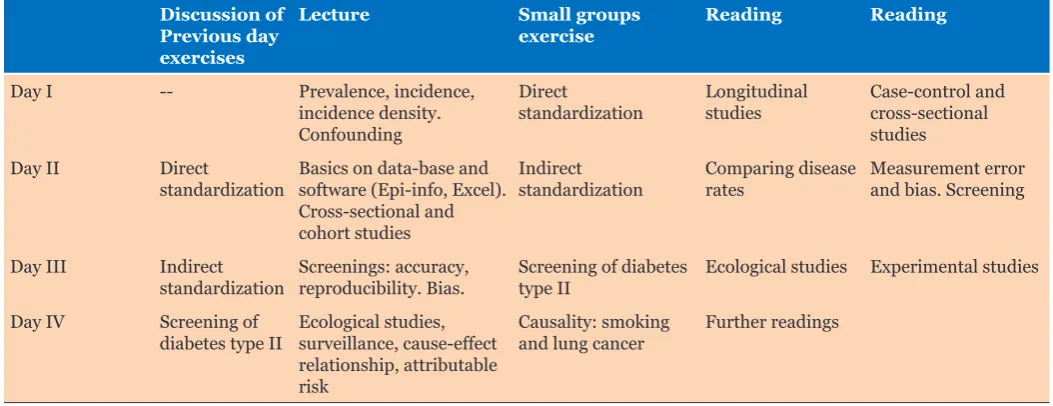
Every day started with the discussion of the exercises, followed by a lecture on the topic of the reading and a discussion. The day ended with a small group exercise (Table 1).
Frequent interruptions of the lectures to question the class or single students about clinical examples of diagnostic tests, risks (e.g., bladder catheterization and infections) or treatments (e.g., bed sores) did not substantially alter a “vertical” relationship between myself, the teacher (the authority), and the students (the recipients) who had to memorize without criticism. During the first lesson, when some issue about populations has to be introduced, I always questioned about the first census of Western History. Even if I suggested that this was an event splitting the human history in two different eras, I have not remember anyone quoting the census of the roman empire when Jesus Christ was born! When I claimed for an example of a regular survey of the adult population, only few students made the example of elections. Finally, speaking of the cause-effect relationship, time sequence seemed to be a surprise, not to say about conditions that can be necessary and/or sufficient to produce an effect.
disappearing, maybe as a result of the critical reasoning of epidemiology.
I can summarize the problems and advises of teaching epidemiology as follows:
• proficiency in english is invaluable (it applies to all medical courses)
• tailoring lessons and exercises to what is more relevant to the students’ past experience or education can facilitate you and your students, but be not prone to satisfy a particular audience at hand; it can be a mixture of most different professionals. Furthermore, this can be an occasion to challenge epidemiology as an interdisciplinary topic
• do not fear logic and its application to the real world, i.e., mathematics. Take profit, for example, of the examination results of the previous course (a most interesting affair for the students!) to explain a distribution and a category (passed/not passed): the class will grasp every single word!
• there is no better example than a problem taken from the real world, e.g., from the newspapers (demographics, “discoveries” of miraculous treatments)
• provide resources (first of all your time, then handouts, and a textbook); except for lectures, classes should not exceed 20–30 students
• aphorisms can help: e.g., “descriptive statistic is not the poor sister of research”, or “the art of epidemiology includes the ability of obtaining reasonable answers from imperfect data” [10]
• humor is useful, like the answer of an epidemiologist to the question “How do you do?”: “Compared to whom?” the epidemiologist says.
• fair examinations follow accurate courses
• last but not least: challenge certainty.
What about the opportunities? I am rather confident that the most important one is talent scouting; a good
teacher should be able to select successful candidates to clinical research, epidemiology and public health. The reverse is true: young people select exciting teachers who transmit enthusiasm.
I noticed that few students answer my final question, when I end my course (I do not give any definition): what you think is epidemiology? Is it worthwhile to learn it? Does it help? To do what? Few as you want, someone answers, no matter if right or wrong. Pay attention to this kind of students. My experience is confined to teaching introductory epidemiology, but I had the chance to meet again some of these students in team working in designing studies, collecting data, analyzing and finally publishing them. These constituted the most satisfactory experiences of my career. Many of them seem somewhat like the Medical Director who called me 35 years ago and said: “I need someone proficient with numbers”. Now I am called for reasoning.
My students report a good level of satisfaction of my courses, but can this be due to a social desirability bias?
Pioneering is behind us, now what about the future? I cannot support my conclusions with any piece of evidence, nor can I answer to these final questions. My reader has to trust on a personal experience, as, when I began my career as a clinician, I had to trust on senior physicians.
Keywords: Teaching epidemiology, Field of public
health, Epidemiological methods, Aims of epidemiology,
How to cite this article
Di Ciommo VM. Teaching epidemiology: A personal experience. Edorium J Epidemiol 2015;1:1–5.
Article ID: 100001E06VC2015
Table 1: Schedule of a course of basic epidemiology
Discussion of Previous day exercises
Lecture Small groups
exercise Reading Reading
Day I -- Prevalence, incidence, incidence density. Confounding
Direct
standardization Longitudinal studies Case-control and cross-sectional studies
Day II Direct
standardization Basics on data-base and software (Epi-info, Excel). Cross-sectional and cohort studies
Indirect
standardization Comparing disease rates Measurement error and bias. Screening
Day III Indirect
standardization Screenings: accuracy, reproducibility. Bias. Screening of diabetes type II Ecological studies Experimental studies Day IV Screening of
diabetes type II Ecological studies, surveillance, cause-effect relationship, attributable risk
Causality: smoking
*********
doi:10.5348/E06-2015-1-ED-1
*********
Acknowledgements
Dr. F. Gesualdo, MD revised the manuscript and G. Delpidio, R.N., Director of the School of Nursing of the Bambino Gesù Children’s Hospital, provided the data about the school.
Author Contributions
Vincenzo M. Di Ciommo – Substantial contributions to conception and design, Acquisition of data, Analysis and interpretation of data, Drafting the article, Revising it critically for important intellectual content, Final approval of the version to be published
Guarantor
The corresponding author is the guarantor of submission.
Conflict of Interest
Authors declare no conflict of interest.
Copyright
© 2015 Vincenzo M. Di Ciommo. This article is distributed under the terms of Creative Commons Attribution License which permits unrestricted use, distribution and reproduction in any medium provided the original author(s) and original publisher are properly credited. Please see the copyright policy on the journal website for more information.
REFERENCES
1. Samet JM, Savitz DA. Education in epidemiology: “The Times They Are a-Changin’”. Epidemiology 2008 Mar;19(2):345–6.
2. Keyes KM, Galea S. Current practices in teaching introductory epidemiology: how we got here, where to go. Am J Epidemiol 2014 Oct 1;180(7):661–8. 3. Cochrane AL. Effectiveness and efficiency: Random
reflections on health services. The Nuffield Provincial Hospital Trusts 1972.
4. Epidemiology in Medical Practice Eds. Barker DJP, and Rose G. Churchill Livingstone: Edinburgh. 1976. 5. Statistics in Medicine. T. Colton. Little, Brown and
Company, Boston, Mass. 1974 – Italian Ed. 1979, PiccinPadova.
6. Lilienfeld MA. Lilienfeld DE. Foundations of Epidemiology. Oxford University Press, New York, 1980. [Translated by Assennato G, Merlo F. Fondamenti di Epidemiologia. PiccinPadova, 1986] 7. Dhalla S, Kopec JA. The CAGE questionnaire for
alcohol misuse: a review of reliability and validity studies. Clin Invest Med 2007;30(1):33–41.
8. Center for Disease Control and Prevention. Epi-Info software. Available at: http://www.cdc.gov/ epiinfo/7/
9. Coggon D, Rose G, Barker DJP. “Epidemiology for the uninitiated”. Available at: http://www.bmj. com/about-bmj/resources-readers/publications/ epidemiology-uninitiated
10. Gonzàlez-Garcia L, Chemello C, Garcia-Sànchez F, et al. Aphorisms and short phrases as pieces of knowledge in the pedagogical framework of the andalusian school of public health. Int J Prev Med 2012 Mar;3(3):197–210.
SUGGESTED READING
Olsen J, Saracci R, Trichoupulos D, eds. Teaching Epidemiology, 2nd ed. Oxford; Oxford University Press; 2001
Szklo M, Nieto FJ
Epidemiology: beyond the basics. Third Edition Jones and Bartlett Publishers Sudbury MA -2012
Swinscow TDV Revised by M J Campbell, University of Southampton
Statistics at Square One Ninth Edition
Access full text article on