Analysis of Fixed Free Beam by using
Experiment and Numerical Methods
Rizwana Ali A. V. Patil
PG Student Associate Professor
Department of Mechanical Engineering Department of Mechanical Engineering SSGBCOET Bhusawal, Maharashtra, India SSGBCOET Bhusawal, Maharashtra, India
Abstract
Sandwich beam or composite beams are mostly consisting of two or more different materials. These material are bonded with glue or bonding agent to form a single material. The material used for this nature is rubber, neoprene, and FRP. The beam is formed in the combination of AL-Ru-AL, AL-Ne-Al, FRP-Ru-FRP, FRP-Neoprene-FRP. The experimental analysis and finite element analysis is done on the beam to get the natural frequency of the beam and it is found that the combination of FRP and Neoprene shows better results.
Keywords: Sandwich Beam, Composite Beam, al-ru-al,al-ne-al, FRP-ru or Ne-FRP
_______________________________________________________________________________________________________
I.
I
NTRODUCTIONNoise and vibration control in any system leads to a great challenge for a designer. Structures with damping have a high consequence to dynamic loading. Fiber reinforced polymer (FRP) is an interfacial zone of layers. FRP composite sandwich structures are mostly composed of two FRP skins and one lightweight core. This help to reduce weight and increase flexural stiffness with energy absorbability. These types of composite structures are mostly used in automotive. A GFRP i.e glass fiber reinforced polymer sandwich material has been used in the transit bus vehicles [2].
FRP structures have entirely different mechanisms of failure than that of conventional steel structures [1]. The low weight and high strength with more stiffness are the important characteristics of Sandwich beams. In the sandwich beam, there are two thin skins one on top and one on the bottom, while the core material is in between the two layers. This feature leads to form the stiffer, strong, light and durable structure. There are various types of sandwich structure. The sandwich beam prepare of two thin layers of metal and core of plastic, rubber, recycle paper, honey comb etc. The fig.1. give the idea of the sandwich beam, the strength of the beam depends upon the core layer thickness. More the thickness more is the strength. The interface between the two layer is due to adhesive and if the layers is too weak than result will be delayed [3].
The sandwich beam made of aluminum in top and bottom layer and rubber or carbon fiber material in core being studied and the result of natural frequencies, modes of vibration and structure are being investigated by [4].
Here in these paper four different core materials is used for study of the damping effect of beam. The main objective is to find the natural frequency of the four different sandwich beams. This will help to predict the most reliable beam structure.
Fig. 1: Sandwich beam model [3]
II.
L
ITERATURE REVIEWA material property plays an important role in sandwich beam. It should have high temperature resistivity, high surface finish, high strength etc. The main function of the core material is to provide support to the thin layer of face material. The shear and compressive modulus are the requirements of the core material. The features of core material are mainly low density, good shear strength, damping of vibration and noise. The bottom and top layer of sandwich structure called as face and can be of any material. The face material must have good wear resistance, high impact resistance nad good surface finish.
viscoelastic sandwich beams and the result being compared with numerical method. The author used GHM (Golla, Hughes and Mc Tavish method) method. The behavior of structure evaluate more accurate by numerical as compare to experimental. Y.P.Ravitej, et. al., numerical tested the mild steel rubber composite beam by three point method in ANSYS by varying the core thickness. Dvir Elmalich, et.al. gives an analytical approach for the displacement and stress field of sub region. P. Bangarubabu, et.al. Investigate the viscoelastic layer distribution and loss factor by experimental method. M. R. Doddamani, et.al. prepared the sandwich beam of jute epoxy and fly ash with rubber core by using casting techniques. The author studied the dynamic analysis of beam. Y. Mohammadi et.al. Studied the composite plates for free vibration analysis. M Siva Prasad et.al. predicted that the sandwich beams are most probably used as light weight load bearing components which having high stiffness-to-weight and Strength-to weight ratios. FEA method is used to judge the overall transient responses and harmonic response of the beam.
III.
F
INITE ELEMENT ANALYSIS(FEA)
FEA is a discritize method which solve the complex problem from whole to part. Here the geometry is divided in finite elements and each elements is having a set of polynomials. These polynomial are solved by matrix algebra method. There are several package available for the solution of the problem in this paper ANSYS is used for solving the composite beam problem. The analysis can be either linear or non-linear. The software is organized into several processors. A typical ANSYS analysis involves using three processors,
1) Pre-processing (PREP7 processor), where the user provides data such as the geometry, material property, and element types to the program; meshes elements, create nodes, applies constraints, etc.
2) Pre-processing (PREP7 processor), where the user provides data such as the geometry, material property, and element types to the program; meshes elements, create nodes, applies constraints, etc.
3) Solution (SOLUTION processor), where the user defines analysis type and options, applies loads and initiates the finite element solution.
4) Post-processing (POST1 or POST26 processors), where the user reviews the results of the analysis through graphics displays and tabular listings.
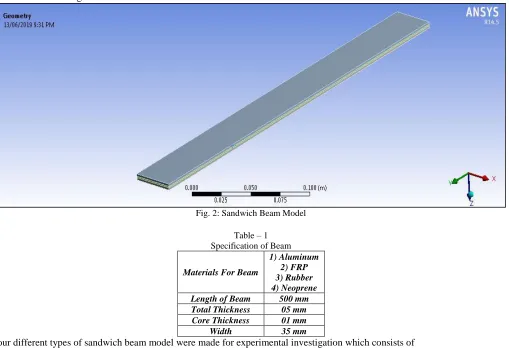
Fig. 2: Sandwich Beam Model
Table – 1 Specification of Beam
Materials For Beam
1) Aluminum 2) FRP 3) Rubber 4) Neoprene
Length of Beam 500 mm
Total Thickness 05 mm
Core Thickness 01 mm
Width 35 mm
Four different types of sandwich beam model were made for experimental investigation which consists of Beam 1: Aluminium – Rubber- Aluminium
Table – 2
Material properties of sandwich beam for face and core layers
Type of material Young’s Modulus
E (GPa)
Shear Modulus G (GPa)
Density
in Kg/m3 Poisson’s Ratio (𝝂)
Aluminium 70 27.3 2766 0.33
FRP 2 0.5 1700 0.3
Rubber 0.00154 0.005 950 0.45
Neoprene 0.0008154 0.000273 960 0.49
Fig. 3: Fixed Free Boundary Condition
Mode I Mode II
Mode III Mode IV
Mode I Mode II
Mode III Mode IV
Fig. 5: Frequency Response of Al-Ne-Al Fixed Free Beam
Mode I Mode II
Mode I Mode II
Mode III Mode IV
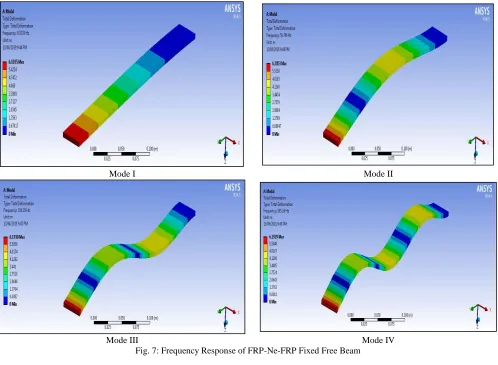
Fig. 7: Frequency Response of FRP-Ne-FRP Fixed Free Beam
Table – 3
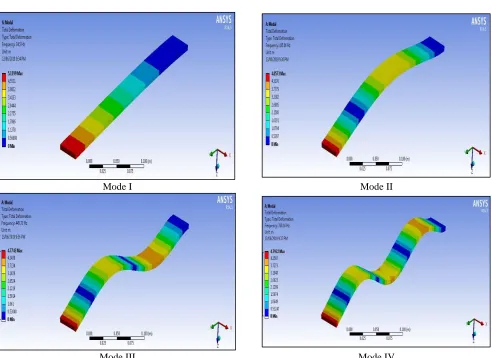
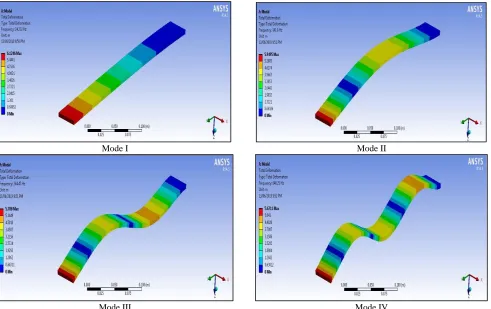
First Four Mode Natural Frequencies for Sandwich fixed free Beam (By using ANSYS)
Sr No Sandwich Pattern Natural Frequency
Mode 1 Mode 2 Mode 3 Mode4
1 Al-Ru-Al 34.5 185.06 445.72 760.16
2 Al-Ne-Al 13.533 81.712 227.6 445.99
3 FRP-Ru-FRP 24.232 141.9 363.47 648.25
4 FRP-NE-FRP 9.9728 56.796 156.39 305.26
Numerical Results
Fig 3. To fig 7 shows the mode shape of fixed free beam. The table 3 gives the result as per boundary condition given in ANSYS software. The natural frequencies of fixed free beams calculated by using ANSYS package. The result shows that the natural frequency FRP-Ne-FRP specimen is well lower as compare to other cases.
IV.
E
XPERIMENTAL ANALYSISIn the previous section it is cleared that if core material is replaced by any other stiffer material then the damping capacity of beam get increase. The FEA result is on the conceptual basis lets validate the result with the experimental analysis.
The equipment used for experimentation are a clamp, accelerator, hammer and FFT analyzer. Analysis is done experimentally with the help of FFT analyzer, accelerometer and impact hammer. Natural frequencies are developed by hitting the plate with hammer;
Experimental Procedure
1) Choose a beam of a particular material as mention in previous article. 2) One end of the sandwich beam is clamped.
3) Hit the free end of beam with a hammer and place an accelerometer at the free end of the cantilever beam and at the middle point along the length for simply support beam, to measure the free vibration response (acceleration).
5) Repeat the procedure for 5 to 10 times to check the repeatability of the experimentation. 6) Repeat the whole experiment for different specimen and different condition.
7) Record the whole set of data in a data base.
Table – 3
First Four Mode Natural Frequencies for Sandwich fixed free Beam (Experimental Analysis)
Sr No Sandwich Pattern Natural Frequency
Mode 1 Mode 2 Mode 3 Mode4
1 Al-Ru-Al 31.72 182.2 442.85 757.29
2 Al-Ne-Al 10.6 78.842 224.73 443.12
3 FRP-Ru-FRP 21.362 139.03 361.6 645.38
4 FRP-NE-FRP 7.102 53.926 153.52 302.39
The above table gives the result data for the experimental analysis. Where FRP-Ne-FRP shows well lower natural frequency.
V.
C
ONCLUSIONThe viscoelastic sandwich beam has been successfully modeled using finite element method. The developed model is then validated with the experimental method and the result found is more literally close to FEA result. The sandwich beams modeled here with varying of faces and core layers. The sandwich beams modeled here are carried out for modal analysis using finite element method, to study the damping effect on the beams for the fixed free beam. The results obtained from the modal analysis clearly show t hat natural frequency for the same mode. From the results one can infer that damping characteristics for neoprene viscoelastic material has significant effect when compared with the rubber viscoelastic material results show that the viscoelastic constrained layer damping treatment has a great significance in controlling the vibration of structures like beams, plates, etc.
R
EFERENCES[1] Hwai-Chung Wu*, Bin Mu, Kraig Warnemuende, Failure analysis of FRP sandwich bus panels by finite element method, Composites: Part B 34, 2003,pp.51– 58.
[2] ElDorado National. Mechanical test composite bus panels. Experimental Report; 1992.
[3] Manish Kumar, Earnest Vinay Prakash, Prabhat Kumar Sinha and Avinash Shilpi, To Study Analysis Of Sandwich Beam With Ansys And Fem, International Journal of Information Research and Review Vol. 2, Issue, 07, July, 2015, pp. 947-951.
[4] Prashant R. Mahale, Prof.Dr.D.M.Mate, Modal analysis of aluminium and natural rubber sandwich beam, International Journal of Science & Technology, Vol. 6 Issue 4, October 2016. pp. 12-19
[5] Rupali R. Chavan Prof P. S. Talmale, Free Vibration Analysis of FRP base Composite Sandwich Beam using FEA & Experimental approach, IJSRD - International Journal for Scientific Research & Development| Vol. 5, Issue 07, 2017 | ISSN (online): 2321-0613 pp-342-349.
[6] Waldir Neme Felippe Filho, Flávio de Souza Barbosa, Ney Roitman, Carlos Magluta, Flávia Carolina Borges, Experimental and numerical evaluation of viscoelastic sandwich beams, REM, Int. Eng. J., Ouro Preto, 70(3), 281-287, jul. sep. | 2017, pp 281-287
[7] Y.P.Ravitej, Swaroop V, Ramesh S, Adarsha H, Veerachari, Nischith, Finite Element analysis of mild steel-rubber sandwich composite material, IOP Conf. Series: Materials Science and Engineering, 2018, 012040 doi:10.1088/1757-899X/376/1/012040,pp. 376.
[8] Dvir Elmalich, Oded Rabin ovitch, “On the effect of inter- laminar contact on the dynamics of locally delaminated FRP strengthened walls”, International Journal of Non-Linear Mechanics 77, 2015, pp. 141–157
[9] P. Bangarubabu, K. Kishore Kumar and Y. Krishna, “Damping Effect of Viscoelastic Materials on Sandwich Beams”, International Conference on Trends in Industrial and Mechanical Engineering (ICTIME'2012), Dubai, 2012 March, pp. 24-25.
[10] M. R. Doddamani, S. M. Kulkarni, “Dynamic response of fly ash reinforced functionally graded rubber composite sandwiches - a Taguchi approach”, International Journal of Engineering, Science and Technology Vol. 3, No. 1, 2011, pp. 166-182
[11] Y. Mohammadi1 and S.M.R. Khalili, “Free Vibration analysis of Sandwich Plates with Functionally Graded Face sheets by improved High-Order Sandwich Plate Theory”, Proc. of Int. Conf. on Advances in Industrial and Production Engineering, 2011,
[12] M Siva Prasad, P Satish Reddy, Matta Manoj, N.Guru Murthy, “Analysis of Sandwich Beam”, International Journal of Science Engineering and Advance Technology, IJSEAT, Vol 2, Issue 12, 2014 December, ISSN 2321-6905.
![Fig. 1: Sandwich beam model [3]](https://thumb-us.123doks.com/thumbv2/123dok_us/7802607.1660730/1.612.118.486.504.599/fig-sandwich-beam-model.webp)