ISSN (e): 2250-3021, ISSN (p): 2278-8719
Vol. 09, Issue 5 (May. 2019), ||S (X) || PP 01-07
Implementation: Security through Automatic Recogition of
Number Plate with Notification
Mangesh Shahu, ShahanaPreveen, ParulJha
Department of Computer Science &Engg., Jhulelal Institute of Technology, Nagpur, India
Abstract:
The growing effluence of urban India has made the ownership of vehicle a necessity. This has resulted in an unexpected civic problem that of vehicle identification and security. Security of vehicle has become overstressed due to growing numbers of vehicles.Automatic Number Plate Recognition (ANPR) is an intelligent system which has the capability to recognize the character on vehicle number plate. It is a combination of hardware and software designed to offer the optimum reliability. Since the past decades, many researchers have been proposed to recognize the vehicle number plate and implemented it in various access control, law enforcement and security, including parking management system, toll gate access, border access, tracking of stolen vehicles and traffic violations. However, previous researches implemented ANPR system on personal computer (PC) with high resolution camera and high computational capability. On the other hand, not many researches have been conducted on the design of ANPR in Android smartphone platform which has limited camera resolution and limited computational power. The main challenges of implementation ANPR algorithm on smartphone are higher coding efficiency, lower computational complexity, and higher the scalability. The objectives of this research is to design ANPR with notification on Android smartphone, including graphical user interface (GUI) design and database design. First, a comprehensive survey on the pre-processing, segmentation, and optical character recognition is conducted. Secondly, proposed system development and algorithm implementation is explained in more details. Results show that our proposed design can be implemented effectively in Android smart phoneI.
Introduction
Vehicle’s license and number plate recognition (LNPR) system has been an important area of research interest in image monitoring and processing systems. With the advent of high-tech cameras, number plate recognition system has numerous applications for traffic management applications. LNPR system has many applications such as border crossing control, identification of stolen vehicles , automated parking attendant, red light camera, petrol station surveillance, speed enforcement, security. For many of these applications, most of the basic processing algorithms remain the same. The LNPR system works in three steps, the first step is the detection and capturing a vehicle image, the second one is the detection and extraction of number plate in an image. The third step uses image segmentation technique to get the individual character and optical character recognition (OCR) to recognize the individual character with the help of database stored for each and every alphanumeric character.
The automatic number plate recognition (ANPR) considerably can be used for those reasons. As an intelligent tool, ANPR has the ability to detect and recognize the vehicle’s number plate and provide the information regarding the vehicle properties. The ANPR is an image processing technique to extract the image of license plate on vehicle taken by camera or taken by either a colour, a grey scale camera or an infrared camera and identified the vehicles by their number plate through optical character recognition. The ANPR system recognizes characters on license plate through the combination of various techniques and algorithms, namely image pre-processing, object detection, and character recognition. It consists of a camera to detect the number plate object and processing unit to process and extract the characters and interpret the pixels into numerically readable characters. It became much exciting in the last decade along with the improvement of digital camera technology and the computational processing. Nowadays, the ANPR system has been used in traffic law enforcement, including speed trap, stolen car detection and border monitoring.
image. Although many researches on ANPR has been conducted, but not many researches are focused on the smartphone platform. In this paper, ANPR algorithm is designed and implemented in the low resolution camera and low processing power of smartphone.
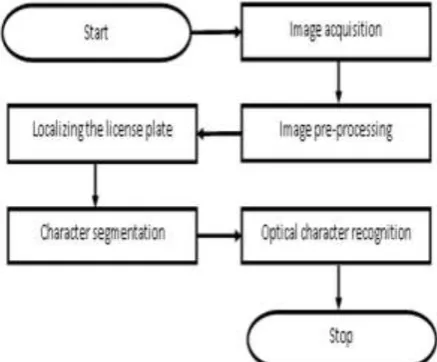
The ANPR system, as seen in Figure 1, generally can be composed of the following five stages.The first stage is image acquisition which capture the image of license plate using a camera by considering the camera resolution, orientation, shutter speed and lighting condition. The second stage is image pre-processing, such as normalization, brightness and contrast adjustment, and skewness correction of the captured image.
Figure 1. General Flow Chart of ANPR System
The third stage is localizing the license plate to extract the license plate from the whole vehicle image based on some features, such as the boundary, the colour, or the presence of the characters. The fourth stage is character segmentation to segment the characters on the license plate by locating and identifying the individual character on the license plate image.
The final stage is optical character recognition to recognize thesegmented characters by pattern matching or classifiers, such as artificial neural networks (ANN), fuzzy logic, and template matching. The overall performance of an ANPR system is depending on the performance of each individual stage. The output of ANPR system i.e. recognized plate number can be connected to other applications or databases. ANPR used a sequence of image manipulation methods to detect, normalize and improve a license plate image and optical character recognition (OCR) to recognize the alphanumeric of license plate. During the last decade, it became much interesting alongside due to the enhancement of digital camera technology and computational processing. It also can be used to detect, secure, maintain the record of vehicle and also prevent criminal activities.
II.
Android Platform
Android is a software environment made for mobile devices such as smartphone and tablet. It has to be stated that Android is not a hardware platform. Android consists of a Linux kernel-based OS, a rich UI, end-user applications, code libraries, application frameworks, multimedia support, and much more. Android was founded by Open Handset Alliance (group of over 30 companies led by Google) in July 2005. In the next sections, Leptonicalibraries will be discussed.
3.1. Leptonica
Leptonica is an open source C library which is useful for efficient image processing and image analysis applications. The library is developed since 2001 by a Google employee, Dan Bloomberg, and it is licensed under a Creative Commons Attribution 3.0 United States License.
III.
Proposed Design Of ANPR System On Android Smartphone
To implement ANPR algorithm on Android smartphone, it requires system development environment and system design. System development environment used as the development tools which consist of hardware and software. In this section, hardware and software used for the development are presented. The system design explains the prototyping design of all ANPR subsystems including graphical user interfaces (GUI) design and database design. It provides advantages for the developer as guidance to develop and implement the ANPR system on any Android platform.
3.1. Hardware and Software Environment Development
The Android smartphone used in this research is Samsung GT-S5830 code name Galaxy Ace also known as Galaxy Cooper which is mid-end smart phone family released by Samsung. It has 800 MHz 1 Core ARM v6 of processor with 278.34 MB of RAM. The screen resolution is HVGA (480 x 320) ~165 ppi pixel density and 5 mega pixels of camera resolution.
The ANPR system is constructed using Java Development Kit (JDK), Eclipse IDE (Integrated Development Environment), Android SDK (Software Development Kit) and Android Developer Tool (ADT), i.e. an Eclipse plug-in. The minimum Android API (Application Programming Interface) used for the constructing of the ANPR system is Android API 16 to develop application for Android 4.1 version (Jelly Bean).
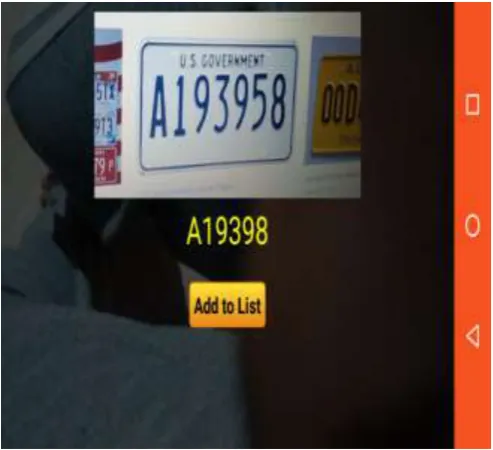
Figure 2: Capture page
4.2 Graphical User Interface Design
User interface design helps the developer to the concern on how the system presents the information to user. It is very important since user need the easiest way and simple to operate the system.
4.2.1. Database Design
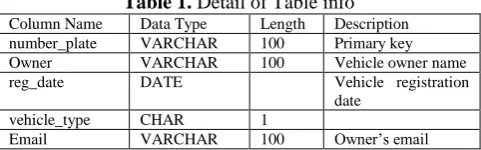
In this research, database is designed to support the ANPR system. It aims to record the data collection of vehicle number plate. The database is required by ANPR system in order to record and retrieve some information related to the number plate such as owner information, vehicle information, and position information of the vehicle.
Table 1. Detail of Table info Column Name Data Type Length Description number_plate VARCHAR 100 Primary key Owner VARCHAR 100 Vehicle owner name reg_date DATE Vehicle registration
date vehicle_type CHAR 1
Email VARCHAR 100 Owner’s email
The info_collection table will be updated frequently as the data received from the ANPR system in Android smartphone. It has many relations due to the required capability to record many data for the same number plate as foreign key which represents the number plate as the primary key in info table.
The second table is info_collection table as shown in Table 3. It records the data which are sent from the ANPR system in Android smartphone. For the purpose of this research it contains only three fields, including create_time,create_date, and info_number_plate. It includes date and time when the number plate was taken and the number plate in string as the string format.
Table 2. Details of Table info_collection Column Name Date Type Length Description info_number_
plate
VARCHAR 10 Foreign key
create_date DATE 100 Dateof taken number plate image create_time TIME 100 Time of taken
number plate image
3.2.2. Email Interface
There is a function to send an e-mail. To send mail, first the information about the email address and SMTP server must be set up. An acknowledgement about time and date when the vehicles entered or exit the campus is sent by this interface to the registered mail ID with an attached time, date and license plate number of vehicle if the number plate is available in the database.
IV.
Algorithm For Proposed System
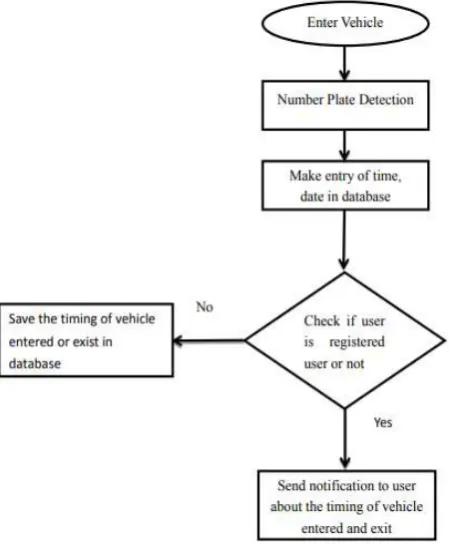
Step 1: With the help of camera, the number plate of vehicle will be captured.Step 2: The number plate of the vehicle will be processed using an image processing technique.
Step 3: Once the license number is extracted from the overall image, it will be compared and searched in the centralize database and the respective vehicle owner’s details will be fetched.
Step 4: Along with the details, it will also check whether the owner of the vehicle is registered user.
Step 5: If the owner of the vehicle is registered user then the system will send notification about the timing of vehicle enter or exit.
Step 6: Else if the owner of the vehicle is not registered user then the system will only store the detail in database.
Figure 3. Flow diagram of vehicle monitoring system with notification
V.
ANPR Algorithm Implemetation
In this section, the implementations of ANPR system on Android smartphone are presented. There are various methods for every step in ANPR algorithm. The selected algorithm in every step of the development of ANPR will be discussed in more details.
5.1. Acquisition of Number Plate Image
The first phase of ANPR system is acquisition of number plate image. The number plate image is captured using camera that is available in Android smartphone. The Android smartphone used in this research has a camera with 5 mega pixel resolution, which has capability to produce maximum of 2592x1944 pixels image and minimum of 640x480 pixels. In this research, the captured images sizes were 640x480 pixels to reduce the use of storage resources and also to reduce computational complexity. Figure 4 shows the sample of image captured by Android smartphone’s camera.
The next step of ANPR system is image pre-processing. This step is a significant process for the ANPR system. This step will produce an image that should be easily used to perform character segmentation. It means that the captured images need to have minimum noises and high contrast between character and its background.
5.3. Character Segmentation of the Number Plate Image
Generally, the number plates contain the characters which are having the equal width or fixed pitch. It will be easier to perform the character segmentation. The method that we used in this step is fixed pitch detection and chopping as proposed by Ray Smith for the Tesseract OCR engine. The fixed pitch method tests the number plate’s text lines to determine if they are fixed pitch. If fixed pitch text found in number plate, the fixed pitch method chops the number plate into characters using the pitch. Those characters are ready for the recognition.
5.4. Character Recognition of Numbers Plate Image
The final step in ANPR system is recognition of numbers plate. A main task of this step is to identify the characters’ image. There are numerous of methods have been proposed for the recognition process. ANN is dominating the feature extraction techniques for pattern recognition, while template matching is among the most selected method for number plate recognition. In this research, template matching algorithm is chosen due to its better recognition rate compare to other algorithmsand its simplicity. This arrangement is selected due to its impression on the overall performance of the ANPR systems.
VI.
Proposed System Advantages
LNPR system has some advantages as follows: Easier vehicle’s arrivals/departures to/from a campus. Increasing security in the area.
No need to install additional equipment on vehicles for recognizing them (like different cards, etc.)
Automatic opening the gate to authorized vehicles immediately upon recognizing their license plate and manual opening of the gate by the guard and issuing permission for specific vehicles as well as registering their license plates
Recording the entry/exit date and time for the vehicles
Sending notification about the time and date of vehicle entered/exit to the authorized person and while storing the time and date of vehicle entered/exit in the database for the unauthorized person.
Storing vehicle information for an unlimited time.
VII.
Conclusion
This paper has discussed comprehensive literature review on ANPR algorithms, including pre-processing, localization, character segmentation, and optical character recognition. Leptonica library was used for efficient image processing and character recognition. The system design, including GUI, process, and database design, has been discussed in details. The proposed ANPR algorithm was implemented and results show the effectiveness of our proposed design. More thorough performance evaluation including the recognition rate of ANN versus template matching algorithms needs to be conducted. Moreover, the proposed design could be further optimized to balance the processing requirement with the accuracy.Further research includes performance evaluation of the proposed ANPR algorithms using template matching based OCR. Also users can have the information of vehicle incoming and out coming time with the help of notification. System will automatically make entry of vehicle. And User will be ensuring that their vehicles are safe within the campus.
References
[1]. Muhammad Sarfraz, Mohammed Jameel Ahmed, and Syed A. Ghazi ,“Saudi arebian licence plate recognition system”, International Conference on Geometric Modeling and Graphics (GMAG’03), 2003.
[2]. SerkanOzbay, and Ergun Ercelebi,” Automatic Vehicle Identification by Plate Recognition”, Processing of world academy of science engineering and technology vol9, ISSN 1307-6884, november 2005.
[3]. HumayunKarimSulehria, Ye Zhang, Danish Irfan, AtifKarimSulehria,” Vehicle Number Plate Recognition Using Mathematical Morphology and Neural Networks”, WSEAS TRANSACTIONS on COMPUTERS, Volume 7,ISSN: 1109-2750, Issue 6, June 2008.
[4]. Zhen-Xue Chen, Cheng-Yun Liu, Fa-Liang Chang, and Guo-You Wang,” Automatic License-Plate Location and Recognition Based on Feature Salience”, IEEE Transaction on vehicle technology, VOL. 58, NO. 7, september 2009.
[6]. KumarParasuraman, Member, IEEE and P.Vasantha Kumar, “ An Efficient Method for Indian Vehicle License Plate Extraction and Character Segmentation”, IEEE International Conference on Computational Intelligence and Computing Research,2010.
[7]. Muhammad H Dashtban, Zahra Dashtban, Hassan Bevrani, “ A Novel Approach for Vehicle License Plate Localization and Recognition”, International Journal of Computer Applications (0975 – 8887), Volume 26– No.11, July 2011.
[8]. StutiAsthana, Niresh Sharma, Rajdeep Singh, “Vehicle number plate recognition using multiple layer back propagation neural networks”, International Journal of Computer Technology and Electronics Engineering (IJCTEE), Volume 1, Issue 1, July 10, 2011. [9]. Chetan Sharma1 and Amandeep Kaur2, “ INDIAN VEHICLE LICENSE PLATE EXTRACTION AND SEGMENTATION”,
International Journal of Computer Science and Communication, Vol. 2, No. 2, pp. 593-599, July-December 2011.
[10]. R. T. Lee, K. C. Hung, and H. S. Wang,“Real Time Vehicle License Plate Recognition Based on 2D Haar Discrete Wavelet Transform”, International Journal of Scientific & Engineering Research, Volume 3, Issue 4, ISSN 2229-5518, April-2012. [11]. Lekhana G.C, M.Tech; R.Srikantaswamy, Professor,“Real time license plate recognition system”, International Journal of
Advanced Technology & Engineering Research (IJATER) National Conference on Emerging Trends in Technology (NCET-Tech) ISSN, Volume 2, Issue 4, ISSN No: 2250-3536, July 2012.
[12]. Wengang Zhou, Houqiang Li, Yijuan Lu, Member, IEEE, and Qi Tian, Senior Member, IEEE, “Principal Visual Word Discovery for Automatic License Plate Detection”, IEEE transaction on image processing ,vol21, NO. 9, September 2012.
[13]. P.Sandhya Rani1, VaraPrasad,“License plate character segmentation based on pixel distribution density”, [IJESAT] International journal of engineering science and advanced technology, Volume-2, Issue-5, 1539 – 1542, Sep-Oct 2012.