Non-linear Multi-attribute Based Online Auction
Bidding Model and Platform
Jie Lin, Jinghua Zhao
(School of Economics and Management, Tongji University, Shanghai 200092, China) Email: [email protected], [email protected]
Ling Xue
Department of Operations and Information Management, University of Scranton, Scranton, PA 18510, USA
Email:[email protected]
Abstract—To build a new bidding model of multi-attribute
online auctions, this paper introduces the concepts of multi-type attribute and nonlinear function. The model can measure the effect of the attributes in auctions by adopting the normalized method of weighting and it will set the stage for the purchasers to evaluate suppliers in the procurement management. Furthermore, this paper developed an application platform system of nonlinear multi-attribute online auction (which is based on B/S) using the Struts framework developed J2EE. Finally, the related experiments and practices were conducted.
Index Terms
—
auctions/bidding; multi-attribute; non-linear; auction modelI.INTRODUCTION
Multi-attribute auction is different from traditional single-attribute auction. In traditional auction, the competition focus is mainly on the single-attribute—price, though the modes and the relationships between the counterparts of auctions vary differently. However, as values of many substitutes do not solely depend on price, it is unilateral to consider the price only. Especially in the procurement auction between enterprises, attributes other than price always yields the same importance. Scholars usually use multiple-attribute auction to refer to the auction in which the buyers consider more attributes besides price.
Traditional online auction has been studied for a long time. However, the importance of multi-attribute online auction has attracted more attention in recent years. Many scholars have studied the models of multi-attribute online auctions and mainly focused on the profits generated for
buyers and sellers, the bidding strategies and the set of multi-attribute weight. For example, Vulkan and Jeenings focused on the specific problem of service allocation among autonomous, automated agents[1]; Bitchler conducted a practical analysis on various kinds of auctions and found that more utilities can be generated from multi-attribute auction than from single-attribute auction[2]; Sairamesh studied the problem of service allocation among agents using multi-attribute English auction protocol[3]; C.C.Lee and C.OU-Yang investigated the negotiation efficiency for the various bidding strategies the demander employed in different order conditions[4]; Lee put forward an algorithm of multi-attribute computer negotiation; one of their contributions is the two-phases process which solves the most important attributes first and then the rest[5]. Recently, researchers in China begin to study this area and the majority of them are still concentrating in the analytical studies instead of practical applications of multi-attribute auctions.
In the practice of enterprise procurement, it is common that a single buyer deals with multiple suppliers. By introducing multi-attribute auction in procurement, we can achieve benefits such as full competition, optimized resource allocation, supply chain improvement, full development of suppliers’ potential as well as avoiding collusions among suppliers to some extent. However, due to the requirements on both technology and personnel, few applications can implement multi-attribute online procurement auction.
To improve the feasibility and adaptability of the multi-attribute procurement auction, we introduce non-linear function into the auction, put forward a non-linear multi-attribute-based online procurement auction bidding model and design the implementation of the auction platform based on the model.
II.NON-LINEAR ULTI-ATTRIBUTE BASED ONLINE
PROCUREMENT AUCTION MODEL National Natural Science Foundation, China (No. 71071114),
Doctoral Fund of Ministry of Education of China (No. 200802470009), Shanghai Leading Academic Discipline Project (No. B310).
This model is developed from Bichler’s weighted sum model, and then we introduce the concept of multi-type attributes and non-linear function into the model. In this model, different methods are used to calculate the values of different types of attributes. Finally, the weight sum of the normalized attribute value is used to calculate a comprehensive score, which is used to determine the auction winner.
A.Assumed Condition
Prior to the establishment of the model, we have the following assumptions:
1)A buyer has a number of suppliers to choose, each supplier’s ability to provide products varies.
2)When bidding, suppliers compete with each other on a limited number of product attributes
Y
i(i>1) designated by the buyer. Each bid contains the required values of all attributes (compared to the traditional auctions each bid contains only a single attribute value, the “price”) and regards the comprehensive score of multi-attribute as the final evaluation of the bid.3)Suppliers do not know each other’s bids but their own current ranks.
4)Evaluate each bid from suppliers and offer a comprehensive score, at the end of the auction, the supplier with the highest score wins.
B. Non-linear Multi-attribute Based Online
Procurement Auction Model
(1)The handling of multi-type attributes
Suppose that there are j suppliers participating in this auction, and they need to bid on i attributes of the product, then
(
i
j
)
x
f
Y
ij=
i(
ij)
1
<
,
1
<
(1) whereY
ij represents thei
th attribute score obtainedby the
j
th supplier;x
ij represents the bidding value of thei
th attribute submitted by thej
th supplier;f
irepresents the scoring rule applied to the
i
th attribute, which is determined by the buyer.In the traditional single-attribute auction, we only compare prices among suppliers and determine the ranking (namely
Y
j=
x
j,rankY
j). In multi-attribute auction, since the meanings of the attribute values are different (such as the values of price and accounts payable period: the lower the price and the longer the accounts payable period, the better for the buyer. In addition, the orders of magnitude of these two attributes are also different), we cannot simply compare them based on the values. Instead, we use functions to convert the bidding into proper values.The attributes of a product can be various, but we can divide the attribute types into three categories, namely,
the numeric, interval and text. This paper deals with the three types respectively as follows:
① The numeric type
The numeric type attribute means that the attributes can be directly described by numbers, such as price, delivery time (days) and quantity.
In practice, since the order-of-magnitude of each number type attribute is different, it is necessary to normalize the value of each attribute to facilitate the set of functions, thus
min max
min
i i
i ij ij
x
x
x
x
X
−
−
=
(2)where
x
ij represents the actual bid value on the thi
attribute submitted by the
j
th supplier;x
imin is the minimum value of thei
thattribute;x
imax represents the maximum value of thei
th attribute;X
ij represents the normalized value ofi
th attribute. Thus, we can limit the value of each numeric type attribute in the range of 0 to 1.Then we substitute
X
ij into the functionf
i to control the final comprehensive score, as well as normalize the value of the function to make the weight set effective, thusmin max
min
)
(
)
(
i i
i ij i ij i
f
f
f
X
f
X
F
−
−
=
(3)where
f
i(
X
ij)
represents the function value afterthe substitution of
X
ij;f
imin represents the minimum value of the function;f
imax represents the maximum value of the function (When the function is an increasing function, thenf
imin=f
i(
0
)
,f
imax=f
i(
1
)
and vice versa).In this model, we can use simple linear function, such as
f
(
x
)
=
ax
+
b
andf
(
x
)
, or more widely used non-linear function such as S shape functionx
be
a
x
f
+
=
1
)
(
and so forth. In linear multi-attributepart ranges from 1 to 4 days, and the supply of the other parts has not kept pace with it, there is no additional income for the buyer no matter how fast this kind of part can be supplied. Thus, when the value of this attribute ranges from 1 to 4, the evaluation score of this attribute will not change a lot; when the value ranges from 5 to 9, it will accelerate the decline of score; and when the value is bigger than 10, maybe due to the best sales time has passed, the score will be directly 0). In addition, the introduction of non-linear function also brings the buyers greater flexibility - their benefit can be maximized by getting guidance on suppliers’ bids and adjusting the function slope according to their own needs or preferences.
②The interval type
To make the model more applicable, we divide the value range of an attribute into intervals described by using different functions. The precondition is that the sub-functions must have the same monotonicity, called interval type attribute.
Suppose the sub-function is a monotone increasing function, then
min max
min
)
(
)
(
first last
first ij
i ij i
f
f
f
X
f
X
F
−
−
=
(4)where
f
lastmax represents the maximum value of the last interval of the value range (namely, the maximum value of the function),f
firstmin represents the minimum value of the first interval of the value range (namely, the minimum value of the function), and when the sub-function is a monotone decreasing function, then just exchangef
last andf
first . It is apparent that the number type attribute is a special form of the interval type attribute (when the attribute has only one interval).Integrating numeric and interval type attribute, formula (1) can be converted to
)
(
iji ij
F
X
Y
=
(5)③The text type
In practical, not every attribute can be described by numbers, such that buyers have different preferences on some attributes such as quality. For these attributes, we can make a number of text options for suppliers to select and give each option a value based on the following calculation, this is the so-called text type attribute. Suppose the
r
th attribute is a text type attribute and has totally m options, then{
x
x
x
} (
m
)
x
Y
rm r
r rj
rj
=
1
<
,
,
,
max
1 2L
L
(6)Where
x
rj represents the value of the option of the thr
attribute selected by thej
th supplier;Y
rjrepresents the score of the
r
th attribute obtained by the thj
supplier; it is apparent that the score has been limited in the range from 0 to 1, so the normalization is not needed.(2) Weight settings
After calculating the score of all the attributes, we assign each attribute a weight to reflect the preferences of buyers, then
∑
=
i i i i
w
w
W
(7)Where
w
i represents the weight assigned to thei
thattribute by the buyer;
W
i representsw
i’s proportion of the total weight, namely the real weight in the calculation of the comprehensive score.(3) Determination of the winner
To sum up, we can draw
∑
=
i ij i j
W
Y
S
(8)Where
S
j represents the comprehensive score of one bid of thej
thsupplier. By doing so, we can rank the suppliers based on the scores and determine the final winner.According to condition (3) “Suppliers do not know each other’s bidding but their own current ranking position.” we can avoid to some extent of the vicious competition on one attribute among the suppliers. The final comprehensive score of each supplier reflects the comprehensive effect of all the values of attributes submitted. If the suppliers want to make their own score the highest, after full competition, there must be
) , , ,
( 1 max 2 max 3 max
max j j j LL
j
j S x x x
S = =φ (9)
Where
S
jmax represents the highest comprehensive score of thej
th supplier,x
1jmax,
x
2jmax ,x
3jmax respectively represents the highest value of each attribute submitted by thej
th supplier,φ
represents the scoring rule.Finally, based on the ranking among the comprehensive scores, the supplier with the highest score wins, that is
{
S S S}
(
n j)
S
Sn= max=max 1, 2,LL, j 1≤ ≤ (10)
where Sn represents the comprehensive score of the
winner (suppose the
n
th supplier is the winner), Smaxrepresents the highest comprehensive score, formula (9) and (10) mean that only the supplier who gives full play to its advantages on each field can be the final winner.
Since that the online procurement auction may involve many suppliers from different regions, we choose a more adaptable framework- B/S (Browser/Server) framework (Figure 1). In Windows operating system, we use the design mode, which is widely used in Web system development, MVC (Model, View and Controller). We use Struts of J2EE, which is a mature classic open-source application framework based on MVC, the application framework. By integrating Servlet, JSP, JavaBean, custom labels and information resources into a unified framework, Struts offers an MVC development mode which can be highly configured in Web-based system development.
Figure 1 System platform architecture
A. SystemFunctionDesign
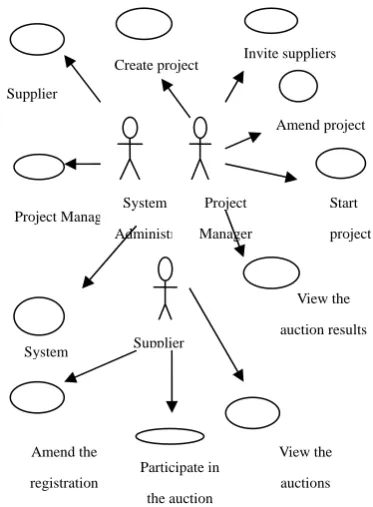
Based on the bidding model, non-linear multi-attribute online procurement auction system should involve three groups of users, including suppliers, project manager (the person who creates, manages and controls the auction project and is assigned by the buyer) and system administrator. We use unified modeling language (UML) to establish the use-case diagram (Figure 2).
The system uses role-based access control: users from three different groups use different URL address to login, and the system identifies them by user names and passwords and provides the appropriate interface. Among different group of users, the system administrator is responsible to audit the registration of new suppliers and other registrants and at the same time maintain the new project manager. Only the supplier or the project manager who has been audited by the system administrator can login to the system. The project manager is the host of the auction, who is mainly in charge of managing the procurement project, including the establishment of the project (set up the name of the project, the time to begin
and end and all the attributes, etc.), inviting the suppliers to participate in the auction (only the invited suppliers can see the project when login), amending the project (including the time to begin and end, attribute parameters, etc.), starting the project and reviewing the auction results. The suppliers can review the invited available procurement projects, select the project to participate in and amend their own registration information to get in touch with buyers.
Figure 2 the UML of Multi-attribute online auction system
B. Bidding Process Design
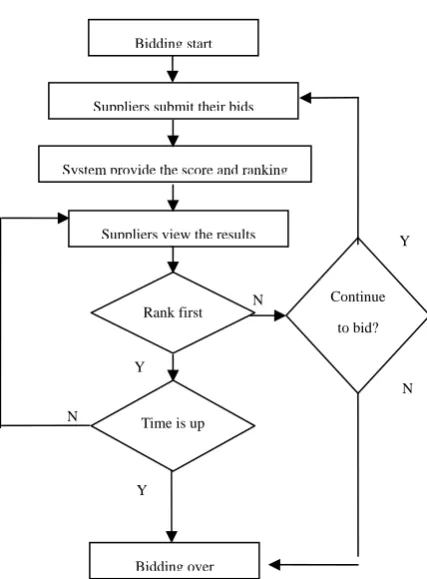
The core function of the multi-attribute online procurement auction system is to allow multiple suppliers to bid online at the same time and the buyers to monitor the process of the bidding. So we put forward the following suppliers bidding process based on the bidding model (Figure 3).
After the auction begins, suppliers can submit their bids through web controls such as text boxes and drop-down lists. The system then provides comprehensive scores and the ranking position for suppliers. The position is updated every second (via AJAX, Asynchronous JavaScript and XML, ranking update will not cause the refresh of the whole web explorer and greatly enhance the user experience), so that the suppliers can bid in real time and response timely. If the supplier’s bid ranks first, there is no need to respond until the end, unless the position dropped; if its ranking osition fell behind, then the supplier has to decide whether to bid again or not. If yes, then the supplier should consider how to adjust the attributes values to enhance the comprehensive score, leading us to the first step in this cycle.
Amend project
Project Manager
System
Start
project Supplier
View the
auction results
Participate in
the auction
Create project Invite suppliers
System
Administr
Project
Manager
Supplier
View the
auctions Amend the
registration Supplier info
Project info
Attribute set Supplier
Supplier
Auction Server
Supplier
Project
Manager
System
Manager
Internet
Internet
Internet
Figure 3 Multi-attribute online auction bidding process
C. DatabaseDesign
One of the difficulties of the system implementation is the database design. A project manager can create a number of procurement projects, each project contains a number of attributes, each attribute has a number of functions to use, and each function contains different parameters (we provide two kinds of functions, line function and S shape function). Database tables involved and the basic ER diagram is shown in Figure 4 (only show the relationship between the main entities).
The following is a brief description of the ER diagram, in which PK represents the primary key and FK represents the foreign key. The supplier table contains supplier ID (PK), user name, password, industry, region, company name, address, telephone, etc.; The system administrator table contains system administrator ID (PK), user name, password, name, telephone, etc.; The project manager table contains project manager ID (PK), user name, password, name, telephone, department, etc.; The procurement project table contains project ID (PK), project name, auction mode, project manager ID (FK), telephone, starting time, end time, project status, creating time, number o f attributes, etc.
.
Figure 4 ER diagram of the multi-attribute online auction
1
Supplier N
1
1 1
Number attribute
N
N
Interval attribute contains
contains
Interval
Text attribute
N N
1
1
contains
Level
1
submit
Bidding
table
corresponds
Project
1 1
manage
Project Manager
1
publish
Procurement
N
1
manage
N
System manage N
bidding
N
1
1
Bidding start
Suppliers submit their bids
System provide the score and ranking
Suppliers view the results
Rank first
Y
Time is up
Continue
to bid?
N
Y
N
Bidding over
Y
The relationship between the projects and the attributes is the main point in the database design. The attributes and projects relationship table (project ID (FK), attribute ID) is to indicate the relationship between the projects and the attributes, showing which attributes a project is related to. In addition, the number type attribute table—number type attribute ID (PK), attribute name, weight, minimum value, maximum value, used function and function parameter. In which the “number type attribute ID” column is the column of auto-generated code, and the same as the following attribute ID. The “minimum value” and the “maximum value” identify the value range of this attribute. In addition, the interval type attribute table (Interval attribute ID (PK), attribute name, weight, number of intervals) is used to save the basic information of the attributes. Since the number of intervals of each interval attribute is different, the relationship between the attribute and the intervals is a one-to-many relationship. We need another table to save the value of each intervals-the interval table, which includes interval type attribute ID (FK), interval ID, minimum value, maximum value, used function and function parameter. For each interval, value range is defined by a pair of “minimum value” and “maximum value”, and each interval has a corresponding used function. Same as the interval type attribute table, the text type attribute table (text attribute ID (PK), attribute name, weight, number of levels) is also used to save the basic information of the attributes. . Moreover, the level table (text type attribute ID (FK), level ID, level name, description, corresponding value) is to store the detailed information of levels. For each text level, we need to set the name and description to tell the demand of the buyers in detail. At last we need to set the corresponding values which are used to calculate the scores. The text type attributes do not have any functions, and the corresponding values equal the values that are calculated from the functions of the other attributes.
In addition, we can see that from the above, a project corresponds to a number of attributes and the interval or text type attribute corresponds to a number of intervals or levels. Therefore, it is impossible to record all the bids from all the projects in one table. So we use the bidding record table corresponding to one project and each table is generated automatically by the system. The table includes: supplier ID (FK), attribute ID 1, attribute ID 2, ……, comprehensive score, submit time.
IV. APPLICATIONS
Based on the system design, we complete the multi-attribute online procurement auction system development. We use the B/S structure and the Struts framework of J2EE in Windows operating system. We choose the HyperText Mark-up Language (HTML), Java Server Pages (JSP), Java and JavaScript as the programming languages and supplemented by AJAX, partial page update technology, use Eclipse3.1 as the
development environment and SQL server as the database. If the servers of the system are deployed by the buyer, the suppliers can just login the system and participate in the auction project at the scheduled time.
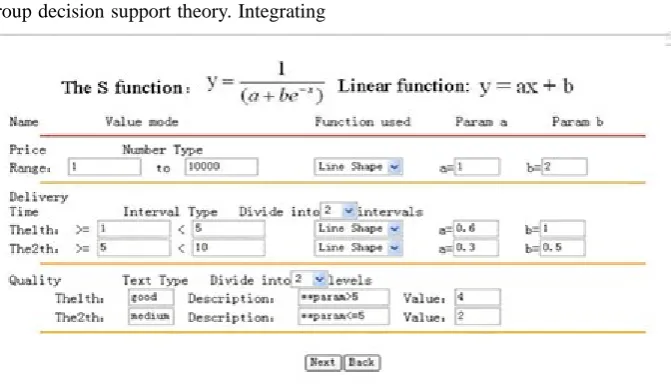
The main interface of the system consists of a title on the top, a menu on the left and the main part on the right. When the users from different groups login to the system, the menu bar will show different options accordingly. Figure 5 shows the menu when a project manager login: the main part shows the core process to create a new project, which is the setting of each attribute. In this example, the manager chooses price, delivery time and quality as the attributes, for the project, and number, interval and text as the attribute type. For number type attributes, the manager need to type in the value range and choose the corresponding function and the function parameters; for the interval type attributes, he need to select the interval number first and then set each interval as number type attributes; and for text type attributes, he also need to select the level number first, then name and describe each level and set the corresponding values respectively. When the attribute setting is completed, then the project manager can invite suppliers and start the project.
When the project starts, suppliers can login to the system and participate in the auction. Through textboxes (number type and interval type) and drop-down list boxes (text type), they can type in the bids and submit to the server. They also can see their rankings and bidding records in the page as reference for the next bid.
While suppliers are bidding, the project manager can monitor the competition and see the ranking via the system. When the bidding is over, the manager can contact the winner soon.
Since the remaining functions and the functions of system administrator are external functions of the system, we will not discuss them in this paper.
V. CONCLUSIONS
The multi-attribute online procurement auction can bring full competition, optimize resource allocation, improve supply chain process and develop suppliers’ full potential. It is also an opportunity for the buyers to re-select suppliers. The competition of non-price attributes exposes suppliers’ ability completely, so it is a good chance for buyers to transform the supply chain and an opportunity for the suppliers to adjust the production structure. By developing their own potential, transforming the industrial structure and improving the concept of cost, the suppliers can also pave the way for the future development.
Non-linear multi-attribute auction theory can also be integrated into group decision support theory. Integrating
this application platform with
Figure 5 Core processes to create a project
group decision support system (GDSS) to build a new procurement platform and studying the procurement process, supplier management and incentive mechanism is also a new idea to solve the modern procurement problem. It also can aid the business decision-making and promote the supply chain coordination.
ACKNOWLEDGEMENTS
This work was supported by National Natural Science Foundation, China (No. 71071114), Doctoral Fund of Ministry of Education of China (No. 200802470009), Shanghai Leading Academic Discipline Project (No. B310).
REFERENCES
[1] Vulkan N., & Jennings N. R.. Efficient Mechanisms for the supply of services in multi-agent environments. Decision support systems, 2000, 28, 5-19
[2] M.Bichler. An Experimental Analysis of Multi-attributes Auction. Decision Support System, 2000, 29(3):249-268 [3] J.Sairamesh, R.Mohan. A Platform for
Business-To-Business Sell-Side, private Exchanges and Marketplaces. IBM Systems Journal, 2000, 41(2):242-252 [4] C.C.Lee & C.OU-Yang. Development and evaluation of
the interactive bidding strategies for a demander and its suppliers in supplier selection auction market. International Journal of Production Research, 2008, 17: 4827-4848
[5] Lee.H.G. Electronic Brokerage and Electronic Auction: the impact of IT on market structure. Proceedings of the 29 th Hawaii International Conference on System Sciences, Maui, HI,1999, 4:397-406
[6] Y.K.Che. Design Competition through Multidimensional Auction. RAND Journal of Economics, 1993, 24(4):668-680
[7] R.P.McAfee, J.M. Auctions and bidding. Journal of Economic Literature, 1987, 7:699-738
Jie Lin, a Sichuan Quxian native (1967-), a Ph. D. graduated from Fudan University and a professor in School of Economics and Management at Tongji University, his research interests include management information system, electronic commence and supply chain management, etc.
Email: [email protected]
Jinghua Zhao, a Shandong Guanxian native (1984-), a Ph. D. candidate in School of Economics and Management at Tongji University, her research interests include management information system, electronic commence and supply chain management, etc.
E-mail: [email protected]
Ling Xue,a shanghai native (1975- ), a Ph.D. graduated from University of Texas at Austin, and is a assistant professor in the university of Scranton, His Research and Teaching Interests include: E-Commerce, IT governance, IT value, IT security, E-Commerce, Database, IT management.