An Efficient Lung Disease Identification and
Segmentation Based on Contour Extraction
Olivia Russel T.Cithra
UG Scholar Assistant Professor
Department of Electronics Communication Engineering Department of Electronics Communication Engineering CCET, Oddanchatram Tamilnadu – 624619 CCET, Oddanchatram Tamilnadu – 624619
A. Praveena Uma maheswari
UG Scholar UG Scholar
Department of Electronics Communication Engineering Department of Electronics Communication Engineering CCET, Oddanchatram Tamilnadu – 624619 CCET, Oddanchatram Tamilnadu – 624619
Murugeswari UG Scholar
Department of Electronics Communication Engineering CCET, Oddanchatram Tamilnadu – 624619
Abstract
The classification and identification of the disease in medical images were helpful in biomedical applications. The process of segmentation of the diseased portion in the lung lobe images were done based on Toboggan algorithm. The lung lobes were segmented from the input images based on gradient estimation following original Toboggan algorithm. If the segmented lung lobes were disease affected means then the identification of disease location is done. The classification process is employed using SVM classifier with the help of features extracted from lung lobes using XCSLBP texture identification. From the gradient estimated lung lesion inside the segmented lung lobes were extracted based on the improved Toboggan algorithm. Contours were extracted over the identified lung lesion regions. The overall performance of the process were measured based on the performance metrics. The accuracy obtained here is 99.74% and sensitivity is about 100%.
Keywords: Computed Tomography (CT), SVM classifier, Toboggan algorithm, Region growing, XCLBP
________________________________________________________________________________________________________ I. INTRODUCTION
LUNG cancer is the leading cause of cancer mortality around the world. Up to 10 million patients in the world will die of lung cancer by 2030 in terms of the report from the World Health Organization. Early prevention of lung tumor has an important role for survival benefit improvements. With the hypothesis that deep analysis of radiographic images can inform and quantify the microenvironment and the extent of intra-tumoral heterogeneity for personalized medicine, analysis of large numbers of image features extracted from computed tomography (CT) with high Throughput can capture spatial and temporal genetic heterogeneity in a non-invasive way, which is better than invasive biopsy based molecular assays. It will be useful for medical research, computer-aided diagnosis, radiotherapy and evaluations of surgery outcome as well. For this purpose, accurate segmentation of lung lesions is the pre-requisite. One method for lung lesion segmentation is that experts with experience such as radiologists delineate the lesion manually. It is a difficult task to obtain robust and efficient results for a variety of reasons. First, the experts may overestimate the lesion volume to enclose the whole lesion .
process; therefore, its success is related directly to its disease detection accuracy. Today, CAD systems are frequently utilized to detect and diagnose numerous abnormalities in routine clinical work.
II. PROPOSED METHOD
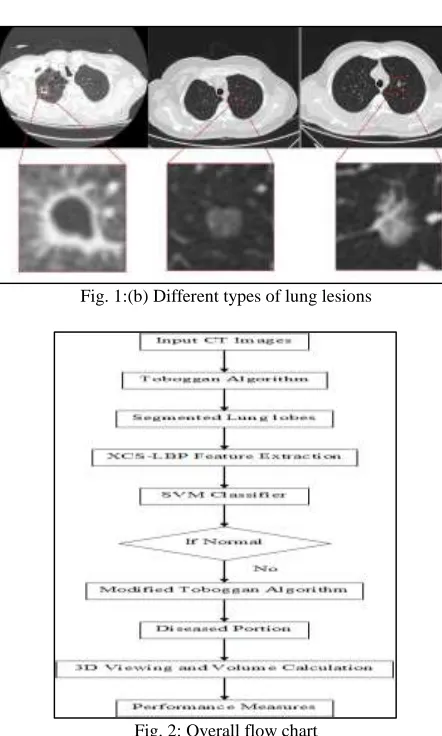
The existing method involves gradient extraction and then it undergoes lung lobe segmentation and then does the process of region growing, back swapping using improved Toboggan algorithm. The diseased portion is shown in 3D view. The sensitivity was found to be 96.35%. The major difference between both existing and proposed method is identifying the very minute changes in the lung lobes in the proposed than existing method. The proposed method consist of Original Toboggan algorithm, Classification, Disease Identification by Improved Toboggan algorithm, Performance Metrics. The different types of lung lesions are shown in figure 1. The detailed flow chart are in the following which gives thorough knowledge about the entire system. It involves mainly four phases a) seed point location b) Gradient Extraction c) Region Growing d) Segmentation. This technique is found to be more efficient than before.
Fig. 1: (a) Different types of lung lesions
Fig. 1:(b) Different types of lung lesions
Fig. 3: System architecture
Original toboggan algorithm
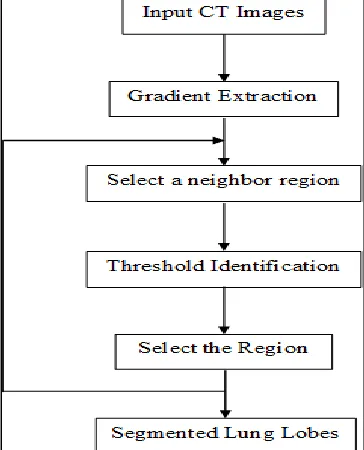
The lung lobe segmentation process is employed based on Toboggan algorithm. In Toboggan algorithm the neighbors of each pixel were examined and the steepest downward direction in the sliding list is recorded. Then region growing process is employed in order to find the shortest paths from each inner pixels in the non-local-minimum flat regions to its lower boundary. The remaining empty sliding lists belong to the local-minimum flat regions. The connected components were used for recognizing local minimum flat regions. Finally a topological sort is applied by taking the pixels as the vertices and the corresponding pixels in the sliding list as the targets of the directed edges.
Fig. 4: Flow diagram of original toboggan algorithm
Classification
Fig. 5: Flow diagram of classification process
Disease Identification by improved toboggan algorithm
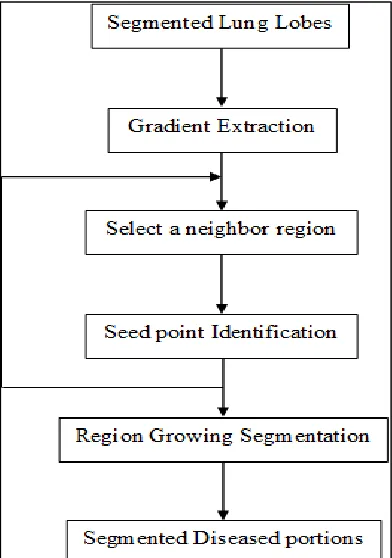
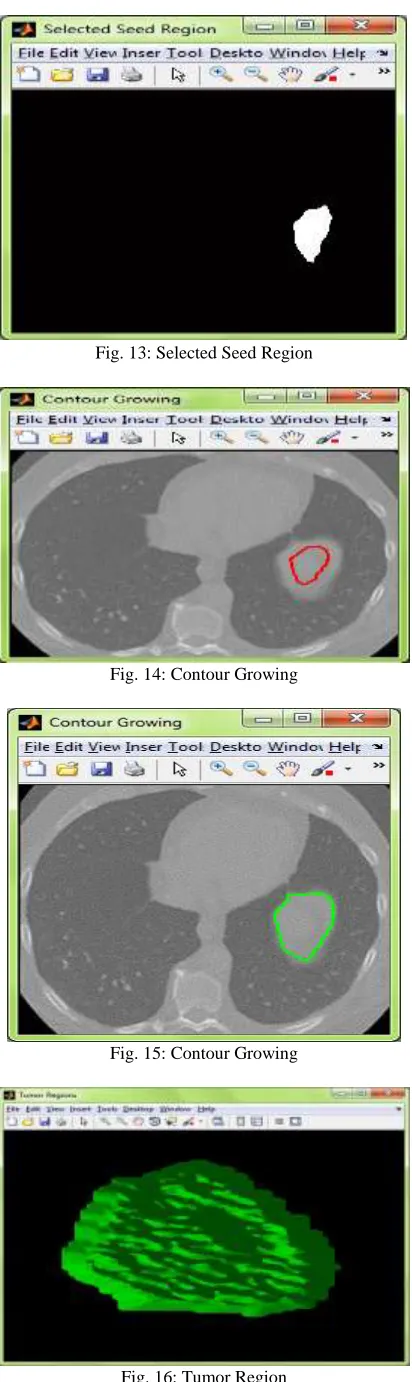
The diseased portions in the lung images were identified based on improved toboggan algorithm. By the improved toboggan method, the highlighted vessels, tracheal wall and other noise in the gradient image will be moved into the lung field while the lesion remains at a higher value. Therefore, the other tissues would be dimmed and the lesion could be enhanced in the label image for the subsequent automatic seed point selection. The improved toboggan algorithm is based on improving the gradient obtained from the lung lobes. The area and the perimeter for the different diseased locations in the images were setted and by comparing with those values the diseased locations were segmented from the images. From the gradient estimated lung lesion inside the segmented lung lobes were extracted based on the improved Toboggan algorithm. Contours were extracted over the identified lung lesion regions.
Fig. 6: Flow diagram of diseased identification by improved toboggan algorithm
Performance Measures
True positive = correctly identified False positive = incorrectly identified True negative = correctly rejected False negative = incorrectly rejected
III. RESULTS
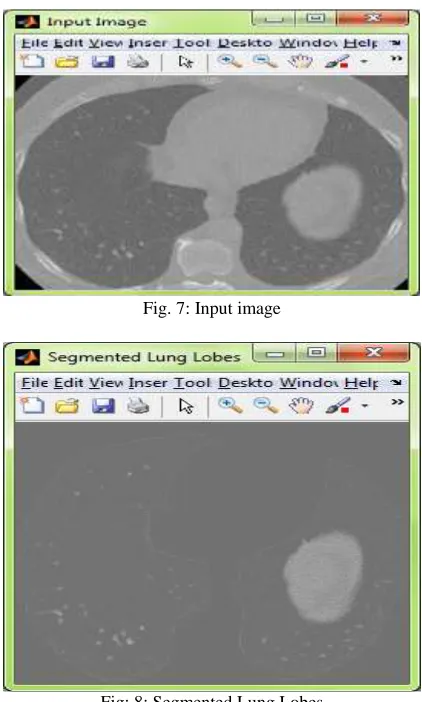
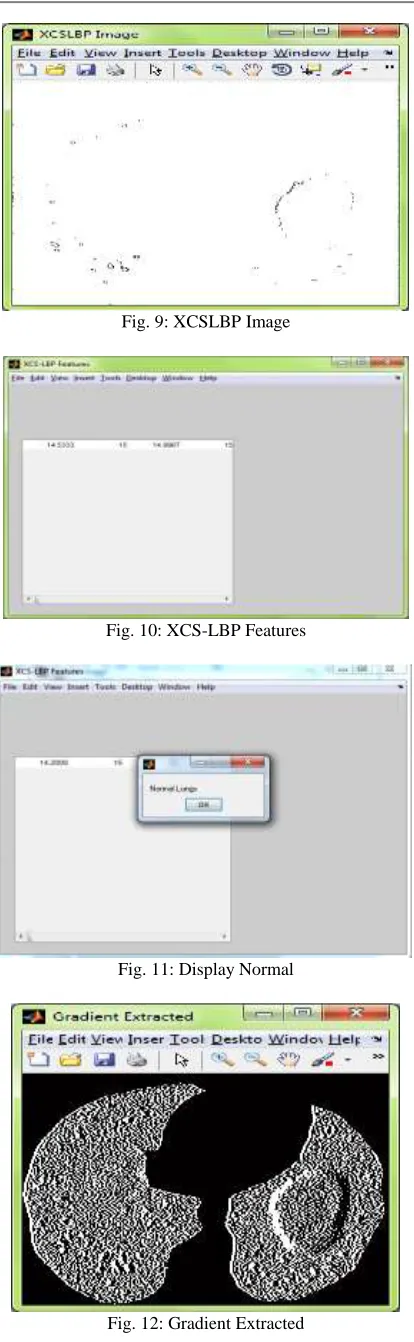
By the usage of the Toboggan algorithm, the lung lobe images are segmented and the disease is identified and detected more efficiently. Modification process is adapted here such as seed point selection, gradient extraction, region growing through contour extraction, segmentation for improved technique. When the input CT image is given then it undergoes gradient extraction through Toboggan algorithm. Further, the gradient image gets feature extracted by using XCSLBP. The image then goes classification process through SVM classifier which identifies whether the lung is disease affected or not. If no damage is traced out then it comes out of the process as normal lung shown in figure 12.If any disease is identified then it goes into Improved Toboggan algorithm. The overall performance is measured by using performance metrics.
Fig. 7: Input image
Fig. 9: XCSLBP Image
Fig. 10: XCS-LBP Features
Fig. 11: Display Normal
Fig. 13: Selected Seed Region
Fig. 14: Contour Growing
Fig. 15: Contour Growing
Performance Metrics Existing
system Proposed Approach Accuracy 96.145 99.745 Sensitivity 84.7 100 Specificity 83.807 84.807 Area Under Curve 90.43 93.383 Dice Coefficients 81.93 91.779 Hausdorff Distance 0.82 0.98
True Positives 12540 61850 True Negatives 1263 3126 False Positives 360 560
False Negatives 0 0
Fig. 17: Tabulation of performance measures
IV. CONCLUSION
CT Lung images were taken as the input. The lung positives, False Negatives, Area under Curve, Accuracy, Sensitivity and Specificity of the classifiers. lobes were segmented from the CT lung images based on Toboggan algorithm. XCS-LBP is employed for the extraction of texture features from the images. The extracted features were then classified using SVM classifier in order to find whether the lung lobes were disease affected or not. If the lung lobes were disease affected then the diseased portions were segmented using Modified Toboggan algorithm. The performance of the process is measured based on the performance like True Positives, True Negatives, False
REFERENCES
[1] H. J. W. L. Aerts, E. R. Velazquez, R. T. H. Leijenaar, C. Parmar, P.Grossmann, S. Cavalho, J. Bussink, R. Monshouwer, B. Haibe-Kains,D. Rietveld, F. Hoebers, M. M. Rietbergen, C. R. Leemans, A. Dekker,J. Quackenbush, R. J. Gillies, and P. Lambin, “Decoding tumourPhenotype by noninvasive imaging using a quantitative radiomics Approach.” Nat. Communes., vol. 5, p. 4006, 2014
[2] Bian and Zijian et al., “Accurate airway centerline extraction basedOn topological thinning using graph-theoretic analysis,” Bio-medical Materials and engineering, vol. 24, no. 6, pp. 3239–3249, 2014.
[3] Caiyum Yang,Li Fan , Kun Wang ,Feng Yang,shiyuan Liu, and Jie Tian, “Lung lesion extraction using a toboggan based growing automatic segmentation approach”IEEE Transactions on medical imaging, vol.35 no.1,January 2016.
[4] D. M. Campos, A. Simões, I. Ramos, and A. Campilho, “Feature-Based Supervised Lung Nodule Segmentation,” no. Ci, pp. 23–26, 2014.
[5] S. Candemir, S. Jaeger, K. Palaniappan, J. P. Musco, R. K. Singh,“Lung segmentation in chest radiographs using anatomical atlases with Nonrigid registration,” IEEE Trans. Med. Imaging, vol. 33, no. 2, pp. 577–590, 2014.
[6] B. Lassen, E. M. Van Rikxoort, M. Schmidt, S. Kerkstra, B. Van Ginneken,And J. M. Kuhnigk, “Automatic segmentation of the pulmonaryLobes from chest CT scans based on Fissures, Vessels, Bronchi,” IEEETrans. Med. Imaging, vol. 32, no. 2, pp. 210–222, 2013.
[7] M. Nakata, H. Saeki, I. Takata, Y. Segawa, H. Mogami, K. Mandai, andK. Eguchi, “Focal ground-glass opacity detected by low-dose helical CT,” Chest, vol. 121, no. 5, pp. 1464–1467, 2002.
[8] W. H. Organization, “Description of the global burden of NCDs, their Risk factors and determinants,” Geneva, Switzerland: World Health Organization, 2011.
[9] R. Siegel, D. Naishadham, and A. Jemal, “Cancer statistics, 2013,” CACancer J Clin, vol. 63, pp. 11–30, Jan. 2013.