e-ISSN: 2278-067X, p-ISSN: 2278-800X, www.ijerd.com
Volume 12, Issue 8 (August 2016), PP.70-85
Managing Network Resources Over Wireless Device
Homer Ricacho Ampong, Andrew M. Curso, Noel P. Tancinco
Naval State University, Naval, Biliran Province, Philippines
Abstract:
This study was focused on discovering an innovative way of developing a network management solution that will utilize wireless remote control through Internet. These wireless devices offer great connectivity that other types of devices cannot offer. In this study, a wireless technique is devised to implement a monitoring system by using Java – based client/server applications. In order for this device to support the ava application programs, a Mobile Information Device Profile (MIDP) is implemented. The MIDP is a profile defined specifically for the wireless devices that is implemented on top of a Connection Limited Device Configuration (CLDC) defined for handheld devices. The Connection Limited Device Configuration is a configuration for handheld and resource constrained devices, which is based on Java 2 Micro edition technology. The monitoring system consists of user interface, Middle application, and Servlet application via Hyper Text Transfer Protocol (HTTP). The Servlet application runs on the web server. Furthermore, the proposed wireless remote monitoring method will enable us t access the server in the network i.e. anytime and from anywhere. The programs, specifically the client module and the module that could be developed in this thesis, may support not only for the server in a network but also could be applied to any other remote control application.KeyTerms
:
Network Management; Network Operating System; Wireless Device;I.
INTRODUCTION
A network is a communication system that allows its user to share resources and exchange information. Business have invested in this technology to sustain competitive advantage over their competitors. They use the technology to bring in more services to further strengthen their workforce and the satisfaction of their clients. Some of their services include unified messaging, collaboration, conferencing, application services and long distance communication via Voice – over – IP to name a few. With these innovations in network – driven services, system administrators, devote their full attention in maintaining and ensuring these services are running 24 hours a day, 7 days a week or 365 days a year. As a consequence, Network Management standards and solutions have emerged through the years to equip the systems administrators to maintain the network in fighting potential threat that may affect the performance or worst shutdown of the network. But how come networks and its services are still experiencing high levels of downtimes? Despite the fact that both hardware and software solutions are available on the market and management standards were already in place, unscheduled downtimes still exist. The million – dollar question is, can we really prevent these downtimes? In a recent finding of Data Recovery Report [1], 44% of this downtime is accounted for hardware and 14% for software. Other factors that have contributed are: 32% for human error, 7% for virus and 3% for natural causes. Interruption to these services may not only spell loss on money for business but may also tarnish the reputation of the company to its clients. These systems administrators need to be more proactive in dealing with this matter.
2.2 Conceptual Framework
The study aims to provide systems administrators a network management tools built on a wireless device that will empower them to effectively manage their networks even when they are not physically presents at a given site and has no access to a PC or laptop.
The network management techniques already discussed will guide the proponent to the core areas of concern to effectively manage a network. The system will also source its inputs from the software development kits or SDK’s available on the internet and from the network operating system. These inputs will be the basis and foundation of the Wireless Network Management solution that the proponents is planning to implement. Finally, utilizing this tool in tandem with the existing network management solutions proprietary or open – source that may already be installed and configured on the network, the researcher envisions to minimize to a greater level the unscheduled network downtimes thus contributing the increase of network availability and services.
Figure 2 -2 shows the paradigm on Managing Local Area Network over Wireless Device.
\NPUT PROCESS OUTPUT
Feedback
Figure 1. A Paradigm Showing the Managing of Network Server Resources over Wireless Device
2.3Statement of the Problem
This study aims to design and develop a wireless network management application. Specifically, the following problems were investigated:
(1) What network management techniques do systems administrator employ in terms of the following: ● Performance Management;
● Configuration Management; ● Sec+urity Management ● Accounting Management; and ● Fault Management
(2) What network management standards do systems administrators implementation managing their networks?
(3) How their choice of platform affects the overall performance of their networks?
(4) How does a network management solution contribute in the overall effort in managing a network?
2.4Objectives of the Study 2.4.1 General Objectives:
This study is focused on discovering the innovative ways of developing a network management solution that will utilized application programming interface available on the Internet, network operating system, and/or management solution and integrate all its functionality in a wireless device. This will empower systems administrators to effectively and efficiently manage their network.
2.4.2 Specific Objectives:
Considering the multi – faceted nature and intricacies of the study, the following goals were set in conducting the demands of the study.
(1) To discover and learn from the various implementations of the five conceptual areas of managing a network specifically in the area of performance.
(2) To pioneer and set the foundation for other developers to follow to and expound.
(3) To determine and study the variety of network and industry standards of network management.
(4) To assess and gain from the different strategies employed by systems administrators in managing their networks.
(5) To explore and evaluate current technologies in developing of the implementation of network management standard in a particular network operating system.
2.5Significance of the Study
site and without access to a PC or laptop. This study leverages the existing investments on the network operating system and/or management solutions software without incurring additional cost to the company.
2.6Scope and Limitations of the Study
This study covered the five conceptual areas or the network management elements, prevailing networking and industry standards on network management (e.g. SNMP, RMON, etc.), network management solutions already running on the network, and the set of application programming interfaces provided by the network platform. The researcher will gather data from selected Internet Service Providers.
The study is subject to known and still unknown limitations, some of which are easily determined and some are still to be discovered. Therefore, the following are the identified factors that may directly or indirectly affect the study.
● The study will concentrate on one particular network management standard and network operating system. ● Availability of network resources to simulate a true network environment similar to those of the Internet
Service Providers.
● The proponent will only use a wireless device emulator to connect and retrieve resource status of a network server.
● The proponent will use variety of tools that may include proprietary or open – source.
● The emerging network and internet technology standards available today wich includes the IEEE 802.1 lb for Wireless LAN, Bluetooth, HTTP, and GSM’s General Packet Radio Service or GPRS and the different tools available to develop a wireless application which includes Sun Microsystems’s Java 2 Micro Edition (J2ME), Wireless Application Protocol (WAP), PALM development tools and may more.
● The development of wireless network management application is totally dependent on the specifications agreed upon by the different
● Companies involved.
● The features and capabilities of the proposed system will be limited to programming interfaces available from the development libraries and network operating system. The output of the study will depend on how much functionalities are available in these programming interfaces. It may or may not be possible to include other network management functions but performance management API’s will be the top priority.
● The study is limited to TCP/IP – based networks.
II.
METHODS AND PROCEDURE
This chapter outlines the strategies that the proponent considers in accomplishing the expected output in this phase. The sections in this document is divided into the following methodology and technology solution, respondents of the study, sources of data, data gathering instruments, data gathering procedure, construction and validation, and statistical treatment of data.
4.1 Technology Solution
4.1.1 Requirements Gathering and Refinements
In this phase, proponent gathered inputs relating to the diverse strategies of managing the network. Specifically, the different approach of system administrators relating to performance, configuration, fault, accounting and security aspects are to be gathered from the identified respondents through the data gathering instruments that are identified and explained later in this document. These requirements and network management techniques will serve as guide in determining the initial features of the prototype. In preparation for development, two PC’s will to be connected, one would function as the server and the other as client. This is needed to simulate a typical network setup. Installation and proper configuration of services should be running on the server. All of these are done to somehow mimic a typical ISP setup. Additional PC’s may be connected .to the network. This serves as the “test environment” That would allow the proponent to stimulate a network environment that is one or the other similar in the “real world” This is imperative and crucial in developing the system so as to have a clearer perspective of what is really like in the “driver’s seat” Selected inputs gathered from the target respondents are to be implement in the “test environment.” Additional and succeeding requirements that are considered vital are to be integrated in this phase. Review and through understanding of the different specifications such as the MIDP/CLDC and other related Java 2 platform specifications are also needed in this phase.
4.1.2 Quick Design
In this phase, non –operational prototype of the client and server module are to be produced using the various tools download from the Internet, such tools include software development kits (SDK) such as Nokia’s Developer’s Suite, and Java Micro Edition’s Wireless Toolkit, Java 2 platform SDK, different Nokia emulators, and Apache Tomcat. These tools should be properly installed and configured on the PC’s acting as server and client. The initial design of the user interface and functionalities on the client module depends on the J2ME packages. The initial functionalities of the serve module depend on the packages of the HTTP/ Servlet service.
4.1.3 Building of Prototype
Capitalizing on the accomplishments of the pervious phases, this phase would construct the core functionalities for both the client and server modules. Client and server communication are to be tested in this phase using the API’s provided by the J2ME, servlet, and SNMP packages. Using the Nokia emulators, each and every component defined on client module will be tested and evaluated. Assessments are to be done by the proponent using the test environment to ensure that every major features of the prototype is functioning as expected. A favorable assessment and feedback of every component are to be finalized and integrated to the prototype.
4.1.4 User Evaluation of Prototype
It is of great importance that every component of the prototype is assessed, in this phase the assessments will be done by the proponent himself for each and every component accomplished in the prior phases. Evaluation that will come from selected systems administrations done once all components are deployed and completely tested.
4.1.5 Refining the Prototype
Additional requirements that are considered vital to the prototype to overall functions of the prototype are to be considered and eventually integrated. Through testing and evaluation done in this phase is considered to be top priority to ensure that all components are working accordingly. Enhancements to the features of the prototype are essentials to achieve higher user satisfaction.
4.1.6 Engineer Product
In this final phase, every major feature of the prototype should all be integrated into the system in preparation for its deployment in the production network. The client module should be deployed on the actual device and should be able to connect and retrieved resources status coming from server module that should be running and able to receive and process the request and send back resource status to client module using on HTTP/Servlet service. Overall the system should be able to execute its defined functions and be able to deliver the output expected from it.
4.2 Respondents of the study
already small. Instead, the actual size of the population of systems administration were considered, one for each company numbering approximately less than 10, setting the ratio of systems administrations to company 1:1.
4.3 Sources of Data
The data gathered from two sources namely: the primary and secondary sources. The primary sources of data comprised of questionnaires, interview and observation. Secondary sources of data comprised of articles from the internet, acquisition of books related to wireless application development, and group discussion and posting from interested forums and e-mail messages from selected sources.
Data gathered from the result of requirements, interview conducted with the selected respondents, acquisition of books and/ or articles related to the study, and from the network “test environment” were the primary sources of data. Posting and messages from discussion forums and other interest groups related also to the study such as from Nokia, Sun, Microsoft, PALM, Symbian, and e-mails from people considered as experts on the subjects were the secondary sources of data.
4.4 Data Gathering Instruments
The proponent developed, distributed, and collected questionnaires from respondents. Afterwards an interview was conducted. Inputs and techniques gathered were implemented on the “test environment”, this to verify the validity and effectiveness of the inputs. The proponent subscribed to group forums, communicated with selected sources through e-mail, collect related articles, and acquire books.
4.4.1 Questionnaire
The respondents to the study composed of one system administrator each per company. The questionnaires contain questions stated in the statement of the problem, which are: “What techniques do systems administrators employ in terms of Performance Management, Configuration Management, Security Management, Accounting Management, and Fault Management;” “What network management standards do systems administrators implement in managing their networks:” “How does their choices of network platform affect the overall performance of their networks;” and “How does network management solutions contribute in the overall effort in managing a network.” The proponent distributed the questionnaires personally and retrieved it after a short time.
4.4.2 Interview
After collecting all questionnaires from the respondents, the proponent reviewed the inputs and analysed the results. The proponent determined what questions were answered vaguely and followed up on those that needed further clarification from the respondents. This was done to ensure that critical issues or concerns were addressed before undergoing the succeeding stages. One system administrator from a leading Internet Service Provider in Tacloban City has shared his insights about the study. The proponent has conducted other interviews from valuable sources, vital information were drawn from these discussions, which greatly contributed to the development of the system.
4.4.3 Observation
The selected inputs provided by the primary and secondary sources of data were applied to the test environment. The original idea was run the prototype in a production local area network to gather baseline performance result from a server serving 80-100 active nodes but it did not materialize due to unforeseeable constraints encountered before the deployment, instead the proponent have settled to apply and validated some of the valuable workable inputs that came from the respondents.
To augment and support the primary data sources, the proponent has subscribed to group forums such as the Java 2 platform forum (forum.java.sun.com) and other discussion groups that have focused and interested in wireless application development, servlet technology, and network management using SNMP. The proponent has corresponded with people and institutions through e-mails and produced favourable results that are valuable during development of the system. Articles focusing on the subjects of J2ME’s MIDP and CLDC, servlets technology, Java Native Interfaces (JNI), Windows 2000 Core Platform SDK, third party SNMP API’s, and other important technologies were collected and reviewed. Books relating to wireless application development using J2EE’s servlet technology were acquired.
this particular requirement. The second approach is to use an evaluation or trial copy of third party SNMP API’s already available on the internet. This approach was considered and integrated in the server module thus has accelerated the time to develop this particular requirement and made the system portable and end-to-end Java-based solution.
4.5 Data Gathering Procedure
The proponent has developed, distributed, and analysed the questionnaires collected from the respondents. Selected respondents were interviewed to clarify issues and concerns that emanated based on the results of analysis of questionnaires. Some of the valuable inputs that came from these activities were implemented in the test environment to observe the effects. The proponent has also subscribed to groups forum, corresponded to different technology gurus and institution, collected articles from the internet, and acquired pertinent books to augment and support the proponent’s development efforts.
4.6 Construction and Validation
The questions that were included in the questionnaires were developed by first considering the general and specific problems of the study. It served as a guide to formulate the open and closed, general to specific types of questions found in the questionnaire. The help of our school’s research staff to ensure all questions included are relevant to the study validated the questionnaire.
System Analysis An Design
This chapter presents how the proponent has been able to apply the research methodology, constructed the solutions to the different problem identified, how the objectives of this study were realized, and the interpretation of the results of data gathered from the respondents.
5.1 Analysis
In order to solve the specific problems and objective of this study, the proponent has invested time to research on the plethora of topics on network management, wireless application development, servlet technology, and the “HOW T-TO’s” in developing a network management application that can be ported to a wireless device like a cell phone or a Personal Digital Assistant (PDA). Technology innovators like Microsoft, Sun Microsystems, and IBM to name a few, were already marching towards “wireless horizon”, this only proves that the next frontier in application development is in the wireless arena. Microsoft is pushing for the .NET technology and Sun has Java 2 Micro Edition or J2ME, all contenders and in contention to be the premier wireless development tool. Taking this to account, the proponent has decided to embrace the J2ME platform because the proponent believe that in order to manage a network that may comprise of dissimilar components, developers must have a tool that is truly portable. The “write once, run” anywhere” idea came to play and was really the deciding factor. However, it’s important to mention that the proponent has very little background in Java programming at all and grasping the Java lingua franca was really daunting.
Vital to the proposed system is the network operating system; the proponent has Windows 2000 server as the platform to use since familiarity was a crucial factor. But then it became complicated since the development tool and network operating system are not of the same kind, a marriage of two different and often antagonizing leaders in the software industry, possible conflicts may arise and worst the system may end up not working at all. But again the proponent decided to stick with Java and Windows 2000 as the development tool and operating platform to use. Through research on J2ME and Windows 2000 Server administration was consummated.
Unabated research to find the right combination of solution has brought to the proponent other tools of interest like Nokia Developer Suite, Apache Tomcat – an open-source technology HTTP and servlet container, Microsoft’s Platform SDK, Forte for Java 4 Micro Edition, Jace – an open-source technology for Java Native Interface (JNI) i.e. totally compatible and supports the J2ME specifications and can be implemented on the Windows 2000 server, and Monfox’s DynamicsSNMP – Java-based API’s for building network management applications.
The result of the analysis extracted from the questionnaires submitted and gathered from the Internet Service Providers (ISP), the proponent has produced an interesting result. It somehow verified the proponent’ choice of network operating system and network management standard to use. The results are as follow:
● 10 of 10 or 100% ISP’s I survived offers web services, 9 of them offers e-mail service, amd 5 of them are providing server co-location and/or application services.
● 50% of these ISP’s have over 300 corporate and non-corporate clients. ● Six of them has E1 link, while the rest has T1 connection to the Internet.
● Nine of them uses Linux as their operating platform, 7 are with Windows NT/2000, and 3 of them uses UNIX. Interestingly, the system can still be implemented on 7 ISP’s that uses Windows NT/2000 if there’s chance to sell it to them.
● Nine of 10 Systems administrator are aware of and has knowledge of the five functional areas of network management.
● Nine of 10 of these ISP’s answered affirm that they are satisfied with their current operating system. ● Seven of 10 of these Systems Administrators are using SNMP as their choice of network standard for
managing the resources on their network. The rest of the ISP’s either is not using it or unaware of the standard.
● Eight of 10 of the Systems Administrators answered that the server processor and memory are the frequently monitored resources on the server, 7 of them answered disk, and the rest the router and server UPS.
● Six of 10 of these systems administrators still manage their network even on remote sites.
● Nine of 10 of these Systems Administrators answered it will be helpful and great advantage if they can manage their network using wireless device.
5.2 System Overview
The system is divided into two major application components namely. The client component hereafter referred to as the MIDLET application, which houses the user interface, process the sending of status request of a resource on the server, and sending of the request on the mobile device. The server component hereafter referred to as the SERVLET application, which will run on the operating system, receive and process incoming request, invoke the SNMP function to get the status of the requested resources, and return the resources status back to the MIDLET application.
5.3 System Objective
As follows are the specific requirements or functions that the MIDLET application component must satisfy:
● To comply with the specifications defined in the MIDP/CLDC specifications
● To any use the higher-level API’s if possible to be totally portable in any mobile device. It should be noted that lower-level API’s are device specific API’s and its use may pose a complicit in terms of MIDLET portability.
● The mobile device should have a capability to connect to the internet. Newer mobile phones use GPRS to be able to connect to the internet.
● The application should successfully establish a server connection first via HTTP connection before any sending and retrieving is done.
● The application should successfully send the user status request via Output Stream.
● The application should successfully retrieve the status response coming from the Servlet application via Input Stream.
● To be able for the MIDLET to successfully access a specific resource, certain counters should exist on Windows 2000 server. For instance, to be able to get current connections of the HTTP service, the service should be properly running and its Management Information Base or MIB is installed. The existence of the counters of the HTTP service can be verified using the Performance Monitor tool of the Windows 2000 server.
● The application should be able to store the status of a resource and retrieve the records of resources status from the MIDLET data store.
As follows are the specific requirements or functions that the SERVLET application should satisfy: ● The Apache Tomcat should be running properly and without errors to enable the application to respond to
incoming request.
● The application should first successfully capture the request coming from the MIDLET via HTTP request get parameter method.
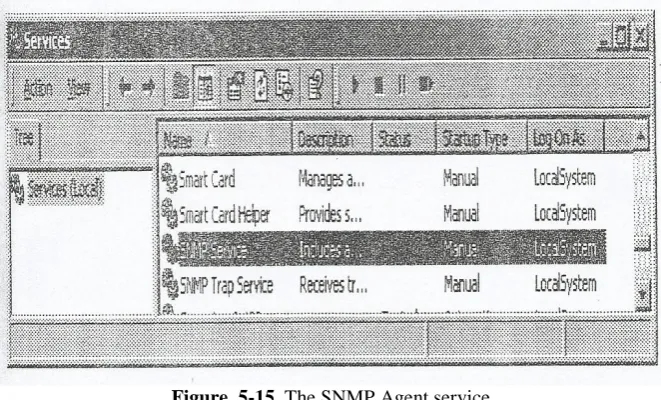
● The SNMP agent service should also be configured e.g. community names, host etc. and running properly without errors prior to access to a resource counter. The SNMP agent service can be setup to run either automatically or manually
5.4 System Scope and Limitations
Like a typical SNNP management system, all components should be properly running. These components which are all vital to its proper execution are the MIDLET application, SERVLET application running on Apache Tomcat, SNMP agent service running on Windows 2000 Server as a service. This is the complete composition of a network management system.
For the entire system to deliver the expected functionality and output, its vital components should be properly configured and functional. The following are the problems that may be encountered in using the system and following are the problems that may be encountered in using the system and may produce a corresponding system prompt if possible.
● Failure of the MIDLET application to establish a connection to the SERVLET application. It should be noted that for the MIDLET to be able to send a request should first establish a connection to the SERVLET application via HTTP connection object.
● Failure to instantiate and use the Output Stream object, which enables the MIDLET to write the status request to I/O stream.
● Failure to instantiate and use the Input Stream object, which enables the MIDLET to read the status request to I/O stream.
● Failures of Apache Tomcat, which serves both HTTP and servlet container service, to initialize properly and invoke the SERVLET application.
● Failure to the SNMP agent running on Windows 2000 server to run or respond to request. This may be due to improper configuration of the service or error on certain dependencies.
Failure of any of these components might cause the entire system not to deliver or perform what is expected of it. Therefore it is imperative that these vital components should be maintained as for the case of Windows 2000 Server, Apache Tomcat, and the J2ME and SNMO API’s which from time to time needs update or patches to be applied.
5.5 Architectural Design
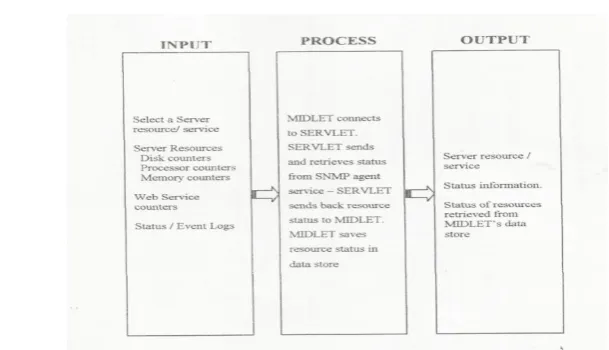
The system is composed of two major components namely: a MIDLET application and SERVLET application. The MIDLET is composed of functions to build its user interface, instantiate an http connection object and use it to establish a connection and communicate to the SERVLET application , write to and read from the I/O stream, store the status of a resource coming from the SERVLET application is composed of functions to accept request coming from the MIDLET application, to process the sending of request and receiving of response using SNMP functions to the SNMP agent service running on the server, instantiate and use the response object to send back the status of resource to the MIDLET application. The following figures 5-1 to 5-10 are the diagrams that show the design interactions of these components.
Figures 5-2. A Detailed Input Process Output Showing The Server Resources Menu Selection Of
Managing A Network Over Wireless Device
Figures 5-3. A Detailed Input Process Outpt Showing The CPU Resources Menu Selection Of Managing A Network Over Wireless Device
Figures 5-4. A Detailed Input Process Output Showing The Security Resources Menu Selection Of Managing A Network Over Wireless Device
Figures 5-5. A Detailed Input Process Output Showing The Web Server Resources Menu Selection Of Managing A Network Over Wireless Device
Figures 5-6. A Detailed Input Process Output Showing Status Logs Interface Of Managing A Network Over Wireless Devic
Figures 5-7. A Detailed Input Process Output Showing About The Application Interface Of Managing A Network Over Wireless Device
Figures 5-8. A Detailed Input Process Output Showing About The Add Status To Log method Of Managing A Network Over Wireless Device
Figures 5-9. A Detailed Input Process Output Showing The About The Execution of HTTP Post Method Of Managing A Network Over Wireless Device
Figures 5-10. A Detailed Input Process Output Showing The About The Sending Of Resource Status Of Managing A Network Over Wireless Device
5.6 System Function
Table 5-1 System Functions
System Component Description
MIDLET Application
● Construct the user interface Assembles all needed user interface (UI) components
● Instantiate HTTP connection Establishes communication with SERVLET application. This communication is important to be able to send request and received status.
● Instantiate and use OutputStream object To be able to write user request to I/O stream. Depends on the status of HTTP connection object.
● Add status of resource of data store A function to store the status of a resource in the MIDLET’s data store
● Retrieve records of resources status A function to retrieve and show the past status records of resources in the data store.
● About the Application A function to show credits to the developer SERVLET Application
● Retrieve the status request via HTTP request getparameter method
A class defined in SERVLET packaged. It is used to retrieve data passed via request object.
● Utilize SNMP functions Functions that are defined in the NSMP dynamic library used to connect to the agent, send the request, retrieve the response and close the connection.
Instantiate and use PrintWriter object A class defined in the java I/O class. It is used to send resource status via response object.
Figure 5-15. The SNMP Agent service
5.7 Physical Environment and Resources
The following are the hardware and software resources needed to implement the system. Hardware Resources
● Any branded or clone that is capable of running Windows 2000 Server and Apache Tomcat or any similar HTTP and servlet container. Check recommended system requirements.
● A mobile phone that complies with J2ME’s MIDP/CLDC specification and has a capability to the Internet Software Resources
● Windows 2000 Server with SNMP agent service installed and configured ● Apache Tomcat or any similar HTTP and servlet container User Specification ● 3-5 years experience in handling network and system related work.
● Must have a good grasp of TCP/IP and SNMP concepts and network management practices ● Must know or understand servlet applications
● Network certification either Microsoft Certified Systems Engineer(MSCE) or any similar certification desired but not required
5.8 Design and Implementation Issues
In the conceptualization and design stages of the system, the proponent has to research and learn not only the J2ME APT’s but also the core API’s defined in the java 2 Standard Edition or J2ME API’s defined in the Java 2 Enterprise Edition or J2EE. These API’s are vital to the construction of the MIDLET and SERVLET application because some of these API’s are related and all adheres to the concept of object orientation. The proponent was immersed to the new concepts of wireless application programming and how it differs with developing applications for desktop computers.
Understanding of the concepts of web programming, the nature of HTTP protocol, SNMP implementation and functions, and servlet programming using J2EE classes defined in the javax.servlet and javax.servlet.http packages in tandem with core class defined in java.io enables the proponent to develop the SERVLET application. One major issue that emanated during this time is the MIDLET and SERVLET communication. For the servlet application to execute it needs to be inside a container, to be specific a servlet container like Apache Tomcat. Lots of programming hours and research were allocated just to make the two applications communicate, errors surfaced during testing and it almost discouraged the proponent to continue the development of the system, learning also that many developers from the discussion forums have encountered similar problems. The context, data flow and other diagrams will give the readers an almost complete picture on the internal design and workarounds of the system. The system and program flowcharts and visual table of content details the functions and methods involved in the entire operation of the system.
5.9 Observation and Results
Among the things that should be noted in the result of the survey are: ● All of the ISP surveyed are providing web services
● Most of them answered that the most frequently monitored resource on the server are the processor, memory and disk.
● 6 of 10 of these systems administrators manages their network even on remote locations, and
● 9 of 10 of these systems administrators said that it would be advantageous to use a wireless device as a toll to manage their network.
The results gathered from the respondents have been the basis for some of the consideration during development of the system.
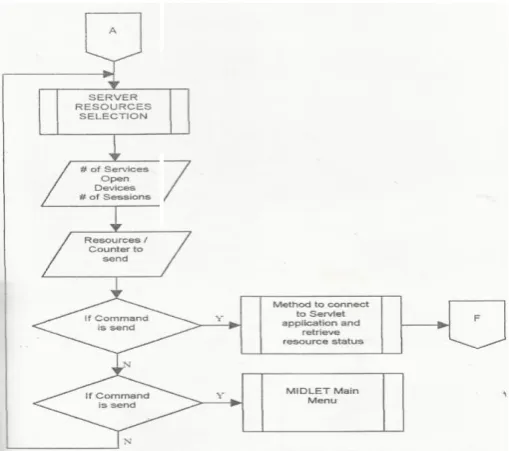
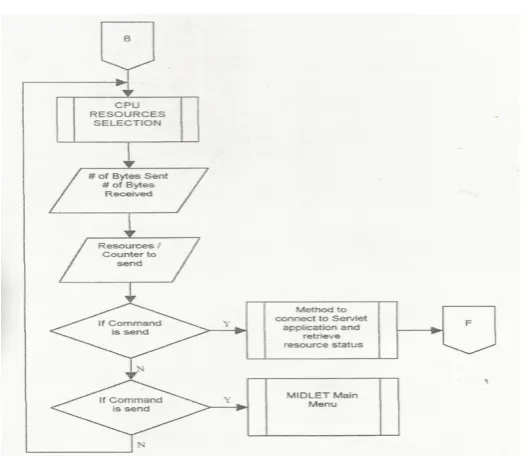
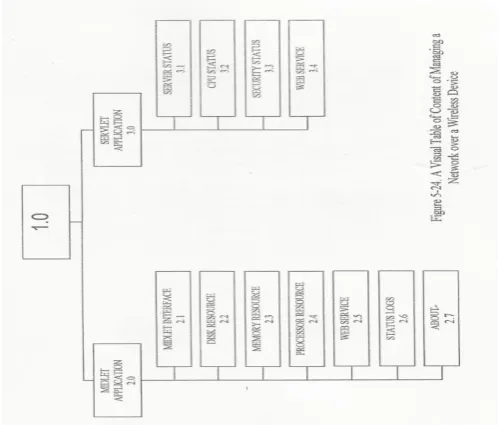
The original concept of this study is to produce an application that will run on a wireless device that is capable of managing the resources connected on the network including but not limited to active components such as routers, switches and storage devices among other things. The lack of enough resources to mimic a setup comparable to those of a typical ISP and the results of the survey has convinced the proponent to concentrate on the development instead of a system that can monitor the resources and services running on the network server. These succeeding figures, figures 5-16 to 5-23, will illustrate the system flowcharts showing the different Menus of the system. Figure 5-24 shows the table of content found in the system figures 5-26 to 5-29 show the context diagrams.
Figure 5-16. a System Flowchart of Managing a Network over Wireless Device
Figure 5 – 17. A Program Flowchart showing the Main Menu of Managing a Network Server Resources over Wireless Device
Figure 5 – 19. A Program Flowchart showing the CPU Resources Selection of Managing a Network Server Resources over Wireless Device
Figure 5 – 20. A Program Flowchart showing the Security Resources Selection of Managing a Network Server Resources over Wireless Device
Figure 5 – 22. A Program Flowchart showing the Status Logs of Managing a Network Server Resources over Wireless Device
III.
CONCLUSION
The wireless devices, including cell phones and two-way pagers may allow the users to be connected to the outside world at anytime from anywhere. They offer a great connectivity that other types of devices cannot offer. Therefore the development of application for the wireless devices is tantamount to the great demand of the devices.
Connection Limited Device configuration defined for handheld devices. The Connection Limited Device Configuration is a configuration for handheld resource constrained devices which is based on Java 2 Micro Edition technology.
The wireless monitoring system designed in this thesis consists of user interface, Midlet applications, and Servlet applications. The Midlet application communicates with the servlet application via Hyper Text Transfer Protocol (HTTP). The Servlet application runs on the web server.
Recommendations
The process of monitoring the server resources starts from the client module. The module should be able to communicate and retrieve status information from the server module. The Server module running on a web server receives, process and sends back the status information requested.
The proposed wireless remote monitoring method will enable us to access the server in the network at any time and from anywhere. The program, developed in this thesis, will support not only the server in a network but can also be applied to any other remote control applications.
REFERENCE
[1]. Gueco, W. C. C., Villorente, D. F., Larin, L.R., Mendoza, R.C., Olesco, R.O, “Next Generation Internet in the Philippines (2001): The Philippine Research Education & Government Information Network (PREGINET),” Philippine Journal of ICT and Microelectronics, 2001.
[2]. Byers, S., Kormann, D., “Access Point Mapping,” Communications of the ACM, May, 2003.
[3]. Goff, M, “A Historical Look at Java’s Emerging Role in the Changing System and Network Management: Java in the Management, Part 1,” http://www.javaworld.com.,1999.
[4]. “Common Information Model (CIM) Specification v2.2 (2002)”, http://www.dmtf.org/standards/cim_spec_v22/, 2002, August 22.
[5]. Feng, Y., “Network Programming with J2ME Wireless Devices (2000),” http://www.wirelessdevnet.com/channel/java/features/j2me_http.phtml, 2002, August 15.
[6]. Mahmoud, Q., “MIDP GUI Programming: Programming the Phone, Interface,” http://www.wireless.java.sun.com/midp/articles/gui (2002), (Nov. 21, 2002).
[7]. “Web-Based Enterprise Management (WBEM) Initiative (2002)”, http://www.dmtf.org/standards/standard_wbem.php., (2002).
[8]. Chander, D. Mobile Computing: A System Integrator’s Handbook, Ranade, J (ED). McGraw-Hill, 1997.
[9]. “Windows 2000 Resources Kit (2000),” msdn.microsoft.com.
[10]. Lienward, A., Conroy, K.F., Network Management: A Practical Perspective. Addison- Wesley Longman Inc., 1996.
[11]. Allen, P, Bambara, J.J., J2EE Unleashed. SAMS, 2002. [12]. Steinberg, D., JAVA 2 Bible, 2001.
[13]. Atkinson, S., Professional Java Mobile Programming. WROX, 2002. [14]. “What is GPRS?”, www.gsmworld.com/technology/gprs/intro.shtml, 2002.