OPTIMAL M2M COMMUNICATION USING MULTILEVEL
FEEDBACK
SCHEDULING
FOR
REAL
TIME
IOT
APPLICATIONS IN SMART CITIES
S.Abinaya 1, Dr. R. Gunasundari21. INTRODUCTION
Machine-to-Machine (M2M) communication enables a network device to exchange information (data) and perform actions without human intervention. Tasks such as health remote surveillance, and environment monitoring, smart grids, smart cities, home and traffic security, and intelligent transportation, are well-known instances of M2M communications. Internet of Things (IoT) is expected to dramatically increase the number of connected devices[1]. Multiple forecasts estimate that the number of IoT devices to go beyond 100 billion. Over the last approximately three decades, Internet has brought a significant impact on our society. IoT is expected to become the next big leap of the Internet, where almost anything can be connected [8]. For upcoming 5G systems, the requirements aim to support 1000,000 devices per square kilometers [1].
And also provides high data transmission widespread connectivity covering about 300,000 within one cell.IoT implementations use different technical communications models, each with its own characteristic.
Four common communications models described by the Internet Architecture Board include: Device, Device-to-Cloud, Device-to-Gateway, Machine-to-Machine and Back-End Data-Sharing. .In particular, deterministic network calculus (DNC) calculates the delay bound, backlog bound, and other service quality parameters by using arrival curves and service curves [4]. Compared with the traditional queuing theory, DNC is able to provide a determined boundary analysis for system performance, and offer a strict service guarantee by computing the worst-case scenarios. Taking the advantage of network calculus being a systematically structured theory, we, in this paper, propose a priority-based admission control model for M2M communications in smart cities, and analyze its performance by leveraging network calculus [6]. These models highlight the flexibility in the ways that IoT devices can connect and provide value to the user. Not only devices or machines are increasing gradually the traffic demands also increasing as per the devices. So it can cause starvation and congestion in the flow of data.
2. PROPOSED WORK
2.1 M2M ACA with MFQS Model
The successful design and implementation of M2M communications in the IoT for sustainable smart cities must be supported by an existing architectural framework. Only under such an architectural framework support, can ubiquitous MTCDs be effectively allowed to access base stations. There is an urgent need for the IoT to become an open, complete, standardized, and universal architectural framework, which facilitates various newly developed techniques in M2m communication, to be included in a consistent and effective manner.
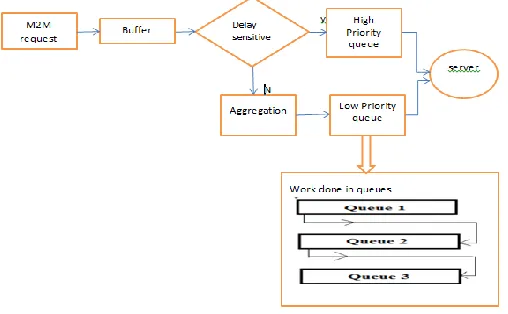
Now introduce the admission control with multilevel feedback queue model for M2M communications, which is depicted in Fig. 1. In the access layer depicted in the incoming M2M requests for each base station or access point. And it collects all the information from various applications (such as Health monitoring, traffic intelligence, Remote surveillance etc.,) by using sensors. And then it sends M2M request to buffer. Here Buffer is used to store all the packets. And it has some threshold
1 M.Tech ,Dept of Electronics and Communication Engineering, Pondicherry Engineering College, Puducherry, India.
2 Professor, Deptof Electronics and Communication Engineering, Pondicherry Engineering College, Puducherry, India.
Abstract – Internet of Things (IoT) are expected to be the most important part of Machine to Machine (M2M) communication and its applications. Nowadays cities are becoming smart, notonly the aggressive growth of devices andalso traffic demand increasing consequently as per the devices. However, conventional network gateways are unable to provide sustainable solutions to the challenges posted by the massive amounts of M2M communications requests, especially in the context of the IoT for its applications. In this paper, we present Admission control algorithm differentiates all M2M requests into delay-tolerant and delay-sensitive, then aggregates all delay-delay-tolerant requests by routing them into low-priority queue as well as delay sensitive are routed to the high priority queue. Then queue is replaced with multilevel feedback queue scheduling, aiming to reduce the data losses from various devices to the access point in the IoT for sustainable smart cities,solvecongestion and starvation issue in queue and also improve the performance of QoS parameter.
Keywords - Machine-to-machine communications (M2M), Internet of Things (IoT), sustainable smart city, Admission control, Multilevel feedback scheduling.
value for various applications. Admission control is used to classify the data according to its priority. If the packets reach more than the threshold value it is, consider as the delay sensitive packets routed to the high priority queue. If the packets are less, then threshold value then it is considering as the delay tolerant it aggregates all the packets and then it routed to low priority queue. A single is queue is not enough to transferring all the packets. It has congestion, data losses and starvation occurs. Here replacing a single queue into multilevel feedback queue scheduling in both high and low priority queues. It has three layers Q1,Q2,Q3.According to the processing time of the packet it has been routed to its queue. MQFS is used to schedule the packet first,and then it transfersthe packets according to priority into the queue. If Q1 is filled with the packet of data it will check the processing time; if it is less time it will wait or takes more time, the upcoming packets will not wait for Q1 automatically it moves to Q2. If Q2 is also filled, then move to Q3. Likewise, the packets will move between the queues according to its schedule. So we can avoid packet losses congestion and starvation. And also avoid delay and backlog data.
Figure 1. M2M ACA with MLFS Model
2.2 The Admission Control Algorithm
Due to the massive amounts of M2M communication request, an acceptance and/or rejection algorithm with regard to these requests used to avoid traffic congestion and delay occur in the network. An algorithm is used to handle the M2M access requests on the basis of their service rate and the arrival capability of the service node.
2.3 Multiple Feedback Queue Scheduling Algorithm
The multilevel feedback queue scheduling algorithm, allows a process to move between queues. The idea is to separate processes according to the characteristics of their processing time. If a process uses too much time, it will be moved to a lower-priority queue. In addition, a process that waits too long in a lower-priority queue may be moved to a higher-priority queue. This form of aging prevents starvation. In this way all of the packet will transfer from machine to machine will be forwarded without any losses. Multilevel Feedback Queue scheduling is an evolution of the Compatible Time-Share System, which was described for multiuser timeshare scheduling system, utilizing a multilevel process queue.
3. EXPERIMENT AND RESULT
3.1 Formation of design for given Architecture
The proposed architecture is based on ACA with MLFS backbone network that connects to the different application.
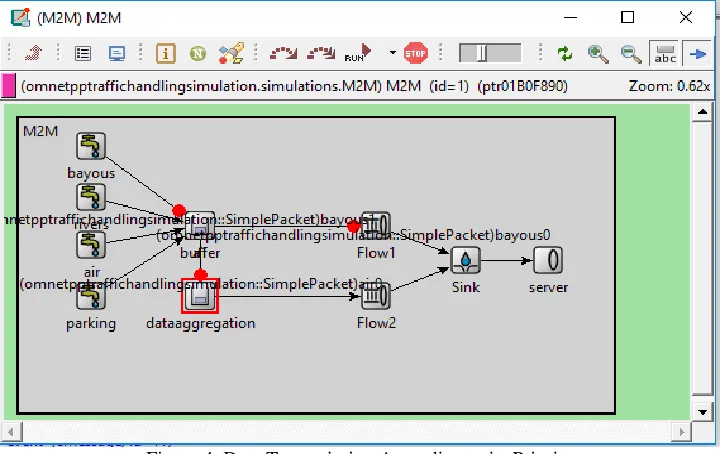
The above figure.2 shows the network architecture of the proposed method. The architecture consist of buffer, high and low priority queue, sink, server, and applications such as parking, air, river and bayous. Buffer is used to store the data. And aggregation is used to group the packet of data and sent through the queue. From the Queue it transmits the packets to sink from the queue and to the server.
Figure 3. Storage of Data
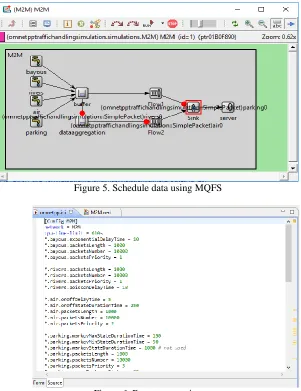
For example four applications such as traffic, parking, air and bayous have been used in the proposed method. At first, It sense the packet of data’s from different application andit will send the data to the buffer which is shown in Fig 3.When the buffer has data it applies admission control algorithm to split the data according to its priority. The low priority data are fed into flow2 queue and the high priority data are fed into flow1 queue which is shown in fig 4. After splitting data according to its priority then multilevel feedback queue scheduling is applied at flow1 and flow2 queue which helps to schedule the data according to its data processing time which is shown in above fig 5
Figure 5. Schedule data using MQFS
Figure 6. Parameter setting
The message sent by air, traffic, bayous and parking message is received by the sink. At which time the message is sent and received is stored and displayed in execution window which is shown in fig. 7 for example message sent by traffic application is received by sink, where the message is passed through the buffer act as an intermediate stage.
3. RESULT:
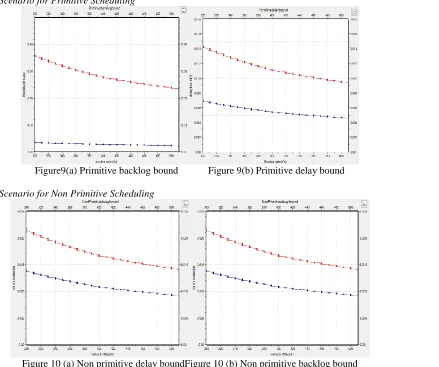
In Admission control algorithm with multilevel feedback scheduling is used to separate the data according to its priority and then schedule the data according to its processing time to multilevel queue from source to sink. So that it reduces the congestion then fairness utility of the flow of data. And it is common process for all the simulated graphs given below. Adding ACA with MFQS is used reduces half of its delay and backlog in high and low priority queue comparing to existing.
Figure8(a). Delay bound Figure 8(b). Backlog bound
3.1 Simulation Scenario for Primitive Scheduling
Figure9(a) Primitive backlog bound Figure 9(b) Primitive delay bound
3.2 Simulation Scenario for Non Primitive Scheduling
Figure 10 (a) Non primitive delay boundFigure 10 (b) Non primitive backlog bound
4. CONCLUSION
using network calculus, simulation using OMNeT++4.1. This model differentiates all M2M requests into delay-tolerant and delay-sensitive. It aggregates all delay-tolerant packets by routing them into one low-priority multilevel queue and delay sensitive packets are routed to the high priority multilevel queue. By using MLFS aiming to reduce the data losses and delay from various devices to the access point in the IoT for smart cities and also solve congestion, starvation in the queue. It effectively deals with such an enormous amount of M2M access requests and a subsequent data transmission in IoT thus it hinder the bottleneck problem in the development of sustainable smart cities. The most M2M requests are delay tolerant packets so proposed a priority based model for M2M communications, which can reduce the congestion and packet losses possibility caused by random M2M communication on wireless channels.
5. REFERENCES
[1]. Jun Huang,Cong-cong Xing, Sung Shin and Fen Hou, “Optimizing M2M Communications and Quality of Services in the IoT for Sustainable Smart
Cities” IEEE Transactions On Sustainable Computing, vol.1, no.1 pp.1-12, June 2017.
[2]. A. Rajandekar and B. Sikdar, “A survey of mac layer issues and protocols for machine-to-machine communications,” IEEE Internet of Things Journal,
vol.2, no.2, pp. 175–186, April 2015.
[3]. PrateekAnand, “Towards Evolution of M2M into Internet of Things for Analytics,” IEEE/ACM transaction on Networking, vol.5, no.1, pp.388-393,
December 2015.
[4]. R. Bruns, J. Dunkel, H. Masbruch and S. Stipkovic, 'Intelligent M2M: Complex event processing for machine-to-machine communication', Expert
Systems with Applications, vol. 42, no. 3, pp. 1235-1246, December 2015.
[5]. A.Zanella, N. Bui, A. Castellani, L. Vangelista, and M. Zorzi, “Internet of things for smart cities,” IEEE Internet of Things Journal, vol.1, no.1, pp. 22–
32, February 2014.
[6]. I.Stojmenovic, “Machine-to-machine communications with in network data aggregation, processing, and actuation for large scale cyber-physical
systems,” IEEE Internet of Things Journal, vol. 1, no. 2, pp. 122–128, April 2014.
[7]. Dr. Sanjay. K. Dwivedi and Ritesh Gupta, “A simulator based performance analysis of Multilevel Feedback Queue Scheduling,” IEEE International
conference, vol. 10, no. 1, pp.341-346, September 2014.
[8]. L. Da Xu, W. He, S. Li, "Internet of Things in Industries: A Survey", IEEE Transaction Industrial Information, vol. 10, no. 4, pp. 2233-43, March 2014.
[9]. Dwivedi, Sanjay.K., and Ritesh Gupta. "A simulator based performance analysis of multilevel feedback queue scheduling",2014
InternationalConference on Computer and Communication Technology (ICCCT), pp.341-545, March 2014.