LA CROSSE ENCEPHALITIS: A REVIEW
Sanjay B Bhawar1, Nackihet S Dighe2, Sunil A Nirmal3, Anuja Patil3, Vinayak M Gaware2, Mangesh B Hole2 ,Santosh R Butle4 and Santosh B Dighe1
1- Department of Pharmacology,Pravara Rural College of Pharmacy, Pravaranagar, M S, India
2- Department of Pharmachemistry,Pravara Rural College of Pharmacy, Pravaranagar, M S, India
3- Department of Pharmacognosy,Pravara Rural College of Pharmacy, Pravaranagar, M S, India
4- School Of Pharmacy, S R T M University, Nanded ,M S ,India
Summary
La crosse Encephalitis, also called California Encephalitis, is a viral disease that is transmitted through the bite of a mosquito. Although it remains symptom free, in some people the virus causes swelling in the brain, called encephalitis. Most cases of LAC encephalitis occur in children under 16 years of age.LAC virus is a Bunyavirus and is a zoonotic pathogen cycled between the daytime-biting tree hole mosquito, Aedes triseriatus and vertebrate amplifier hosts in deciduous forest habitats. Bunyaviruses replicate in arthropods. The gut of the vector is infected initially and after a few days or weeks the virus appears in the saliva; the arthropod then remains infective for life but is not ill. Viremia subsides with the appearance of humoral antibody and the host recovers unless a specific target organ usually brain is damaged. Humans may become ill when infected, but human blood rarely infects biting arthropods in the natural cycle; therefore, humans are usually dead-end hosts. Even with systemic viremia, significant virus reproduction occurs in the nasal turbinates and the virus may seed the CNS via the olfactory nerves. No vaccine till today is available and treatment is only symptomatic.
Keywords: Bunyavirus, California Encephalitis,La crosse Encephalitis.
Address for correspondence Mr. Sanjay B Bhawar
Assistant Professor & HOD Department of Pharmacology,
Pravara Rural College of Pharmacy, Pravaranagar A/P- Loni Bk.Taluka -Rahata,Dist-Ahmednagar 413736, India (MS).
Phone no:+91-9860102411
Introduction
La crosse Encephalitis, also called California Encephalitis, is a viral disease that is transmitted through the bite of a mosquito. In most people, the virus does not cause any illness and most people do not even know they have been infected. But in some people, the virus causes swelling in the brain, called encephalitis. La Crosse Encephalitis is one of the four most common types of encephalitis caused by mosquito-borne viruses in the United States. Most cases of mosquito-transmitted encephalitis occur from June through September, when mosquitoes are most active. In warmer parts of the country, where mosquitoes are active late into the year, cases can occur into the winter months.1 La Crosse encephalitis (LACE) is a predominantly pediatric illnesscaused by La Crosse (LAC) virus, a mosquito-transmitted bunyavirusof the California serogroup viruses. Historically, most casesof LACE have been reported from the mid western states. However, LACE is endemic in North Carolina and increasingly recognizedin Tennessee, Virginia and West Virginia.The fatality rate of LACE is low, approximately 0.5% of cases. La Crosse virus (LACV), family Bunyaviridae, is a mosquito-borne pathogen endemic in the United States. LACV infection results in 70–130 clinical cases a year and is the major cause of pediatric arboviral encephalitis in North America . LACV was first identified as human pathogen in 1960 after its isolation from a 4 year-old girl from Minnesota who suffered meningoencephalitis and later died in La Crosse, Wisconsin. The majority of LACV infections are mild and never reported, however serologic studies estimate annual infection rates of 10–30/100,000 in endemic areas .LACV is a member of the California serogroup of viruses in the genus Orthobunyavirus.2 The serogroup contains members found on five continents that include human pathogens such as La Crosse, Snowshoe hare and Jamestown Canyon viruses in North America; Guaroa virus in North and South America; Inkoo and Tahyna viruses in Europe; and Lumbo virus in Africa At present, a vaccine or FDA approved antiviral therapy is not available.3
History
La Crosse (LAC) encephalitis was discovered in La Crosse, Wisconsin in 1963. Since then, the virus has been identified in several Midwestern and Mid-Atlantic states. During an average year, about 75 cases of LAC encephalitis are reported to the CDC. Most cases of LAC encephalitis occur in children under 16 years of age.4 LAC virus is a Bunyavirus and is a zoonotic pathogen cycled between the daytime-biting tree hole mosquito, Aedes triseriatus and vertebrate amplifier hosts (chipmunks, tree squirrels) in deciduous forest habitats. The virus is maintained over the winter by transovarial transmission in mosquito eggs. If the female mosquito is infected, she may lay eggs that carry the virus and the adults coming from those eggs may be able to transmit the virus to chipmunks and to humans.18During 1996–1997, a total of 252 La Crosse encephalitis (LAC) cases (103 confirmed and 149 probable; one fatal) were reported from 12 states. Patients ranged in age from 5 months to 78 years (mean: 9 years) and 95% of cases occurred in persons aged <18 years; 153 (61%) cases occurred in males, 209 (83%) in whites and seven (3%) in persons of races other than white; in 36 (14%) cases, race was unspecified. Dates of
onset of illness ranged from late June to early November. West Virginia reported 139 cases (55% of the national total), an average of 3.8 per 100,000 population per year. Among persons aged <18 years, who accounted for 133 (96%) of the total number of cases in West Virginia, the incidence is 15.8 per year. 5
Epidemiology
Historically, most cases of LAC encephalitis occur in the upper Midwestern states (Minnesota, Wisconsin, Iowa, Illinois, Indiana and Ohio). Recently, more cases are being reported from states in the mid-Atlantic (West Virginia, Virginia and North Carolina) and southeastern (Alabama and Mississippi) regions of the country. It has long been suspected that LAC encephalitis has a broader distribution and a higher incidence in the eastern United States, but is under-reported because the etiologic agent is often not specifically identified.7
Replication
Bunyaviruses replicate in arthropods. The gut of the vector is infected initially and after a few days or weeks the virus appears in the saliva; the arthropod then remains infective for life but is not ill. When the vector takes a blood meal, the infective saliva enters the small capillaries or lymphatics of the human or other vertebrate host .The primary site of replication in humans is not known; it may be the vascular endothelium, the skin, or the regional lymph nodes. An incubation period of a few days ensues, after which the vertebrate host develops viremia.8 The infection is usually inapparent. Less often, the host becomes febrile, manifesting the more serious signs and symptoms that are characteristic of the infecting virus. Viremia subsides with the appearance of humoral antibody and the host recovers unless a specific target organ is affected. This target organ the brain in La Crosse encephalitis damaged and disease occurs. Although the damage in most infections is believed to result from direct invasion by the virus and not from a host-mediated antigen-antibody or antigen-lymphocyte reaction, the pathogenesis of bunyaviruses in the vertebrate host has not been extensively studied. 9
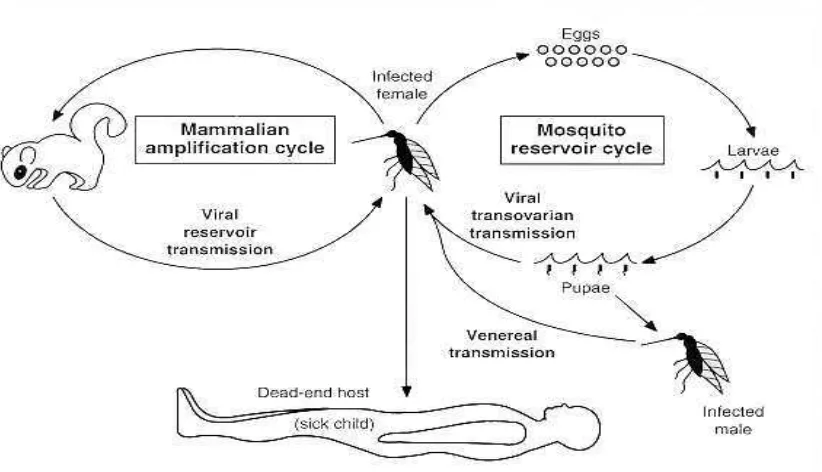
Life Cycle of La Crosse Virus
Figure 1: Life Cycle of La Crosse Virus
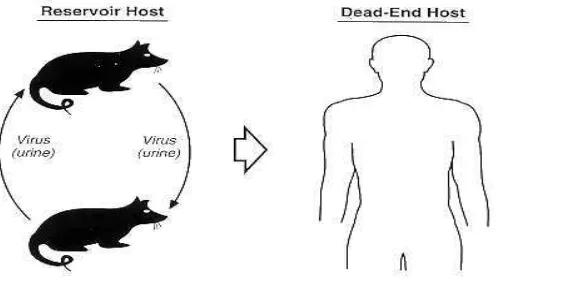
In addition to the arthropod-vertebrate-arthropod cycle, some bunyaviruses, are transmitted transovarially in the arthropod and can therefore over winter in the egg and be transmitted to humans in the late spring or early summer, when the adult arthropod emerges. Transmission to humans is believed to occur by inhalation of virus excreted in rodent urine and other body fluids.10
Figure 2: Transmission to Human host
The La Crosse encephalitis organism is an arbovirus (a virus carried by arthropods such as mosquitoes, flies and ticks). It is normally cycled between the treehole mosquito Ochlerotatus triseriatus and vertebrate hosts (chipmunks and squirrels) in forest habitats throughout the range of the disease.The treehole mosquito, Ochlerotatus triseriatus. A. triseriatus is a daytime biting mosquito that normally inhabits tree holes, but can also breed in other water holding containers such as discarded tires, cans, etc. Recently, eggs of the Asian Tiger Mosquito, Aedes albopictus, infected with the La Crosse encephalitis virus have been collected in North Carolina and Tennessee.The virus can be maintained during the winter by transmission in mosquito eggs (an infected female lays eggs that carry the virus and eventually develop into infected adults).In a normal cycle,the virus is transmitted to the vertebrate host through the bite of an infected mosquito. In the host, the virus replicates and increases in abundance rapidly (a process known as amplification). When sufficiently abundant, the virus can then be passed on to other mosquitoes that may bite the infected vertebrate host. Infected chipmunks and squirrels do not show signs or symptoms of disease. Although not part of the normal cycle of the disease, humans can also contract the disease by the bite of an infected mosquito. However, humans are “dead end hosts”, meaning that an infected human can't transmit the disease because sufficient amplification of the virus does not occur in humans. 10, 11
Occurrence
efficient vector of LAC).Historically, most cases of LAC encephalitis occur in the upper Midwestern states (Minnesota, Wisconsin, Iowa, Illinois, Indiana and Ohio). Recently, more cases are being reported from states in the mid-Atlantic (West Virginia, Virginia and North Carolina) and southeastern (Alabama and Mississippi) regions of the country. It has long been suspected that LAC encephalitis has a broader distribution and a higher incidence in the eastern United States, but is under-reported because the etiologic agent is often not specifically identified. (18)An average of 73cases is reported annually in the United States by the Centersfor Disease Control and Prevention.12 Between 1996 and 1997, North Carolina ranked eighth in the nation for LACE cases, accountingfor 2.8% of the 252 cases reported over the two-year period. During the same time period, LACE was the most frequently reportedarthropod-borne encephalitis in the United States. The firstdeath reported in North Carolina from LACE occurred in the summer of 2000 (Communicable Disease Mortality Statistic, North CarolinaDepartment of Health and Human Services and Epidemiology Section).The fatality rate of LACE is low, approximately 0.5% of cases. Retrospectiveserologic surveys indicate that the ratio of inapparent-to-apparent LAC virus infections in children ranges from 26:1 to 1,571:1. Antibody prevalence increases with age, reaching 35% by adulthoodin some endemic areas. 13
Disease Cases* Reported by State, 1964-2008 (USA) 14, 15, 17
Figure 3: Disease Case of La Crosse Encephalitis’s in USA
Vectors
The treehole mosquito, Aedes triseriatus, is both the vector and reservoir of LAC in nature, since the virus is transovarially transmitted to the offspring.15
Pathophysiology
Year Place Cases
1964 – 2008 Alabama 06
1964 – 2008 Arkansas 05
1964 – 2008 California 01
1964 – 2008 Colorado 01
1964 – 2008 Connecticut 02
1964 – 2008 Florida 04
1964 – 2008 Georgia 23
1964 – 2008 Illinois 241
1964 – 2008 Indiana 142
1964 – 2008 Iowa 134
1964 – 2008 Kentucky 22
1964 – 2008 Louisiana 25
1964 – 2008 Maryland 02
1964 – 2008 Michigan 29
1964 – 2008 Minnesota 366
1964 – 2008 Mississippi 14
1964 – 2008 Missouri 13
1964 – 2008 New Jersey 03
1964 – 2008 New York 58
1964 – 2008 North Carolina 199
1964 – 2008 Ohio 893
1964 – 2008 Oklahoma 02
1964 – 2008 Pennsylvania 08
1964 – 2008 Rhode Island 01
1964 – 2008 South Carolina 03
1964 – 2008 Tennessee 146
1964 – 2008 Texas 04
1964 – 2008 Virginia 28
1964 – 2008 West Virginia 584
1964 – 2008 Wisconsin 585
Table 1: Disease Case of La Crosse Encephalitis’s in USA (1964 - 2008)
Symptoms
Symptoms include nausea, headache, vomiting in milder cases and seizures, coma, paralysis and permanent brain damage in severe cases. LAC encephalitis initially presents as a nonspecific summertime illness with fever, headache, nausea, vomiting and lethargy. Severe disease occurs most commonly in children under the age of 16 and is characterized by seizures, coma, paralysis and a variety of neurological sequelae after recovery.18 Death from LAC encephalitis occurs in less than 1% of clinical cases. In many clinical settings, pediatric cases presenting with CNS involvement are routinely screened for herpes or enteroviral etiologies. Since there is no specific treatment for LAC encephalitis,
physicians often do not request the tests required to specifically identifying LAC virus and the cases are reported as aseptic meningitis or viral encephalitis of unknown etiology. Like with many infections, the very young, the very old and the immunocompromised are at a higher risk of developing severe symptoms. 19
Diagnosis
Illnesses caused by bunyaviruses are diagnosed by isolating the virus, detecting RNA by RT-PCR, or by showing a fourfold or greater rise in antibody titer between acute- and convalescent-phase sera. The virus can be isolated from blood (or from brain, liver and other organs postmortem) during the viremic phase, but not usually after the third day of fever. It is propagated in baby mice or mosquitoes or in vertebrate or invertebrate tissue cultures. The RNA has been detected in lung tissue from cases of Hantavirus pulmonary syndrome postmortem. Serologic tests used to diagnose bunyavirus infections include the enzyme-linked immunosorbent assay and complement fixation, fluorescent antibody, neutralization and Hemagglutination inhibition tests. The complement fixation and fluorescent antibody tests and the enzyme-linked immunosorbent assay (ELISA) are often grouped reactive; the neutralization and Hemagglutination inhibition tests are type specific.20 Assessments of IgM may be especially useful in establishing an early diagnosis. Once isolated, virus is identified by the same tests with a reference immune serum. Bunyavirus diseases usually are restricted to focal geographic areas because of the limited distribution of their vectors and vertebrate hosts. Awareness of their geographic distribution, seasonality and clinical syndrome may help in establishing a diagnosis. For instance, hemorrhagic fever with renal syndrome should be strongly suspected in a person in Europe or Asia who has fever, proteinuria, thrombocytopenia and elevated blood urea nitrogen, especially if the patient has been exposed to rodents. Definitive diagnosis, however, can be made only by laboratory tests. 21
Population at high risk for La Crosse Encephalitis
Severe cases occur primarily in children (average case age is six years old). In Minnesota, cases of La Crosse encephalitis have been found in 19 southeastern counties from the Twin Cities to the Iowa border. Three to 13 cases are reported each year in Minnesota. Most people are exposed to infected mosquitoes in wooded habitat, as the mosquito that transmits the virus is found in hardwood forests.21
Fatality rate
Most people infected with this virus will have either no symptoms, or a mild flu-like illness. A small percentage of people (especially children) may develop encephalitis (inflammation of the brain). Approximately 1- 3% of these encephalitis cases are fatal and another 15% of patients have long-term nervous system problems. 22
Vector data, the density and infection rate of Ae. Triseriatus should be monitored. Adults can be collected at bait or resting in the laboratory, under storey of the woodlot. Ovitraps can be used to abundance determine the number of eggs produced by population. Eggs from the ovitraps can then be used to determine the proportion of offspring transovarially infected with LAC. Because ovitraps compete with naturally occurring oviposition sites for egg deposition, results should be interpreted with caution. Ovitraps results are useful for comparing density within a site over time, but comparisons of population density between woodlots are not reliable. Discarded tires and other artificial containers often serve as LAC virus foci near human habitations and these should be inspected. Where Ae. Albopictus is abundant, collect and process specimens for virus
1. Home and travel sites are evaluated for treehole mosquito breeding potential, especially tree holes, containers such as tires, cans, buckets, etc. which hold water. Since the LAC virus is transmitted by the female mosquito to her offspring, these containers constitute the source of infected mosquitoes. Samples of water with mosquito larvae and small containers may be collected and sent to the Zoonotic Disease Program (ZDP), for vector evaluation. Containers should be disposed off, placed under cover so they will not collect rainwater, or properly maintained (e.g., flushing bird baths weekly, cleaning out gutters).
2. Prevent mosquito bites. It only takes one bite from an infected mosquito to transmit disease.
• Avoid mosquito bites.
• Avoid areas where mosquitoes are active.
• Avoid outdoor activities during the peak mosquito biting times of dawn, dusk and early evening.
• When outdoors, apply mosquito repellant as directed to clothing and exposed skin.
• Reapply mosquito repellant as needed especially if swimming or sweating.
• Clothing will help protect you from mosquito bites. If weather permits, wear long pants, long sleeves and/or socks.
• Install or repair window and door screens to keep mosquitoes outside.
• Eliminate mosquito breeding sites.
• At least once or twice a week, empty water from flower pots, pet food and water dishes, birdbaths, swimming pool covers, buckets, barrels and cans.
• Check for clogged rain gutters and clean them out.
• Remove discarded tires and other items that could collect water.
• Be sure to check for containers or trash in places that may be hard to see, such as under bushes or under your home.
Treatment 13, 21
There is no specific treatment for LAC. Antibiotics are not effective against viruses and no effective anti-viral drugs have been discovered. Patient care centers on treatment of symptoms and complications.
Medical Care
¾ No antiviral agent is available.
¾ Supportive care is the mainstay of treatment.
¾ Treat seizures or any neurologic symptoms.
¾ No vaccine is available for preexposure protection.
¾ Patient isolation during acute illness is necessary.
Vaccination
Conclusions
La crosse Encephalitis is a rare viral disease that is transmitted through the bite of a mosquito. Children, because of their undeveloped immunity and nasal secretions, easily become victim as virus flourishes in nasal turbinates and travels to brain easily. The disease is not severe and mortality rate is very minor but can lead to neuronal abnormalities. Correct diagnosis is possible through ELISA and IgM determination. Treatment is only symptomatic as vaccines, antibiotics and antivirals are not found useful in these cases. The only promising ways remains are prevention of mosquito bites and an integrated mosquito control.
References
1. Thompson WH, Gundersen CB, La Crosse encephalitis: occurrence of disease and control in a suburban area. Calisher CH, New York: A. R. Liss, Inc 1983, 225–236.
2. Kappus KD, Monath TP, Kaminski RM, Calisher CH. Reported encephalitis associated with California serogroup virus infections in the United States, New York: Alan R. Liss, Inc , 1983, 31–41.
3. Arboviral Infections of the Central Nervous System, United States, ”CDC, 1996–1997.
4. Centers for Disease Control and Prevention,. Arboviral infections of the central nervous system, United States, MMWR Morb Mortal Wkly Rep1998, 47: 517–540.
5. Jones TR, Craig AS, Nasci RS, Patterson LER, Erwin PC, Gerhardt RR, Ussery XT, Schaffner W, 1999. Newly recognized focus of La Crosse encephalitis in Tennessee. Clin Infect Dis1995, 28: 93–97.
6. Rust RS, Thompson WH, Mathews CG, Beaty BF, Chun RWM,. La Crosse and other forms of California encephalitis. J Child Neurol, 1999,14: 1–14.
7. "Possible congenital infection with La Crosse encephalitis virus-West Virginia, MMWR Morb. Mortal. Wkly. Rep. January 2009, 58 (1): 4–7
8. McJunkin JE, de los Reyes EC, Irazuzta JE, Caceres MJ, Khan RR, Minnich LL, Fu KD, Lovett GD, Tsai T, Thompson A: La Crosse encephalitis in children, N Engl J Med 2001, 344(11):801-807.
9. Calisher CH: Medically important arboviruses of the United States and Canada, Clin Microbiol Rev 1994, 7(1):89-116.
10. Thompson WH, Gundersen CB: La Crosse encephalitis: occurrence of disease and control in a suburban area, Prog Clin Biol Res, 1983, 123:225-236.
11. Thompson WH, Kalfayan B, Anslow RO: Isolation of California Encephalitis Group Virus From a Fatal Human Illness. American Journal Of Epidemiology 1965, 81(2):245-253
12. Grimstad PR, Barrett CL, Humphrey RL, Sinsko MJ: Serologic evidence for widespread infection with La Crosse and St. Louis encephalitis viruses in the Indiana human population. Am J Epidemiol 1984, 119(6):913-930.
13. McJunkin JE, Khan RR, Tsai TF: California-La Crosse encephalitis. Infect Dis Clin North Am 1998, 12(1):83-93. 14. Nichol ST: Bunyaviruses. In Fields Virology. Volume 2. Fourth edition. Edited by: Knipe DM, Howley PM.
Philadelphia, PA , Lippincott Williams & Wilkins; 2001:1603-1633.
15. Balfour HH Jr , Siem RA, Bauer H, Quie PG: California arbovirus (La Crosse) infections. I. Clinical and laboratory findings in 66 children with meningoencephalitis. Pediatrics 1973, 52(5):680-691
16. Wurtz R, Paleologos N: La Crosse encephalitis presenting likes herpes simplex encephalitis in an immunocompromised adult, Clin Infect Dis 2000, 31(4):1113-1114.
17. Utz JT, Apperson CS, MacCormack JN, Salyers M, Dietz EJ, McPherson JT: Economic and social impacts of La Crosse encephalitis in western North Carolina. Am J Trop Med Hyg 2003, 69(5):509-518.
18. Jones TR, Craig AS, Nasci RS, Patterson LER, Erwin PC, Gerhardt RR, Ussery XT, Schaffner W, Newly recognized focus of La Crosse encephalitis in Tennessee. Clin Infect Dis 1999,28: 93–97
19. Centers for Disease Control and Prevention, 1998. Arboviral infections of the central nervous system, United States, MMWR Morb Mortal Wkly Rep1996–1997, 47: 517–540
20. Rust RS, Thompson WH, Mathews CG, Beaty BF, Chun RWM. La Crosse and other forms of California encephalitis. J Child Neurol, 1999, 14: 1–14
21. Wayne E Anderson, DO California Encephalitis, e-medicines, 2008, 11: 121-125.