CRASHED VEHICLE PROFILE CREATION BASED ON DIGITAL
CLOSE-RANGE PHOTOGRAMMETRY
Valeria Ersilia Oniga*1, Ana-Maria Loghin2 and Daniela Corina Păun3
1
Lecturer, Ph. D Eng., “Gheorghe Asachi” Technical University of Iași, Faculty of Hydrotechnical Engineering, Geodesy and Environmental Engineering, Department of
Terrestrial Measurements and Cadastre, Romania.
2Ph.D. Student, Eng., “Gheorghe Asachi” Technical University of Iași, Faculty of
Hydrotechnical Engineering, Geodesy and Environmental Engineering, Romania.
3
Ph.D. Student, Eng., Faculty of Geodesy, Technical University of Civil Engineering Bucharest, Romania.
Article Received on 12/05/2016 Article Revised on 02/06/2016 Article Accepted on 23/06/2016
ABSTRACT
For many years, close-range photogrammetry has been dealing with the extraction of high accuracy information from images, representing one of the most attractive and provocative researching domain. The data acquisition process is performed without any direct contact with the studied object, in a very short time, thus close-range photogrammetry has applications in areas such as: preservation of cultural heritage, soil erosion, buildings 3D modelling and vehicle measurements in damaged-based accident reconstruction. In order to determine the correct amount of the material damage caused by the traffic accident, insurance companies need accurate quantitative information regarding the damage sustained by the crashed vehicle. So, in this paper, the crashed vehicle profile was created by digital close-range photogrammetry, using the digital images acquired with a digital camera. In order to obtain the results, first the digital camera was calibrated using a 2D target, then the vehicle involved in a crash accident was modelled in 3D based on digital images. Finally, using the Hausdorff distance, the
World Journal of Engineering Research and Technology
WJERT
www.wjert.org
SJIF Impact Factor: 3.419*Corresponding Author
Dr. Valeria Ersilia Oniga
Lecturer, Ph.D Eng.,
“Gheorghe Asachi”
Technical University of
Iași, Faculty of
Hydrotechnical
Engineering, Geodesy and
Environmental
Engineering, Department
of Terrestrial
Measurements and
KEYWORDS: close-range photogrammetry, vehicle profile reconstruction, 3D model.
1. INTRODUCTION
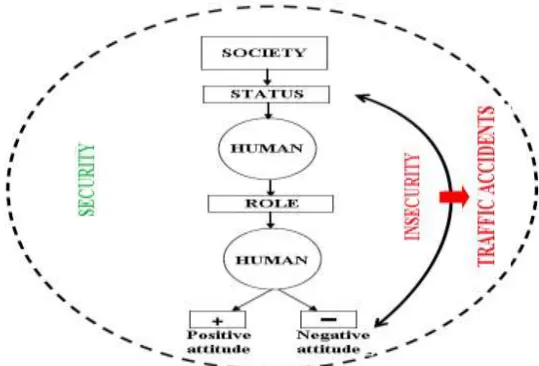
In last decades, the development of road transport together with the increasing number of vehicles led to a continuous attention concerning traffic security. The street traffic is composed by four principal elements: human, vehicle, road and the rule of road. A road- traffic accident is an unexpected event that occurs on a travelling road when a vehicle collides with another vehicle, animal, stationary obstruction or trees, due to the disregard of the rule of road. Traffic collisions may lead in injury, death or property damage.
Road accidents occur as a result of one, or more than one of the following factors: human factors, vehicle factors, road and environmental factors. Driving faster or slower than the flow of traffic – which may or may not accord with the posted speed limit – has robustly been demonstrated to increase the likelihood and severity of crashes (Ohakwe, Iwueze, Chikezie, 2011).
The impact of car crash injuries on public health is substantial everywhere in the world and is increasing (Murray, Lopez, 1997). Road traffic accidents are consistently in the top ten causes of deaths world-wide. In order to reduce the number of fatalities caused by traffic collision, better knowledge and understanding of the sequence of events prior to and during a traffic accident, Accident Reconstruction, is required. So, it is important to obtain detailed quantitative information about the damage sustained by the crashed vehicles (Coyle F., 2008).
recently, they are used to quantify the vehicle dimensions and crush damage (Randles B., Jones B., Welcher J., Szabo T., Elliott D., MacAdams C., 2010).
With the ever wider adoption of spatial information analysis, there has been an increasing awareness of the importance of 3D data acquisition systems to support traffic accident reconstruction and forensic analysis. In an application such as accident reconstruction, GIS and CAD systems have limited utility without the underlying data (Fraser, 2006).
Over recent years, total stations and even laser scanners have been employed for incident scene dimensioning. These technologies are producing more accurate and in the case of laser scanners, more comprehensive 3D models, but data acquisition at the scene is slow compared to the photogrammetric approach. Moreover, total stations and laser scanners are relatively expensive and complex for local police and traffic agencies to use. Digital close-range photogrammetry displays many attributes which make it a well suited technology for the provision of the necessary 3D measurement data. It has a major advantage concerning the data acquisition speed and is an easy-to-use, accurate and reliable measurement tool that incorporates a reasonable degree of process automation. The scene can be recorded in a very short time and imagery provides a permanent archival record that will support further measurement after the accident (Fraser, Cronk, Hanley, 2008). These data, taken in situ, are the basis to perform the necessary calculations, basically the energy analysis of the road accident, for the corresponding expert reports and the reconstruction of the accident itself, especially in those accidents with important damages and consequences (Morales A., Gonzalez-Aguilera D., Gutiérrez M. A., López A.I., 2015).
The principal purpose of this article is to create a crashed vehicle profile by means of close-range photogrammetry techniques, in order to determine the correct amount of the material damage caused by a traffic accident, or which parts of the vehicle body were affected by the crash, as insurance companies need accurate quantitative information regarding the damage sustained by the crashed vehicle.
2. MATERIALS, EQUIPMENTS AND METHODS
Fig 1: Traffic security and fluency.
2.1 PRESENTATION OF THE TRAFFIC ACCIDENT
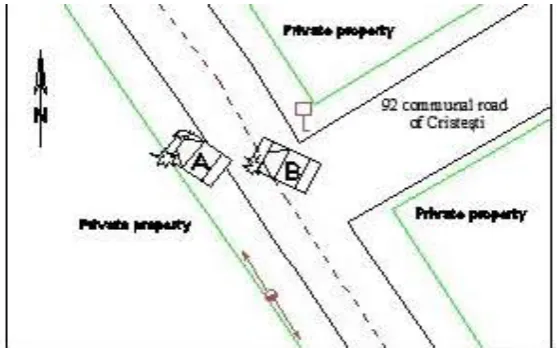
Concerning the conditions of the traffic accident, there are analyzed the exact location and time of the occurred event, the speed and movement direction, the state of the road and meteorological conditions, the technical condition of the vehicles, the caused damage after the incident and also victim injuries.
Fig 2: CAD drawings illustrating the accident scene reconstruction.
Fig 3: Perspective view of the crashed “Dacia Logan” vehicle.
2.2. EQUIPMENTS
In order to graphically reconstruct the accident scene, measurements were carried out at the crash site with a GNSS South S82T with all its components and also with a total station Leica TC 110A with included accessories.
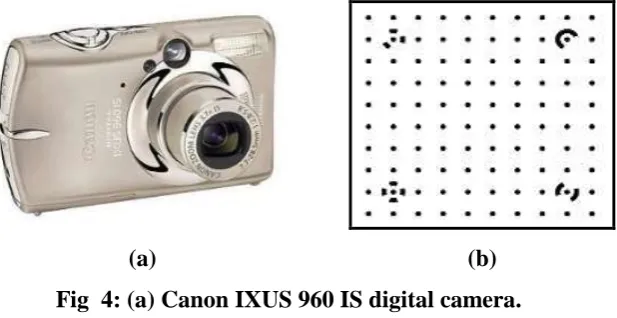
The images were taken with a Canon IXUS 960 IS digital compact photo camera, having 12.1 Mega pixel resolution (Fig. 4a). In this paper, it was used the minimum focal length of 8mm, the digital images having the resolution of 1600 x 1200 pixels.
(a) (b) Fig 4: (a) Canon IXUS 960 IS digital camera.
(b) 2D calibration grid
2.3 MATERIALS FOR DATA PROCESSING
The vehicle involved in the crash accident was modeled in 3D based on digital images, using artificial targets placed on the vehicles bodies and the “PhotoModeler Scanner 6” software. This photogrammetric software is developed by Eos Systems Inc. Company from Vancouver, Canada and is used in metric information extraction from photographs taken with an ordinary digital camera, allowing camera calibration process, 3D model generation and data information exporting in different formats.
In order to determine the deformations of the crashed vehicle, the 3D model of the deformed vehicle was compared to the 3D model of the same type of vehicle undistorted, using the “CloudCompare” software. This software allows 3D point cloud editing and processing
algorithms, like: registration, resampling, statistic computation, segmentation.
3. RESULTS AND DISCUSSION 3.1 CAMERA CALIBRATION
A previous important step in 3D model generation is represented by the camera calibration process, that has as result the intrinsic parameters of the camera, or the interior orientation parameters: the focal length, the coordinates of the principal point in pixels and also the coefficients for radial and tangential distortions (Loghin, Oniga, 2014).
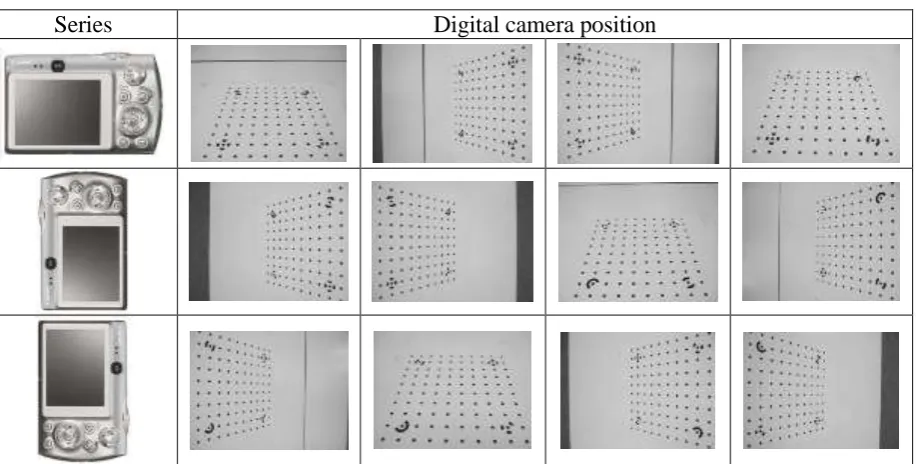
Table 1: Calibration image capturing.
Series Digital camera position
The twelve calibration images were imported into "PhotoModeler Scanner" software and the Camera calibration project was processed. Finally, the intrinsic parameters of the Canon Digital IXUS 960 IS camera were obtained, as can be seen in Table 2.
Table 2: The Canon Digital IXUS 960 IS digital camera intrinsic parameters. Focal
length f [mm]
u0
[pixels]
v0
[pixels]
k1
[mm]
k2
[mm]
p1
[mm]
p2
[mm]
f = 8 mm 7.9230 1261.055 879.545 2.559•10-3 -1.880•10-5 6.169•10-5 -9.405•10-6
3.2 THE 3D MODEL GENERATION OF THE VEHICLE
(a) (b)
(c)
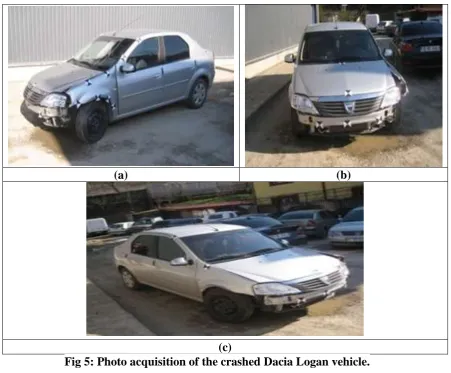
Fig 5: Photo acquisition of the crashed Dacia Logan vehicle.
(a) left- side view; (b) frontal view; (c) right- frontal side view
The images were then imported into the “PhotoModeler Scaner” software and the manually match common features method was used. The detail points and lines together with the artificial targets placed on the vehicle body, were identified and correlated, using the “Reference Mode” software’s function (Fig. 6).
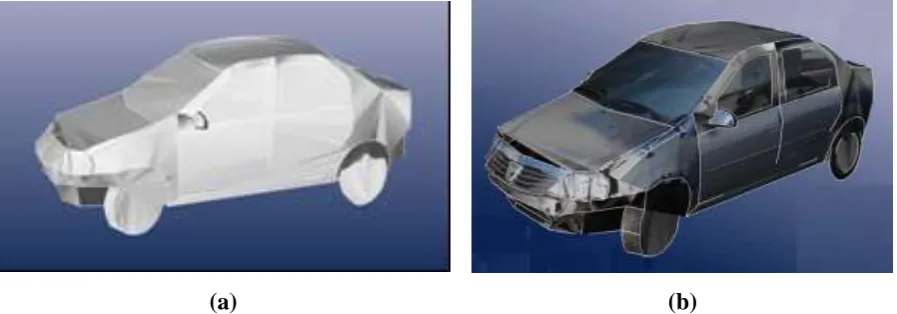
After the correlation process, the entire project was processed and the three-dimensional coordinates of 370 characteristic points of the crashed vehicle were calculated based on a number of eight digital images, as well as the exterior orientation parameters for each camera position. Using points, lines and curves, the 3D model of the crashed vehicle was obtained. As the 3D model was created in a local coordinate system at an arbitrary scale, the scaling process was necesary. So, a reference distance was measured, namely the distance between the central points of the car wheels from the same side of the vehicle. The final 3D model can be visualized with the created surfaces or in a textured mode, using the software’s high- quality option (Fig. 7).
(a) (b)
Fig 7: The 3D model of the Dacia Logan crashed vehicle, created in “PhotoModeler Scanner” software (a) with surfaces and (b) with textures.
In order to obtain the 3D model of the undistorted “Dacia Logan” vehicle, the same processing steps as in the case of the crached vehicle were followed.
3.3 QUALITY ASSESSMENT OF THE CRASHED VEHICLE 3D MODEL
For this case study, all the image coordinate errors were less than 5 pixels, tolerance suggested by "PhotoModeler Scanner". The overall residual of the project was 1.62 pixels, less than the recommended of 5 pixels.
(a) (b)
Fig 8: (a) The total errors distribution histogram and (b) the percentage of error repartition of the measured detail points image coordinates.
Second, the total errors for determining the crached vehicle detail points coordinates in world units were calculated. From the total error distribution histogram of the detail points coordinates (Fig. 9 a), it can be seen that the errors ranges between 0.5 cm and 3.9 cm (Oniga V. E., 2014). It was also realised the percentage of errors repartition of the detail points world coordinates, with an interval of 1 cm, that can be seen in Fig. 9 b.
(a) (b)
Fig 9: (a) The total errors distribution histogram and (b) the error repartition of the measured detail points coordinates in world units.
Fig 10: The percentage repartition of the angles between the projection rays.
3.4 COMPARATIVE ANALYSIS OF THE TWO GENERATED 3D MODELS
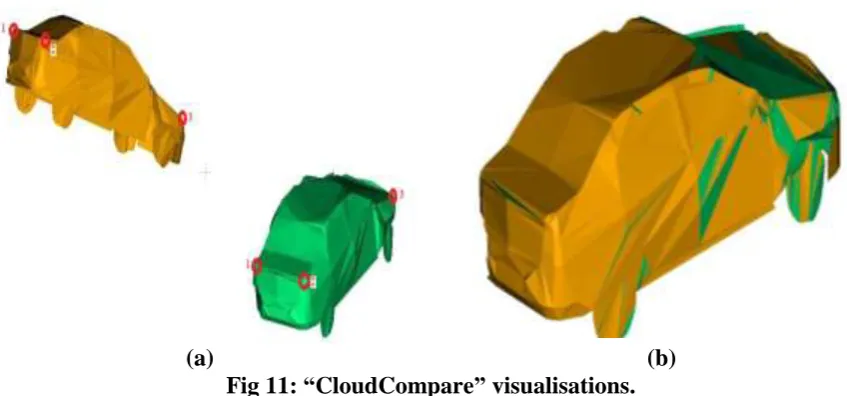
In order to determine the degree of damage of the crached “Dacia Logan” vehicle, its 3D model was compared with the 3D model of the same type of vehicle undistorted, considered as reference model, using the Hausdorff distance implemented into “CloudCompare” software. In a first phase, the two 3D models were imported into “CloudCompare” software. In a second step, the two 3D models were aligned using three manually selected corresponding points, as it can be seen in the Fig. 11.
(a) (b)
Fig 11: “CloudCompare” visualisations.
(a) the two 3D models in their own coordinate system and (b) the aligned 3D models
In the last step, the Haussdorf distance between the two 3D models was computed, using the
“Compute cloud to mesh distance” function of the software, resulting the 3D model of the
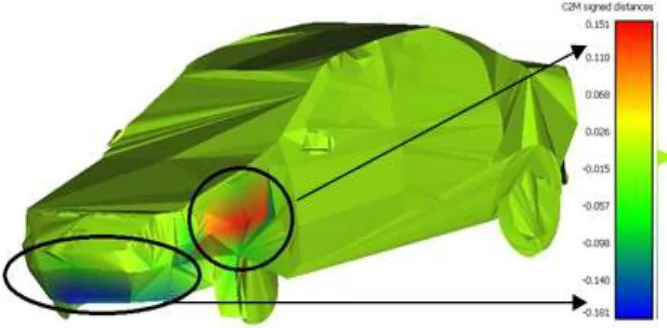
deformations appear and the components of the body car were distorted outwards and finally, if the differences are negative, the deformations are also negative in that area, fact that means that part of the car’s body are missing or are inward distorted.
Fig 12: The 3D model of the crashed vehicle with the deformations.
From the resulted 3D model it can be seen that in the frontal part there are blue colored triangles, showing that negative distances with values of around 18 cm were calculated, which means that the bumper is missing. Also, on the left-side, there are red colored triangles, showing that positive distances with values of around 15 cm were calculated, the left guard being outwards distorted, as can also be seen in Fig. 5 b..
The difference is of 0.38 m3 representing a percentage of 8.64%, if the original model is considered to have 100%. It can be concluded that the vehicle involved in the traffic accident was damaged in a percentage of 8.64%.
4. CONCLUSIONS
This study shows the importance and use of digital close-range photogrammetry in vehicle modelling and measurements in damaged-based accident reconstruction, as one of the key problems of the insurance companies when evaluating the material damages caused by a trafic accident, includes the accurate knowledge of the vehicle body deformations and the degree of car damages.
So, the crashed vehicle profile was created using the “PhotoModeler Scanner” software and the digital images acquired with a CANON IXUS 960 IS digital camera which was previously calibrated. By comparing the crashed vehicle 3D model with the 3D model of the same type of vehicle undistorted, considered as reference model, using the Hausdorff distance, the deformation values were calculated and highlighted using a colour palette. Analyzing the color palette, a short analysis over the deformations of the crashed vehicle body can be made in order to see which parts of the vehicle body were affected by the crash. By calculating the volumes for the closed mesh surfaces, representing the damaged, respectively undamaged vehicle profile, the correct amount of the material damage caused by a traffic accident can be determined.
The 3D reconstruction of the crashed vehicle profile can be made using digital close-range photogrammetry with high accuracy, in a very fast way and at a smaller price in comparison to other technologies.
5. REFERENCES
1. Coyle F. “Digital close-range Photogrammetry in motor vehicle accident reconstruction”, Doctoral thesis, Dublin Institute of Technology., 2008.
2. Fraser C., 2006, “Accident reconstruction via digital close-range Photogrammetry”, American Society of Photogrammetry and Remote Sensing, Annual Conference proceedings, Reno, Nevada, May 2006; 1-5, 121-128.
178- 185.
6. Morales A., Gonzalez-Aguilera D., Gutiérrez M. A., López A. I. “Energy Analysis of Road Accidents Based on Close-Range Photogrammetry”, Remote Sensing, 2015; 7: 15161-15178.
7. Murray C, Lopez A. ”Alternative projections of mortality and disability by cause 1990– 2020: Global Burden of Disease Study”, Lancet., 1997; 349: 1498–1504.
8. Ohakwe J., Iwueze I.S., Chikezie, D. C. “Analysis of Road Traffic Accidents in Nigeria: A case study of Obinze/ Nekede/ Iheagwa Road in Imo State, outheastern, Nigeria”, Malaysia, Asian Journal of Applied Sciences, 2011; 4(2): 166-175
9. Oniga V. E. “Buildings 3D modelling by classical and digital photogrammetry”, ISBN 978-606-687-119-8, Tehnopress, Iasi, Romania., 2014.